
Cross-website tracking—the practice of collecting user data across different, unrelated websites—has been the engine of digital advertising for over two decades. This mechanism built a multi-billion dollar industry on a simple premise: understanding a user’s complete digital footprint to deliver hyper-personalized ads. But that era is over. Driven by a global demand for privacy and foundational shifts in browser technology, the very architecture of digital tracking is being rebuilt from the ground up.
For any business that relies on digital channels to acquire customers, this is not a minor adjustment; it is a critical inflection point. The strategies that once fueled growth are now obsolete. The challenge ahead is to navigate this new landscape, where understanding the customer journey is more important than ever, but the methods for achieving it must be rebuilt on a foundation of transparency and consent. This guide will deconstruct the old and introduce the new, providing a practical roadmap for effective and ethical tracking in a post-cookie world.
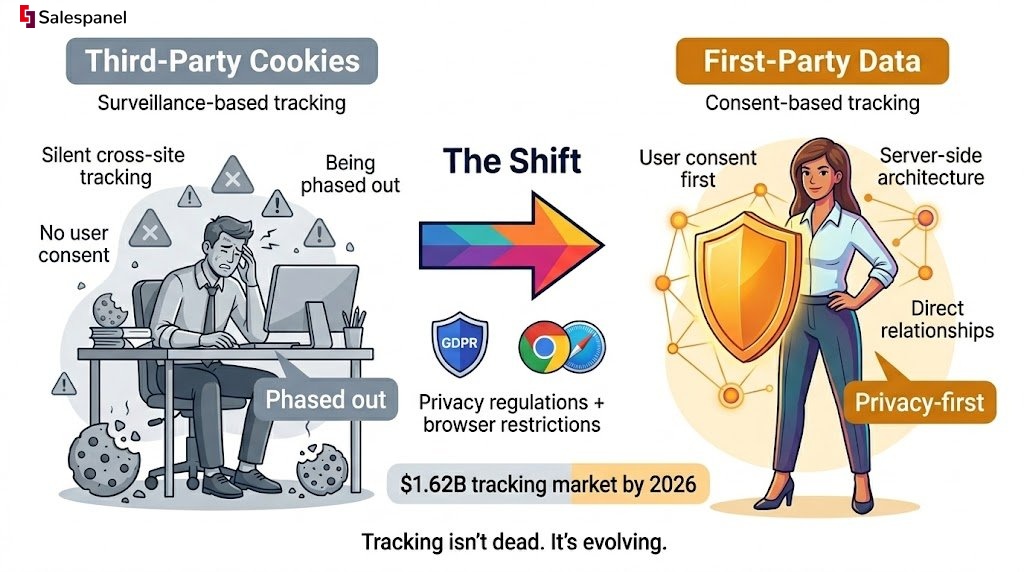
The End of an Era for Digital Tracking
For decades, digital marketing ran on a simple but incredibly effective piece of tech: the third-party cookie. This tiny text file acted as a universal passport for a user’s browser, allowing advertisers and analytics platforms to recognize an individual as they moved from one site to another. This was the technical foundation for everything from retargeting campaigns that seemed to follow users across the web to the creation of highly specific audience segments.
This system spun an intricate web of data sharing. A user could be researching software on a review site, then jump over to a news outlet, and finally check their social media. All the while, third-party scripts were quietly logging these activities in the background. The end result was a rich, cross-context profile that powered a massive advertising machine. For example, an ad network could identify a user who visited a B2B software site and later read an article on a financial news blog, correctly inferring they were a business decision-maker and targeting them with relevant ads.
But that era of unchecked data collection is officially winding down.
The Forces Driving Change
The move away from traditional cross-website tracking isn’t happening in a vacuum. It’s being pushed by two massive forces that are completely reshaping the internet: new regulations and new technology.
- Privacy Legislation: Landmark rules like the General Data Protection Regulation (GDPR) in Europe and the California Consumer Privacy Act (CCPA) have changed the game. They put user consent front and center, giving people more control over their personal data. This makes the old model of tracking without explicit permission legally untenable.
- Browser Restrictions: The big tech players are tearing down the infrastructure that made third-party tracking possible. Apple’s Intelligent Tracking Prevention (ITP) in Safari was the first major blow. Now, Google’s plan to phase out third-party cookies in its market-dominant Chrome browser is the final nail in the coffin for the old model.
These changes mean businesses have to adapt, and fast. The strategies that once fueled customer acquisition are becoming obsolete. For marketers who rely on digital insights, understanding the new world of cross-website tracking isn’t just a good idea—it’s essential for survival.
Why Modern Tracking Still Matters
Just because third-party cookies are on their way out doesn’t mean tracking is dead. It’s simply evolving into something more transparent and privacy-focused. The need to understand customer behavior is as strong as ever.
In fact, the market for website visitor tracking software is still growing, expected to hit roughly $1.62 billion USD by 2026. With a projected compound annual growth rate (CAGR) of around 15.7%, the industry’s expansion shows just how much businesses still value robust analytics. You can explore the full market analysis on datainsightsmarket.com.
The core challenge for modern businesses is to balance the critical need for meaningful customer data with an unwavering respect for user privacy. This balance is the central theme defining the next generation of marketing technology.
This new reality demands a strategic pivot. The focus has to shift toward building direct relationships with customers and leveraging first-party data—information you collect with clear consent on your own digital properties. This guide will walk you through this new terrain, breaking down how modern tracking works, how to stay compliant, and how to implement solutions that are both effective and ethical. The takeaway is clear: we must leave surveillance behind and move toward a more respectful and, ultimately, more insightful understanding of the customer journey.
How Cross Website Tracking Works
To grasp why the marketing world is in such upheaval, you must understand the mechanics of the old system. At its core, traditional cross-website tracking was about connecting the dots—turning a series of anonymous clicks across disparate websites into a coherent story about a single person. This process hinged on a few key technologies designed to create and follow a user’s digital footprint.
Let’s use a practical example. A user starts their day on TechNews.com reading an article about AI. Later, they browse CloudSoftware.com to compare enterprise solutions. Finally, they land on BusinessConference.com to look at event tickets. Without cross-website tracking, these appear as three random, unrelated visits. But with it, a marketer sees a single individual interested in technology, enterprise software, and professional development—a high-value B2B prospect.
The Role of Third-Party Cookies
For years, the main engine driving this entire operation has been the third-party cookie. The easiest way to think of it is as a digital name tag that an ad network places on your browser when you visit a website they partner with.
Here’s a technical breakdown of how it works:
- You visit TechNews.com, which has an ad from “AdNetworkX.” A script from adnetworkx.com runs and places a cookie on your browser with a unique ID, like User123. This cookie is “third-party” because it’s set by a domain different from the one you’re visiting.
- Hours later, you browse CloudSoftware.com, which also displays an ad from AdNetworkX. The script from adnetworkx.com loads again and reads the User123 cookie already present in your browser.
- The connection is made. The network now knows the same person who read about AI is also researching cloud software. This process repeats across thousands of websites in the network, building a detailed profile of interests, all tied to that single cookie ID. This is precisely how an ad for a specific software you viewed seems to follow you from site to site.
Pixels and Fingerprinting: The Supporting Cast
While cookies got the headlines, a couple of other methods played crucial supporting roles in this ecosystem.
A tracking pixel (or web beacon) is a tiny, often invisible 1×1 pixel image embedded on a webpage or in an email. When your browser loads the page, it must request this image from its host server. That simple GET request can transmit key information like your IP address, browser type, and the page URL to the server, confirming you viewed a piece of content or opened a marketing email.
Then there’s the more aggressive technique: browser fingerprinting. This method collects a host of specific settings from your device—such as your operating system, screen resolution, installed fonts, and browser plugins. When combined, these attributes often create a unique digital signature, or “fingerprint,” that can identify you with high accuracy, even if you block cookies entirely.
By pulling all these techniques together, data platforms could build incredibly detailed profiles. This information was often poured into Data Management Platforms (DMPs), creating massive databases of cross-domain user data that allowed advertisers to target very specific audiences with surgical precision.
This table breaks down the different tracking methods, what they’re used for, and where they stand today.
Comparison of Cross Website Tracking Methods
| Tracking Method | How It Works | Primary Use Case | Current Status |
|---|---|---|---|
| Third-Party Cookies | A small text file placed on a user’s browser by a domain other than the one they are visiting. It tracks them across multiple websites. | Retargeting, cross-site ad personalization, and audience building for ad networks. | Being phased out by major browsers like Chrome, Safari, and Firefox due to privacy concerns. No longer a reliable long-term strategy. |
| Tracking Pixels | A 1×1 transparent image embedded in a website or email. When loaded, it sends data (like IP address, page viewed) to a server. | Conversion tracking (e.g., confirming a purchase), ad impression counting, and email open tracking. | Still widely used, but its effectiveness is reduced by ad blockers and privacy-focused email clients that block automatic image loading. |
| Browser Fingerprinting | Gathers a unique combination of browser and device settings (OS, fonts, screen resolution, plugins) to create a persistent identifier. | Identifying users even when cookies are blocked. Used for fraud detection and, more controversially, for tracking without consent. | Faces heavy scrutiny from privacy advocates and regulators. Browsers are actively working to make fingerprinting more difficult. |
| First-Party Cookies | A cookie set by the website the user is directly visiting. It can only be read by that same domain. | Remembering login information, site preferences, and shopping cart items. Also used for on-site analytics. | Viable and privacy-friendly. The foundation of modern, consent-based tracking and personalization strategies. |
As you can see, the methods that rely on tracking people without their direct knowledge are on their way out. The future is clearly centered around first-party data, where the relationship is directly between the user and the website they’re visiting.
The chart below really drives home the differences between the old way and the new.
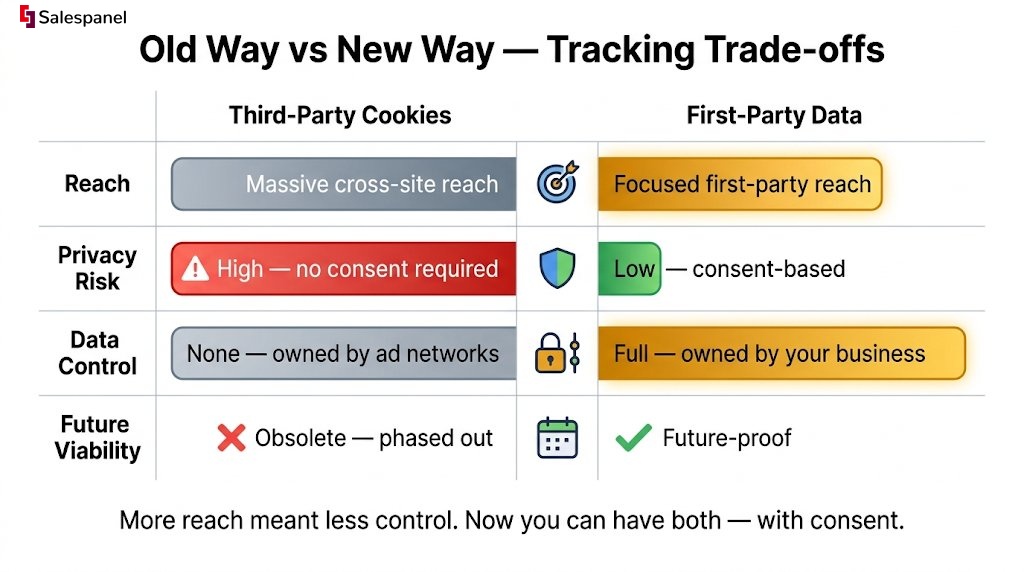
This visual shows the trade-offs perfectly. Third-party cookies gave advertisers massive reach, but at the cost of serious privacy risks and zero data control for businesses. That’s precisely why the whole industry is shifting toward more transparent, first-party solutions that put compliance and data ownership back in the hands of businesses.
Navigating Privacy Regulations and Compliance
The significant shift away from traditional cross-website tracking is not merely a technological trend; it is a direct response to a massive legal and ethical realignment. For years, data collection operated in a gray area, but stringent new privacy laws have drawn clear lines. Adhering to these regulations is now a core business function, not just an issue for the IT or marketing departments.
These regulations are all built around one powerful idea: informed consent. In short, you must inform people what data you’re collecting and why, and they must explicitly agree to it before you start tracking. This principle completely flips the old model, putting the user back in control. The consequences of non-compliance are severe, ranging from heavy fines to the even more damaging loss of customer trust—an asset far harder to regain than any marketing budget.
The Impact of Landmark Legislation
Two laws, in particular, have set the new global standard for data privacy, forcing every company that operates online to rethink how they handle cross-website tracking.
- The General Data Protection Regulation (GDPR): This EU law is the global benchmark. GDPR demands a legitimate basis for processing personal data and requires clear, affirmative consent for tracking. Practically, this means cookie banners cannot have pre-checked boxes; users must actively opt-in.
- The California Consumer Privacy Act (CCPA) / California Privacy Rights Act (CPRA): This framework gives Californians the right to know, delete, and stop the sale or sharing of their personal information. It mandates the “Do Not Sell Or Share My Personal Information” link, making it simple for consumers to opt out of their data being used for cross-context behavioral advertising.
These laws have a ripple effect that extends far beyond Europe or California. If your business has any kind of global presence, you must comply, making privacy-first design the new default.
The core principle of modern compliance is transparency. Users are not an abstract audience to be tracked; they are partners in a value exchange. If you want their data, you must clearly articulate what you’re offering in return and respect their decision.
This means every detail, from the design of a cookie consent banner to the language in your privacy policy, must be clear, honest, and user-centric. A well-structured Cookie Policy is a central component for managing user consent effectively. The goal is not to find loopholes but to build a data strategy so transparent that it strengthens customer relationships.
Moving to First-Party and Server-Side Solutions
The demise of third-party cookies is forcing a complete rebuild of digital analytics architecture. The old method, known as client-side tracking, is being replaced by more robust, privacy-centric models.
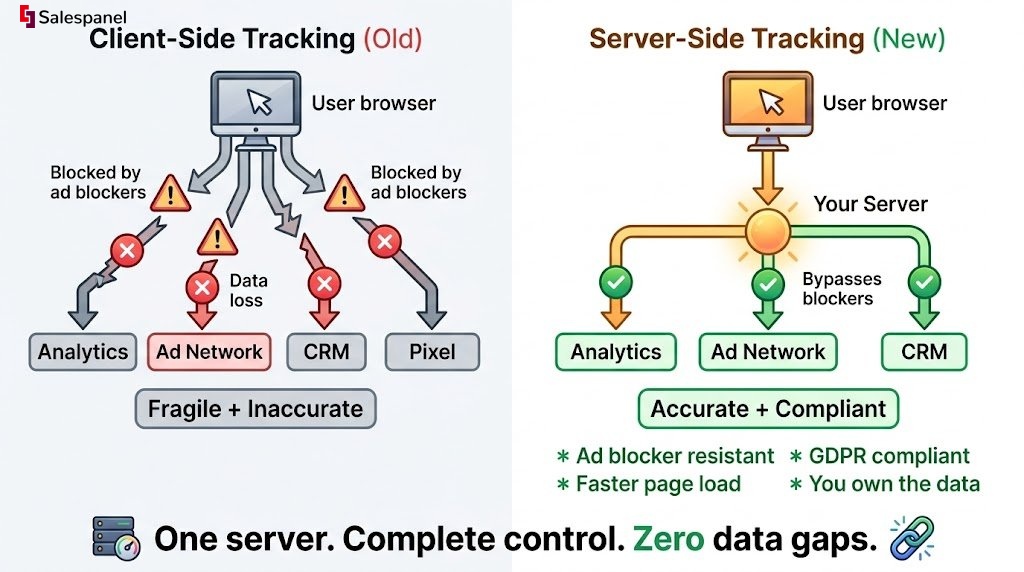
To understand the shift, consider the flow of data. Client-side tracking puts the user’s browser (the “client”) in charge of sending data directly to various analytics and advertising platforms. It’s simple but fragile. Ad blockers can easily intercept these requests, and browser privacy features can prevent tracking scripts from running at all, creating significant data gaps. A practical example is a marketing analytics script that is blocked by a browser extension, resulting in a failure to record a conversion.
Server-side tracking, conversely, changes the data flow entirely. Instead of the browser sending data to multiple third-party destinations, it sends a single, secure data stream to your server. From there, your server decides what information to forward to which platforms. This gives you complete control, enhances security, and ensures far more accurate data collection.
The Power Shift to First-Party Data
This architectural change is built upon a strategic pivot to first-party data. This is the information you collect directly from your audience on your own digital properties with their full consent—data from your sign-up forms, CRM, and product usage. It is information that you own and control, collected transparently.
First-party data is not just a replacement for third-party cookies; it’s a significant upgrade. It allows you to build a direct relationship with your audience based on trust and a clear value exchange. When a user provides their information for a newsletter, a resource, or an improved experience, that data is infinitely more accurate and valuable than anything purchased from a data broker.
The Technical Upside of Server-Side Tracking
Shifting the tracking workload from the user’s browser to your own server provides immediate technical advantages. This approach is the new backbone for ethical cross-website tracking because it establishes a single source of truth for every user interaction, ensuring your data is clean, complete, and reliable.
Here’s why moving to a server-side framework is the logical next step:
- Dramatically Improved Data Accuracy: Ad blockers and browser privacy settings are notorious for preventing client-side scripts from executing. By sending data from your server, you bypass these client-side obstacles, resulting in a much more complete and accurate picture of user behavior.
- Enhanced Website Performance: Loading numerous third-party tracking scripts in a user’s browser significantly slows down page load times. Consolidating these into a single server-side stream reduces the client-side burden, leading to a faster website and a better user experience.
- Tighter Security and Control: When data passes through your server first, you can scrub, filter, and anonymize it before sending it to third-party tools. This is a crucial benefit for compliance, as you can strip out personally identifiable information (PII) before it ever leaves your control, simplifying adherence to regulations like GDPR.
- Durable Data Ownership: With a server-side setup, you are the gatekeeper. You build a durable, first-party data asset that is not dependent on the whims of browser developers or ad platforms, effectively future-proofing your analytics infrastructure.
The whole point of server-side tracking is to take back control. By routing data through your own infrastructure, you stop being a passive user of third-party platforms and become the active owner of your own business intelligence.
How This Works in the Real World
Implementing this strategy involves creating a unified identity for users across different domains you own. While third-party cookies did this across the web, modern methods use first-party techniques to achieve this within your own digital ecosystem. For example, a first-party cookie set on your main domain (company.com) can recognize the same user when they navigate to a subdomain like support.company.com, stitching their session into one continuous journey.
Modern platforms are now built to manage this automatically. For instance, Salespanel’s deep tracking is designed from the ground up to capture and unify these interactions, starting from the very first touchpoint. By relying on first-party data and a solid server-side architecture, it ensures every click, view, and submission is accurately logged and tied to a single visitor profile. This gives you a clear, complete, and compliant view of the entire customer journey across all your web properties.
Unifying the Customer Journey with Deep Tracking
The goal of modern marketing technology is no longer just to collect data, but to create a cohesive narrative. For too long, marketers have operated with a fractured view of their prospects, with valuable intelligence siloed across disparate systems—a website visit here, an ad click there, a CRM entry somewhere else.
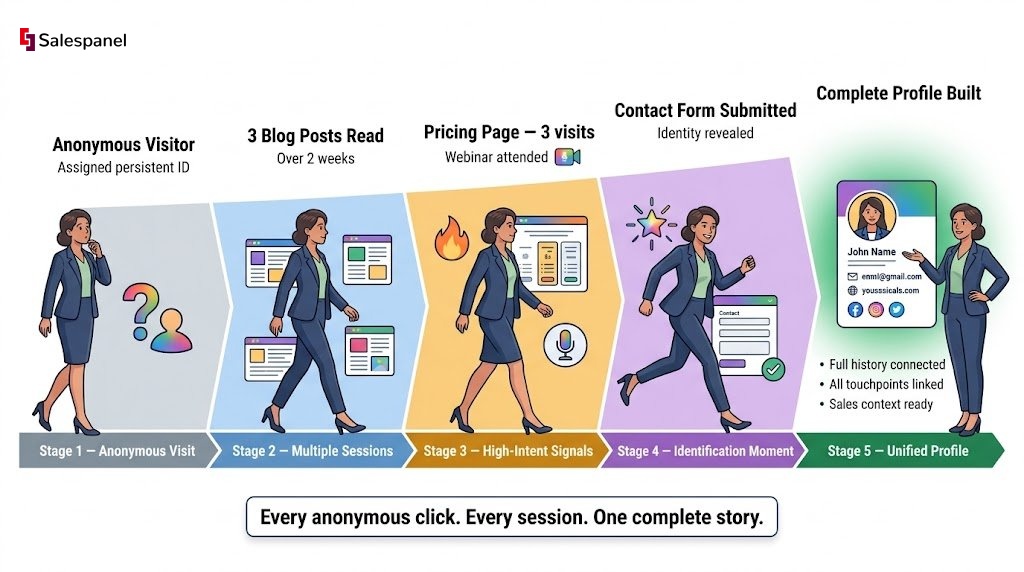
This data fragmentation is a significant obstacle, particularly for B2B marketers. Without a unified timeline, attributing conversions and understanding which touchpoints are truly influential is nearly impossible. You might know a lead came from a paid ad, but what about the five blog posts they read and the webinar they attended before ever submitting a form? That context is what transforms data into intelligence. Advanced first-party data solutions are built to solve this problem by stitching every interaction into a single, chronological customer story.
From Anonymity to Identification
The customer journey almost always begins with an anonymous visitor. They land on your site, browse a few pages, and perhaps leave. Traditional analytics would simply record a session, but modern tracking sees this as the start of a potential relationship. A robust platform can assign a persistent, anonymous ID to that visitor using first-party data, allowing you to track their behavior across multiple sessions over days or weeks.
The pivotal moment occurs when that anonymous visitor identifies themselves. Whether they download an ebook, sign up for a webinar, or request a demo, that single action connects their entire historical browsing activity to a real identity. A practical example: a visitor reads three blog posts over two weeks, then finally fills out a contact form. A deep tracking system will instantly link those previous anonymous sessions to the new lead, providing immediate context on their interests.
Modern, effective tracking isn’t about surveillance. It’s about creating a cohesive and respectful customer experience. It turns a jumble of disconnected data points into a meaningful story that helps you serve your customers better.
Building a Complete Customer Profile
This is where advanced tracking delivers its greatest value: connecting pre-conversion anonymous activity to a known lead. For instance, Salespanel’s deep tracking captures every interaction from the very first touchpoint, following the visitor’s journey across all your web properties and logging every page view, download, and session.
When that visitor finally converts, the system instantly reconciles their new contact information with their complete historical activity. Suddenly, you have a unified profile that shows every step they took:
- The initial ad that brought them to your site.
- The specific blog articles they read to educate themselves.
- The pricing page they revisited three times.
- The final demo request form they submitted.
This comprehensive view provides sales and marketing teams with a deep understanding of a lead’s interests and intent. Instead of a cold call, a salesperson can initiate a conversation based on the specific content the prospect has already consumed, making the interaction far more relevant and effective. This data-driven approach is a clear takeaway for any B2B business looking to align sales and marketing. When you have rich data, presenting it clearly is key; applying data visualization best practices can turn complex tracking information into actionable insights for your team.
Still Have Questions About Cross-Website Tracking?
As the digital marketing world continues to shift, it’s natural to have questions about cross-website tracking, privacy, and the best way forward. Let’s tackle some of the most common ones we hear.
Do I Need Cross-Website Tracking for My Subdomains?
Nope, you can breathe easy on this one. You don’t need to set up cross-domain tracking for subdomains. Modern analytics platforms like Google Analytics 4 are smart enough to automatically recognize and follow users as they move between subdomains of the same core domain.
Think of it this way: if a visitor is on www.yourcompany.com and then clicks over to your help center at help.yourcompany.com, their session stays perfectly intact. The first-party cookie that was set on yourcompany.com is available to all its subdomains, giving you a clean, unified view of that person’s entire journey on your web properties—no extra setup required.
Is Cross-Website Tracking Illegal?
This is a big one. Tracking itself isn’t illegal, but how you do it is under a microscope. The legality all comes down to transparency and getting the user’s permission first. Any tracking that collects data across different websites without clear, informed consent is a fast track to violating privacy laws like GDPR and CCPA.
To keep things above board, you absolutely must:
- Get explicit consent before any non-essential tracking scripts fire up.
- Have a crystal-clear privacy policy that spells out what data you collect and why.
- Give users an easy way to opt out or change their mind about consent at any time.
The days of silently tracking people in the digital shadows are long gone. Compliant tracking today is a partnership built on trust between you and your users.
Why Is My Own Domain Showing Up as a Traffic Source?
Ah, the classic self-referral problem. This is a tell-tale sign that your tracking setup is broken. It happens when your analytics tool gets confused and mistakenly credits your own domain as the source of traffic.
Imagine a user starts on yourwebsite.com, which is linked to your checkout portal on yourcheckout.com. Without proper cross-domain tracking, the analytics on yourcheckout.com will report the traffic as coming from yourwebsite.com, completely losing the original source, like that expensive Google Ad you’re running.
This wreaks havoc on your marketing data and makes it impossible to accurately calculate your campaign ROI. A proper cross-domain setup fixes this by passing a unique ID between the domains, stitching the session together so you can see the true start of the journey.
How Do I Test if My Cross-Domain Tracking is Working?
Testing your setup is the final, crucial step. Thankfully, it’s pretty straightforward and will tell you if data is flowing correctly between your domains.
- Start on your first domain (e.g., domainA.com).
- Click a link that takes you to the second domain (e.g., domainB.com).
- Look closely at the URL of the second domain. You should see a special parameter tacked on, usually _gl= followed by a long jumble of characters. This is the “linker” that carries the user’s session info across the two sites.
- If you spot that parameter, you’re likely in good shape. For extra confirmation, you can use your browser’s developer tools to check that the main analytics cookie (like _ga for Google Analytics) has the exact same value on both domains.
To truly unify the customer journey while respecting user privacy, you need a powerful first-party data solution. At Salespanel, our philosophy is that effective marketing is built on a foundation of trust and transparency. We offer advanced server-side and deep tracking designed for the modern B2B marketer, enabling you to identify anonymous visitors, connect their complete browsing history to a single lead, and gain a compliant, 360-degree view of every touchpoint.
Explore our resources to build a data strategy that’s ready for the future.