The classic Marketing Qualified Lead (MQL) definition is broken. For years, marketing teams played a simple numbers game, treating a single whitepaper download as a sales-ready signal. This outdated approach is precisely why even top-performing companies see a staggering 98.46% of their MQLs fail to convert into revenue. That isn’t a minor leak; it’s a fundamental flaw in the traditional sales and marketing pipeline. The future doesn’t belong to the teams that generate the most leads, but to those who can most accurately identify genuine purchase intent. This guide provides an in-depth, practical framework to redefine your MQL process, moving from a volume-based relic of the past to a modern, intent-driven engine that predictably connects marketing actions to sales wins.
Why Your MQL Definition Needs an Upgrade
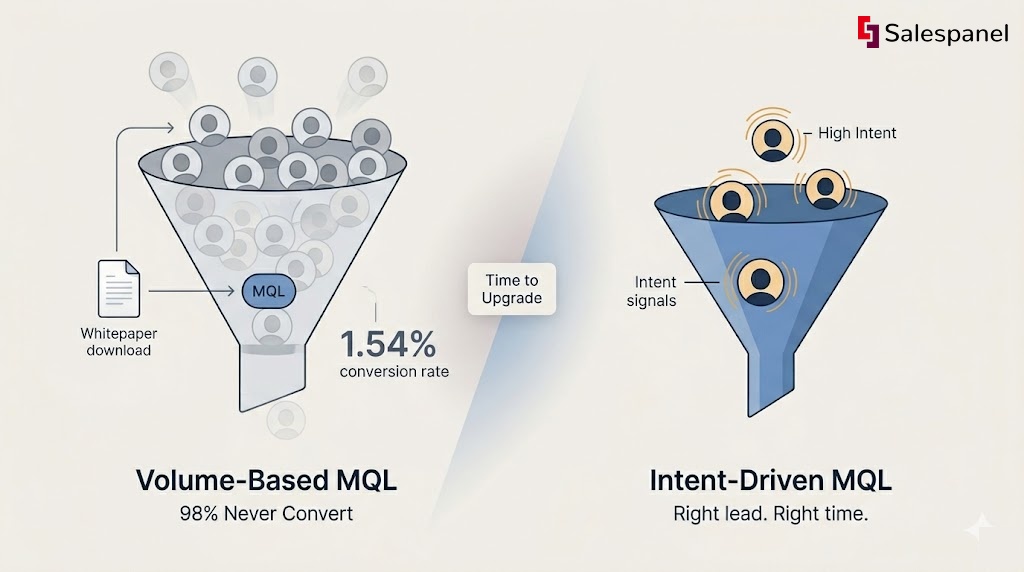
Let’s be honest—the classic marketing qualified leads definition feels like a relic from a different era. For years, marketing teams played a simple numbers game. If someone downloaded a whitepaper, boom—they were an MQL, and a sales rep was dialing their number.
This outdated thinking is exactly why even top-performing companies only convert a measly 1.54% of their MQLs into actual revenue. That means a staggering 98% of those “qualified” leads go nowhere. Ouch.
This isn’t a sign that MQLs are dead. It’s a massive, flashing neon sign telling us that the definition needs a serious overhaul. Today’s buyer journey isn’t a straight line; it’s a complex, winding road of self-education across dozens of channels. A static definition built for a simpler time just can’t keep up.
The Evolution From Volume to Intent
The central theme and real challenge today has shifted from just getting leads to identifying genuine purchase intent. Old-school MQL models treated every action as equal. A college student downloading an ebook for a research paper was often tossed into the same bucket as a C-level executive from a target company who just watched a full product demo.
This created enormous friction, wasted sales cycles, and a growing distrust between marketing and sales. A practical example: a sales team receiving 100 “MQLs” might find only five are actually worth a call. The other 95 leads create noise, lower morale, and burn valuable resources.
High-growth companies understand that an MQL definition isn’t a static checkbox but a living, breathing agreement. It must evolve. Modern marketers now define MQLs through a combination of intentional engagement and a tight fit with their Ideal Customer Profile (ICP). This ensures that when marketing passes a lead over, the sales team can confidently move it to the Sales Qualified Lead (SQL) stage.
Why a Modern Definition Is Non-Negotiable
Nailing down your MQL definition is the bedrock of building a predictable revenue engine. When you get this right, everything else starts to click into place. The key takeaway is that a precise, modern framework is not a “nice-to-have”; it’s a core component of scalable growth.
A precise, modern framework ensures that:
- Sales resources are focused on people who are actually interested and ready to talk, not just kicking tires.
- Marketing efforts are aligned with real business outcomes, not just vanity metrics like the total number of leads generated.
- The customer experience improves because you stop jumping the gun with premature sales pitches and focus on providing value.
This guide will take you beyond the theory. We’re here to give you a practical blueprint for redefining what a marketing qualified lead means for your business. It’s time to stop chasing ghosts in your pipeline and start building a system that reliably connects marketing actions to sales wins.
What Exactly Is a Marketing Qualified Lead These Days?
In the modern marketing landscape, an MQL is a prospect whose digital body language indicates strong interest and whose profile aligns perfectly with your best customers. This dual qualification is the central theme that separates high-potential leads from the noise.
Consider a practical example: a project manager from a target company downloads a detailed implementation guide. Their action (engagement) and their role (fit) combine to create a strong MQL signal. This is fundamentally different from a college student downloading an introductory ebook for a research paper.
Getting this right is a huge deal. Without this clarity, your sales team ends up wasting precious hours chasing down leads who are just window shopping, not genuinely in the market to buy. A true marketing qualified lead has hit a specific, pre-agreed-upon milestone that tells you they’re ready for a real conversation with sales.
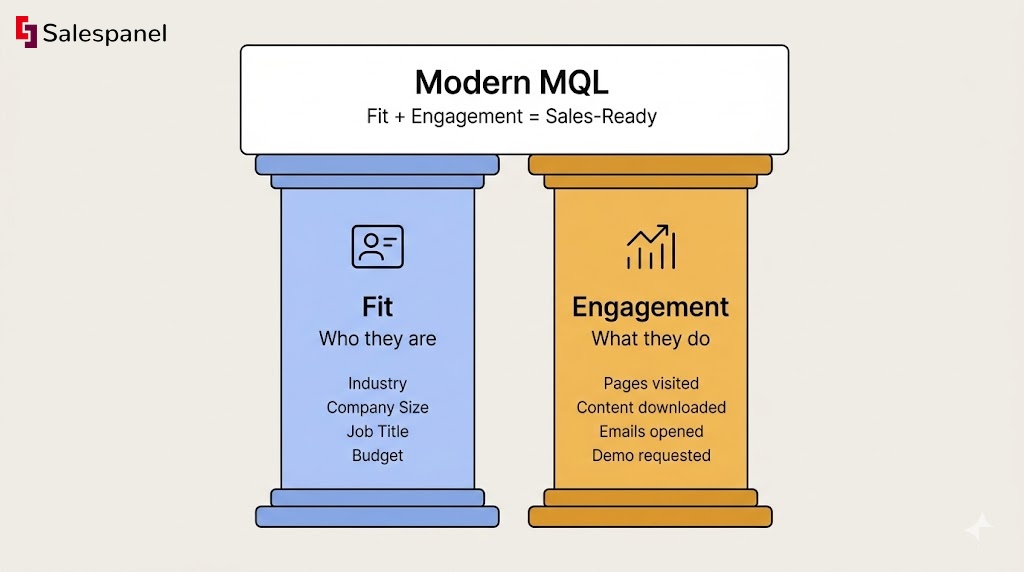
This modern MQL definition really hinges on two core ideas that have to work together: Fit and Engagement. A lead needs to check both of these boxes to earn that coveted MQL status.
The First Pillar of Qualification: Fit
First things first: who is this person? That’s what Fit is all about. It’s the firmographic and demographic data—the hard facts—that tells you whether this person or their company matches your Ideal Customer Profile (ICP). This part is non-negotiable. If a lead isn’t a good fit, it doesn’t matter how many times they visit your website.
Here are the kinds of questions you should be asking to nail down fit:
- Company Size: Is their company in the sweet spot you typically sell to, employee-wise?
- Industry: Do they operate in a vertical where your solution really shines?
- Geography: Are they in a country or region you can actually serve?
- Job Title/Role: Does this person have the influence or authority to make a buying decision? A “Director of Operations” is a far more promising fit than an “Intern.”
You usually gather this info upfront through forms when someone downloads a resource or signs up for a webinar. A strong fit is the solid foundation every quality lead is built on.
The Second Pillar of Qualification: Engagement
Once you know they’re the right kind of person, you need to know what they’re doing. That’s Engagement. It’s all the behavioral data that shows how interested they really are. A perfect fit is just a name in your database if they’re not actively showing any buying signals.
A prospect crosses the bridge to becoming an MQL once their actions show real, measurable interest in what you offer. These signals could be anything from downloading resources to signing up for your newsletter or repeatedly visiting key pages on your site. This is how marketing builds a bridge to sales, by highlighting the leads who are most likely to turn into customers.
An MQL isn’t just a contact; it’s a story of interest told through data. Their actions—visiting a pricing page, watching a product demo, or engaging with case studies—are the chapters that reveal their intent to buy.
When you combine a strong Fit score with an active Engagement score, you get a complete, accurate picture of an MQL. This two-pillar strategy ensures that marketing isn’t just throwing contacts over the fence; they’re handing over leads that sales is genuinely excited to call. It’s how you stop your funnel from leaking and start building a predictable revenue engine.
Decoding MQL Qualification Criteria
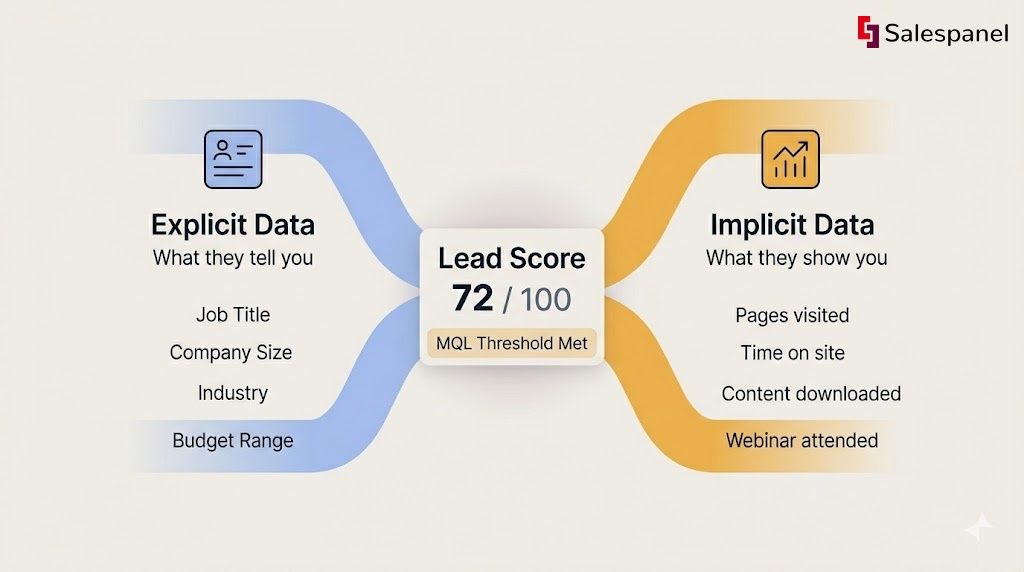
So, how do we get from a vague idea of a “marketing qualified lead” to a practical, working definition that actually helps your sales team? It all comes down to the data. The central theme of a modern MQL is this synthesis of explicit information (who they are) and implicit behavior (what they do).
Think of explicit data as the information a prospect hands you directly, like their business card. It tells you who they are and if they even match your Ideal Customer Profile (ICP). This is the stuff you typically get from forms on your website.
Implicit data, on the other hand, is all about what they do. It’s the trail of digital breadcrumbs they leave as they interact with your brand. This shows you their interest level and intent, which is often a way better predictor of sales-readiness than a fancy job title.
Explicit Data: The Foundation of Fit
Explicit data answers the first crucial question: “Is this the right kind of person for us to even be talking to?” It’s the firmographic and demographic info that sets the baseline for whether a lead is worth pursuing at all.
Common explicit data points we look for include:
- Job Title: Are we talking to a decision-maker like a “VP of Operations,” or someone less influential, like a “Marketing Intern”? The difference is huge.
- Company Size: Is their organization the right size for our solution? Do they have enough employees to signal a good fit?
- Industry: Do they operate in a vertical where we know our product solves a painful, urgent problem?
- Geography: Are they in a region we can actually serve?
But here’s the catch: explicit data alone isn’t enough. A practical example: a VP of Operations from a perfect-fit company who only visited your homepage once and left is not an MQL. That’s a cold lead. This is precisely where implicit data comes in to complete the picture.
Implicit Data: The Language of Intent
Implicit data is all about action. It’s the digital body language that screams “I’m interested!” This is how you separate the window shoppers from the serious buyers. Honestly, tracking and understanding these behaviors is where most marketing funnels either make it or break it.
Here are some of the most powerful implicit signals:
- High-Value Page Visits: Someone visiting your pricing page three times in a week is sending a much stronger signal than someone who only reads a few blog posts.
- Content Consumption: Did they download a fluffy, top-of-funnel ebook or a detailed, bottom-of-funnel implementation guide? The second one suggests they’re much further along in their buying journey.
- Email Engagement: If they’re consistently opening your emails and clicking the links, their interest is active and sustained.
- Demo or Trial Requests: This is the ultimate hand-raise. It’s a crystal-clear signal that they’re ready to give your solution a serious look.
Capturing this behavioral data effectively is non-negotiable. For instance, website visitor tracking from Salespanel can monitor these digital footprints in real-time, giving you the deep insights needed to spot high-intent actions the second they happen.
MQL Qualification Data Types Compared
| Data Type | Definition | Examples | Role in Qualification |
|---|---|---|---|
| Explicit Data | Information provided directly and consciously by the lead. | Job title, company size, industry, location, budget. | Establishes if the lead matches your Ideal Customer Profile (ICP). Answers: “Are they a good fit?” |
| Implicit Data | Information gathered by observing a lead’s behavior and actions. | Website pages visited, content downloads, email clicks, demo requests. | Indicates the lead’s level of interest and buying intent. Answers: “Are they interested now?” |
Ultimately, neither data type can stand on its own. A perfect-fit lead with no interest is a waste of time, and a highly engaged lead who can’t use your product is a dead end.
This chart drives home how a well-oiled MQL process impacts the bottom line, from conversion rates to how long it takes to close a deal.
As the visual shows, a precise marketing qualified leads definition is a direct line to efficiency. It helps keep customer acquisition costs in check and shortens the sales cycle. By blending both explicit and implicit data, you build a complete, 3D view of every lead. This ensures your sales team spends their valuable time only on prospects who are both a great fit and genuinely interested in buying.
Navigating the MQL to SQL Handoff
The jump from a Marketing Qualified Lead (MQL) to a Sales Qualified Lead (SQL) is easily the most delicate—and often most broken—part of the entire sales funnel. It’s a critical moment of truth.
Don’t believe me? Research shows that even top-performing companies only turn 1.54% of their MQLs into actual revenue. That staggering number tells a story of dropped batons and missed opportunities. This is exactly where a rock-solid marketing qualified leads definition becomes your most valuable player, acting as the handshake between marketing’s hard work and a real sales conversation.
The difference between the two is everything. An MQL is someone marketing has flagged as a good fit based on their digital body language and profile data. But an SQL? That’s a lead the sales team has personally spoken to, vetted, and given their stamp of approval. It’s the difference between a promising signal and a confirmed conversation.
The Anatomy of a Successful Handoff
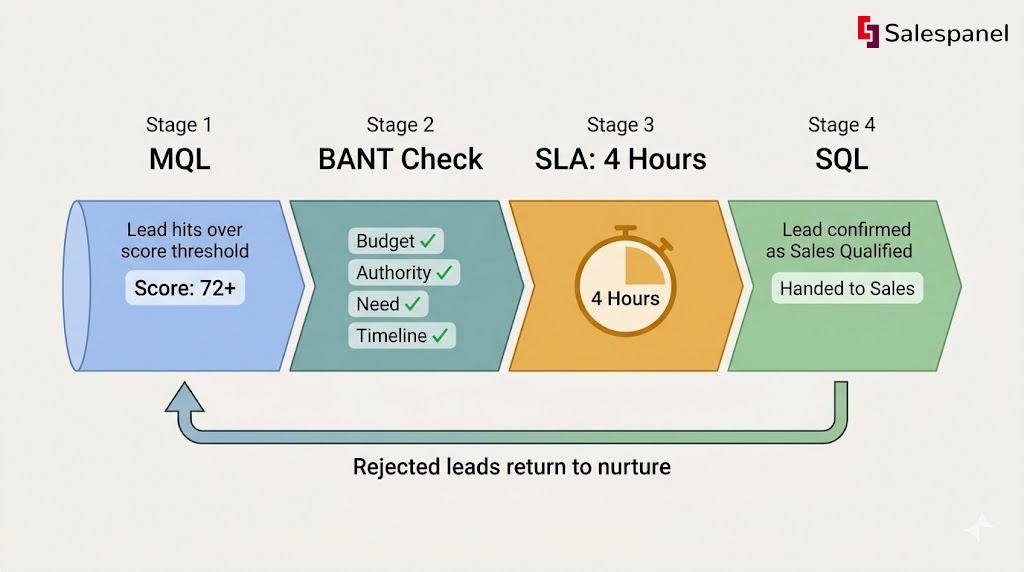
A smooth handoff is not an accident; it is a well-defined process. The moment a lead’s score meets the MQL threshold, an automated workflow should assign it to a Sales Development Representative (SDR). The SDR’s mission is not to close, but to validate the data through a discovery call.
A practical example of validation is using the classic BANT framework:
- Budget: Do they actually have the money to invest in a solution like ours?
- Authority: Are we talking to the person who can sign the check, or at least someone who has their ear?
- Need: Is there a real, nagging problem that our product can solve for them right now?
- Timeline: Are they looking to make a move this quarter, or is this just a “tire-kicking” exercise for next year?
If the SDR gets a confident “yes” across these points, the lead is officially accepted by sales and graduates to SQL status. From there, it’s passed to an Account Executive who can start the real work of closing the deal.
The Role of a Service Level Agreement
This entire process is far too important to be left to chance or good intentions. This is where a formal Service Level Agreement (SLA) between your marketing and sales teams comes in. Think of it as the official rulebook for engagement.
An SLA isn’t just another piece of corporate paperwork; it’s a living document that gets everyone on the same page. The central theme here is accountability.
An SLA takes your MQL definition and puts teeth into it. It dictates how quickly sales has to follow up on a new MQL—we’re talking hours, not days—and clarifies the exact steps for rejecting a lead that isn’t a good fit. This builds accountability and stops hot leads from going cold in someone’s inbox.
Even more importantly, the SLA creates a crucial feedback loop. When sales rejects an MQL, the SLA should force them to explain why. Was the budget not there? Was it the wrong contact person? This feedback is pure gold for marketing, allowing them to continuously refine the marketing qualified leads definition to deliver better leads next time.
Building a Practical Lead Scoring System
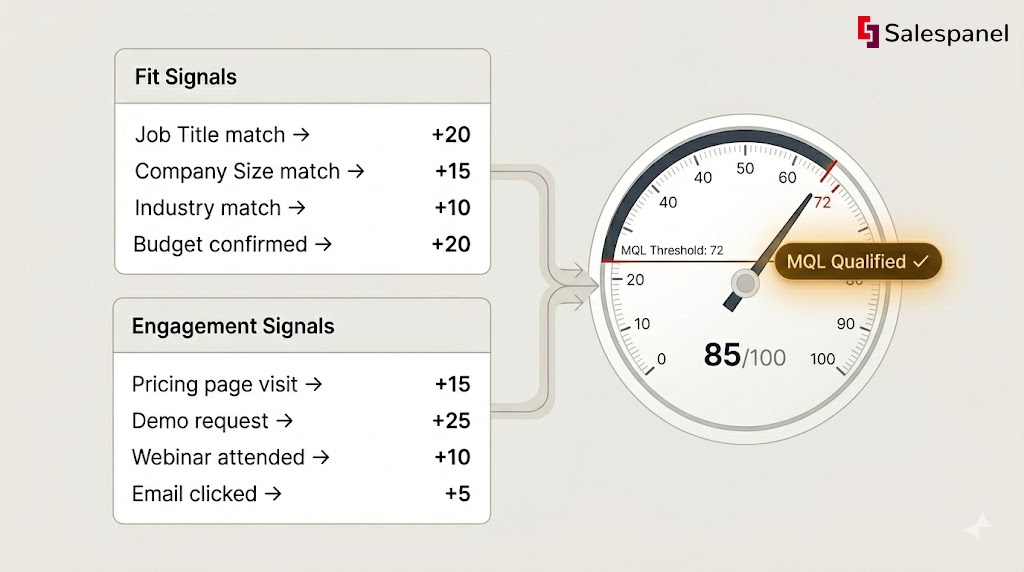
Your marketing qualified leads definition is the blueprint, but a lead scoring system is the engine that brings it to life at scale. This system assigns points to a lead’s profile (fit) and actions (intent) to quantify their sales-readiness in real-time. The central theme is transforming qualitative observations into a quantitative, actionable score.
The absolute first step is a collaborative workshop between marketing and sales. Together, you must define your Ideal Customer Profile (ICP) and agree on the specific behaviors that signal purchase intent. Without this alignment, the system is built on guesswork. With it, you create a shared language for lead quality.
Assigning Points for Fit and Intent
A robust lead scoring model operates on two parallel tracks: who a lead is (explicit scoring) and what they do (implicit scoring).
Explicit Scoring (Fit): This assigns points based on firmographic and demographic data. A practical example:
- Job Title: A “Director of Operations” gets +15 points. An “Intern” gets +1 point.
- Company Size: If your sweet spot is 200-1,000 employees, a lead in this range gets +10 points.
- Industry: A lead from a key vertical like “SaaS” or “Manufacturing” earns +10 points.
Implicit Scoring (Intent): This rewards behaviors that indicate active interest. The point values must reflect the level of intent. For example:
- Pricing Page Visit: This is a strong buying signal. Assign +20 points.
- Case Study Download: Shows solution-oriented research. Give +15 points.
- Webinar Attendance: They invested significant time. This is worth +10 points.
- Email Click: A small sign of engagement. Add +2 points.
A lead officially becomes an MQL once their total score hits a pre-agreed threshold, for instance, 100 points. This trigger automates the handoff to sales. Salespanel’s philosophy is that this process should be seamless; a tool like the lead scoring framework from Salespanel helps you combine demographic, firmographic, and behavioral data into one unified score to automate this qualification.
The Power of Negative Scoring
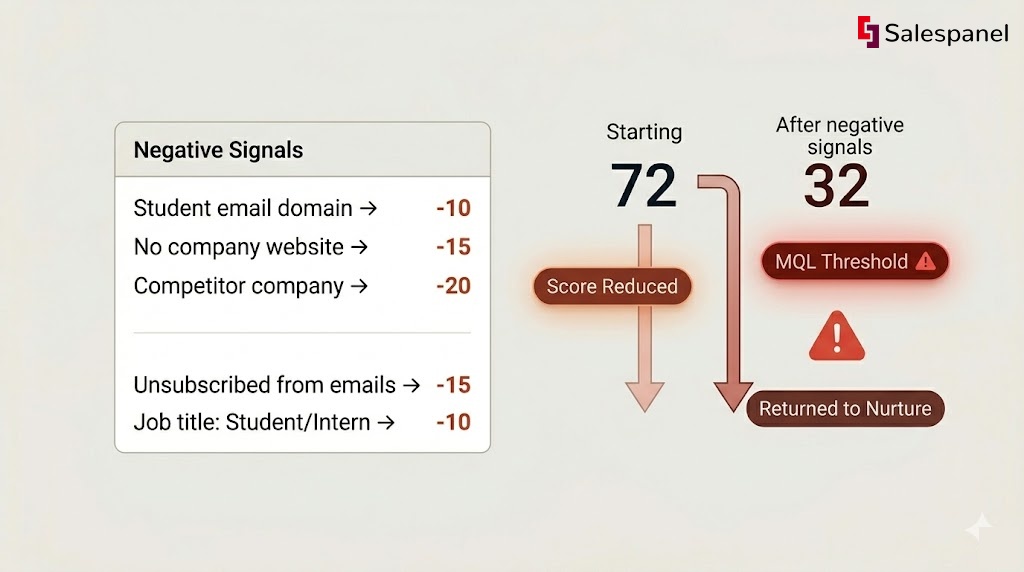
Awarding points is only half the battle. You also have to take them away. Negative scoring is a critical filter that saves your sales team from wasted effort. Research shows over 50% of companies use this tactic to eliminate noise.
A lead scoring system isn’t just about finding the best leads; it’s about actively filtering out the worst. Applying negative scores for non-business email domains or visits to your “Careers” page protects your sales team’s time and focus.
Common triggers for negative scores include:
- -50 points for using a personal email address (like @gmail.com or @yahoo.com).
- -25 points for visiting the careers or jobs page.
- -10 points if a lead shows no activity for a prolonged period.
When you build a system that rewards the right profiles and actions while penalizing red flags, you turn lead qualification from an art into a data-driven science.
Your Game Plan for a Better MQL Process
Defining your MQL is not a one-time task; it’s a continuous cycle of refinement. To build a true revenue engine, you need a clear, actionable plan that connects marketing efforts to tangible sales wins. The central goal is to create a closed-loop system where data flows freely between marketing and sales, enabling you to sharpen your marketing qualified leads definition over time. This approach transforms the objective from simply hitting lead quotas to cultivating genuine sales opportunities.
A Practical Implementation Checklist
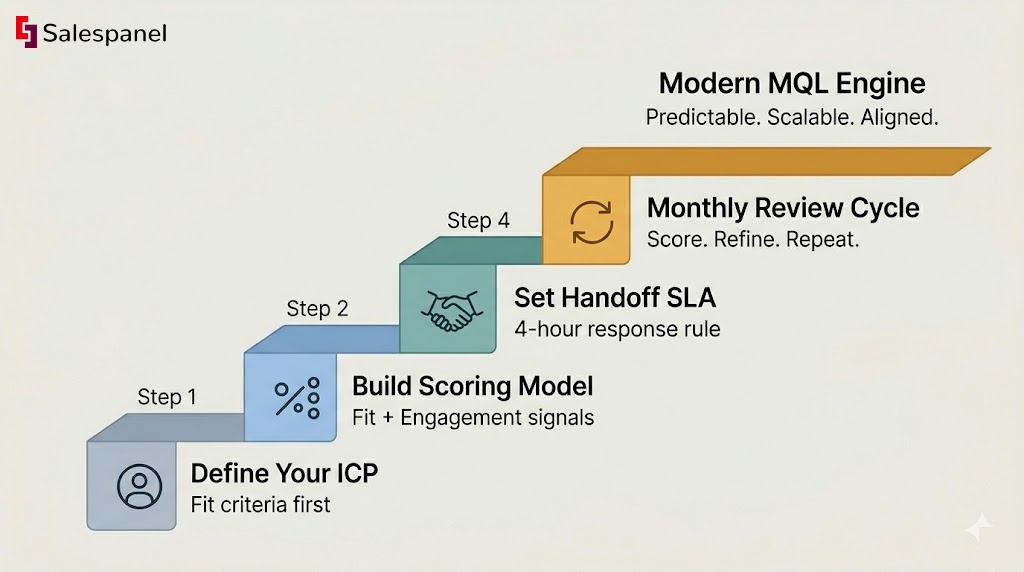
To build an MQL process that delivers consistent results, focus on these four foundational pillars. Each step demands deep collaboration with your sales team to ensure your framework is grounded in reality, not marketing assumptions. This checklist is your key takeaway for action.
- Define Your Ideal Customer Profile (ICP) Together: Your very first meeting must be a workshop with sales. The goal is to define, in detail, what a perfect customer looks like. Go beyond basic firmographics to pinpoint the specific pains and attributes of companies that derive the most value from your solution.
- Map the Real Buyer’s Journey: Sit down with sales to identify which content and actions are true buying signals. A practical example: a prospect who downloads a technical case study is signaling something far more valuable than someone who just reads top-of-funnel blog posts. Assign value accordingly.
- Build a Unified Lead Scoring Model: Use your ICP and journey map to create a lead scoring system with the sales team. You must agree on the point values for both explicit data (like job titles) and implicit behaviors (like visiting the pricing page). This shared model becomes the single source of truth for lead quality.
- Establish a Rock-Solid Service Level Agreement (SLA): Document the entire handoff process. The SLA must specify the exact MQL criteria, the maximum time sales has to follow up, and the precise reasons a lead can be rejected. This feedback loop is essential for continuous improvement.
Got Questions? We’ve Got Answers
Once you start digging into the details of a modern marketing qualified leads definition, a few practical questions always pop up. Let’s tackle the most common ones to help you put these ideas into action.
How Often Should I Tweak My MQL Criteria?
Your MQL definition can’t be a “set it and forget it” kind of thing. The market shifts, your product evolves, and so should your criteria. A good rule of thumb is to review your MQL criteria and lead scoring at least quarterly.
This regular check-in helps you stay aligned with what’s actually happening on the ground. You should also trigger a review anytime something major happens, like:
- Sales starts consistently flagging MQLs as low-quality.
- You’re launching a big new marketing campaign or breaking into a new market.
- Your product or service gets a significant update.
Staying proactive here ensures your definition of a “good lead” actually matches reality.
What Do I Do When Sales Rejects My MQLs?
First off, don’t panic. When sales rejects an MQL, it’s not a failure—it’s a gift. It’s a crucial piece of feedback you can’t get anywhere else.
The first step is to make sure your CRM requires a specific reason for every rejection, as you should have laid out in your SLA. Vague excuses like “bad lead” just won’t cut it. You need the specifics.
When a lead is rejected, it’s a data point, not a dead end. Analyzing rejection reasons—like “not a decision-maker” or “no current project”—provides the exact insights marketing needs to refine targeting and scoring criteria.
Get in a room with the sales team regularly to go over these rejection reasons. It’s the best way to build trust and fine-tune the lead qualification process together.
How Can I Measure MQL Success Beyond Just Counting Them?
Piling up a huge number of MQLs might feel good, but it’s a classic vanity metric. The real measure of success is how well those MQLs turn into actual revenue.
Instead of just counting leads, start tracking the KPIs that really matter to the business:
- MQL-to-SQL Conversion Rate: What percentage of MQLs does sales actually accept and agree to work?
- SQL-to-Opportunity Conversion Rate: Of those accepted leads, how many become legitimate sales opportunities?
- Pipeline Velocity: How fast are these MQLs moving from one stage to the next? Are they getting stuck?
- Win Rate from MQLs: When an opportunity comes from an MQL, what percentage of the time does it close as a win?
Tracking these numbers gives you a clear, honest picture of whether your MQL program is actually driving growth.
Ready to turn anonymous website traffic into actionable sales opportunities? At Salespanel, our philosophy is that every marketing action should align with revenue. We provide the tools to identify high-intent prospects and score their readiness in real-time, building a more effective revenue engine. Explore our comprehensive resources and guides to learn more. Learn more at https://salespanel.io/resources.