B2B Lead Scoring: Guide and Best Tools for 2026
Article Updated on May 14, 2026.
The world of B2B marketing and sales has changed dramatically in 2026. Advances in AI and hybrid (AI plus expert rules) lead scoring have transformed how organizations identify valuable prospects and avoid wasting resources on the wrong ones. Today, real-time, omnichannel data, trust signals, and AI-powered explainability are standard. Increasingly, teams rely on modern lead scoring tools to prioritize high-intent leads and activate them immediately at scale, across email, web, and CRM. In this article, we’ll cover the essentials of B2B lead scoring and share the latest frameworks, tools, and best practices to help you get started or level up now.
What is Lead Scoring for B2B?
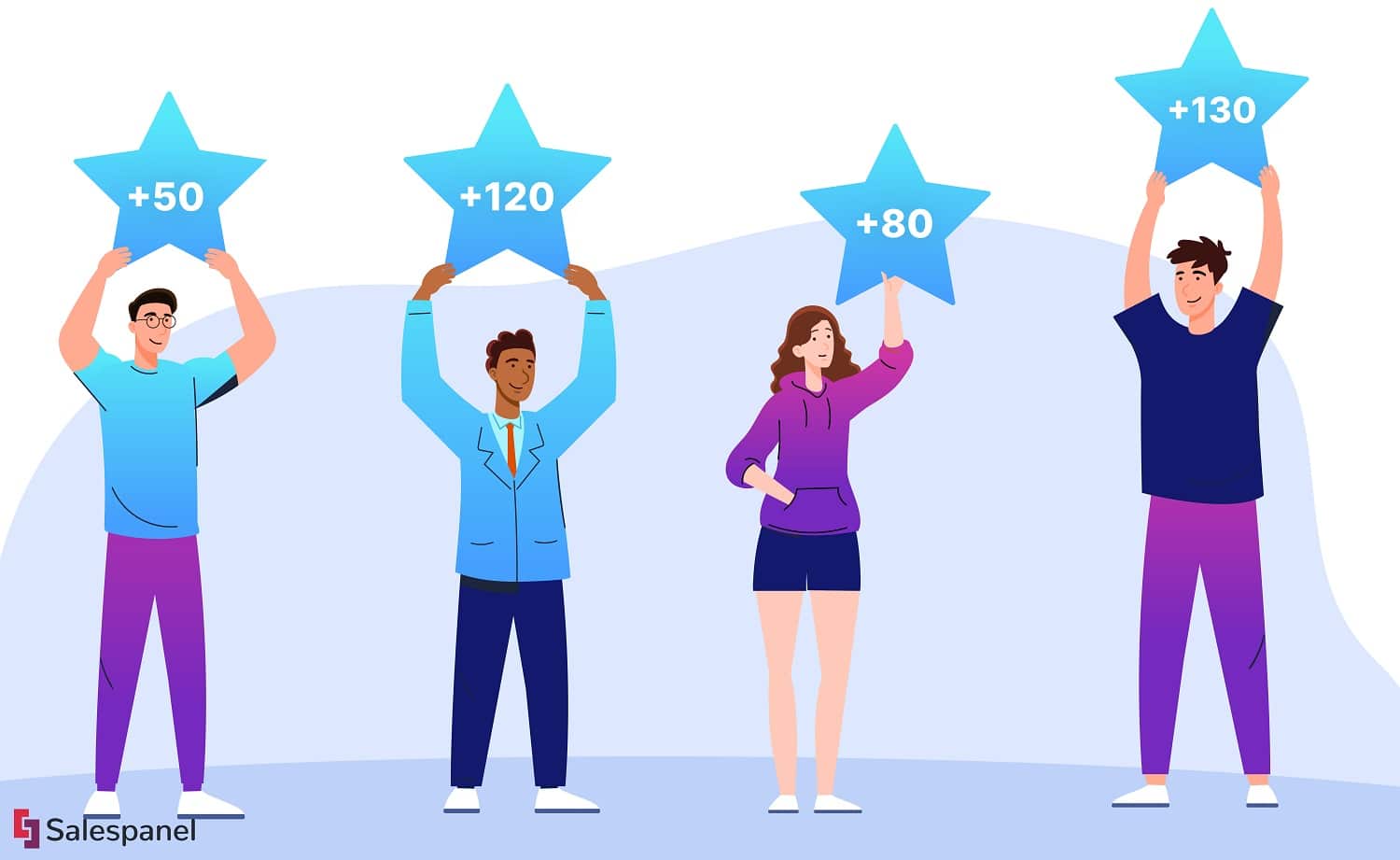
Lead scoring is a methodology used to rank prospects against a scale in numerical values. Traditionally, it relied on rules to positively or negatively score leads based on characteristics and actions such as job role, company data, and engagement. Today, in 2026, lead scoring for B2B organizations is powered by broader data signals and explainable AI. Modern scoring frameworks go beyond legacy rule-based or intent-only strategies, they combine fit (does this account match our ICP?), intent (how strongly is this person showing purchase interest?), and convertibility (are they progressing in reliable conversion signals?).
Contemporary solutions now support omnichannel lead scoring: tracking real-time website activity, email engagement, chat interactions, dark social mentions, review site visits, and more. Explainable models where marketing and sales can see why a lead scores high are a market norm. Many platforms employ hybrid approaches that blend transparent rules for sales trust and AI/ML for dynamic prioritization.
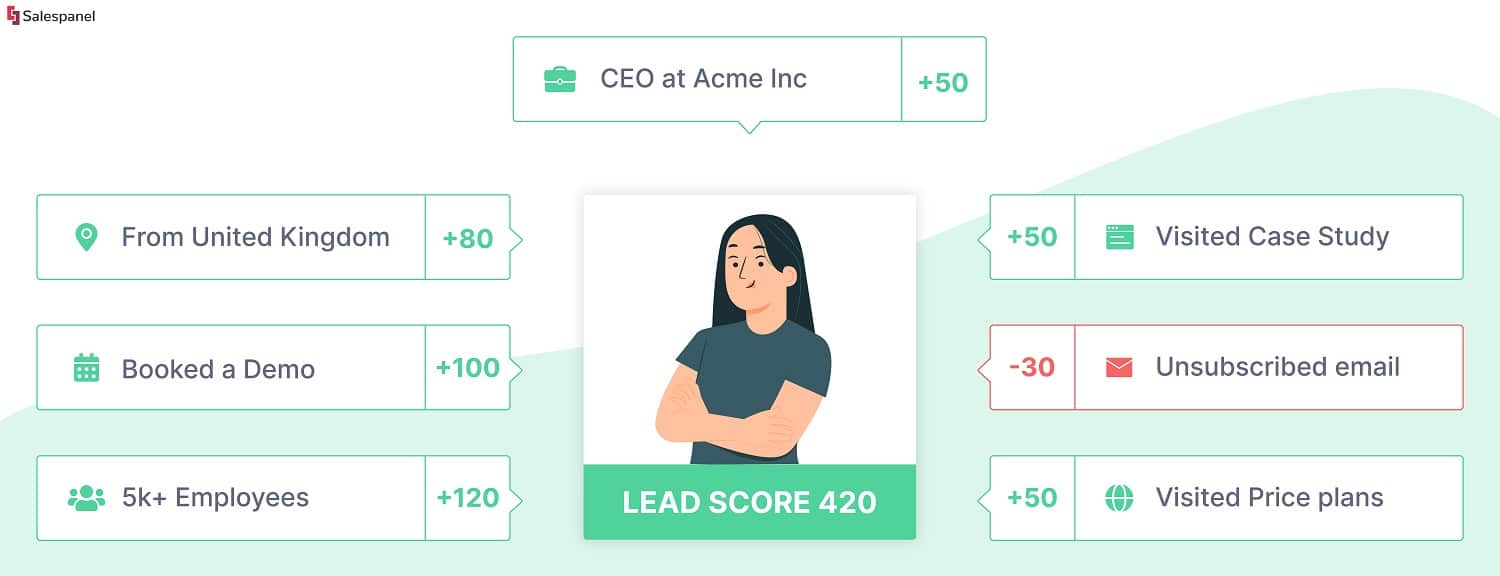
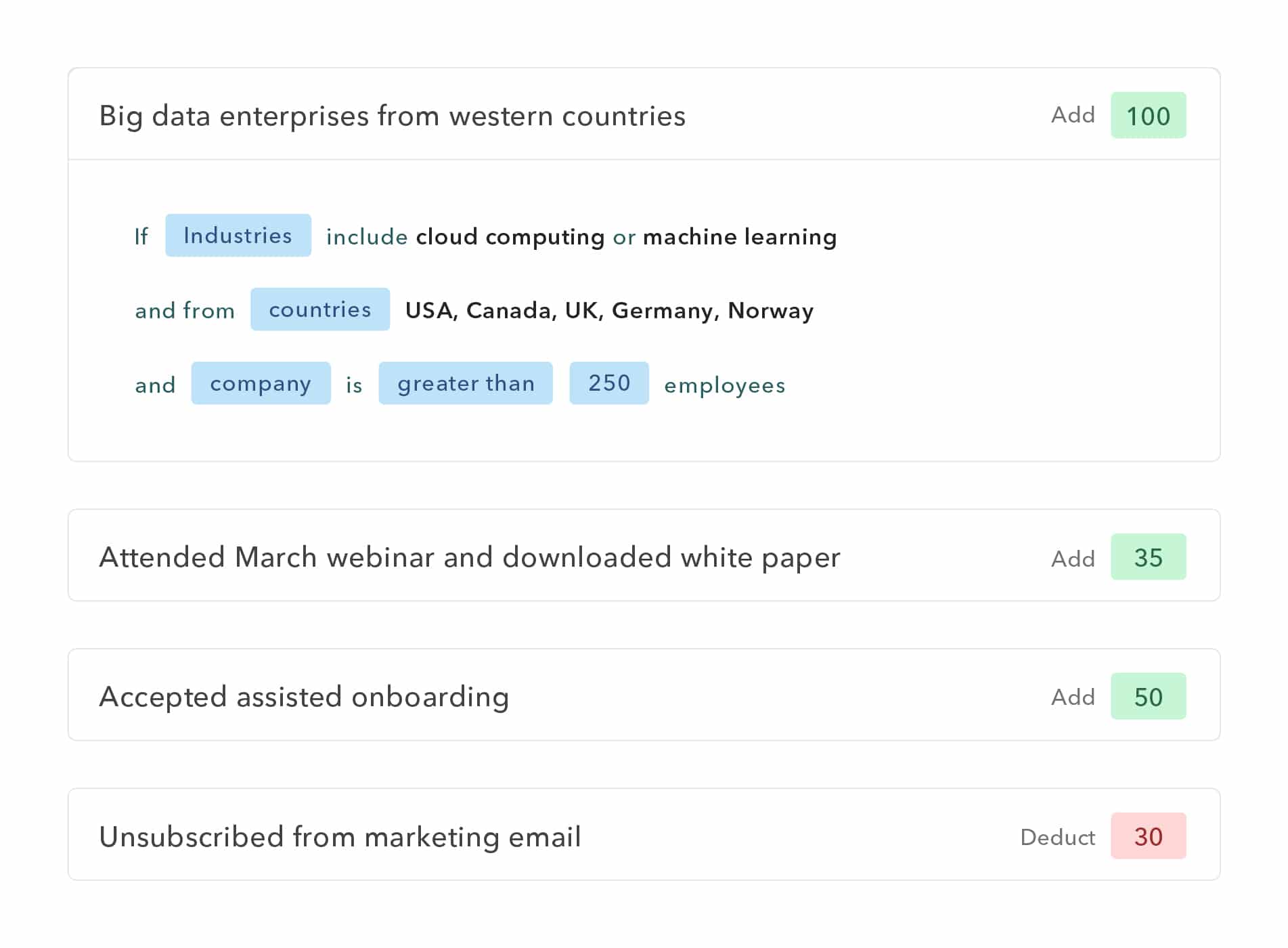
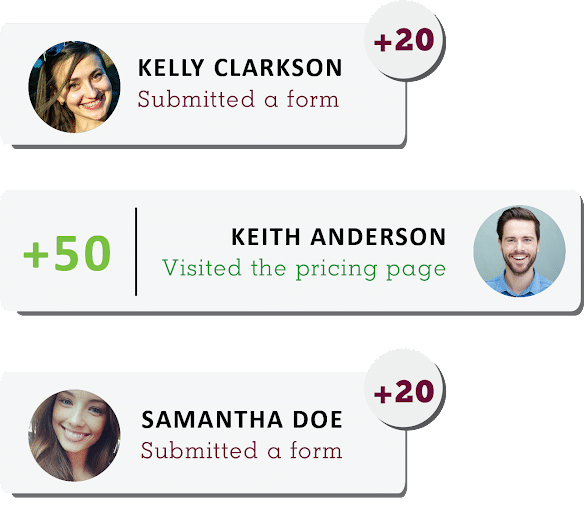
Lead scoring is also used to determine the sales readiness of leads, especially in B2B sales, and move them through stages of the buying cycle. Leads can either be given positive points or negative points. Positive points are awarded for positive characteristics or behaviors (eg: lead is from a targeted business demographic). Similarly, points are deducted for negative behavior (eg: unsubscribing from important mailing subscriptions or removing payment information).
While job role and company data are key elements for initial qualification, behavioral data is what lead scoring shines with. Why? A B2B lead won’t buy on their first visit. They would gradually engage with you by consuming your content (case studies, webinars, etc.). They might also schedule a call, start a free trial, or talk to support. All of these engagement points would be used to gradually score leads.
Who is Lead Scoring For? Is it the Right Thing for Your Business?
Now that we understand what B2B lead scoring is and how it works, it is time to determine if lead scoring is right for your business. Depending on how many leads you generate and your ticket size, lead scoring can either be essential or good to have. You might also not need lead scoring at all.
Lead scoring is essential for you if you:
- Process hundreds or thousands of leads per month and your sales/marketing system is being pushed to the limit.
- Have to deal with a lot of unqualified leads and waste time on them.
- Are missing out on good leads because you can’t prioritize them.
- Are you spending a significant amount of resources on leads who don’t convert?
- You want to replicate your best leads and customers and run personalized retargeting campaigns for the best leads.
If any of these apply to you, you need lead scoring. If your volume is on the higher side, both predictive and rule-based scoring will work for you (discussed later). In 2026, even light-data implementations benefit from predictive and AI-powered methods. Many tools now offer built-in governance and retraining workflows, and CRM-native solutions have made powerful scoring accessible even to SMBs.
Coming to advertising, the more data you have, the more lead scoring can help you create lookalike audiences of your best leads and customers or qualify best leads and show personalized content on your website, through emails, and with retargeting.
Lead scoring is good to have for you if you:
- Have a lower volume of leads to deal with.
- You deal with unqualified leads but you don’t lose out on opportunities because of it.
- You don’t miss out on good leads because your volume is low.
- You want to replicate your best leads and customers and run personalized retargeting campaigns for the best leads.
If these apply to you, lead scoring is absolutely not essential for you but it is still something that you would benefit from having. While your reps will deal with all leads, having lead scoring will help you prioritize leads and act accordingly on leads with high scores. You can also personalize your retargeting campaigns for higher priority leads and create lookalike audiences. Your reps will also know the strong attributes of the leads (if your scoring system provides breakdowns of scores).
If you fall in this category, rule-based scoring will work more efficiently as you have less data to work with, and having close control would suit you better. Basic predictive scoring to go along with it would be a bonus.
You don’t need lead scoring at all if you:
- Are a startup or a very small business with a small number of leads generated every month.
- You have very high ticket prices (but a low volume of leads) and have a fixed selling process where you talk to all leads regardless.
If any of these match your situation, lead scoring will probably not help you much.
Why Should I Use Lead Scoring and Not Another Method?
The need for qualifying leads is pretty apparent by now. But, you might be wondering why lead scoring is the best method for B2B lead qualification. After all, you can just match with your customer profile once or have your reps qualify. The answer is simple. Lead scoring works gradually as leads progress through the funnel. In B2B, the sales cycles are longer and lead actions play a crucial factor in helping you understand their intent. Plus, if you have your reps call everyone manually, a lot of time will be wasted.
Still not convinced? Here’s updated data for 2026:
- 61% of B2B sales teams now report using AI-assisted lead scoring for their primary qualification workflows (Digital Applied, 2026).
- According to industry research, marketers’ top priorities in 2026 remain lead quality and sales alignment, with 77% focusing on advancing scoring frameworks and governance as their main initiative.
- 34% of B2B sales professionals indicate that lead qualification and prospecting are still the biggest challenge (data has remained consistent or increased slightly per recent Pipedrive and Apollo.io surveys).
In 2026, governance and cross-functional scoring definitions are now standard. Marketing, sales, and revenue operations must align on what qualifies as a sales-ready lead and update scoring logic as markets, products, and buyer journeys evolve.
Breakdown of Data Points
Let’s have a look at all the sales and marketing data points that can be used to qualify leads:
Individual Data: This data consists of information about the person who is evaluating the product on behalf of their company. The most commonly used individual data for lead qualification are job role and seniority. This helps in identifying leads who are decision-makers.
Company Data: This dataset consists of firmographic information of your leads like company size, industry, revenue, etc. The data helps you filter out leads who match your target business profile and also separate leads based on ticket size.
Attribution Data: This data point connects your qualification strategy with your marketing campaigns. Let’s take an example. You are a CRM company and you are running an ad campaign on keyword ‘CRM’. Two leads land from this campaign with one landing after searching ‘best CRM software’ and the other after searching ‘what is a CRM’. Which of them do you think has higher buying intent? Similarly, leads who visit after finding your blog post from social media usually have lower intent/urgency than those who visit your website while actively looking for your product.
Marketing attribution connects your leads to campaigns and source of visit which in turn helps you qualify your leads. The loop gets closed in the sense that marketing attribution helps you identify campaigns that bring you the most customers which you, in turn, use to prioritize leads and amplify the outcomes of higher-performing campaigns. So, leads from historically better-converting campaigns can be given higher scores.
Behavioral Data: As we mentioned earlier, this is the data point where gradual scoring comes into action. Leads perform different activities while interacting with your content and touchpoints. As leads perform these desired or undesired activities, their score keeps changing dynamically. Apart from helping understand a lead’s intent for initial qualification, behavioral data also helps in moving leads through different stages of the buying process and serving personalized content.
Sales/CRM Data: This dataset brings information from sales to marketing for revenue attribution, lead qualification and targeted nurturing. The information from sales interactions and CRM databases can be brought back to marketing for an aligned qualification effort.
Since 2026, modern lead scoring increasingly leverages new data points:
- Omnichannel signals: Tracks engagement across not just web and email, but also in-app actions, chat, review sites, social (even dark social referrals), G2/Capterra, and affiliate partners.
- Trust and credibility signals: Includes reviews, security compliance badges, executive sponsorship, and intent indicators beyond the funnel.
- Account-based touchpoints: Scores are generated both at the person and at the account level, factoring in multi-contact engagement and buying group activity.
- Governance touchpoints: Interactions such as re-training dates, model evaluation flags, and feedback loops for recalibrating scoring logic are explicitly tracked.
Modern platforms regularly score leads across 10 or more interaction types and expose these scores with clear, auditable data trails for collaboration and governance.
Businesses also use other data points like technographic data and demographic data in accordance to their requirements. Lead scoring is heavily reliant on data and data enrichment is needed for a proper lead scoring strategy.
2026 Best Practice Frameworks for Lead Scoring
2026 industry standards now dictate that successful B2B lead scoring programs include:
- Hybrid scoring models—Combining rules-based (for explainability/sales trust) and AI/ML scoring (for improved conversion prediction).
- MQL/SQL gates and strict governance—Clearly defined Marketing Qualified Lead (MQL) and Sales Qualified Lead (SQL) thresholds agreed upon by Sales/Marketing/RevOps, with regular scheduled retraining (monthly or quarterly is now standard).
- Omnichannel data—Scoring systems that monitor touchpoints across digital channels, dark social, events, and review platforms.
- Sales acceptance and feedback—Processes for sales to approve/reject and annotate scored leads, closing the loop for continuous model improvement.
The best lead scoring programs “show their math” (clear explanations and auditability), retrain scoring rules as sales cycles and product-market fit evolve, and prioritize simplicity for sales enablement.
Academic Advances: The Two‑Stage Predictive PRISM Model
Recent academic research has put a spotlight on the PRISM (Predictive, Robust, Interpretable, Segmented, Multistage) model, now validated in industry. The PRISM approach uses a two-stage process: it first clusters leads into fit-based groups, then ranks them within each group using behavioral and conversion data. Adoption of this approach has been shown to significantly boost conversion rates for B2B teams managing complex buying committees and hybrid sales models.
Types of Lead Scoring
There are two prominent methods to score leads: predictive and rule-based. Let’s have a look at them and find out how they differ from each other.
Predictive Lead Scoring:
A predictive lead scoring software uses algorithms to automatically score your leads based on your marketing or sales data. Some lead scoring software would also use external data or combine with a third-party data enrichment software to score your leads.
Predictive lead scoring is completely automatic and will work based on the data it is fed and how the software has been designed.
Source: https://untitled-research.com/blog/lead-prioritization-with-predictive-analytics-in-recruitment
Rule-based Lead Scoring
Rule-based lead scoring is a simpler lead scoring method where you set up rules to score your leads. Rules can be set up based on the data available to you and the functionality provided by the lead scoring software.
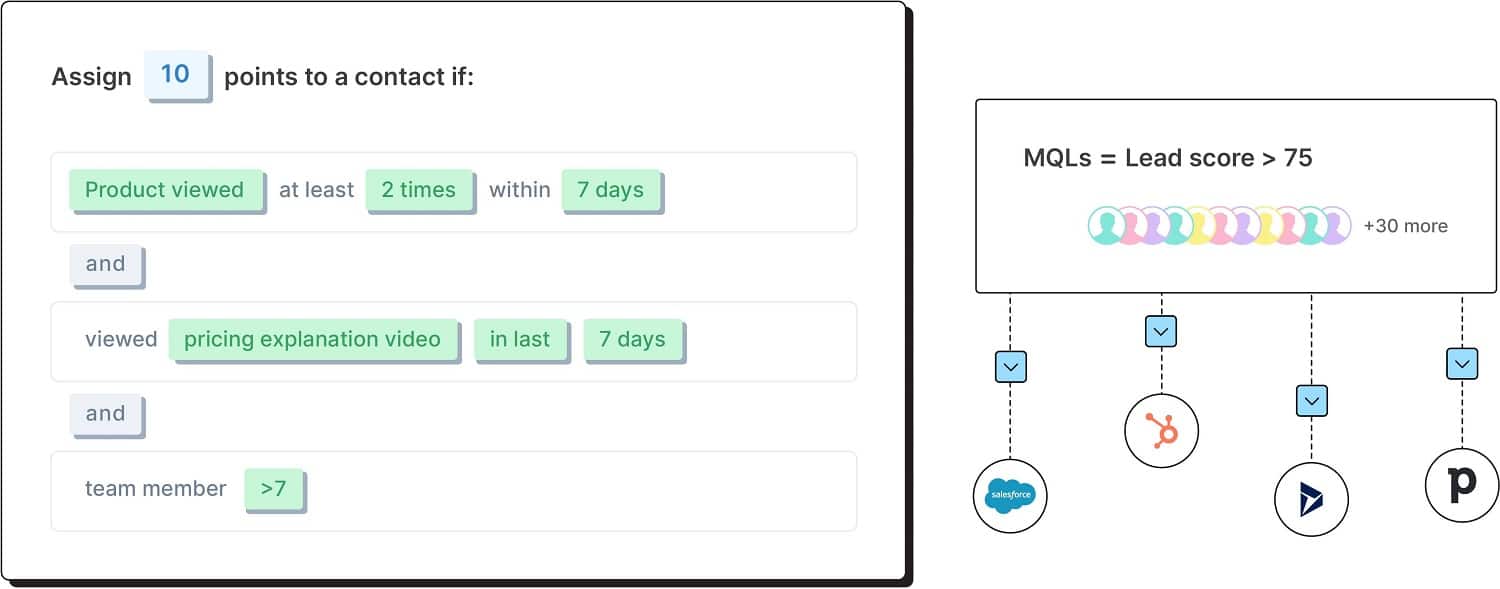
When a lead triggers a rule set by you, the lead score is updated. You can set up rules based on desired or undesired characteristics and behaviors like we mentioned before and the score will keep changing. You can then trigger workflows based on lead score or set up a minimum scoring threshold to mark a lead qualified. For example, you can create a system where when a lead accumulates a minimum score of 100, they are sent to sales or served pre-sales content.
The Key Difference Between Predictive Lead Scoring And Rule-based Lead Scoring Approach
The main difference in these two approaches is that with predictive lead scoring, the software does the work for you and with manual lead scoring, you set up your lead scoring workflow based on how you intend it to work. Rule-based lead scoring offers you the flexibility to set up your rules how you want to and assign weightage to each characteristic or behavior.
Let’s say, based on previous won deals, you have found out that a key product interaction (eg: trial extension) is a very strong indicator of purchase intent. You can simply create a lead scoring rule for this but can a predictive lead scoring software find this correlation? Maybe it can, but this entirely depends on how the machine learning process and the algorithm works. So, the results might vary from software to software. Also, it would be harder to use predictive lead scoring to move deals across different stages of the buying process through stage-based nurturing.
The advantage predictive lead scoring has over rule-based lead scoring is that it can pull data from a lot of different sources and you essentially don’t have to work on setting anything up yourself or analyze data to find key indicators. Depending on which software you use, you might also need to subscribe to data vendors for setup. This applies to both predictive and rule-based solutions but not all vendors need you to purchase 3rd-party data. Salespanel, for example, comes with data out of the box.
10 Best B2B Lead Scoring Tools in the Market for 2026 and Their Prices
In this section, we will cover some of the top B2B lead scoring tools available in the market and compare their features and prices (for the ones that have open pricing, of course!). We will also explain how each tool helps you score leads.
This is not a ranked list, by the way. You be the judge!
Salespanel
We spent a lot of blood and sweat on this article, creating it and updating it constantly. Only fair if we start this list with our tool, eh? Maximum impressions that way! 😀
Sales pitch in 3…2…1…
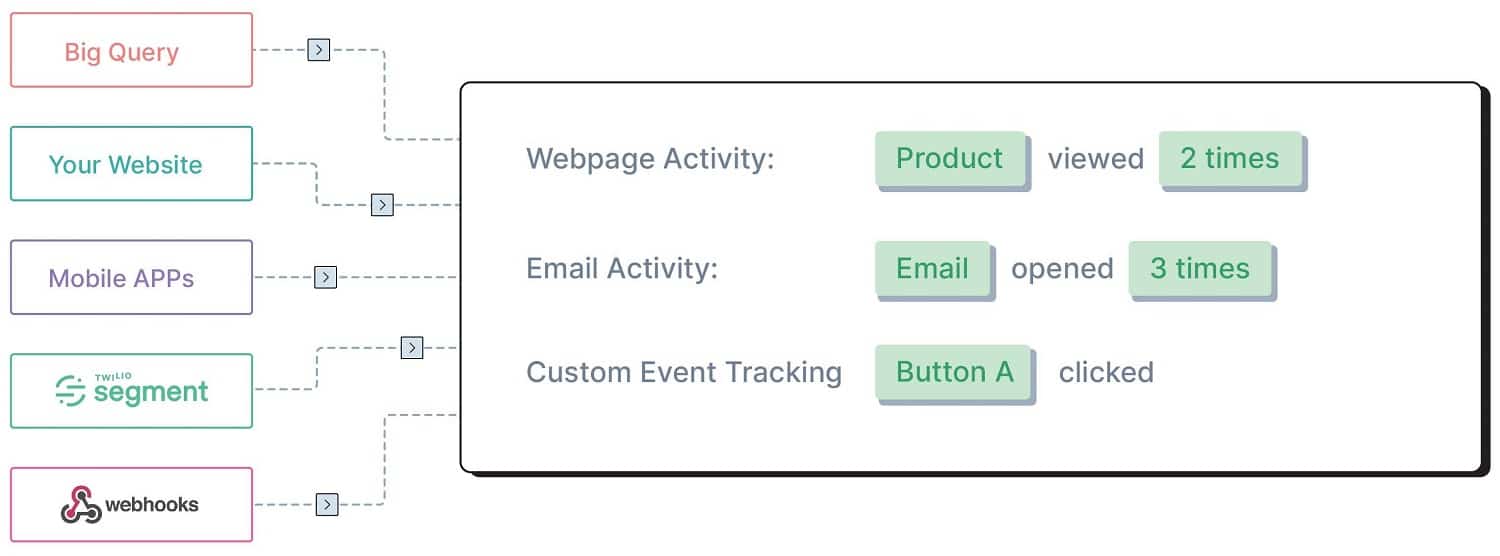
Salespanel helps you automatically capture your leads from different acquisition channels and track their touchpoints and score them in real-time. So, not only do you use lead data but also use buyer intent data to score as they gradually engage with your marketing content. When it comes to buyer intent data, Salespanel’s tracking goes in-depth. From tracking how a lead originated to tracking specific actions like button clicks, video views, or pageview duration, Salespanel can do it all. Your team can also set up custom action events. For example, if you are a SaaS product, and leads who watch the onboarding video or download a specific case study are more likely to convert, you can track those specific events to score your leads.
Salespanel now combines advanced rule-based lead scoring with predictive hybrid scoring that leverages AI, machine learning, and deep first-party data signals. The platform offers full omnichannel integration—scoring leads based on web, email, chat, and multi-source activity—and supports robust governance with scheduled retraining and explainable rules outputs for commercial teams. You can qualify and activate your visitors, leads, and accounts in real-time, drive personalized web and CRM experiences, and monitor the “why” behind every score.
Lead scoring is available on $249/month and higher plans. Talk to us to learn more. Salespanel plans scale as you scale and is suitable for all types of B2B businesses that have at least 1000 visitors on their website.
HubSpot Lead Scoring
HubSpot remains the world’s most widely adopted SMB/enterprise CRM, and its lead scoring tools have seen significant AI and hybrid upgrades for 2026. The Marketing Hub now features both rule-based and predictive scoring at the Pro (starting at $890/month) and Enterprise levels (starting at $3,200/month). Predictive scoring using AI is also available in Sales Hub Enterprise (from $1,200/month). HubSpot customers use lead profile, firmographic, omnichannel, and new trust data points for real-time scoring, with retraining and audit trails baked into new scoring dashboards.
The system is ideal for organizations already invested in HubSpot’s platform and CRM, especially with new AI explanations and RevOps integrations lowering the learning curve substantially. Note: Rule-based scoring is available only in Marketing Hub Pro/Enterprise.
Infer (IgniteTech)
Infer, now under the IgniteTech brand, continues to serve enterprise clients with robust predictive scoring. Its latest iterations offer deeper integrations with data enrichment vendors and greater explainability for qualifying leads by fit, behavior, and account group. It remains a strong choice for large, complex sales teams needing advanced modeling. Pricing is not disclosed—contact IgniteTech for quotes, but expect enterprise-level rates.
ActiveCampaign
ActiveCampaign has continued improving its “Customer Experience Automation Platform” with expanded rule-based scoring and more seamless omnichannel data capture, integrating with web chat, email, in-app, and SMS. Lead scoring is available from $49/month and is especially competitive for small and mid-sized businesses wanting to score leads without enterprise-level spend.
The scoring features focus on engagement from email, website, and campaign activity, and are best for businesses needing tight marketing automation. For 2026, integrations with external CRMs and support for attribute-based scoring have been strengthened.
MadKudu
MadKudu has pioneered hybrid predictive lead scoring for SaaS and product-led companies. In 2026, the platform’s new “Lead Grade” feature combines AI-powered eligibility scoring with sales-aligned rule visibility, so sales teams see both the score and the reasons behind it. MadKudu ingests first-party, product usage, and sales touchpoints to identify Product Qualified Leads (PQLs) at scale. Pricing starts at $1,999/month (verify for custom plans); the product is best for high-volume B2B workflows and teams seeking deeper data science for lead modeling.
Breadcrumbs continues to deliver a flexible and transparent lead scoring solution that blends machine learning with rule-based models. Its “mix-and-match” system allows users to create custom models with adjustable weights and auditability, integrating with modern marketing stacks (Intercom, HubSpot, ActiveCampaign, Mailchimp, Marketo, Mixpanel, Pendo, Salesforce, Segment, and more).
Pricing starts at $999/month for up to 2000 contacts. New for 2026, Breadcrumbs has expanded support for account-based scoring, omnichannel touchpoints, governance events, and closed-loop sales feedback.
Conturs
Conturs is a notable new entrant, offering explainable, similarity-based lead scoring for B2B sales teams seeking closed-won “lookalike” analysis. It leverages AI models based on your historical sales data to identify and score new leads most like your best customers, but with full transparency—each score can be cross-referenced by sales and marketing. Conturs supports scheduled model retraining and account-based fit scoring, with direct CRM and RevOps platform integrations. Pricing starts at $39/month and they also have a free plan.
Abmatic
Abmatic is a unified lead intelligence solution that burst onto the scene with deep scoring, buying committee identification, and real-time sales activation in 2026. The platform combines score attribution (see why a lead is hot), dynamic conversion signals, and advanced account engagement data—all served to sales in real-time. Ideal for B2B orgs moving to ABM and RevOps, Abmatic excels at surfacing hidden buying signals in midsize and enterprise sales. Pricing is available on request.
Salesforce Einstein Lead Scoring
Salesforce Einstein has significantly improved its lead scoring capabilities over the past years. In 2026, it provides AI-powered scoring for both individual leads and accounts, using predictive models based on historical conversion data, engagement, and opportunity close rates. New explainability features let teams see the factors behind every score, and built-in workflows allow for MQL/SQL gates and automated handoffs. Available on Salesforce Enterprise or higher plans (contact Salesforce for exact pricing). Best suited for businesses already leveraging the Salesforce ecosystem.
Pardot (now Marketing Cloud Account Engagement)
Pardot (now fully rebranded as Salesforce Marketing Cloud Account Engagement) continues to offer automated lead scoring with improved fit and engagement models. Integration with Salesforce CRM and Einstein analytics enables more granularity and model retraining, supporting real-time sales readiness workflows and RevOps dashboards. Pricing varies by plan; ideal for current Salesforce and Marketing Cloud users looking for deep platform integration.
Setting Up Lead Scoring
For predictive lead scoring, setup is fairly simple. Integrate the software with your CRM, marketing tools, data enrichment service, or your website, and you are good to go. The software will start scoring your leads automatically. For rule-based lead scoring tools, in addition to connecting your lead scoring software to your sales and marketing workspace, you need to set up your rules. The flexibility of rule-based lead scoring requires a bit more effort in setting up your workflow.
In this article, we are covering the lead scoring setup with Salespanel. The fundamentals, however, should be similar for other tools as well. With Salespanel, you receive individual, company, and activity data right from the start. You need to connect Salespanel to your website and your CRM if you want to use sales data. Once set up, you can create various rules based on the data provided.
Before setting up your rules, research your previous deals to identify strong indicators. Useful data filters include job role, company size, page visits, email engagement, etc. Behavioral data allows you to progressively score leads and move them through the sales process. If you need more information to identify strong indicators, check out reports on Salespanel and discuss with your sales team—they often know which indicators are stronger.
Examples of B2B Lead Scoring Models to Help You Get Started
To help you get started with lead scoring, we will share examples of two lead scoring models. The first uses account data to score leads and match them to your customer profile and the second uses behavioral data to gauge buying intent. You can also mix and match from both of these models to create your own model. These models can be created with lead scoring tools like Salespanel.
Example 1: Account-Based Lead Scoring Model
This model uses account information such as employee count and revenue to score leads. Leads from accounts that align closely with the company’s target customer profile are scored higher.
Scoring Components:
1. Demographics:
- Employee Count:
– 1-50 employees: 10 points
– 51-200 employees: 20 points
– 201-500 employees: 30 points
– 501-1000 employees: 40 points
– 1001+ employees: 50 points - Annual Revenue:
– <$1 million: 10 points
– $1-10 million: 20 points
– $10-50 million: 30 points
– $50-100 million: 40 points
– $100+ million: 50 points
2. Industry Fit:
- High-fit industries (e.g., Tech, Finance): 30 points
- Medium-fit industries (e.g., Healthcare, Education): 20 points
- Low-fit industries (e.g., Retail, Hospitality): 10 points
3. Geographic Location:
- Preferred regions (e.g., North America, Europe): 20 points
- Secondary regions (e.g., Asia, South America): 10 points
- Other regions: 5 points
4. Company Growth Rate:
- High growth (20%+ annual growth): 30 points
- Moderate growth (10-20% annual growth): 20 points
- Low growth (<10% annual growth): 10 points
Process:
- Identify the enrichment attributes you would need to create your model.
- Confirm if the data is available on your lead scoring tool.
- Create your rules and complete setting up your module.
- Test if your module is working as intended.
For example, a lead from a tech company with 300 employees, $25 million in revenue, located in North America, and experiencing high growth would score: 30 + 30 + 30 + 20 + 30 = 140 points.
Example 2: Behavior-Based Lead Scoring Model
This model scores leads based on behavioral data such as time spent on specific converting pages and buyer intent showing pages like Pricing and Case Studies.
Scoring Components:
1. Behavior:
- Time Spent on Website:
– <1 minute: 5 points
– 1-3 minutes: 10 points
– 3-5 minutes: 20 points
– 5+ minutes: 30 points - Page Visits:
– Product Page: 20 points
– Pricing Page: 30 points
– Case Studies Page: 25 points
– Blog or Resources Page: 10 points - Downloads:
– Whitepapers or E-books: 30 points
– Product Brochures: 20 points - Forms Filled:
– Contact Form: 25 points
– Demo Request Form: 35 points
– Newsletter Signup: 10 points - Email Engagement:
– Opens: 5 points per open
– Clicks: 10 points per click
Process:
- Identify the behavioral attributes you would need to create your model.
- Confirm if the attribute is available on your lead scoring tool.
- Create your rules and complete setting up your module.
- Test if your module is working as intended.
For instance, a lead who spent 4 minutes on the website, visited the Pricing and Case Studies pages, downloaded a whitepaper, filled out a demo request form, and attended a webinar would score: 20 + 30 + 25 + 30 + 35 + 20 = 160 points.
Syncing Data and Triggering Marketing Automation
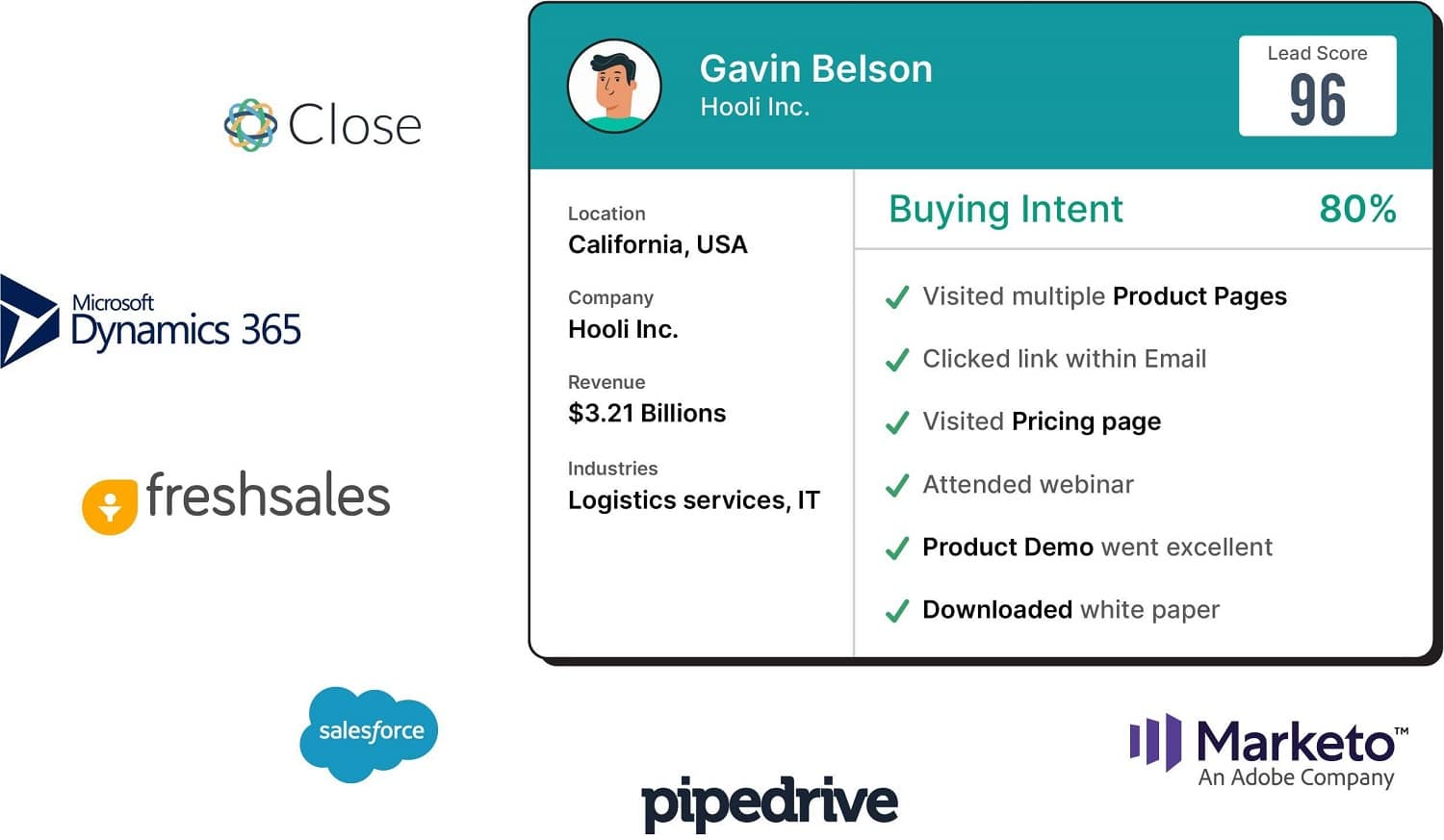
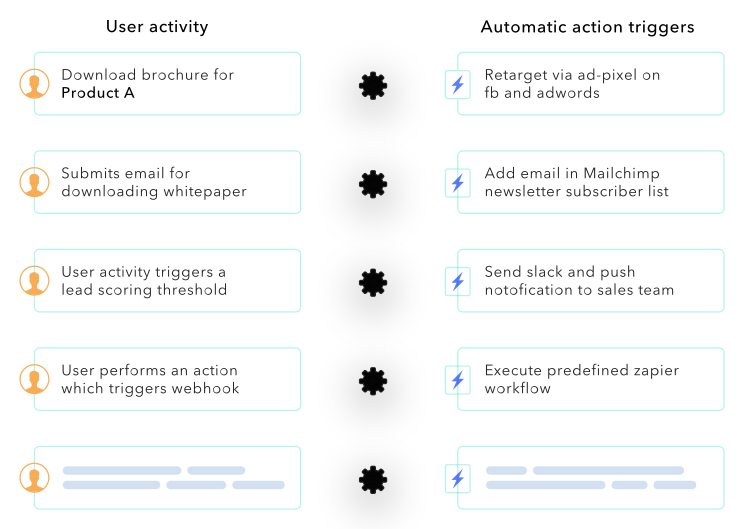
The lead scoring data can stay on your lead scoring software but it makes more sense if you leverage the data to trigger certain workflows or send the data to sales to help them prioritize hot leads. Salespanel can sync lead scores to other platforms like your CRM or Slack instantly. This will help your sales know about intent signals in real-time and prioritize hotter prospects. You can also create a system to notify sales when leads cross a certain minimum score.
Lead score can also be used to trigger nurturing campaigns or optimize bidding value for your retargeting and nurturing campaigns. We will talk more about it in the future. Please leave us a message if you are interested in knowing more.
To conclude, lead scoring is a crucial asset in modern B2B sales and marketing. It can be beneficial for all digital businesses irrespective of size. While predictive lead scoring is more geared towards enterprise businesses with high volume, rule-based lead scoring can be helpful for all.
Frequently Asked Questions
Is AI-powered lead scoring the default in 2026?
Yes. As of 2026, 61% of B2B organizations rely on AI-assisted or fully AI-based lead scoring as a primary or hybrid approach. Most platforms offer explainable AI features and human-in-the-loop governance to ensure trust and collaboration.
What is hybrid lead scoring in 2026?
Hybrid lead scoring combines rule-based scoring (using explicit criteria, championed for sales trust and explainability) with machine learning/AI approaches (for dynamic prioritization). Hybrid models let sales and marketing set rules for key signals while the platform adapts model weights and priorities based on real-world outcomes, supporting regular retraining and governance.
Are AI lead scoring tools explainable and accepted by sales teams?
Yes. Modern AI lead scoring tools must provide clear explanations for each score—audit trails, specific triggers, and business logic. Explainability is essential for sales acceptance, allowing commercial teams to understand and trust every recommended prioritization. Leading solutions also offer sales feedback mechanisms for continuous improvement.
How often should lead scoring models be updated or retrained?
Industry best practice in 2026 is to update or retrain models quarterly, or whenever go-to-market, product, or ICP changes occur. Some platforms enable automatic or scheduled retraining and prompt revenue operations for human review to ensure scoring stays aligned with market reality.
What is the difference between MQL and SQL in the current landscape?
MQL (Marketing Qualified Lead) and SQL (Sales Qualified Lead) remain important in 2026, but scoring and progress gates are now defined cross-functionally with agreed governance. An MQL today is usually a lead who meets fit and minimum intent, while an SQL is validated as ready for direct sales engagement—based on additional score or a sales-accepted action.
Sell more, understand your customers’ journey for free!
Sales and Marketing teams spend millions of dollars to bring visitors to your website. But do you track your customer’s journey? Do you know who buys and why?
Around 8% of your website traffic will sign up on your lead forms. What happens to the other 92% of your traffic? Can you identify your visiting accounts? Can you engage and retarget your qualified visitors even if they are not identified?
- B2B Lead Scoring: Guide and Best Tools for 2026
- What are Product Qualified Leads (PQLs)? VS MQLs and SQLs