
Over the past 10 years, the strategy behind B2B Marketing was rather elementary: drive traffic to your site, capture leads with forms, and nurture them. This strategy no longer holds because it relies on forms submitted voluntarily and third-party cookies for retargeting. Currently, up to 98% of potential revenue can be lost because you don’t see the traffic on your site. The future is meant for those who can decipher this traffic and turn invisible browsers into predictable, consistent sales pipelines.

For results that go beyond antiquated tactics, leveraging the right technologies and methodologies will allow you to identify the businesses visiting your site and find and act on the intel with laser focus. Real-time, actionable data from traffic to your site makes it possible to re-engineer your entire go-to-market strategy to recover leads you would have missed otherwise. The goal is to turn the lost prospects that would have generated revenue into prospects with definable buying behavior.
Why Your Anonymous Website Traffic Is a Goldmine

The Hidden Value in Your Traffic Data
Most of the visitors that come to a business’s site every day are visitors. They evaluate your pricing, consume your case studies, and assess your solutions without even filling out a contact form. This is not passive traffic – this is a consistent flow of high-intent prospects, and many are going through a sales funnel without contacting your business for a solution offered. This is a considerable event. A gap of this size in a sales funnel means lost potential revenue and a lost sales opportunity. Most importantly, it has been estimated that 96% to 98% of website visitors never identify themselves.
To show the importance of this, let’s use a simple example. Picture a B2B business that gets 10,000 visitors every month and has a $50,000 average deal size. By identifying and converting just 1% you could unlock an additional $5 million in annual revenue. This is a significant acceleration of the sales pipeline.
From Anonymity to Actionable Pipeline
Let’s focus on the mission: transforming invisible traffic into a reliable sales pipeline. For large marketing teams, privacy-compliant identification technologies are invaluable tools. They are game changers for sustainable growth. With the right systems, you can start to solve important business questions.
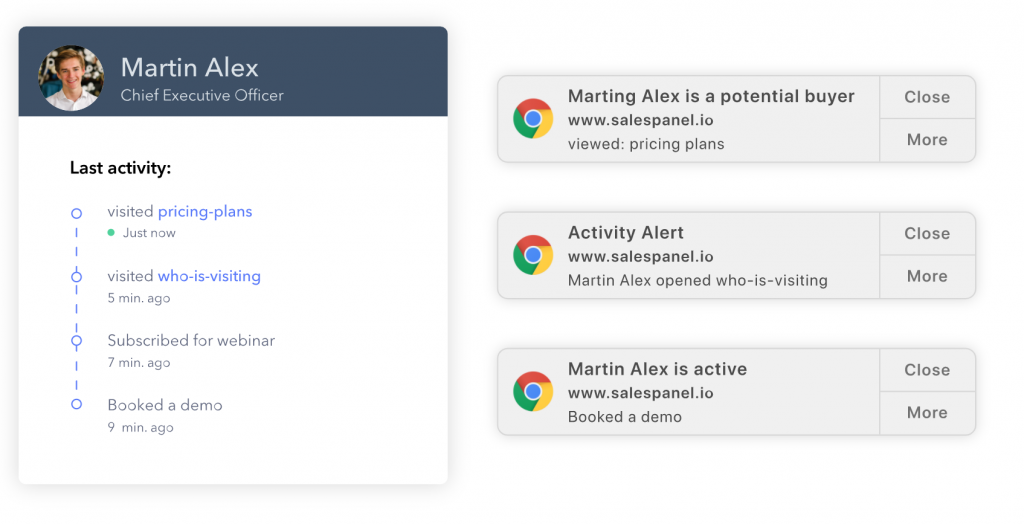
What if your sales team got a real-time notification that a key account just spent ten minutes on your enterprise pricing page? That’s more than just data. It’s a high-priority sales trigger. It turns a passive browsing session into a real-time reach-out opportunity. This is the practical takeaway. It becomes your most valuable asset. That’s the right use of technology.
- Which companies are showing interest? Identify the companies that are showing interest in your solutions, even if they never contact you directly.
- What content are they engaging with? Identify their pain points by seeing which pages and resources they consume.
- When is the right time to reach out? Identify real-time buying signals and reach out when their intent is at its peak.
What if your sales team got a real-time notification that a key account just spent ten minutes on your enterprise pricing page? That’s more than just data. It’s a high-priority sales trigger. It turns a passive browsing session into a real-time reach-out opportunity. This is the practical takeaway. It becomes your most valuable asset. That’s the right use of technology.
How Visitor Identification Technology Uncovers Your Hidden Audience

There is a methodical application of technology behind uncovering anonymous visitors. When a visitor comes to your website, a small tracking script is embedded in your website’s header. This becomes a method to turn a string of numbers, that is an IP address, into an actionable company profile.
This script does more than count page views. Upon a visitor’s arrival, it captures their IP address and begins logging crucial first-party behavioral data: the specific pages they view, the duration of their visit, and their engagement with various content elements. However, an IP address in isolation is merely a digital location marker. The substantive work involves IP address resolution and reverse DNS lookups. These techniques function as a digital investigation, tracing an IP address back to its registered owner—which, in a B2B context, is frequently a specific company.
From IP Address to Company Profile
After an IP address gets associated with a company, then the data enrichment process starts, and this is when the visitor identification platforms demonstrate their true value. They build and maintain vast, continuously updated databases connecting corporate IP addresses to a wealth of firmographic information. This is not speculative. It is the product of sophisticated data aggregation from analytical public records and business directories. Other data may come from proprietary means. Just an IP gets transformed into a detailed company profile that may show:
- Company Name and Domain: The company’s base identifier.
- Industry and Size: This is important in determining their fit to your ideal customer profile (ICP).
- Location: Finding their headquarters, or the actual office from where the visit came.
- Revenue and Employee Count: Key figures in sales territory mapping and defining lead qualifications.
These technologies work together to create a complete and actionable profile of a previously anonymous visitor.
By tracking an IP address, you can create essential firmographic values that form the foundation of B2B sales intelligence, demonstrating the worth of customer identification.
Practical Example
Consider the following example. You are a B2B SaaS company selling enterprise-level project management software. A company is one of your target customers, a Fortune 500 manufacturing firm. Your website analytics show a triggered alert from a Fortune 500 manufacturing firm, and a visitor downloads a case study on supply chain optimization and spends 15 minutes on your pricing page. Without identification technology like Salespanel, you would simply mark this as an anonymous session in your lost data.
With this technology, your sales team gets a real-time alert. They know the company name and size, and the exact problems the company is researching.
This enables your sales team to time their outreach perfectly and increase the likelihood of a positive response. It would not be a cold call, and they can reference the exact pain points the visitor was recently researching. The practical application is turning a passive, unknown browser into a warm, qualified lead.
Visitor Identification Method Comparison
For a better technical understanding, we can evaluate the most commonly used techniques to identify website visitors. Each has distinct mechanics, strengths, and ideal use cases in the B2B marketing field.
| Identification Method | How It Works | Best For | Limitations |
| IP Address Tracking & Resolution | Maps a visitor’s IP address to a company’s registered IP range, then enriches it with firmographic data from a provider’s database. | B2B lead generation; identifying high-value accounts showing buying intent; personalizing content for specific industries. | Can’t identify individual people, only the company. Less effective with remote workers using residential IPs. |
| First-Party Cookies | A tracking script places a unique identifier (cookie) in the visitor’s browser. When they return or fill out a form, their activity is linked to their profile. | Tracking the customer journey of known leads, understanding user behavior over time, and personalizing the experience for returning visitors. | Only works after a visitor has identified themselves (e.g., through a form fill). It can be blocked by browsers or deleted by users. |
| Form Submissions | A visitor voluntarily provides their contact information (name, email, company) by filling out a form for a demo, webinar, or content download. | Capturing explicit buying signals, building an email list, and creating known contacts in your CRM. | Relies on the visitor taking a specific action; provides no insight into anonymous visitors who don’t convert. |
| CRM Integration | Connects your website tracking tool with your CRM. When an existing contact visits, their activity is logged on their contact record. | Deepening your understanding of existing leads and customers, enabling sales with timely activity alerts, and scoring leads based on website behavior. | Only works for contacts already in your CRM; it doesn’t help identify new, unknown companies. |
In the end, the strongest approach is a transform visitor data into sales intelligence. IP tracking reveals the companies that had previously been hidden, while first-party cookies and CRM integrations offer an understanding of leads that you have. That is the most complete view possible.
Turning Visitor Data Into Sales Intelligence
Identifying the company that is visiting your site is a vital first step, but it is just the beginning. Raw firmographic data—company name, industry, location—is just a breadcrumb. The value comes when this is turned into interpreting the why behind the visit for your sales team. This is possible by understanding the entire customer journey- the complete behavioral picture; why the visit occurred, and that goes beyond identification. It is knowing the From Visitor Activity to Buying Signals to reveal their needs, pain points, and most importantly, their intent to purchase.
From Visitor Activity to Buying Signals
Every click on your site is as meaningful as every click on a storefront. All downloads and page views tell a story, reminding us that a site is also a case study. As case studies are loaded and accounting firms are reviewed, what does it mean when a key target account hits your site three times in three weeks and looks at three different case studies? They are not just flipping through case studies. They are reading them, deep in the valuation, understanding your case, and exploring the solution to a key puzzle. This is what behavioral intent data is all about. The behavioral clues that reveal a prospect’s interests and position in the buying journey.
Significant or meaningful insights come through signals that must be tracked or captured. They must be:
- High-Value Page Visits: Time on the pricing, demo request, and contact pages highlights movement on a continuum from light or casual research to deep or active consideration.
- Content Consumption: When people download certain whitepapers or view certain webinars, we can see the problem they are trying to solve.
- Visit Frequency and Duration: When the same organization visits the site repeatedly in a short timeframe, they are probably showing increasing interest and activity evaluation.
At the descriptive level, it’s critical to connect the who (the identified company) with the what (their on-site behavior). The evidence you have showing a desire or intent to purchase makes passively watching your case studies very powerful, and you should prioritize your sales team’s focus.
Activating Intelligence with Behavioral Scoring
When behavioral data is captured, the recording will need a systematic approach to focus and prioritize outreach. That’s behavioral scoring. Action taken on the site gets point values assigned, and prospects can be ranked accordingly. For instance, visiting the homepage might be assigned 1 point, viewing the pricing page 10 points, and requesting a demo 50 points
This framework enables you to identify when individuals are casually browsing and when they are ready for a sales conversation. One example is Salespanel’s website visitor tracking, which includes the behavioral data for this type of scoring. Here is a practical example of how this works.
Suppose a target account, Innovate Corp, is visiting your site. They spend 7 minutes looking at a case study related to their industry. They then go to your enterprise pricing page and spend 3 minutes there. Finally, they visit the ‘About Us’ page to learn about your company.
A well-designed behavioral scoring system will, in real-time, send alerts to the assigned sales rep. Alerts won’t say, “Innovate Corp is on the site.” They will say, “Innovate Corp, high-value account, just viewed the enterprise pricing page after reading the case study on manufacturing.” This context dramatically changes the sales conversation. The sales rep is likely to have a warm, relevant conversation. The critical takeaway for any B2B company is that the likely conversion is not a passive site visit. It is an immediate, personalized sales opportunity.
How to Choose a Reliable Identification Tool
Some identification tools fit the description, and some do not. The value proposition varies greatly; the data offered can range from high quality to dead weight, from harmful to a company to not adding any value at all. The quality of the underlying data needs to be of the highest integrity within the tool range offered. The value within the tool depends on the IP-to-company database and the matching algorithms. One of the most important aspects of the data is its freshness; is it freeze-dried, incomplete, and crusty, or is it complete, robust, continuously refreshed, and ethically sourced?
Vetting Providers for Data Accuracy
The sad reality of the industry is that there is a data accuracy problem. Third-party assessments have shown that most providers have issues around accuracy, being able to ID between 5 and 30% of previously anonymous visitors. In contrast, the top players like 6sense, Salespanel are able to provide 65 to 85% accuracy. That is a significant difference. You can read more on the data accuracy crisis and its repercussions.
Using the wrong tool will have your sales team going after the wrong targets. To avoid this from happening, you need to put prospective vendors through an extensive questioning process.
- What are your data sources, and what is your verification process? Expect an answer from them about how data is collected, how it is validated, and how transparent they will be in the process.
- What is your match rate versus your accuracy rate? A high match rate means nothing if the matches are wrong.
- How do you handle remote workers and VPNs? This is essential, and a qualified provider will have an effective solution.
Verifiable accuracy beats high match rate claims every time. A smaller list of high-confidence leads will be more valuable and less demoralizing to your sales team than a large, unreliable list.
Navigating the Privacy and Compliance Landscape
Last but certainly not least in importance, ensuring your chosen tool complies with the expected regulations is necessary. GDPR and CCPA need to be considered. While it comes to B2B marketing activity, the key principle would be “legitimate interest.” Identifying companies visiting your site is a standard B2B practice, granted you are compliant with GDPR.
It is up to you to confirm that your chosen provider clearly outlines their data privacy policies. The best tools offer ways to identify anonymous site visitors, minimizing compliance risks and protecting the business. This serves as a solid starting point for building your sales and marketing intelligence.
Tying It All Together: Integrating Visitor Data Across Your Tech Stack

Recognizing anonymous visitors is just the beginning. The information you gather is invaluable, yet its true power is unlocked when you integrate it with your other marketing and sales tools. Data that is isolated offers no strategic value. The objective is to enable the data to circulate readily within your CRM, marketing automation tools, and ad platforms.
With the right connections, you can understand every customer interaction in a new way. It can be helpful to know an important customer is visiting your site, but personalizing their experience and guiding your outreach is a game-changer. The aim is to combine an account’s journey seamlessly. The anonymous browsing and the known contact info and insights. This continuous stream of information makes marketing more effective and sales more successful.
Creating a Unified Customer View
Integration sets the goal of establishing a single source of truth. Connecting your CRM to your visitor identification tool means all your behavioral data will now be attached to a specific contact and account record. This will help eliminate the fragmented knowledge that currently exists within sales and marketing teams.
Consider a sales representative preparing for a call with a potential client. Thanks to integrated data, they know a member of the target account spent twenty minutes reviewing a case study and examining the pricing page the day before. This changes everything. The call is no longer a routine check-in and instead focuses on the prospect’s challenges. The key takeaway is the value of integration. Integrating anonymous visitor data with your CRM will give you the essential 360-degree view of prospect engagement and allow you to spot buying intent early.
Practical Ways to Use This Data Across Your Stack
When you integrate data and stop siloing blindsight traffic, you unlock countless applications that create real business value. This can be embedded in your operational processes.
Here are several ways to leverage integrated data:
- Personalize Your Website on the Fly: Dynamically alter website headlines, CTAs, or featured case studies based on the prospect’s industry. If a healthcare professional visits your site, for instance, the personalized healthcare webpage should feature the testimonial from a hospital instead of a manufacturing firm. Such personalization is likely to improve engagement.
- Run Hyper-Targeted Ad Campaigns: You can build tailor-made audiences on services such as LinkedIn or Google Ads by including companies that have visited high-intent pages but have not yet converted. This enables you to retarget the entire buying committee with ads that focus on the particular issues they were investigating on your site.
- Supercharge Your Lead Scoring: To achieve accurate lead scoring, it is vital to obtain a complete view of engagement. Salespanel’s lead scoring framework allows you to combine anonymous visit data with known contact details. In this way, you will obtain a complete view of an account as well as the true interest level. This will guarantee your sales team puts its focus on the accounts that are really expressing purchase intent, as opposed to those that only engaged with something like a whitepaper a while ago.
Common Questions About Visitor Identification
Visitor identification technology poses numerous challenges. These include the legal scope, the specifics of the technology, and the consequences of each and every option. These challenges must be resolved first before any option can be selected. To guide us, let’s look at the most popular challenges.
Is It Legal to Identify Anonymous Website Visitors?
For most B2B marketing, the answer is most likely legal. For most B2B queries and uses, the systems identify the implied business requesting the information through the IP address of the client. Since GDPR and CCPA treat such IP business data as sensitive personal information, special care must be exercised. In most B2B cases, the systems rely on the ‘legitimate interest’ for marketing purposes. Always check if the data provider is compliant, though.
What Percentage of Anonymous Visitors Can Be Identified?
The percentage of visitors having IP addresses that can be recognized varies with the tool. Advanced identification systems, such as the B2B identifier systems, can align between 20% and 40% of anonymous visitors to real clients. However, the real value to keep in mind is the accuracy of identification. Identifying a large number of clients with poor precision will direct a business to misuse its resources, data sourcing, and verification methodologies.
How Does This Work for Remote Employees?
Locating remote workers can be hard from a technical standpoint because they don’t use business IP addresses, but rather home addresses. The most sophisticated systems forgoing basic IP address identification use a multi-layered approach. These include:
- Professional Mobile Device IDs.
- Corporate Network IP Address-visited Persistent Cookies.
- Corporate VPN Connections.
Although no technique is ever perfect, these advanced systems significantly boost the chances of accurately identifying site visitors, even when they operate outside a physical office.
Can I Identify Specific People or Just Companies?
Most visitor identification tools locate the visiting company. This is basic privacy compliance, as identification is done at the company level. However, some advanced systems can append company data at a level where they can hypothesize ‘likely’ contacts based on the other company data and signals of interest. For example, a visit from a tech company and a ‘Marketing Manager’ or ‘Sales Director’ is a probable contact. This helps your outreach be more focused, yet still respect privacy.
Are you ready to transform anonymous traffic into real sales intelligence? Salespanel enables you to identify and track high-intent accounts and understand their behavior as you sync this data seamlessly across your entire tech stack. Visit our resources to learn more: https://salespanel.io/resources.