
In an era where marketing has evolved from a creative cost center to the primary engine of corporate growth, the ability to measure its financial return is no longer a tactical exercise—it’s a strategic imperative. The classic formula, (Revenue – Marketing Investment) / Marketing Investment x 100%, offers a basic snapshot, but in today’s fragmented digital landscape, relying on it alone is like navigating a modern metropolis with a medieval map. It fails to account for the complex, multi-touch customer journeys that define contemporary commerce.
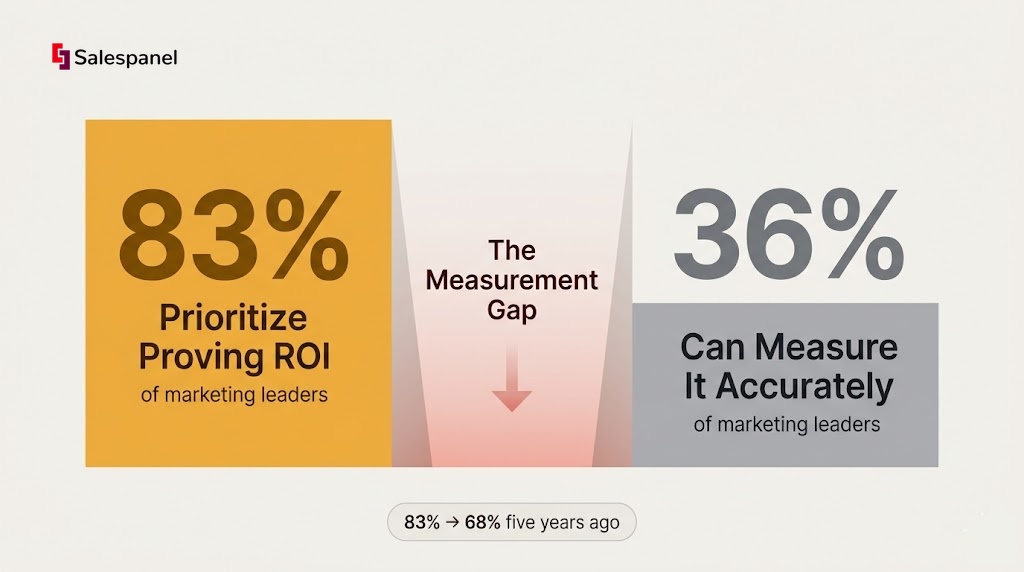
The stakes have never been higher. By 2026, a commanding 83% of marketing leaders will prioritize proving ROI, a significant leap from just 68% five years prior. Yet, a stark reality remains: only 36% feel equipped to measure it accurately. This guide provides a technical and journalistic framework to bridge that gap, moving beyond simplistic calculations to build a robust, defensible model for measuring true marketing return. We will explore the central theme of connecting every marketing action to tangible business outcomes, providing you with a clear takeaway: a methodology to transform your marketing department into a predictable revenue machine.
Why Proving Marketing ROI Is Non-Negotiable
The game has completely changed for marketers. Not too long ago, marketing was seen as a cost center. Our job was to manage budgets for things like brand awareness and creative campaigns. Now? We’re expected to be the primary growth engine, directly responsible for bringing in revenue and showing a tangible financial impact.
This fundamental shift makes most old-school ROI models totally obsolete. A practical example is the B2B buyer’s journey, which now involves an average of 10-20 touchpoints across various channels before a decision is made. A traditional ROI formula that credits only the final interaction—like a demo request form—completely ignores the foundational work done by blog posts, webinars, and social media engagement that made the conversion possible. Trying to measure modern marketing with an outdated map is a surefire way to get lost.
The Modern Imperative for Accountability
The pressure to prove our value isn’t just a suggestion anymore; it’s a fundamental part of the job. By 2026, a massive 83% of marketing leaders are calling ROI their top priority. That’s a huge jump from 68% just five years ago.
But here’s the kicker: despite all that focus, only a measly 36% feel they can actually measure it accurately. Nearly half are still wrestling with multi-channel attribution.
This data points to a massive disconnect. The C-suite is demanding financial proof, but the tools and methods most marketers are using just aren’t cutting it. This gap creates some serious problems:
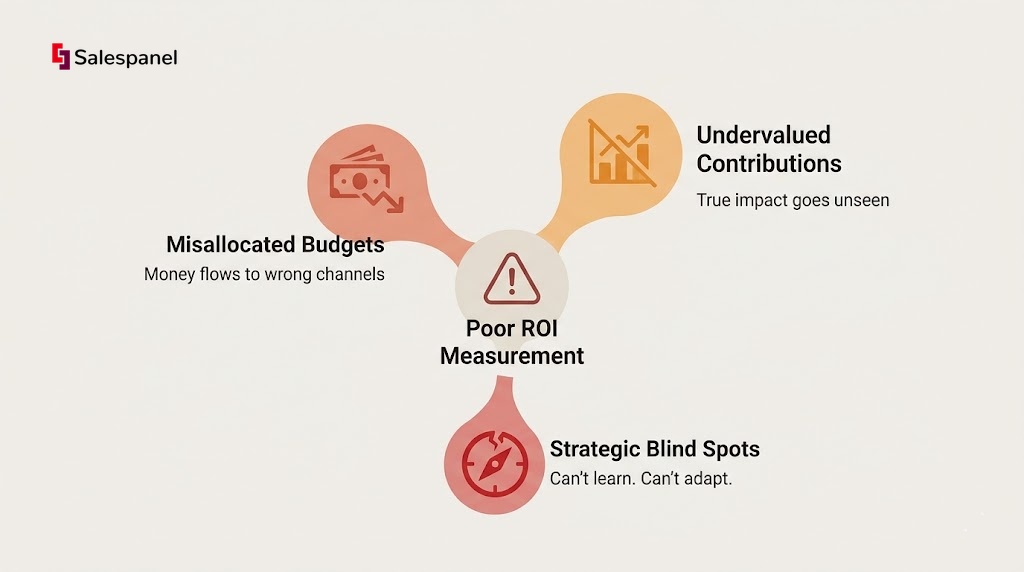
- Misallocated Budgets: When you don’t have clear ROI data, money gets thrown at channels that feel like they’re working instead of the ones that actually are.
- Undervalued Contributions: Marketing’s true impact, especially on long sales cycles and customer lifetime value, gets completely overlooked.
- Strategic Blind Spots: If you can’t connect specific campaigns to revenue, your team can’t learn, adapt, or get better. You’re just flying blind.
A New Framework for Strategic Decisions
The whole point of this guide is to move you beyond simply justifying your budget. Getting ROI measurement right is the bedrock of making smarter, more profitable decisions. It’s about figuring out which levers to pull to drive real growth, not just slapping together a report on what already happened.
The goal is to kill vanity metrics like raw lead volume and replace them with quality signals that actually forecast revenue. This transforms marketing from a cost center into a predictable revenue machine.
By mastering a modern, more nuanced way of looking at marketing ROI, you’re not just calculating a number. You’re building a clear roadmap for success and creating a more effective, respected, and data-driven marketing operation. The key takeaway from this section is that accurate ROI measurement is the foundation of strategic marketing leadership.
Building Your Foundation for ROI Measurement
Before you even think about plugging numbers into a formula, you need to build a solid foundation. Trying to measure marketing ROI without this groundwork is like building a house on sand—it’s just going to collapse, and you’ll be left with data you can’t trust. Getting this prep work right is non-negotiable.
It all starts with defining what you’re actually trying to achieve. And I don’t mean vanity metrics like social media likes or a mountain of unqualified leads. We need to tie our marketing objectives directly to real business goals. A practical example would be shifting from a goal of “increase website traffic” to a more technically sound objective like “increase marketing-qualified leads (MQLs) from organic search by 15% quarter-over-quarter” or “reduce customer acquisition cost (CAC) for paid channels by 10%.” These are the outcomes that actually move the needle.
Setting Meaningful KPIs
Once you know your main objectives, the next move is to pick the right Key Performance Indicators (KPIs) to track how you’re doing. These can’t be one-size-fits-all; they have to be tailored to the specific campaign and where it sits in your marketing funnel. A brand awareness campaign, for example, isn’t going to be measured by immediate sales. Its success lies in metrics that show you’re grabbing more attention.
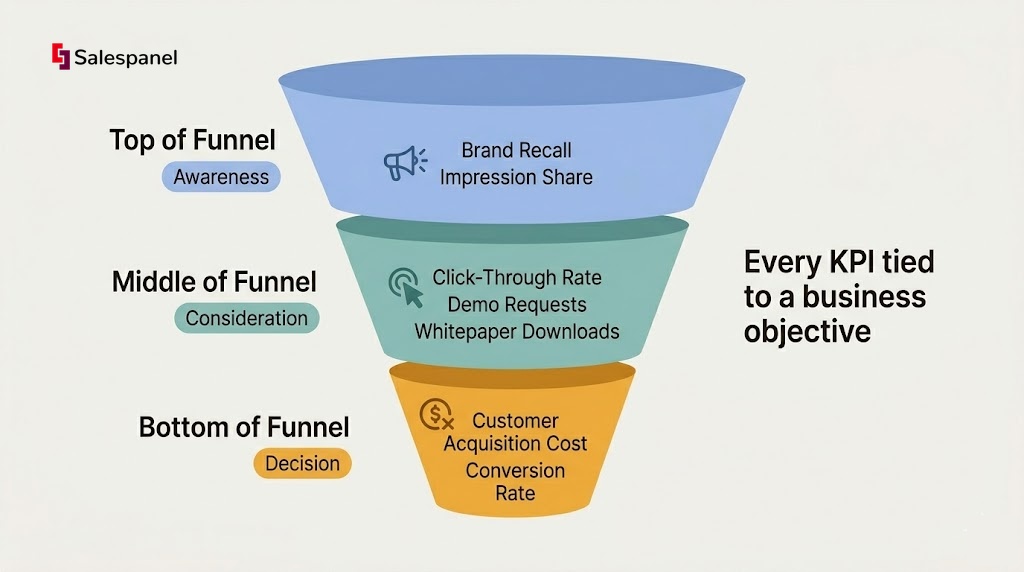
Your KPI framework should cover the whole customer journey, from that first “hello” to the final handshake.
- Top-of-Funnel (Awareness): Look at metrics like unaided brand recall and impression share. These tell you how well you’re cutting through the noise and introducing your brand to the right people.
- Middle-of-Funnel (Consideration): Here, you’re tracking active interest. Think Click-Through Rate (CTR) on your ads and the number of whitepaper downloads or demo requests. These are signs that people are leaning in.
- Bottom-of-Funnel (Decision): This is where the money is. KPIs like Customer Acquisition Cost (CAC) and conversion rate take the spotlight, directly connecting your marketing spend to actual sales.
It’s crucial to document this strategy. Map every single KPI back to a business objective, spell out how it’s calculated, and assign someone to own it. This keeps everyone on the same page and accountable. Your main takeaway here is that a documented KPI framework provides the structural integrity for any ROI calculation.
Creating a Single Source of Truth
One of the biggest headaches in measuring ROI accurately? Fragmented data. Your marketing info is in one place, sales data is in your CRM, and website analytics are somewhere else entirely. These data silos make it impossible to get a clear picture of the customer’s journey from start to finish.
The goal is to integrate these disparate systems into a cohesive ‘single source of truth.’ This unified data environment ensures that every touchpoint, from the first ad click to the final sales call, is captured and attributed correctly.
Getting this right means connecting your essential tools. For instance, by integrating your marketing platform with your CRM, you can finally see how marketing-generated leads actually move through the sales pipeline. A practical application is passing UTM parameters from an ad click into hidden fields on a form, which then populate specific properties in a CRM contact record, creating a traceable link from ad to lead.
You can take it a step further by enriching this data with tools like website visitor tracking from Salespanel. This can help you identify anonymous companies visiting your site and map their entire journey, giving you the hard data needed to tie revenue directly back to specific campaigns. This is how you close the loop and make your ROI calculations both defensible and genuinely useful.
Matching ROI Metrics to Marketing Channels
Trying to calculate marketing ROI with a single, universal formula is like trying to use a hammer for every job in your toolbox. It just doesn’t work. The metrics that tell you if an email campaign was a home run are completely different from the ones you’d use to judge a long-term content strategy. The central theme of this section is strategic alignment: matching your measurement methodology to the specific function of each marketing channel.
If you apply a one-size-fits-all approach, you’re setting yourself up to misread your data and, frankly, waste your budget. You’ve got to tailor your measurement to the specific role each channel plays. Some channels are designed to get an immediate sale, while others are all about building brand love and warming up leads over the long haul. Getting this distinction right is everything.
Performance and Direct Response Channels
Channels like paid search and email marketing are the sprinters of your marketing team. They’re built for speed and are judged on their ability to drive immediate, tangible actions. Here, the ROI calculation is usually pretty straightforward: how much direct revenue did we generate versus what we spent? The line between spend and return is clear and the results come in fast.
Some of these channels are absolute powerhouses. Email marketing, for example, is legendary for its returns, pulling in an average of $42 for every $1 invested. Why? Because it’s a direct, personal line to your audience that you can automate and scale. SEO is another heavy hitter for long-term value, producing around $22.24 per dollar spent, while paid search is a reliable workhorse, typically returning $2 for every dollar spent.
This simple chart paints a clear picture of what a successful campaign looks like when you compare spend to revenue.
It’s easy to see how a $10,000 investment can bring in $50,000 in revenue, locking in a solid 400% ROI. A practical example is an e-commerce company running a Google Shopping campaign. They can directly track clicks to purchases and calculate ROI on a daily basis using revenue data from their analytics platform.
Brand Building and Long-Term Channels
Now for the marathon runners: content marketing and organic social media. These channels often have a much less direct and more drawn-out impact on the bottom line. If you judge a social media campaign just on last-click sales, you’re missing the entire point. Its real value is in building awareness, creating a community, and getting people into the top of your funnel.
The ROI here is measured differently, often using proxy metrics that point toward future growth. For instance, to figure out your content marketing ROI, you’d need to track conversions from organic search over several months and measure that against what you spent creating and promoting the content. A technical approach would be to track assisted conversions in Google Analytics, where a blog post might be an early touchpoint in a journey that eventually converts through a different channel.
The key is to recognize that not all marketing activities are designed to close a deal today. Some are planting seeds that will grow into profitable customer relationships tomorrow.
To give you a clearer idea of how these channels stack up, I’ve put together a quick profile of each, highlighting their typical ROI, how tricky they are to measure, and their primary job in your marketing mix.
Marketing Channel ROI and Measurement Profile
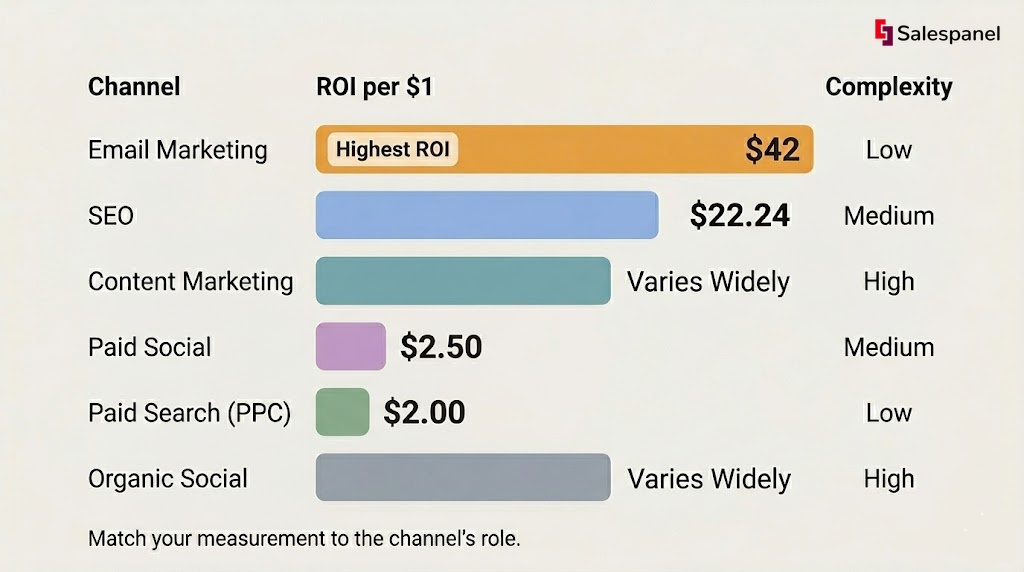
This table provides a snapshot of common marketing channels, offering a realistic look at what to expect in terms of returns, measurement difficulty, and their strategic purpose.
| Channel | Average ROI (Per $1 Spent) | Measurement Complexity | Primary Role |
|---|---|---|---|
| Paid Search (PPC) | $2.00 | Low | Drive direct conversions and bottom-funnel leads. |
| SEO | $22.24 | Medium | Build sustainable organic traffic and brand authority. |
| Content Marketing | Varies Widely | High | Educate prospects, generate organic leads, and build trust. |
| Email Marketing | $42.00 | Low | Nurture leads, drive repeat sales, and retain customers. |
| Organic Social Media | Varies Widely | High | Build brand awareness, community, and top-funnel traffic. |
| Paid Social Media | $2.50 (Varies) | Medium | Target specific demographics for awareness and lead generation. |
By using this kind of framework, you can set much more realistic expectations for each channel. The main takeaway is that applying the right measurement lens to each channel is critical for understanding its true contribution to your business.
Solving the Attribution Puzzle
Attribution. If there’s one place where marketing ROI efforts go to die, this is it. It’s the messy, often maddening process of connecting a sale back to the marketing touchpoints that nudged the customer along. Without a decent attribution model, you’re just throwing spaghetti at the wall and hoping some of it sticks. You’re guessing.
The core of the problem? The customer journey has morphed from a straight line into something that looks more like a tangled ball of yarn. A single deal might be touched by a dozen different marketing efforts over months—that blog post they read ages ago, a social media ad that followed them around, a webinar they signed up for, and a few email reminders to seal the deal.
If you’re still relying on a simplistic model that gives all the credit to the final click, you’re looking at a dangerously warped picture of what’s actually working.
You have to move beyond last-click. The goal is to get a complete view of the entire customer journey, recognizing that every single touchpoint adds some value. That’s the key to understanding your real marketing ROI.
This shift in mindset is absolutely critical. If you only credit the last thing a person did before buying, you’ll inevitably slash the budget for top-of-funnel activities. You know, the very things that fill your pipeline in the first place.
Cracking the Code on Common Attribution Models
To untangle this puzzle, you need to get familiar with the different ways you can assign credit. Think of each model as a different lens for viewing your data. The right one for you will depend entirely on your business goals and how long your sales cycle is.
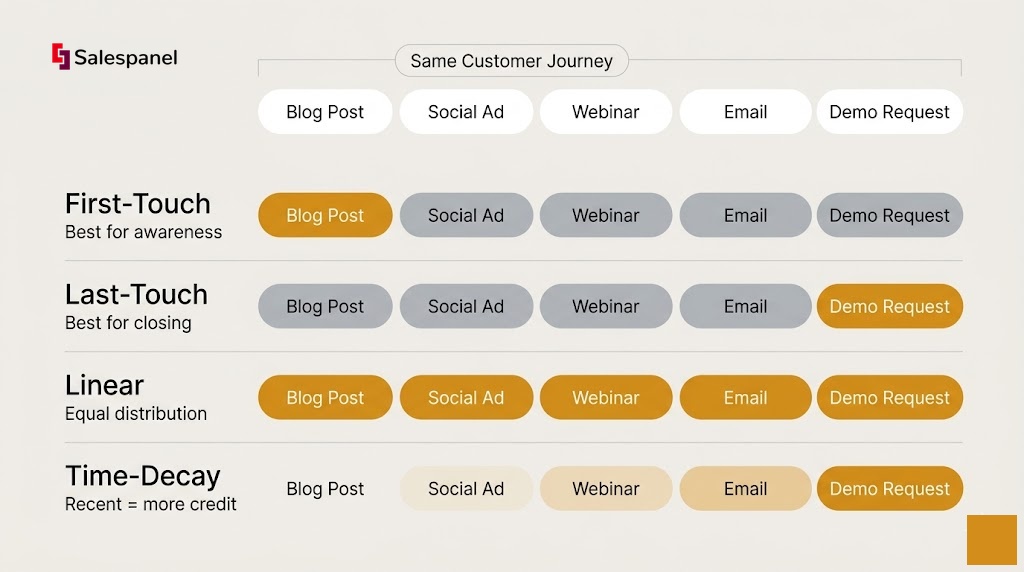
- First-Touch Attribution: This one is simple. It gives 100% of the credit to the very first interaction someone has with your brand. It’s fantastic for figuring out which channels are killing it at generating new awareness and bringing fresh faces into your world.
- Last-Touch Attribution: The polar opposite. This model hands 100% of the credit to the final touchpoint right before a conversion. It’s handy for identifying what’s best at closing deals, but it completely ignores everything that led up to that magic moment.
- Linear Attribution: This model is the diplomat of the group. It takes a balanced approach, spreading the credit equally across every single touchpoint in the customer’s journey. It’s a step in the right direction because it acknowledges that every interaction played a part.
- Time-Decay Attribution: Here’s where things get a bit more sophisticated. This model gives more credit to the touchpoints that happened closer to the sale. The logic is pretty sound: the most recent interactions were probably the most influential.
How Multi-Touch Attribution Plays Out in the Real World
Single-touch models are clean and easy, but let’s be honest—for most businesses, especially in B2B, they just don’t reflect reality. Multi-touch models are where the real insights are.
Imagine a SaaS company with a typical six-month sales cycle. A customer’s path might look something like this:
- A prospect first stumbles upon the company by downloading a whitepaper they found through an organic search (First Touch).
- Over the next couple of months, they’re hit with some retargeting ads and engage with a few social media posts.
- Finally, they attend a webinar promoted through an email campaign and request a demo right after (Last Touch).
If this company uses a U-shaped attribution model, they’d assign a hefty chunk of credit (say, 40% each) to both the initial whitepaper download and the final webinar. The remaining 20% gets distributed among those middle touchpoints, like the social ads.
This approach correctly values both the channel that brought the lead in the door and the one that closed the deal. That gives them a much more complete, and frankly, more useful insight into where their marketing budget is actually making a difference. The key takeaway is that selecting an attribution model that mirrors your customer’s actual buying journey is essential for accurate ROI analysis.
Using Modern Tools for Data-Driven Decisions
Tracking ROI in a spreadsheet is a thing of the past. Trying to piece together a complex, multi-channel customer journey with manual data entry isn’t just slow—it’s a recipe for bad conclusions and wasted money. Today’s marketing technology is designed to connect disparate data sources, breaking down the silos that have historically made true ROI calculation a nightmare.
These platforms pull your website analytics, CRM data, and campaign metrics into one unified view, letting you finally see the complete path a customer takes. A practical example is an integrated marketing automation platform that automatically logs every email open, link click, and page view to a lead’s record in the CRM, creating a comprehensive activity timeline. This is the bedrock of making smart, data-driven decisions.
The Rise of AI in Predictive Analytics
The biggest leap forward in measurement recently has been the arrival of Artificial Intelligence. AI-driven analytics platforms have moved way beyond just reporting what already happened. Now, we’re talking about predictive modeling.
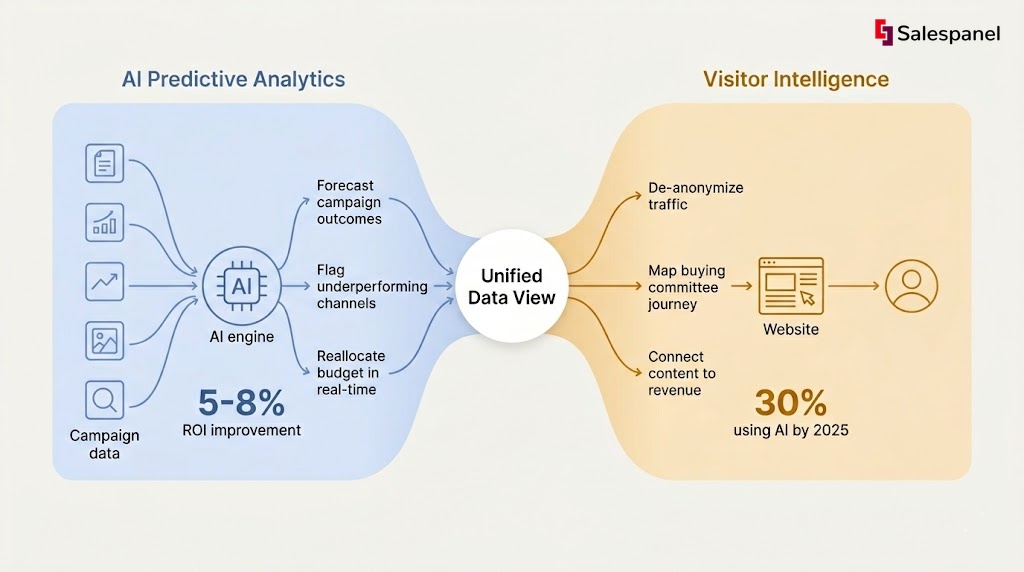
This means you can actually forecast campaign outcomes with a surprising degree of accuracy, allowing you to optimize your ad spend and tweak your strategy in real-time. Instead of waiting weeks to see what worked, these tools can flag underperforming channels and suggest you reallocate your budget on the fly. It’s a total game-changer for maximizing ROI.
It’s catching on fast, too. By 2026, it’s expected that around 30% of businesses will be using AI analytics to sharpen their tracking. And the results speak for themselves—strategies backed by this kind of data intelligence are seeing ROI jump by 5-8% compared to their competitors.
The real power of modern tools isn’t just in measuring what happened; it’s in predicting what will happen next. This shift from reactive analysis to proactive optimization is where top-tier marketing teams create their competitive advantage.
Closing the Attribution Loop with Visitor Intelligence
One of the oldest headaches in B2B marketing has been tying top-of-funnel activities—which are often anonymous—to actual revenue. How do you prove that blog post you wrote three months ago influenced a six-figure deal? This is where specialized tools have become absolutely essential for closing the attribution gap.
Take website visitor tracking from Salespanel, for instance. This kind of tool can identify the anonymous companies visiting your site long before a single person fills out a form. It de-anonymizes that traffic, giving you firmographic data and letting you watch how key accounts interact with your content. By connecting an IP address to a company profile, Salespanel can show that three engineers from a target account read a technical whitepaper before a sales-qualified lead was ever created.
Suddenly, you have the concrete data you need to connect your marketing campaigns directly to revenue.
- Identify High-Intent Accounts: You can pinpoint which of your target companies are actively researching solutions like yours.
- Trace the Full Journey: You can map every single touchpoint for an entire buying committee, from the first blog post they read to the final demo request.
- Attribute Revenue Accurately: You can finally connect that early-stage content engagement to the closed-won deals in your CRM.
When you can link those previously invisible top-of-funnel interactions to the closed-won deals in your CRM, your marketing ROI transforms from a rough estimate into a precise, actionable metric. It’s the kind of clarity that fundamentally changes how you operate.
Calculating Customer Lifetime Value for True ROI
The first sale is just the opening act. If you really want to understand your marketing ROI, you have to look beyond that initial transaction and focus on building profitable, long-term customer relationships. The central theme of truly mature ROI measurement is a shift from acquisition-focused metrics to a holistic view of customer value over time.
This is a massive blind spot in most ROI calculations. They’re obsessed with the first conversion, completely ignoring the full value a customer brings to the table over months or even years. To get the real story, you need to shift your focus to Customer Lifetime Value (CLV).
Beyond the First Transaction
CLV gives you a glimpse into the future. It estimates the total revenue you can expect from a single customer, helping you understand that not all customers are created equal. Some of your marketing channels might reel in customers who make a small first purchase but come back again and again, leading to a massive CLV. Other channels might have a higher upfront Customer Acquisition Cost (CAC) but attract incredibly loyal, high-value clients who more than justify the investment.
Without looking at CLV, you might make a terrible mistake—like cutting the budget for a channel that’s secretly your most profitable one in the long run.
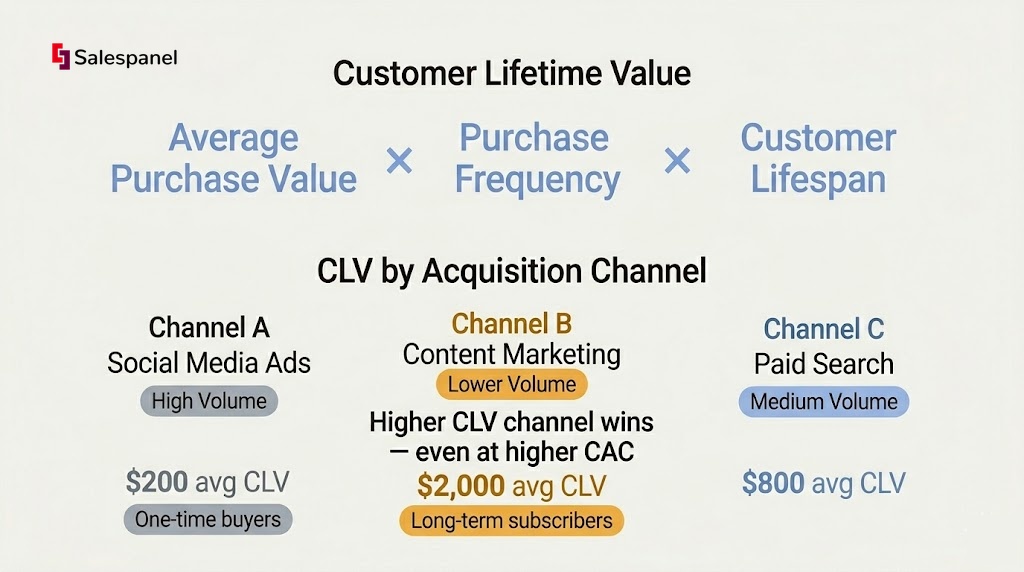
Think about it this way: a cheap social media ad campaign might flood your site with one-time buyers. The immediate ROI looks great on a spreadsheet. But what about a more targeted, and likely more expensive, content marketing strategy? It might bring in fewer customers, but if they become long-term subscribers with a CLV that’s 10 times higher, which campaign was truly more successful? This is a practical validation of why focusing solely on immediate CAC can be misleading.
Understanding CLV transforms your marketing ROI from a simple historical report into a predictive tool for future revenue. It’s about recognizing that the goal isn’t just to acquire customers, but to acquire the right customers.
At its core, the calculation is straightforward: CLV = (Average Purchase Value × Purchase Frequency × Customer Lifespan).
Where it gets really powerful is when you start segmenting this data. By breaking down CLV by region or acquisition channel, you can pinpoint your most valuable markets and confidently allocate your budget where it will have the biggest impact.
When you bring CLV into your analysis, you’re arming yourself with the data needed to make smarter, more profitable decisions. The ultimate takeaway is that marketing is not just a cost center—it’s the primary engine for sustainable, long-term growth.
At Salespanel, our philosophy is that every marketing touchpoint can and should be connected to revenue. We build tools that provide the clarity needed to measure and optimize your true ROI. Explore our resources to build a more data-driven marketing strategy at Salespanel Resources.