
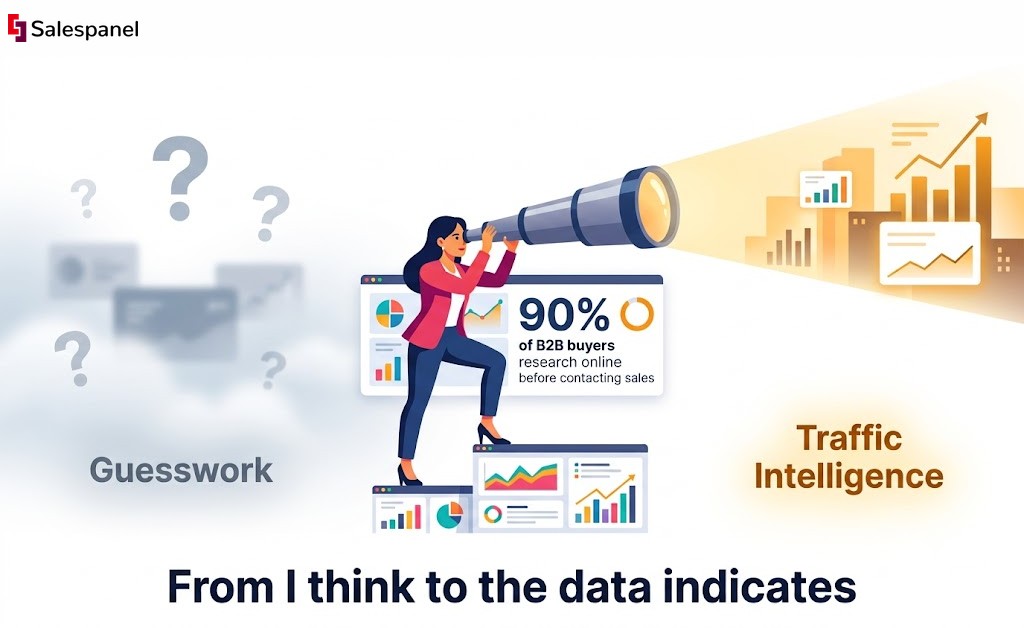
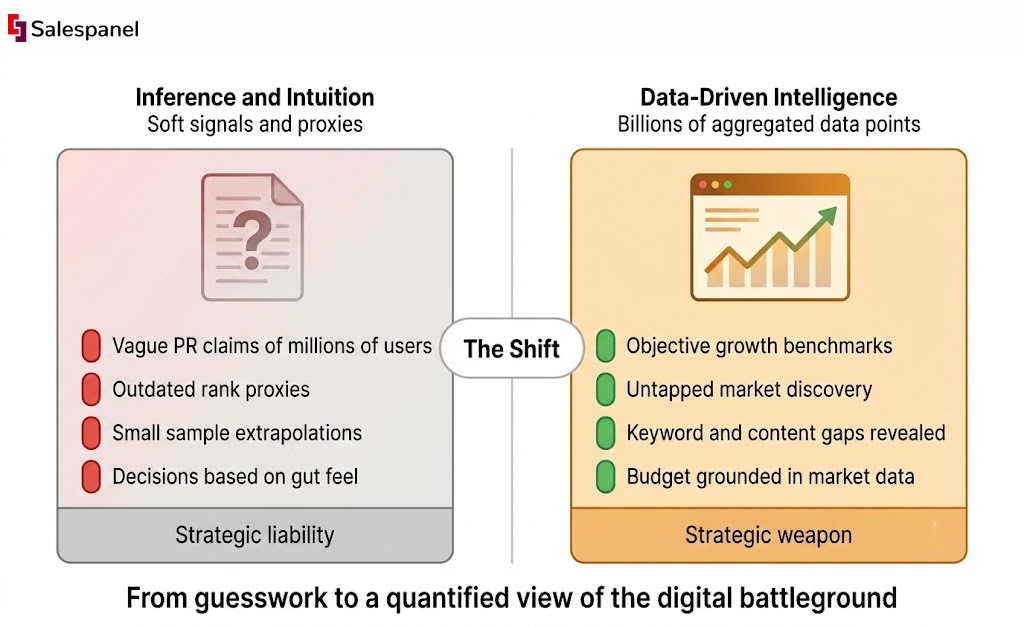
In the not-so-distant past, competitive analysis was an art of inference. Marketers relied on soft signals like Alexa Rank or PR statements about “millions of users,” operating more on intuition than on empirical data. Today, that approach is a strategic liability. The modern digital landscape, where over 90% of B2B buyers conduct online research before ever engaging with sales, demands a shift from guesswork to precision. The central theme of this guide is to move beyond vanity metrics and transform raw traffic data into a strategic weapon.
This transition from estimation to evidence-based intelligence is non-negotiable. We’ve entered an era where platforms like Semrush and Similarweb aggregate billions of data points, offering a quantified view of the digital battleground. This guide provides a technical framework for not only checking competitor website traffic but also for deconstructing their entire digital strategy—turning macro insights into the micro-actions that drive revenue.
Why Eyeballing Competitor Traffic No Longer Works
It wasn’t that long ago that sizing up a competitor’s online presence was fundamentally qualitative. We would analyze backlinks or follow their press releases, but these were proxies, not direct measures of audience engagement. Competitive analysis felt more like an art than a science, but it was the best available methodology.
That model is now obsolete. The B2B buyer’s journey has been completely inverted. Today, buyers complete a significant portion of their research independently online before initiating contact with a salesperson. In this environment, making assumptions about a rival’s digital footprint isn’t just outdated—it’s a critical strategic failure.
The Shift to Data-Driven Intelligence
The era of educated guesses is over. We are now operating in an environment where data-driven traffic intelligence is the baseline for strategic marketing. Modern analytics platforms have fundamentally altered the landscape by processing billions of anonymized data points to render a clear, quantifiable picture of who is winning the digital turf war. The discourse has evolved from “I think…” to “The data indicates…”
For B2B marketers, the implications are profound. It means you can:
- Establish a Baseline: You can finally set an objective benchmark for your own growth. The critical question is no longer, “Are we growing?” but rather, “Is our growth rate exceeding that of our key competitors?”
- Identify Opportunities: Rigorous traffic analysis illuminates untapped markets. For instance, you might discover a competitor is neglecting a valuable long-tail keyword cluster or has a weak digital presence in a geographic region you can strategically penetrate.
- Make Strategic Decisions: Every significant decision, from marketing budget allocation to content development pipelines, can be grounded in empirical market data instead of subjective intuition.
This migration away from unreliable signals is powered by massive data aggregation. Until the early 2010s, most analyses were based on small sample sizes or extrapolations. Now, platforms like Semrush track hundreds of millions of user journeys to estimate traffic for top domains, with monthly updates that capture market dynamics in near real-time. You can find more data about the rise of third-party traffic intelligence and its strategic importance.
Key Takeaway: Competitive traffic analysis is no longer about vanity metrics. It is about deeply understanding market dynamics, reverse-engineering successful strategies, and identifying the specific levers you can manipulate to gain a competitive advantage.
From Macro Insights to Micro Actions
Obtaining a high-level view of the competitive landscape is merely the initial step. While external tools provide a comparative market position, the real strategic advantage emerges when you integrate that macro view with your own first-party data. This is how you close the loop between market intelligence and revenue generation.
For any platform specializing in identity resolution, this synthesis is critical. It’s one thing to know a competitor attracts 50,000 monthly visitors from organic search. It’s an entirely different level of intelligence to know which high-value accounts from that traffic segment are also evaluating your website.
This integrated approach connects otherwise disparate data points. For example, Website Visitor Tracking from Salespanel can identify anonymous companies landing on your pages immediately after they have researched a competitor. Suddenly, broad market analysis transforms into a prioritized list of warm leads. You can focus outreach on prospects who are actively engaged in a comparative evaluation, converting a competitive data report into a direct source of sales pipeline.
Building Your Competitor Analysis Toolkit
Before inputting URLs into traffic estimation platforms, it’s crucial to establish a methodical framework. An effective analysis does not begin with tools; it begins with strategic clarity. Without a structured approach, you will accumulate a collection of interesting—but ultimately unactionable—data points.
The initial step is to map your competitive landscape with precision. This exercise extends beyond simply listing companies you encounter in sales cycles. A robust map categorizes rivals into tiers, each presenting a distinct competitive threat or strategic opportunity.
Defining Your Competitive Landscape
Your analysis should segment competitors into three distinct categories. This classification enables you to focus your analytical resources and fully comprehend the spectrum of market pressures you face.
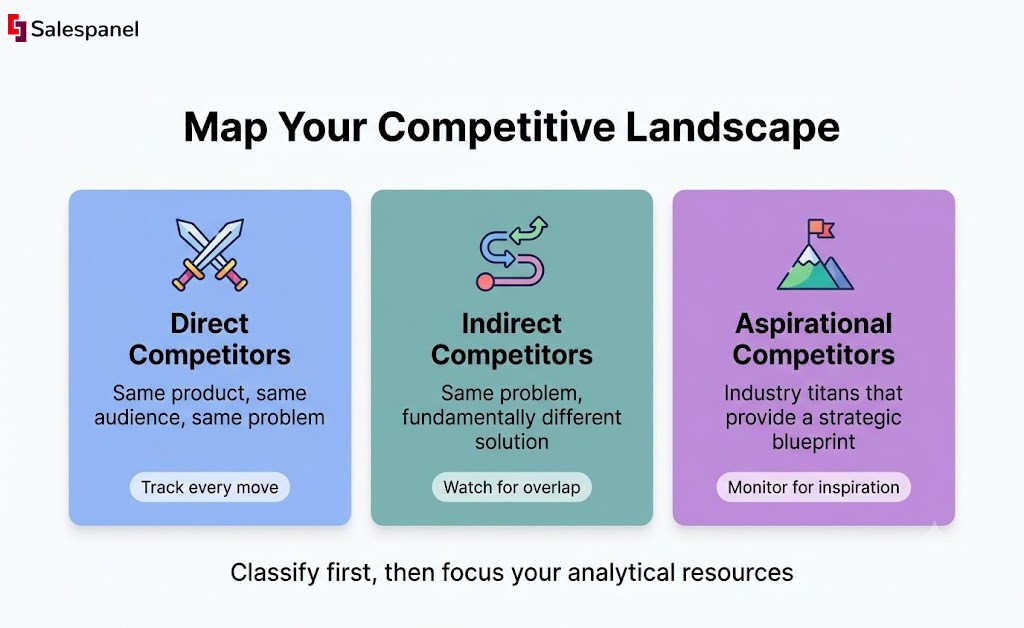
- Direct Competitors: These are the most obvious rivals. They offer a nearly identical product to the same target audience, solving the exact same problem. For a project management SaaS, another PM platform is a direct competitor.
- Indirect Competitors: This category requires more nuanced analysis. These companies solve the same core problem but with a fundamentally different solution. For our PM SaaS example, a collaboration tool like Slack or a workspace platform like Notion could be an indirect competitor, as users often adapt them for project management functions.
- Aspirational Competitors: These are the titans of your industry or an adjacent one. While you may not compete with them for deals today, their strategy, content ecosystem, and market dominance provide a valuable strategic blueprint. For a smaller PM tool, Atlassian would be the aspirational competitor to monitor.
Once you’ve classified your competitors, you can apply a more strategic lens. You will want to track every tactical move of a direct competitor, but for an aspirational one, you might only monitor major content initiatives for strategic inspiration.
Pinpointing the Metrics That Matter
With your targets identified, the next step is to define what you will measure. Raw traffic volume is just the entry point. To gain a true competitive edge, you must focus on metrics that reveal their underlying strategy and its efficacy.
Not all data is equally valuable. Pursuing the wrong metrics leads to a rabbit hole of vanity statistics that do not inform better decision-making. Here are the core metrics that yield deep strategic insights:
- Traffic Sources: The channel mix (organic, paid, direct, referral) is a direct indicator of their customer acquisition model. A practical example: a competitor generating 70% of its traffic from organic search has a mature content engine, whereas another relying on 50% paid traffic is actively buying its market share.
- Top-Performing Content: Identifying the pages that attract the most traffic reveals what resonates with your shared target audience. Are they winning with comprehensive, long-form blog posts, high-converting landing pages, or authoritative pillar pages?
- User Engagement: Metrics such as bounce rate, pages per visit, and average session duration serve as proxies for traffic quality. A high-traffic page with poor engagement metrics signals a misalignment between content and user intent.
- Keyword Positioning: Analyzing the keywords for which they rank—especially those you don’t—provides a roadmap for your SEO strategy. It highlights content gaps that need to be addressed and search intent you can capture.
A successful competitive analysis is defined less by the volume of data collected and more by the quality of the questions asked. Begin by asking, “What strategic decision will this metric help me make?” before initiating data collection.
For a deeper dive into this process, check out this an actionable guide to SEO competitor analysis. It’s a great resource for moving beyond simply checking traffic numbers to strategically deconstructing a competitor’s entire digital playbook. This foundational work sets you up perfectly for choosing the right tools for the job.
Using Key Platforms to Estimate Competitor Traffic
You have mapped your competitive landscape. Now it’s time to deploy the tools that provide visibility into your competitors’ website performance. This is the stage where theory becomes practice, and we begin extracting the data needed to understand the drivers of their digital strategy.
The most reliable method for assessing a competitor’s website traffic is through established third-party platforms. It’s important to be clear: no external tool can match the precision of a site’s own internal Google Analytics. However, for understanding market positioning and obtaining solid directional data, they are indispensable. Think of them less as a precise speedometer and more as a powerful compass guiding your strategy.
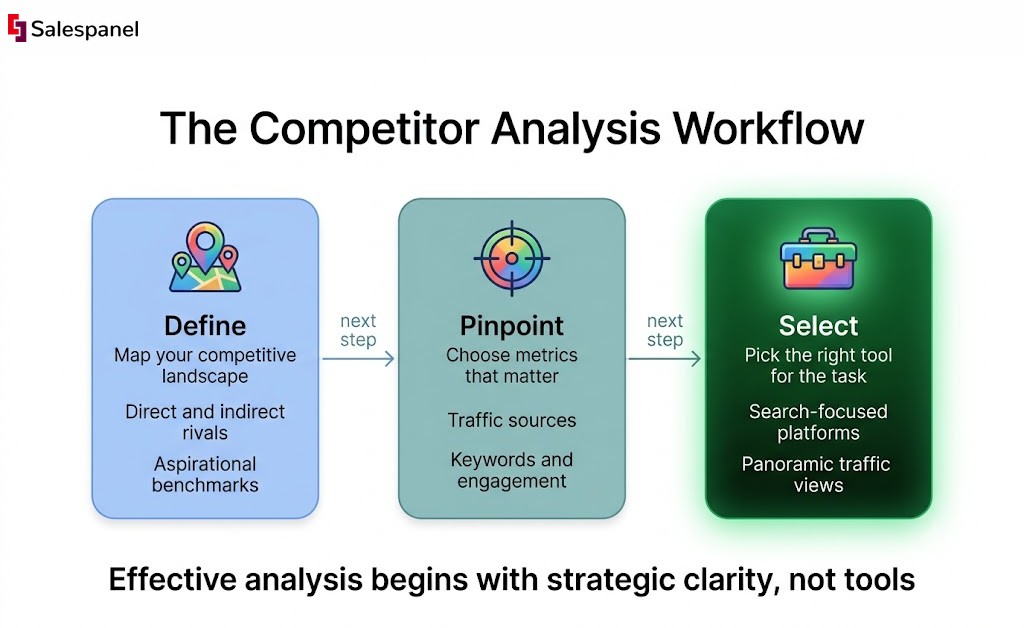
This is the standard workflow I employ for any competitor traffic analysis to ensure the process remains grounded and focused. It’s a simple but effective framework: know who you’re analyzing, decide what metrics are critical, and then select the appropriate tool for the task.
Leveraging the Power of Semrush
When it comes to SEO and competitive intelligence, Semrush is a dominant force. Its primary strength lies in its vast keyword and backlink databases, which it uses to construct some of the most robust traffic estimates available, particularly for organic and paid search channels.
When you input a competitor’s domain into its Traffic Analytics tool, you receive far more than a single traffic number; you get a strategic snapshot.
For a practical example, let’s say a competitor B2B SaaS company registers an estimated 200,000 monthly visits. The raw number is interesting, but the strategic value lies in the breakdown. Semrush allows you to determine if that traffic is concentrated around a few high-value commercial keywords or distributed across thousands of long-tail informational terms.
Another feature I find incredibly valuable for B2B analysis is the traffic segmentation by country. If you discover a competitor is deriving 30% of their traffic from Germany, a market where you have no presence, you have just identified a potential expansion opportunity. It also helps you discern whether their growth stems from a recent, high-spend paid advertising campaign or from a consistent, long-term content marketing strategy.
A common error is to treat the traffic estimate as an absolute figure. It is not. The optimal use is as a reliable index score. Its true value is in tracking trends over time and benchmarking your domain’s performance against your rivals’.
Getting a Broader View with Similarweb
While Semrush excels in search-centric data, Similarweb provides a more panoramic view of a website’s overall traffic. It incorporates direct, referral, and social channels into its estimates, offering a different—but equally valuable—perspective. This is particularly effective for gauging brand equity and the effectiveness of partnership ecosystems.
For instance, running a competitor through Similarweb might reveal that 40% of their traffic is categorized as ‘Direct’. This is a significant signal, indicating strong brand recognition and a loyal customer base that navigates directly to their URL. If another competitor shows high ‘Referral’ traffic, you can drill down to identify the specific domains sending them visitors, potentially uncovering their most valuable affiliate or co-marketing partnerships.
A Quick Look at the Top Tools
The selection of the right tool often depends on your specific analytical objectives and budget. Here is a comparative overview of the leading platforms tailored for B2B marketers.
Comparison of Traffic Analysis Tools for B2B Marketers
| Tool | Data Source Method | Key B2B Features | Relative Accuracy | Best For |
|---|---|---|---|---|
| Semrush | Clickstream data, keyword rank tracking, backlink analysis | Top pages by traffic, keyword gap analysis, paid search ad copy | High for search | Deep SEO & PPC analysis, content strategy reverse-engineering. |
| Similarweb | User panel data, public data sources, direct measurement | Traffic source breakdown (Direct, Referral), audience demographics | High for overall traffic | Understanding brand strength, referral partnerships, and audience makeup. |
| Ahrefs | Keyword rank tracking, massive backlink index, clickstream data | Top pages by traffic share, backlink growth, organic keyword trends | High for organic | Organic traffic estimation, backlink analysis, and content research. |
| Google Trends | Aggregated Google search data | Interest over time for brand names and topics, related queries | Directional for brand | Gauging brand popularity trends and seasonal interest for free. |
Each platform provides a unique analytical lens. Semrush and Ahrefs are my primary choices for SEO-related investigations, while Similarweb offers that crucial, high-level context. Google Trends is an excellent free resource for a quick assessment of brand momentum.
Resourceful Free Methods for Deeper Insights
While paid platforms are indispensable, you can achieve a more textured analysis by supplementing their data with clever, no-cost techniques. This requires more manual effort, but the resulting insights often fill gaps left by automated tools.
- Dissecting XML Sitemaps: Nearly every website maintains a public XML sitemap (typically found at competitor.com/sitemap.xml). This file serves as a literal roadmap of their content architecture. By analyzing it, you can discern how they structure their blog, organize product pages, and prioritize resources—a blueprint of their content strategy.
- Monitoring Social Shares and Press: You don’t always need a paid tool for this. Simple searches on social media or using the free version of a tool like BuzzSumo can reveal which of their articles or pages are generating the most engagement. High share counts and press mentions are strong proxies for what content is resonating with your shared audience.
By combining the powerful data from a tool like Semrush, the broad perspective of Similarweb, and your own manual investigation, you begin to assemble a comprehensive intelligence picture. You move beyond mere numbers to understand the why behind your competitors’ online success.
Decoding Traffic Sources and Top Content
Knowing your competitor’s total traffic volume is a useful starting point, but it’s merely the surface. The real strategic intelligence is derived from understanding where that traffic originates. A company’s traffic source mix is effectively their marketing playbook laid bare—it reveals their strengths, vulnerabilities, and capital allocation priorities.
When you check competitors website traffic, analyzing this channel mix tells a strategic story. Is your rival a well-established brand that users navigate to directly? Or have they engineered an SEO powerhouse that captures thousands of visitors from organic search? Answering these questions transforms raw data into a tangible competitive advantage.
Analyzing the B2B Traffic Source Mix
In the B2B sector, each traffic source carries distinct strategic implications. Examining the balance between them can reveal a great deal about a company’s go-to-market strategy. A robust digital presence is typically characterized by a healthy diversification across these channels.
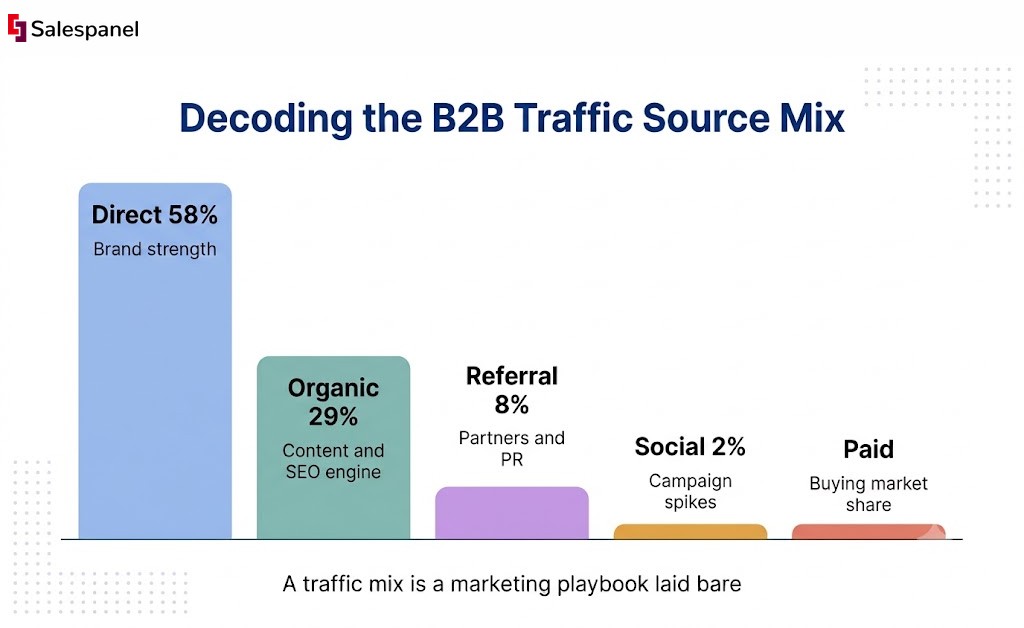
- Direct Traffic: This usually indicates strong brand recognition and customer loyalty. High direct traffic means people are typing the URL straight into their browser—a sign of a mature company or one with a highly effective offline or brand marketing strategy.
- Referral Traffic: A significant proportion of referral traffic suggests a strong network of partners, affiliates, or a successful public relations engine. You can drill down into the specific referring domains to identify their most significant advocates.
- Organic Search: Dominance in organic search implies a sophisticated content marketing and SEO strategy. This traffic is typically high-quality as it originates from users actively searching for solutions that both you and your competitor provide.
- Paid Search: This is a clear indicator of their direct investment in customer acquisition. By analyzing their paid traffic, you can see which keywords they are bidding on and which landing pages they believe have the highest conversion potential.
- Social Traffic: While often a smaller component of the B2B traffic mix, a sudden spike in social traffic can signal a successful campaign on a platform like LinkedIn or a piece of content that has achieved viral reach within a professional niche.
This breakdown provides a much clearer picture of your competitors’ strategic orientation. It helps you decide whether to double down on your own SEO to maintain pace or to exploit a vulnerability, such as their over-reliance on paid advertising.
Pinpointing a Competitor’s Most Valuable Content
Once you understand where their visitors originate, the next logical inquiry is where are they going? Identifying a competitor’s top-performing pages is equivalent to reverse-engineering their content strategy. It shows you precisely what is resonating with your shared audience.
Consider these pages as the primary assets of their marketing operation. A single blog post ranking for a high-intent keyword might be generating thousands of qualified visitors monthly. A comprehensive pillar page could serve as the cornerstone of their entire SEO presence, establishing them as an authority on a critical topic.
By identifying these key assets, you can begin to ask important strategic questions:
- What topics are driving the most traffic for them?
- Which content formats are most effective—long-form guides, case studies, interactive tools?
- Are there discernible content gaps in our strategy that their success highlights?
This is no longer just traffic estimation; it is strategic content intelligence. You’re not just seeing how many visitors they get, but why they get them.
Benchmarking Against Industry Averages
To contextualize your competitor’s channel mix, it is useful to compare it against broader industry benchmarks. Globally, direct traffic remains the largest source, accounting for approximately 58% of visits. This is followed by organic search at 29%, referrals at 8%, and organic social at a distant 2%. It is also critical to note that mobile now constitutes 61.19% of all web traffic. You can explore these website statistics to see how your specific industry compares.
Therefore, if you identify a rival B2B platform generating 50–60% of its traffic from search—significantly above the 29% average—you can confidently conclude they have a strong focus on SEO and content. Conversely, a company with a traffic profile skewed toward direct and referral is likely succeeding based on brand strength and partnerships. This context is what elevates the analysis from observation to insight.
This is the perfect juncture to merge third-party macro data with your own first-party intelligence. While external tools excel at showing which competitors are best at attracting visitors, solutions that provide server-side tracking like Salespanel show you which of those visitors are qualified accounts actually progressing through your pipeline. It’s how you tie competitive insights directly back to revenue.
Turning Competitive Data Into Actionable Strategy
Data, in isolation, is simply noise. You have analyzed your competitors’ traffic, identified their top-performing content, and mapped their keyword strategy. The critical phase is now: translating those insights into a concrete, actionable plan for your own business. This is where you transition from analyst to strategist.
The objective is to move beyond spreadsheets and address the pivotal questions. Are we lagging in organic search visibility? Where are our competitors allocating their advertising spend, and is it yielding results? Have we overlooked a content format that our shared audience is clearly engaging with? Answering these questions requires not just data, but a framework for action.
From Macro Insights to Targeted Action
The true strategic advantage is realized when you connect these high-level market insights with your own first-party data. It is one thing to know a competitor dominates rankings for a high-intent keyword like “enterprise compliance software.” It is a different level of intelligence to know which specific companies searching for that exact term are also visiting your website.
This is where a tool like Website Visitor Tracking from Salespanel becomes invaluable. After identifying a rival’s dominance in a specific search cluster, Salespanel can help you identify the high-value companies that land on your site from those very same searches. This connection transforms a broad competitive finding into a prioritized list of active prospects.
By linking competitive intelligence to your own visitor data, you can prioritize outreach to companies that are actively evaluating you and your competition. You’re no longer guessing at intent; you’re acting on verified buyer behavior.
Building a Strategic Framework
To avoid becoming overwhelmed by data, you need a system to organize your findings and assign clear next steps. A simple framework is sufficient to categorize insights and convert them into a tactical plan. For a more structured approach, developing a comprehensive competitive analysis framework blueprint can be instrumental in guiding your strategic decisions.
Here’s a practical method for structuring your analysis:
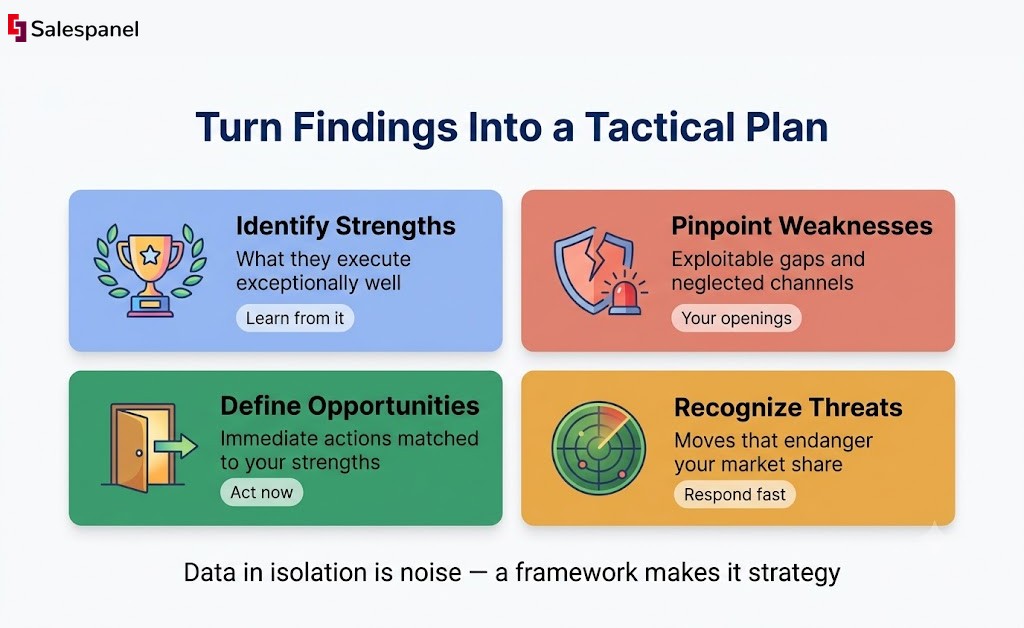
- Identify Strengths: What is your competitor executing exceptionally well? This could be their blog’s extensive organic reach or their high-converting paid landing pages. Document what is effective for them and analyze the underlying reasons.
- Pinpoint Weaknesses: Where are the exploitable gaps? Are they completely neglecting a key social channel? Is their user engagement poor despite high traffic volumes? Their weaknesses represent your strategic openings.
- Define Your Opportunities: Based on their vulnerabilities and your own core competencies, what immediate actions can you take? This could range from creating content around a keyword cluster they have neglected to launching a paid campaign in a geographic region they have overlooked.
- Recognize Threats: What actions are they taking that pose a direct threat to your market share? If a competitor suddenly allocates a massive budget to paid search, that is a clear signal that requires a strategic response.
The Importance of Context in a Crowded Market
In today’s saturated digital ecosystem, this type of traffic benchmarking is not merely beneficial; it is essential. As of 2025, there were over 1.2 billion websites in existence, though only about 15% of them are active. This still leaves approximately 180 million sites competing for audience attention.
For B2B marketing managers, this means when you check a competitor’s website traffic, you’re not just asking, “Are they big?” The more critical question is, “Are they gaining or losing visibility as the market constantly reshuffles?” A rival SaaS product with flat traffic numbers might actually be ceding market share in a rapidly growing segment where new entrants are experiencing double-digit growth. You can dive deeper into these website traffic trends and what they mean for your strategy.
This is why pairing macro trends with specific tool reports from platforms like Semrush or Similarweb is so critical. It allows you to segment competitors by region, traffic source mix, and device share, enabling you to prioritize markets where rivals are either over- or under-performing. This strategic layer transforms simple traffic checking into a sophisticated market analysis, providing the clarity needed to make data-backed decisions that drive growth.
Got Questions? We’ve Got Answers
Once you begin analyzing competitor traffic, a series of practical questions inevitably arises. You may wonder about the reliability of the data, the legal and ethical boundaries, and how to proceed when a tool yields no information.
Let’s address the most common questions we encounter.
How Accurate Are These Traffic Estimation Tools, Really?
Platforms like Semrush and Similarweb employ sophisticated models based on clickstream data from massive user panels. But are they 100% accurate? No. Only the website owner with access to their own Google Analytics dashboard has the definitive, unfiltered numbers.
However, absolute precision is not the primary objective. Their value lies not in providing an exact visitor count down to the individual.
Think of them as a powerful compass, not a GPS. They indicate direction, trends, and the relative scale of one competitor against another.
Focus on the strategic picture: Are they exhibiting month-over-month growth? Did a recent product launch significantly impact traffic? How does their traffic channel mix compare to yours? That is where the actionable intelligence resides. For the most reliable view, always triangulate data from at least two different sources.
Is It Even Legal to Check a Competitor’s Traffic?
Yes, it is entirely legal and ethical. All the methodologies discussed in this guide utilize publicly available information or data derived from anonymized, aggregated user panels.
You are not engaging in unauthorized access to private servers or confidential reports. This is standard, ethical market research, analogous to reviewing a public company’s annual report or analyzing their hiring patterns on LinkedIn.
How Often Should I Be Spying on My Competitors?
For most B2B companies, a comprehensive analysis conducted quarterly strikes the optimal balance. This cadence is frequent enough to detect significant shifts in strategy or market dynamics without getting bogged down by minor, statistically insignificant weekly fluctuations.
However, you may want to increase the frequency to a monthly review if:
- You operate in a highly dynamic industry where market conditions change rapidly.
- You have just launched a major marketing campaign and need to monitor its immediate market impact.
- A new, aggressive competitor has entered your space and requires close observation.
What if a Competitor Shows Zero Traffic in These Tools?
This is a common occurrence. If a competitor does not register in the major traffic estimation tools, it almost always indicates their traffic volume is below the platform’s minimum reporting threshold.
This is typical for very early-stage startups, companies in hyper-niche B2B sectors, or businesses that rely primarily on outbound sales rather than inbound marketing.
When you encounter this, it’s time to shift from a quantitative to a qualitative analysis. Look for other signals of activity:
- Analyze their backlink profile with a tool like Ahrefs to see who is linking to them.
- Examine their social media presence. Is there engagement? What type of content are they promoting?
- Monitor press releases and industry news. Are they generating any market buzz?
Even without hard traffic numbers, you can still construct a reasonably clear intelligence picture of their strategy and market position.
At Salespanel, we believe that understanding the competitive landscape is just the starting point. While third-party tools provide the 10,000-foot view, our platform brings that intelligence down to ground level by identifying the specific high-value accounts visiting your site right now. At Salespanel, our philosophy is to connect broad market data to an actionable sales pipeline.
Ready to connect the dots between market trends and your bottom line?