
Since its inception in 2018, the General Data Protection Regulation (GDPR) has fundamentally re-engineered the digital landscape. It shifted data privacy from a legal footnote to a core business imperative, forcing organizations to be transparent about data collection, secure explicit consent before processing, and provide clear mechanisms for individuals to exercise their rights. This is not a static legal hurdle; it’s the cornerstone of user trust in the digital economy. The evolution is clear: what began as a European directive is now the global benchmark for data privacy.
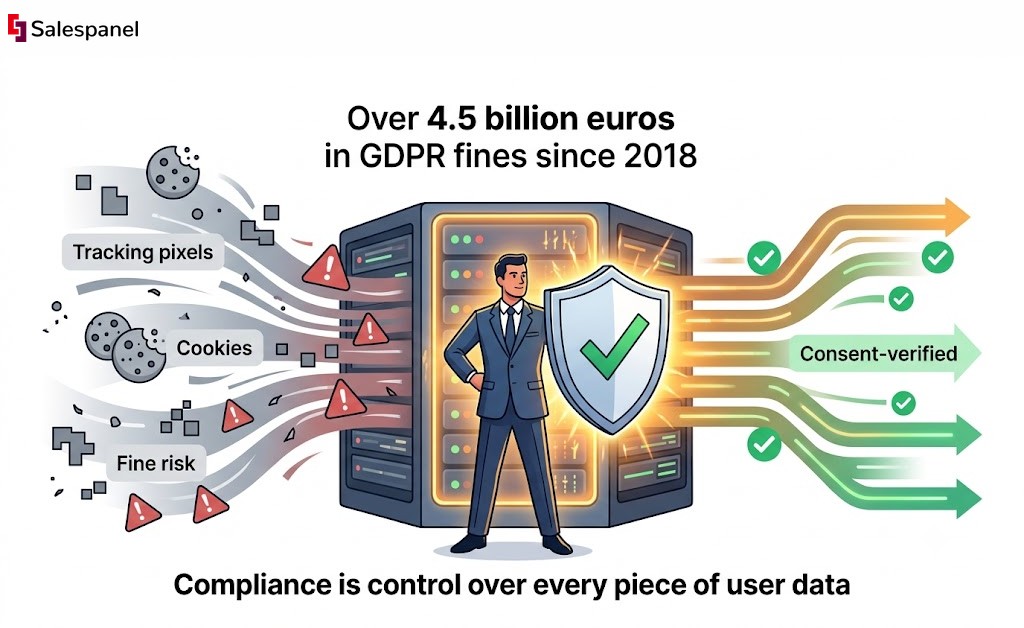
The stakes have never been higher. Since May 2018, EU regulators have levied over €4.5 billion in fines across more than 2,000 enforcement actions, a figure that continues to climb as enforcement intensifies. The financial penalties are just the beginning; non-compliance risks severe reputational damage, loss of customer trust, and disqualification from enterprise sales deals where data governance is a non-negotiable prerequisite. This guide provides an in-depth, technical framework for navigating GDPR compliance, moving beyond superficial fixes to build a robust, defensible, and future-proof data strategy. The central theme is control: achieving auditable, transparent, and verifiable command over every piece of user data from collection to processing.
The High-Stakes World of Website Data Privacy
The era of treating website compliance as a perfunctory item on a launch checklist is over. GDPR has permanently altered the mechanics of data handling, placing every tracking script, analytics pixel, and lead capture form under a regulatory microscope. For B2B marketing and sales operations, this shift has been seismic, demanding a complete re-evaluation of the technologies and processes used to engage prospects and customers.
This is not an abstract legal theory but a tangible financial and operational risk. The numbers paint a stark picture. Fines are escalating, with a Statista-based analysis showing a clear upward trend in both the number and value of penalties. The message from regulators is unequivocal: enforcement is becoming more stringent, and tolerance for non-compliance is diminishing.
The Real Cost of Non-Compliance
The eye-watering fines are just one facet of the risk. A compliance failure can irreparably damage brand reputation, erode customer trust, and serve as a deal-breaker in enterprise procurement processes where data governance is paramount. Consider the intricate data ecosystem of a typical B2B marketing operation, which often includes a mix of third-party tools for analytics, advertising, and lead enrichment.
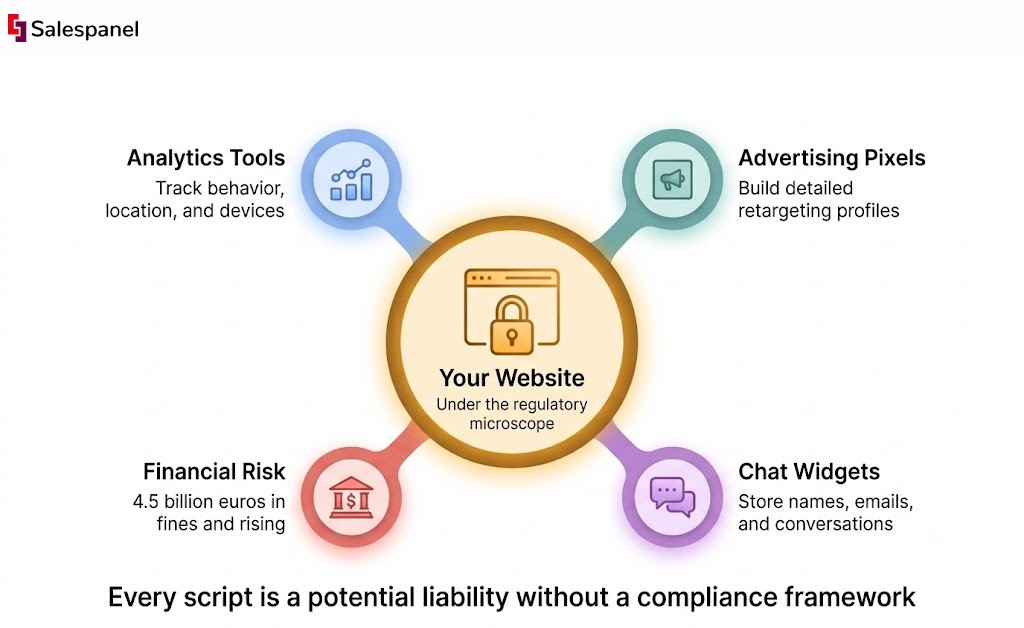
- Analytics Tools: Scripts like Google Analytics track user behavior, geographic location, and device information.
- Advertising Pixels: The LinkedIn Insight Tag, for instance, builds detailed audience profiles for retargeting campaigns.
- Chat Widgets: These tools collect names, email addresses, and complete conversation logs, often storing them on third-party servers.
Without a robust, centralized compliance framework, each of these scripts represents a potential liability, processing personal data unlawfully before valid consent has been obtained. This is the core technical challenge that modern marketing teams must solve.
Moving Beyond Surface-Level Fixes
The only viable strategy is to move beyond superficial, client-side cookie banners that offer a false sense of security. True GDPR compliance for websites requires a deeper, architectural commitment to privacy-by-design. This means shifting towards server-side frameworks where the business—not third-party vendors—maintains ultimate control over the data flow.
The core theme of modern compliance is control. Businesses must build an auditable, transparent, and verifiable trail of consent that dictates how every piece of user data is processed, from initial collection to its final destination.
This architectural shift is critical. As AI becomes more integrated into marketing technology, understanding GDPR compliant AI integration strategies becomes non-negotiable for maintaining compliance. Building a compliant operation is not merely about avoiding fines; it is about future-proofing the entire marketing and sales engine in a global economy that unequivocally prioritizes data privacy.
Laying the Groundwork: Your Foundational Website Data Audit
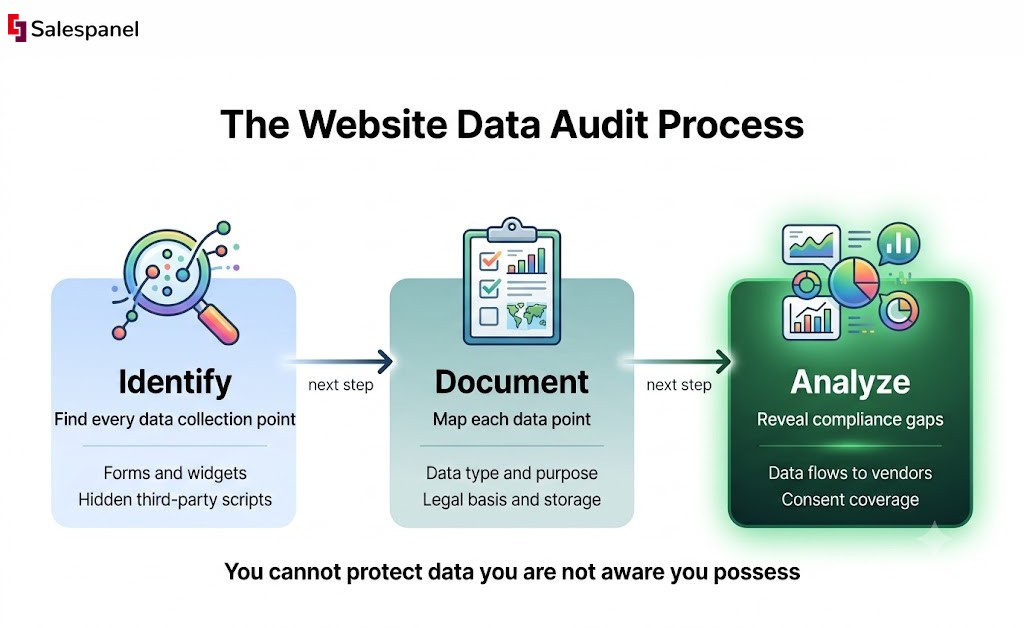
You cannot protect data you are not aware you possess. This fundamental principle is the starting point for any credible GDPR compliance strategy and, critically, where many organizations falter. A foundational website data audit is not an abstract legal exercise; it is a meticulous, technical investigation into every data ingress and egress point across your digital properties. This audit serves as the blueprint for your entire compliance framework, identifying every piece of personal information your website collects, processes, or shares.
The objective extends far beyond obvious collection points like contact forms. The most significant compliance risks often originate from covert trackers and third-party scripts operating in the background. A comprehensive audit illuminates these hidden data flows, producing a complete inventory of every data point. Without this granular map, any privacy policy or consent mechanism is based on guesswork, not fact.
Mapping Every Single Point of Data Collection
The initial phase requires a systematic process to identify and document every mechanism that gathers personal data. This involves both manual inspection of your website’s front-end and the use of technical tools to scan for third-party scripts, pixels, and API calls. A common error is to focus exclusively on first-party data collection while ignoring the vast amount of data being exfiltrated to external vendors.
For each identified data point, your documentation must include:
- Data Type: Be specific. Is it a name, email address, IP address, device ID, cookie identifier, or browsing history?
- Collection Point: Where is the data captured? A specific form field, a live chat widget, or an analytics script that executes on every page?
- Purpose of Processing: Articulate the precise reason for collection. “Marketing” is insufficient. “To deliver a monthly product update newsletter” or “to construct a retargeting audience on LinkedIn for users who visited the pricing page” provides the necessary clarity.
- Legal Basis: Under GDPR, what is your legal justification? For most marketing activities, this will be either consent or legitimate interest.
- Data Storage Location: Specify the system where the data resides—your CRM, a cloud database, a third-party analytics platform, etc.
- Third-Party Sharing: List every vendor that receives this data, from email service providers to analytics and advertising platforms.
A Real-World Audit for a B2B SaaS Website
To make this practical, consider a typical B2B SaaS website. The marketing team utilizes several tools for lead generation and qualification. When asked, they might identify only their “Contact Us” and “Demo Request” forms as data collection mechanisms. A technical audit, however, will invariably reveal a more complex reality.
A thorough data audit is an act of discovery. It forces you to confront the reality of your data ecosystem, often revealing legacy scripts and forgotten vendor integrations that pose a significant compliance risk.
Using browser developer tools and tag management scanners, the audit would quickly identify other active scripts: a Google Analytics pixel for performance measurement, a LinkedIn Insight Tag for advertising campaigns, and a script from a marketing automation platform. Each of these is collecting and processing personal data—including IP addresses and cookie identifiers—often before a user has granted consent. This constitutes a significant compliance gap.
The resulting data map from this audit would be highly detailed. It would specify, for example, that the marketing automation script collects browsing behavior to enrich lead profiles and that the legal basis for this processing is consent. This level of granularity is not optional; it is a prerequisite for achieving genuine GDPR compliance for websites. It provides the necessary clarity to architect a granular consent management system that empowers users and ensures your operations are defensible under regulatory scrutiny.
Implementing Robust Consent and Tracking Governance
Let’s be blunt: consent is the absolute heart of GDPR, but it’s also where most websites get it wrong. That passive, informational “cookie banner” with a single “Accept” button? It’s not just outdated; it’s a compliance risk waiting to happen.
Real GDPR compliance demands an active, granular, and fully auditable framework. It’s all about giving users genuine control over their data before any non-essential trackers or scripts fire. This principle is called prior consent, and it’s non-negotiable.
The strange thing is, even years after GDPR became law, many businesses are still playing catch-up. A Statista-based analysis found that by 2023, only 53% of companies felt they were fully prepared. The situation is even more surprising in the US, home to many martech vendors, where a staggering 91% of businesses legally required to comply were still unprepared in late 2022.
This gap between the rules and reality is a huge liability. Regulators are actively targeting websites that load tracking scripts before getting explicit user consent. It’s an easy violation to spot and a clear sign that a company doesn’t grasp the fundamentals of the law.
The Shift from Client-Side to Server-Side Control
For years, consent was managed almost entirely on the client side—that is, in the user’s browser. A Consent Management Platform (CMP) would use JavaScript to try and block third-party scripts based on the user’s choices. While it was better than nothing, the approach is fragile.
Browser-level blocking can be bypassed by sophisticated trackers, misconfigured scripts, or even browser updates, leading to accidental data leakage. It’s like putting a chain lock on a bank vault.
A much more secure architecture moves this control to the server. With a server-side model, your website sends data to your own secure server first. From this central hub, you decide exactly what information gets forwarded to third-party tools like Google Analytics or your CRM, but only after confirming the user’s consent status.
Takeaway: Server-side tracking turns consent from a flimsy browser-level suggestion into an enforceable server-level rule. It creates a single, auditable chokepoint for all outbound data, guaranteeing no personal data is shared without a valid legal basis.
The first step in governing your data is understanding what data you have. This audit process is foundational to building any effective consent strategy. This methodical approach of identifying, documenting, and analyzing your data flows is essential before you can properly manage consent for them.
Practical Implementation of a Compliant Framework
Building a genuinely robust consent and tracking system is more than just installing a plugin. It’s about architecting your data flows with privacy as the default setting.
Core Components of a Modern Consent Framework:
- Granular Choices: Your consent pop-up needs to let users opt in to specific purposes (e.g., “Analytics,” “Marketing,” “Personalization”). A simple “Accept All” isn’t enough; the option to “Reject All” must be just as easy to find and click.
- Zero-Load on Entry: This is critical. No non-essential tracking scripts, pixels, or cookies should load before the user explicitly opts in. The default state must always be “opt-out.”
- Auditable Consent Logs: You must keep a secure, unchangeable record of every consent action. This log needs to show who consented, when, to what, and how they did it.
- Easy Withdrawal: Users must be able to change or withdraw their consent at any time. The process has to be as simple as giving it in the first place, usually through a persistent link or icon on your site.
Client-Side vs Server-Side Consent Management
The technical approach you choose for managing consent has major implications for your compliance posture. Traditional client-side scripts operate in the user’s browser, which can be unreliable. A modern server-side approach, however, enforces consent rules before data ever leaves your control.
Here’s a look at how the two stack up:
| Feature | Client-Side Consent | Server-Side Consent |
|---|---|---|
| Enforcement Point | In the user’s browser (via JavaScript). | On your own server, acting as a gateway. |
| Reliability | Prone to errors from ad blockers, browser settings, script conflicts, and tracker workarounds. | Highly reliable. Creates a single, controlled chokepoint for all outbound data, immune to browser issues. |
| Data Leakage Risk | High. Misconfigurations or blocked scripts failing can lead to unauthorized data sharing with third parties. | Low. Data is held on your server until consent is verified, preventing accidental leakage. |
| Auditing & Control | More difficult to audit centrally. Relies on the client-side environment behaving as expected. | Centralized and easily auditable. You have a definitive log of what data was sent where, and on what legal basis. |
| Compliance Guarantee | Offers a “best effort” approach but can’t provide a foolproof guarantee against unauthorized data processing. | Provides a technical guarantee that consent preferences are honored before any data is forwarded to vendors. |
| Performance Impact | Can be heavy, as it often involves loading multiple scripts to manage other scripts, potentially slowing the site. | Minimal impact on the user’s browser, as the heavy lifting is done on the server. |
Ultimately, a server-side framework provides a much stronger technical safeguard, making compliance a systematic part of your infrastructure rather than a browser-dependent feature.
This is exactly the kind of control that a platform like Salespanel provides. Its server-side architecture captures visitor data and processes it on your server first. This allows you to enforce your privacy policies centrally, ensuring data only goes to third-party tools if a valid consent record exists for that user and purpose.
This approach moves GDPR compliance for websites from a reactive, browser-based hope to a proactive, server-enforced guarantee.
Managing Third-Party Vendors and Data Transfers
Here’s a hard truth: your website’s GDPR compliance is only as solid as your weakest link. More often than not, that weak link is a third-party script running silently in the background.
Every single analytics tool, advertising pixel, chat widget, and embedded form is a potential data processor. Under GDPR, you are on the hook for what they do with your users’ data. This shared responsibility means you can’t just install a tool and forget about it; vendor governance has to be a core part of your compliance strategy.
The stakes are getting higher. As of 2025, a staggering 71% of organizations said that managing cross-border data transfers was their number one regulatory headache. At the same time, roughly 63% of global data breaches in 2024 were traced back to third-party providers. This reality is forcing everyone to take a much closer look at the vendor code running on their sites.
Vetting Your Vendors and Requiring DPAs
Before you even think about adding a new tool to your marketing stack, you need to do your homework. This means a thorough due diligence process where you scrutinize each vendor’s privacy posture, how they handle data, and what legal safeguards they have in place.
This isn’t just a box-ticking exercise. It’s a foundational step to protect your business and your users. When you’re looking to integrate an external service, you absolutely have to determine if a service like SurveyMonkey is GDPR compliant, because their compliance status directly affects your own.
Here’s a quick vetting checklist I always use:
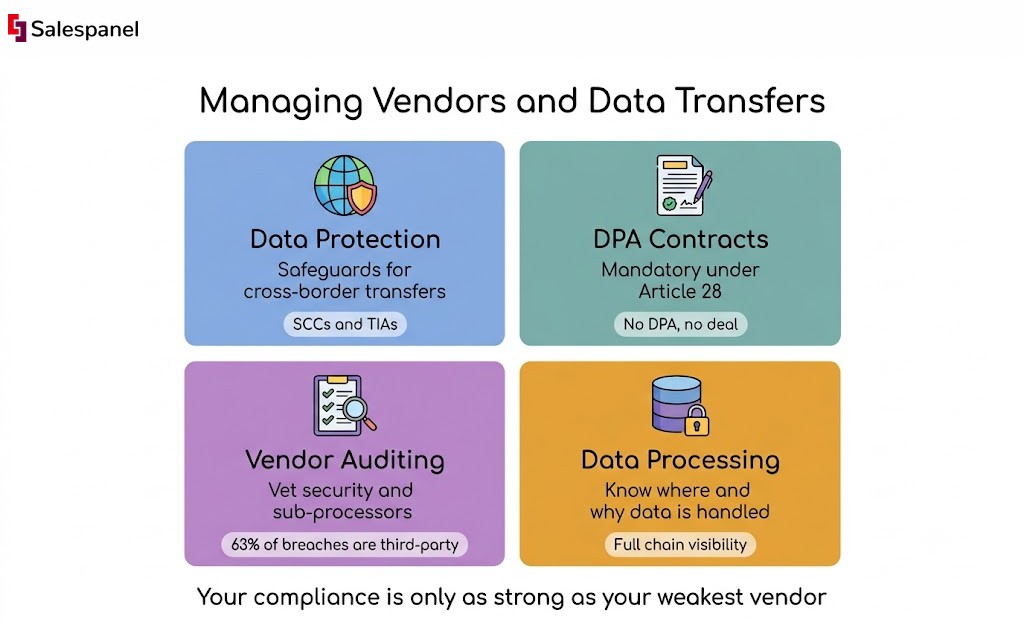
- Data Processing Location: Where will they store and process personal data? If it’s outside the EU, what’s their legal basis for the transfer?
- Security Certifications: Do they have recognized certifications like ISO 27001 or SOC 2? This shows they take security seriously.
- Sub-Processor Transparency: Can they give you a clear, up-to-date list of their vendors (sub-processors)? You need to know the entire chain.
- Data Breach Notification Process: What’s their plan if they get breached? How quickly will they tell you?
If a vendor makes it through this initial screening, the next step is a deal-breaker: you must have a signed Data Processing Agreement (DPA). A DPA is a legally binding contract that clearly lays out the rules for processing personal data.
A DPA isn’t a “nice-to-have.” It’s a mandatory legal requirement under Article 28 of the GDPR. Without a valid DPA with every single third-party data processor, your website is simply not compliant.
The Challenge of EU-US Data Transfers
One of the trickiest parts of vendor management is international data transfers, especially to the United States. The legal ground here has been shaky for years, with the Privacy Shield framework getting thrown out in 2020. While the new EU-U.S. Data Privacy Framework offers a path forward, relying on US-based vendors still brings major compliance hurdles.
The heart of the problem is the potential for US government surveillance programs to access EU citizens’ data, something EU courts have repeatedly said clashes with GDPR’s fundamental rights.
Let’s walk through a common scenario. Imagine a B2B marketing team is excited about a new AI-powered analytics tool hosted on US servers. Their due diligence can’t just be about features and pricing. They must verify if the vendor is part of the Data Privacy Framework or if they’re using Standard Contractual Clauses (SCCs) paired with a Transfer Impact Assessment (TIA). This is the only way to ensure the data is properly protected.
A Practical Due Diligence Scenario
Let’s stick with that AI analytics tool. Here’s a simplified workflow for how you’d vet them:
- Initial Vetting: First, read their privacy policy and DPA. Check that they explicitly mention GDPR and their commitment to it.
- Data Transfer Mechanism: Pinpoint their legal basis for moving data from the EU to the US. Is it the Data Privacy Framework? SCCs? Get it in writing.
- Security Review: Send them a straightforward security questionnaire. Ask about encryption, access controls, and their breach response plan.
- Contractual Agreement: Make sure the DPA is signed before a single byte of personal data is processed. No DPA, no deal.
Following a process like this ensures you stay in control of your data, even when it’s handled by someone else. At the end of the day, solid vendor management is the bedrock of any sustainable GDPR compliance for websites. It turns compliance from a dreaded checklist into a robust, ongoing governance program.
Let’s be honest: GDPR compliance isn’t a “one and done” project you can check off a list. It’s a living, breathing part of your daily operations. And nowhere is that more obvious than when you have to handle a Data Subject Access Request (DSAR). This is where the rubber really meets the road, testing both your policies and your tech stack.
Under GDPR, the people whose data you hold have some serious rights, and it’s your legal duty to make it easy for them to exercise those rights. These aren’t just abstract legal ideas; they’re concrete demands any EU individual can make at any time. You absolutely must have a clear, documented, and well-rehearsed process for receiving, validating, and responding to these requests within the strict one-month deadline. Dropping the ball here is a direct violation and a fast track to getting a complaint filed against you.
The Core Rights Your Website Must Support
When a DSAR lands in your inbox, it’s typically a request for one of the fundamental rights granted by GDPR. Your operational plan needs to be ready to handle each one without breaking a sweat.
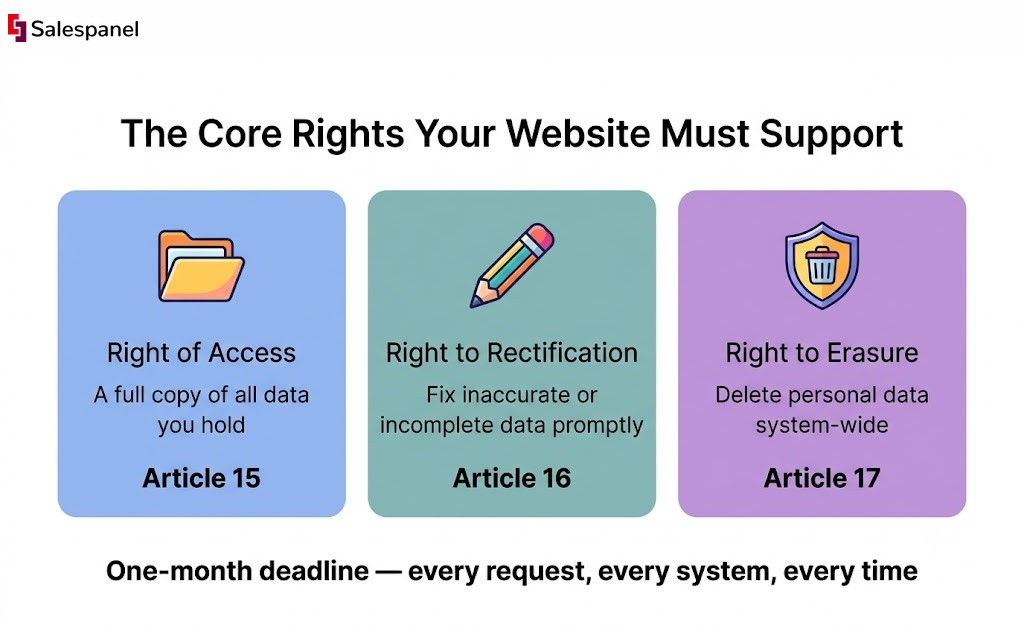
- The Right of Access (Article 15): The user wants a full copy of every piece of personal data you have on them. They’ll also want to know why you have it, who you’ve shared it with, and how long you’re keeping it.
- The Right to Rectification (Article 16): If a user spots something inaccurate or incomplete in the data you hold, they can demand you fix it, and you have to do it promptly.
- The Right to Erasure or ‘Right to be Forgotten’ (Article 17): This is a big one. A user can ask you to delete their personal data. It’s not an absolute right—there are some exceptions for legal obligations—but it’s a common request that demands a thorough, system-wide response.
Trying to manage these requests manually is a recipe for disaster. Imagine a marketer gets an erasure request. They might delete the contact from the CRM, but what about the analytics platform? The email marketing tool? The custom audiences in your ad platforms? Forgetting even one of these makes the deletion incomplete, and that’s a compliance failure, plain and simple.
Building a Compliant DSAR Workflow
A solid DSAR workflow is your best defense against chaos. It turns a potential fire drill into a systematic, repeatable, and auditable process. Here’s what that looks like in practice.
- Intake and Verification: First, you need a clear, easy-to-find way for people to submit requests. A dedicated email address or a simple form on your privacy page works perfectly. Once a request comes in, your first job is to reasonably verify the person’s identity. You can’t just hand over data to anyone who asks.
- Logging and Tracking: Every single request needs to be logged in a central register. Track the date you received it, what was asked for, how you verified the identity, the key steps you took internally, and the date you sent the final response. This log is your proof that you’re taking this seriously.
- Data Retrieval and Compilation: Here’s where things get technically tricky. You need a process to hunt down and gather all of the individual’s personal data from every single system you use—from your website’s database to every third-party vendor.
- Review and Response: With all the data collected, review it and package it up for the user in a common, machine-readable format like JSON or CSV. If it’s a deletion request, you have to ensure the data is permanently wiped and then circle back to the user to confirm you’ve done it.
One of the biggest mistakes I see companies make is underestimating just how hard it is to find every shred of a user’s data. Without a unified view of your data, a single DSAR can kick off a frantic, week-long scavenger hunt across dozens of disconnected tools, putting that 30-day response deadline in serious jeopardy.
The Necessity of Impeccable Record-Keeping
Beyond just handling requests, GDPR demands you keep meticulous, auditable records of all your data processing activities. This isn’t just about your DSAR log; it’s about your records of consent, too. If a regulator ever asks you to prove you had a legal basis to process someone’s data, you’d better be able to produce a timestamped, unchangeable record of the exact consent they gave you.
This is where having a centralized data infrastructure goes from a “nice-to-have” to an absolute necessity. When your tools are all siloed, it’s virtually impossible to maintain a single source of truth for user consent and data. For instance, Salespanel for website visitor tracking brings visitor data, interaction histories, and consent logs together into one unified profile. When a DSAR comes in, your team isn’t scrambling to piece together a puzzle from ten different boxes. They can pull up a comprehensive record for that individual in one place, making the whole retrieval and erasure process dramatically simpler and faster.
Got Questions About GDPR Website Compliance? We’ve Got Answers.
Even with the rulebook in hand, GDPR compliance can feel like navigating a maze. Marketers, web developers, and founders often get tripped up by the same practical questions. Let’s clear the air on some of the most common sticking points we see when it comes to getting websites fully compliant.
Does GDPR Apply to My B2B Website If We’re Based Outside the EU?
Yes, almost certainly. This is one of the biggest misconceptions about GDPR. The regulation has what’s called extraterritorial scope, meaning its rules stretch far beyond the EU’s physical borders. It’s designed to protect the data of people inside the EU, no matter where the company handling that data is located.
If your website offers goods or services to people in the EU or monitors their behavior, you’re on the hook. For a B2B site, this is an easy bar to clear:
- Offering Services: Have a contact form, a demo request, or a pricing page? If someone from the EU can access it, you’re likely “offering services” to them.
- Monitoring Behavior: This one is even broader. If you use any analytics or advertising trackers—think Google Analytics or a LinkedIn Insight Tag—to gather data on visitors from EU countries, you’re officially “monitoring their behavior.”
The bottom line? Your company’s location doesn’t matter; your visitor’s location does. If you get any traffic from the EU, you need a GDPR game plan.
What’s the Real Difference Between a Cookie Banner and a CMP?
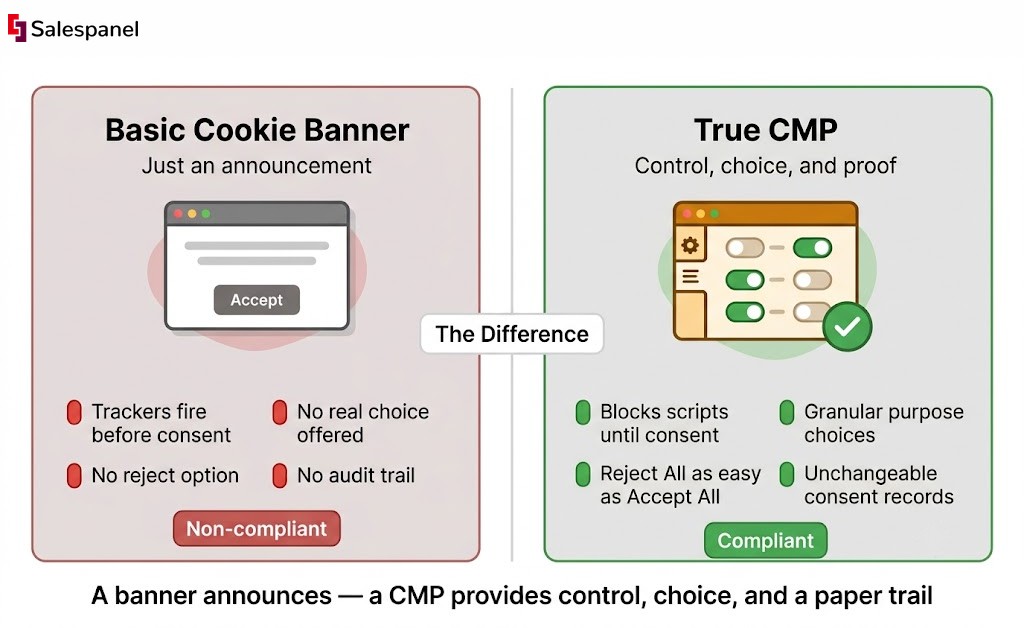
This is a huge one, and a mistake that could land you in hot water. A simple banner that just says, “We use cookies, click OK to accept,” is not GDPR-compliant. Not even close. It fails the test for valid consent because it doesn’t offer a real choice.
A true Consent Management Platform (CMP) is a sophisticated tool that handles several non-negotiable tasks:
- Blocks First, Asks Later: It must prevent all non-essential scripts and trackers from loading until a user has given clear, affirmative consent.
- Offers Granular Control: Users need the ability to pick and choose. They should be able to approve “Analytics” while rejecting “Marketing.” Critically, an “Accept All” button must have an equally prominent “Reject All” counterpart.
- Makes Withdrawing Easy: Taking back consent has to be just as simple as giving it. A user should be able to pull up their preferences anytime via an easy-to-find link or icon.
- Keeps Detailed Records: A compliant CMP maintains a secure, unchangeable audit trail of every consent action—what was chosen, when it happened—to prove you’re following the rules.
A simple banner is just an announcement. A real CMP provides control, choice, and a paper trail. That’s what GDPR demands.
How Does Server-Side Tracking Actually Help with GDPR?
Server-side tracking gives you a massive advantage for GDPR compliance by putting you firmly in the driver’s seat. It creates a powerful control point between your user’s browser and all your third-party tools.
With traditional client-side tracking, scripts from Google, Meta, and dozens of others run wild in the user’s browser. This often means data gets sent out before you can properly manage consent, creating a huge risk of accidental data breaches.
In a server-side setup, your website sends a single, clean data stream to your own server first. From that central hub, you have total control. Your server looks at the user’s consent status and then decides precisely what data, if any, gets forwarded to your marketing and analytics tools. This model stops unauthorized data sharing cold, makes your site less dependent on vulnerable third-party cookies, and gives you one single place to enforce your privacy rules before any data ever leaves your control.
What Are the Most Common GDPR Mistakes Websites Are Still Making?
Years after GDPR became law, we still see the same basic errors pop up again and again. Here are the most common—and riskiest—mistakes:
- Using Pre-Ticked Consent Boxes: Consent must be an active choice. Pre-checking boxes on your forms for newsletters or marketing permissions is a definite no-go.
- Loading Trackers Before Consent: This is a cardinal sin of GDPR. Firing your analytics or ad scripts the second a page loads—before the user has even seen the consent banner—is a direct violation of the “prior consent” rule.
- Hiding the Privacy Policy (Or Making It Unreadable): Your privacy notice needs to be easy to find and written in plain English. It must spell out exactly what data you collect, why you collect it, and the legal basis for doing so.
- Making It a Pain to Withdraw Consent: Burying the option to change consent settings in some obscure footer menu or behind multiple clicks is a classic “dark pattern” that regulators frown upon.
- Forgetting Vendor Contracts (DPAs): This is non-negotiable. You must have a signed Data Processing Agreement (DPA) with every single third-party vendor that processes personal data for you, from your email provider to your CRM.
At Salespanel, our philosophy is that you don’t have to choose between strong data privacy and effective marketing. Our server-side tracking and consent management solutions are architected to provide the control and confidence necessary for a fully compliant, future-proof marketing engine. Explore our resources to learn more about building a privacy-first strategy that works.