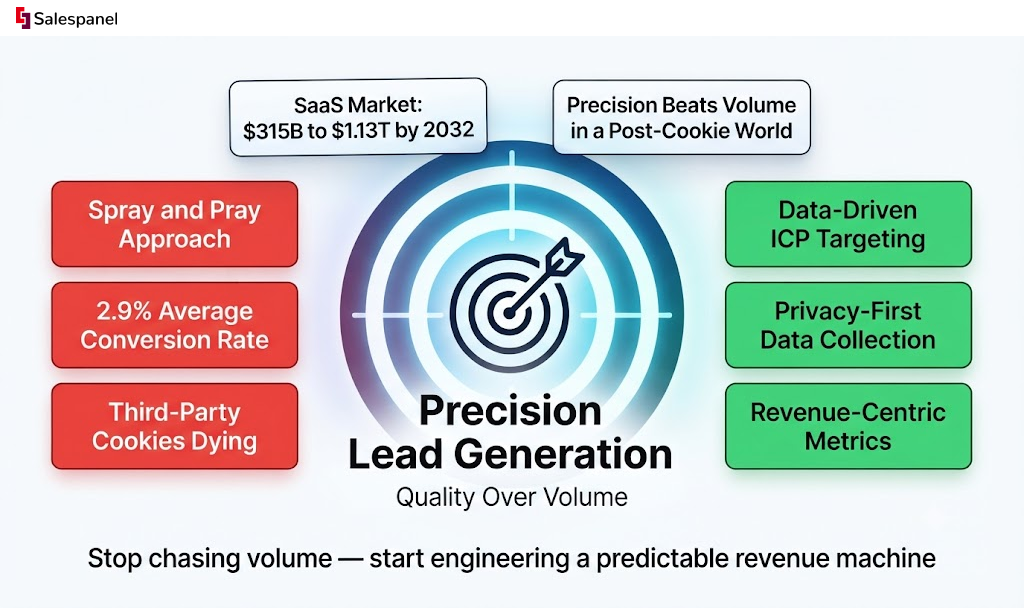
The playbook for SaaS lead generation has been rewritten. Just a few years ago, success was measured in volume, driven by third-party cookies and a “spray and pray” approach that bloated sales pipelines. That era is over. Today, in a market projected to surge from $315.68 billion in 2025 to over $1.13 trillion by 2032, the only way to win is through precision, privacy, and quality. With the average B2B conversion rate hovering at a dismal 2.9%, it’s technically and financially unviable to operate on outdated models. This guide provides the modern framework for building a predictable revenue machine, detailing how to find, engage, and convert high-value prospects in a post-cookie world. Reading this is essential for survival and growth.
The New Rules of SaaS Lead Generation
The rapid expansion of the SaaS market brings ferocious competition, rendering obsolete the lead generation tactics of the past. When premium SaaS products often see conversion rates even lower than the industry average, it becomes evident that volume-based strategies are a recipe for burning capital. A quick look at key SaaS marketing metrics will likely validate this reality against your own benchmarks.
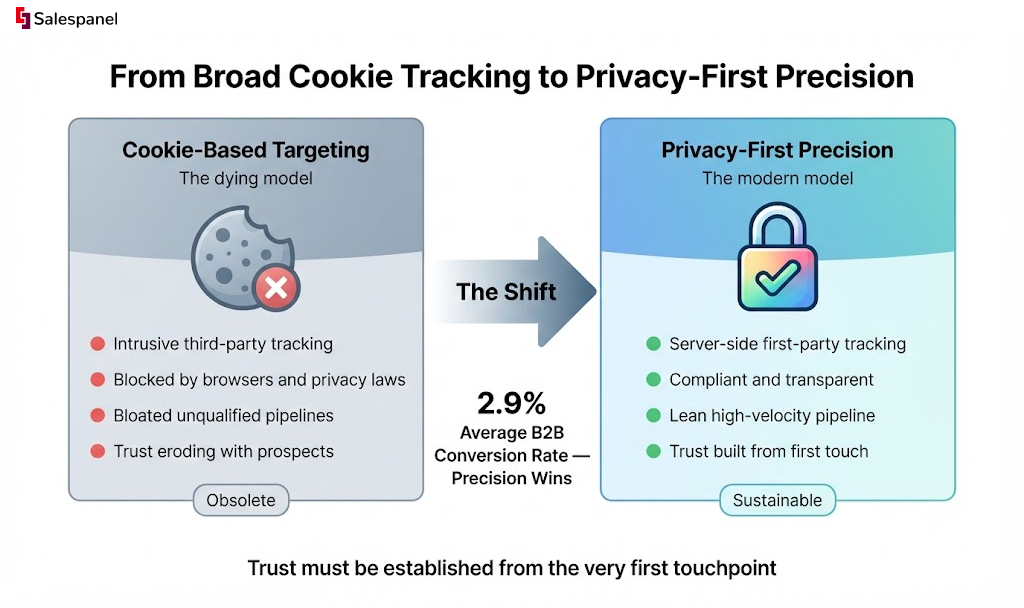
Yesterday’s growth engine was fueled by a high-quantity, low-quality mentality. Marketers obsessed over maximizing lead volume, leaning heavily on intrusive tracking methods that are now being systematically dismantled by privacy legislation like GDPR and browser updates from Apple and Google. This scattergun approach resulted in bloated sales pipelines filled with unqualified prospects, wasting both marketing budgets and the valuable time of sales representatives.
From Volume to Value
The future of lead generation for SaaS is surgical. It demands a deep, technical understanding of your Ideal Customer Profile (ICP) and a precise mapping of their buying journey. Instead of casting a wide, inefficient net, the most successful SaaS companies are architecting resilient, privacy-first growth engines laser-focused on attracting and converting their absolute best-fit customers. The central theme of this modern approach is this: build a system that predictably attracts high-value prospects you can convert efficiently.
This isn’t merely a strategic tweak; it is a fundamental operational shift:
- Quality over Quantity: The focus must shift from the total number of leads to the acquisition of leads with a high probability of converting into profitable, long-term customers.
- Privacy-First Data Collection: Trust must be established from the initial touchpoint. This requires implementing compliant and transparent data practices, such as server-side tracking, to understand visitor behavior without invasive methods.
- Precision Targeting: Leverage first-party data to create hyper-relevant marketing campaigns that directly address the specific pain points and use cases of defined audience segments.
- Revenue-Centric Metrics: Discard vanity metrics like raw website traffic. The only numbers that matter are KPIs that directly correlate to revenue, primarily Customer Acquisition Cost (CAC) and Lifetime Value (LTV).
The core idea behind modern SaaS lead generation is simple but powerful: build a system that predictably attracts high-value prospects you can convert efficiently. This guide is your playbook to get it done.
The shift in focus is undeniable. What was valued just a few years ago is quickly becoming obsolete, replaced by a more strategic, sustainable, and technically sound approach.
Key SaaS Lead Generation Metrics Then vs Now
| Metric Focus | Traditional Approach (Past) | Modern Approach (Future) |
|---|---|---|
| Lead Goal | High Volume (MQLs) | High Quality (SQLs, PQLs) |
| Data Source | Third-Party Cookies | First-Party & Zero-Party Data |
| Primary KPI | Cost Per Lead (CPL) | Customer Acquisition Cost (CAC) & LTV |
| Targeting | Broad, Demographic-Based | Precise, Behavior & Intent-Based (ICP) |
| Privacy | Afterthought / Reactive | Foundational / Proactive |
| Sales Pipeline | Bloated, Low Conversion | Lean, High-Velocity Conversion |
This table captures the technical and strategic evolution—we’re moving from a broad, often intrusive model to a sharp, respectful, and ultimately more profitable one. The central takeaway is that efficiency and quality are the new pillars of growth.
A New Strategic Imperative
The entire purpose of this guide is to help you engineer a predictable revenue machine. This isn’t just about getting more leads; it’s about acquiring the right leads and implementing the systems required to nurture them into customers.
We will begin with the fundamentals, such as defining a data-driven ICP, and progress to advanced tactical execution across organic, paid, and partnership channels. You will walk away with a clear plan to implement the technical infrastructure needed for a privacy-first world, ensuring your growth is both sustainable and built to scale.
Defining Your Ideal Customer to Guide Your Strategy
Before executing any campaign, it is critical to define who you are selling to. This is the foundational layer of the entire strategy. Powerful lead generation for SaaS is not a numbers game about attracting everyone; it is a precision game about attracting the right one.
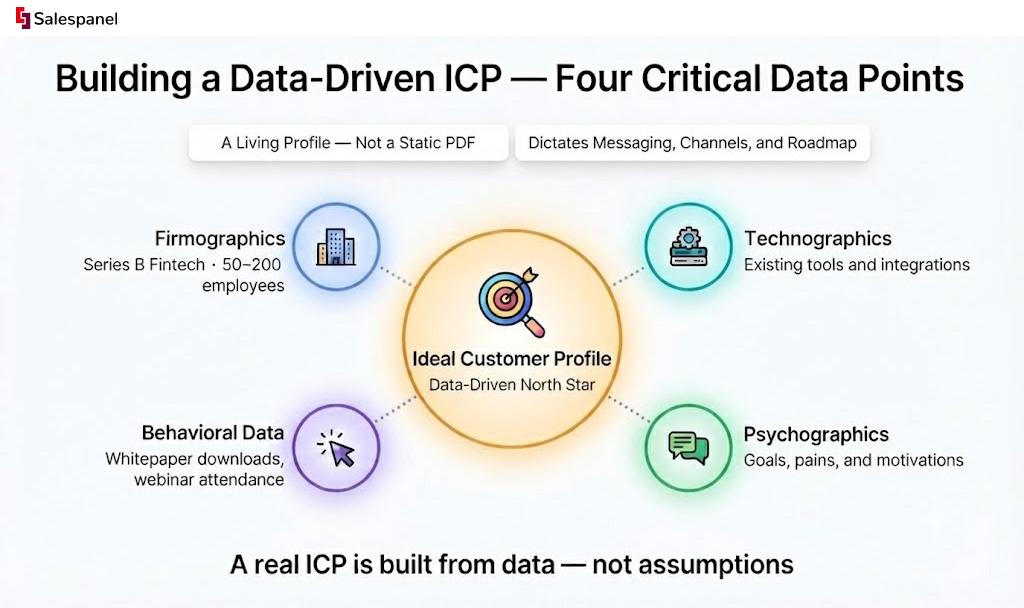
The old-school, persona-based approach—like creating a fictional “Marketing Mary”—is insufficient in today’s data-rich environment. Modern marketing demands a data-driven Ideal Customer Profile (ICP), a strategic North Star that ensures every marketing dollar is spent with maximum focus. This is not a theoretical exercise. A real ICP is a composite profile built from both quantitative product analytics and qualitative insights from customer interviews and sales call recordings. Getting this right is what separates high-growth SaaS companies from those who burn cash on unqualified traffic.
Uncovering the Data That Matters
Building a powerful ICP involves synthesizing data from several key sources to create a complete picture of your best customers. The process starts by analyzing your current customer base to identify the common attributes of your most successful, highest-LTV accounts.
Here are the key data points to analyze:
- Firmographics: Be specific. Analyze company size (by revenue and employee count), industry or vertical, and geographical location. A practical example: your data might reveal that your best customers are Series B fintech startups in the US with 50-200 employees. That is the required level of granularity.
- Technographics: What technologies are in their existing stack? Knowing the software and tools your ideal customers use provides a significant advantage for integration marketing and targeted messaging. If they all use Salesforce, for example, your marketing can emphasize a seamless integration.
- Behavioral Data: How did these customers discover you? What specific path did they take on your website before converting? Perhaps a cohort of high-value customers all downloaded a specific whitepaper or attended the same webinar. This data reveals buying signals and validates which content resonates.
- Psychographics: This requires direct human interaction. Conduct interviews to understand their strategic goals, their most significant operational challenges, and their professional motivations. What “job” are they hiring your software to perform? What are their key business pains?
A robust ICP isn’t a static PDF you create once and forget about. It’s a living, breathing profile that should evolve as you gather more data. It will dictate your messaging, your channel selection, and even your product roadmap, making sure your entire company is aligned on serving the right customer.
Mapping the SaaS Buyer Journey
Once you know who you’re targeting, the next technical step is to understand how they buy. The B2B SaaS buyer journey is rarely a linear path. It is a complex process, often involving multiple stakeholders and dozens of digital and human touchpoints. Mapping this journey prevents common mistakes, such as pushing a decision-stage offer (like a demo) to a prospect who is only beginning to research their problem. It is about meeting them at their precise point of need.
A practical and effective framework is to segment the journey into three distinct stages. The objective is to identify the critical questions your ICP is asking at each phase.
The Three Core Stages of Awareness
- Awareness Stage: The prospect is experiencing the symptoms of a problem but may not have a term for it. They are using search queries related to their pain points, not solutions. Their primary question is, “Why am I struggling with [insert pain point]?”
- Consideration Stage: The prospect has now defined their problem and is actively researching categories of solutions. They are asking, “What are the different ways I can solve [the now-defined problem]?”
- Decision Stage: The prospect has selected a solution category (e.g., your software) and is now conducting a comparative analysis of specific vendors. The question becomes, “Which provider is the best fit for my team, my needs, and my budget?”
As a practical example, a prospect for a project management tool might begin by searching “why is my team always missing deadlines” (Awareness). They might then progress to “best software for remote team collaboration” (Consideration). Finally, they will conduct high-intent searches like “[Your Brand] vs Asana” (Decision). Understanding these stages is the foundation of a successful content and channel strategy, transforming lead generation for SaaS from guesswork into a predictable system for growth.
Choosing and Dominating Your Acquisition Channels
With a well-defined Ideal Customer Profile and a mapped buyer journey, the next step is execution: determining where to find and engage these prospects. While a “multi-channel” strategy is often touted, it is a frequent trap for early-stage companies. The primary challenge in lead generation for saas is not universal presence, but deep, effective penetration in a few key channels. Spreading budget and resources too thinly is one of the fastest ways to burn capital with minimal return.
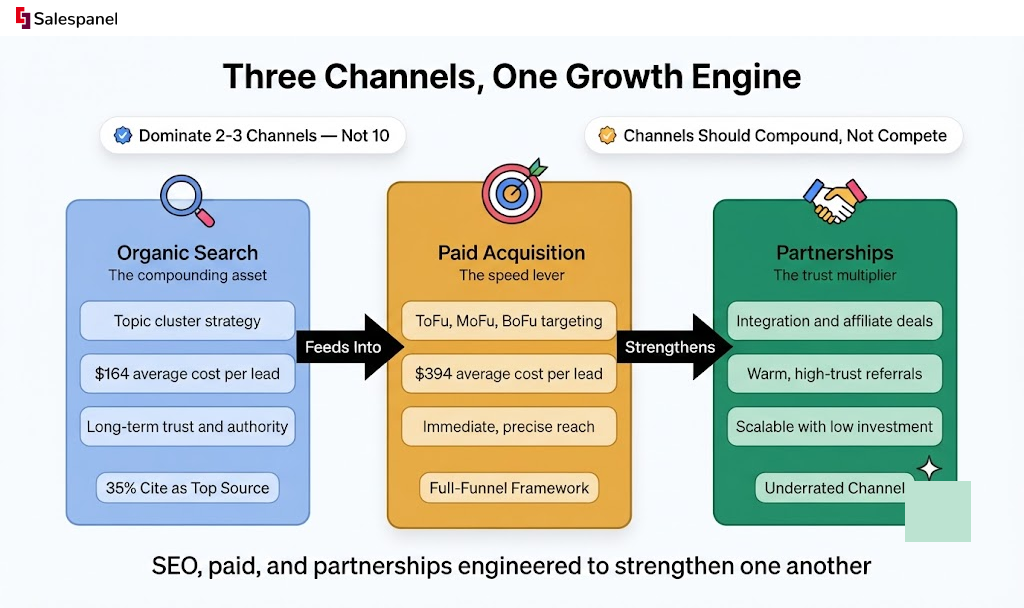
The objective is not a superficial presence across ten platforms but strategic dominance in two or three. This involves building significant expertise and compounding returns in the channels most relevant to your ICP. A practical example would be achieving topical authority in search, which yields dividends for years, or becoming a trusted voice in a niche professional community. This approach ensures your efforts are focused on building a true competitive advantage.
Organic (SEO), paid advertising, and partnerships are not isolated tactics. They should be engineered to feed into and strengthen one another in a cohesive system.
Mastering Organic Search with Topic Clusters
For most SaaS companies, SEO is the bedrock of sustainable lead generation. Data validates this: 35% of B2B SaaS companies identify organic search as their top source of high-quality leads. The economics are compelling. The average cost per lead from SEO is approximately $164, whereas a platform like LinkedIn Ads can cost upwards of $394 per lead. SEO’s most significant value, however, lies in its long-term, compounding returns and the inherent trust users place in organic results over advertisements. For a deeper analysis, these lead generation statistics provide further context.
Modern SaaS SEO has evolved beyond targeting individual keywords. The prevailing strategy is now the development of topic clusters. This technical approach involves creating a central “pillar” page on a broad topic (e.g., “employee onboarding software”) and supporting it with multiple “cluster” articles that explore related subtopics in-depth (e.g., “onboarding checklist for remote employees,” “best new hire welcome kits”). Each cluster article links back to the pillar page. This structure signals deep authority to search engines and, more importantly, provides comprehensive value to prospects at every stage of their research journey.
Structuring Paid Acquisition for the Full Funnel
Paid channels provide what organic channels cannot: immediate speed and targeting precision. They are a critical component of a balanced strategy, but their effective use requires moving beyond simply driving cold traffic to a “request a demo” page. A well-structured paid strategy meets buyers at their current stage in the journey.
Here is a practical, full-funnel framework:
- Top-of-Funnel (ToFu): Use platforms like LinkedIn to promote genuinely useful, ungated content such as insightful blog posts or industry reports. The objective is not immediate lead capture but building awareness and creating a custom audience of engaged individuals who match your ICP for future retargeting.
- Middle-of-Funnel (MoFu): Target the retargeting audiences (and lookalikes) from your ToFu campaigns with higher-value, gated assets. This is the appropriate stage for a webinar, a comprehensive whitepaper, or a free diagnostic tool. You are capturing lead information from an audience that has already been warmed up.
- Bottom-of-Funnel (BoFu): This is where high-intent search ads on Google are most effective. Bidding on keywords like “[competitor] alternatives” or “[your software category] for enterprise” captures users with clear purchase intent. The Call-to-Action (CTA) should be direct and conversion-focused: “Request a Demo” or “Start Free Trial.”
This tiered, technical approach warms up prospects before asking for the sale, which dramatically improves conversion rates and maximizes the efficiency of your ad spend. The takeaway is that a high-performing lead generation engine relies on a symbiotic relationship between channels.
Building a Scalable Partnership Program
Partnerships are one of the most powerful and often underrated channels for SaaS growth. A well-executed program can deliver a steady stream of high-quality, high-trust referrals, creating a scalable system for new business.
There are three primary types of partnerships to develop:
- Integration Partners: Collaborate with non-competing software companies that serve the same ICP. A practical example is a project management tool partnering with a time-tracking application. Joint marketing efforts and in-app promotions introduce your product to a perfectly matched, warm audience.
- Affiliate Partners: Engage bloggers, consultants, and industry influencers to promote your product in exchange for a commission on sales. This performance-based model can scale rapidly with minimal upfront investment.
- Agency Partners: Establish relationships with marketing agencies, Value-Added Resellers (VARs), or consultants who advise your target customers. By providing them with resources and a referral fee, they can function as an extension of your sales team, recommending your solution directly to their clients.
Success in partnerships is predicated on creating mutual value and maintaining clear, consistent communication. Nurturing these relationships requires dedicated effort, but a robust partner program can quickly become your most efficient acquisition channel.
Building Your Technical Infrastructure for Lead Capture
Driving traffic to your website is only the first step. That traffic is functionally worthless if you cannot effectively capture, identify, and qualify your best prospects. Your technology stack serves as the central nervous system for your entire lead generation for SaaS engine, distinguishing a high-conversion machine from a leaky bucket.
The previous playbook, reliant on client-side pixels and third-party cookies, is now obsolete. With ad blockers used by over 42% of internet users and a global shift toward data privacy, these methods are no longer reliable. A modern tech stack must be resilient, accurate, and founded on the principle of trust.
Shifting to Server-Side Tracking for Accuracy
The single most critical technical shift for SaaS companies is the migration from client-side to server-side tracking. In the traditional model, tracking scripts from platforms like Google Analytics or Meta executed directly in the user’s browser. This made them vulnerable to ad blockers, privacy features like Apple’s Intelligent Tracking Prevention (ITP), and network issues, often resulting in incomplete or inaccurate data.
Server-side tracking inverts this architecture. The user’s browser sends a single, consolidated data stream to your server first. Your server then securely relays that information to your various marketing and analytics tools—CRM, analytics platforms, and ad networks.
This technical approach yields several immediate benefits:
- Drastically Improved Data Accuracy: By bypassing browser-level blockers, you obtain a much clearer and more complete picture of user behavior, leading to better attribution and more informed strategic decisions.
- Tighter Security and Control: You act as the data gatekeeper, deciding precisely what information is sent to each third-party tool. This minimizes data exposure and ensures compliance.
- Faster Site Performance: Reducing the number of third-party scripts running in the browser results in faster page load times, which improves user experience and provides a tangible SEO benefit.
Implementing Consent and Capturing High-Intent Leads
A privacy-first approach is not merely a compliance checkbox; it is a competitive advantage. Implementing a clear Consent Management Platform (CMP) is non-negotiable. It allows you to be transparent with visitors about data collection, which is fundamental to building the trust necessary for them to share their information.
With a compliant framework in place, you can focus on high-conversion lead capture methods beyond the standard “Contact Us” form. The objective is to offer tangible value in exchange for information.
Consider these high-impact methods:
- Interactive Demos: Allow prospects to take a self-guided tour of your product, providing value without requiring a sales call.
- Free Assessment Tools: A simple calculator or diagnostic tool that helps a prospect quantify their pain point can be a powerful lead magnet.
- Ungated Content Hubs: Instead of gating every asset, create a resource center. Use tools that can identify the companies visiting these pages, turning anonymous traffic into warm leads without a form submission.
Your capture strategy should be all about reducing friction for the user while dialing up the signal quality for your team. Every form field, every click, every step should serve a clear purpose tied directly to qualifying that lead.
Creating a Practical Lead Scoring Model
Not all leads are created equal. A student downloading a whitepaper is fundamentally different from a Director of Engineering at a target account who has visited your pricing page three times. Lead scoring is the system that automatically distinguishes the curious from the serious. By assigning points based on demographic fit and behavioral signals, it ensures your sales team focuses only on prospects demonstrating genuine purchase intent.
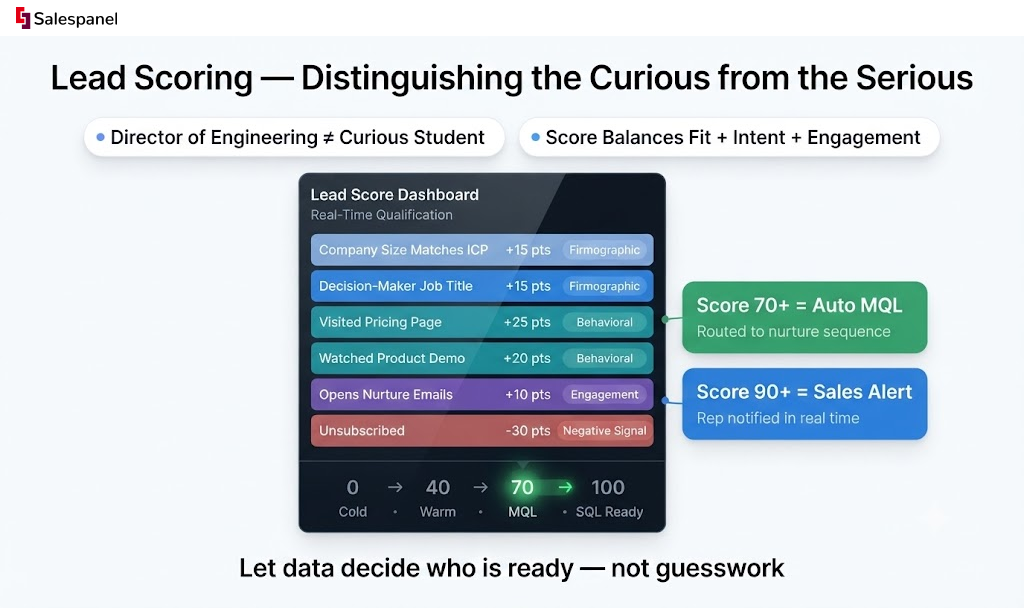
A robust scoring model balances several types of signals:
- Firmographic/Demographic Data: Does the lead’s company size, industry, and location align with your ICP? Does their job title indicate decision-making authority?
- Behavioral Data (Website Activity): High-value actions—such as visiting the pricing page, watching a product demo, or engaging with case studies—should be assigned significantly more points than a brief blog post view.
- Engagement Data (Email/Ads): Are they consistently opening nurture emails, clicking links, or engaging with retargeting ads?
For example, a website visitor tracker from Salespanel can monitor these behavioral signals in real time. This technical capability allows you to build a dynamic scoring system that automatically surfaces your most qualified prospects, creating a highly efficient sales pipeline.
Getting Leads to the Finish Line: Nurturing and Sales Handoff
Capturing a lead is the beginning, not the end, of the acquisition process. Most prospects who download an ebook or attend a webinar are not prepared to make an immediate purchase. The critical work in SaaS lead generation occurs after the initial capture. This phase, known as lead nurturing, is the bridge between marketing’s first touchpoint and sales’ first meaningful conversation. Neglecting this stage is a primary cause of lost revenue. The central theme remains: build a system that moves high-value prospects efficiently through the funnel.
Building Nurturing Sequences That Actually Work
Effective nurturing involves delivering the right message at the right moment, triggered by a prospect’s specific actions. This is a departure from generic email blasts. The technical implementation requires creating smart, automated email flows tailored to distinct behaviors. For instance, a webinar registrant and a demo requester are in completely different stages of the buyer journey, and your communication must reflect this.
- Practical Example 1: The Webinar Registrant: This individual is in an educational mindset. The follow-up sequence should support this. The flow should include a registration confirmation, a reminder, and a link to the recording. Subsequent emails should provide related content—blog posts, case studies, or guides—that builds on the webinar’s topic. This process establishes trust and authority, gradually guiding them toward product consideration.
- Practical Example 2: The Demo Requester: This is a high-intent lead. Nurturing should focus on preparing them for a productive sales call. The sequence should confirm the booking, introduce the account executive, and perhaps share a short video highlighting a key feature relevant to their likely pain point. The goal is to build anticipation and set the stage for a successful conversation.
The objective is always personalization at scale. Use dynamic content within emails to reference their industry, company size, or the specific asset they downloaded. This small technical detail demonstrates attentiveness and significantly elevates your communication above generic marketing automation.
The Make-or-Break Marketing-to-Sales Handoff
The handoff between marketing and sales is a common failure point where qualified leads are lost. An undefined process creates friction, resulting in dropped leads and missed opportunities. The solution is a formal agreement built on shared definitions and mutual accountability.
First, establish clear lead stages. Both teams must agree on the precise criteria that define a Marketing Qualified Lead (MQL) and a Sales Qualified Lead (SQL).
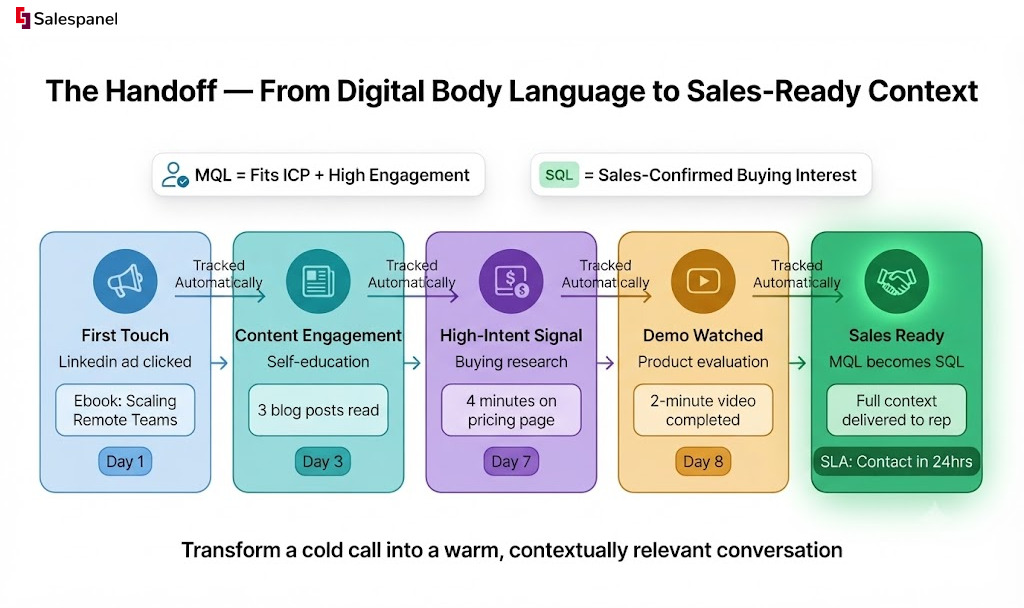
- MQL (Marketing Qualified Lead): A lead that has been nurtured by marketing. They fit the ICP criteria and have demonstrated significant engagement (reflected in a high lead score). They are qualified for further nurturing but not yet ready for a direct sales conversation.
- SQL (Sales Qualified Lead): An MQL that has been reviewed and accepted by the sales team. Sales has confirmed a legitimate, near-term buying interest, justifying a one-on-one engagement.
The handoff should not be a one-way transfer. It must be a seamless exchange of intelligence governed by a Service Level Agreement (SLA). The SLA formally defines marketing’s commitment to deliver a specific number of qualified leads and sales’ commitment to follow up within an agreed-upon timeframe. This eliminates ambiguity.
Arming Sales with “Digital Body Language”
For the initial sales call to be effective, marketing must provide more than just contact information. It must transmit the full context of the lead’s journey—their “digital body language.” A robust tracking platform is the key technical enabler for this.
Website visitor tracking from Salespanel allows you to capture and relay a complete history of every touchpoint. When a sales representative receives a lead, they should see the entire narrative, not just a name and email.
Imagine a sales rep knowing the following before making a call:
- The prospect originated from a LinkedIn ad for an ebook on “Scaling Remote Teams.”
- Two days later, they returned to read three blog posts on project management workflows.
- Last week, they spent four minutes on the pricing page.
- Yesterday, they watched a 2-minute product demo video immediately before requesting a consultation.
This level of insight is transformative. It turns a cold call into a warm, contextually relevant conversation. The rep can tailor their opening, bypass redundant discovery questions, and address the prospect’s evident pain points directly. This takeaway is critical: this process not only increases conversion rates but also forges a unified and powerful growth engine between your marketing and sales teams.
Measuring What Matters to Optimize Performance
Successful lead generation is not a one-time setup; it is a continuous cycle of measurement, analysis, and refinement. To build a predictable revenue engine, you must filter out vanity metrics like raw traffic and focus on Key Performance Indicators (KPIs) that directly impact the bottom line. This practice is what separates stagnant SaaS companies from those that scale successfully. The goal is to create a continuous feedback loop where performance data directly informs strategic adjustments.
Core Revenue-Centric Metrics
Your marketing dashboard should be centered on a few critical metrics that accurately represent your growth trajectory. These numbers draw a direct line from marketing expenditure to revenue, providing a clear picture of what is effective.
Begin by focusing on these three essential metrics:
- Customer Acquisition Cost (CAC): The total sales and marketing cost required to acquire a new customer over a specific period. This is the ultimate measure of efficiency.
- Lead-to-Customer Conversion Rate: The percentage of qualified leads that ultimately become paying customers. This metric indicates the health of your funnel from marketing handoff to a closed deal.
- Lifetime Value to CAC Ratio (LTV:CAC): This is the paramount SaaS metric. It compares the total revenue a customer will generate against the cost of acquiring them. A healthy ratio, typically 3:1 or higher, signifies a sustainable business model.
The goal isn’t just to generate leads; it’s to acquire profitable customers. A relentless focus on CAC and LTV:CAC ensures every marketing dollar is invested in activities that drive sustainable, long-term growth.
Building Your Optimization Loop
With these core metrics as your foundation, you can begin the iterative process of optimization. This involves a systematic approach: forming a hypothesis, running a test, and diagnosing your funnel to identify and resolve leaks. Practical examples include running A/B tests on landing page messaging, conducting cohort analyses to understand customer retention drivers, and performing funnel diagnostics to pinpoint where prospects are dropping off. This continuous improvement cycle is the mechanism that prevents your lead generation for SaaS strategy from becoming obsolete, making it progressively more efficient and effective over time.
Got Questions? We’ve Got Answers.
Here are some of the most common questions that pop up when talking about SaaS lead generation. We’re tackling them head-on to help you clear up any confusion and navigate the usual sticking points.
What’s the Best Lead Gen Channel for a Brand New SaaS?
Honestly, it depends on your target customer and how much cash you have to play with. But if I were starting from scratch today, I’d bet on a powerful one-two punch: highly targeted content marketing (SEO) and focused outbound prospecting.
Think of SEO as your long game. It’s an investment that builds a real, sustainable asset over time. As your authority grows, it will start pulling in high-intent leads on autopilot. But that takes time.
While that’s cooking, you need traction now. That’s where personalized outbound on platforms like LinkedIn or good old-fashioned cold email comes in. It’s the fastest way to get in front of your ideal customers, secure those crucial first users, and get invaluable feedback. This dual approach lets you refine your ICP and messaging on the fly while your SEO engine warms up.
How Can I Generate Leads with a Shoestring Budget?
When you’re running lean, you have to focus on high-leverage, low-cost activities. The absolute priority? Create genuinely helpful content that solves a specific, painful problem for your ideal customer. No fluff.
This could be anything from a ridiculously detailed blog post to a free tool or a practical template they can use immediately.
Once you have that killer piece of content, don’t just let it sit there. Go share it where your people hang out. Think relevant subreddits, niche industry forums, or specific LinkedIn groups. Another killer, cost-effective strategy is to build partnerships with non-competing companies that serve the same audience. It’s a win-win.
How Long Does It Really Take to See Results?
This is the million-dollar question, and the answer varies wildly depending on the channel you’re using.
- Paid Ads: If you’re running campaigns on Google or LinkedIn, you can see leads trickle in within days or weeks. The catch? The moment you stop spending, the leads dry up. It’s like a faucet.
- Content & SEO: This is a marathon, not a sprint. You’re building a foundation. Realistically, it can take 6-12 months before you see a significant, consistent stream of organic leads. Patience is key here.
- Outbound: A sharp, focused outbound campaign can start booking meetings in a matter of weeks. But it demands constant, dedicated effort to keep that pipeline full. It’s not a set-it-and-forget-it channel.
The smartest approach is a balanced one. Use short-term tactics for immediate wins and customer feedback while you consistently invest in long-term channels for sustainable, scalable growth.
Ready to build a predictable revenue engine with a privacy-first approach? Explore the resources from Salespanel to master modern marketing and sales alignment. Learn more by checking out our SaaS marketing resources.