The architecture of your marketing technology stack is no longer a niche technical concern—it has become the central nervous system of modern business growth. Just a decade ago, a marketer’s toolkit was simple: an email platform and basic analytics. Today, that simple toolbox has exploded into a sprawling ecosystem of specialized solutions, creating a landscape where strategic integration is the single greatest determinant of success. Understanding this evolution is critical, as it explains precisely why a well-architected stack is no longer optional.
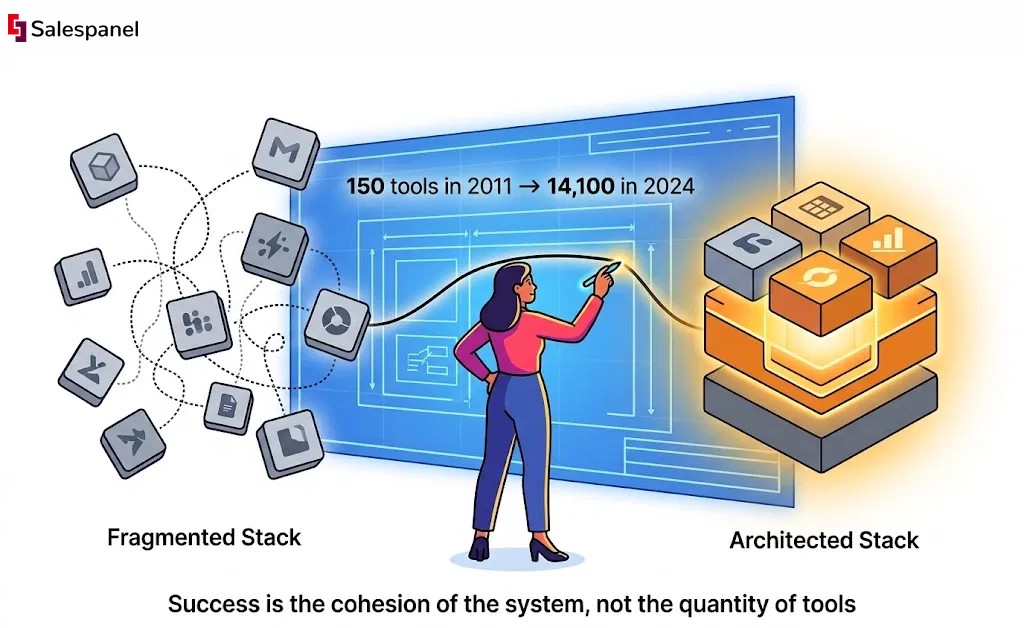
This shift from simple tools to a complex, interconnected web of systems is quantified by staggering market growth. The first Marketing Technology Landscape chart in 2011 listed around 150 solutions. By 2024, that number has ballooned to approximately 14,100. This near-hundred-fold increase has fueled a market where global revenue hit roughly $669.3 billion USD in 2023 and has surpassed $800 billion as of 2025, according to Statista.
The central theme of modern marketing is this: success is not defined by the quantity of tools you own, but by the cohesion of the system you build. This guide provides an in-depth, technical framework for architecting a marketing tech stack that moves beyond a fragmented collection of software. We will deconstruct the core functional layers, analyze the technical backbones that ensure data integrity, and provide proven blueprints for building a powerful, compliant, and efficient marketing engine that delivers a unified view of the customer and drives measurable results.
The Evolution of Modern Marketing Tech Stacks
Just a decade ago, a marketer’s toolkit was pretty straightforward. Most of us got by with an all-in-one platform for email and some basic analytics. Simple.
Today, that simple toolbox has exploded. We’re now dealing with a sprawling ecosystem of specialized solutions for every conceivable task. This shift is the single greatest challenge—and opportunity—for modern B2B marketers. Understanding the architecture of these marketing tech stacks isn’t some niche technical skill anymore; it’s a critical driver of growth, compliance, and competitive advantage.
This isn’t just a feeling; the numbers are staggering. In 2011, the first Marketing Technology Landscape chart listed around 150 MarTech solutions. Fast forward to 2024, and that number has ballooned to about 14,100 solutions worldwide. That’s a nearly hundred-fold increase.
Unsurprisingly, spending has kept pace. Global marketing technology revenue hit roughly $669.3 billion USD in 2023 and has cleared $800 billion as of 2025. This explosion has completely changed how B2B teams operate, forcing a move away from clunky, monolithic platforms toward managing dozens of specialized apps for everything from advertising to data warehousing.
From Simple Tools to Complex Ecosystems
This rapid fire growth in technology has created a new set of high-stakes problems. Many organizations now find themselves tangled in a complex web of integrations where fragmented data and poor connectivity can cripple their marketing effectiveness. A recent survey, for instance, found that 57% of marketers added between one and five new applications to their stack in a single year. While each new tool promises a new capability, this constant addition often leads to a bloated, inefficient, and expensive setup if not managed with a clear strategy.
The real challenge of modern MarTech is no longer just about buying the “best” tools. It’s about architecting them into a cohesive system that delivers a single, unified view of the customer. Success now hinges on solving a few key architectural puzzles:
- Data Silos: How do we get the data from our CRM, analytics platform, and ad networks to actually speak the same language?
- Identity Resolution: How can we recognize the same person across different devices and touchpoints to deliver a consistent, coherent experience?
- Privacy and Consent: How do we build a stack that respects user consent and complies with global regulations like GDPR and CCPA without sacrificing performance?
- Measuring ROI: How can we accurately attribute revenue to our marketing efforts when the customer journey is scattered across so many different systems?
A poorly constructed stack doesn’t just waste budget on unused software. It creates friction for your customers, burns out your team, and ultimately puts the brakes on growth. The cost of technological complexity has risen just as fast as the number of tools available.
This guide is designed to give you a clear, actionable framework for navigating this new reality. We’ll deconstruct the marketing tech stack into its core functional layers, explore the technical backbones that hold it all together, and provide proven blueprints to help you build a powerful, compliant, and efficient marketing engine.
Deconstructing the Core Layers of Your Martech Stack
To truly optimize a marketing tech stack, one must view it not as a collection of software logos, but as an integrated intelligence operation. Each layer of technology has a specific role in a logical workflow, transforming raw, chaotic data into precise, revenue-driving actions. Many expensive stacks fail because they lack this strategic flow; they are merely collections of tools, not cohesive systems.
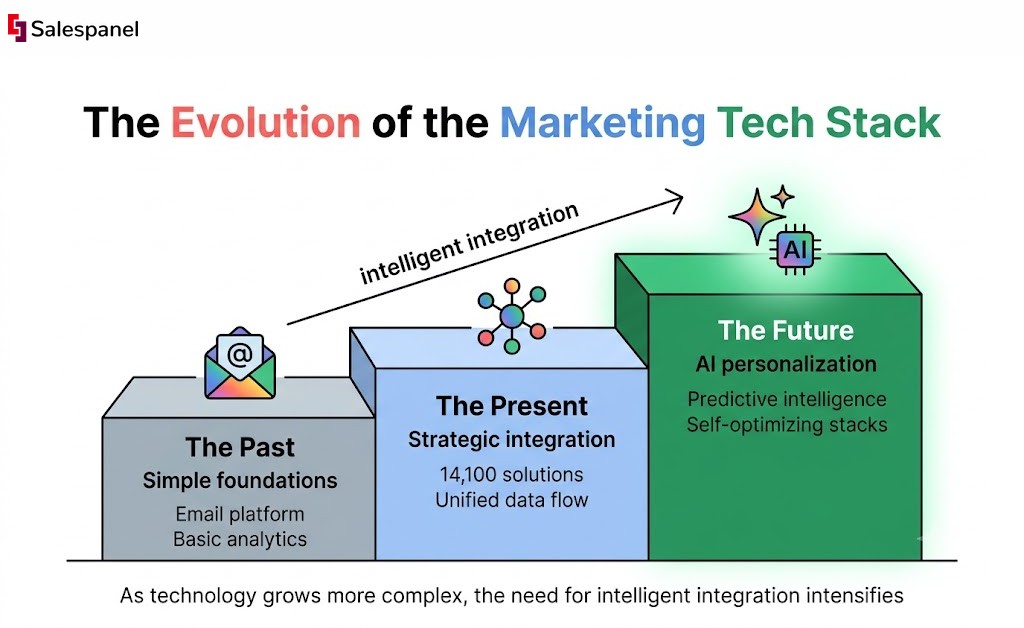
The evolution from the simple tools of the past to our complex, integrated present—and the AI-driven future we’re heading towards—underscores a fundamental principle. This evolution makes one thing crystal clear: as the technology becomes more complex, the fundamental need for intelligent integration has only intensified. Let’s dissect the functional layers that enable this intelligence operation. Each layer builds upon the one before it, creating a powerful, logical progression from raw data to tangible business results.
Functional Layers of a Modern Marketing Tech Stack
| Layer | Core Function | Example Tool Categories |
|---|---|---|
| Data Collection | Captures every prospect interaction across all touchpoints (website, ads, email). | Website Analytics, Tag Managers, Ad Pixels, Visitor Tracking |
| Identity Resolution | Connects anonymous signals from different sources into a single, unified customer profile. | Customer Data Platforms (CDPs), Identity Resolution Platforms |
| Analytics & Intelligence | Analyzes data to find patterns, segment audiences, and score leads for prioritization. | Business Intelligence (BI), Product Analytics, Lead Scoring Systems |
| Activation & Orchestration | Delivers personalized messages and experiences across channels based on insights. | Email Marketing, Ad Platforms, Sales Engagement, CRM |
| Consent & Compliance | Manages user consent and ensures data practices adhere to privacy regulations. | Consent Management Platforms (CMPs) |
This structure represents a deliberate flow of information. Let’s examine the technical function of each layer.
The Data Collection Layer
This is the frontline of your intelligence operation—the field agents gathering raw information. These tools are responsible for capturing every interaction a prospect has with your brand, from website visits and ad clicks to email opens and content downloads. Their primary function is to ensure a steady stream of high-quality data enters your ecosystem. If this layer is weak, the rest of your stack is operating on incomplete or inaccurate information.
- Practical Example: A prospect lands on your pricing page from a LinkedIn ad. The ad platform’s pixel fires, sending a conversion event. Simultaneously, Website visitor tracking from Salespanel captures the page view, session duration, and referral source. Both are distinct data collection agents reporting back to a central system.
- Common Tools: Website analytics like Google Analytics, tag managers like Google Tag Manager, advertising pixels (Meta, LinkedIn), and event tracking scripts.
The Identity Resolution Layer
With raw data collected, the next critical step is to connect the dots. The identity resolution layer takes disparate, anonymous signals from different sources and stitches them into a single, unified customer profile. This layer addresses the fundamental challenge of recognizing an individual across multiple devices and touchpoints over time. It transforms fragmented data points—an ad click, a website visit, an email open—into a coherent narrative about a single person.
A study found that organizations using identity resolution technology were 2.6 times more likely to report significant revenue growth. This isn’t a “nice-to-have”; it’s the engine of modern, personalized marketing.
For instance, a user might browse your site on their work laptop and later on their personal phone. Without identity resolution, these appear as two distinct visitors. With it, you recognize a single, multi-device journey, enabling a consistent and relevant experience. This capability is foundational for effective account-based marketing (ABM) and sophisticated lead nurturing.
The Analytics and Intelligence Layer
With a unified customer profile established, the analytics and intelligence layer interprets the data to extract actionable insights. Here, tools are used to identify behavioral patterns, segment audiences based on firmographic and behavioral data, and score leads for sales prioritization. This is the point where raw information is transformed into strategic intelligence, moving from knowing what happened to understanding why and predicting what to do next.
- Practical Example: A prospect from a target account visits your product pages three times, downloads a case study, and matches your ideal customer profile (ICP). A tool in this layer processes these signals. The lead scoring framework in Salespanel allows you to automatically assign a high “intent score,” flagging them as a marketing-qualified lead ready for a sales conversation.
- Common Tools: Business intelligence (BI) platforms like Tableau, product analytics tools such as Mixpanel, and integrated lead scoring systems.
The Activation and Orchestration Layer
The final layer executes the mission. The activation layer comprises the tools that deliver personalized messages and experiences to your audience across all channels. This is where marketing strategy is put into action. Whether sending a timed email based on a behavioral trigger, showing a personalized ad to an account showing intent, or alerting a sales representative to a high-scoring lead, the activation layer closes the loop, turning data-driven insights into customer engagement and revenue.
Choosing Your Stack’s Technical Backbone
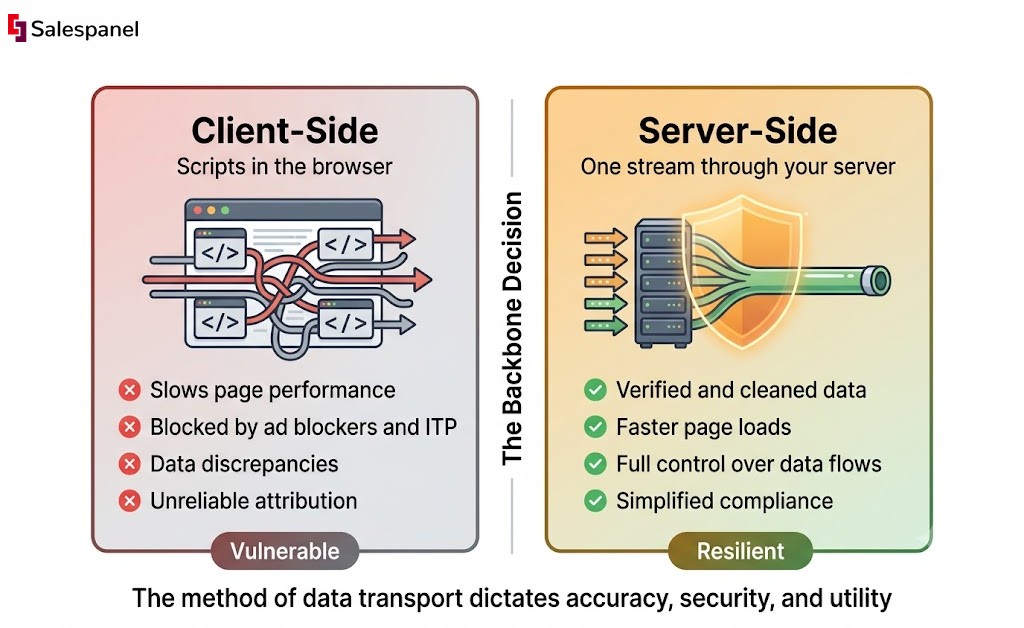
Understanding the functional layers of a marketing tech stack is crucial, but making them communicate effectively is the true technical challenge. The efficacy of a stack is determined not by the software logos it contains, but by the technical plumbing that connects them. The method of data transport between tools dictates accuracy, security, and utility. The two primary architectural patterns are client-side and server-side tracking, and this choice is foundational to building a resilient marketing engine.
Client-Side vs. Server-Side Data Flow
Client-side tracking involves loading multiple tracking scripts—from tools like Google Analytics, Meta, and LinkedIn—directly onto a visitor’s web browser (the “client”). Each script acts as an independent agent, collecting data and sending it directly to its respective platform. While easy to implement, this method creates significant problems: it degrades website performance, is vulnerable to ad blockers and browser privacy features like ITP, and results in data discrepancies between platforms, making reliable attribution nearly impossible.
In contrast, server-side tracking utilizes a single, lightweight script on the browser that sends a unified stream of data to your own server first. This server acts as a central data hub where information can be verified, cleaned, and enriched before being securely forwarded to various marketing tools via their APIs.
The technical advantages are substantial:
- Data Integrity: By centralizing data collection before distribution, you mitigate the data loss and discrepancies caused by ad blockers and browser restrictions, establishing a single source of truth.
- Performance: Reducing the number of scripts running in the browser significantly improves page load times, enhancing user experience and SEO performance.
- Security and Control: You act as the gatekeeper, controlling precisely what data is sent to third-party vendors. This reduces data leakage and simplifies privacy compliance.
Adopting a server-side architecture is a core strategic decision. It directly addresses the primary challenges of modern marketing: data inaccuracy, privacy compliance, and poor website performance.
The Role of CDPs and APIs
In a server-side architecture, two technologies become essential: Customer Data Platforms (CDPs) and APIs.
A Customer Data Platform (CDP) serves as the central database and processing engine of a modern stack. It ingests raw data from all sources—website, CRM, support systems—and performs the critical function of identity resolution, creating a unified profile for each customer. It then distributes this clean, organized data to every other tool in the stack.
APIs (Application Programming Interfaces) are the protocols that enable communication between your tools. They provide a universal language that allows your CDP to update a lead score in your CRM, or your CRM to trigger a campaign in your email automation platform. An API-first approach provides the flexibility to integrate, replace, or upgrade tools without overhauling the entire stack’s foundation.
A server-side architecture built around a robust CDP and connected via APIs creates a powerful, centralized system. This technical backbone ensures the right data reaches the right tool at the right time, enabling a truly unified marketing strategy.
Unleashing AI and Automation in Your Stack
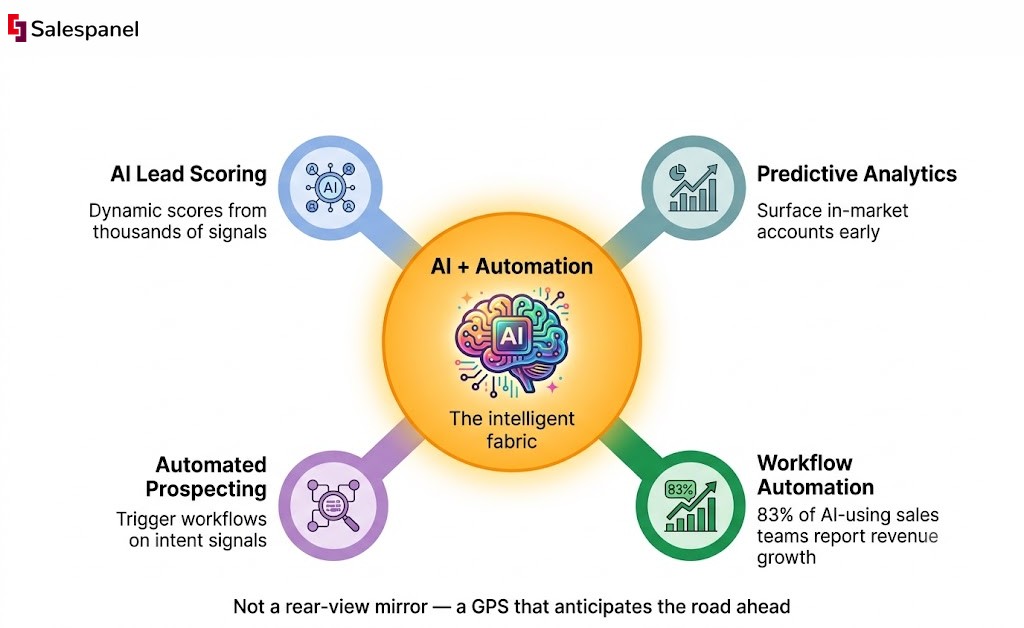
If the technical backbone is the skeleton of your marketing stack, then AI and automation constitute its brain and nervous system. This is not an additional layer but an intelligent fabric woven throughout the entire system, transforming passive data into proactive, revenue-generating actions. A stack lacking intelligent automation is already operating at a competitive disadvantage.
The financial impact is significant and immediate. The marketing automation market was valued at $7.3 billion USD in 2023 and is projected to nearly double by 2030. Currently, about 64% of marketers utilize automation and AI. For sales teams, a staggering 83% using AI report revenue growth, compared to 66% of teams without it. These figures demonstrate that automated lead qualification and AI-assisted prospecting are no longer novelties but essential components of a competitive strategy.
Moving Beyond Buzzwords to Practical Application
In a B2B context, AI and automation are most effective when applied to solve specific, high-value problems that are manually intractable at scale. Here’s how these capabilities manifest in a modern stack:
- AI-Driven Lead Scoring: Traditional rule-based scoring models (+5 for a VP title, +10 for a pricing page visit) are static. AI models analyze thousands of behavioral and firmographic signals to generate dynamic scores, predicting purchase likelihood in real-time and adapting as new data becomes available.
- Predictive Analytics for Account Intent: AI can identify buying signals across the web, surfacing accounts that are actively researching solutions like yours, even before they visit your website. This enables proactive targeting of high-intent accounts before competitors are aware of them.
- Automated Prospecting Workflows: Instead of manual list building, automation can trigger workflows based on intent signals. When an ideal-fit account exhibits buying behavior, the system can automatically identify key contacts, enroll them in a sales sequence, and notify the appropriate account executive.
A modern marketing tech stack uses AI not just to analyze the past, but to predict and shape the future. It’s the difference between looking in a rear-view mirror and using a GPS that anticipates traffic ahead.
Operationalizing Intelligence in Your Stack
The true value is realized when these intelligent capabilities are operationalized, seamlessly feeding insights into the daily workflows of sales and marketing teams. This is where platforms designed for B2B intelligence demonstrate their worth. At Salespanel, we believe that an effective marketing platform must make intelligence actionable. For example, Salespanel’s lead scoring framework allows you to construct sophisticated models that blend real-time behavioral tracking with deep firmographic data. It operationalizes this intelligence by automatically qualifying leads and pushing their scores directly into your CRM, ensuring your sales team focuses on opportunities with the highest probability of closing.
Furthermore, generative AI is transforming content creation and optimization. Preparing your stack for the next wave of search is critical. Resources like the 12 Best AI SEO Tools to Dominate Search are now essential reading. These tools integrate with analytics and activation layers, using AI to provide a sharper competitive edge. A stack without this intelligence is merely a toolbox; with it, it becomes a self-optimizing growth engine.
Building a Privacy-First Stack Architecture
For years, privacy regulations like GDPR and CCPA were often viewed as operational hurdles. This perspective is now obsolete. A resilient, future-proof marketing engine must have privacy at its architectural core. This approach is not about compliance as a constraint but about building customer trust as a competitive advantage. A privacy-first architecture is not about collecting less data; it is about being more intelligent and responsible with the data you collect. The guiding question shifts from “How much data can we gather?” to “What data do we need, and do we have explicit permission for its intended use?”
This discipline inherently leads to higher-quality data and more meaningful customer interactions. Companies that master this approach build deeper relationships and insulate themselves from the volatility of changing browser policies and new privacy legislation.
Architecting for Consent
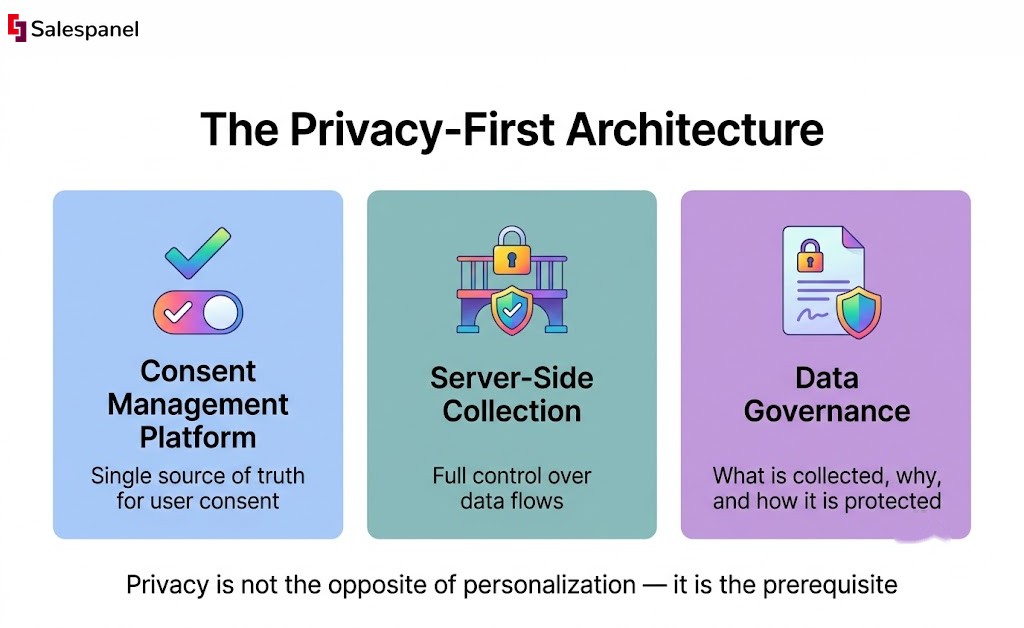
The foundation of a privacy-first stack is robust consent management. This extends beyond a simple cookie banner. A true consent architecture ensures a user’s choices are respected across every single tool in the stack, from analytics platforms to the CRM. This requires a Consent Management Platform (CMP) to serve as the central source of truth for user consent. It captures, stores, and propagates these preferences throughout the ecosystem.
Here’s how it works in practice: A visitor uses a CMP banner to opt out of “Analytics” cookies while keeping “Functional” ones enabled. A well-architected stack honors this choice instantly. The Google Analytics tag does not fire, but a script that manages shopping cart state will. Flawless orchestration is critical. A stack that fires tracking pixels despite a user’s opt-out not only violates regulations but also irrevocably damages customer trust. The design philosophy at Salespanel is centered on providing this control, enabling you to manage script execution based on explicit user consent.
Privacy is not the opposite of personalization. It’s the prerequisite. When customers trust you with their data because you respect their choices, they are more willing to share the information needed for you to create truly relevant experiences.
The Role of Server-Side Tracking and Data Governance
As previously discussed, server-side tracking is pivotal for data accuracy and performance. It is also a cornerstone of modern, privacy-first architecture. By routing data through your own server before sending it to third-party tools, you gain critical control over what information leaves your environment. This control enables the enforcement of strict data governance policies. You can filter, hash, or anonymize personally identifiable information (PII) before it reaches an advertising or analytics vendor, dramatically reducing data exposure and compliance risk.
In summary, a privacy-first stack is built on a deliberate strategy integrating three key components:
- A powerful Consent Management Platform (CMP) as the single source of truth for user consent.
- Server-side data collection as a secure gateway, providing full control over data flows to third parties.
- Strict data governance policies defining what data is collected, why it is collected, and how it is protected.
By embedding these principles into your marketing tech stack’s architecture, compliance shifts from a reactive burden to a proactive strategy that builds trust, improves data quality, and creates a sustainable competitive advantage.
Four Proven B2B Stack Blueprints
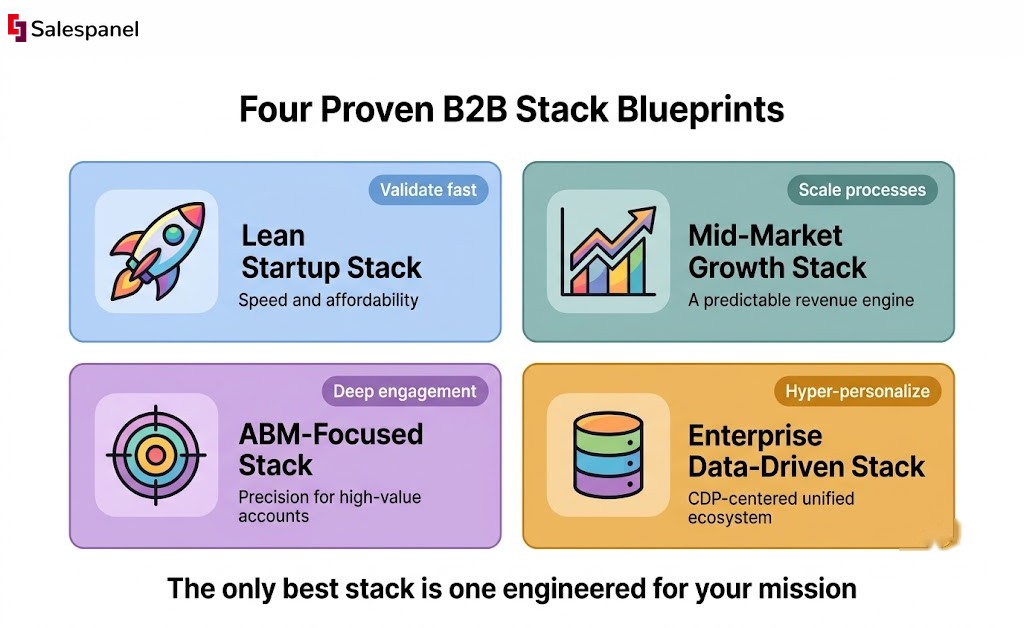
Theory provides a framework, but practical application demonstrates its value. There is no single “best” stack; the optimal configuration of tools is determined by a company’s stage, budget, and strategic objectives. The only “best” stack is one engineered specifically for your mission. The following four B2B blueprints illustrate how technology can be mapped to specific business needs.
The Lean Startup Stack
For an early-stage startup, the primary objectives are rapid learning and cost-effective lead generation. This stack prioritizes speed, affordability, and simplicity, utilizing tools with free or generous starter plans to gain initial traction without significant technical overhead.
- Data Collection & Analytics: Google Analytics 4 (GA4) with Google Tag Manager serves as the foundation for website traffic analysis. Adding Website Visitor Tracking from Salespanel enables the identification of high-value companies visiting the site, even without a form submission.
- Activation & CRM: A free CRM like HubSpot is sufficient for managing initial contacts and deals. For email marketing and simple automation, tools like Mailchimp or Brevo are effective.
- Integration Strategy: Integrations are direct and minimal, relying on native connections (e.g., Mailchimp to HubSpot) to avoid the cost of a central data platform. The goal is to validate the business model before investing in scalable technology.
The Mid-Market Growth Stack
As a company scales, its needs become more sophisticated. The objective shifts from lead capture to building a predictable revenue engine. This stack introduces more powerful automation, deeper analytics, and the beginnings of a centralized data strategy to manage increased volume and complexity. This is a critical transition point where many companies struggle. As tech investment grows, so does operational complexity. Bain & Company’s research highlights that while 57% of marketers added up to five new tools in a single year, 66% cite data infrastructure and integration as major roadblocks. Marketing leaders are twice as likely to have a mature, integrated stack, proving that cohesion is a strategic advantage.
- Central Hub: A full-featured CRM like Salesforce or a higher HubSpot tier becomes the single source of truth for customer data.
- Intelligence & Orchestration: Marketing automation platforms like Pardot or Marketo are implemented to manage complex nurture campaigns. Salespanel’s lead scoring framework allows you to enrich CRM data with real-time behavioral intent signals, ensuring sales focuses on the most engaged leads.
- Activation: Dedicated tools for paid advertising (LinkedIn Ads, Google Ads) and sales engagement (Outreach, Salesloft) are integrated directly with the CRM.
This stack moves beyond basic tools to create a connected system where marketing insights directly fuel sales actions. It’s about building repeatable processes that can scale right alongside the business.
The ABM-Focused Stack
For businesses targeting a specific list of high-value accounts, the stack must function as a precision instrument for account-based marketing (ABM). The focus shifts from lead volume to driving deep engagement within target accounts. This requires tools that provide account-level intelligence and coordinate multi-channel outreach flawlessly. A comprehensive guide on the top B2B lead generation tools can help form the core of a serious ABM blueprint.
- Account Intelligence: Platforms like 6sense or Demandbase are essential for identifying in-market target accounts and providing insights into their research behavior.
- Orchestration & Activation: An ABM platform coordinates “plays” across channels—display ads, social media, email—to target specific personas within chosen accounts, tightly integrated with the sales team’s engagement platform.
- Measurement: Analytics shift from MQLs to account-level metrics such as engagement scores, pipeline velocity within target accounts, and influenced revenue.
The Enterprise Data-Driven Stack
At the enterprise level, the stack evolves into a sophisticated data ecosystem, typically architected around a Customer Data Platform (CDP). The primary goal is to create a single, unified view of the customer across numerous touchpoints and business units, enabling hyper-personalization, predictive modeling, and robust compliance.
- Technical Backbone: A CDP (like Segment or Tealium) serves as the operational heart. It ingests data from all sources via server-side tracking, resolves customer identities, and distributes clean, unified data to all other tools. A data warehouse like Snowflake or BigQuery provides long-term storage for analytics.
- Intelligence Layer: In-house data science teams or platforms like DataRobot use the clean data from the CDP to build predictive models for customer churn, lifetime value (LTV), and propensity to buy.
- Compliance: A robust Consent Management Platform (CMP) like OneTrust is integrated at the CDP level to ensure customer consent preferences are automatically enforced across all activation channels globally.
Got Questions? We’ve Got Answers.
How Often Should We Really Audit Our Marketing Tech Stack?
A full, deep-dive audit should be conducted at least annually. This is a comprehensive review of your marketing engine’s health. However, a lighter review should occur quarterly to monitor tool utilization, identify redundancies, and ensure KPIs are being met. An immediate audit is warranted during a major strategic shift, in response to new privacy legislation, or if your team consistently reports workflow inefficiencies. The objective is to ensure the stack evolves with your business, preventing costly “shelfware.”
What’s the Biggest Mistake People Make When Building a Stack?
The most common pitfall is “shiny object syndrome”—the tendency to adopt new tools based on hype rather than strategic need. This approach inevitably leads to a bloated, disconnected stack with siloed data, making ROI calculation nearly impossible. The takeaway is to be disciplined and strategy-driven.
Start by mapping out your customer’s journey from start to finish. Pinpoint the exact problems you need to solve or the processes that are slowing you down. Then, and only then, should you start looking for tools that fix those specific issues and play nicely with what you already have.
How Do I Actually Measure the ROI of My Stack?
Measuring the ROI of your tech investment requires moving beyond tool-specific vanity metrics (e.g., email open rates) to business outcomes that matter to the C-suite. Focus on metrics that directly connect your stack to bottom-line results.
Key performance indicators to track include:
- Customer Acquisition Cost (CAC): Is your technology reducing the cost to acquire new customers?
- Customer Lifetime Value (LTV): Are your tools improving customer retention and increasing their long-term value?
- Marketing-Influenced Pipeline: What portion of the sales pipeline can be directly attributed to marketing activities powered by your stack?
- Sales Cycle Length: Is your stack enabling the sales team to close deals faster?
Also, measure operational efficiency gains, such as hours saved through automation. For instance, you can track how Salespanel’s lead scoring framework allows you to boost conversion rates and shorten the time from lead to close, tying your tech investment directly to revenue growth.
At Salespanel, we’re focused on giving you the tools and insights to build a smart, privacy-first marketing tech stack that drives real B2B growth. Dive into our guides and see how our platform can bring your data together and fire up your sales pipeline. Learn More