12 SaaS Marketing Strategies to Build Pipeline
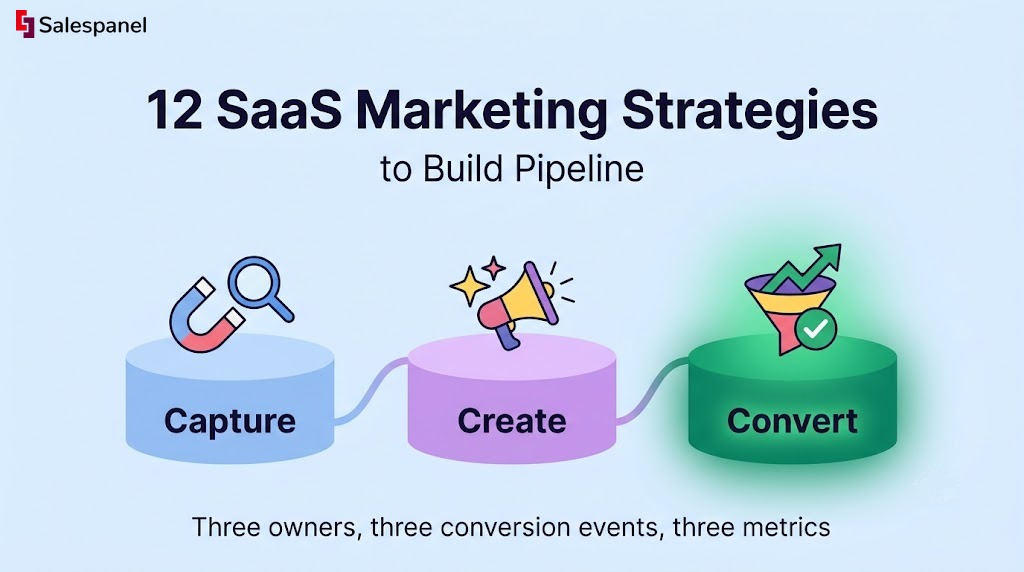
Our focus will be building a SaaS Marketing Plan that produces Pipeline
I would like to talk about how SaaS marketing strategies actually get chosen, because most teams skip that part and jump straight to execution. By the end of this guide you will have a way to pick three to five strategies, assign a named owner to each, build a conversion path for each, and measure them at the account level instead of the click level.
This is a prioritization and execution guide. It is not a list of 40 disconnected tactics you can bolt onto whatever you are already doing.
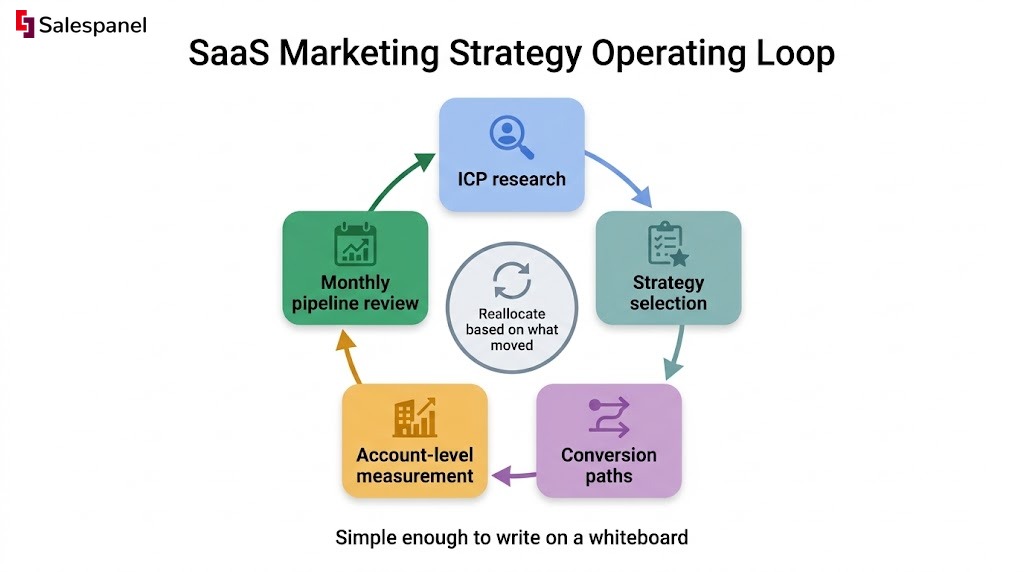
The workflow underneath it is simple enough to write on a whiteboard: define your revenue motion, choose strategies that match that motion, build conversion paths for each one, measure account-level progress, then reallocate budget monthly based on what moved.
One rule holds the whole thing together. A strategy does not earn budget until it has a defined audience, a specific offer, a distribution channel, a conversion event, an owner, and a success metric. Five of six is not enough. If you want the broader framing first, our B2B marketing strategy guide covers the planning layer above this one.
What Is SaaS Marketing?
SaaS marketing is the process of attracting, converting, activating, retaining, and expanding users or accounts for subscription software. In B2B SaaS, marketing has to serve several stakeholders inside one account — the practitioner who uses the product, the manager who owns the budget, and the IT or security reviewer who can block the deal.
That recurring-revenue structure is what separates it from marketing a one-time software purchase. When revenue arrives monthly, the sale does not end at checkout. Activation, product adoption, retention, and expansion all become marketing’s problem, because a customer who never reaches first value churns before the acquisition cost is recovered.
Three growth motions dominate:
- Product-led growth (PLG): trial, freemium, or self-serve purchase, with the product doing most of the convincing.
- Sales-led: demand capture and account education feeding sales-assisted conversion.
- Hybrid: self-serve access for small teams, sales support for larger accounts.
The motion changes your channel mix, your lead definitions, and how you attribute revenue. A PLG team calling every trial signup an MQL will drown; a sales-led team ignoring form fills will starve.
One distinction worth keeping: “capture high-intent comparison traffic” is a strategy. “Publish 10 comparison pages” is a tactic. The strategy survives when the tactic underperforms. Our product-led growth and B2B demand generation resources go deeper on each motion.
Before you start. Choose Your Primary Go-to-Market Motion
Pick the motion before the channels. Sales-led means revenue depends on booked conversations. Product-led means the buyer experiences value inside the product before paying anyone. Hybrid means both paths run at once, which is harder than it sounds because the two produce conflicting definitions of a “good” lead.
Five criteria usually settle it: product complexity, time-to-value, price point, whether a security review is required, and how many stakeholders sign off. If a user can reach something useful in 15 minutes without configuration help, self-serve is viable. If implementation requires data migration, SSO, and a DPA, sales-led is the honest answer no matter how much the team admires PLG.
The operational consequence shows up in what each team optimizes. Sales-led marketers optimize for qualified meetings. Product-led marketers optimize for activated accounts. Hybrid teams need an explicit, written product-qualified-account rule — for example, three or more users from the same domain reaching the setup milestone — otherwise sales works whatever happens to look busy.
Take one campaign and watch it change shape. Say it is a webinar on migrating off a legacy tool. Under a sales-led motion, the conversion event is a booked migration-assessment call and the follow-up is a human sequence. Under PLG, the same webinar ends with a migration template and an in-product import flow, and success is measured by accounts that complete an import within seven days. Under hybrid, you run both endings and route by company size. Same content, three different conversion architectures. That is the part most “PLG vs sales-led” articles leave out — the labels are easy, the plumbing is the work.
Step 1: Choose the Right SaaS Marketing Strategies Before Launching Channels
The right strategies depend on five variables: buying motion, average contract value, sales cycle length, category maturity, and how much demand already exists for what you sell. A $6,000 ACV product with a 21-day cycle in an established category needs a different mix than a $90,000 ACV product in a category buyers cannot name yet.
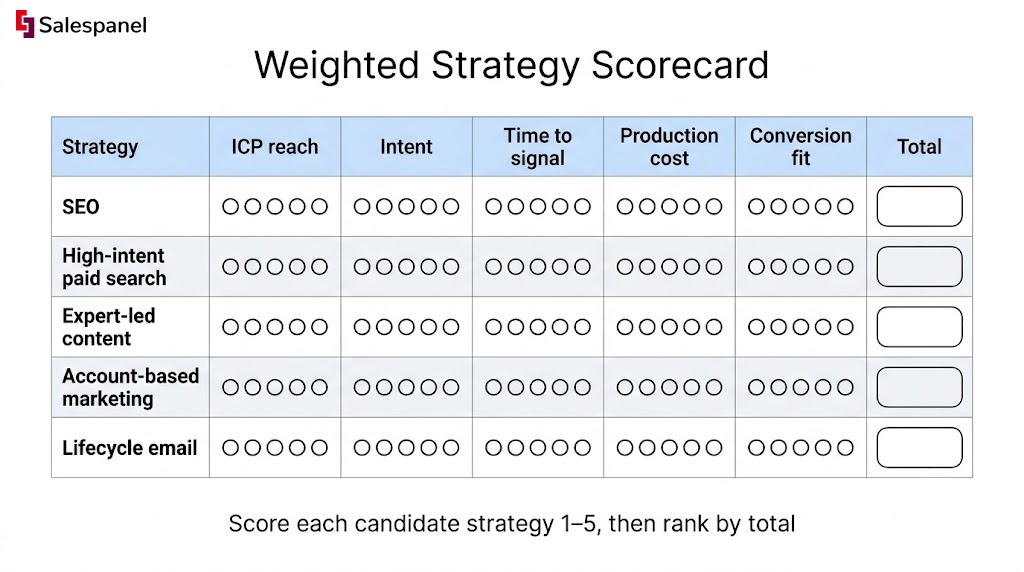
Score each candidate strategy 1–5 against these five criteria, then rank by total:
| Criterion | What you are checking |
|---|---|
| ICP reach | Can the channel reliably reach named roles or target accounts? |
| Intent | Is the audience researching a problem, a category, or a specific vendor? |
| Time to signal | Will you see meaningful data within 30–60 days? |
| Production cost | Content, design, engineering, media, and subject-matter-expert hours |
| Conversion fit | Can this channel lead naturally to a demo, trial, assessment, or newsletter? |
Time to signal is the one teams underweight. SEO in a competitive category may take nine months to produce a single qualified opportunity, which is fine if you have runway and fatal if you need pipeline this quarter.
Business condition should also determine the shortlist:
- New category: category education, founder and expert content, problem-led paid social. Nobody is searching for your product name yet.
- Established category: search, comparison and alternatives pages, review-site presence, migration pages.
- Enterprise motion: account-based campaigns, partner marketing, buying-committee content for finance and security.
- PLG motion: free tools, templates, onboarding lifecycle, product-qualified lead workflows.
Set the baseline metrics first
Before anything launches, write down your current numbers: monthly qualified pipeline, win rate, sales cycle length, demo-to-opportunity rate or trial-to-paid rate, non-brand organic traffic, and whatever retention signal matters for your product. Use your own last 90 days. Published SaaS benchmark conversion rates vary so widely by ACV and motion that borrowing one will give you a target that means nothing for your business. You can validate search demand directly in Google Search Console rather than guessing at category interest.
Pick three priorities, not 12 simultaneous projects
For the first quarter, commit to one demand-capture strategy, one demand-creation strategy, and one conversion or retention program. Three owners, three conversion events, three metrics.
Watch out for: picking channels because a competitor is visible there. You see their output, not their production capacity, their team size, or whether the channel is actually working for them.
Step 2: Define the Audience, Problem, and Offer for Each Strategy
SaaS campaigns fail when “we market to mid-market companies” replaces a specific role with an urgent job and a reason to act this month. Companies do not read emails. People with quarterly targets do.
Write a short ICP brief for every priority segment, covering:
- Firmographics: company size, industry, geography, and technology environment.
- Role: economic buyer, champion, end user, and likely blocker.
- Trigger: hiring for a relevant role, new funding, a tool migration, a compliance deadline, traffic growth, team expansion, or another event you can actually verify from outside the company.
- Pain and desired outcome, written in the customer’s words, not your product’s words.
- Proof required to move forward: ROI, implementation effort, security posture, integrations, peer validation, or a specific product capability.
The trigger field is the one that pays for itself. A target account that just hired a demand gen lead is a different prospect than the same account six months earlier, and your sequence should say so.
Build a Message System That Makes the Product Easy to Evaluate
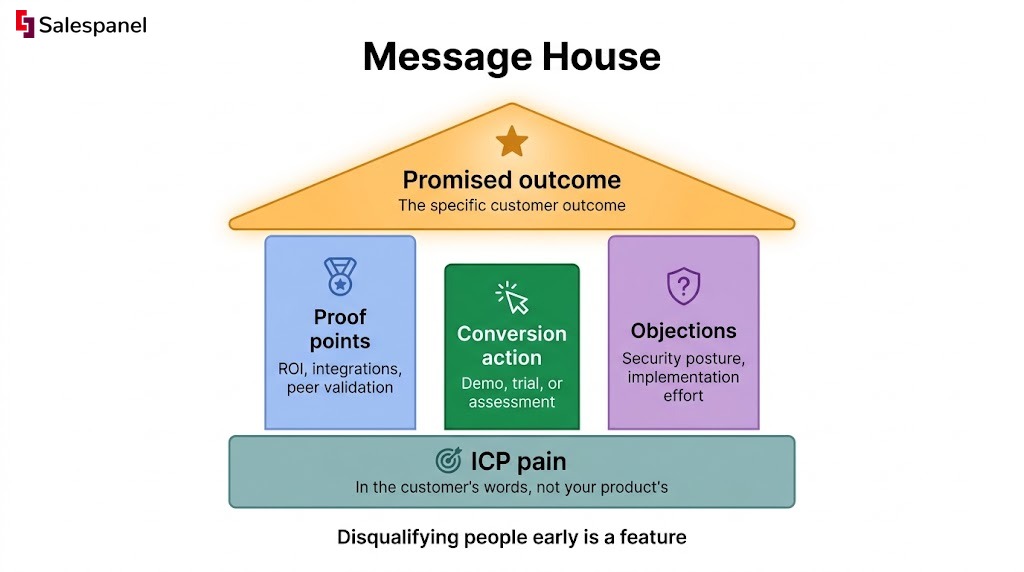
Good SaaS positioning helps a buyer decide whether you fit their problem before they reach your pricing page or book a demo. Disqualifying people early is a feature. The demo calendar fills with worse meetings when the messaging is vague enough that everyone sees themselves in it.
Build the hierarchy in this order: the category or problem you address, the specific customer outcome, the proof, the differentiation, the objections you expect, and the conversion action. Each layer should survive being read on its own.
Source the language from evidence, not from internal feature names. Sales call transcripts, support tickets, win/loss notes, G2 reviews in your category, and the actual search queries in Search Console will tell you what buyers call the problem. If your product page says “unified engagement layer” and every review says “we wanted to know which companies visited our site,” the reviews win.
Variants by audience are fine as long as the core promise does not change. A security reviewer and a demand gen manager need different emphasis, different proof, and different objections handled — the same underlying claim. If you are working on identifying high-intent website visitors, the message for RevOps is about routing hygiene while the message for sales is about context before the call.
Map content to the buying committee
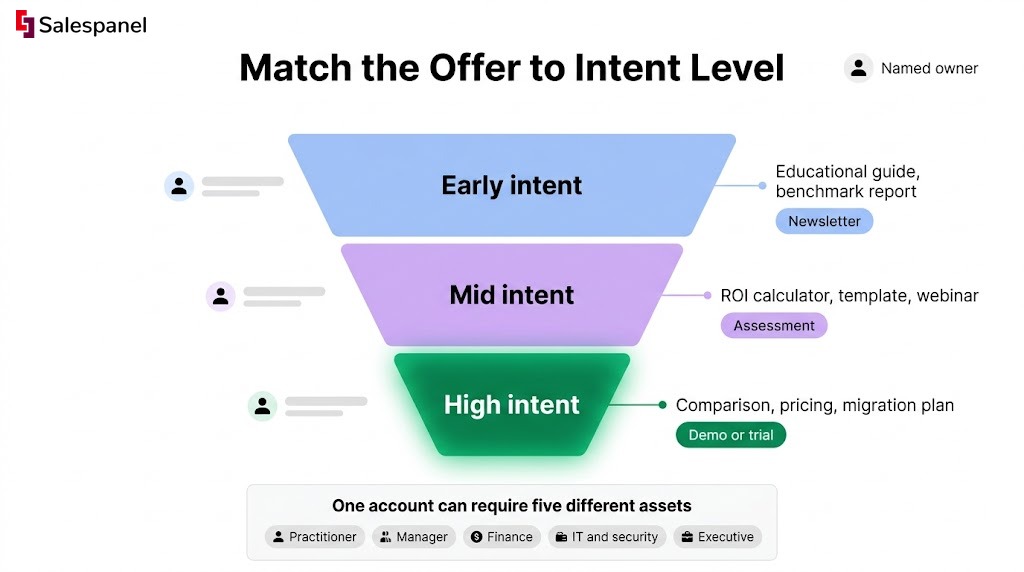
One account can require five different assets. Practitioners want to know how the thing works. Managers want to know what changes in their reporting. Finance wants the cost comparison. IT and security want the data-handling answers. Executives want the outcome in one slide.
Worked example, for visitor intelligence software: demand gen needs pipeline visibility and proof that anonymous traffic converts into named accounts; RevOps needs clean routing rules and CRM field mapping; sales needs account context they can open before a call without logging into another tool. Three assets, one account, one promise.
Match the offer to intent level
- High intent: demo, trial, pricing explanation, migration plan, head-to-head comparison.
- Mid intent: ROI calculator, assessment, template, webinar, implementation checklist.
- Early intent: educational guide, benchmark report, newsletter, practitioner event.
Watch out for: gating everything. If a searcher is still deciding whether the category is worth a budget line, a form in front of the answer sends them to a competitor who left the door open.
Our ideal customer profile and lead scoring guides cover the qualification side of this in more detail.
Step 3: Execute 12 SaaS Marketing Strategies in Three Connected Plays
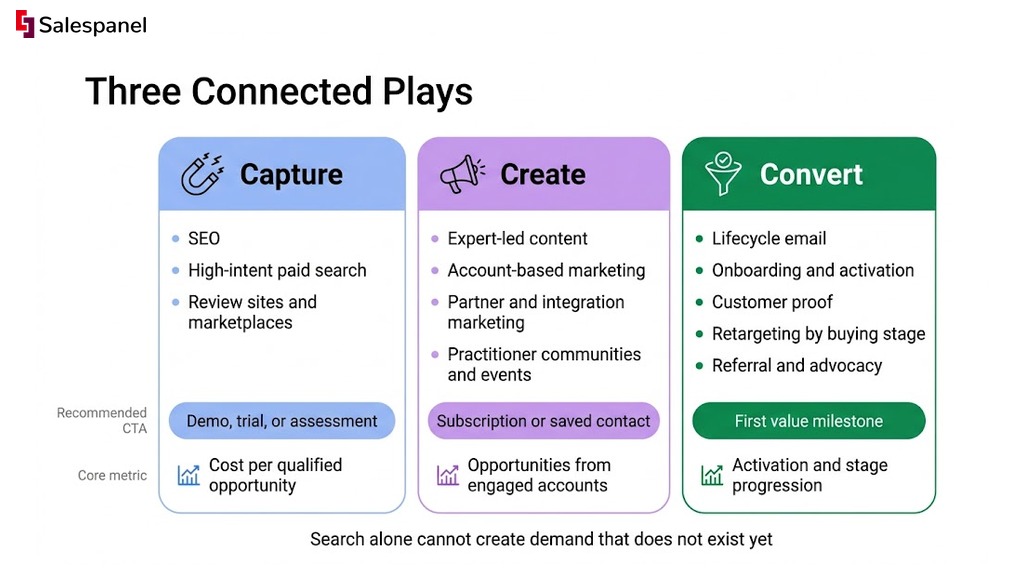
A balanced SaaS program runs three plays at once: demand capture, demand creation, and conversion. Search alone cannot create demand that does not exist yet. Awareness alone produces expensive pipeline with no reliable landing point. Each strategy below follows the same format — when to use it, the first action, the primary conversion, what to measure, and the failure mode that kills it.
Demand capture: 1. SEO for problem, category, and comparison searches
Use this when people already search for your category or the problem it solves. Start by sorting queries into page types: problem-led educational pages, category pages, alternatives and comparison pages, integration pages, use-case pages, and pricing or implementation questions. Match format to intent — a comparison query needs a table and a verdict, not a 2,000-word blog post. Primary conversion is a demo, trial, or assessment placed inside the relevant page. Measure qualified organic conversions, influenced opportunities, and non-branded impressions. Google Search Central’s guidance on people-first content is still the clearest statement of what gets rewarded. Failure mode: reporting total traffic while non-brand conversions stay flat.
Demand capture: 2. High-intent paid search
Use this when you need signal in weeks instead of quarters. Build separate campaigns for category, competitor, alternative, integration, and pain-point searches, because they convert at very different rates and deserve different bids. First action is a landing page per campaign whose headline repeats the query language. Negative-keyword hygiene is weekly work, not a launch-day task. Measure cost per qualified opportunity and pipeline created. Watch out for: routing every paid click to the homepage, which quietly doubles your cost per opportunity.
Demand capture: 3. Review sites and marketplace listings
Use this in established categories where buyers build shortlists before contacting anyone. Complete the profile properly, run a repeatable review-collection process tied to customer milestones, pick the categories you can realistically win, and assign someone to respond to reviews. Listings help buyers validate a shortlist. They do not replace your own conversion path, and traffic from them is rented. Measure assisted opportunities and sourced demo requests by listing source.
Demand creation: 4. Expert-led content distribution
Use this when the people you want cannot be reached through search because they are not looking yet. Turn internal expertise into articles, LinkedIn posts, a newsletter, webinars, and short video — adapted per format, not copy-pasted across all five. Mine sales calls, onboarding questions, implementation tickets, and customer interviews for the objections that recur. Primary conversion is a subscription or a saved contact, not an immediate demo. Measure subscriber quality, returning visitors, demo assists, and opportunities from content-engaged accounts. Failure mode: publishing on a schedule nobody reads because distribution was never planned.
Demand creation: 5. Account-based marketing (ABM)
Use this when ACV justifies per-account effort and the buying group has four or more people. Start with a finite account list — finite meaning you can name every account — then map contacts, identify account-specific signals, and agree on sales follow-up before anything launches. Minimum campaign kit: an account-relevant landing page, one tailored proof asset, a retargeting audience, a sales sequence, and one shared dashboard both teams actually open. Measure account engagement, buying-group coverage, meetings booked, and account progression. Click-through rate on an 80-account program is noise. Our account-based marketing guide covers the operational build.
Demand creation: 6. Partner and integration marketing
Use this when another vendor already has the trust and audience you are trying to build. Co-market with implementation partners, agencies, technology partners, and adjacent SaaS vendors. Before promotion, agree on one shared use case, one co-produced asset, and a written lead-handling agreement covering who follows up and how fast. Measure partner-sourced and partner-influenced pipeline separately, otherwise the program looks better than it is. Failure mode: a joint webinar with no agreed follow-up, which produces a shared list and zero meetings.
Demand creation: 7. Practitioner communities and events
Use this when your buyers trust peers more than vendors, which in RevOps and security is almost always. Niche Slack groups, professional communities, virtual workshops, field dinners, and customer roundtables all work at different scales. Contribute before promoting: answer specific implementation questions, post real examples, and let people find you. Measure qualified conversations, follow-up meetings, and pipeline by event cohort. Failure mode: dropping a product link into a community thread, which costs more credibility than it generates clicks.
Conversion and expansion: 8. Lifecycle email
Use this always — it is the cheapest conversion lever most SaaS teams underbuild. Run separate sequences for new subscribers, demo no-shows, active trial users, stalled evaluations, new customers, and expansion-ready accounts. Trigger on behavior: viewing pricing twice, inviting a teammate, completing setup, or abandoning an activation milestone. Measure activation and stage progression. Open rate tells you about your subject line and nothing beyond that.
Conversion and expansion: 9. Product onboarding and activation campaigns
Use this in any motion where users touch the product before or after purchase. Get marketing, product, and customer success in one room to define the first value milestone — one specific, observable event. Build toward it with setup prompts, checklists, use-case emails, in-app education, and human help for users who stall. Measure time to value, activation rate, and conversion to paid or sales-qualified. Failure mode: onboarding that teaches the interface instead of delivering the outcome the user signed up for.
Conversion and expansion: 10. Customer proof and case-study systems
Use this once you have enough customers to segment. Collect proof by use case, segment, integration, and measurable outcome so sales can pull a relevant story instead of the only story. Run it quarterly: identify candidates from renewal and usage data, validate the claim with real numbers, secure approval, then produce modular assets — a quote, a stat, a one-pager, a full story. Watch out for: vague testimonials that omit context, implementation timeline, or outcome. “Great product, great team” persuades nobody in an evaluation.
Conversion and expansion: 11. Retargeting by buying-stage behavior
Use this when you have enough qualified traffic to segment meaningfully. Build separate audiences for pricing-page visitors, comparison-page visitors, webinar attendees, and high-fit accounts with repeat visits — each gets different creative. Set frequency caps, sequence the messages so the fourth impression is not the first one again, and exclude converted users. Measure carefully: view-through numbers flatter retargeting badly, so do not credit a deal to it without corroborating CRM activity.
Conversion and expansion: 12. Referral and customer advocacy programs
Use this when retention is healthy enough that customers will put their name on a recommendation. Identify promoters through product adoption depth, renewal health, and customer-success input rather than a survey score alone. Mechanics that work in B2B: a warm peer introduction, a co-hosted event, a review request timed to a success moment, or a seat on a customer advisory board. Measure referred pipeline, referral-to-win rate, and time to close — referred deals usually close faster, and that gap is worth quantifying for your own business.
More tactical detail lives in our B2B lead generation strategies guide.
Step 4: Connect Visitor Activity to Qualification and Sales Follow-Up
Marketing cannot improve pipeline conversion while it only records form fills. Most of the evaluation happens before the form and continues after it — comparison pages, pricing visits, a second and third person from the same company showing up two weeks later. If that activity is invisible, follow-up is guesswork.
A lightweight operating model works like this:
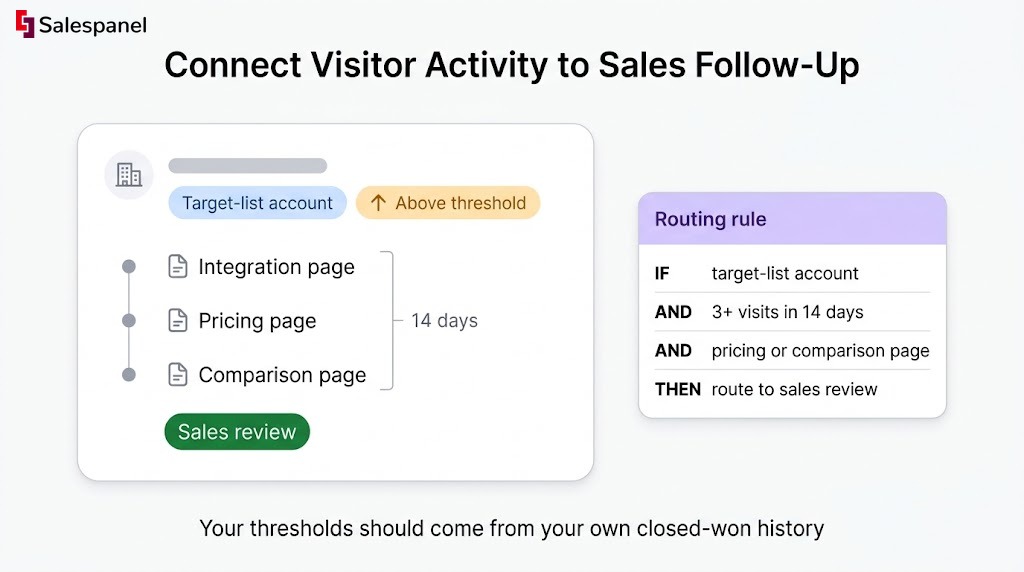
- Identify high-fit accounts visiting key pages.
- Combine fit signals (industry, company size, technology environment) with intent signals (pricing, comparison, integration pages, repeat visits).
- Route accounts based on thresholds and ownership both teams agreed to in writing.
- Hand sales real context: pages viewed, campaign source, known contacts at the account, and a recommended next step.
Define a qualified signal with sales
Here is an illustrative framework, not a universal rule. A target-list account with three or more visits in 14 days that includes a pricing or comparison page probably deserves sales review. One person reading one blog post does not, no matter how good the post was. Your thresholds should come from your own closed-won history.
Then review it weekly. Accepted handoffs, rejected handoffs, and ignored handoffs — the third category is the most informative, because silence usually means the signal was not worth opening.
Where Salespanel fits
If first-party data intelligence is the gap (which means knowing which accounts are on your site and what they are doing there), Salespanel is one option: it identifies and scores both known and anonymous website visitors, enriches account context, and pushes intent signals into the workflows sales and marketing already use. The point is prioritization — working the accounts already showing evaluation behavior before working the list alphabetically. Our lead scoring guide covers the threshold design.
Step 5: Measure SaaS Marketing Strategies by Revenue, Not Channel Vanity Metrics
Reporting should climb a ladder: activity, then response, then pipeline, then revenue — while keeping enough channel detail that you can still make a budget decision at the bottom.
The minimum stack:
- Activity: content published, spend, event attendance, audience growth.
- Response: engaged accounts, qualified leads, trials started, demo requests.
- Pipeline: opportunities created, pipeline value, opportunity conversion rate.
- Revenue: closed-won revenue, retention, and expansion where the strategy touches existing customers.
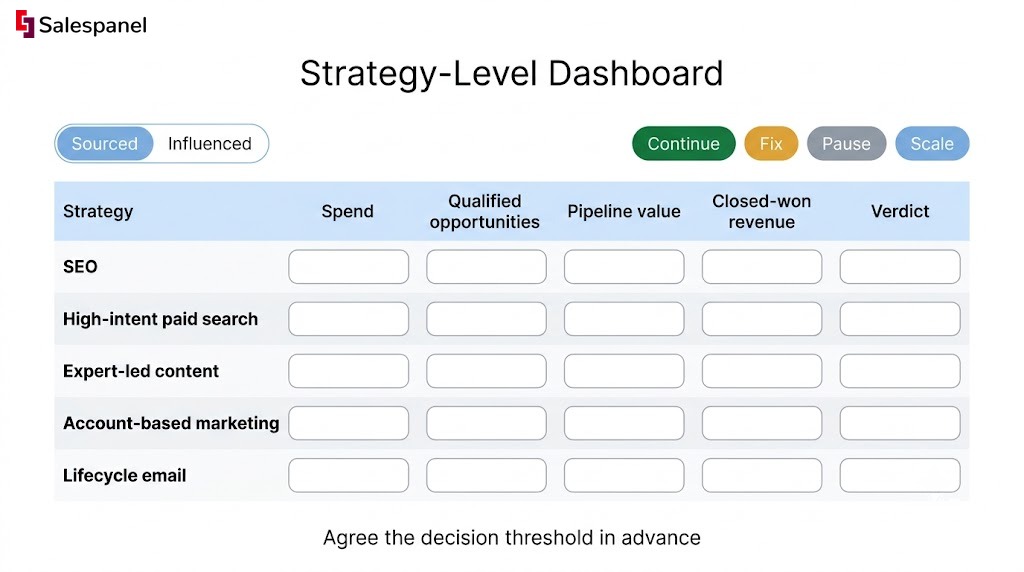
Write down your attribution definition before you report anything. Sourced means the strategy created the opportunity; influenced means it touched an opportunity created elsewhere. Without that written down, three channels will each claim the same deal and your board deck will show more pipeline than your CRM. If you are building this inside a CRM, follow the vendor’s own documentation on campaign objects — Salesforce campaign documentation is the reference point for most B2B setups.
Review monthly with four possible verdicts: continue, fix, pause, or scale. Agree the decision threshold in advance so the review is an arithmetic exercise rather than a debate about who tried hardest.
Watch out for: celebrating cost per lead. A $9 lead source that produces zero accepted opportunities is more expensive than a $400 one that produces four. Our marketing attribution guide covers the modeling side.
Common SaaS Marketing Mistakes to Avoid
Most SaaS marketing waste traces back to three things: weak positioning, broken handoffs between marketing and sales, and metrics that reward volume instead of buyer progress. These five show up most often.
Treating every lead as equally valuable
Fit and behavior both have to influence prioritization. A perfect-fit account reading one page and a terrible-fit student downloading three ebooks will look identical in a volume report and should never get the same follow-up.
Publishing content without a distribution plan
Every major asset needs a documented path to an audience before production starts — search, email, social, partner, sales enablement, or paid. If nobody can name the channel, the asset is a hobby.
Measuring channels in isolation
Buyers touch multiple things before they convert. Consistent campaign naming and CRM discipline are what make the journey inspectable later; retrofitting naming conventions after six months of campaigns rarely works.
Sending sales unqualified intent alerts
Too many alerts train sales to ignore all of them, including the good ones. Calibrate with rejected-lead reasons and tighten the threshold until acceptance rates recover.
Copying competitor strategy lists
Run the scorecard. A strategy is only useful when it matches your motion, your resources, and how your buyers actually behave.
Create Your 90-Day SaaS Marketing Execution Plan
A 90-day plan should produce learning and measurable pipeline movement. Building every channel at once produces neither.
Days 1–30: Diagnose and choose
Audit funnel metrics against your last 90 days, interview sales and customer success about what buyers actually ask, build the scorecard, and select three priorities with named owners.
Days 31–60: Build conversion paths
Launch or fix landing pages and offers, install tracking, write routing rules, and ship the first campaign assets. No scaling yet.
Days 61–90: Run, review, and reallocate
Weekly funnel reviews, one monthly budget decision. Scale only what shows verified qualified-opportunity or pipeline signal — not what feels busy.
Pick one demand-capture strategy, one demand-creation strategy, and one conversion strategy this quarter, and give each one an owner before Friday.
If account-level website visitor tracking and routing is the piece you are missing, Salespanel can identify, score, and route high-intent visitors into the workflows your team already runs.
FAQ: SaaS Marketing Strategies
What are the 5 main marketing strategies?
The five main marketing strategies are market segmentation and positioning, content marketing, search and paid demand capture, lifecycle and retention marketing, and partner or account-based marketing. A SaaS company should choose among them based on its sales motion, customer acquisition cost, the size of its buying committee, and whether buyers already search for its category by name.
What are the types of SaaS?
Common SaaS types include horizontal SaaS, which serves many industries with functions such as CRM or accounting; vertical SaaS, built for one specific industry like healthcare or construction; product-led SaaS, which emphasizes self-serve trial and adoption; and enterprise SaaS, which relies on sales-assisted buying, security reviews, procurement, and implementation support.
What are the six marketing strategies?
Six practical SaaS marketing strategies are SEO, paid search, expert-led content, account-based marketing, lifecycle email, and partner marketing. Together they cover existing demand, future demand, conversion, and expansion. The appropriate mix depends on the SaaS product’s price point, sales cycle length, and how buyers in that category actually research and shortlist vendors.
How many SaaS marketing strategies should a startup use at once?
A SaaS startup should usually run three priority strategies at once: one demand-capture channel, one demand-creation channel, and one conversion or retention program. Running more than three before measurement systems and clear ownership exist tends to spread content production, budget, and sales follow-up capacity too thin to produce a readable signal from any of them.
Sell more, understand your customers’ journey for free!
Sales and Marketing teams spend millions of dollars to bring visitors to your website. But do you track your customer’s journey? Do you know who buys and why?
Around 8% of your website traffic will sign up on your lead forms. What happens to the other 92% of your traffic? Can you identify your visiting accounts? Can you engage and retarget your qualified visitors even if they are not identified?