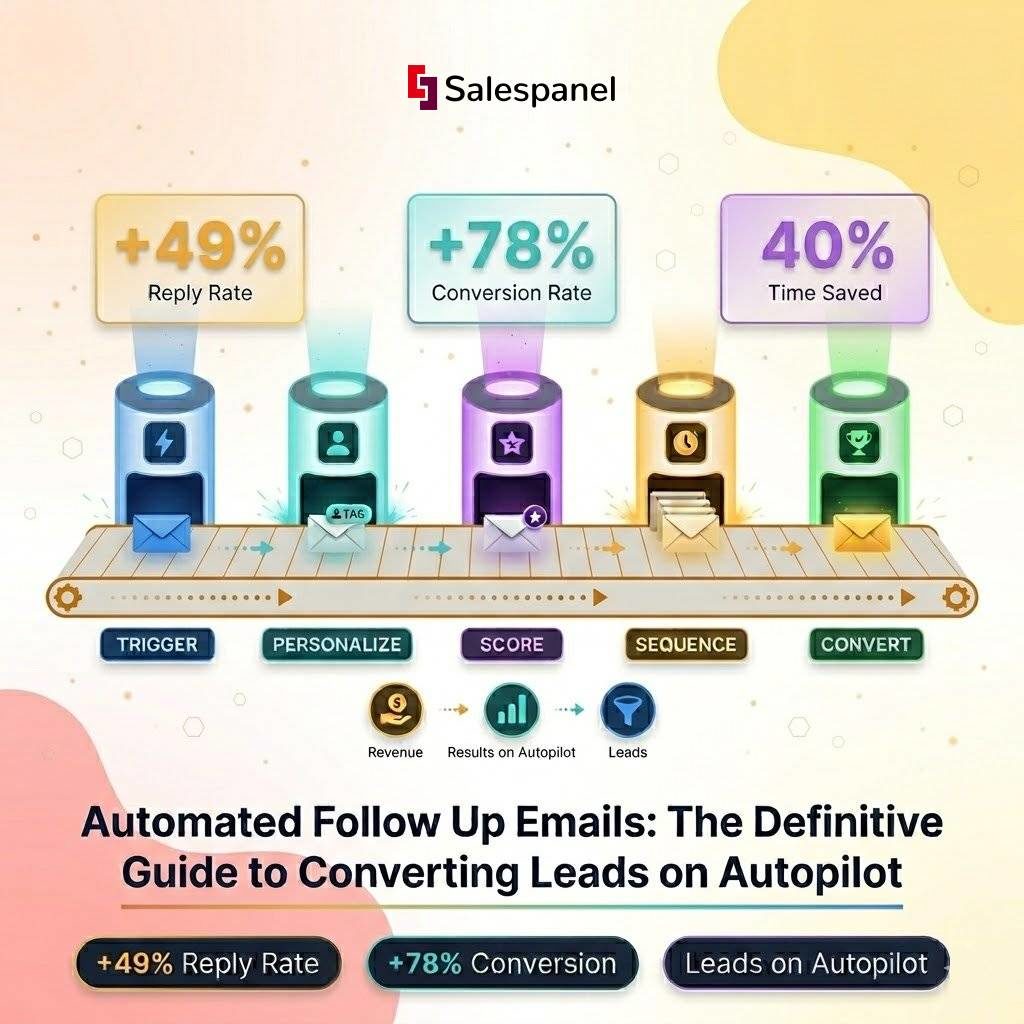
The evolution of email marketing has brought the industry to a critical inflection point. The old paradigm—broadcasting a single, generic message to an entire database—is a relic of the past, increasingly ineffective in an era of digital saturation. Today, relevance is the currency of engagement. The future belongs to marketers who can move beyond mass messaging and master the technical art of segmentation, transforming monolithic lists into dynamic, responsive audiences. The data is unequivocal: marketers who used segmented campaigns noted as much as a 760% increase in revenue. This guide provides an in-depth, journalistic analysis of the strategies and tools required to segment email lists effectively, ensuring your message not only gets delivered but resonates and converts.
Why Generic Email Marketing No Longer Works
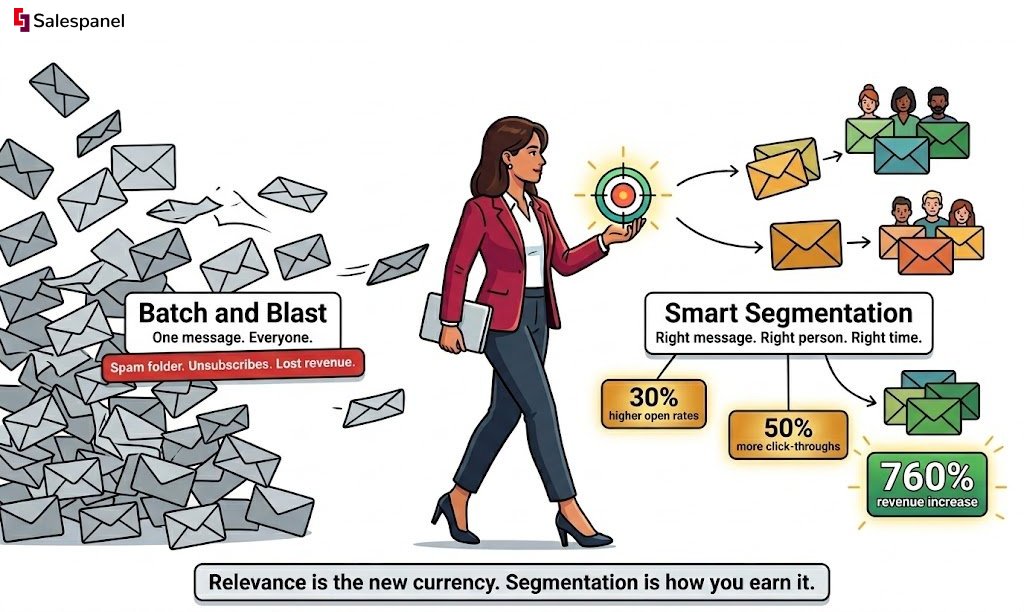
The days of ‘batch and blast’ are over. Historically, the size of a mailing list was a primary metric of success, but in today’s hyper-competitive inboxes, relevance is the sole determinant of performance. Sending a uniform message to all subscribers, irrespective of their interests, purchase history, or on-site behavior, is a direct path to the spam folder and brand irrelevance.
This one-size-fits-all strategy fundamentally fails because an audience is not a monolith. It is a composite of individuals with distinct needs, behaviors, and expectations. Generic campaigns are inherently impersonal, leading to suppressed engagement, high unsubscribe rates, and a significant loss of potential revenue.
The Clear Impact of Personalization
Transitioning from static lists to dynamic, behavior-driven segments has a direct and quantifiable impact on revenue and customer loyalty. When communication is tailored to the recipient, the dynamic shifts from selling a product to solving a specific problem for a specific individual.
The core principle is simple: relevance is the new currency in email marketing, and segmentation is how you earn it. By delivering the right message to the right person at the right time, you transform your email list from a passive audience into an engaged community.
This chart provides a clear visualization of the performance differential between generic broadcasts and targeted campaigns.
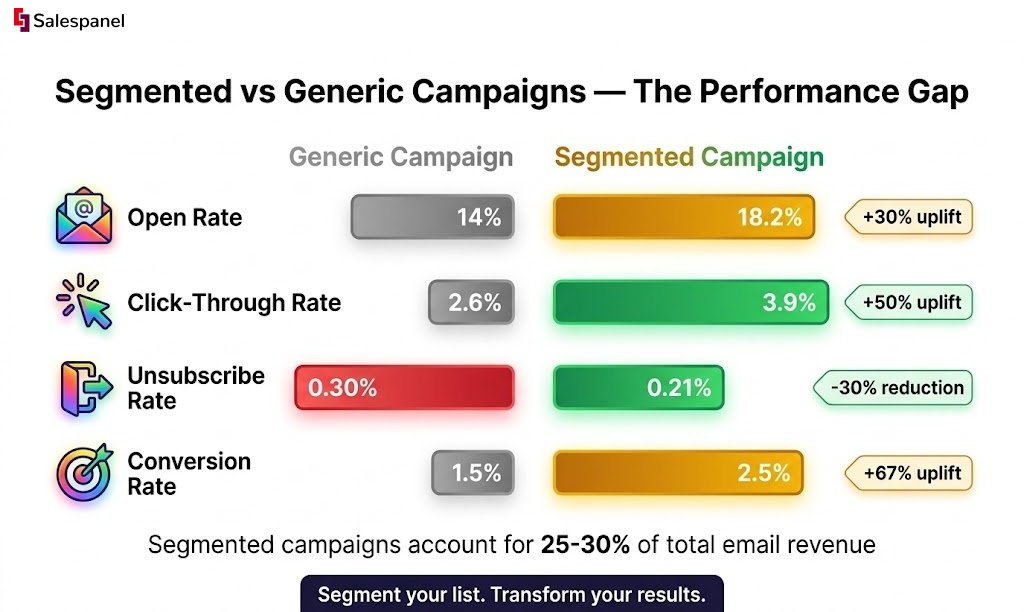
As illustrated, segmented campaigns consistently outperform generic sends across all key engagement metrics, including open rates and click-throughs.
The statistics validate this observation. Segmented campaigns can achieve 30% higher open rates and 50% more click-throughs. More critically, these highly targeted lists can account for 25–30% of a company’s total email marketing revenue. This establishes a direct correlation between relevance and financial results.
Here is a more granular breakdown of the performance uplift, based on average industry data.
Impact of Segmentation on Key Email Metrics
| Metric | Non-Segmented Campaign (Average) | Segmented Campaign (Average) | Performance Uplift |
|---|---|---|---|
| Open Rate | 14% | 18.2% | +30% |
| Click-Through Rate (CTR) | 2.6% | 3.9% | +50% |
| Unsubscribe Rate | 0.30% | 0.21% | -30% |
| Conversion Rate | 1.5% | 2.5% | +67% |
The data presents an undeniable conclusion: segmentation is not an optional tactic but a foundational strategy for optimizing every significant email metric, from engagement to conversion, while simultaneously mitigating list churn.
Of course, segmentation is only one component. To maximize the value of email outreach, particularly for complex sales funnels, a robust follow-up strategy is essential. Mastering Email Marketing Sequences is the logical next step. Once you have identified the correct audience segment, a well-structured sequence ensures your message is delivered with maximum impact.
Laying the Groundwork with Foundational Segments
Before architecting complex, automated email workflows, it is imperative to establish a solid foundation. This begins with constructing essential segments based on the core demographic and firmographic data already available for your subscribers.
Consider these initial groupings as the foundational building blocks of your segmentation architecture. They provide immediate utility and create the necessary structure for more sophisticated strategies.
Who Are They? Demographics and Firmographics
For B2C organizations, demographic data is fundamental. This comprises standard profile attributes that define your subscribers.
- Geography: Segmenting by city, state, or country enables the deployment of location-specific promotions, event invitations, and culturally relevant content.
- Age and Gender: A practical example is an apparel retailer using age and gender segments to ensure new collections are marketed to the most appropriate audience, immediately increasing message potency.
In a B2B context, firmographic data serves the same purpose, categorizing subscribers based on their professional attributes.
- Industry: A SaaS provider’s value proposition for the financial sector must differ significantly from its messaging for healthcare. Industry segmentation allows for the precise highlighting of relevant features and benefits.
- Company Size: The operational challenges of a startup bear little resemblance to those of a large enterprise. Segmenting by employee count facilitates messaging that addresses these unique pain points directly.
- Job Title: Communication directed at a CEO should be strategic, focusing on ROI and business impact. In contrast, messaging for a marketing manager can be more tactical, delving into specific features and implementation details.
Why Do They Care? Psychographic Segmentation
While demographics identify who is on your list, psychographic data uncovers why they might purchase. This involves grouping individuals based on shared interests, values, and lifestyle attributes.
Practical Example: An outdoor equipment company can create a segment for “Eco-Conscious Adventurers,” comprising subscribers who have historically purchased or engaged with content related to sustainable products. This enables hyper-targeted campaigns that resonate on a deeper, value-aligned level.
The Takeaway: This foundational layer is the first step in shifting from impersonal broadcasts to meaningful conversations with distinct audience groups. It is the mechanism by which you demonstrate an understanding of your audience, a prerequisite for building trust and driving action.
Using Behavior to Drive Conversions
Moving beyond static attributes, behavioral segmentation analyzes what subscribers do. This is the fulcrum upon which high-performing email campaigns are built. We are now creating dynamic segments based on concrete actions—the digital footprints individuals leave across your web properties.
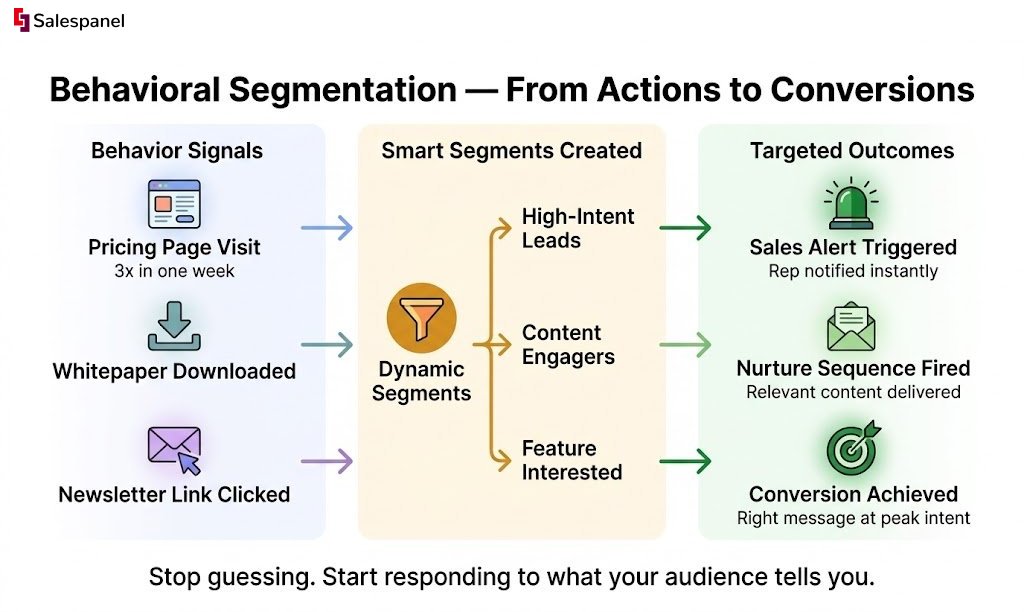
This methodology permits an extraordinary level of communication precision. You can message frequent buyers differently than one-time purchasers, offering loyalty incentives to the former and re-engagement campaigns to the latter. The objective is to respond to their actions with relevant, timely communication that guides them toward the next logical step in their journey.
Tying Website Activity to Your Email Strategy
Tracking on-site user behavior is one of the most powerful methods of behavioral segmentation. A subscriber’s page-view history provides a direct window into their specific interests and, critically, their purchase intent. This requires a modern marketing automation tool.
For instance, website visitor tracking from Salespanel provides this exact capability. It allows you to monitor which pages a lead visits even before they subscribe. Upon opt-in, this historical data is automatically used to place them in the appropriate segment.
Here are practical applications of this technology:
- Visited Pricing Page: A user who repeatedly visits your pricing page is exhibiting high purchase intent. They should be automatically added to a “High-Intent” segment, triggering either a direct sales follow-up or a targeted case study designed to substantiate value.
- Viewed Specific Service Page: A lead who dedicates significant time to your “Enterprise Solutions” page has vastly different requirements than one exploring “Small Business Plans.” Segmenting based on this activity enables the delivery of content that directly addresses their specific challenges.
- Clicked a Link in a Newsletter: A subscriber clicking a link about a new product feature is explicitly signaling interest. This single action can trigger an automated follow-up sequence that provides a deeper dive into that feature, complete with tutorials or testimonials.
The Takeaway: By connecting on-site behavior to your email strategy, you eliminate guesswork. You begin responding to the explicit signals your audience provides through their clicks and page views, creating a more intelligent and effective marketing apparatus.
Real-World Scenario: Tackling Cart Abandonment
A classic and highly effective application of behavioral segmentation is the abandoned cart workflow. An e-commerce system can be configured to create a dynamic segment of all subscribers who add an item to their cart but fail to complete the purchase within a set timeframe (e.g., one hour).
This action triggers an automated email sequence.
- Email 1 (1 hour post-abandonment): A simple reminder, “Did you forget something?”
- Email 2 (24 hours post-abandonment): If no action is taken, a second email can be deployed. This might include a small discount or customer reviews for the abandoned item to build trust and urgency. This technical workflow consistently recovers otherwise lost revenue.
Applying Lead Scoring to Your Segments
While behavioral segmentation identifies what subscribers are interested in, it doesn’t always quantify their readiness to purchase. This is the function of lead scoring, a critical layer that helps prioritize high-value prospects.
Instead of treating all leads equally, you assign numerical values based on a combination of their demographic/firmographic profile and their on-site behavior. This process creates a quantifiable hierarchy, distinguishing casually interested browsers from sales-ready prospects.
Combining Demographics and Behavior for Smarter Scores
An effective lead scoring model must synthesize explicit data (what they tell you) and implicit data (what their actions reveal). Points should be assigned for both static attributes and dynamic behaviors.
Here is a practical model:
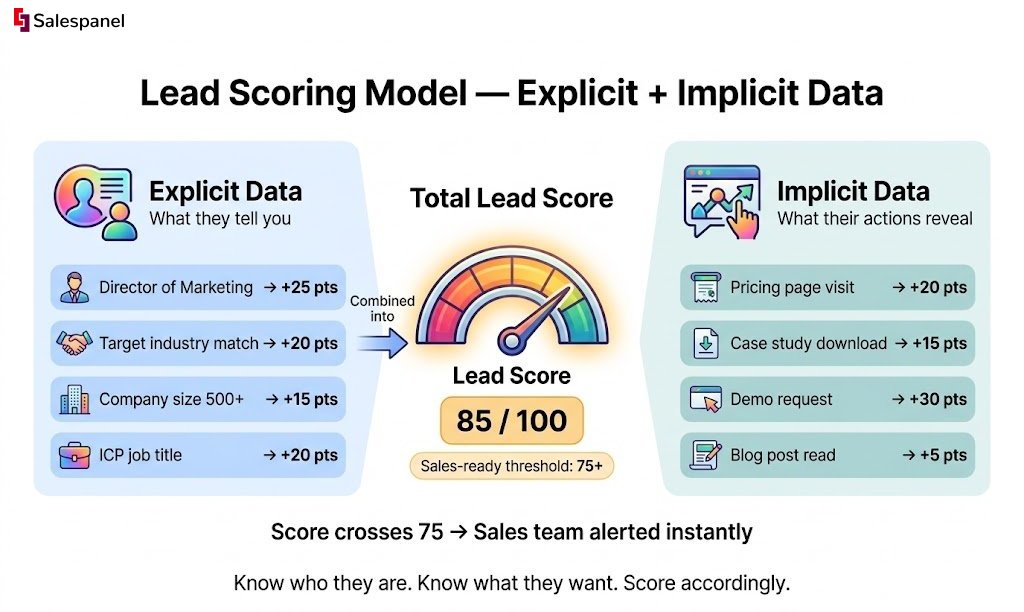
- Explicit Data (Who They Are): Assign higher scores to leads matching your Ideal Customer Profile (ICP). A Director of Marketing in a target industry might receive +25 points, whereas an intern from a non-target vertical might receive +5 points.
- Implicit Data (What They Do): Score actions based on demonstrated intent. Downloading a detailed case study (+15 points) signals stronger intent than reading a single blog post (+5 points).
This dual-input model provides a more accurate assessment. For instance, a junior employee who visits your pricing page three times could represent a hotter lead than a C-level executive who only opened one introductory email.
The Takeaway: The goal is to create a dynamic score reflecting a lead’s true position in the buyer’s journey. This moves beyond simplistic labels, enabling sales teams to focus their resources where they will have the greatest impact. Salespanel’s lead scoring framework allows you to automate this entire process, setting rules to alert sales teams the moment a lead crosses a defined point threshold, ensuring engagement at the peak of their interest. To streamline this process, specialized lead scoring software is essential for managing this complexity at scale.
Separating Leads by Lifecycle Stage
Communication must be contextual. You would not engage a new subscriber with the same message as a long-term, loyal customer. Segmenting contacts by their lifecycle stage is therefore essential. This methodology ensures you are not prematurely pushing for a sale or delivering redundant introductory content to experienced users.
This approach organizes your audience based on their relationship with your brand, facilitating more relevant and timely interactions. Each stage requires a distinct communication strategy to guide them effectively to the next.
Defining Key Lifecycle Segments
The primary objective is to align your message with the subscriber’s current status. Proper alignment dramatically improves the customer experience.
These are the essential lifecycle stages for segmentation:
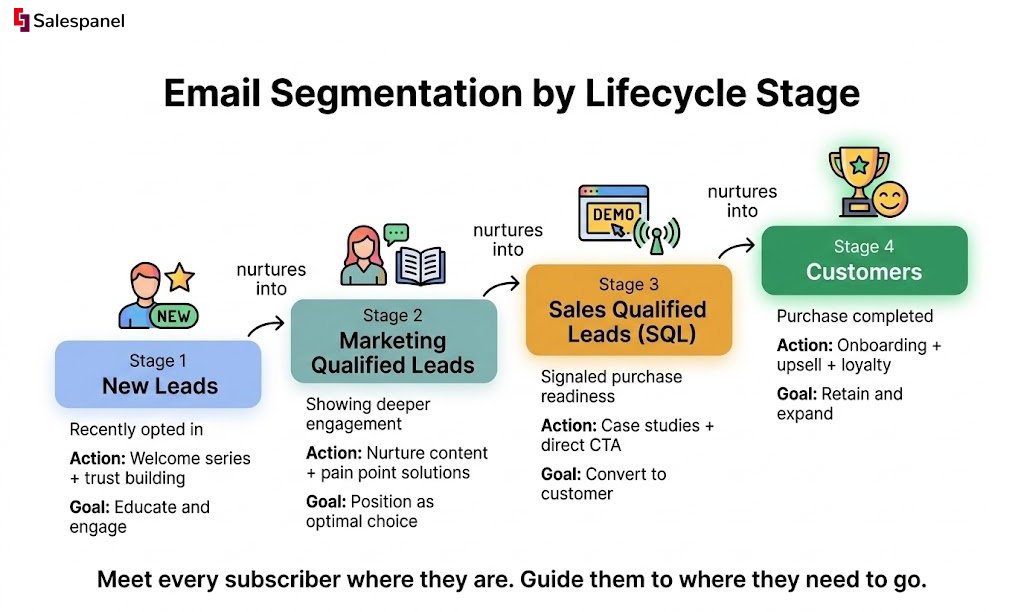
- New Leads: Individuals who have recently opted in. The goal is education and trust-building. A well-architected welcome email series is the primary tool here, introducing the brand and delivering initial value.
- Marketing Qualified Leads (MQLs): An MQL has demonstrated deeper engagement, such as downloading a gated asset or repeatedly visiting a key service page. This segment requires lead nurturing content that addresses their pain points and positions your solution as the optimal choice.
- Sales Qualified Leads (SQLs): An SQL has signaled purchase readiness, perhaps by requesting a demo or spending significant time on the pricing page. Messaging must become more direct, featuring case studies, testimonials, or a direct call-to-action for a consultation.
- Customers: These contacts have completed a purchase. The objective shifts from acquisition to retention and expansion. This audience should receive onboarding content, exclusive offers, feedback requests, and campaigns to upsell or cross-sell complementary products.
The Takeaway: When email content aligns with a subscriber’s lifecycle stage, you create a persuasive and logical journey. This structured approach respects their current relationship with your brand and is far more effective at nurturing them into long-term advocates.
Don’t Make These Common Segmentation Mistakes
The benefits of email list segmentation are significant, but implementation is fraught with common pitfalls. Marketers often fall into one of two traps: “analysis paralysis,” where they are overwhelmed by data and fail to act, or the opposite extreme of over-segmentation.
Over-segmenting is the practice of creating an excessive number of hyper-specific lists. While the intent—perfect personalization—is commendable, the result is a logistical nightmare. These micro-segments are often too small to yield statistically significant data, making it impossible to evaluate performance. Furthermore, the content creation burden becomes unsustainable.
The solution is to begin with a focused approach. Target one or two high-impact segments directly tied to primary business objectives.
Overcoming Data and Tech Hurdles
Another significant barrier is perceived complexity. Despite the clear advantages, a technology and skills gap persists. Industry data shows that only about 15% of marketers fully leverage email list segmentation. This represents a massive competitive opportunity, especially when considering that segmented campaigns can lead to 20% lower unsubscribe rates.
What causes this hesitation? While 51% of marketers acknowledge segmentation’s high effectiveness, many are deterred by the prospect of manual execution. You can explore these email segmentation statistics to see the full scope of the impact.
The Takeaway: The most practical advice is to avoid trying to “boil the ocean.” Instead of building a dozen segments simultaneously, select a single, clear business problem—such as re-engaging inactive subscribers or nurturing high-intent leads—and build one powerful, automated segment to address that specific goal. This is where modern marketing platforms are indispensable. At Salespanel, our philosophy is to build powerful, automated tools to handle this heavy lifting, allowing you to implement a sophisticated, scalable strategy without requiring a large operational team.
A Few Lingering Questions
Still have technical or strategic questions? Here are answers to some of the most common queries from marketers implementing segmentation for the first time.
How Many Segments Should I Create?
There is no universal number. A practical starting point is 3-5 broad, high-impact segments that align with core business goals. Examples include new subscribers, active customers, and inactive contacts.
The critical technical requirement is that each segment must be large enough to provide statistically significant data. It is far more effective to have a few well-defined, high-performing segments than dozens of micro-segments that are impossible to manage or measure effectively.
What’s the Difference Between a List and a Segment?
The distinction is fundamental to modern email marketing.
A list is a static container of subscribers, typically grouped by their acquisition source (e.g. “Newsletter Subscribers”). It remains unchanged unless manually modified.
A segment, in contrast, is dynamic. It is a group defined by a set of rules based on subscriber attributes or actions. For example, a segment could be defined as “Subscribers in California who purchased in the last 60 days.” The key advantage is that segments update automatically as subscriber data changes, making them an incredibly powerful tool for automated, real-time marketing.
How Do I Re-Engage an Inactive Segment?
First, you must define “inactive” based on your business cycle. A common metric is no email opens within the last 90 days.
Once defined, create a dedicated re-engagement campaign for this segment. The subject line must be compelling, such as, “Is this goodbye?”
The email content should provide a clear incentive to remain subscribed. This could be a special offer, a request for feedback, or a reminder of the value you provide. If the subscriber remains unresponsive after a multi-touch campaign, you have two options: move them to a low-frequency mailing list or—critically for deliverability—remove them entirely to protect your sender reputation.
At Salespanel, our philosophy is that a deep, data-driven understanding of your audience is the cornerstone of sustainable growth. Our platform provides the technical tools to track visitor behavior, implement lead scoring, and build the dynamic segments necessary to deliver the right message at the right time. Ready to build a more intelligent marketing strategy? Explore our resources to learn more. Find out more at.