Email automation has transformed from a simple convenience into a critical revenue engine. A decade ago, a basic welcome series was considered advanced. Today, competitors are deploying behavior-triggered, hyper-personalized journeys that nurture leads from their first website visit to the final sale. In B2B, where sales cycles are long and complex, generic messaging no longer cuts it.
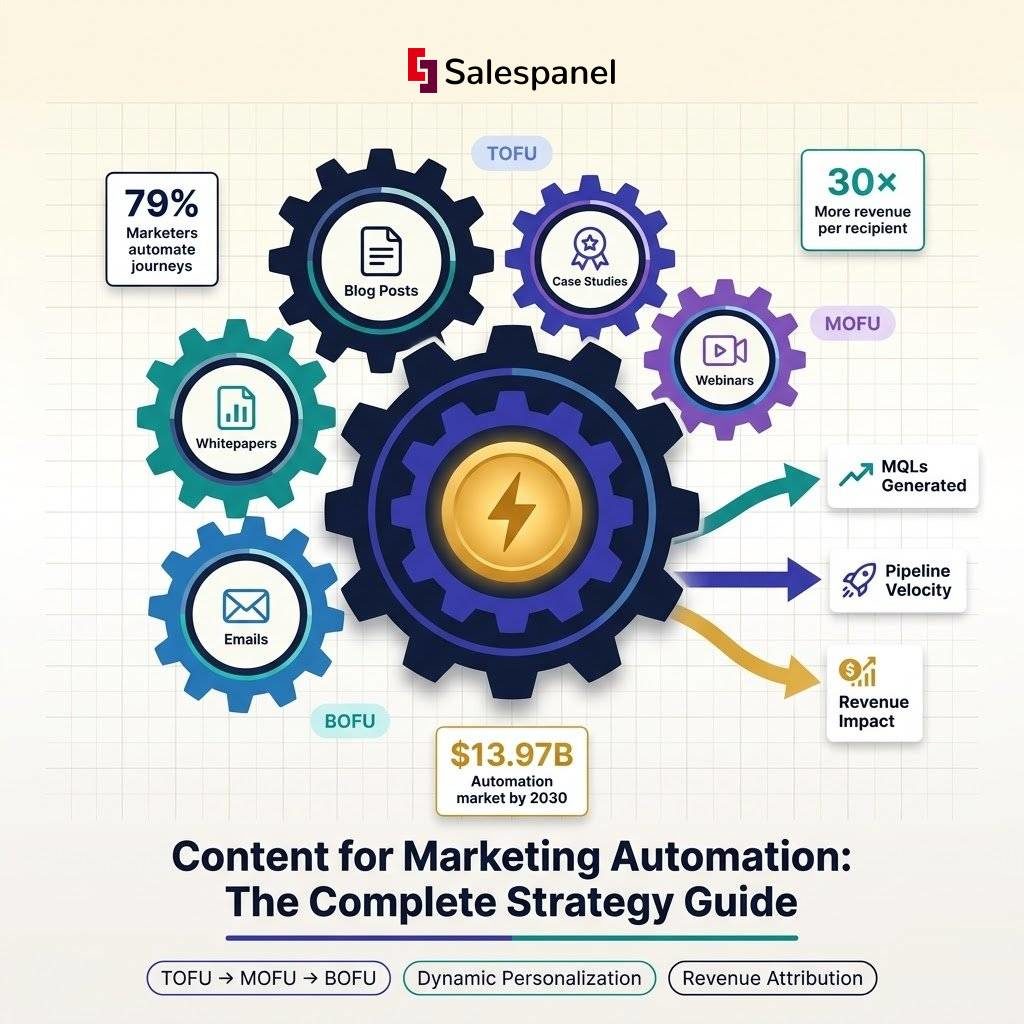
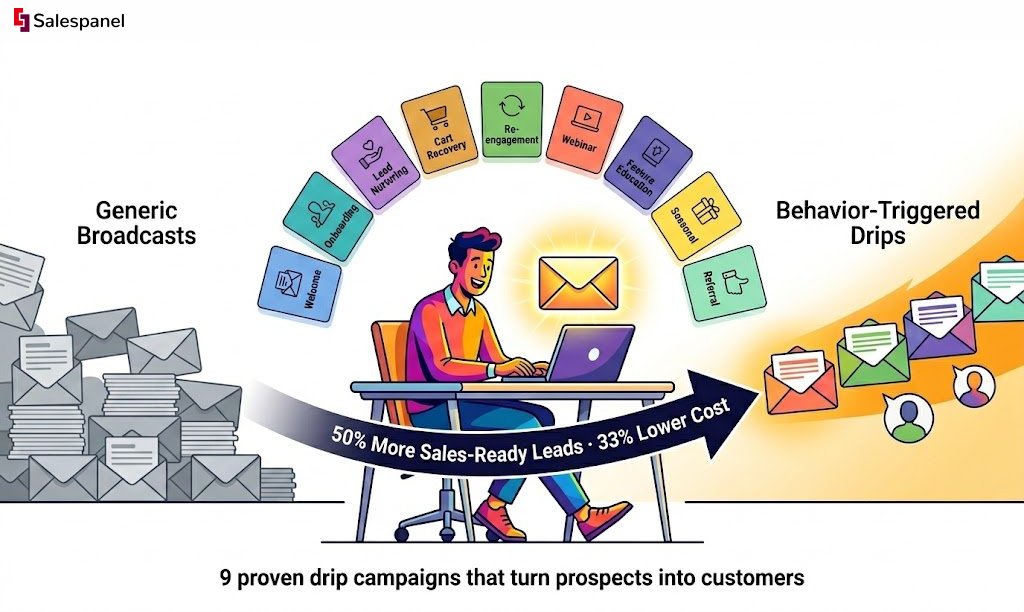
Companies leveraging sophisticated drip campaigns see 50% more sales-ready leads at a 33% lower cost, a clear indicator that intelligent automation drives significant ROI. This article moves beyond theory, dissecting 9 real-world B2B email drip campaign examples to provide a replicable blueprint for your marketing strategy. We will break down the strategic objective, the technical workflow, and the precise messaging behind each campaign.
You will learn how to build automated systems that convert anonymous visitors, identified through tools like website visitor tracking from Salespanel, into high-value customers. The future of B2B marketing isn’t just sending emails; it’s about initiating intelligent, automated conversations at scale. This is your practical guide to mastering them.
1. Welcome Series for New Subscribers
A welcome series is arguably the most crucial of all email drip campaign examples. It’s a foundational sequence triggered immediately after a user subscribes to your list, registers for an account, or requests a demo. This initial interaction is your best opportunity to make a strong first impression, set clear expectations, and guide new contacts toward their first “aha!” moment with your brand. The primary goal is to capitalize on the high engagement rates typical of new subscribers, transforming initial interest into lasting brand affinity.
A practical example is Grammarly’s welcome series. Upon signup, the first email doesn’t just confirm the subscription; it immediately demonstrates value by providing a simple writing tip. Subsequent emails systematically introduce features like the browser extension and tone detection, guiding the user toward deeper product adoption. This works because each email delivers immediate, tangible value, validating the user’s decision to subscribe.
Strategic Breakdown
- Objective: Nurture new leads, increase user activation, and reduce initial churn. The campaign aims to build trust and educate subscribers on the value proposition right away.
- Workflow Trigger: A user submits a form (e.g., newsletter signup, account creation).
- Key Tactic: Send the first email instantly. A delay of even a few minutes can cause a significant drop in open rates, as the subscriber’s attention has already moved elsewhere.
Actionable Takeaways
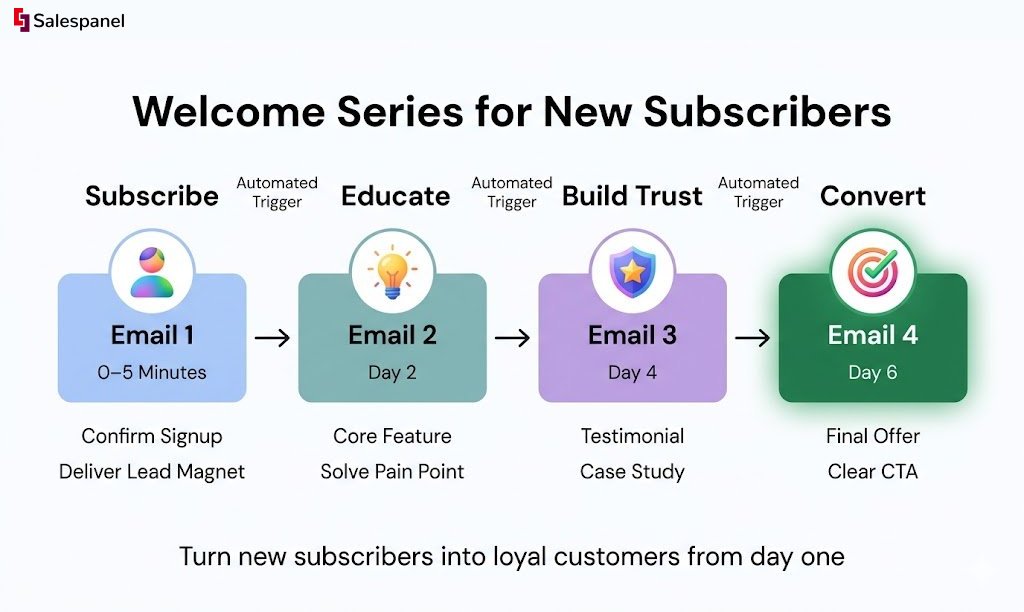
- Email 1 (0-5 minutes): Instantly confirm the subscription and deliver the promised lead magnet or resource. Include a warm welcome and a single, clear call-to-action (CTA) like “Log in to Your Account” or “Read Our Getting Started Guide.”
- Email 2 (Day 2): Introduce a core product feature or share a key piece of educational content that solves a common pain point for your audience.
- Email 3 (Day 4): Build credibility by sharing social proof, such as a customer testimonial, case study, or impressive user statistic.
- Email 4 (Day 6): Nudge the user toward a specific action with a final offer or a clear next step. You can refine this outreach by integrating data from powerful email outreach tools to personalize the messaging based on user behavior.
2. Post-Purchase/Onboarding Drip Campaign
A post-purchase drip campaign is a critical sequence sent immediately after a customer makes a purchase. Its purpose extends beyond a simple transaction receipt; it’s designed to reaffirm the customer’s decision, set expectations for delivery and usage, and begin the transition from a one-time buyer into a loyal advocate. The primary goal is to combat buyer’s remorse and enhance the customer experience, paving the way for repeat business and higher customer lifetime value.
Peloton’s onboarding series for new members offers a technical masterclass. The first email confirms the purchase and provides a delivery timeline. Subsequent emails are not random; they are timed to coincide with the bike’s arrival, offering setup guides, class recommendations based on fitness goals, and community introductions. This campaign succeeds because it provides continuous, context-aware value after the sale is complete.
Strategic Breakdown
- Objective: Increase customer satisfaction, reduce returns, and drive repeat purchases. This campaign focuses on reinforcing the value of the purchase and building a long-term relationship.
- Workflow Trigger: A customer completes a purchase or a new user signs up for a paid service.
- Key Tactic: Shift the focus from selling to supporting. The post-purchase phase is about demonstrating that you care about the customer’s success with your product, not just their initial transaction.
Actionable Takeaways
- Email 1 (0-1 hour): Send an immediate order confirmation with all key details: order number, items purchased, total cost, and shipping address. This reassures the customer that their purchase was successful.
- Email 2 (24-48 hours): Provide a shipping notification with a tracking number. This proactive communication manages expectations and reduces support inquiries.
- Email 3 (Day 5-7): Offer product tips, setup guides, or best practices to help the customer get the most out of their purchase.
- Email 4 (Day 14): Nudge the customer toward deeper engagement by sharing complementary products or asking for a review once they’ve had sufficient time with the product.
3. Lead Nurturing Campaign for B2B Sales Funnels
A B2B lead nurturing campaign is a sophisticated, longer-term sequence designed to guide qualified leads through a complex sales funnel. Unlike a short welcome series, this drip campaign methodically builds a relationship by delivering targeted, educational content over weeks or even months. The primary goal is to establish trust, demonstrate expertise, and keep your brand top-of-mind, warming up prospects until they are ready for a sales conversation. This is one of the most vital email drip campaign examples for businesses with long B2B sales cycles.
Marketo, a marketing automation platform, provides a textbook example. After a user downloads a whitepaper on lead generation, Marketo’s drip campaign doesn’t immediately push a demo. Instead, it sends a follow-up email with a related case study, then another with a webinar recording on ROI analysis. This approach works by positioning them as a trusted advisor, not just a vendor, making the eventual sales handoff smoother and more effective.
Strategic Breakdown
- Objective: Educate and build trust with marketing-qualified leads (MQLs), moving them toward a sales-ready state (SQL) without aggressive sales pressure.
- Workflow Trigger: A lead downloads a middle-of-funnel asset (e.g., a whitepaper, case study, or webinar recording).
- Key Tactic: Use lead scoring to track engagement. Assign points for email opens, link clicks, and website visits to identify the most engaged prospects who are ready for sales outreach.
Actionable Takeaways
- Email 1 (Day 1): Deliver the requested asset immediately. Follow up with a concise message that frames the problem your asset helps solve and hints at future valuable content.
- Email 2 (Day 5): Share a related customer success story or case study. Use social proof to show how a similar company solved the exact pain point your lead is researching.
- Email 3 (Day 10): Offer a different content format, such as a webinar recording or an ROI calculator. This caters to different learning preferences and deepens their understanding of the solution. For businesses looking to dive deeper into automating their lead engagement, this comprehensive resource offers valuable insights into effective Marketing Automation Lead Nurturing Guide.
- Email 4 (Day 15): Introduce a soft call-to-action (CTA), like an invitation to a product demo or a “15-minute strategy call.” This email is often triggered only after the lead’s score has reached a specific threshold, ensuring the sales team connects with genuinely interested prospects.
4. Abandoned Cart Recovery Campaign
An abandoned cart recovery campaign is a high-impact, automated email sequence sent to users who add items to their online shopping cart but leave without completing the purchase. This behavior is incredibly common, with studies showing cart abandonment rates hovering around 70%. This drip campaign is designed to bring those potential customers back by reminding them of their items, addressing potential hesitations, and providing a gentle nudge toward checkout. The primary goal is to recover potentially lost revenue by re-engaging users at a moment of high buying intent.
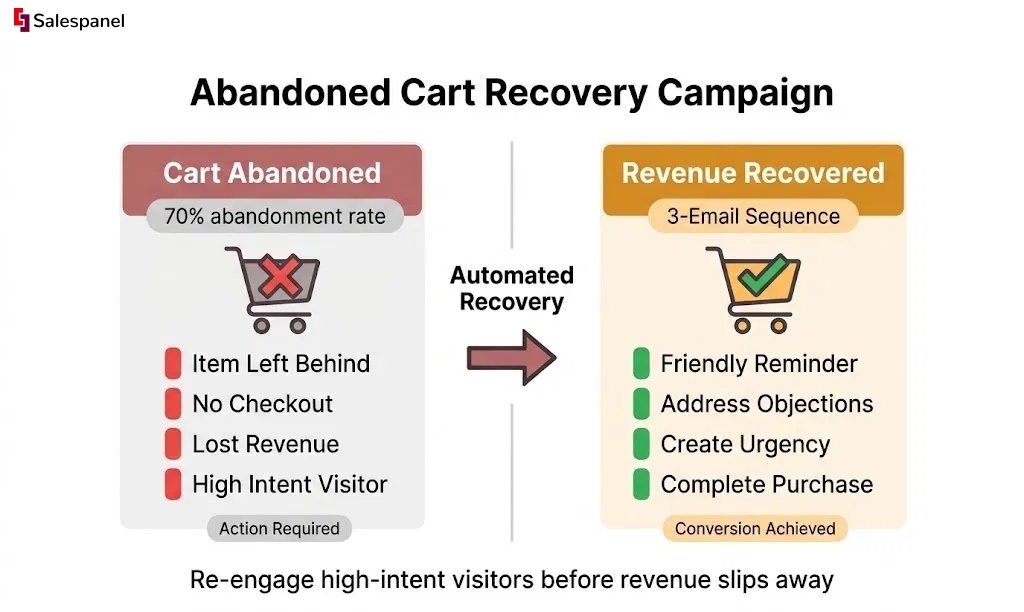
A great practical example is from the online retailer ASOS. Their first abandoned cart email is a simple, visual reminder of the items left behind. If the user doesn’t convert, the second email often introduces a subtle incentive, like free shipping, addressing a common friction point. The third and final email creates urgency with a time-sensitive discount. This multi-touch approach is successful because it escalates the incentive, addressing different reasons for abandonment from simple forgetfulness to price sensitivity.
Strategic Breakdown
- Objective: Recover lost sales, increase conversion rates, and understand common purchase objections. The campaign aims to re-engage high-intent visitors and guide them back to the checkout process.
- Workflow Trigger: A known user adds a product to their cart but does not complete the purchase within a predefined time (e.g., 60 minutes).
- Key Tactic: Personalization is non-negotiable. Dynamically insert images, names, and links to the specific products the user left in their cart to create a highly relevant and compelling reminder.
Actionable Takeaways
- Email 1 (1-2 Hours): Send a simple, friendly reminder. Ask if they had trouble checking out and include clear images of the cart items with a direct link back to their cart. Avoid discounts at this stage.
- Email 2 (24 Hours): Address potential barriers. Offer help via customer support, highlight free shipping if available, and consider introducing a small, time-sensitive incentive like a 10% discount to overcome price hesitation.
- Email 3 (48 Hours): Create a sense of urgency. This is your final attempt, so emphasize that the discount is expiring or that the items may go out of stock. A clear “Complete Your Order Now” CTA is essential.
- Email 4 (Optional): Segment users who still haven’t purchased and add them to a different nurture sequence. You can leverage powerful email outreach tools to manage these segments and tailor future communications based on their browsing history.
5. Re-engagement Campaign for Inactive Subscribers
A re-engagement campaign, often called a win-back series, is a vital tool for managing list health and rekindling relationships with disengaged subscribers. This automated sequence targets contacts who have stopped opening or clicking your emails, typically for 60 to 90 days. Instead of letting these subscribers go cold, the campaign aims to remind them of your value, showcase what they’ve missed, and ultimately either bring them back into the fold or cleanly remove them from your active list.
Netflix provides a classic example, sending playful “We miss you” emails that highlight new, popular content tailored to the user’s past viewing history. The technical execution is key: the email isn’t just generic but dynamically populated with shows the user is likely to enjoy. This campaign is effective because it combines a light, emotional appeal with a data-driven value proposition, making it tempting for users to return. This strategy is a prime example of how targeted email drip campaign examples can revive potential revenue and improve deliverability.
Strategic Breakdown
- Objective: Reactivate dormant subscribers, improve overall email engagement metrics, and maintain a clean, high-quality email list to improve deliverability.
- Workflow Trigger: A contact has not opened or clicked an email in a predefined period (e.g., 90 days).
- Key Tactic: Use a compelling, attention-grabbing subject line that directly addresses their absence, like “Is This Goodbye?” or “Still Interested?” This initial interaction must cut through the noise to have any chance of success.
Actionable Takeaways
- Email 1 (Day 1): Send a simple, direct “we miss you” email. Acknowledge their absence and ask if they still want to hear from you.
- Email 2 (Day 3): Remind them of the value you offer. Showcase new features, top-performing content, or recent product updates they might have missed.
- Email 3 (Day 7): Present an exclusive incentive. This could be a discount, a free resource, or early access to a new feature to entice them back.
- Email 4 (Day 14): The final attempt. This email should clearly state that you will be unsubscribing them if they don’t take action, providing one last, easy link to stay on the list. This respects their inbox and cleans your list.
6. Educational Webinar/Event Promotion Series
An educational webinar or event promotion series is a time-sensitive drip campaign designed to maximize attendance for a live or virtual event. This multi-phase sequence builds anticipation, drives registrations, and ensures attendees show up by delivering a steady stream of information and reminders. The goal is to convert initial interest into a committed attendee by showcasing the event’s value, speakers, and key learning outcomes over several weeks.
HubSpot executes this flawlessly. For a webinar on “SEO in 2025,” their campaign starts with an announcement email focused on the high-level topic. The second email introduces the expert speakers and their credentials. A third email details the specific agenda and key takeaways. Finally, a series of reminders on the day before and the hour of the event drive attendance. This campaign is effective because it systematically builds value and uses timed reminders to combat the natural tendency for registrants to forget.
Strategic Breakdown
- Objective: Maximize event registrations, increase live attendance rates, and engage prospects with high-value educational content.
- Workflow Trigger: A user shows interest in a specific topic or a new event is announced to a relevant audience segment.
- Key Tactic: Structure the campaign in distinct phases: Awareness (announcement), Consideration (speaker and agenda details), and Decision (urgency and final reminders). This methodical approach guides the user through the sign-up process without overwhelming them.
Actionable Takeaways
- Email 1 (3-4 weeks out): Announce the event with a “Save the Date.” Focus on the core topic and the primary benefit for the attendee.
- Email 2 (2 weeks out): Introduce the speakers and their expertise to build credibility. Share a detailed agenda to set clear expectations of the value they will receive.
- Email 3 (1 week out): Create urgency by highlighting limited spots or a “last chance to register” message. Reinforce the key takeaways and benefits.
- Email 4 (1 day & 1 hour before): Send two separate reminders. The first reminder a day before helps them plan, while the one-hour reminder brings the event to the top of their inbox, significantly boosting live attendance.
- Email 5 (Post-event): Follow up with all registrants (both attendees and no-shows) by sending a link to the recording, a copy of the slides, and a call-to-action for the next step.
7. Product Feature Education Campaign
A product feature education campaign is a powerful post-purchase sequence designed to increase customer engagement and reduce churn. This drip is triggered for existing users to highlight specific product features they haven’t yet adopted. The goal is to deepen their product knowledge, showcase the full value of their investment, and transform them from casual users into power users who fully leverage your solution.
Asana, a project management tool, excels at this. They use in-app behavior to identify users who manage multiple projects but haven’t used the “Portfolios” feature. These users then receive a short email series. The first email explains what Portfolios are, the second shows a GIF of the feature in action, and the third shares a case study of a team that improved efficiency using it. This campaign succeeds because it is hyper-relevant, behaviorally triggered, and focused on demonstrating tangible user benefits, thus boosting long-term retention.
Strategic Breakdown
- Objective: Increase feature adoption, demonstrate ongoing product value, and reduce user churn by educating customers on powerful, underutilized functionalities.
- Workflow Trigger: A user has been active for a set period (e.g., 30 days) but has not engaged with a specific key feature, as tracked by product analytics.
- Key Tactic: Use segmentation based on in-app behavior. Sending a generic feature blast is ineffective; a campaign should only target users who would genuinely benefit from the feature being promoted.
Actionable Takeaways
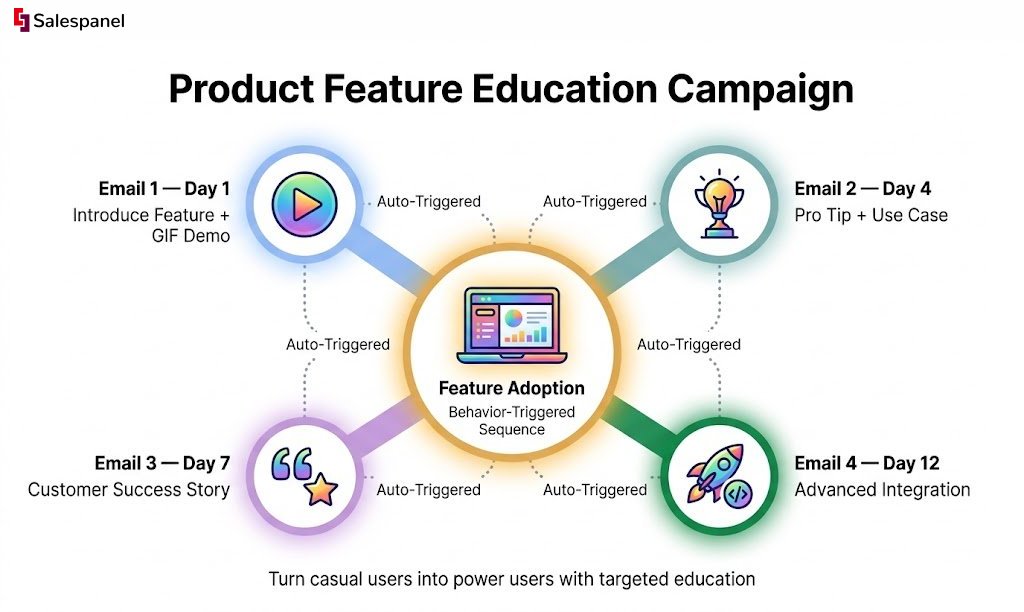
- Email 1 (Day 1): Introduce the feature and its primary benefit. Frame it around a common pain point and use a GIF to show the feature in action. The CTA should lead to a short blog post or video tutorial.
- Email 2 (Day 4): Share a specific use case or a “pro tip” related to the feature. For instance, if your product involves a learning curve, you might explore methods like a how to create a drip course module to deliver educational content over time.
- Email 3 (Day 7): Provide social proof by sharing a customer story or quote about how the feature delivered significant ROI for them.
- Email 4 (Day 12): Offer a final, compelling reason to try the feature, perhaps by highlighting an advanced integration or a little-known shortcut. This final push solidifies the value proposition.
8. Seasonal Promotion and Sale Campaign
A seasonal promotion campaign is a time-sensitive drip sequence designed to capitalize on holidays, specific seasons, or major sales events like Black Friday. This campaign builds anticipation, creates a sense of urgency, and drives sales over a defined period. The goal is to move subscribers through a carefully orchestrated journey, from initial awareness to a final purchase decision, using a mix of teaser content, exclusive offers, and scarcity-driven messaging. It’s a high-impact strategy that leverages external events to create internal sales momentum.
A technical example is how Amazon approaches Prime Day. The campaign begins weeks in advance with “teaser” emails showcasing upcoming deal categories. They then offer “early access” to Prime members, segmenting their most valuable customers. During the event, they use dynamic content to show deals related to a user’s past browsing history. Finally, “last chance” emails with countdown timers create urgency. These email drip campaign examples work because they tap into consumer psychology, leveraging Fear of Missing Out (FOMO) and the excitement of a limited-time event.
Strategic Breakdown
- Objective: Maximize revenue during a specific, high-intent period. This involves building hype, driving traffic, and converting subscribers with time-sensitive offers.
- Workflow Trigger: A manually initiated campaign targeted at a specific audience segment (e.g., all subscribers, past purchasers).
- Key Tactic: Use countdown timers and scarcity messaging (e.g., “limited stock,” “offer ends tonight”) to create urgency and compel immediate action.
Actionable Takeaways
- Email 1 (1-2 weeks before): Send a “teaser” email announcing the upcoming sale. Include a clear CTA for subscribers to sign up for early access or get a sneak peek.
- Email 2 (Day 1 of sale): Launch the sale with a bold announcement. Highlight your best deals and direct traffic to key product categories.
- Email 3 (Mid-sale): Maintain momentum by showcasing different product categories or sharing social proof like user-generated content or top-rated items.
- Email 4 (Final 24 hours): Create strong urgency with a “last chance” or “ends tonight” message. This is often the highest-converting email in the sequence.
9. Referral and Affiliate Program Recruitment Campaign
A referral or affiliate program recruitment campaign turns your most loyal customers into a powerful, word-of-mouth marketing engine. This automated sequence is designed to proactively invite, educate, and onboard existing users into a program where they earn rewards for bringing new business. The primary goal is to leverage the trust and satisfaction of your current customer base to acquire new, high-quality leads at a lower cost than traditional advertising.
Referral and Affiliate Program Recruitment Campaign
Dropbox’s famous referral program is a classic technical example. The trigger wasn’t random; it was often prompted after a user exhibited positive behavior, such as uploading multiple files. The email clearly explained the mutual benefit: the referrer gets more space, and the new user gets more space. Crucially, the email contained a unique, pre-generated referral link and one-click sharing buttons for social media, making participation frictionless. This campaign succeeded because it offered a clear, mutual benefit and made the act of sharing incredibly simple for the user.
Strategic Breakdown
- Objective: Drive cost-effective customer acquisition, increase customer lifetime value, and enhance brand loyalty by turning customers into advocates.
- Workflow Trigger: A user reaches a specific milestone indicating satisfaction (e.g., high NPS score, repeat purchase, positive product usage behavior).
- Key Tactic: Make participation frictionless. Provide users with pre-populated messages, unique sharing links, and a simple dashboard to track their progress and rewards.
Actionable Takeaways
- Email 1 (Trigger): Announce the program and clearly state the primary benefit (“What’s in it for me?”). Explain the value proposition for both the referrer and the person they invite.
- Email 2 (Day 3): Provide a simple, step-by-step guide on how the referral process works. Include a clear call-to-action that leads directly to their unique referral link or dashboard.
- Email 3 (Day 7): Equip your new advocate with shareable assets. Offer pre-written email templates and social media posts they can copy and paste to make sharing effortless.
- Email 4 (Day 14): Reinforce the program’s value with social proof. Showcase success stories from top referrers or highlight impressive reward statistics to motivate participation.
Comparison of 9 Email Drip Campaign Examples
| Campaign | Implementation Complexity | Resource Requirements | Expected Outcomes | Ideal Use Cases | Key Advantages |
|---|---|---|---|---|---|
| Welcome Series for New Subscribers | Low | Basic email templates, minimal automation setup | Rapid initial engagement; higher open rates; reduced unsubscribes | New signups; onboarding lists | Captures peak interest; easy to measure |
| Post-Purchase / Onboarding Drip | Medium | Order/fulfillment integration, product guides, timeline coordination | Reduced returns; higher product adoption; increased repeat purchases | E‑commerce, physical products, SaaS onboarding | Improves satisfaction; promotes cross‑sell |
| Lead Nurturing for B2B Sales Funnels | High | CRM/sales integration, high-quality content, lead scoring | More qualified leads; shorter sales cycles; larger deal sizes | Complex B2B sales, long purchase cycles | Qualifies leads pre‑sales; builds thought leadership |
| Abandoned Cart Recovery | Low–Medium | E‑commerce integration, product images, short persuasive copy | Quick recovered revenue; high ROI per send | Online retail with cart abandonment | Fast wins; high conversion potential |
| Re‑engagement for Inactive Subscribers | Low–Medium | Segmentation, special offers/content, preference center | Reactivated users; cleaner lists; improved deliverability | Dormant subscriber segments (90+ days) | Cost‑effective list hygiene; potential uplift |
| Educational Webinar / Event Promotion Series | Medium | Event assets, registration flow, timed reminders | Predictable registrations; qualified attendee pipeline | Webinars, virtual events, lead generation | Drives attendance; extends content value |
| Product Feature Education Campaign | Medium | Tutorials/videos, usage analytics, progressive content | Increased feature adoption; reduced churn; better ROI | SaaS/product-led growth, feature rollouts | Demonstrates value; enables upsells |
| Seasonal Promotion and Sale Campaign | Medium | Creative assets, discounting strategy, segmentation | Significant short‑term revenue boost; inventory movement | Holiday sales, seasonal promotions, flash sales | Predictable sales spikes; reusable templates |
| Referral & Affiliate Program Recruitment | Medium–High | Tracking systems, incentive management, shareable assets | Lower CAC; high‑quality referred customers | Growth programs, SaaS, marketplaces | Leverages existing customers; high long‑term ROI |
The Takeaway: Actionable Intelligence is the Core of Effective Drips
The diverse collection of email drip campaign examples we’ve explored, from welcome sequences to complex B2B lead nurturing funnels, all share a single, unifying principle: success is rooted in data-driven responsiveness. Modern drip campaigns are not just automated; they are intelligent systems designed to react to individual user behavior, transforming generic broadcasts into personalized, timely conversations.
Static, pre-set sequences are a relic of the past. Today’s most effective campaigns are dynamic, triggered by specific actions a prospect takes. A re-engagement campaign isn’t just sent on day 90; it’s triggered when a previously active lead’s engagement score drops below a certain threshold. An onboarding sequence adapts based on which features a new user actually explores first.
From Blueprint to High-Performance Engine
The strategic blueprints laid out in this article provide the foundational structure for your campaigns. However, to truly elevate their performance, you must power them with real-time behavioral data intelligence. The difference between a good campaign and a great one lies in its ability to answer critical questions:
- Who are they? Moving beyond just an email address to understand their firmographic data and professional context.
- What did they do? Tracking specific page visits, content downloads, and pricing page interactions.
- What do they need next? Using their behavior to predict their intent and deliver the most relevant content to move them forward.
This is where the integration of advanced tracking and identity resolution becomes a competitive advantage. The B2B lead nurturing sequence, for instance, hinges entirely on knowing precisely when a prospect downloads a specific case study or revisits your pricing page. This level of insight is what separates a generic “checking in” email from a hyper-relevant message that arrives at the peak of their interest.
Activating Your Data for Smarter Drips
The ultimate goal is to build a system where every email feels less like an automated message and more like a direct, one-to-one response guided by the prospect’s actions. This is achieved by connecting behavioral signals directly to your automation triggers.
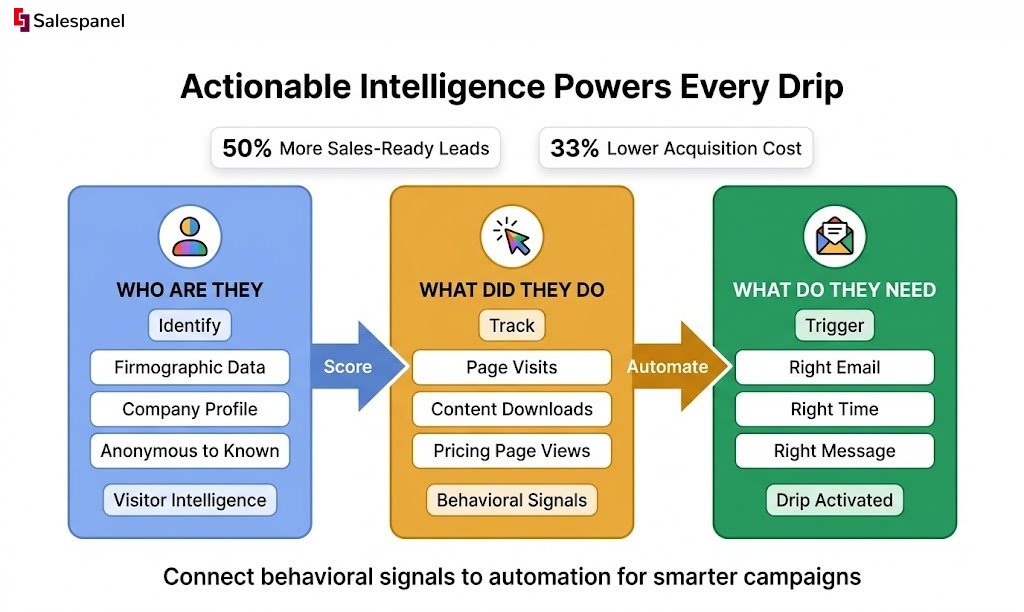
For example, website visitor tracking from Salespanel allows you to capture these granular signals in real-time, even from anonymous visitors, and use them as the catalyst for your drip campaigns. By applying a sophisticated lead scoring framework, you can automatically segment prospects based on their engagement and intent levels. This ensures your sales team invests their time on leads who are not just interested, but genuinely sales-ready. The intelligence gathered doesn’t just inform your emails; it refines your entire sales and marketing process.
The most powerful takeaway from these email drip campaign examples is that the strategy and the technology are now inseparable. The frameworks are your map, but real-time first-party data is your compass, guiding every decision and ensuring each communication is relevant, timely, and impactful.
Ready to power your drip campaigns with actionable intelligence? See how Salespanel can help you track visitor behavior, score leads based on their actions, and trigger perfectly timed emails that convert. Explore our resources and see the platform in action at Salespanel.