In the not-so-distant past, marketing automation was the shiny new engine of B2B growth, promising a future of scalable, personalized communication. Fast forward to today, and that future is here, yet many of these powerful engines are sputtering. The reason is simple but critical: they’re being fed low-grade fuel. While the market for automation technology is projected to hit $13.97 billion by 2030, the success of any platform hinges entirely on the quality of the content that powers it. This isn’t about one-off campaigns; it’s about creating a strategic library of assets—from incisive blog posts to deep-dive case studies—designed specifically for automated, data-driven customer journeys.
This guide provides an in-depth framework for engineering the high-octane content for marketing automation that transforms a sophisticated platform from an expensive email scheduler into a revenue-generating machine. We will dissect the technical requirements for content at each stage of the buyer’s journey, from awareness to decision, and provide practical examples to validate each concept. The central theme is this: your content must be as intelligent, modular, and data-responsive as the automation system it inhabits. Without this synergy, even the most advanced workflows will fail to convert.
Why Your Automation Is Failing Without Great Content
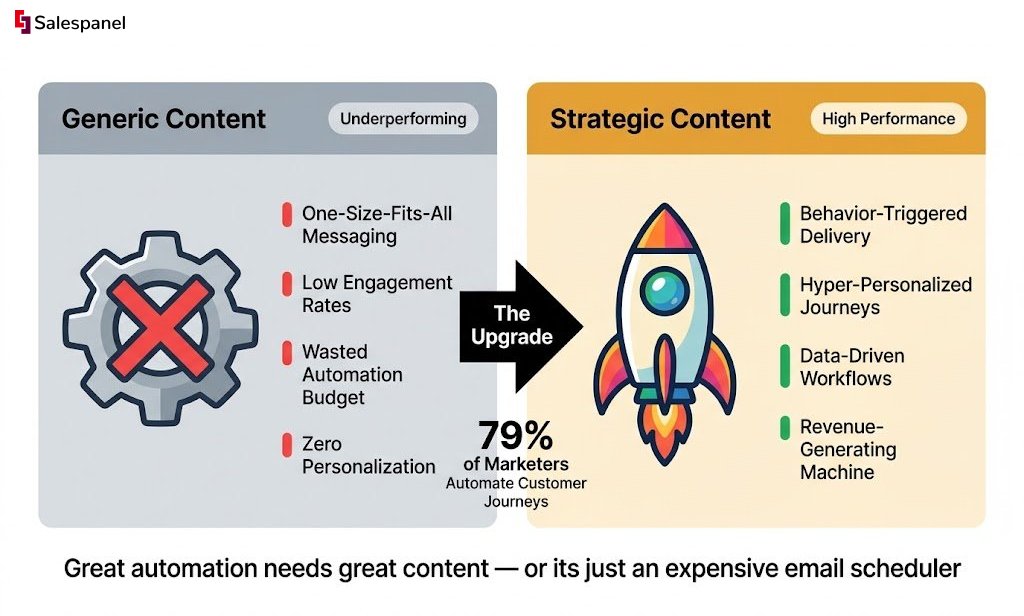
Marketing automation platforms are the operational core of modern B2B growth, an engine built to manage complex customer journeys and deliver measurable ROI. But a significant disconnect exists in many organizations. They invest heavily in a high-performance automation engine but then attempt to run it on generic, one-size-fits-all content. This is the single biggest reason automation strategies fall flat.
The result is a frustrating paradox: teams possess incredibly powerful platforms capable of segmenting audiences, tracking behavior, and triggering communications with surgical precision, yet they feed these systems bland, irrelevant assets. This approach generates high-tech noise—a speedy delivery mechanism for low-impact messages that do nothing to build relationships or drive revenue.
From One-Off Campaigns to Ongoing Conversations
Historically, marketing revolved around distinct campaigns with a clear start and end. A product launch would trigger a three-month ad blitz, with success measured by a few isolated metrics. Automation flips this model on its head. The focus shifts from short-term “blasts” to long-term, continuous “journeys” that adapt to a prospect’s behavior over time.
This evolution necessitates a complete re-architecture of content strategy. The objective is no longer to create a single whitepaper for a single campaign. Instead, you must build a library of interconnected assets that can be mixed, matched, and delivered based on an individual’s real-time needs. Your content must function as a virtual salesperson—answering questions, handling objections, and guiding the prospect toward a decision at their own pace.
The Undeniable Impact of Automated Journeys
The data validates this shift. Marketing automation is no longer a niche tactic; it is central to how modern companies operate, with 79% of marketers now automating their customer journey in some form. Executed correctly, the results are significant. Workflows like a simple post-purchase follow-up can generate up to 30 times more revenue per recipient than a standard email blast.
Your content strategy has to be designed for the machine. It needs to be modular, data-driven, and built to scale. Without this, your automation platform is just an expensive email scheduler.
To fully leverage this potential, one must first grasp the fundamentals of marketing automation. The technology provides the “how,” but your content delivers the “what” and the “why.” Without thoughtfully engineered assets, the true power of your marketing tech stack remains locked. This guide presents a step-by-step framework for planning, creating, and optimizing the very content that will make your automation efforts a quantifiable success.
Mapping Content to the Automated Buyer Journey
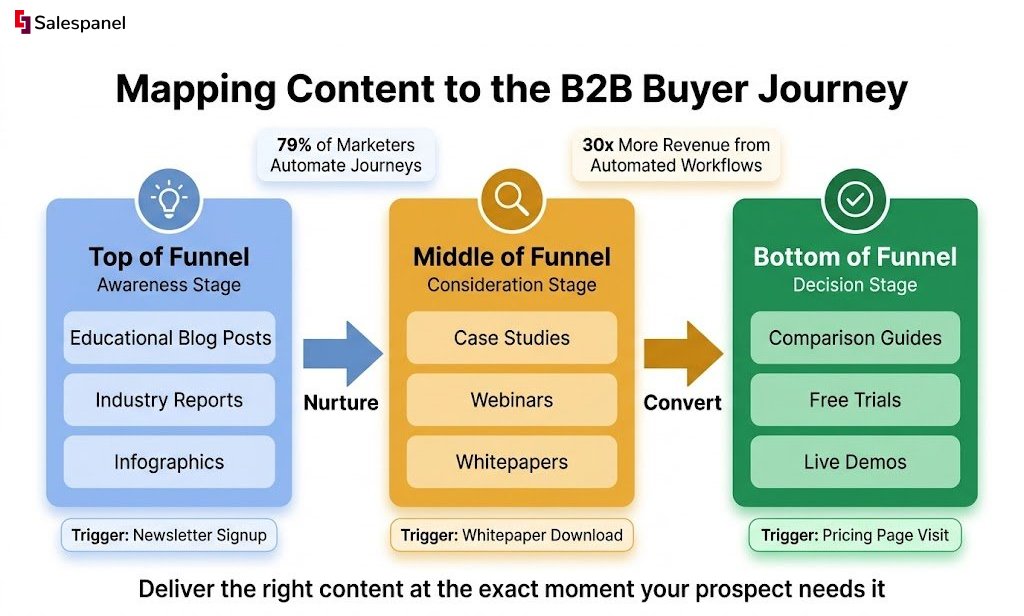
Effective marketing automation is not about broadcasting more emails. It’s about delivering the right message at the exact moment a prospect requires it. This level of precision is only achievable when you have a strategic map connecting your content assets to each stage of the B2B buyer’s journey. Without this map, even the most sophisticated automation platform degrades into a glorified spam cannon, firing mismatched messages that alienate potential customers.
The core principle is straightforward: a prospect in the initial research phase has fundamentally different informational needs than one deep in vendor comparison. Your content—and the automation that delivers it—must reflect this reality. The process begins with developing detailed user personas to ensure every piece of content speaks directly to your audience’s specific challenges and objectives. This foundational step prevents the creation of content in a strategic vacuum.
The process flow below illustrates a common pitfall: sophisticated automation paired with generic, one-size-fits-all content is destined to underperform.
This underscores the technical reality that technology alone is insufficient. It requires a thoughtful, human-centric content strategy to become effective.\
Top of Funnel (TOFU): Content for Awareness
At the top of the funnel (TOFU), your audience is problem-aware, not solution-aware. They are experiencing pain points but have not yet diagnosed the root cause or begun evaluating products. The primary objective here is to educate, not sell. The content must address their questions in a genuinely helpful, non-promotional manner. Your goal is to capture initial interest and establish your brand as a credible resource. Automation triggers at this stage are typically light-touch, such as a blog subscription or a first-time website visit.
Practical Examples of TOFU Content:
- Educational Blog Posts: Articles that answer common “what is” or “how to” questions in your industry. For example, a cybersecurity firm might publish “5 Early Warning Signs of a Data Breach,” targeting initial search queries.
- Infographics and Checklists: These assets break down complex topics into easily digestible formats. They provide quick, scannable value and are highly shareable, widening your reach.
- Industry Reports and Trend Analyses: Authoritative, data-backed content positions your company as a thought leader and provides the audience with valuable information they can apply to their own business context.
Middle of Funnel (MOFU): Content for Consideration
Once a prospect enters the middle of the funnel (MOFU), they have defined their problem and are actively researching potential solutions. Here, your content must shift from broad education to more specific, solution-oriented guidance. The mission is to build trust and demonstrate how your approach or product category resolves their specific challenge. At this stage, they have likely provided an email address in exchange for a TOFU asset, enabling your automated workflows to deliver more targeted content based on their demonstrated interests.
Practical Examples of MOFU Content:
- In-Depth Case Studies: Real-world success stories are powerful forms of social proof. A case study titled “How Acme Corp Reduced Downtime by 40% with Our Solution” provides tangible evidence of value to a similar company.
- Webinars and Expert Interviews: These interactive formats allow for a deeper exploration of a topic and showcase your team’s expertise. An automated follow-up email sequence containing the recording and related resources is a standard and effective automation play.
- Whitepapers and Ebooks: These are comprehensive guides that explore a challenge in detail while subtly introducing your solution’s framework as the logical next step.
A well-structured MOFU sequence does more than just nurture; it qualifies. By tracking which assets a prospect engages with, you gain critical insight into their specific interests and level of intent.
Bottom of Funnel (BOFU): Content for Decision-Making
At the bottom of the funnel (BOFU), prospects are prepared to make a purchase. They are comparing vendors, analyzing pricing, and weighing final details. Your content must now be direct, persuasive, and engineered to overcome any final objections. Automation triggers at this stage are high-intent actions—visiting a pricing page, requesting a demo, or initiating a trial. Your content needs to directly support the sales conversation.
Practical Examples of BOFU Content:
- Comparison Guides: Create honest, detailed comparisons between your product and top competitors. A guide titled “Our Platform vs. Competitor X: A Feature-by-Feature Analysis” directly addresses the comparison shopper’s needs.
- Implementation and Onboarding Guides: Show prospects how seamless it is to get started. A “First 30 Days with Our Platform” guide can reduce perceived friction and be a deciding factor.
- Free Trials and Live Demos: This is the ultimate “show, don’t tell” content. An automated email sequence can guide users through a trial, ensuring they experience key “aha!” moments that demonstrate value.
B2B Content and Automation Matrix
To integrate these concepts, here is a matrix mapping content types and automation triggers to each stage of the B2B buyer’s journey. This serves as a practical blueprint for constructing an automated content strategy.
| Funnel Stage | Primary Goal | Content Examples | Automation Trigger Example |
|---|---|---|---|
| TOFU | Educate & Build Trust | Blog Posts, Infographics, Industry Reports | Subscribes to newsletter after reading a blog post. |
| MOFU | Demonstrate Value | Case Studies, Webinars, Whitepapers, Ebooks | Downloads a whitepaper on a specific solution category. |
| BOFU | Drive Purchase | Comparison Guides, Free Trials, Demos, Pricing Guides | Visits the pricing page twice in one week. |
This framework provides a clear, logical path from initial awareness to the final purchase decision. Aligning content and automation in this manner ensures the consistent delivery of value, building trust and moving prospects forward in a natural, helpful way.
Executing Dynamic Content and Personalization
This is where marketing automation transcends simple message broadcasting and begins to facilitate one-to-one conversations at scale. It is the point at which your technology stack becomes truly operational, transforming static content into a responsive, personalized experience for each prospect. This goes far beyond inserting a [First Name] token; true dynamic content involves swapping entire sections of emails, landing pages, and website copy based on real-time user data.
The underlying mechanics are often simpler than they appear, but the impact is profound. By leveraging known data about a prospect—their industry, company size, job title, or website browsing history—you can automatically serve the most relevant information. This is not merely a clever tactic; it represents a fundamental shift in communication strategy.
The Power of First-Party Data
Effective personalization requires one critical ingredient: rich, reliable first-party data. This is the information you collect directly from your audience through their interactions with your website, emails, and content. It is your most valuable data asset because it is a direct reflection of real user behavior and intent. With solid first-party data, you transition from making broad assumptions to taking precise, informed actions. Instead of guessing what a prospect from the manufacturing sector cares about, their digital footprint provides an exact blueprint of their needs.
This is where website visitor tracking from Salespanel becomes indispensable. It provides the granular, first-party data needed to power these highly personalized experiences, connecting the dots between an anonymous click and a known prospect’s profile. Every interaction suddenly feels tailored specifically for them.
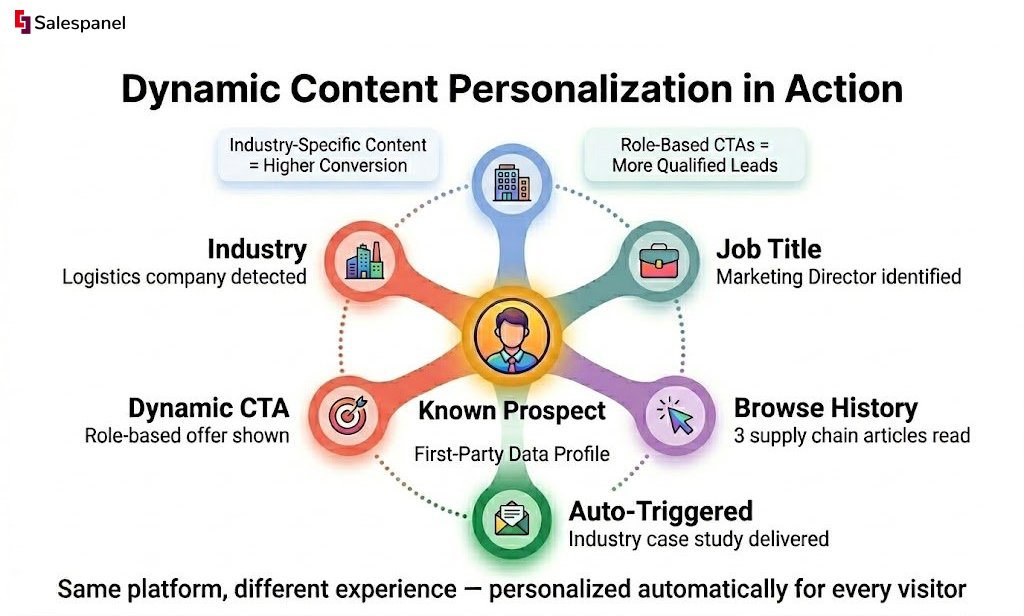
Practical Examples of Dynamic Content:
- Industry-Specific Case Studies: A visitor from a logistics company arrives on your homepage. Instead of a generic testimonial, the page dynamically displays a hero image and a case study featuring a major shipping client. This immediately communicates an understanding of their specific industry challenges.
- Role-Based CTAs: A marketing director lands on a blog post and sees a call-to-action to download a “Content Strategy Template.” Simultaneously, a sales manager viewing the same page is prompted to “Book a Sales Efficiency Demo.” Same page, different journey, executed automatically.
- Behavior-Driven Messaging: A prospect has read three articles on supply chain optimization. On their next visit, your website presents a banner for an advanced webinar on that exact topic. This demonstrates a system that is responsive to user interest.
Implementing Dynamic Content Blocks
Most marketing automation platforms feature tools for creating “dynamic content blocks.” These are conditional snippets—of text, images, or code—that are displayed only if a prospect meets predefined criteria. The logic is typically a simple “if/then” statement.
Example of Technical Logic in an Email:
Consider an email announcing a new feature. A default introduction is created, but rules are added to show different headlines based on a prospect’s industry data.
IF Industry = ‘Finance’ THEN Show Headline: “Enhance Security and Compliance with Our New Feature” IF Industry = ‘Healthcare’ THEN Show Headline: “Streamline Patient Data Management Securely” ELSE (Default for all other segments) THEN Show Headline: “Discover Our Powerful New Feature”
This same logic applies to landing pages. Customer logos, testimonials, and form fields can be dynamically swapped to match a visitor’s profile, reducing friction and increasing conversion rates.
The best personalization isn’t about being clever; it’s about being helpful. When dynamic content is done right, the user shouldn’t even notice it. The experience should just feel natural, relevant, and perfectly timed.
Scaling Personalization Beyond Simple Fields
True personalization extends beyond swapping a headline; it involves tailoring the entire journey. Modern email outreach tools are highly sophisticated, enabling complex campaigns that feel anything but automated.
To scale these efforts effectively, consider these advanced applications:
- Personalized Content Hubs: Instead of directing prospects to a generic resources page, create dynamic hubs that automatically surface the most relevant blog posts, whitepapers, and case studies based on a user’s past behavior and lead score.
- Dynamic Nurture Tracks: Segment nurture flows based on behavior, not just demographics. A prospect who binge-watches a webinar series should be moved to a more product-focused track than someone who only downloaded a top-of-funnel checklist.
- Real-Time Website Personalization: Use tracking data to modify your website for returning visitors on the fly. If a known prospect from a key target account returns, you could trigger a personalized pop-up from their assigned account manager.
By combining a solid first-party data foundation with a thoughtful content strategy, your marketing automation platform evolves from an email blaster into an engine for building genuine customer relationships.
Using Data to Power Smarter Content Delivery
Your marketing automation platform is an execution machine, but its fuel is data. Without a steady stream of high-quality information, even the most sophisticated workflows operate on guesswork. The core of effective content for marketing automation is not just what you send, but who you send it to and why, based on empirical data.
The entire operation pivots on a technical concept called identity resolution. This is the process of connecting the disparate data points of an anonymous website visitor with the known contact record in your CRM. Successfully stitching these identities together unlocks a complete, chronological history of a prospect’s interests and buying signals.
This unified data profile is the key to transforming your automation from a reactive scheduler into a proactive marketing and sales engine. It enables you to move beyond basic demographic segmentation and trigger workflows based on observed behavior.
From Anonymous Clicks to Actionable Intelligence
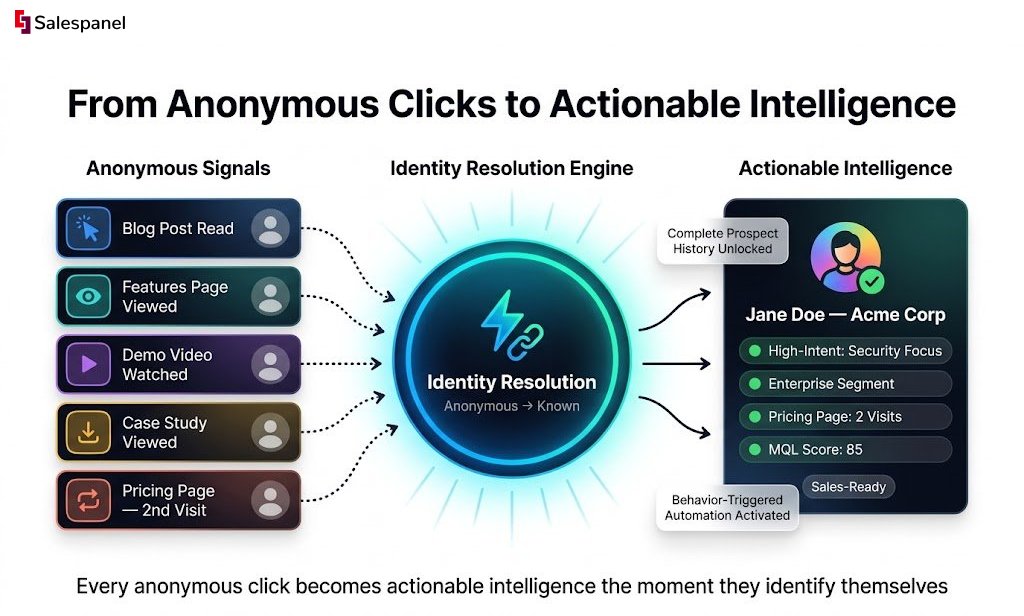
Every action a prospect takes on your website is a data signal. Reading a blog post on a specific pain point, viewing a features page, or downloading a case study—each is a breadcrumb that reveals their needs. Initially, most of these actions are anonymous. Identity resolution links these anonymous behavioral data breadcrumbs to a contact record the moment a user identifies themselves, typically by completing a form. Their profile is then retroactively populated with all their previous on-site activity.
A Practical Scenario of Identity Resolution:
- An anonymous visitor from a target enterprise company lands on your site via a search for “enterprise data security solutions.”
- Over two weeks, they read three blog posts on compliance, visit the integrations page, and watch a product demo video. They remain anonymous.
- On their fifth visit, they download a whitepaper, providing their name and email.
- Identity resolution instantly connects that email to their entire browsing history, revealing a sustained, high-intent interest in enterprise-level security.
Without this connection, they are just another name on a list. With it, they are immediately identified as a high-value prospect with a clearly defined area of interest.
Activating Data with Intelligent Workflows
With this rich, unified view of a prospect, you can construct highly intelligent and timely automation. The objective is to use their behavior as a direct trigger for hyper-relevant content delivery or a perfectly timed sales engagement.
For instance, a key prospect from a target account visits your pricing page for the second time in a week. Instead of passive hope, your automation recognizes this powerful buying signal. It instantly alerts the assigned sales representative via Slack, providing full context: “Jane Doe from Acme Corp just viewed the pricing page again. She has previously downloaded our ‘ROI of Our Platform’ case study and read the competitor comparison guide.” This enables a warm, well-informed conversation, not a cold call.
The most powerful automation doesn’t just send the next email in a sequence. It analyzes a prospect’s entire digital body language and uses that insight to deliver the perfect message or alert the right person at the exact moment of peak interest.
The Role of Automated Lead Scoring
Manually tracking every click for thousands of prospects is impossible. This is why automated lead scoring is a critical component of any data-driven automation strategy. It systematizes the qualification process based on a prospect’s complete journey. At Salespanel, our philosophy is that a lead’s actions tell you more than their job title alone, and our lead scoring system is built on this principle. Salespanel’s lead scoring framework allows you to automatically assign point values to different actions and attributes, building a dynamic score that reflects a prospect’s true engagement and buying readiness.
Technical Breakdown of Lead Scoring:
- Demographic Scoring: Points are assigned based on ideal customer profile fit. A “Director of IT” at a target company might receive +15 points.
- Behavioral Scoring: High-value actions are weighted more heavily. Visiting the pricing page could be worth +20 points, while a simple email open is +2 points.
- Engagement Decay: Scores can be configured to decrease over time if a prospect becomes inactive, ensuring sales focuses on leads that are currently engaged.
This system ensures that when a lead reaches a predefined threshold—for example, 100 points—they are automatically designated a Marketing Qualified Lead (MQL) and routed to sales. It is a data-driven handoff that equips your sales team with the best leads at the perfect moment, armed with a full history of the content that nurtured them.
Proving Your Content’s ROI Inside Your Automation System
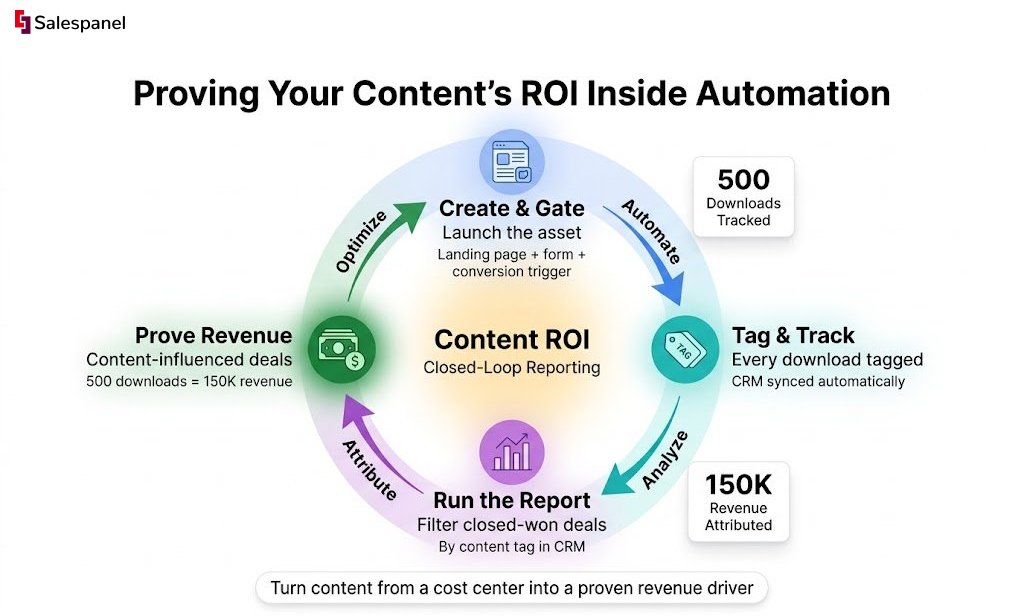
Creating high-quality content for marketing automation requires a significant investment of time and resources. Therefore, it is imperative to prove its direct contribution to revenue, moving beyond vanity metrics like clicks and opens. The methodology involves connecting content engagement data from your marketing automation platform with sales outcome data from your CRM. The objective is to draw a clear, defensible line from a specific content asset to a signed contract.
This requires a disciplined approach to tracking, attribution, and reporting. When you can demonstrate that “prospects who engage with this case study have a 25% higher MQL-to-SQL conversion rate,” you have successfully shifted the conversation from content as a cost center to content as a revenue driver.
Moving Past Clicks and Opens to Real Business Impact
Traditional content metrics can be misleading. A blog post with thousands of views may generate zero qualified leads. To measure true ROI, you must track metrics that are meaningful to the business, focusing on how content impacts lead quality, accelerates the lead generation pipeline, and contributes to closed deals.
Key Revenue-Centric Metrics:
- Content-Influenced Revenue: The total revenue from deals where the customer engaged with a piece of content at some point in their buying journey.
- Pipeline Velocity: The speed at which leads move through the sales funnel after consuming specific content assets. For example, do leads who attend a product webinar convert to the opportunity stage faster?
- Lead-to-Opportunity Conversion Rate by Content: This identifies the specific assets that are most effective at converting early-stage leads into sales-ready opportunities.
- Cost Per MQL by Content Asset: This measures the efficiency of your content. An e-book may have a higher production cost, but if it delivers MQLs at a lower cost than other tactics, it represents a significant win.
How to Build Your Content Attribution Model
Attribution is the process of assigning credit to the marketing touchpoints that lead to a sale. While complex multi-touch models exist, a simple first-touch or last-touch model configured within your marketing automation tool can provide powerful initial insights.
Practical Example: Proving a Whitepaper’s Value
Let’s say you launch a whitepaper on “Navigating Data Privacy Regulations.” Here is a step-by-step technical process to track its direct ROI:
- Gate and Track: The whitepaper is hosted on a landing page with a form. A submission triggers a specific conversion event in your automation system.
- Tag Everything: Anyone who downloads the whitepaper is automatically tagged with ‘Downloaded_Privacy_Whitepaper’ in your marketing automation platform.
- Sync to CRM: This tag is automatically synced to the corresponding lead or contact record in your CRM. This is the critical technical link.
- Run the Report: Build a report in your CRM that filters for all closed-won deals where the contact record includes the ‘Downloaded_Privacy_Whitepaper’ tag.
By summing the value of these deals, you have calculated the content-influenced revenue for that single asset. The narrative shifts from “the whitepaper got 500 downloads” to “the whitepaper influenced $150,000 in new business this quarter.”
Shifting your focus to revenue-centric metrics is the single best way to get bigger budgets and more respect for your content strategy. When you prove content is a revenue machine, it’s no longer seen as an optional expense.
Using Your Tech Stack to Get the Full Story
This level of reporting depends on a seamless integration between your marketing automation platform and your CRM. This technical connection forms the backbone for linking pre-sale marketing activities with post-sale revenue. By integrating behavioral data from a tool like Salespanel, you can provide sales with the full context of a prospect’s content journey, enabling smarter conversations that close deals faster. By tying every asset to a measurable business outcome, you build an undeniable case for content’s role as a primary driver of growth.
Got Questions? We’ve Got Answers
Executing a content strategy for marketing automation can seem like a significant undertaking. Below are answers to common questions from marketers implementing these systems.
How Can a Small Team Start with Content for Marketing Automation?
For a small team, the key is to start lean and focus on maximum impact. Avoid the temptation to build a comprehensive content machine for every possible scenario from the outset. Instead, identify the single most critical path in your buyer’s journey, which is often the sequence from a high-intent form submission (e.g., a demo request) to a sales conversation.
Build a short, focused lead nurturing sequence for this specific path, likely using existing content assets. A simple four-email sequence can be highly effective:
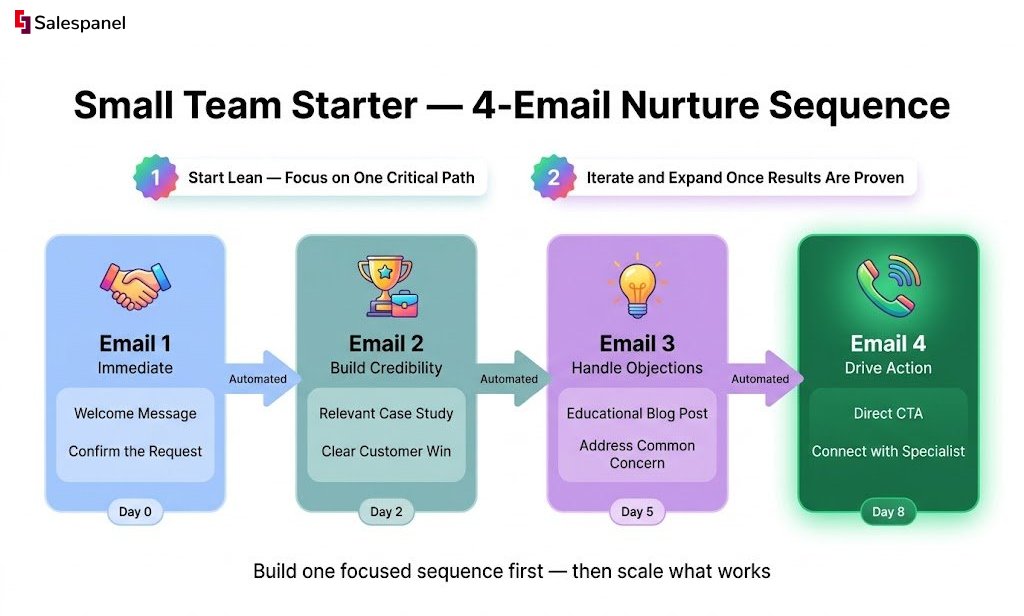
- Email 1: A simple welcome and confirmation of the request.
- Email 2: A relevant case study demonstrating a clear customer win.
- Email 3: An educational blog post that addresses a common objection.
- Email 4: A direct call-to-action to connect with a specialist.
Once this core sequence is operational and delivering measurable results, you can incrementally expand to other journeys, such as a nurture for new blog subscribers or webinar attendees. The principle is iterative development, not a monolithic launch.
How Often Should You Update Automated Content?
There is no universal frequency, but a quarterly health check of your core automation sequences is a solid rule of thumb. Foundational, evergreen assets like pillar whitepapers may remain relevant for longer periods. However, other content can become outdated quickly.
Think of your automated content as a living, breathing part of your marketing ecosystem. It’s not a “set it and forget it” task. It needs regular check-ups to stay effective and keep delivering results.
During your quarterly review, look for these indicators of decay:
- Outdated Statistics: A 2021 statistic in a 2024 email undermines credibility.
- Broken Links: A dead link creates a dead end in the user journey.
- Underperforming Assets: If a specific email in a sequence has a chronically low open or click-through rate, replace its content with a newer blog post or a different case study and measure the impact.
How Do You Balance Personalization with Privacy?
This is the central challenge for the modern marketer. The solution is to ground your strategy in first-party data and radical transparency. Shift focus away from purchasing third-party lists and toward the data you collect directly from users who willingly engage with your brand. This data, which can be captured with tools like website visitor tracking from Salespanel, is not only more accurate but is also built on a foundation of user consent.
Be explicit about why you are collecting data in your data privacy policy. The goal is not surveillance but helpfulness. A visitor who spends ten minutes reading three blog posts on a specific feature will likely find value in an email about an upcoming webinar on that exact topic. This is relevant personalization, not an invasion of privacy.
Salespanel offers a suite of tools designed to help you create smarter, data-driven content journeys while respecting user privacy. Explore our resources to build a strategy that converts. Find out more at https://salespanel.io/resources.