What Is B2B Sales? A Complete Guide to How B2B Selling Works
What You’ll Learn From This B2B Sales Guide
Most pages built around the B2B sales definition stop at one sentence and a comparison table. This guide goes further. By the end, you’ll be able to identify whether a sale is actually B2B, explain how it differs from B2C in ways that change your process, map a basic B2B buying journey across stakeholders, and see where marketing, sales, and visitor intelligence each do their work.
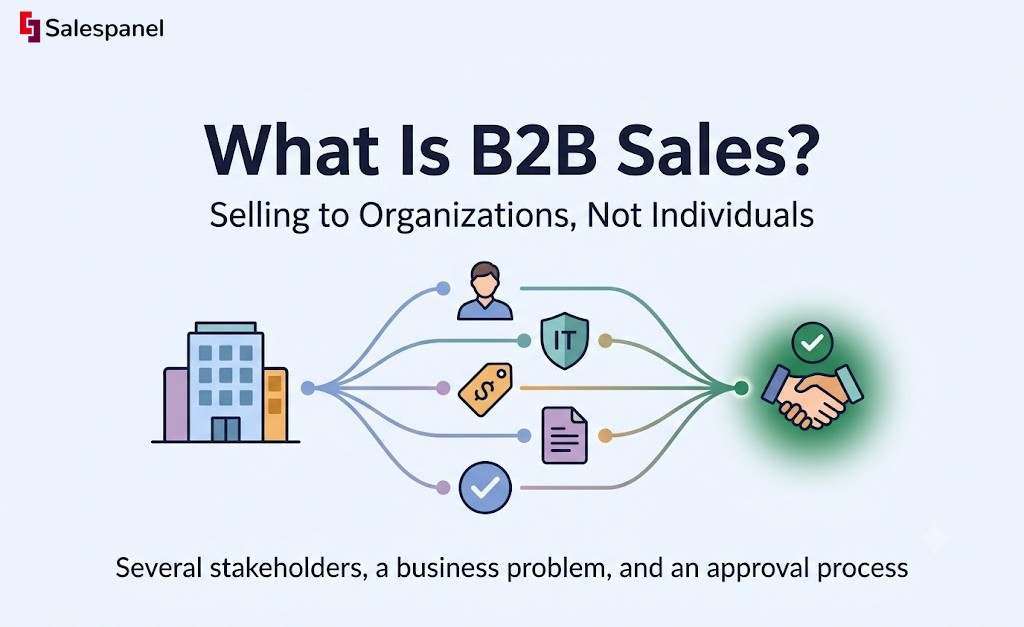
That is the practical frame. B2B sales usually involves several stakeholders, a business problem that costs the company something, and a purchasing process with approval steps attached to it. Deal complexity, though, varies enormously. Price, perceived risk, and the size of the buying team move the needle far more than the “B2B” label does.
We’ve expanded this article from its original definition-only version because the questions people actually ask around it go much wider — B2B sales meaning, what are B2B sales, B2B selling as a practice, and what “B2B sales experience” means on a résumé. All of it is covered below.
If you’re new to the field, read it start to finish. If you already sell for a living, skip to the process and mistakes sections.
B2B Sales Definition: What Does B2B Sales Mean?
B2B sales is the process of selling products or services to organizations that use, resell, or support those products in their operations. The buyer is a company, agency, or institution rather than an individual consumer, and the purchase is made with business money for a business purpose — usually with approval from more than one person.
That buyer can take many shapes. A two-person startup buying a $49/month analytics tool is a B2B customer. So is a hospital system running a nine-month procurement cycle, a county government agency, a nonprofit, a reseller stocking inventory, a contract manufacturer, and a law firm buying practice-management software.
What organizations pay for is an outcome they can defend internally: more revenue, lower operating cost, reduced risk, compliance with a regulation, faster delivery, or a capability they don’t currently have. Personal preference exists in B2B — buyers are still people — but preference alone rarely survives a finance review.
Three related terms get used interchangeably and shouldn’t be. B2B sales is the selling motion itself, including the pipeline, stages, and process. B2B selling refers to the practice and craft — the skills someone applies inside that motion. B2B sales experience describes a person’s track record selling to organizational buyers, which is what hiring managers mean when they put it in a job description.
Now the part that generic definitions get wrong: “business buyer” does not automatically mean “long enterprise deal.” A $99-per-month SaaS subscription bought on a credit card by a marketing manager and a six-figure ERP implementation procured through a formal RFP are both B2B sales. One closes in 20 minutes with a self-serve checkout. The other takes eleven months, four security reviews, and a legal redline cycle. Same category, completely different sales motion — and building your process around the wrong one is a common, expensive error.
For a general commercial definition, Investopedia’s B2B entry covers the transaction type in broader economic terms.
A simple test for deciding whether a sale is B2B
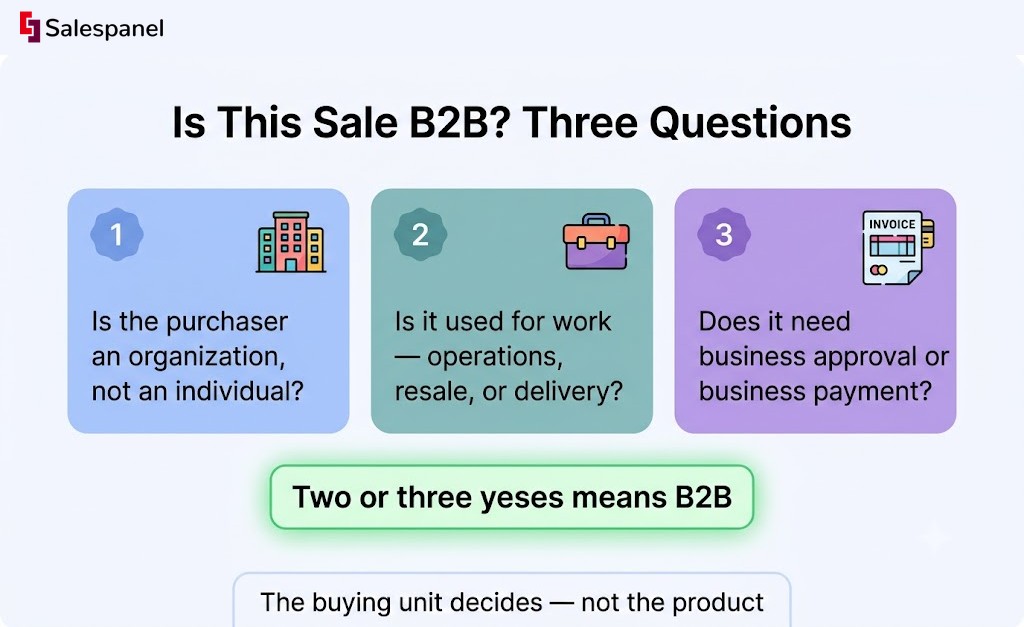
Three questions settle almost every edge case:
- Is the purchaser an organization, not a private individual?
- Is the purchase used for work — operations, resale, manufacturing, or service delivery?
- Does the purchase require business approval or business payment (company card, invoice, PO, expense claim)?
Two or three yeses means B2B. This test kills the most common misconception in the category: selling something to an employee personally is usually B2C, even when that employee works at a company. A marketing director buying a course for their own career development with their own money is a consumer purchase. The same director buying the same course for eight team members on the company card is B2B. The product didn’t change. The buying unit did.
B2B Sales vs. B2C Sales: The Differences That Change the Process
B2B and B2C sales differ most in who approves the purchase, how the buyer assesses risk, and how much implementation shapes the decision. Everything else — cycle length, deal size, contract structure — tends to follow from those three.
| Dimension | B2B | B2C |
|---|---|---|
| Buyer | Organization, buying for operational use | Individual, buying for personal use |
| Decision-makers | Often 3-10+ people across functions | Usually 1, sometimes a household |
| Deal value | Wide range: $40/month to seven figures | Typically lower, more uniform |
| Sales cycle | Days to many months, scales with risk | Minutes to weeks |
| Evaluation criteria | ROI, security, integration, vendor stability | Price, preference, convenience, reviews |
| Contract terms | Negotiated; MSAs, DPAs, SLAs, renewals | Standard terms of service |
| Implementation | Often required; can involve IT and training | Rarely a factor |
| Retention model | Renewal, expansion, account management | Repeat purchase, loyalty programs |
Be careful with the universal claims you’ll read elsewhere. “B2B always takes longer” isn’t true — plenty of product-led B2B tools close faster than someone buying a mattress. Complexity rises when price rises, when switching cost is high, when a security review is triggered, or when the tool sits in the path of revenue or regulated data. A self-serve scheduling app touches none of those. A payments processor touches all four. The stakeholder spread is where the process really diverges. In a typical mid-market deal you may be dealing with an end user who feels the daily pain, a champion pushing internally, an economic buyer who owns the budget, a technical evaluator checking integrations and architecture, plus procurement, legal, finance, and sometimes an executive sponsor who only appears at the end.
Consensus is the job. You aren’t persuading a person; you’re helping a group reach an agreement they can all defend afterward. That is why a brilliant demo to one enthusiastic champion so often produces a deal that stalls at “we’ve decided to revisit next quarter.” If you want to go deeper on how those groups actually move, read our breakdown of how B2B buyer journeys work.
Where B2B and B2C sales overlap
Both motions need clear positioning, fast follow-up, trust, and visible proof that the product solves the stated problem. Buyers in both worlds read reviews, ask peers, and abandon vendors who take four days to reply.
And don’t overcorrect. Not every B2B purchase involves procurement, an RFP, or even a demo. A large share of small-business software gets bought after a free trial with zero human contact. Forcing a nine-stage enterprise process onto that buyer adds friction and loses deals.
Examples of B2B Sales Across Common Business Models
An example of B2B sales is a software company selling a CRM subscription to another company’s revenue team, or an industrial supplier selling maintenance parts to a manufacturer’s facilities department. In each case an organization buys something it uses to operate, resell, manufacture, or deliver services to its own customers.
Concrete cases across categories:
- Salesforce selling CRM software to a 200-person revenue team that needs pipeline visibility.
- Grainger selling MRO supplies — maintenance, repair, and operations parts — to a facilities team keeping equipment running.
- A cybersecurity provider selling endpoint protection to an IT department under pressure from a cyber-insurance requirement.
- A packaging manufacturer selling custom boxes to a DTC ecommerce brand scaling shipments.
- A consulting firm selling implementation services to a company migrating from one ERP system to another.
- A component distributor selling parts to another manufacturer’s production line.
Three things make all of these B2B: the buyer is an organization, the purchase supports business activity, and someone has to justify the spend internally to another person.
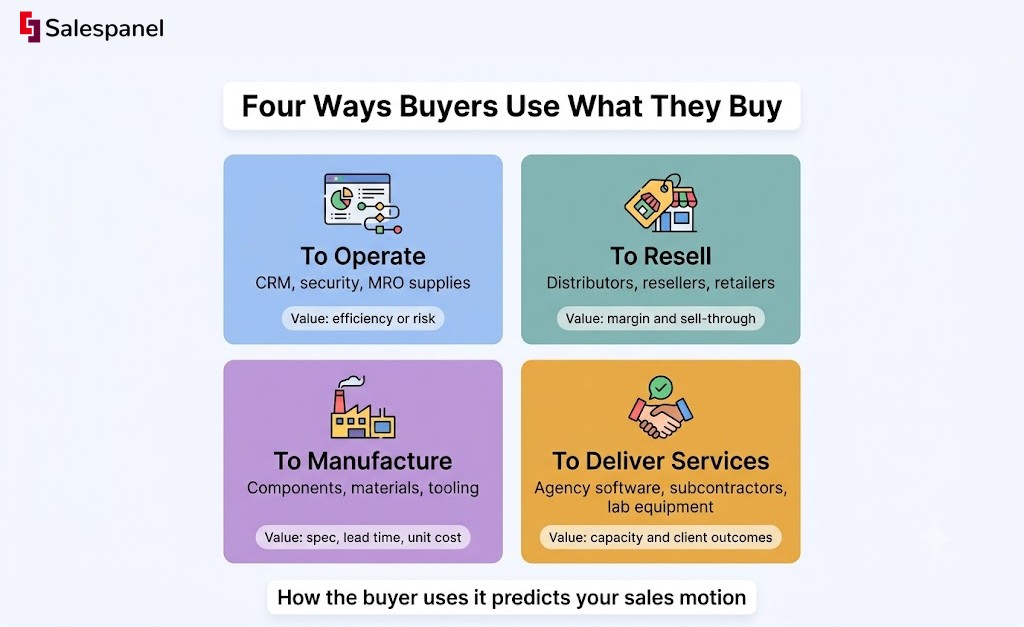
Rather than reading that as a flat list, classify examples by how the buyer uses what they bought. That’s the variable that predicts your sales motion:
- To operate — CRM, endpoint security, MRO supplies. The value case is efficiency or risk.
- To resell — distributors, resellers, retailers. The value case is margin and sell-through.
- To manufacture — components, raw materials, tooling. The value case is specification, lead time, and unit cost.
- To deliver services — agency software, consulting subcontractors, lab equipment. The value case is capacity and client outcomes.
Two deals with identical contract values can require completely different evidence depending on which of those four boxes they sit in.
Four B2B sales models practitioners should recognize
| Model | Typical buying trigger | Proof the buyer demands |
|---|---|---|
| SaaS / subscription | A workflow gap or tool consolidation | Product evaluation, trial, security review, SOC 2 |
| Professional services | A capability or capacity gap | Case studies, named team, detailed scope of work |
| Manufacturing & distribution | A supply need or supplier failure | Specifications, lead time, sample, pricing tiers |
| Channel / partner | A revenue opportunity for the partner | Margin structure, enablement, territory and deal-reg terms |
If you sell across two of these models, you need two pipelines. Channel deals in particular break standard forecasting, because the person you’re persuading is not the person who ultimately uses the product.
How the B2B Sales Process Works, Step by Step
A workable B2B sales process moves from identifying a relevant account, to validating a real business problem, to building agreement among the people affected, to confirming implementation and commercial terms. Stages are scaffolding for that sequence.
Adapt those stages to your average deal size and buying complexity. Do not inherit a generic CRM pipeline and hope it fits. A team with a $6,000 average contract value and a 19-day cycle running eight stages will produce nothing but stale opportunities and inaccurate forecasts.
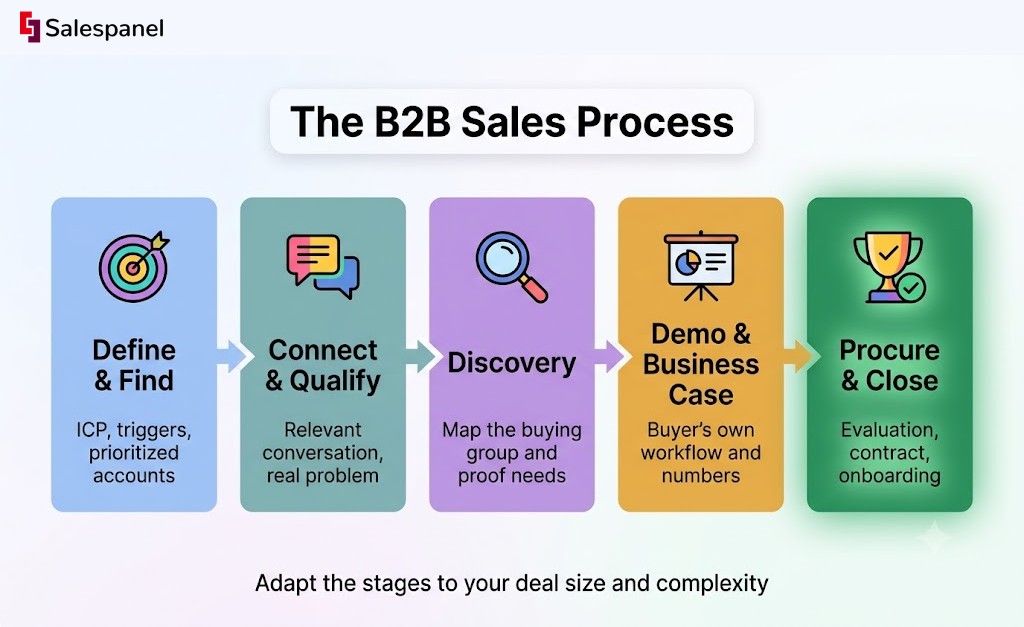
Step 1: Define the ideal customer profile and buying trigger
Write down firmographic fit in specifics: industry, employee count, geography, business model, technology environment, and a realistic budget band. “Mid-market B2B SaaS, 50-500 employees, North America, using HubSpot or Salesforce, $2k-15k annual software budgets” is usable. “Growing companies” is not.
Then list the triggers that make timing right — a funding round, hiring in the department you sell to, a technology migration, expansion into a new market, or a compliance deadline.
Keep ICP and persona separate. The ICP defines the account you want. Personas define the people inside it and what each of them cares about.
Step 2: Find and prioritize accounts
Accounts arrive from outbound research, inbound form fills, event conversations, partner referrals, and website engagement. Each source carries different signal quality, and they should not all enter the same queue at the same priority.
Prioritize on four inputs together: fit, intent, engagement depth, and timing. One page view is not intent. Four people from the same domain hitting your pricing page, integrations page, and implementation docs inside eight days is intent — and you only see that if you’re looking at the account level rather than the individual lead. That’s where first-party visitor data earns its keep. Our guide on how to build a B2B lead-scoring model covers the mechanics.
Step 3: Start a relevant conversation
Lead with observed business context or a suspected problem. A serviceable outreach structure has four parts: the trigger you noticed, the problem you suspect it creates, a credible outcome you’ve delivered for similar companies, and a next step that costs the buyer almost nothing.
One warning. Do not claim insight you cannot substantiate. “I noticed your team is struggling with attribution” when you have no evidence reads as a template, and experienced buyers recognize it instantly.
Step 4: Qualify the opportunity
Six questions change deal strategy more than any framework acronym: What problem is being solved? Why now? Who is affected by it? Who approves the spend? What happens if they do nothing? Which procurement or security steps apply?
Qualification exists to disqualify as much as to advance. A clean “no” in week one is worth more than a maybe you drag through three quarters.
Worked example, hypothetical: a 150-person SaaS company triples paid traffic after a new funding round, but sales cannot tell which accounts are researching seriously. Trial signups look flat. The VP of Marketing is the champion, RevOps owns the CRM, the CFO approved the ad budget and wants to see return. Problem, urgency, affected parties, and approver — all identified before a demo is scheduled.
Step 5: Run discovery and map the buying group
Discovery is evidence gathering. A scripted interrogation produces answers people think you want to hear.
Build a decision-unit map as you go. Four columns: stakeholder, their success criteria, their likely concern, and the proof they need. Then pair every stakeholder with a proof plan — security documentation and a data-flow diagram for IT, ROI assumptions for finance, day-in-the-life workflow detail for end users, and a named implementation owner plus timeline for operations.
Most stalled deals in my experience aren’t lost on price. They stall because one person on that map never got their proof.
Step 6: Demonstrate the right workflow and business case
The demo should follow the use cases confirmed in discovery, in the buyer’s own language, using their own scenario. A feature tour tells six stakeholders that you weren’t listening.
When you connect capability to impact, document the assumptions instead of inventing numbers. Record the current process, the time it consumes, the conversion baseline, the person who owns it, and the period over which you’ll measure. A modest business case built from the buyer’s own figures survives a finance review. An impressive one built from your marketing deck does not.
Late-stage work is administrative and it is where good deals die: technical validation, security questionnaires, legal review, pricing approval, implementation planning, contract redlines.
A verbal yes is not a closed deal while procurement or legal still holds a blocking requirement. Vendor onboarding, insurance certificates, and data processing agreements have ended more quarters than competitors have.
Run a mutual action plan — a shared document listing every remaining step, the owner on each side, and a due date. If the buyer won’t co-own it, that’s information about how real the deal is.
Step 8: Close, onboard, and protect the expansion opportunity
Hand off context, not just a signed PDF. Customer success or implementation needs the stated goals, the stakeholder map, the outcomes you promised, the risks you know about, and the next milestone with a date.
Then measure. Post-sale evidence of the outcome is what supports renewal, funds expansion, and earns the referral — and it’s the only reliable defense when the champion who bought you leaves the company eight months later.
B2B Sales and Marketing: How Both Teams Create Pipeline
Marketing creates and captures demand. Sales converts qualified account interest into conversations, opportunities, and customers. Both teams need shared definitions, or every pipeline review turns into an argument about lead quality.
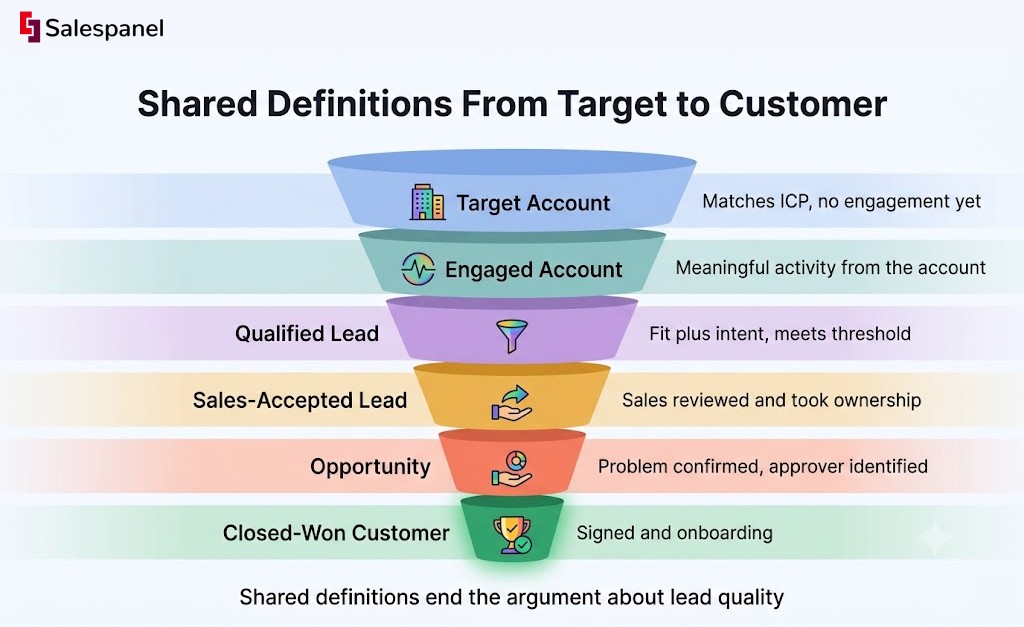
Agree on six terms in writing:
- Target account — matches ICP, no engagement yet
- Engaged account — meaningful activity from one or more people at the account
- Qualified lead — fit plus intent, meets an agreed threshold
- Sales-accepted lead — sales reviewed it and took ownership
- Opportunity — confirmed problem, identified approver, active evaluation
- Closed-won customer — signed and onboarding
A form fill alone is not sales-ready. A university researcher downloading a whitepaper and a director at a 400-person target account requesting pricing both filled in a form. Treating them identically is how “marketing sends us junk leads” becomes a permanent team narrative.
A handoff worth routing on carries: account context and firmographics, pages viewed, campaign source, known contacts at the account, the stated problem, the routing owner, and a follow-up deadline.
This is where first-party visitor intelligence changes the input quality. If you can resolve anonymous traffic to companies, you can see that three people from one target account read your integrations documentation twice this week — then score that activity alongside fit data before anyone reaches out. It lets sales work on engaged accounts rather than waiting for a form. You can read more about how to identify high-intent B2B website visitors.
See how Salespanel helps teams identify engaged accounts and prioritize high-intent visitors.
Illustrative only — not a benchmark:
- ICP industry match: +15
- Employee count in range: +10
- Second visit within 7 days: +10
- Pricing page viewed: +20
- Third or later visitor from same account: +25
- Documentation or integrations page: +15
- Identifiable student, competitor, or job-seeker signal: −30
Numbers like these are a starting hypothesis, nothing beyond that. Validate every threshold against your own closed-won opportunities in your own CRM. If half your wins scored below your MQL line last quarter, the model is wrong, not the deals.
Skills Needed for B2B Sales Experience
B2B sales experience means being able to run a repeatable opportunity process with organizational buyers — prospecting, discovery, stakeholder management, commercial review, and handoff — not simply having held a sales title.
The practitioner skill set breaks down roughly like this: account research, discovery questioning, clear business writing, CRM hygiene, product demonstration, negotiation, forecasting, and cross-functional coordination with marketing, product, legal, and customer success.
CRM hygiene deserves more respect than it gets. It’s a revenue skill. An opportunity missing its next step, its stakeholder list, or its known risk makes the forecast unreliable, which misallocates headcount, marketing spend, and management attention. Two reps with identical win rates produce very different organizational outcomes if one of them records what actually happened.
Industry knowledge helps and takes years. Credibility does not have to wait for it. A seller who asks informed questions, documents the buyer’s context accurately, and comes back with the specific proof each stakeholder asked for will outperform someone who knows the industry but runs the same pitch every time. For the qualification side of this, see our guide to sales qualification and pipeline reporting.
Common B2B Sales Mistakes to Watch Out For
Most avoidable B2B losses trace back to four habits: chasing weak-fit accounts, mistaking activity for intent, never mapping the buying group, and leaving implementation questions until the last two weeks. Below, each mistake with its consequence and the fix.
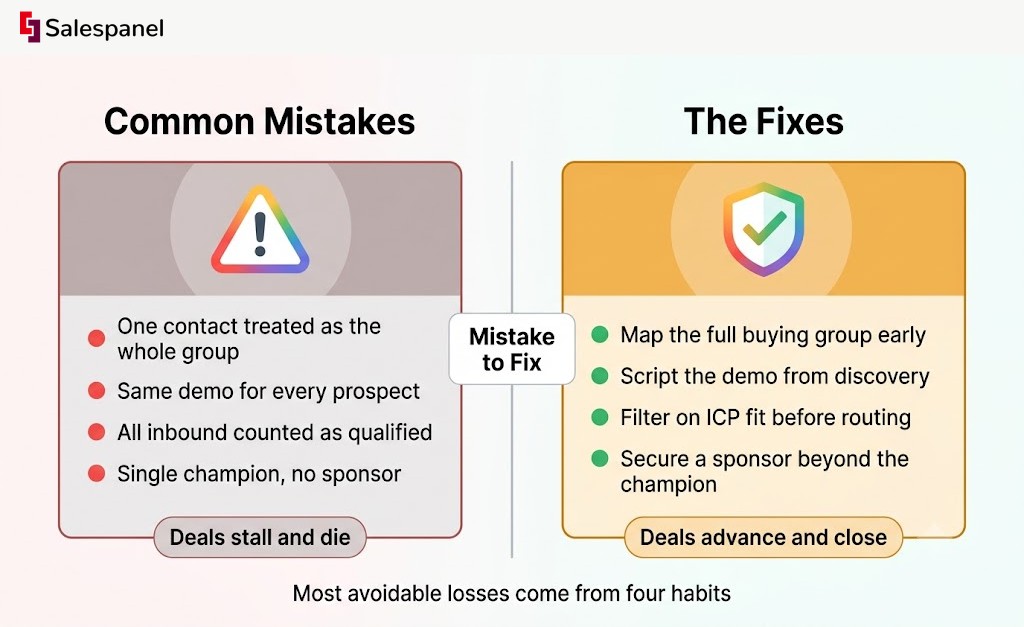
Treating one contact as the entire buying group. Consequence: the deal stalls when an unmet stakeholder objects late. Fix: ask directly who else will be involved in the decision and add them to a decision-unit map by the second call.
Giving the same demo to every prospect. Consequence: buyers conclude you didn’t listen, and your differentiators land on people who don’t care about them. Fix: script the demo from the two or three use cases confirmed in discovery.
Counting all inbound leads as qualified demand. Consequence: inflated pipeline, poor rep productivity, and a permanent marketing-versus-sales dispute. Fix: apply an ICP fit filter before routing, and separate informational inquiries from evaluations.
Sending proposals before confirming decision criteria and procurement steps. Consequence: pricing gets negotiated in a vacuum, and a surprise security review adds six weeks. Fix: confirm criteria, approver, and procurement path before pricing goes out.
Relying on a single champion. Consequence: the deal dies when they change roles or lose internal standing. Fix: secure one executive or operational sponsor beyond the champion before forecasting the deal.
Ignoring website and campaign engagement after the first conversation. Consequence: you miss the week the buying committee re-engages, and a competitor gets the follow-up. Fix: monitor account-level activity through the whole cycle, not just at lead capture.
Overpromising outcomes without agreeing on measurement. Consequence: a churn conversation at month nine. Fix: write down the baseline, the assumptions, and the measurement window before signature.
One field most pipelines don’t have and should: unanswered risk. Before any opportunity advances a stage, the rep records the single largest unresolved buyer concern in plain language. If that field says “none,” it usually means nobody asked. Reviewing this column across the pipeline surfaces stalled deals weeks earlier than close-date slippage does.
Is B2B Sales Hard?
B2B sales is hard in specific ways: you must earn trust with several stakeholders at once, understand a customer’s workflow well enough to discuss it credibly, and manage approval processes you don’t control. It becomes considerably more manageable with a defined ICP, consistent qualification, documented next steps, and proof tailored to each buyer’s role.
The difficulty isn’t uniform, and it isn’t a badge. Selling a $200/month tool to a marketing manager with budget authority is a different job from selling a platform migration to a regulated enterprise. Both are B2B sales. One requires stamina across an eleven-month cycle; the other requires volume and speed.
If you’re new, a practical starting sequence:
- Learn the ICP well enough to explain who you don’t sell to, and why.
- Listen to 10 recorded discovery calls — note which questions produced real information.
- Review 10 closed-won and 10 closed-lost opportunities in the CRM, and write down what separated them.
- Then practice account research and discovery, in that order.
That sequence front-loads pattern recognition. Most struggling new sellers aren’t short on effort; they’re working without the context that would tell them which effort matters.
FAQ: B2B Sales Definition and Meaning
What is the rule of 7 in B2B?
The rule of 7 is a marketing idea suggesting a buyer may need multiple brand exposures before taking action. It is not a fixed law of B2B sales, and no credible research pins the number at exactly seven. B2B teams should track meaningful engagement — repeat website visits, event attendance, replies, and booked meetings — rather than counting touches toward an arbitrary target.
How much money can you make in B2B sales?
B2B sales earnings vary widely by industry, location, seniority, commission plan, territory quality, and average deal size. Compensation usually combines a base salary with variable commission. When comparing offers, candidates should look at on-target earnings, quota size, ramp period, accelerators, clawback terms, and the percentage of the sales team that actually attained quota last year.
What does B2B sales experience mean?
B2B sales experience means experience selling products or services to organizations rather than to individual consumers. It typically includes researching target accounts, qualifying business needs, running discovery calls, coordinating multiple stakeholders across functions, managing opportunities in a CRM, handling commercial and security reviews, and supporting onboarding after a contract is signed.
Is enterprise sales the same as B2B sales?
Enterprise sales is a type of B2B sales focused on large organizations with complex, multi-stakeholder buying processes. All enterprise sales is B2B sales, but many B2B transactions are not enterprise deals. Small-business SaaS subscriptions, wholesale purchasing, agency retainers, and channel partner sales are all B2B without being enterprise.
What is the difference between B2B sales and B2B marketing?
B2B marketing creates awareness, demand, and qualified account engagement through content, campaigns, events, and website activity. B2B sales converts that qualified interest into opportunities and customers through discovery, stakeholder management, evaluation support, and commercial negotiation. Both functions depend on shared qualification criteria and agreed pipeline definitions to work together without disputes over lead quality.
Tools change what’s possible in this job. A decade ago, knowing which companies were researching your pricing page required a form fill and a lucky guess; now it’s a query. That shift doesn’t make B2B selling easier, but it does move the work from hunting to judgment — deciding which engaged account deserves the next hour.
See how Salespanel helps teams identify engaged accounts and prioritize high-intent visitors.
Sell more, understand your customers’ journey for free!
Sales and Marketing teams spend millions of dollars to bring visitors to your website. But do you track your customer’s journey? Do you know who buys and why?
Around 8% of your website traffic will sign up on your lead forms. What happens to the other 92% of your traffic? Can you identify your visiting accounts? Can you engage and retarget your qualified visitors even if they are not identified?