
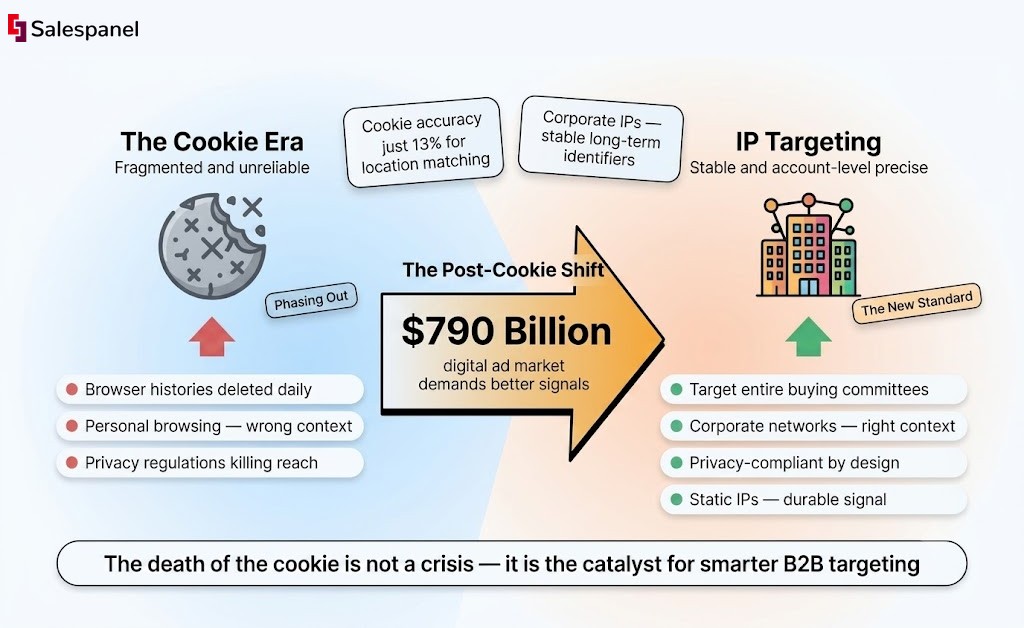
In the high-stakes arena of digital advertising—a market having reached nearly $790 billion as of 2025—precision is paramount. For years, B2B marketers operated in a landscape dominated by the third-party cookie, a notoriously unreliable proxy for tracking professional buyers. This era is ending. The deprecation of cookies is not a crisis but a catalyst, forcing a strategic evolution towards more stable, privacy-compliant signals. This guide provides an in-depth technical framework for leveraging IP targeting, a foundational method for modern account-based marketing (ABM) that transforms anonymous digital footprints into measurable revenue. Understanding this shift is no longer optional; it is critical for survival and growth in the post-cookie world.
The Post-Cookie Reality: A Paradigm Shift in Digital Advertising
The advertising industry is undergoing a tectonic shift as third-party cookies are phased out. The long-standing practice of tracking individual users across the web with browser-based data files is becoming obsolete, compelling marketers to adopt more direct and technically sound methodologies.
For B2B organizations, this represents a significant opportunity to sharpen their focus. IP targeting has emerged as a primary strategy in this new landscape. Instead of pursuing individual users based on fragmented browser histories, this method allows marketers to engage entire organizations at their physical place of work. This approach aligns perfectly with ABM, where the objective is to influence the entire buying committee within a target account, not just a single contact.
From Individual Profiles to Corporate Networks
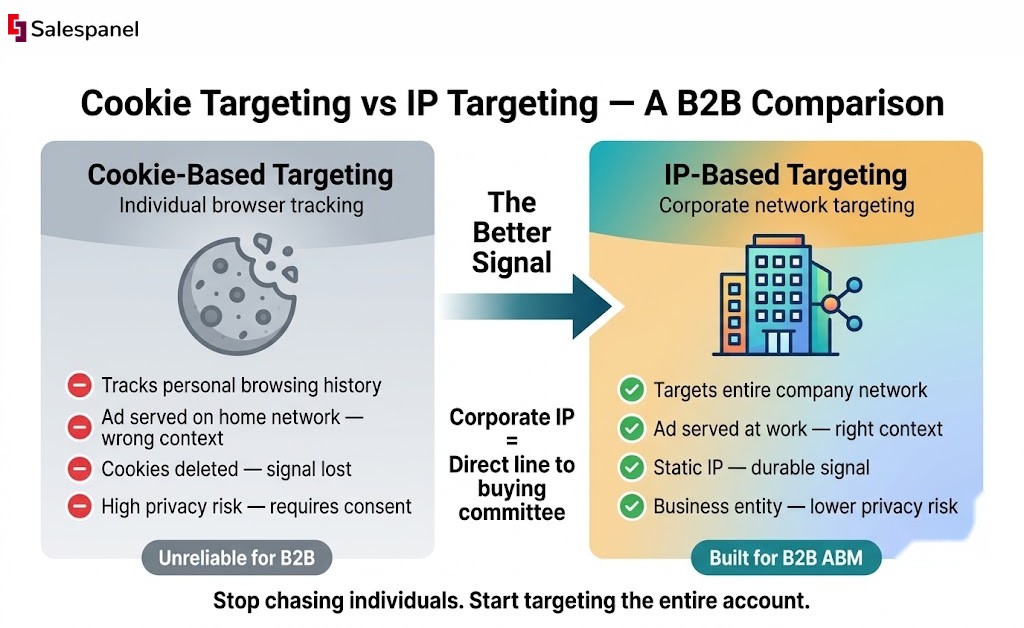
The transition from cookie-based to IP-based targeting constitutes a fundamental change in advertising logic. The technical and strategic differences are stark.
- Cookie-Based Targeting: This legacy method tracks an individual’s browser activity across various sites and devices. For B2B, its effectiveness is often diluted. A common failure scenario is serving a sophisticated enterprise software ad to a target buyer while they are browsing personal content on a home network, resulting in wasted ad spend and poor context.
- IP-Based Targeting: This method focuses ad delivery on a company’s specific network infrastructure. Advertisements are served exclusively within the professional environment where decision-makers and influencers are actively engaged in business-related problem-solving.
This shift provides B2B campaigns with a more durable and reliable targeting signal. Browser cookies are ephemeral and easily deleted, but a corporate IP address is often a static, long-term identifier directly associated with a high-value account. This stability is the bedrock of effective, long-term ABM campaigns.
A Critical Channel in a Trillion-Dollar Market
The scale of this operational change is immense. For a deeper analysis of market trends, these digital marketing statistics for 2025 provide crucial context. The remainder of this article will detail the technical framework required to achieve precision with IP targeting, ensuring every ad dollar is strategically deployed to reach the right corporate networks.
How IP Targeting Works for B2B Marketing
Technically, an Internet Protocol (IP) address functions as the digital equivalent of a physical street address for a corporate network. It is a unique numerical label assigned to an organization’s network, enabling all connected devices to access the internet. IP targeting leverages this identifier to deliver advertisements exclusively to devices operating within the network of designated target accounts.
This method replaces broad demographic guesswork with surgical precision. Instead of attempting to reach a decision-maker on their personal device, marketers can engage them—and their colleagues—within their professional workspace. This account-level focus is precisely why IP targeting advertising is a cornerstone of modern Account-Based Marketing (ABM).
Shifting from Individuals to Buying Committees
The primary strategic advantage of IP targeting is its capacity to influence an entire organization simultaneously. In complex B2B sales cycles, purchasing decisions are rarely made by an individual. They are the product of a buying committee, a cross-functional group of stakeholders from finance, IT, operations, and leadership. Traditional advertising models struggle to reach this entire cohort cohesively.
IP targeting addresses this challenge by defining the entire company network as the audience.
- Practical Example (Cybersecurity): A cybersecurity firm aims to sell its threat detection platform to major financial institutions. Using IP targeting, it can configure an ad campaign to serve exclusively to the corporate IP ranges of investment banks located on Wall Street. Every employee on that network, from security analysts to the CIO, is exposed to the same brand messaging.
- Practical Example (HR Software): An HR software vendor can target the known corporate campuses of Fortune 500 technology companies. This ensures that everyone from the HR manager researching solutions to the CFO approving the budget sees consistent advertising, building internal consensus and brand recognition.
This unified approach creates multiple touchpoints within a single high-value account, accelerating awareness and creating internal momentum for the purchase.
An IP address provides a stable, predictable signal for B2B campaigns. While cookies can be cleared and individual user data is fleeting, a corporate IP is a direct line to a high-value account, allowing you to engage the entire buying team where they work.
Comparison of B2B Targeting Methodologies
To fully appreciate the strategic value of IP targeting for B2B, a side-by-side comparison with other common methodologies is instructive. While each technique has its application, their precision for penetrating specific corporate accounts varies significantly.
| Targeting Method | Primary Identifier | B2B Precision | Privacy Consideration | Best Use Case |
|---|---|---|---|---|
| IP Targeting | Corporate IP Address | High (Account-Level) | Low (Targets a business, not PII) | Account-Based Marketing (ABM) |
| Cookie Retargeting | Browser Cookie | Medium (Individual-Level) | High (Requires user consent) | Re-engaging individual site visitors |
| Demographic Targeting | User Profile Data | Low (Assumed traits) | High (Uses personal data) | Broad awareness campaigns |
For targeted B2B campaigns where the list of target companies is known, IP targeting delivers a level of precision that other methods cannot replicate without encountering significant privacy constraints.
The Technical Setup for an IP Targeting Campaign
With a defined list of target accounts, the next step is implementation. The process of translating a list of company names into a live ad campaign requires a specific technical workflow involving specialized data providers and Demand-Side Platforms (DSPs).
The core technical challenge is mapping a company’s name and physical location to its corporate IP address range. This is the critical function performed by data enrichment services, which form the engine of any serious IP targeting advertising initiative.
Start with Who You Already Know (Even if They’re Anonymous)
The most effective IP targeting campaigns often begin with accounts that are already demonstrating interest in your solution, even if they remain anonymous. By identifying the companies visiting your website, you can build a pre-qualified audience list based on demonstrated intent.
Website visitor tracking from Salespanel, for example, can reverse-lookup the IP addresses of anonymous site visitors to identify the specific companies they belong to. This provides a continuously updated, high-intent list of accounts to target, ensuring ad spend is directed at organizations already in the consideration phase.
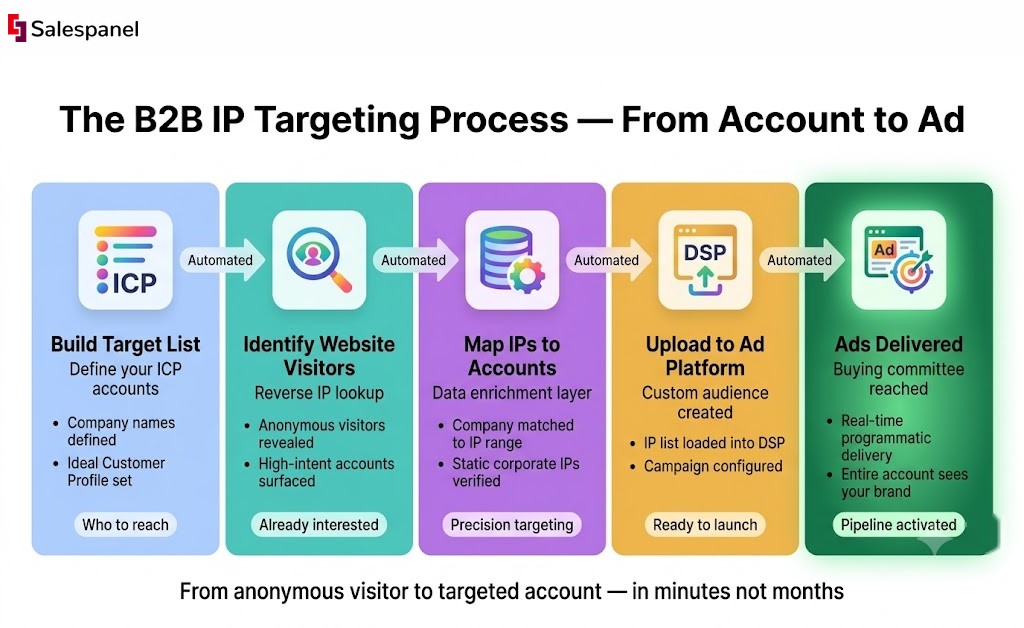
This diagram illustrates the workflow: identifying anonymous visitors, enriching that data, and activating it for targeted advertising campaigns.
From Account List to Ad Delivery
Once the target list is finalized, the technical process begins. Data providers query vast databases to match company names with their registered corporate IP addresses. This enriched list is then uploaded as a custom audience segment into a DSP or ad platform that supports IP-based targeting.
From that point, the process is automated. When a user from a device within a targeted corporate IP range browses a website or app with available ad inventory, the DSP recognizes the IP match and serves the designated ad in real-time. This entire transaction occurs in milliseconds through programmatic ad auctions.
Accurate tracking is essential for measuring campaign effectiveness. A robust tag management system is non-negotiable for any form of digital advertising. This Guide on How to Use Google Tag Manager provides a practical walkthrough for implementation.
The B2B IP targeting process follows a logical sequence: identify target accounts, map them to IP addresses, and deliver ads programmatically.
Static vs. Dynamic IPs: A Critical Technical Distinction
A technical nuance with significant implications for campaign accuracy is the difference between static and dynamic IP addresses.
- Static IPs: These are fixed, permanent addresses assigned to a network. Large corporations almost universally use static IPs to ensure stable, reliable connectivity for their operations. This provides a consistent and durable signal for long-term ad targeting.
- Dynamic IPs: These are temporary addresses that are reassigned periodically. They are common for residential internet connections and some small businesses. Targeting dynamic IPs is inherently less reliable, as the address you target today may be assigned to a different user tomorrow.
For B2B marketers, the prevalence of static IPs in the corporate world is a major advantage. It ensures that targeting remains accurate over the life of a campaign, allowing for consistent engagement with high-value accounts without signal degradation.
Navigating the Murky Waters of Accuracy and Measurement
While IP targeting is a powerful, cookie-free tool for B2B marketers, it is not infallible. Accepting vendor claims of perfect accuracy without rigorous validation can lead to significant budget waste. A realistic understanding of the technology’s limitations is essential for achieving a positive return on investment.
The primary challenge lies in the precision of mapping an IP address to a specific physical location. While large corporate headquarters often have easily identifiable static IP blocks, the data becomes less clear in other scenarios. The proliferation of remote work, the use of VPNs, and smaller offices with dynamic IPs introduce variables that can degrade accuracy. A 100% match rate is a technical impossibility.
The Myth of Pinpoint Accuracy
Following the decline of third-party cookies, many advertisers adopted IP targeting under the assumption that it was a direct, one-to-one replacement. This premise has been challenged by independent research, which has revealed significant limitations, particularly in B2C contexts where an IP is mapped to a household.
For example, one major benchmark study analyzing nearly one billion IP records discovered that the correlation between an IP address and a specific postal address was accurate only 13% of the time. While B2B accuracy is generally higher due to static corporate IPs, this data underscores the importance of a multi-signal approach. You can review the full findings on IP address targeting accuracy to understand the methodology.
A single data point is never the whole picture. The smartest IP targeting strategies treat IP data as a strong clue, not a guaranteed fact. They always back it up with other behavioral and firmographic signals.
How to Actually Validate Impact: MatchBack Analysis
If the initial targeting data is imperfect, how can marketers accurately measure campaign impact? The solution is to move beyond superficial metrics like impressions and clicks and adopt more robust validation methods. The most effective of these is MatchBack analysis.
This process provides powerful, data-driven insights into campaign performance through three simple steps:
- Export Ad Delivery Data: Obtain a complete list of all companies (by IP address or resolved name) to which your campaign served ads from your DSP.
- Cross-Reference with Sales Data: Compare this list against your CRM data for the same period, specifically looking at new leads, opportunities, and closed-won deals.
- Identify Overlap and Influence: Any account appearing on both the ad delivery list and in your sales pipeline represents a direct touchpoint. This overlap provides a clear, measurable link between ad exposure and tangible business outcomes.
By grounding measurement in actual sales activity, marketers can cut through vendor hype and gain a true understanding of ROI. This data-driven validation enables smarter budget allocation and the construction of a B2B marketing engine built on verifiable results.
Legal and Ethical Considerations: GDPR and Privacy
Navigating privacy regulations like GDPR and CCPA is a non-negotiable aspect of modern advertising. For B2B marketers, this raises a critical question: how can IP targeting advertising be used effectively without violating privacy standards?
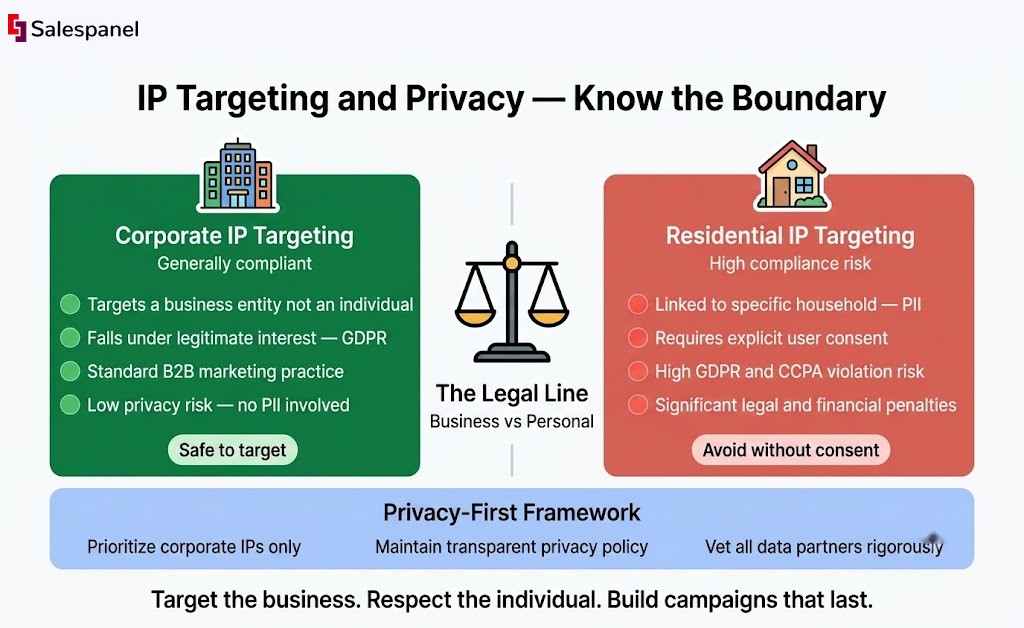
The answer lies in the fundamental distinction between a business IP and a residential IP address.
Targeting a corporate network is a standard and generally compliant B2B practice. In this context, the IP address corresponds to a business entity, not an individual’s private residence. This use case often falls under the “legitimate interest” provision within legal frameworks like GDPR, as the marketing activity is directed at a company.
However, targeting a residential IP address is a different matter entirely. A home IP can often be linked to a specific household, classifying it as Personally Identifiable Information (PII). Targeting residential IPs without obtaining explicit, unambiguous consent is a high-risk activity that can lead to significant legal and financial penalties.
Building a Privacy-First Framework
A sustainable, modern approach must be built on the principles of transparency and consent. For a detailed review of one of the most critical data protection regulations, these GDPR guidelines are an essential resource.
A practical framework for minimizing compliance risk includes these key actions:
- Prioritize Corporate IPs: Establish a clear policy to focus campaigns exclusively on known business IP ranges. Technically filter out all identified residential IPs from targeting lists.
- Maintain Transparency: Your public privacy policy must clearly articulate how IP data is used for advertising and website personalization.
- Obtain Explicit Consent: For any data collection that could be tied to an individual, ensure your consent mechanisms are clear, specific, and easy for the user to understand and manage.
- Vet Data Partners Rigorously: Work only with reputable data providers. Demand detailed information about their data sourcing methods and their own compliance protocols.
Adopting a privacy-first mindset changes compliance from a chore into a competitive advantage. Companies that respect user data build stronger, more trusting relationships with their customers—and that’s the real end goal of any marketing effort.
By focusing strictly on legitimate B2B use cases and treating all data with the respect it requires, you can execute powerful IP targeting campaigns that deliver results without crossing ethical or legal boundaries.
Weaving IP Data Into Your Revenue Funnel
IP targeting transcends being a simple advertising tactic when it is integrated as the connective tissue of a complete go-to-market strategy. It serves as the bridge between anonymous, top-of-funnel brand awareness and the concrete sales actions that generate revenue.
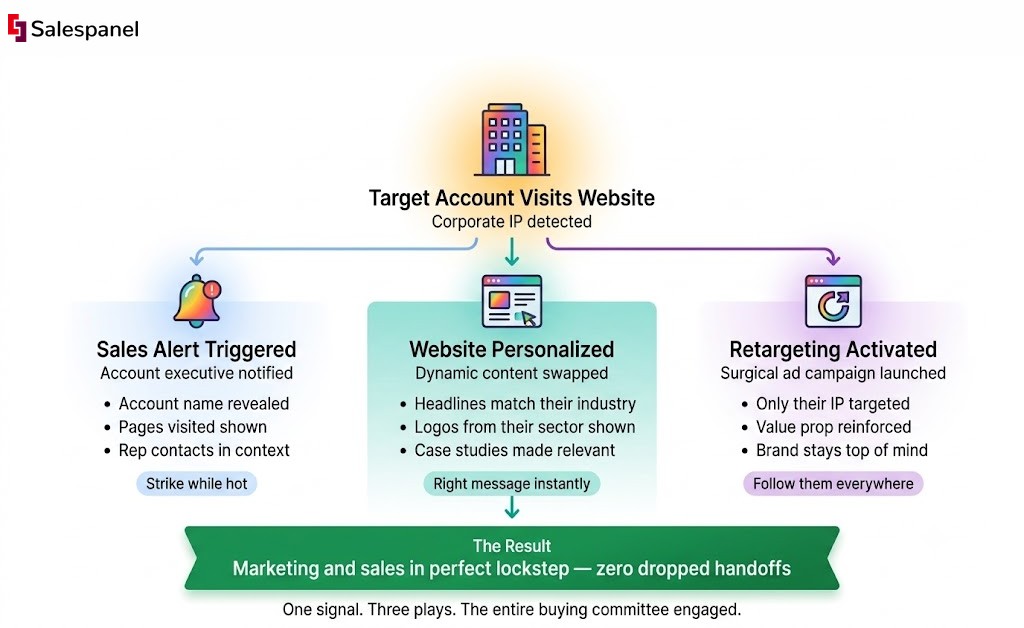
When a company from a target account list visits your website, its corporate IP address functions as an engagement trigger. Instead of passively waiting for a form submission, you can initiate a sequence of automated, proactive sales and marketing plays.
Turning a Visit Into a Full-Funnel Play
The moment a high-value account lands on your website, your entire revenue funnel should activate in a coordinated response.
- Trigger Real-Time Sales Alerts: Instantly notify the assigned account executive that their target account is actively browsing the site, providing the context for a timely and relevant outreach.
- Implement Dynamic Website Personalization: Automatically swap headlines, customer logos, or case studies to align with the visitor’s industry or company name, creating a highly tailored user experience.
- Launch Surgical Retargeting: Initiate a hyper-specific ad campaign targeting only that company’s IP address, reinforcing key value propositions with focused precision.
This synchronized orchestration ensures marketing and sales teams operate in lockstep, using IP data as the seamless handoff mechanism between them.
Use Lead Scoring to Focus Your Firepower
Not all visiting companies represent immediate opportunities. A system is needed to differentiate high-intent accounts from casual browsers, thereby focusing resources where they will have the greatest impact. This is the role of intelligent lead scoring.
The screenshot below demonstrates how visiting companies can be automatically ranked based on their on-site behavior and firmographic fit.
Using Salespanel’s lead scoring framework, you can combine this behavioral data (pages visited, time on site) with firmographic data (company size, industry) to automatically surface the accounts demonstrating the strongest buying signals.
This system ensures that sales outreach and ad spend are concentrated on companies that are genuinely progressing through the evaluation process. While accuracy requires validation, some vendors’ IP targeting performance findings have shown significant impact when this integrated approach is used correctly, with some reporting a 350% return on ad spend.
By integrating IP data with an intelligent scoring model, you replace guesswork with a predictable system for generating revenue pipeline from previously anonymous website traffic.
Got Questions? We’ve Got Answers
Executing an IP targeting strategy often raises several key technical and legal questions. Below are answers to the most common queries from B2B marketers.
Is IP Targeting Legal and GDPR Compliant?
The answer depends entirely on the context. For B2B marketing—targeting a corporate office network—the practice generally falls under the “legitimate interest” legal basis and is considered compliant, as it targets a business entity, not an individual.
The legal risk increases significantly if an IP address can be reasonably linked to a specific household. Under regulations like GDPR, a residential IP is often considered Personally Identifiable Information (PII). The key to compliance is to maintain a strict focus on account-level targeting and consult with legal counsel to ensure your strategy aligns with all relevant regulations.
How Accurate Is IP Targeting for Companies?
Accuracy is typically high for larger corporations that operate on static, registered IP blocks. The signal is strong and stable.
However, accuracy can be lower for smaller businesses, remote workers using residential dynamic IPs, or any user whose traffic is routed through a Virtual Private Network (VPN).
No data provider can guarantee 100% accuracy. IP data should be treated as a strong directional signal, not an absolute fact. The most successful campaigns always layer IP data with other intent and firmographic signals for validation.
What Is the First Step to Launch an IP Targeting Campaign?
The process begins with a well-defined target account list. This list, based on your Ideal Customer Profile (ICP), is the strategic foundation for the entire campaign.
From there, you must enrich this list with corporate IP data from a reputable third-party provider. A more advanced approach is to use a tool to identify which target accounts are already visiting your website, creating a high-intent, pre-warmed audience. This final IP list is then uploaded as a custom audience into a compatible ad platform or DSP to launch your campaign, ensuring your ip targeting advertising budget is focused on accounts that have demonstrated clear interest.
Ready to turn your anonymous website traffic into a predictable revenue pipeline? Explore Salespanel’s advanced B2B marketing resources to build a smarter, privacy-first strategy.