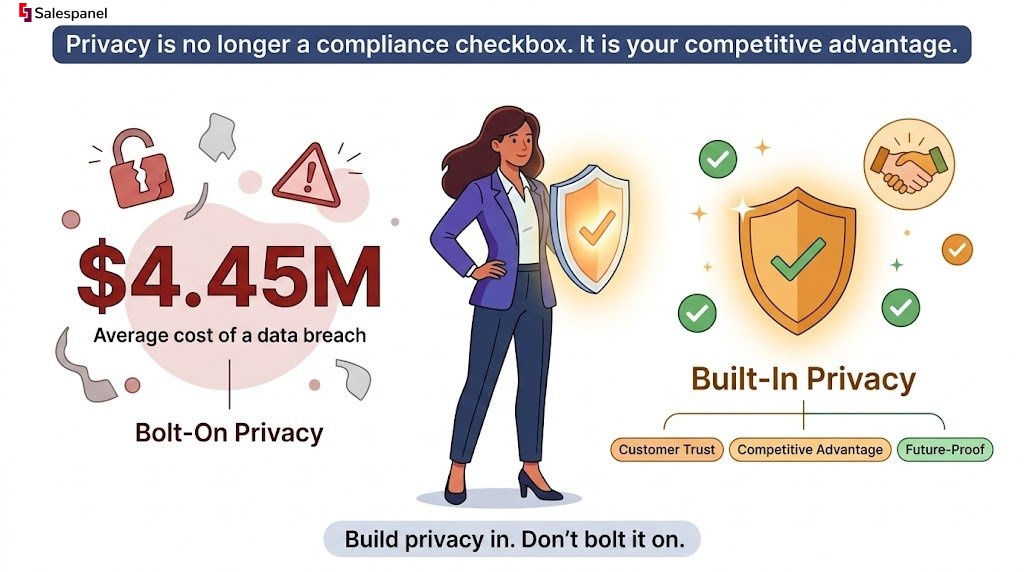
In a digital economy where data is the new oil, trust is the ultimate currency. For decades, businesses operated on a reactive model, treating data privacy as a last-minute compliance hurdle or a frantic damage control exercise after a data breach. This “bolt-on” approach is now obsolete. The average cost of a data breach has soared to over $4.45 million, but the reputational damage is often immeasurable. We have moved from an era of data accumulation to an era of data accountability, driven by a global shift in consumer expectations and regulatory power.
The future belongs to organizations that build, not bolt on, privacy. This proactive, architectural approach is the central theme of the privacy by design framework. It’s a strategic mandate to embed data protection into the very DNA of your technology, processes, and culture from inception. This guide provides an in-depth technical and practical breakdown of this framework, offering marketers a blueprint to move beyond mere compliance and turn privacy into a definitive competitive advantage. By understanding and implementing these principles, you will be equipped to build resilient systems that foster unbreakable customer trust.
From Afterthought to Architecture: The Rise of Privacy
For too long, data privacy was relegated to the final stages of product development—an inconvenient checkbox to be ticked before launch. This reactive methodology created systems that were inherently vulnerable, leading to clunky user experiences and fragile customer relationships easily shattered by a single security incident.
That paradigm has been officially dismantled. With data fueling every aspect of modern business, from product innovation to marketing personalization, privacy has transitioned from a legal silo to a core tenet of brand identity and business strategy. The driving force behind this transformation is the privacy by design framework.
The Old Way vs. The New Reality
The legacy, reactive model involved applying security patches and privacy controls after a system was already operational. This approach is not only technically inefficient but also financially catastrophic. The fallout from this mindset is clear, with data breach costs rising and consumer trust plummeting.
Privacy by Design isn’t about limiting innovation; it’s a positive-sum framework for creating a win-win scenario where robust privacy protections and powerful, data-driven features coexist and reinforce one another. This synergy strengthens customer relationships and drives superior business outcomes.
The proactive model championed by Privacy by Design treats privacy as a non-negotiable architectural requirement. It mandates that data protection is woven into every layer of a system, from the initial schematics and first lines of code to the final user interface. This philosophy is the bedrock for building sustainable customer trust and securing long-term growth.
This infographic quantifies the difference between the two mindsets and their impact on business health.
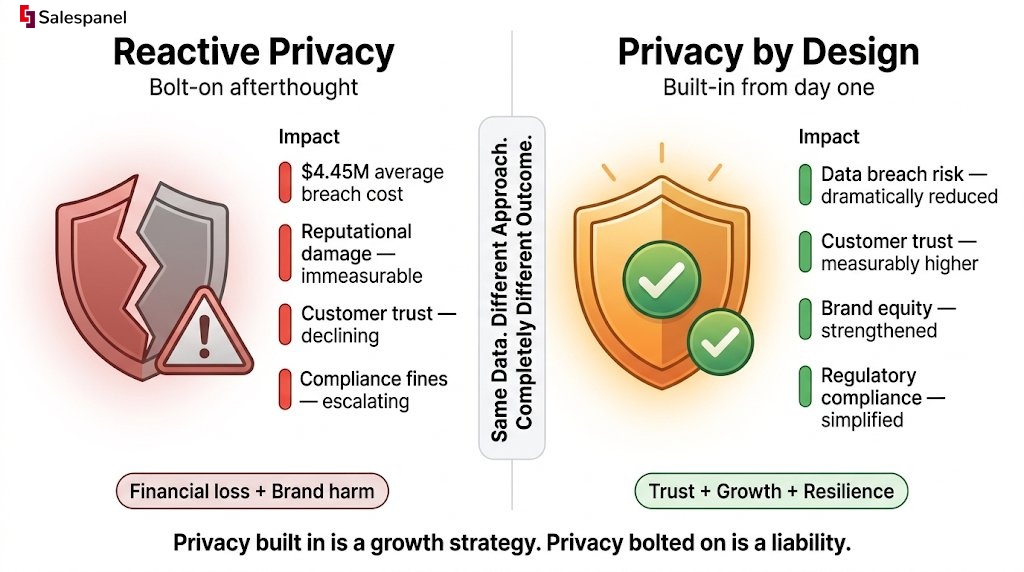
The contrast is stark. A reactive approach is a direct line to financial loss and reputational harm, while a proactive Privacy by Design strategy demonstrably boosts customer trust and brand equity.
A Global Regulatory Mandate
This framework is no longer an academic best practice; it is increasingly codified into law. A pivotal moment occurred in 2016 with the introduction of Article 25 of the European Union’s GDPR, which legally mandated ‘data protection by design and by default.’ This transformed the framework into a legal requirement for any organization processing the data of EU citizens.
Since then, the global momentum has accelerated. Over 160 national privacy laws have been enacted worldwide, and as of 2026, 75% of the global population is now covered by privacy regulations, many drawing directly from PbD principles.
For any marketer or business leader, a deep, technical understanding of this framework is critical for operational success. It provides the blueprint for moving beyond compliance theater and turning privacy into a strategic asset that fuels innovation. This shift from reactive fixes to built-in protection fundamentally changes how we approach security. To get up to speed on the latest proactive defense strategies, it’s worth checking out new security playbooks and best practices.
Throughout this guide, we will dissect the core principles, practical implementation steps, and real-world applications of the privacy by design framework, providing the technical tools to build a more resilient and trustworthy business.
The 7 Principles of Privacy by Design Explained
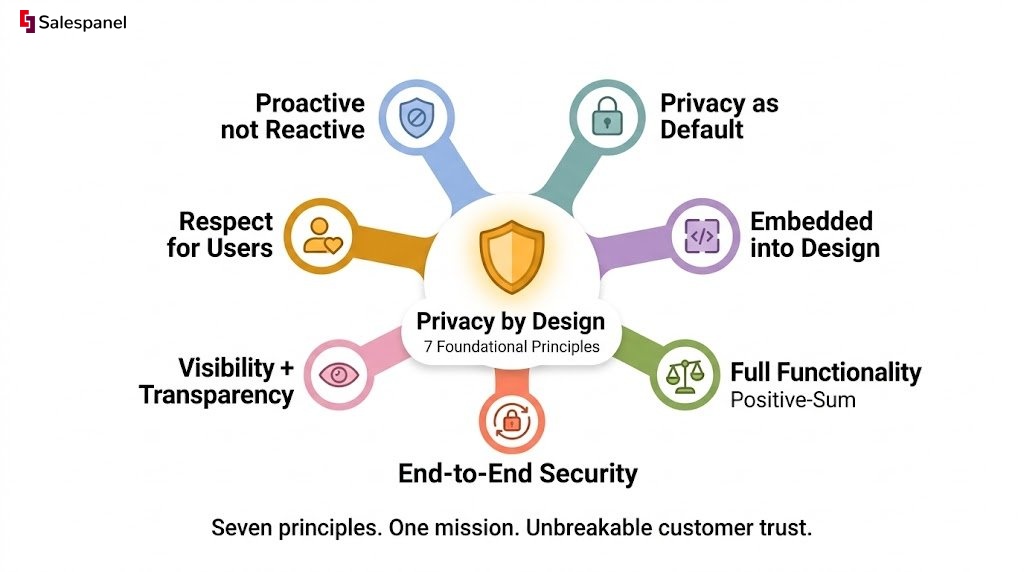
Privacy by Design is not a single action but a comprehensive system of thought, a philosophy architected upon seven foundational and interconnected principles. Originally formulated by Dr. Ann Cavoukian, these principles serve as the technical and practical foundation for building trust and weaving data protection into the very fabric of your operations.
These are not merely academic concepts; they are the bedrock of modern data protection controls and have profoundly influenced landmark regulations like GDPR. The impact is significant: by 2025, 78% of organizations worldwide were leveraging a formal framework to manage privacy, with the DNA of PbD evident in most. To dive deeper, you can learn more about the global adoption of data privacy frameworks.
Understanding these principles is the key to translating abstract privacy goals into concrete, actionable steps for your B2B marketing team. Let’s break down each one with technical and practical examples.
1. Proactive Not Reactive; Preventative Not Remedial
This first principle is the core of the entire framework. It dictates an engineering-led approach to privacy: anticipate and mitigate risks before they materialize. Instead of reacting to data breaches or privacy complaints, you design systems that prevent them by default.
A practical analogy is constructing a building to be earthquake-resistant from the foundation up, rather than attempting to retrofit it after a tremor. One approach is about inherent resilience; the other is about costly, often ineffective, remediation.
Practical Example: In B2B marketing, a reactive approach to designing a lead capture form is to collect a dozen data points “just in case.” The proactive, preventative application of this principle is to conduct a data minimization assessment and ask, “What is the absolute minimum data required to fulfill this specific request and deliver value?” This prevents data over-collection at the source.
2. Privacy as the Default Setting
This principle is simple in concept but profound in application: user privacy must be the automatic, default state of any system. When a user interacts with your technology, the most privacy-protective settings must be pre-configured. The user should not have to navigate complex menus to secure their own data.
Security and privacy must be the out-of-the-box standard. If a user desires a less-protective setting, that must be an explicit, informed, and affirmative action on their part.
Practical Example: The classic case is a newsletter subscription checkbox on a registration form. An unchecked box is the correct implementation, requiring the user to actively opt-in. A pre-checked box violates this principle by assuming consent and forcing the user to take action to protect their privacy, shifting the burden from the data controller to the data subject.
3. Privacy Embedded into Design
Privacy must not be a superficial layer or feature added at the end of a development cycle. It must be a core, non-functional requirement of the system’s architecture, fully integrated into the design and functionality of your products, services, and business processes from day one.
When privacy is truly embedded, it is considered as fundamental to the project’s success criteria as performance, scalability, or usability. It is part of the system’s blueprint, not a coat of paint applied before shipping.
Practical Example: When engineering a new marketing analytics dashboard, features like data pseudonymization, role-based access controls (RBAC), and audit logs are included in the initial technical specifications and developed during the first sprint—not hastily added after the tool is already processing live production data.
4. Full Functionality — Positive-Sum, Not Zero-Sum
A common misconception is that privacy and functionality exist in opposition—a zero-sum game where enhancing one necessitates diminishing the other. This principle fundamentally rejects that premise, positing that it is both possible and necessary to achieve both without compromise.
This is a “positive-sum” approach. The goal is to innovate and find creative technical solutions that satisfy all legitimate objectives simultaneously.
Wrong Approach (Zero-Sum): “We cannot deliver personalized email campaigns without tracking every user interaction across every channel.”
Right Approach (Positive-Sum): “We can deliver highly personalized experiences by leveraging the declared, first-party data our users have consensually provided, thereby respecting their choices while delivering relevant, valuable content.”
5. End-to-End Security — Lifecycle Protection
Data has a lifecycle, and this principle demands robust protection throughout its entire journey—from the moment of collection to the point of secure destruction. Security cannot be a single-point solution like a firewall; it must be a holistic, defense-in-depth strategy.
This requires securing data at every stage:
- Secure Collection: Implementing Transport Layer Security (TLS) for all data submitted via web forms.
- Secure Storage: Using strong cryptographic standards like AES-256 for data at rest.
- Secure Processing: Enforcing strict access controls and processing data in secure, isolated environments.
- Secure Destruction: Employing cryptographic erasure or data wiping techniques to permanently delete data once its retention period has expired.
6. Visibility and Transparency — Keep It Open
Your data processing operations must be transparent and verifiable. This principle mandates that organizations be open and honest about what data they collect, the legal basis for processing, and the purposes for which it is used.
There should be no hidden operations. All practices should be documented and auditable. A clear, machine-readable privacy policy is essential, but transparency also extends to the user interface. This means providing “just-in-time” notices—clear, plain-language explanations at the point of data collection.
7. Respect for User Privacy — Keep It User-Centric
Ultimately, the entire framework is predicated on respect for the individual. This means designing systems and processes that are user-centric, prioritizing their interests and providing them with agency over their personal data.
This involves providing users with clear, accessible tools to exercise their data subject rights, such as the right to access, rectify, or erase their data. The system’s design must reflect that the user is the owner of their data by empowering them with granular control and genuine choice.
To bring it all together, here’s a quick look at how these seven principles translate into real-world B2B marketing practices.
The 7 Principles of Privacy by Design in Practice
| Principle | Core Concept | B2B Marketing Example |
|---|---|---|
| 1. Proactive not Reactive | Anticipate and prevent privacy risks before they occur. | Instead of collecting all possible data on a demo request form, you only ask for the name, email, and company—the minimum needed to schedule the call. |
| 2. Privacy as the Default | The most privacy-friendly settings are applied automatically. | On your platform, you disable third-party ad tracking by default. Users must actively opt-in to enable it. |
| 3. Privacy Embedded into Design | Privacy is a core, integrated component of the system. | When developing a new lead scoring model, you build in data anonymization from the start, not as an afterthought. |
| 4. Full Functionality (Positive-Sum) | Achieve both privacy and functionality without trade-offs. | You provide personalized content recommendations based on the user’s explicit topic interests (first-party data) rather than covertly tracking their browsing history. |
| 5. End-to-End Security | Data is protected throughout its entire lifecycle. | A lead’s data is encrypted when submitted via a form, stored securely, and then automatically purged from the CRM 90 days after the sales cycle closes. |
| 6. Visibility and Transparency | Be open and honest about your data practices. | Your website includes a “just-in-time” notice next to the email field that clearly explains why you’re asking for their email and links to your privacy policy. |
| 7. Respect for User Privacy | Put the user’s interests and control first. | You provide a self-service preference center where users can easily view, update, or delete their personal information at any time. |
These principles are not a mere compliance checklist; they are a technical and cultural roadmap for building more trustworthy, resilient, and effective marketing operations. By adopting this mindset, you are not just protecting your customers—you are future-proofing your brand.
Integrating Privacy Into Your Marketing Tech Stack
Moving from the theory of the privacy by design framework to actual practice is where most companies get stuck. It’s one thing to have a policy document, but the real test is in the architectural choices you make for your marketing technology stack.
Every tool you use—from your CRM to your analytics platform—is either a potential privacy risk or a bastion of user trust. The outcome depends entirely on how you implement it.
Embedding privacy isn’t just a technical fix; it’s a procedural one that demands a proactive mindset. It’s about building a privacy-first culture that shapes every decision, from buying new software to configuring its settings. This is how abstract principles like data minimization become tangible, everyday realities.
The Foundational Step: Privacy Impact Assessments
Before any new tool ever touches your martech stack, your first move should be a Privacy Impact Assessment (PIA). Think of a PIA as a pre-flight check for data handling. You wouldn’t launch a plane without checking the systems, and you shouldn’t launch a new marketing tool without doing the same for privacy.
A solid PIA for a B2B marketing tool needs to answer a few critical questions:
- What data are we collecting? Get specific. List every single data point, from IP addresses to job titles.
- Why do we need this data? Justify each data point against a legitimate business goal. This is data minimization in action.
- How will it be stored and secured? Look at the encryption standards, both for data in transit and at rest.
- Who can access this data? Define clear roles and permissions so only authorized people can touch sensitive information.
- What’s our data retention policy? Set a clear timeline for how long you’ll keep the data before it’s securely deleted.
By making a PIA your first step, you shift privacy from an afterthought to a core requirement for any new technology.
Configuring Your Core Systems for Privacy
With a strong vetting process in place, the next step is to configure the tools you already have. Your CRM and marketing automation platform are the central nervous system of your operations, so getting their setup right is crucial. The goal is simple: make privacy the default setting.
Practical Example: A B2B SaaS Company Scenario
Imagine a SaaS company wants to adopt a new website analytics tool to better understand user behavior. With a privacy by design approach, their process looks nothing like the old “install and forget” method.
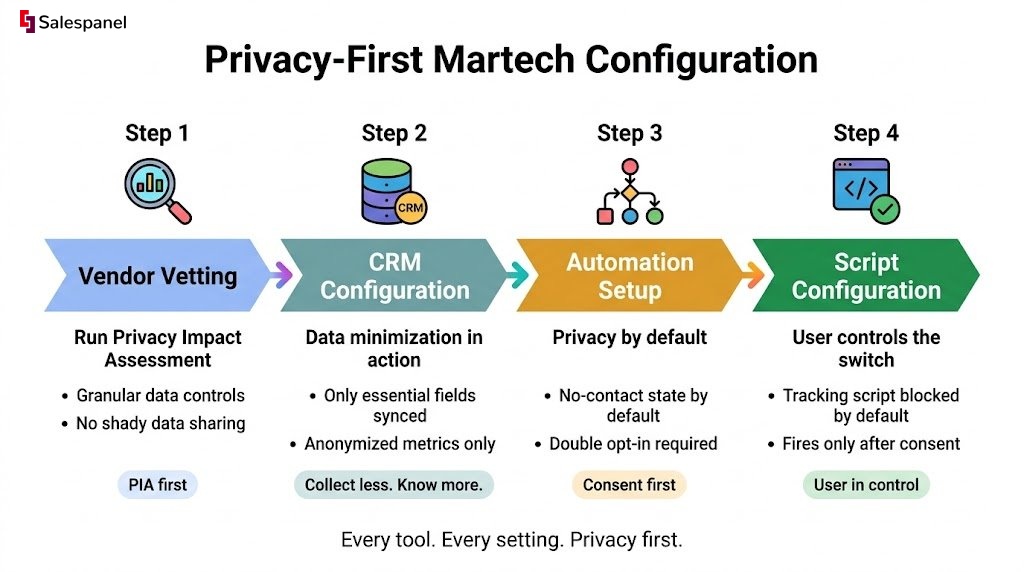
- Vendor Vetting (PIA): First, they run a PIA. They deliberately choose a vendor that offers granular control over data collection and is transparent about its practices. Any tools that bundle data or have shady data-sharing agreements are immediately rejected.
- CRM Configuration (Data Minimization): In their CRM, they set up custom field settings to limit what data gets synced from the new tool. Instead of pulling in every possible data point, they only import essential, anonymized metrics needed for lead scoring. Data over-collection is stopped before it can start.
- Automation Setup (Privacy by Default): Next, they configure their marketing automation platform to respect user consent from the get-go. New contacts automatically enter a “no-contact” state until they give explicit consent through a double opt-in process. Privacy is now the default.
- Script Configuration (User-Centric Control): When they deploy the analytics tool’s tracking script, they integrate it with their consent management platform. The script simply won’t fire—or collect any data—until a user has given clear, affirmative consent. This puts the user squarely in control.
This step-by-step blueprint works for integrating any new technology, ensuring that growth never comes at the cost of user trust. As technology evolves, it’s crucial to keep looking ahead. For those interested in the next frontier, exploring Web3 Marketing Automation Best Practices can offer valuable insights into building privacy into emerging platforms.
The core philosophy of a privacy-first tech stack is simple: empower marketing and sales without disempowering the user. This is achieved by making conscious choices about data collection and processing at every single touchpoint.
At Salespanel, this philosophy is not just a talking point; it’s engineered into our product architecture. Our Website visitor tracking from Salespanel, for example, is designed with consent as a primary consideration, allowing businesses to gather valuable journey insights while fully honoring the privacy choices of their audience. This demonstrates that achieving both effective marketing and strong privacy isn’t just possible—it’s essential for sustainable growth.
How to Measure Your Privacy by Design Adoption Rate
Look, implementing a privacy by design framework is a huge step. But how do you actually prove it’s making a difference? Noble intentions don’t exactly show up on a dashboard. To get from a good idea to a measurable result, you need a solid Key Performance Indicator (KPI): the Privacy by Design Adoption Rate.
This isn’t just another number to track. It takes your privacy efforts from a fuzzy, qualitative goal and turns them into a hard, quantitative score. Think of it less as a compliance checkbox and more as a leading indicator of your company’s health—pointing to lower data breach risks, stronger customer trust, and even better operational efficiency down the road. By tracking it, you can finally show a real return on your privacy investment.
Defining and Calculating the Adoption Rate
At its core, the Privacy by Design Adoption Rate is pretty simple. It measures the percentage of new projects and initiatives that successfully build in PbD principles right from the get-go.
The formula is straightforward but powerful:
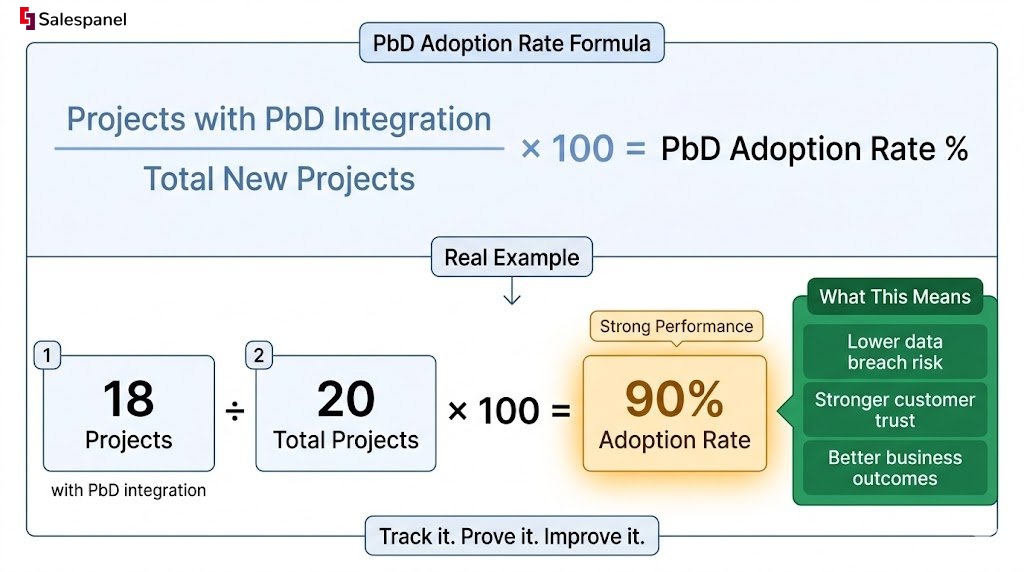
(Number of New Projects with PbD Integration / Total Number of New Projects) x 100 = PbD Adoption Rate
A “new project” can be anything from a major software update to a new marketing campaign or a full-on product launch. “PbD Integration” simply means the project was formally reviewed against the seven principles before it ever saw the light of day.
More and more organizations are weaving this framework into their projects, and this KPI is built to measure exactly that. Companies that hit high adoption rates almost always report better data security and fewer breaches, which has a direct line to stronger customer trust and, ultimately, better business. While the upside is clear, many teams still struggle to embed PbD across different departments and tech stacks. You can discover more about how this KPI is applied in operational governance to see how others are tackling it.
Practical Measurement in B2B Marketing
To get an accurate rate, you need a system. This isn’t about guesswork; it’s about building a repeatable workflow that gives you clean data.
Here’s how a B2B marketing team can put this into action:
- Create a PbD Checklist: Build a standardized checklist based on the seven principles. This becomes your go-to audit tool for every new thing you launch. It should ask simple, direct questions like, “Is data collection minimized to only what is necessary?” or “Are privacy settings set to the highest level by default?”
- Bake It Into Project Kickoffs: Make the PbD checklist a mandatory step in your project management process. Before anyone even starts developing a new email campaign, a product feature, or a webinar sign-up page, the project lead has to complete and sign off on the checklist. No exceptions.
- Audit Campaign Launches: For a new marketing campaign, the audit would confirm that your lead forms only ask for what’s absolutely essential. It would check that consent boxes are clear and un-checked by default, and that any new third-party tools have gone through a proper Privacy Impact Assessment (PIA).
- Review Product Roadmaps: When looking at the product roadmap, the checklist ensures privacy is being considered at the earliest stages of feature development—not just bolted on as an afterthought right before release.
By logging the result of each checklist review as a simple “Passed” or “Failed,” you create a clean, binary data set. At the end of every quarter, calculating your adoption rate is a breeze. For instance, if you launched 20 campaigns and 18 of them passed the PbD audit, you’ve got a solid 90% adoption rate. This gives you a clear, data-backed story to share with leadership and helps you pinpoint exactly which areas need a little more focus.
Balancing B2B Personalization and Privacy
For a long time, B2B marketers have been told they face a tough choice: either deliver a deeply personalized buyer journey or respect user privacy. This forces a false trade-off, making you feel like you have to sacrifice one to get the other. Frankly, this zero-sum thinking is a relic of old-school, intrusive marketing.
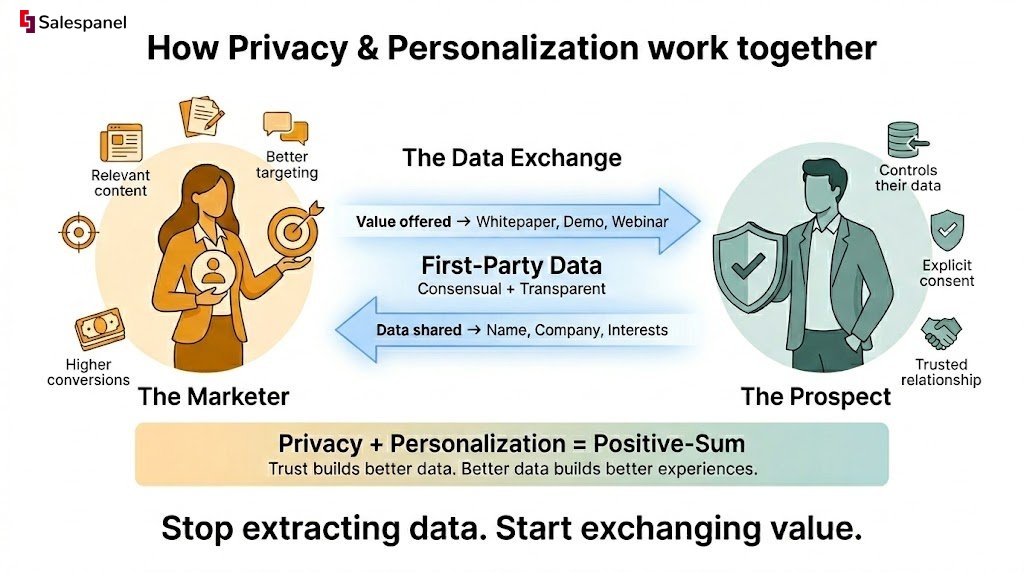
The truth is, a privacy by design framework completely shatters this myth. It’s a strategic roadmap for creating a “positive-sum” game—a scenario where strong personalization and rock-solid privacy don’t just coexist, they actually feed each other. It’s simple, really. When prospects trust you with their data, they’re more willing to share the right information, which then fuels better, more helpful personalization.
It’s not about picking a side. It’s about building a system where trust becomes the engine for your growth.
Shifting from Third-Party to First-Party Data
The secret to striking this balance is moving your focus away from murky third-party data and toward transparent, ethically collected first-party data. Third-party data, often bought from brokers and gathered without anyone’s direct permission, is where most privacy headaches and trust issues begin.
First-party data, on the other hand, is the information prospects and customers give you directly. Think form submissions, website interactions, and the choices they make in a preference center. This data is more accurate, more relevant, and—most importantly—collected with their explicit consent.
By prioritizing first-party data, you’re fundamentally respecting your audience’s autonomy. You shift from a model of data extraction to one of data exchange, where you offer real value (like a whitepaper or a demo) in return for information they willingly provide.
Practical Techniques for Trust-Based Personalization
Getting this balance right comes down to using practical, user-centric techniques. It’s all about designing interactions that are transparent and put the user firmly in the driver’s seat, which aligns perfectly with the core principles of privacy by design.
Here are a few high-impact methods to get you started:
- Progressive Profiling: Instead of hitting someone with a massive form on their first visit, progressive profiling collects information bit by bit over time. A user might give their name and email for a newsletter, then their company name for a webinar, and later their job title for a detailed case study. The whole process feels less like an interrogation and more like building a relationship.
- Transparent Data Usage: Be radically open about how you use the data you collect. If you’re using a prospect’s industry to show them relevant content, just say so. A simple line like, “Because you’re in the manufacturing sector, you might find this guide useful,” transforms personalization from creepy to genuinely helpful.
- User-Centric Preference Centers: Give users granular control. A well-designed preference center lets them easily update their information, pick the topics they want to hear about, and opt out of specific communications without having to hit the “unsubscribe from everything” button.
The ultimate goal is to make the user an active participant in their own personalization journey. When they control the data they share, the resulting personalization feels like a service, not surveillance. This builds immense brand loyalty and long-term trust.
This philosophy of empowering businesses while respecting user privacy is a core part of our own approach. For example, our Website visitor tracking from Salespanel is engineered to work hand-in-glove with consent management platforms. It can be configured to honor user consent signals, allowing you to map the buyer’s journey and understand engagement without ever overriding their privacy choices. This ensures you can gather valuable insights responsibly, proving that effective marketing and ethical data handling go hand in hand. By building trust, you create a flywheel where better data leads to better personalization, which in turn strengthens your customer relationships.
Still Have Questions About Privacy by Design?
Even with the principles laid out, putting the privacy by design framework into practice can bring up some tricky questions. Let’s walk through a few of the most common ones we hear from marketers and developers to clear up any confusion and get your strategy on solid ground.
What Is the Difference Between Privacy by Design and Privacy by Default?
It’s easy to get these two mixed up, but the relationship is pretty straightforward. Think of one as the complete blueprint and the other as a critical safety feature built from that plan.
Privacy by Design is the entire strategic approach. It’s the philosophy of weaving data protection into the very fabric of a system, product, or campaign right from the get-go.
Privacy by Default, on the other hand, is one of the seven foundational principles brought to life. It’s the rule that says the most privacy-protective setting must be the default, out-of-the-box configuration. Your users shouldn’t have to lift a finger to secure their information; protection should be the standard.
Here’s a simple analogy: Privacy by Design is the complete architectural plan for building a secure house, right down to the reinforced walls and integrated alarm system. Privacy by Default is making sure all the doors and windows are already locked when the new owner gets the keys. They can choose to unlock them, but safety is the starting point.
Can You Apply Privacy by Design to Existing Systems?
Absolutely. While the framework is always most effective (and cheaper) when you start with it from day one, you can—and should—apply its principles to legacy systems. It’s a bit like renovating an old building to meet modern safety codes instead of building a new one from scratch.
The process for an existing system usually looks something like this:
- Kick Off a Privacy Audit: Start with a thorough review, like a Data Protection Impact Assessment (DPIA). This helps you map out current data flows, see where you’re collecting information, and spot potential weak points.
- Tackle High-Risk Areas First: You can’t fix everything at once. Focus on the most critical issues first, like insecure data storage, over-collection on your high-traffic forms, or confusing consent pop-ups.
- Roll Out Iterative Fixes: Start retrofitting PbD principles piece by piece. This could mean updating your data retention policies, adding better encryption, or redesigning user interfaces to make consent options crystal clear.
It takes a more targeted effort, but it’s a vital step for modernizing your tech stack and staying on the right side of regulations.
How Can Small Businesses Implement This Framework?
Small businesses can absolutely implement the privacy by design framework without a huge budget. This is less about buying expensive tools and more about building the right mindset.
Focus on these foundational, high-impact actions:
- Be Strict About Data Minimization: This is your most powerful—and cost-effective—tactic. If you don’t have a clear, immediate need for a piece of data, don’t collect it. This one habit slashes your risk and compliance workload.
- Vet Your Third-Party Tools: Before you bring on a new CRM, analytics platform, or email service, dig into its privacy features. Make sure it’s GDPR-compliant and gives you transparent controls for managing data.
- Use a Simple PbD Checklist: Create a basic checklist based on the seven principles. Make it a mandatory step for every new marketing campaign, website update, or feature launch. This ensures privacy gets a look-in every single time.
Building a company-wide culture of privacy costs nothing and will guide your team to make the right choices automatically.
Does Privacy by Design Guarantee GDPR Compliance?
Implementing Privacy by Design gets you a huge part of the way toward GDPR compliance. In fact, it’s a legal requirement under Article 25 (“Data protection by design and by default”). Following the framework helps you build the compliant foundation your systems need.
But—and this is a big but—PbD alone does not guarantee 100% GDPR compliance. The GDPR has other specific requirements that you have to handle separately.
This includes things like:
- Rules for international data transfers (like Standard Contractual Clauses).
- Appointing a Data Protection Officer (DPO) if your organization meets certain criteria.
- Strict breach notification deadlines, requiring you to report a breach to authorities within 72 hours.
Think of the privacy by design framework as the engine and chassis of your compliance car. It’s essential for getting you on the road, but you still need to follow all the other traffic laws to drive safely and legally.
At Salespanel, our philosophy is that respecting user privacy is not a hurdle—it’s a catalyst for building stronger, more trusting customer relationships. Our tools are engineered from the ground up on this principle, helping you gather meaningful insights while always honoring user consent. Explore our resources to see how you can build a marketing strategy that’s both effective and ethical.