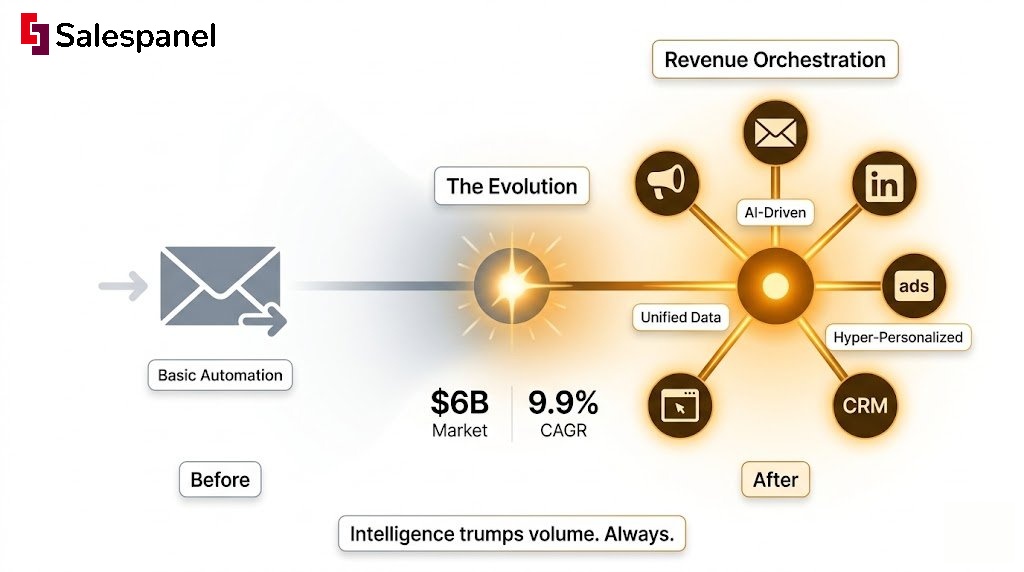
Just a decade ago, marketing automation was a revolutionary concept, promising to streamline repetitive tasks. Today, that baseline efficiency is simply table stakes. The global marketing automation market, valued at over $6 billion and projected to grow at a CAGR of 9.9%, reflects a critical shift. The future of B2B marketing automation strategies is not about doing more with less, but about executing with precision driven by data, AI, and hyper-personalization at scale. We’ve moved beyond simple email drips to a complex ecosystem where intelligence trumps volume.
This evolution demands a new technical and strategic playbook. The strategies that follow are foundational shifts in how modern B2B teams engage, nurture, and convert high-value accounts in a sophisticated, privacy-first landscape. To ensure your approach is effective, you must integrate the latest marketing automation best practices into a cohesive plan. This article provides that framework, transitioning your automation from a background process into the core driver of your revenue engine. The central theme we will pursue is achieving revenue orchestration through the intelligent application of unified data. This is your takeaway: mastering these strategies will transform disjointed actions into a predictable growth machine.
1. Lead Scoring and Progressive Profiling
One of the most foundational B2B marketing automation strategies involves systematically identifying your most sales-ready prospects. This is achieved through a powerful combination of lead scoring, which quantifies a lead’s sales-readiness, and progressive profiling, which enriches their data over time without friction. This dual approach ensures your sales team focuses its energy on high-potential accounts while you build a comprehensive understanding of your audience.
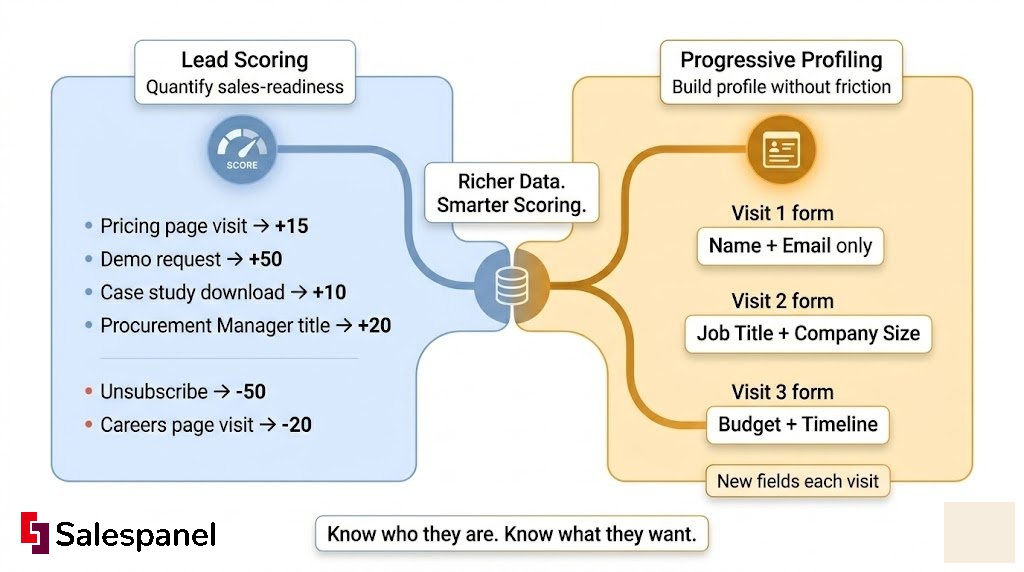
Lead scoring assigns points to prospects based on explicit data (like job title or company size) and implicit behavioral data (like website pages visited or emails opened). Progressive profiling complements this by using smart forms that ask for new information each time a lead interacts, gradually building a detailed profile. A practical example: instead of a single 15-field form, a prospect might provide their name and email on a whitepaper download. When they later register for a webinar, the form will recognize them and ask for their job title and company size, making data collection seamless.
How to Implement This Strategy
This strategy is mission-critical for businesses with a consistent flow of inbound leads that require prioritization. A manufacturing company, for example, could configure its system to assign +20 points to a “Procurement Manager” from a Fortune 500 company who downloaded a “Product Spec Sheet.” A lower score of +5 might go to a “Student” from a university email address who only visited the blog. This quantitative distinction directly guides sales effort.
To effectively implement this, consider these technical steps:
- Define Your Ideal Customer Profile (ICP): Collaborate with sales to codify the firmographic and demographic traits that signal a high-quality lead (e.g., Industry = ‘SaaS’, Company Size > ‘500 employees’).
- Map Critical Behavioral Signals: Identify the digital actions that indicate strong buying intent, such as visiting the pricing page (+15 points), requesting a demo (+50 points), or downloading a case study (+10 points).
- Build Your Scoring Model: Assign positive points for desired attributes and actions. Implement negative scoring for actions that signal disinterest, such as unsubscribing from emails (-50 points) or visiting the “Careers” page (-20 points).
- Configure Progressive Forms: Within your marketing automation platform, set up forms to display new fields to returning visitors, prioritizing questions that will help qualify them further based on your ICP criteria.
2. Account-Based Marketing (ABM) Automation
Instead of casting a wide net, Account-Based Marketing (ABM) is a focused strategy where marketing and sales treat individual high-value accounts as markets of one. Automating this approach transforms it from a resource-intensive task into a scalable engine. B2B marketing automation strategies built on ABM use technology to deliver highly personalized campaigns, ensuring every interaction with stakeholders at a target company is relevant and coordinated.
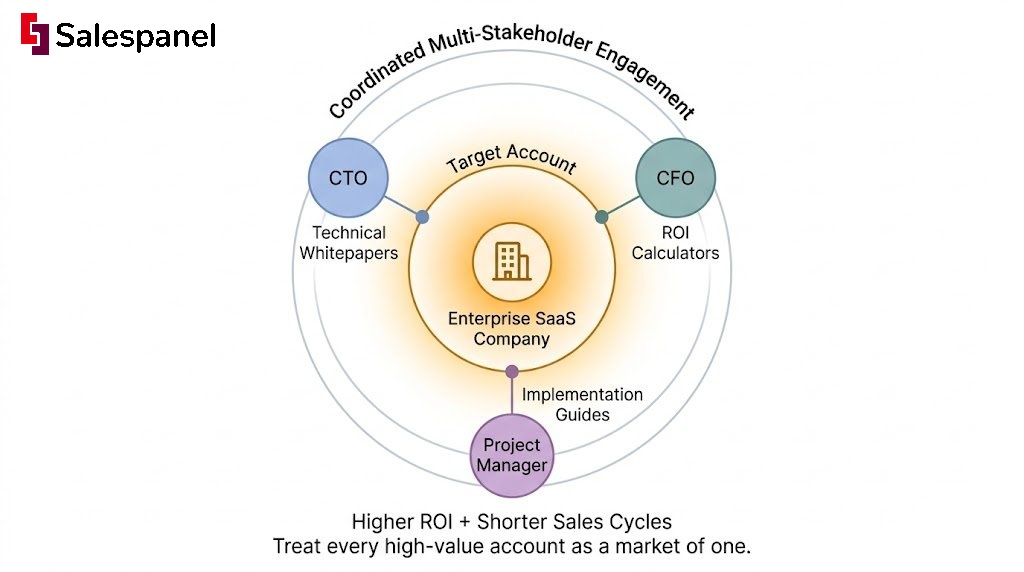
This method inverts the traditional marketing funnel. It begins with identifying target accounts first, then engaging key contacts within them using tailored content. Automation platforms orchestrate this by triggering personalized web experiences, serving account-specific ads, and deploying email sequences to the right people at the right time. The technical goal is to surround the decision-making unit within a target organization with consistent, valuable messaging that addresses their specific pain points.
How to Implement This Strategy
This strategy is ideal for companies with high-value, complex sales cycles where multiple stakeholders are involved. A SaaS company selling enterprise software, for instance, could use ABM automation to simultaneously engage the CTO with technical whitepapers, the CFO with ROI calculators, and the project manager with implementation guides, all within the same target account. This is a practical application of coordinated, multi-threaded engagement.
To effectively implement ABM automation, consider these technical steps:
- Identify and Tier Your Target Accounts: Work with sales to create a definitive, data-validated list of high-value accounts based on revenue potential, strategic importance, and ICP fit.
- Leverage Intent Data: Use tools to monitor which of your target accounts are actively researching solutions like yours. This data provides the crucial “when” for timing your outreach.
- Develop Account-Specific Content: Create personalized assets like landing pages with the target company’s logo, case studies from their industry, and ad creative that speaks directly to their known challenges.
- Coordinate Multi-Channel Plays: Use your automation platform to launch orchestrated campaigns across email, social media (especially LinkedIn), digital advertising, and even direct mail, ensuring a consistent experience for all stakeholders.
3. Drip Campaign Nurturing
While lead scoring identifies who to talk to, drip campaign nurturing dictates what you say and when. This B2B marketing automation strategy involves sending a series of pre-written, automated messages to prospects over time. These campaigns are triggered by specific actions or time intervals, ensuring you deliver relevant content that guides leads through the sales funnel without manual intervention, keeping your brand top-of-mind.
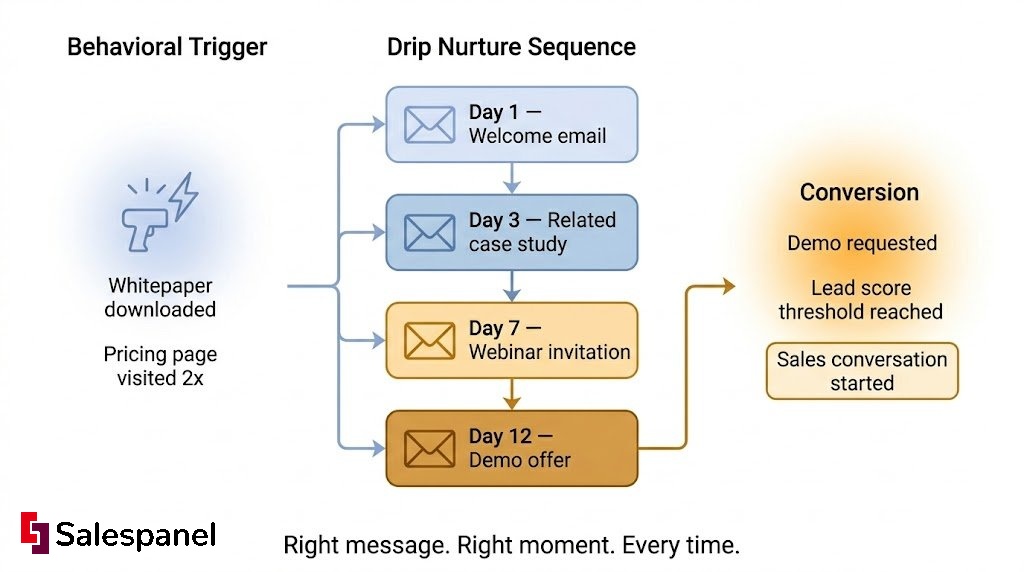
Drip nurturing moves beyond generic email blasts by personalizing communication based on a prospect’s behavior and lifecycle stage. For example, a lead who downloads an awareness-stage whitepaper can be entered into a drip sequence that first offers a related case study, then an invitation to a relevant webinar a week later, and finally a demo offer. This methodical approach builds trust and educates prospects, systematically increasing their lead score until they are ready for a sales conversation.
How to Implement This Strategy
This strategy is essential for businesses with long sales cycles where immediate conversion is unlikely. A practical example is a SaaS company nurturing free trial sign-ups. The sequence might start with a welcome email, followed by Day 3 and Day 7 emails with tips for using key features, and culminating in an offer for a personalized demo on Day 12 as the trial period nears its end.
To effectively implement this, consider these technical steps:
- Map Content to the Buyer’s Journey: Align your email content with awareness, consideration, and decision stages. An initial email might share a blog post, while a later one could offer a pricing comparison sheet.
- Use Behavioral Triggers: Go beyond simple time-based sequences. Trigger campaigns when a prospect visits your pricing page, abandons a cart, or engages with a specific piece of content for more contextual messaging.
- Establish Clear Goals and Exit Criteria: Define the conversion goal for each campaign (e.g., demo request). Crucially, set up rules to automatically remove leads from a nurture sequence once they convert, preventing message fatigue.
- Segment Your Audience: Create distinct drip campaigns for different personas, industries, or lead sources. A prospect from a trade show requires a different conversation than one from an organic search.
4. Dynamic Content Personalization
Going beyond generic messaging, dynamic content personalization is one of the most powerful B2B marketing automation strategies for creating relevant user experiences. It involves automatically delivering customized content, offers, and messaging based on a prospect’s real-time data, firmographics, and behavior. Instead of showing every visitor the same homepage hero image, this strategy tailors the experience to the individual, dramatically increasing engagement.
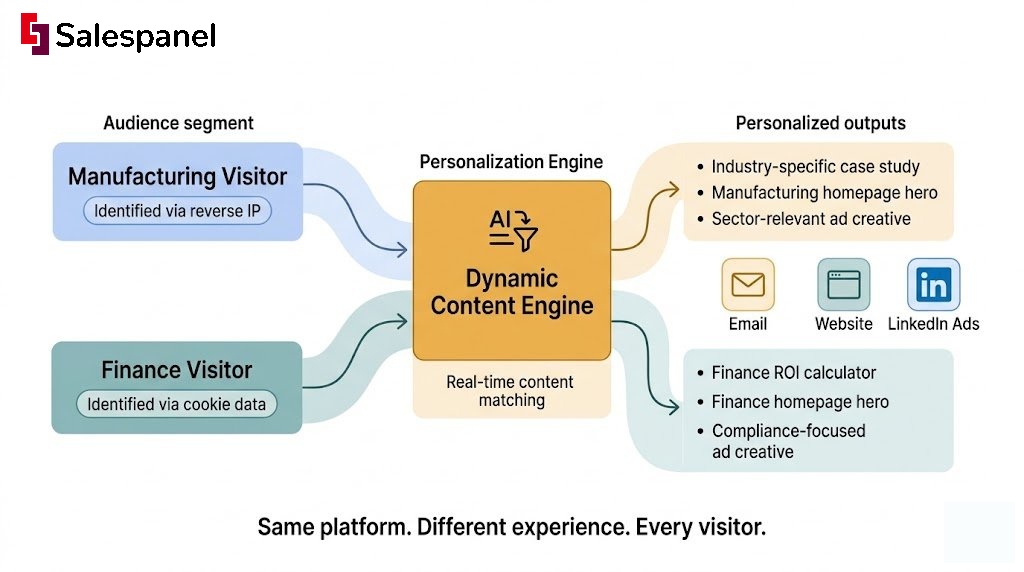
This approach uses data from your marketing automation platform to swap out content elements like text, images, or CTAs for different audience segments. A practical example: a visitor from the manufacturing industry might see a case study relevant to their sector, while a visitor from finance sees a different one. This is achieved by your website’s content management system communicating with your marketing automation database via an API or script to fetch visitor attributes and display the appropriate content block.
How to Implement This Strategy
This strategy is perfect for B2B companies serving multiple industries or buyer personas. A SaaS company could use dynamic content to show different product features on its homepage. A visitor identified (via reverse IP lookup or cookie data) as being from a small business might see information on affordability, while a visitor from an enterprise account is shown details on security, scalability, and integration capabilities.
To effectively implement this, consider these technical steps:
- Segment Your Audience: Define clear audience segments based on firmographics (industry, company size), behavior (pages visited, content downloaded), or lead score.
- Identify Key Personalization Points: Determine which website pages, landing pages, and email campaigns will have the most impact when personalized. Start with high-traffic pages like your homepage or pricing page.
- Create Content Variations: Develop the different content assets (headlines, images, case studies, CTAs) needed for each of your defined segments. Ensure each variation speaks directly to the segment’s pain points.
- Configure Rules in Your Platform: Use your marketing automation tool to set up the rules that will trigger the display of specific content. For example, “If Industry = Healthcare, show Healthcare Case Study Block.”
5. Multi-Channel Campaign Orchestration
Modern B2B buyers operate across email, social media, ads, and your website. Multi-channel campaign orchestration is a strategy that uses marketing automation to deliver a unified, consistent, and context-aware experience across all these touchpoints. Instead of launching siloed campaigns, this approach ensures your messaging is synchronized, creating a seamless conversation.
The technical goal is to create a single customer view that tracks interactions across channels and adapts messaging accordingly. For instance, a prospect who clicks a LinkedIn ad for a webinar might be added to an “Attended Webinar” audience. This data point then triggers a follow-up email, serves a retargeting ad on a news site for a related case study, and qualifies them for personalized content on your website. This cohesive journey guides prospects forward, making it one of the most sophisticated B2B marketing automation strategies.
How to Implement This Strategy
This strategy is crucial for companies with long sales cycles and multiple decision-makers. A practical example: a C-level executive at a target account who downloaded an ebook is shown a high-level ROI case study ad on LinkedIn, while a technical manager from the same account who attended a webinar is emailed a detailed implementation guide. The automation platform acts as the central hub, coordinating these distinct but related actions.
To effectively implement this, consider these technical steps:
- Map the Unified Customer Journey: Chart every potential touchpoint a prospect might have, from initial awareness on social media to post-purchase support via email.
- Centralize Your Data: Ensure your marketing automation platform integrates with your CRM, ad platforms (via APIs), and other martech tools to create a single source of truth for all customer interactions.
- Maintain Brand Consistency, Adapt Format: Your core message and brand voice should be consistent. However, tailor the content format to the channel: a short video for social, a detailed whitepaper for email, and an interactive calculator for your website.
- Use Frequency Capping: Set cross-channel limits on how often a single prospect sees your messages within a specific timeframe to avoid oversaturation and ad blindness.
6. Behavioral Trigger Automation
One of the most potent B2B marketing automation strategies is responding in real-time to specific prospect actions. Behavioral trigger automation enables immediate, contextually relevant engagement by launching workflows based on user behavior, such as visiting a key webpage, downloading a resource, or opening a critical email. This approach delivers marketing messages at the precise moment a prospect’s interest is at its peak.
This strategy moves beyond simple, time-based campaigns to create a dynamic, responsive experience. Technically, this involves setting up “listeners” or tracking scripts that monitor for specific events. For instance, when a lead visits your pricing page for the third time in a week, a tracking script sends this event to your automation platform. This event then triggers a workflow that can instantly notify a sales representative via Slack or enroll the lead in a targeted nurture sequence highlighting your product’s ROI.
How to Implement This Strategy
This strategy is crucial for companies wanting to capitalize on high-intent signals. A practical example: a B2B e-commerce supplier can set a trigger for cart abandonment. If a user adds items worth over $500 to their cart but doesn’t complete the purchase within one hour, an automated email is sent with a reminder and perhaps a limited-time shipping offer.
To effectively implement behavioral triggers, consider these technical steps:
- Map Key Conversion Behaviors: Identify specific actions across your website, emails, and product that signal strong buying intent (e.g., event ‘video_watch_75_percent’, event ‘pricing_page_view’).
- Define Trigger Logic: Establish clear rules for your automation. Use multiple conditions for relevance, such as “visited pricing page > 2 times in 7 days” AND “lead_score > 50.”
- Create Contextual Responses: Develop the automated follow-up for each trigger. This could be adding a lead to a specific list, sending a personalized email from a sales rep’s alias, or displaying a targeted pop-up message.
- Set Exclusion Rules and Delays: Prevent over-communication by creating rules that exclude prospects already in a sales conversation. Use slight delays (e.g., 10 minutes) to make the outreach feel more natural.
7. Sales and Marketing Alignment (Smarketing)
One of the most impactful B2B marketing automation strategies focuses on uniting sales and marketing. This alignment, or “smarketing,” uses shared goals, data, and technology to create a cohesive revenue engine. It eliminates the friction that arises when marketing sends over unqualified leads or when sales fails to follow up, ensuring a seamless journey from the first touchpoint to the final sale.
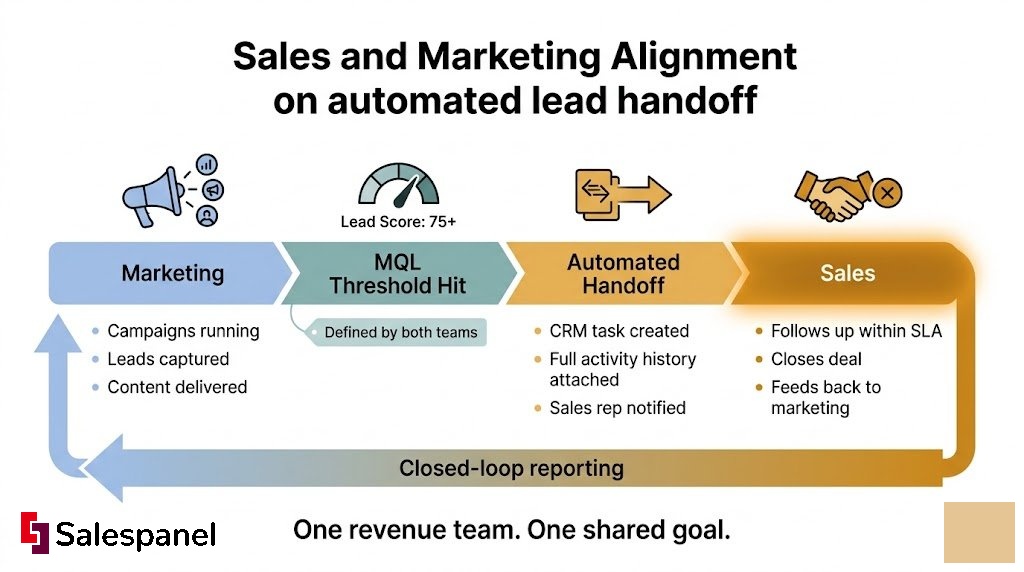
The core principle of smarketing is a unified process where both teams work from the same playbook. Automation platforms serve as the central nervous system, facilitating lead handoffs, providing shared dashboards, and enabling closed-loop reporting. This ensures marketing efforts are directly tied to revenue outcomes and that the sales team has the context and content they need to close deals effectively. A key takeaway is that technology enables this alignment, but it must be built on a foundation of shared definitions and goals.
How to Implement This Strategy
This strategy is crucial for any B2B organization aiming for scalable growth. A practical example: automating the handoff of a product-qualified lead (PQL) directly into a sales rep’s CRM. When a trial user invites three teammates (a key activation metric), the automation platform creates a new task for the account owner in the CRM, complete with a full history of their in-app activities and content downloads.
To effectively implement this, consider these technical steps:
- Establish a Service Level Agreement (SLA): Formally define the responsibilities of each team. Marketing commits to delivering a specific number of Marketing Qualified Leads (MQLs) per month, and sales commits to following up within a set timeframe.
- Unify Lead Definitions: Work together to create clear, data-driven definitions for an MQL and a Sales Qualified Lead (SQL) based on firmographics, behavior, and lead score thresholds.
- Implement Closed-Loop Reporting: Configure your marketing automation platform and CRM to track leads from their original source all the way through to becoming a customer. This provides marketing with direct feedback on which campaigns are driving revenue.
- Develop Joint Buyer Personas: Collaborate on creating and refining your ICP and buyer personas to ensure both teams are targeting and messaging the same audience.
8. Customer Lifecycle Marketing
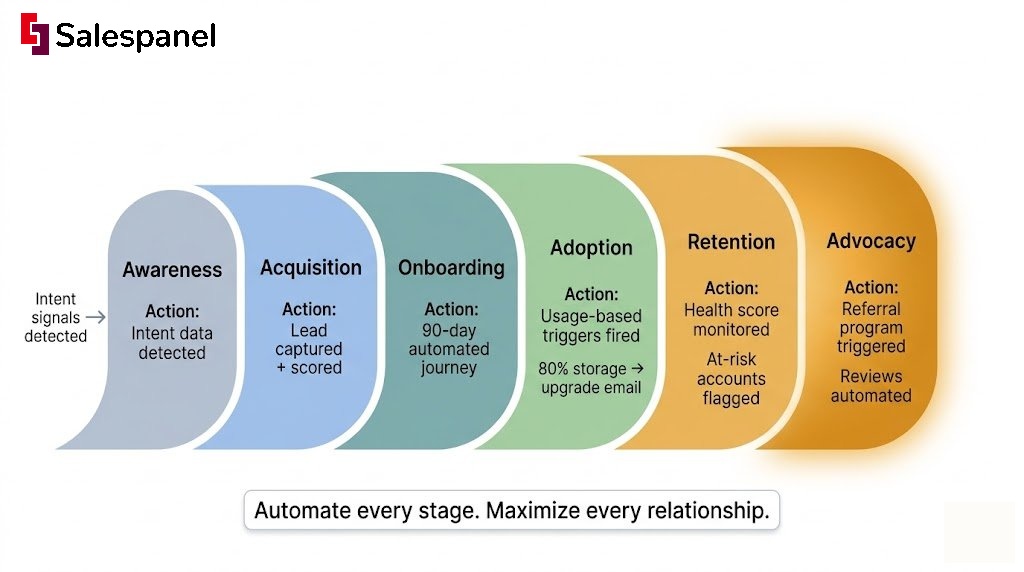
Effective B2B marketing automation strategies extend far beyond lead generation. Customer lifecycle marketing is a comprehensive approach that nurtures relationships at every stage, from awareness and acquisition through to retention, expansion, and advocacy. By automating targeted campaigns for each phase, you ensure customers receive relevant messaging and support, maximizing lifetime value.
This strategy uses automation to deliver value consistently, whether through onboarding sequences for new users, check-ins for at-risk accounts, or upselling campaigns triggered by product usage. A practical example: a SaaS company can automate a 90-day onboarding journey for new clients, with emails triggered by their progress (or lack thereof) in setting up key features. Later, it can trigger an upsell campaign for accounts showing high feature engagement, turning initial buyers into long-term, high-value partners.
How to Implement This Strategy
This strategy is crucial for businesses with a subscription or recurring revenue model, where customer retention and expansion are primary growth drivers. A B2B software company can use its own product usage data as a trigger. For example, when a customer’s data storage reaches 80% of their plan’s limit, an automated email can be sent offering a seamless upgrade to the next tier.
To effectively implement this, consider these technical steps:
- Map the Customer Journey: Identify key stages and transition points in your customer’s relationship, from first purchase to becoming an advocate.
- Create Stage-Specific Metrics: Define what success looks like at each stage. This could be feature adoption rates for new users or referral numbers from long-term advocates.
- Implement Customer Health Scoring: Use automation to track product usage, support tickets, and engagement levels to proactively identify accounts at risk of churning.
- Develop Expansion Campaigns: Analyze usage patterns to identify opportunities for upselling or cross-selling. Automate campaigns that introduce relevant premium features or complementary products to the right users at the right time.
9. Intent Data and Predictive Analytics
One of the most proactive B2B marketing automation strategies is to identify prospects who are actively researching solutions before they visit your website. This is accomplished by combining third-party intent data with first-party predictive analytics. This approach allows you to engage high-value accounts at the earliest signs of buying interest, giving you a powerful first-mover advantage.
Intent data providers monitor content consumption across the web to detect when companies are researching specific topics relevant to your products. Predictive analytics then layers this data on top of your own data (like website visits and CRM history) to identify in-market accounts and prioritize them for outreach. The technical execution involves integrating these data sources via API into your automation platform so that a surge in intent for a target account can trigger a specific marketing or sales “play.”
How to Implement This Strategy
This strategy is a game-changer for B2B companies with long sales cycles. A practical example: a cybersecurity firm could use intent data to identify companies suddenly researching “cloud security compliance.” This signals a potential need, allowing the firm’s marketing team to automatically enroll contacts from that company into a targeted ad campaign and email nurture sequence long before a competitor is even aware of the opportunity.
To effectively implement this, consider these technical steps:
- Identify Your Core Intent Topics: Collaborate with sales and product teams to list the keywords, competitors, and industry topics that signal a prospect is in a buying journey.
- Integrate Data Sources: Connect your chosen intent data platform with your marketing automation system and CRM. This ensures that intent signals automatically enrich account records and trigger workflows.
- Create Targeted Plays: Set up alerts and automated campaigns that activate when an account from your ICP shows a surge in intent for your core topics. This could trigger targeted ads, an email nurture sequence, or a notification for a sales development representative.
- Train Your Sales Team: Equip your sales team with the context behind the intent data. Teach them how to use these insights to craft highly relevant, timely, and non-intrusive outreach messages.
B2B Marketing Automation Strategies Comparison
| Item | Implementation Complexity | Resource Requirements | Expected Outcomes | Ideal Use Cases | Key Advantages |
|---|---|---|---|---|---|
| Lead Scoring and Progressive Profiling | Moderate to High – needs data models and form logic | Significant data and ongoing optimization | Prioritized leads, comprehensive profiles | B2B lead qualification, sales prioritization | Improves efficiency, reduces form abandonment, enables personalization |
| Account-Based Marketing (ABM) Automation | High – requires research, multi-channel setup | High upfront research and budget | Higher ROI, shorter sales cycles | Targeting high-value accounts | Personalized campaigns, better resource allocation, sales-marketing alignment |
| Drip Campaign Nurturing | Moderate – building automated sequences | Continuous content creation and maintenance | Consistent engagement and lead nurturing | Long-term lead nurturing | Scalable, reduces manual follow-up, supports buyer journey stages |
| Dynamic Content Personalization | High – needs real-time data and ML | Substantial data infrastructure and cost | Increased engagement and conversions | Personalized web/email experiences | Higher engagement, improved customer experience, effective cross-selling |
| Multi-Channel Campaign Orchestration | High – complex coordination across channels | High budget and expertise across channels | Greater reach, consistent messaging | Omnichannel marketing strategies | Increases reach, multiple touchpoints, improves brand recognition |
| Behavioral Trigger Automation | Moderate to High – real-time triggers and workflows | Integration with CRM and detailed setup | Immediate, relevant communications | Timely responses to prospect actions | Increased conversion, scalable personalization, reduces manual work |
| Sales and Marketing Alignment (Smarketing) | Moderate to High – organizational and process changes | Cross-team collaboration and technology | Improved lead quality and faster sales | Aligning sales and marketing teams | Enhanced ROI, reduced friction, unified reporting |
| Customer Lifecycle Marketing | High – complex across many stages | Comprehensive data and multi-department coordination | Maximized lifetime value and retention | End-to-end customer relationship management | Predictable revenue, churn prevention, advocacy programs |
| Intent Data and Predictive Analytics | High – requires machine learning and data integration | Costly data sources and analytics tools | Proactive outreach to in-market prospects | Identifying active buyers/account prioritization | Better lead quality, reduced unqualified prospects, competitive insights |
Orchestrating Your Automation Symphony
Navigating the landscape of B2B marketing automation strategies can feel like learning to play multiple instruments at once. From the precision of lead scoring and ABM automation to the real-time responsiveness of behavioral triggers, each strategy detailed in this guide offers a distinct technical advantage. We have explored how to nurture prospects with sophisticated drip campaigns, personalize experiences with dynamic content, and unify touchpoints through multi-channel orchestration.
However, the mastery of marketing automation is not found in executing these strategies in isolation. It lies in conducting them as a unified symphony. The central theme connecting these powerful techniques is the intelligent application of high-quality, unified data. This is where you transform disjointed actions into a cohesive revenue engine. This is the ultimate takeaway: a well-orchestrated, data-driven automation program is not a cost center; it is a predictable revenue generator.
Turning Strategy into Revenue Performance
The most impactful B2B marketing automation strategies are interconnected. Imagine using intent data to identify target accounts for your ABM campaigns. As those accounts engage, behavioral triggers automatically enroll key contacts into personalized nurture sequences. Simultaneously, a dynamic lead scoring model, enriched with this data, tracks their journey and alerts your sales team at the exact moment they become a sales-qualified lead.
This level of orchestration is only possible when your technology stack is built on a solid data foundation. It requires a system that can capture, unify, and activate customer information. For instance, the advanced server-side website visitor tracking from Salespanel provides the rich, first-party data necessary to accurately score leads, personalize content in real-time, and attribute revenue back to your marketing efforts. This philosophy—that better data fuels smarter automation—is key to moving from basic execution to strategic revenue performance.
Your Next Steps in Automation Mastery
As you move forward, focus on integration over isolation. Don’t just implement one of these strategies; look for ways to weave them together. Start by assessing your current data quality and identify where you can create stronger connections between your marketing and sales platforms. To truly harmonize your B2B marketing automation efforts, understanding the latest operational frameworks is key. For a deeper dive into the foundational elements, exploring Marketing Automation Best Practices for 2026 Success can provide the crucial next steps to refine your approach.
Ultimately, the goal is to create an intelligent, self-optimizing system that learns from every interaction. By orchestrating these B2B marketing automation strategies, you elevate your role from a campaign manager to a revenue architect, building a predictable engine that not only attracts but also retains high-value customers for years to come.
Ready to build the data foundation for your automation symphony? Discover how Salespanel captures and activates your first-party data to fuel smarter lead scoring, personalization, and sales alignment. Explore our resources and see how to turn website visitors into revenue at Salespanel.