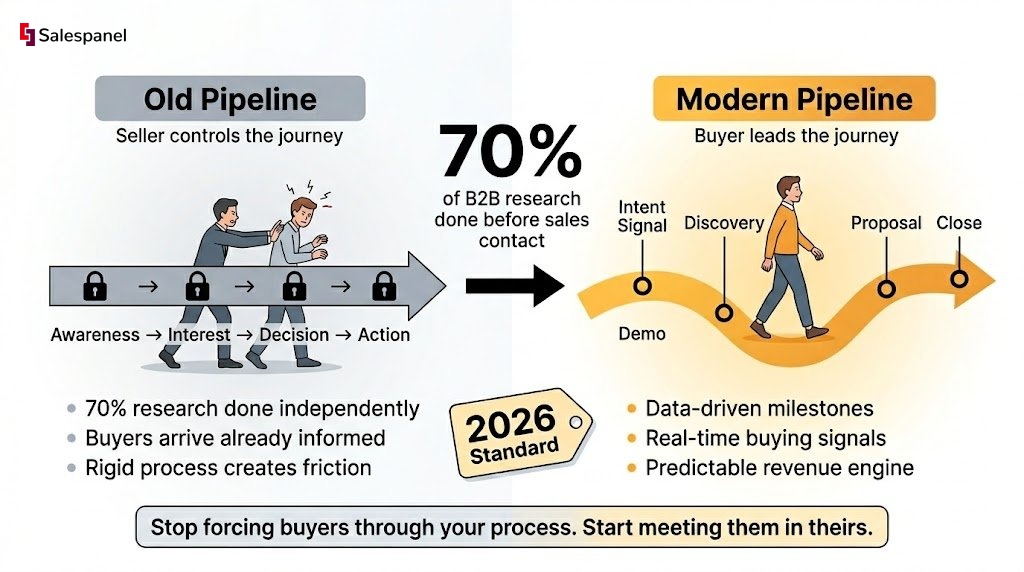
The sales pipeline, once a predictable, linear path managed by sellers, is now a relic. Today’s B2B buyers, armed with infinite information, complete up to 70% of their research independently before ever engaging a sales representative. This seismic shift from a seller-driven to a buyer-centric market means that legacy pipelines built on outdated assumptions are not just inefficient—they are a direct threat to revenue. If your forecast feels like a work of fiction and deals stall without explanation, the problem isn’t your team; it’s the obsolete framework they are forced to operate within.
This guide provides a technical blueprint for re-engineering your sales engine. We will move beyond simply renaming stages in a CRM to constructing a dynamic, data-driven pipeline that mirrors the modern buyer’s journey. The central theme is transforming your pipeline from a passive activity log into a predictive revenue machine by focusing on verifiable buyer commitments, leveraging intent data, and maintaining rigorous operational discipline. The takeaway will be a systematic approach to building a pipeline that thrives in the current market and is resilient enough for the future.
Why Your Old Sales Pipeline Is Holding You Back
The traditional sales playbook is failing. If your pipeline is characterized by unpredictability and stalled deals, the root cause lies in a fundamental misalignment between your process and the modern B2B buyer’s behavior. The entire foundation of B2B purchasing has been disrupted, rendering the linear, seller-controlled pipeline obsolete.
This is not a gradual trend; it’s a structural transformation driven by the digital-first nature of research and decision-making. Contemporary B2B buyers enter the sales process deeply informed, having already benchmarked solutions, read reviews, and defined their requirements. Their journey is self-directed and non-linear. A sales process that fails to acknowledge this reality is destined to create friction and lose opportunities.
The Power Shift from Seller to Buyer
The primary flaw in traditional pipelines is their design for an era when salespeople were the gatekeepers of information. The seller dictated the journey through a rigid sequence: awareness, interest, decision, action. This model was effective when buyers had no alternative.
Today, that control has been completely inverted. Buyers now command their own journeys, engaging with vendors on their terms. The data confirms this shift unequivocally. By 2026, a full 80% of B2B sales interactions between suppliers and buyers are projected to occur in digital channels. More critically, a staggering 72% of B2B buyers conduct extensive independent research before initiating contact with a sales team. They arrive late in the traditional “funnel,” but they are exceptionally well-informed. To explore this evolution further, you can explore more pipeline generation trends and see the data behind the transformation.
The modern sales pipeline must be a reflection of the customer’s journey, not a rigid process you force them through. Its purpose is to meet informed buyers where they are, equipped with the value they need at that specific moment.
Where the Old Model Creates Friction
When a self-educated buyer encounters a rigid, seller-centric pipeline, the result is process friction. The legacy model presumes ignorance and attempts to “educate” a prospect who has already consumed your case studies and competitor analyses. This disconnect generates critical failure points that directly impact revenue.
- Forcing Redundant Discovery: A practical example is a sales representative, adhering to an old script, asking foundational discovery questions that the buyer answered for themselves weeks prior. This wastes the buyer’s time and positions the sales team as unprepared and out of sync with the buyer’s context.
- Ignoring Digital Buying Signals: A traditional pipeline is reactive, typically activating only upon a form submission. It is blind to the high-intent signals of a prospect from a target account who has visited the pricing page five times in a week—a clear indicator of imminent interest that goes completely unnoticed.
- Creating Unnecessary Bottlenecks: A rigid stage like “Qualified to Buy” can stall a deal because a formal budget has not been approved, even as the internal champion is actively building the business case. The pipeline fails to adapt to the non-linear, often messy reality of corporate procurement.
Building for the Future
To win in this new environment, organizations must build a sales pipeline that is dynamic, data-driven, and designed entirely from the buyer’s perspective. This is more than a cosmetic update of stage names in a CRM; it requires a deep, technical understanding of your Ideal Customer Profile (ICP) and the specific, verifiable milestones they must achieve to solve their problem.
This modern approach trades rigid, linear steps for flexible, milestone-based stages. It prioritizes the identification and actioning of buying signals over the mere completion of sales activities. By making this fundamental shift, you are not just updating a process—you are engineering a resilient revenue engine designed for how B2B sales functions today and will continue to evolve.
Designing Your Pipeline Stages Around the Buyer Journey
A generic, downloaded sales pipeline template is functionally useless. A high-performance pipeline is not built around your internal sales process; it is a precise mirror of your customer’s actual buying journey. The common mistake is designing stages around seller activities, leading to ambiguous labels like ‘Lead,’ ‘Contacted,’ or ‘Opportunity.’ These terms offer no insight into the buyer’s position in their decision-making process.
The solution is a complete perspective shift. Instead of tracking your reps’ activities, you must begin tracking your buyer’s commitments. This transforms the pipeline from a simple activity log into a powerful forecasting instrument. The most effective stages are defined by concrete, verifiable buyer actions that signal genuine progress.
From Vague Labels to Concrete Milestones
It is critical to replace abstract labels with tangible, action-oriented milestones. Well-defined pipeline stages are objective and leave no room for subjective interpretation. Consider the difference in clarity between a stage named “Opportunity” and one named “Discovery Call Completed.” The former is based on a rep’s intuition. The latter is a binary event—it either occurred or it did not.
This principle is the cornerstone of modern pipeline architecture: build the process around confirmed buyer actions. Every stage advancement must be triggered by a clear signal of commitment from the prospect.
Here are practical examples of strong, action-based pipeline stages:
- Initial Contact & Qualification: A prospect matching our Ideal Customer Profile (ICP) has been identified, and a substantive, two-way conversation has occurred.
- Discovery Call Completed: A structured discovery call between our sales representative and a key stakeholder has been successfully conducted, validating their needs and challenges.
- Solution Demo Delivered: The prospect and relevant stakeholders attended a tailored product demonstration focused on the specific pain points identified during discovery.
- Proposal Under Review: A formal proposal has been sent, and the primary decision-maker has confirmed its receipt and initiated a review process.
- Final Negotiation: The prospect has communicated their intent to purchase, and discussions are focused on finalizing terms, pricing, or contractual details.
- Closed Won / Closed Lost: The contract is executed, or the prospect has formally communicated their decision not to proceed.
This structured evaluation method provides a systematic filter, refining a large pool of initial interest into a small, highly qualified set of opportunities.
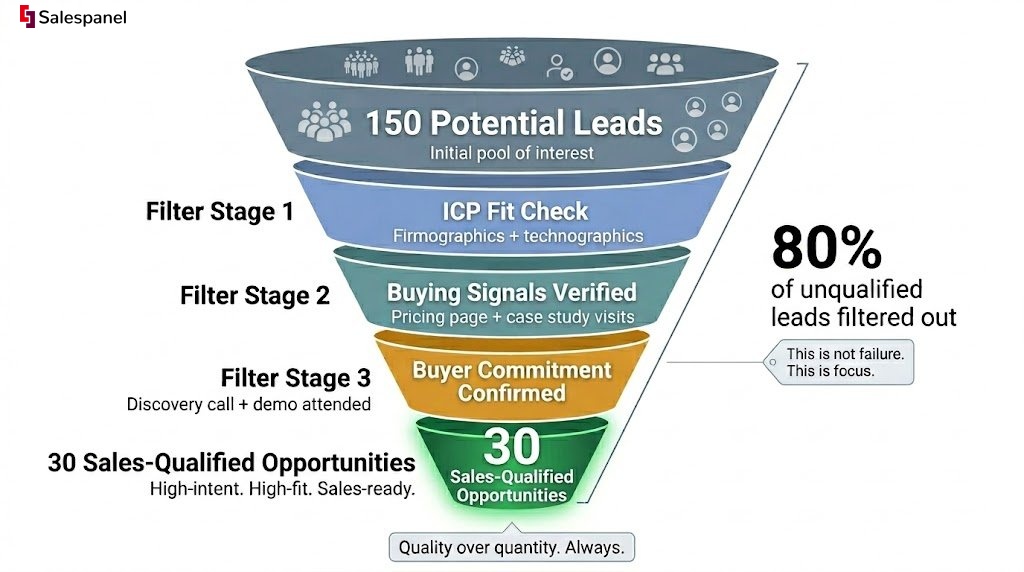
As the infographic illustrates, a starting pool of 150 potential leads might be rigorously qualified down to 30 genuine, sales-qualified opportunities. This is not a failure of conversion; it is a success of focus.
Defining Strict Entry and Exit Criteria
For this system to function with integrity, each stage must have non-negotiable entry and exit criteria. These are the operational rules that prevent “pipeline bloating” and ensure forecast accuracy. A deal cannot advance to the next stage until specific, pre-defined conditions have been met.
Your pipeline stages are only as reliable as the criteria you set for them. Without clear rules, reps may advance deals based on optimism rather than actual buyer commitment, leading to a stalled pipeline and inaccurate forecasts.
For example, a deal is prohibited from moving from ‘Solution Demo Delivered’ to ‘Proposal Under Review’ unless the prospect has explicitly requested a proposal and identified the key reviewers. This simple rule prevents representatives from sending unsolicited proposals that are unlikely to be considered. Likewise, a deal cannot enter ‘Final Negotiation’ until the buyer provides a verbal or written confirmation of their intent to purchase, pending final contract approval.
Example B2B Sales Pipeline Stages and Definitions
To provide a concrete model, the following table details what these stages can look like in practice. This serves as a foundational template to be adapted to your specific sales process.
| Stage Name | Definition | Entry Criteria | Key Sales Activities |
|---|---|---|---|
| Qualification | A new lead has been identified and meets the basic criteria of your ICP. | Lead fits ICP; initial contact has been made. | Research prospect, initial outreach (email/call), confirm basic fit and interest. |
| Discovery Call Completed | A structured call was held to uncover the prospect’s needs, pain points, and budget. | Prospect agreed to and attended a discovery call. | Ask probing questions, listen actively, identify key challenges, establish rapport. |
| Solution Demo Delivered | A tailored product demonstration was provided to key stakeholders. | Prospect agreed to and attended a demo. | Present tailored solutions, handle objections, showcase value relevant to their pain. |
| Proposal Under Review | A formal proposal has been sent at the prospect’s request. | Prospect explicitly requested a proposal and identified reviewers. | Draft and send proposal, schedule a follow-up call to review it together. |
| Negotiation/Verbal Commit | The prospect has agreed in principle to move forward and is finalizing terms. | Prospect has given verbal or written intent to purchase, pending final contract. | Discuss pricing, terms, and legal details; get buy-in from all decision-makers. |
| Closed Won | The contract has been signed and the deal is officially closed. | A signed contract has been received. | Finalize paperwork, kick off the onboarding process, and celebrate the win. |
The objective is absolute clarity and consistency. Every member of the sales organization must understand the precise requirements for a deal to reside in any given stage.
Customizing Your Pipeline for Your Business Model
The specific stages of your pipeline must be tailored to your sales model. A high-volume SaaS company with a transactional, product-led growth model will require a vastly different pipeline than a high-touch enterprise consulting firm with a long, relationship-based sales cycle.
SaaS Company Example (Transactional):
For a SaaS business, the pipeline stages should be aligned with user actions within the product itself.
- Trial Started: A user signs up for a free trial.
- Product-Qualified Lead (PQL): The user achieves key activation milestones (e.g., invites a teammate, integrates a third-party tool).
- Demo Requested: The user encounters a feature gate or usage limit and requests a sales conversation to discuss paid plans.
- Proposal Sent: A formal quote for an annual subscription is delivered following the sales call.
- Closed Won: The user upgrades their account and provides payment information.
Consulting Firm Example (Relationship-Based):
Conversely, a consulting firm’s pipeline must reflect a more complex, multi-stakeholder decision-making process.
- Initial Meeting & Needs Assessment: An in-depth initial meeting to diagnose the client’s core business challenges.
- Scope of Work Drafted: A preliminary document outlining the proposed project is developed and shared for client feedback.
- Workshop with Stakeholders: A strategic, multi-hour session (paid or unpaid) with the client’s leadership team to align on strategy and deliverables.
- Formal Proposal Presented: The comprehensive proposal is presented and discussed in a live meeting, not merely emailed.
- Contract Negotiation: Legal and procurement teams engage to review the Master Services Agreement (MSA).
- Closed Won: The MSA and the initial Statement of Work (SOW) are fully executed.
By designing your pipeline around the specific, observable actions your ideal customers take, you are not just tracking sales activity. You are building a system that delivers genuine clarity and predictability to your entire revenue organization.
Filling Your Pipeline with High-Intent Leads
A perfectly designed sales pipeline is useless if it remains empty. Conversely, populating it with a high volume of unqualified leads is a direct path to stalled deals and sales team burnout. Building a modern pipeline is not about quantity; it is about the quality and, critically, the intent of the leads it contains.
The primary objective is to fill the pipeline with prospects who are already exhibiting buying signals, often before they ever formally identify themselves to a sales representative. This requires a sophisticated, multi-channel strategy that integrates the magnetic pull of inbound marketing with the focused precision of outbound sales.
The Foundation: Your Ideal Customer Profile
Before any content is created or any outreach is initiated, all efforts must be anchored to a meticulously defined Ideal Customer Profile (ICP). The ICP should be treated as a technical specification document describing the perfect-fit company for your solution, moving beyond vague buyer personas.
It must include granular details:
- Firmographics: Industry, company size (revenue and employee count), and geographic location.
- Technographics: The existing technology stack they utilize. For instance, a company using Salesforce is a prime target for a Salesforce integration partner.
- Behavioral Traits: Their purchasing methodology, risk tolerance for new technology, and primary decision drivers (e.g., budget vs. premium features).
- Pain Points: The specific, quantifiable business problems that your product directly solves.
Without a sharp ICP, marketing and sales efforts are inefficient and untargeted, wasting resources on prospects who lack the budget, need, or organizational structure to become customers. A robust ICP ensures that all resources are aimed squarely at the most valuable targets.
Combining Inbound and Outbound Strategies
The most resilient pipelines are never dependent on a single source of leads. An over-reliance on SEO or cold calling creates a single point of failure in your revenue stream. A hybrid approach allows you to capture active demand while simultaneously creating new opportunities in your target market.
Inbound Marketing: Pulling Prospects In
Inbound marketing focuses on creating high-value, technical content that naturally attracts your ICP. When a prospect discovers your solution through a search engine, they are actively seeking a solution to a known problem—the definition of a high-intent lead.
Practical Example: A B2B software company sells project management tools for the construction industry. They publish an in-depth technical guide titled, “A Framework for Reducing Project Delays on Commercial Construction Sites.” By optimizing this asset for search engines, they attract site managers and operations directors who are actively researching that specific problem. The guide delivers immediate value, establishes the company as a subject matter expert, and positions their software as the logical next step.
The most powerful lead generation happens when you solve a prospect’s problem before you ever ask for the sale. High-value content builds trust and authority, making your solution the logical next step in their journey.
Outbound Sales: Creating Opportunities
Outbound sales involves proactively identifying companies that perfectly match your ICP and initiating a targeted conversation. This is essential for engaging high-value accounts that may not be actively searching for a solution but represent a perfect fit.
Practical Example: A sales representative from the same construction software company uses LinkedIn Sales Navigator to identify project managers at mid-sized commercial construction firms in the Midwest. Instead of a generic pitch, the rep sends a personalized connection request referencing a recently completed project by the firm and shares the “Reducing Project Delays” guide. This value-first, targeted approach is how to effectively initiate a meaningful business conversation.
Uncovering Intent Before the Conversion
The most significant advance in modern pipeline development is the ability to identify buyer intent before a prospect completes a form. At this moment, your best future customers may be browsing your website anonymously—reading case studies, analyzing your pricing page, and comparing features. These are powerful buying signals that traditional pipeline models completely ignore.
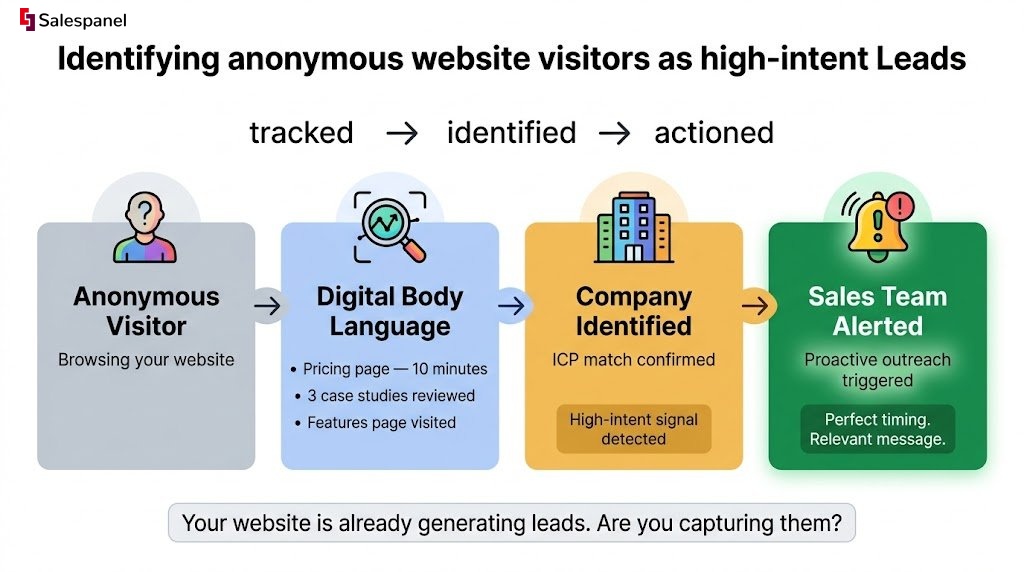
This is where technology provides a decisive competitive advantage. Website visitor tracking from Salespanel, for example, can de-anonymize the companies visiting your website. It connects this “digital body language” to a specific company, providing your sales team with an opportunity to act on previously invisible interest.
Consider the practical application: your sales team receives an alert that a company matching your ICP has spent ten minutes on your pricing page and reviewed three relevant case studies. This is not a cold lead; it is a high-intent opportunity. Instead of passively waiting for a form fill, your team can proactively engage the right stakeholders at that company with a perfectly timed and highly relevant message. This capability transforms a static website into an active, top-of-funnel lead generation engine, filling your pipeline with prospects who have already signaled their interest.
Managing Pipeline Health with the Right Metrics
A filled pipeline is only the beginning. Building a sales pipeline is an act of architectural design; managing it is a daily operational discipline. Without rigorous monitoring and data analysis, even the most well-designed pipeline will leak revenue, deals will stall, and forecasts will become unreliable.
This is the transition from guesswork to a predictable science. The focus shifts from tracking rep activity—call volume, emails sent—to analyzing the health and momentum of the deals themselves. This data-driven approach is the defining characteristic of high-performing sales organizations.
Key Metrics That Actually Matter
An overabundance of data can be as detrimental as a lack of it. To accurately assess pipeline health, focus on a core set of metrics that measure three critical dimensions: efficiency, velocity, and value. These serve as diagnostic tools, pinpointing where the sales process is functioning optimally and where it is failing.
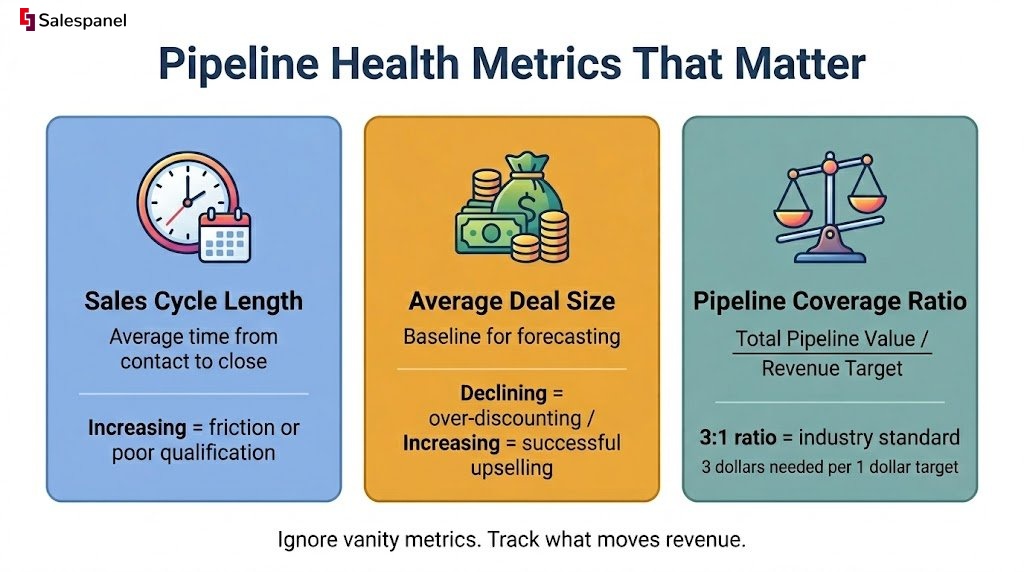
The objective is to disregard vanity metrics and concentrate on numbers with a direct correlation to revenue.
- Sales Cycle Length: The average time required for a deal to progress from initial contact to ‘Closed Won.’ An increasing sales cycle length can signal friction in the sales process, poor lead qualification, or an inability of reps to create urgency. Monitoring this metric helps set realistic timelines and identify stalled deals.
- Average Deal Size: A crucial baseline for forecasting. A declining average deal size may indicate over-discounting or a focus on smaller, non-ICP customers. Conversely, an increase suggests successful upselling or a move upmarket.
- Pipeline Coverage Ratio: Calculated as (Total Pipeline Value / Revenue Target), this metric determines if there are sufficient opportunities to meet quota. A standard benchmark is a 3:1 ratio, meaning $3 in the pipeline is needed for every $1 of the revenue target. This ratio will vary based on industry and sales cycle length.
Diagnosing Bottlenecks with Stage-by-Stage Conversions
The most powerful diagnostic metric is the stage-by-stage conversion rate. This number reveals the percentage of deals that successfully advance from one stage to the next. By tracking these micro-conversions, you can precisely identify bottlenecks where deals consistently stall.
For example, you might observe a healthy 70% conversion from ‘Discovery Call’ to ‘Demo Delivered,’ but a subsequent drop to 20% from ‘Demo Delivered’ to ‘Proposal Requested’.
A low conversion rate at a specific stage is rarely just a rep performance issue; it’s almost always a process issue. It’s a flashing red light signaling a problem with your value prop, your demo script, or how you’re qualifying leads at that critical moment.
This data empowers you to ask targeted diagnostic questions. Is the demonstration failing to connect product features to the prospect’s specific pain points? Are reps not confirming need or budget before scheduling the demo? Identifying the exact point of failure is the first step toward implementing a solution.
The Discipline of Pipeline Reviews
Data is inert without action. The primary forum for translating insights into action is the weekly pipeline review. Too often, these meetings devolve into perfunctory status updates. An effective pipeline review must be a strategic, forward-looking problem-solving session.
- Focus on At-Risk Deals: Utilize your CRM to flag opportunities that have remained in one stage beyond the average duration. Concentrate the discussion on these deals.
- Coach on Strategy, Not Activity: Instead of asking, “Did you follow up?” ask, “What is our strategy to move this deal forward? Who is the economic buyer, and what are their primary business drivers?”
- Validate Next Steps: Every deal discussed must conclude with a concrete, verifiable next step. “Follow up next week” is an insufficient plan. “Scheduled a call for Tuesday with their CFO to review our ROI analysis” is a valid next step.
Sustaining Pipeline Momentum
A healthy pipeline requires two constant inputs: a steady flow of new, qualified opportunities and consistent engagement to advance existing ones. To maintain momentum, it is essential to monitor daily leading indicators, not just lagging revenue metrics at the end of a quarter.
Tracking metrics like the Number of Sales Qualified Leads (SQLs) added and Follow-Ups Completed is crucial. The daily influx of SQLs prevents pipeline stagnation and fuels future revenue. Consistent follow-ups are the engine that moves prospects through the funnel, directly improving conversion rates and sales velocity. You can discover more about essential sales pipeline metrics to see how these small daily activities compound into long-term success.
Letting Technology Handle the Heavy Lifting
Manual sales pipeline management imposes a hard ceiling on growth. In a competitive landscape where speed and precision are paramount, reliance on spreadsheets and memory leads to stalled deals and inaccurate forecasts. The path to breaking through this ceiling involves building an intelligent tech stack that actively works for you—automating administrative tasks, surfacing critical insights, and restoring your sales team’s most valuable resource: time to sell.
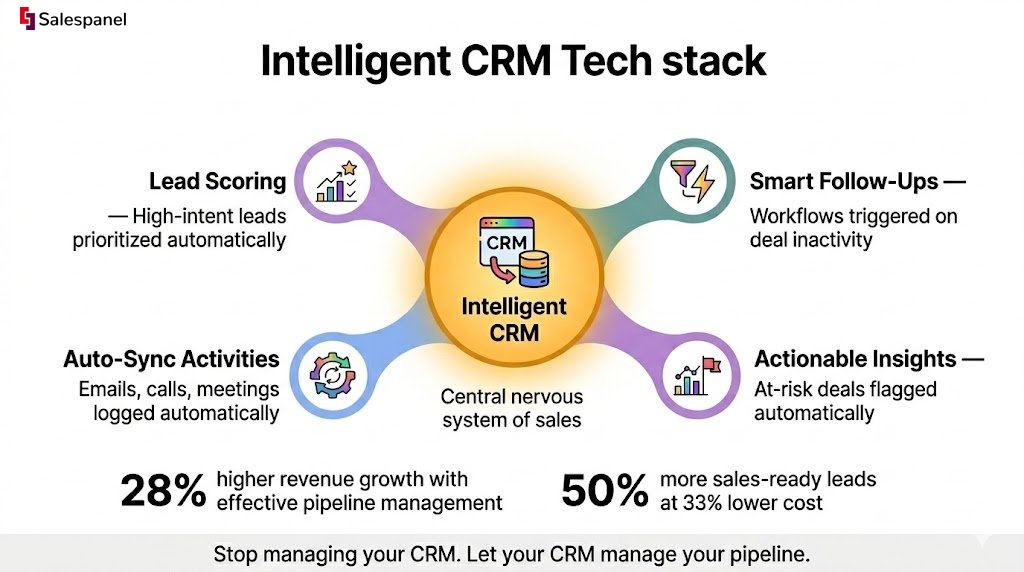
The goal is to elevate your CRM from a digital filing cabinet to the central nervous system of your sales operation. A correctly configured CRM integrates all buyer data into a clear, actionable picture, enabling high-impact automation that eliminates administrative drag and allows your team to focus on strategic execution.
Your CRM Should Be More Than a Database
While a CRM is the single source of truth for customer interactions, its true power is unlocked when integrated with tools that provide real-time data on buyer behavior. An intelligent CRM can trigger automated workflows that maintain deal momentum, often without manual intervention from a sales rep.
This evolution from a passive database to an active sales partner is critical. A modern tech stack should:
- Eliminate Manual Data Entry: Sales reps should be engaging customers, not logging activities. Modern tools can automatically sync emails, calls, and meeting notes directly to the relevant deal record.
- Trigger Smart Follow-Ups: Automated workflows can initiate a follow-up sequence if a prospect goes dark after a demo or create a task for a rep when a deal has been idle in one stage for too long.
- Surface Actionable Insights: Your technology should provide insights, not just data dumps. It can flag at-risk deals based on low engagement or provide closed-loop reporting to show which lead sources generate the most revenue.
Putting Lead Qualification on Autopilot
One of the most effective applications of technology is automating top-of-funnel qualification. Instead of sales reps wasting hours on leads that will never convert, technology can analyze incoming leads and prioritize those exhibiting the strongest buying signals.
The point of sales automation isn’t to replace your sales team. It’s to take the robotic tasks off their plate so they can focus on what humans do best: building relationships, understanding complex problems, and closing deals.
Take Salespanel’s lead scoring framework, for instance. It can be configured to automatically qualify prospects based on a combination of factors. This goes beyond basic demographics to analyze “digital body language”—website behavior, firmographic data, and email engagement. This ensures your sales team consistently engages with leads who are not only a good fit but are also actively demonstrating interest now.
Automatically Surface Product-Qualified Leads
This automated scoring process is the key to identifying Product-Qualified Leads (PQLs), a critical asset for B2B companies. PQLs are prospects who match your ICP and have taken specific, high-intent actions within your product or on your website. This could include repeated visits to the pricing page, activation of a key feature during a free trial, or attendance at an advanced product webinar.
By automatically identifying and flagging these PQLs, you enable your team to focus its energy on closing deals with highly engaged buyers. The quantitative impact is significant. Organizations with effective pipeline management achieve a 28% higher revenue growth rate. This is driven by pure efficiency, as companies that excel at lead nurturing generate 50% more sales-ready leads at a 33% lower cost.
You can learn more about the impact of pipeline management and see how these operational efficiencies compound over time. This approach transforms pipeline management from a reactive administrative task into a proactive, data-driven strategy for predictable growth.
Have Questions About Building a Sales Pipeline? Let’s Clear Them Up
Even with a robust strategy, building and managing a sales pipeline presents technical challenges. Below are answers to common questions from sales leaders and representatives working to optimize their process.
How Many Stages Should a Sales Pipeline Have?
There is no universal number, but the optimal range for most B2B sales pipelines is between five and seven stages.
The primary goal is to accurately map the major milestones of your customer’s buying journey. You require sufficient granularity to diagnose process issues without creating an excessive administrative burden. Too few stages result in a lack of visibility, making it impossible to identify bottlenecks. Too many stages lead to CRM fatigue and reduce time spent selling.
The key is that each stage must represent a clear, verifiable action or commitment from the buyer. This ensures deals only move forward based on real progress, not wishful thinking.
What Is the Difference Between a Sales Pipeline and a Sales Funnel?
These terms are often used interchangeably, but they represent two distinct analytical frameworks for customer acquisition.
A sales funnel is a marketing construct that provides a high-level view of the entire buyer’s journey, tracking the volume of potential customers from initial awareness to purchase. It is concerned with macro-level conversion rates and quantities.
A sales pipeline, in contrast, is a sales management tool focused on the specific, active deals your team is currently working. It tracks the concrete actions and stages required to convert a qualified lead into a closed deal.
In short: the funnel measures volume (“how many”), while the pipeline manages specific opportunities (“who and how”).
How Often Should My Team Review Our Sales Pipeline?
For most sales organizations, a weekly pipeline review meeting is the ideal cadence.
This rhythm provides consistent strategic oversight and coaching opportunities, allowing for the early identification of bottlenecks without devolving into micromanagement. It maintains momentum and ensures accountability for deal progression.
While individual reps should monitor their dashboards daily, the collaborative, in-depth strategy session must be a consistent weekly ritual. This meeting should be dedicated to problem-solving and planning next steps, not reporting on past activities.
Ready to stop guessing and start building a pipeline that actually drives revenue? Salespanel provides the tools to identify high-intent leads, automate the qualification process, and arm your sales team with the insights required to close deals faster.
Explore our resources to see how you can build a more predictable and efficient pipeline today.