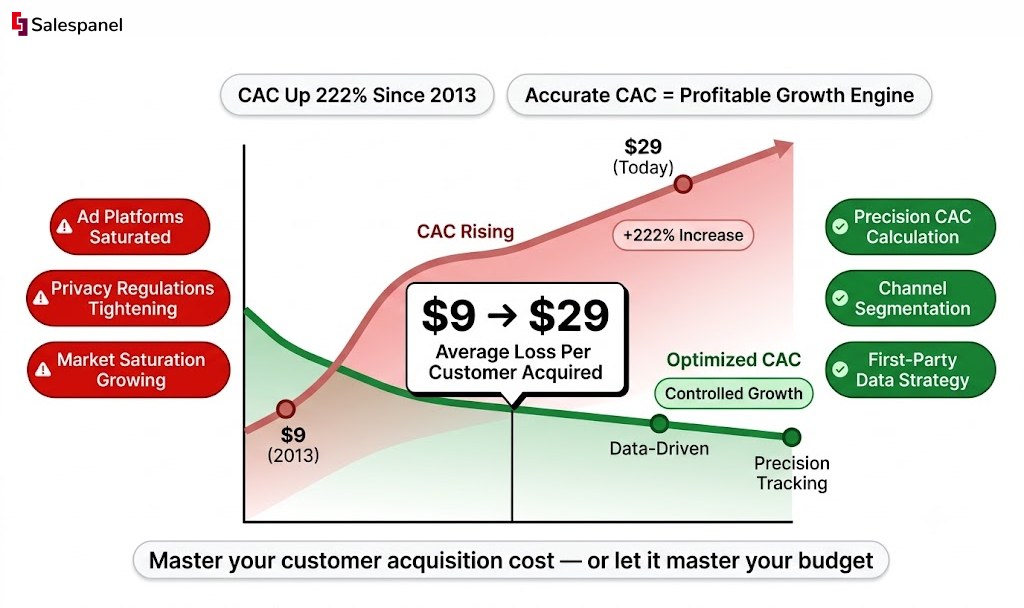
The cost of acquiring a new customer has not just risen; it has fundamentally transformed, escalating from a routine budget item into a critical determinant of business viability. In 2013, the average loss per new customer was a manageable $9. Today, that figure has skyrocketed by over 222% to $29, a stark indicator of an irreversible shift in the digital landscape. This seismic change is fueled by hyper-competitive ad platforms, stringent privacy regulations, and market saturation. In this new era, a superficial estimate of your customer acquisition cost calculation is no longer a minor oversight—it is a strategic vulnerability.
This guide provides a technical and journalistic examination of CAC, moving beyond simplistic formulas to deliver a framework for precision and strategic insight. The central theme is this: mastering your CAC is the most powerful lever you have for building a resilient, profitable growth engine. We will explore the nuanced models required to navigate this complex environment, ensuring every marketing dollar is accounted for and strategically deployed.
Why Mastering CAC Calculation Is No Longer Optional
For years, many companies treated their Customer Acquisition Cost (CAC) as a secondary metric—a “good to know” number that consistently took a backseat to top-line revenue and growth figures. That era has definitively ended. The digital marketing ecosystem has evolved into a far more expensive and complex arena, turning what was once a minor oversight into a significant financial drain.
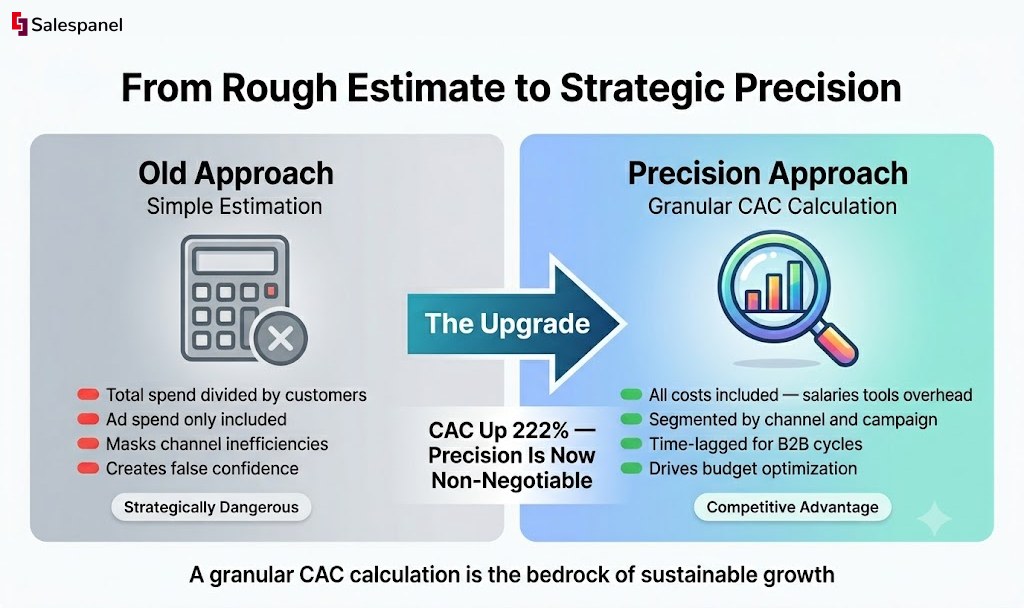
If there is one key takeaway from this analysis, it is that precision is your greatest competitive advantage. The traditional method of dividing total marketing spend by the number of new customers is now obsolete. This rudimentary approach masks critical inefficiencies and fosters ill-informed budget allocations. A granular, methodically accurate CAC calculation is now the bedrock of sustainable growth.
The Soaring Cost of Gaining a Customer
The empirical data is undeniable. The leap in average financial loss per acquired customer from $9 in 2013 to $29 today is not an anomaly; it is the new economic reality of customer acquisition. To understand this trend in greater detail, you can examine these trends and their impact on e-commerce profitability.
This surge is a systemic change, driven by a confluence of factors that every modern marketer must confront:
- Intense Ad Competition: Digital advertising platforms like Google and Meta are saturated, creating a bidding war for high-value keywords and audiences that drives costs progressively higher.
- Privacy-First Regulations: The deprecation of third-party cookies, coupled with legislation like GDPR and CCPA, has complicated tracking and attribution, compelling businesses to adopt more sophisticated—and costly—first-party data strategies.
- Market Saturation: In many sectors, the low-hanging fruit has been harvested. Reaching new, untapped audiences now requires more innovative, resource-intensive, and therefore more expensive campaigns.
Moving from Estimation to Strategic Insight
An accurate customer acquisition cost calculation does more than quantify spending; it provides a strategic roadmap for optimizing that spend. When you dissect your costs with technical rigor, you can identify which channels deliver profitable customers and which ones are merely consuming capital. This level of clarity is mission-critical in the current economic climate.
A precise CAC is not just a marketing metric; it’s a core business health indicator. It informs pricing strategies, validates your business model, and ultimately determines your long-term viability in a competitive market.
This guide will move far beyond basic formulas, demonstrating how to accurately track every expense, account for elongated B2B sales cycles, and identify hidden costs that inflate your CAC. By the conclusion, you will possess the analytical tools to transform CAC from a simple reporting figure into a powerful lever for strategic decision-making and sustainable success.
Nailing the Foundational CAC Formula
Let’s transition from theory to practical application by constructing the basic formula for your customer acquisition cost. At its core, the calculation is deceptively simple and serves as the essential starting point for any business seeking to understand its marketing efficiency.
The foundational formula is: Total Marketing & Sales Costs / New Customers Acquired = Customer Acquisition Cost (CAC)
This equation provides a high-level snapshot of the expenditure required to bring in a new customer. However, its simplicity is also its primary weakness. The true analytical power is unlocked by defining “Total Marketing & Sales Costs” with uncompromising detail. Vague or incomplete inputs render the entire calculation misleading.
What Really Goes into Your Total Costs?
The accuracy of your CAC is directly proportional to the thoroughness with which you account for every dollar spent to win a customer. This extends far beyond advertising spend. It necessitates a comprehensive audit of all related expenses, both direct and indirect. Many organizations err by overlooking these costs, which artificially deflates their CAC and creates a false sense of security. Flawed data inevitably leads to flawed budgetary decisions.
For a true baseline, you must include every component of your acquisition engine. The governing principle is straightforward: if an expense contributes to attracting, nurturing, or closing a new customer, it belongs in the numerator of your equation.
This data-gathering phase is non-negotiable for achieving an accurate CAC. You must compile a comprehensive list of all expenditures that contribute to new business acquisition.
Here is a categorical breakdown of costs that cannot be ignored:
Essential Costs for a Comprehensive CAC Calculation
| Cost Category | Examples | Why It’s Included |
|---|---|---|
| Salaries | Full compensation, benefits, and commissions for all marketing and sales team members. | Human capital is your largest investment. Their expertise and labor are the primary drivers of acquisition. |
| Software & Tools | CRM, marketing automation, analytics platforms, SEO tools (Salespanel, HubSpot, etc.). | These technologies are the operational backbone of your acquisition machine; they are direct costs. |
| Advertising Spend | Paid media campaigns (Google Ads, LinkedIn Ads), sponsored content, affiliate payouts. | This is the most direct cost of reaching potential customers at scale. |
| Creative & Content | Fees for freelance writers, designers, video production, and content agencies. | The assets used to attract and convert leads carry a tangible production cost. |
| Overhead | A proportional share of office rent, utilities, and general business expenses. | Your acquisition teams require infrastructure. This allocates their share of the operational footprint. |
By meticulously tracking each of these line items, you transition from a rough estimate to a verifiable financial metric that reflects the true performance of your acquisition efforts.
Practical Examples: B2C vs. B2B
The composition of these costs varies dramatically depending on the business model. Factors such as sales cycle length, primary marketing channels, and team structure create distinct cost profiles.
Let’s analyze two practical scenarios to illustrate this.
B2C E-commerce Brand (Direct-to-consumer shoe company)
For a DTC brand, the business model is predicated on volume and rapid conversion. Their quarterly costs are heavily weighted toward direct advertising.
- Ad Spend: $50,000 (Meta ads, Google Shopping, influencer marketing)
- Salaries: $45,000 (Two marketing managers, one social media specialist)
- Software: $5,000 (Shopify, Klaviyo, analytics tool)
- Content: $10,000 (Product photography, video ads)
- Total Costs: $110,000
If they acquired 1,100 new customers that quarter: CAC = $110,000 / 1,100 = $100 per customer
B2B SaaS Company (Project management software provider)
In B2B, the sales process is longer and more complex, relying heavily on human interaction and relationship-building. The cost structure reflects this.
- Ad Spend: $30,000 (LinkedIn ads, high-intent Google search keywords)
- Salaries: $75,000 (Marketing director, content marketer, two sales reps)
- Software: $10,000 (HubSpot, Salesforce, SEO tools)
- Content & Events: $15,000 (Webinar production, e-book creation, conference sponsorship)
- Total Costs: $130,000
If they signed 130 new enterprise clients: CAC = $130,000 / 130 = $1,000 per customer
The key takeaway is clear: while the foundational formula is constant, its inputs are deeply contextual. A B2B company’s significant investment in a sales team and high-touch marketing results in a structurally higher CAC than a volume-driven B2C brand.
This basic calculation is the first crucial step toward clarity. It provides a valuable baseline, but for B2B or SaaS businesses, its limitations become apparent quickly, especially when marketing spend in one quarter generates sales in the next. This complexity sets the stage for more advanced models.
Advanced CAC Models for B2B and SaaS
The simple customer acquisition cost calculation offers a useful starting point, but for B2B and SaaS models, it is fundamentally flawed. It operates on the incorrect assumption that marketing expenditures in a given month directly correspond to customer acquisitions in that same month.
This is rarely the case. When sales cycles extend over several months or even quarters, the simple formula misrepresents marketing effectiveness. To achieve true accuracy, it is essential to adopt more sophisticated models that account for the reality of a protracted customer journey.
This requires moving beyond a simple, one-month snapshot.
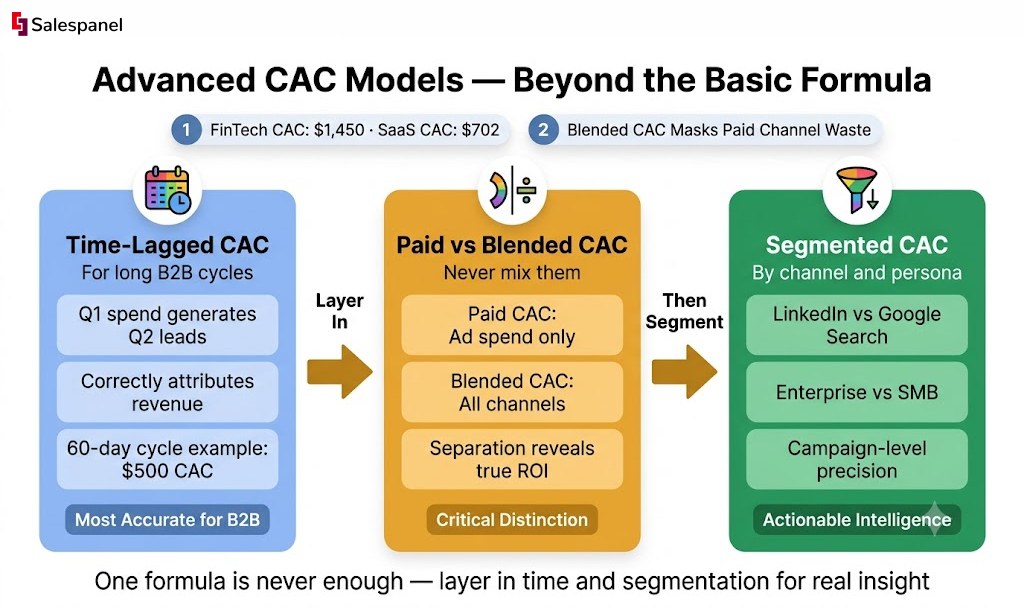
This linear approach is a good first step, but real accuracy comes from layering in time and channel-specific details.
Introducing the Time-Lagged CAC Model
The time-lagged CAC model is indispensable for any business where a significant delay exists between the initial touchpoint and the final sale. Instead of matching this month’s sales to this month’s ad spend, you correctly attribute new customers to the marketing spend from the period in which they were initially generated as a lead.
This methodological shift provides a much clearer view of campaign ROI. For instance, if your average sales cycle is 60 days, you would calculate March’s CAC by dividing the marketing spend from January by the new customers acquired in March. This directly connects the cause (lead generation) with its effect (a closed deal).
A Practical Example with Cohort Analysis
Assume your marketing team spent $20,000 in Q1, generating 400 new leads. By the end of Q2, 40 of those specific leads from the Q1 cohort analysis have converted into paying customers. Your time-lagged CAC for this cohort is precisely $500 ($20,000 / 40), irrespective of your Q2 marketing expenditures. This approach perfectly isolates the effectiveness of your Q1 campaigns.
This model transforms CAC from a reactive, backward-looking metric into a powerful forecasting tool, enabling you to predict future revenue based on current lead generation activities.
Blended vs. Paid CAC: Why You Must Separate Them
A common analytical error is to rely solely on a “blended” CAC, which combines all new customers into a single average. This figure mixes customers acquired through paid channels (e.g., Google Ads, LinkedIn) with those acquired organically (e.g., SEO, word-of-mouth). A blended CAC can appear favorable but often masks the true cost of your paid growth engine.
For an honest assessment, calculate them separately:
- Paid CAC: Total Paid Marketing Spend / New Customers from Paid Channels. This reveals the exact cost to acquire a customer through advertising.
- Blended CAC: Total Sales & Marketing Spend / All New Customers. This provides the overall average, which is naturally lowered by “free” organic channels.
Separating these two metrics is critical for understanding your true marketing ROI. If your Paid CAC is profitable, you have a scalable growth engine. If it is too high, your business may be relying on organic acquisition to subsidize an inefficient paid strategy.
Segmenting CAC for Granular Insights
Ultimately, the objective is to move beyond averages entirely. A single, company-wide CAC is suitable for an investor presentation but lacks the granularity required for actionable marketing decisions. True strategic insights emerge from segmenting your CAC across various dimensions.
This is how you identify your most profitable growth levers and allocate your budget for maximum impact.
Key segmentation dimensions include:
- By Channel: What is the CAC for LinkedIn Ads versus Google Search? This comparison reveals which channels deliver the most cost-effective customers.
- By Campaign: Drill down further. Was the “Summer Promo” campaign more efficient than the “New Feature Launch”?
- By Persona or Firmographics: Analyze the CAC for different customer profiles. You may discover that enterprise clients have a higher acquisition cost but a disproportionately high LTV that justifies the investment.
Achieving this level of detail is impossible without robust tracking. Tools that provide website visitor tracking from Salespanel can connect the entire user journey, from the first touchpoint to final conversion, enabling accurate cost attribution across all these segments.
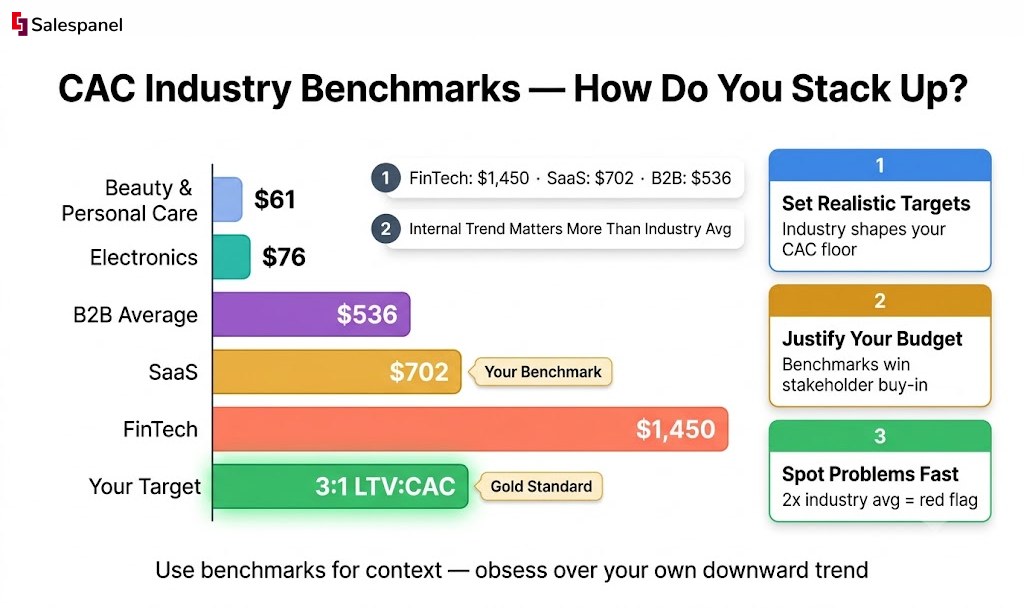
Keep in mind that costs vary wildly by industry. In 2025, the average CAC for fintech is $1,450, while the B2B average is a lower $536, and SaaS sits at around $702. You can discover more customer acquisition cost statistics to see how you stack up.
By adopting these advanced models, you transition from simply reporting costs to strategically managing them. That precision is what separates businesses that grow efficiently from those that merely burn cash.
How Does Your CAC Stack Up? A Reality Check with Industry Benchmarks
You have executed the calculations and arrived at your customer acquisition cost. The number itself, however, is meaningless without context. The immediate and necessary next question is: is this a good CAC?
To answer this, you must compare your performance against established industry benchmarks. This exercise is not about hitting a universal “correct” number. Rather, it is about understanding the market dynamics that dictate the cost of customer acquisition within your specific vertical.
Factors such as product complexity, average price point, sales cycle length, and dominant marketing channels all play a significant role in shaping these benchmarks.
Why Your Industry Is Your Starting Point
Every industry operates within a unique acquisition landscape. The differences are not minor; they are substantial.
For example, the average CAC for a beauty or personal care brand is approximately $61. For an electronics brand, it increases to $76. This disparity is not arbitrary; it reflects consumer purchasing behavior. A customer buying a laptop is likely to conduct extensive research and price comparisons, forcing brands into expensive pay-per-click (PPC) campaigns to capture high-intent buyers.
In contrast, a beauty brand may achieve greater success through influencer marketing and user-generated content, building a community that drives sales more organically and cost-effectively. For a deeper analysis, you can find more data on how average customer acquisition costs vary by industry.
Knowing these benchmarks provides a critical reality check. They help you:
- Set Realistic Targets: If you sell high-end electronics, aiming for a $20 CAC is likely an exercise in frustration. Benchmarks ground your objectives in market reality.
- Justify Your Budget: Presenting your marketing spend in the context of industry averages provides stakeholders with the necessary framework to approve budget requests.
- Spot Potential Problems: If your CAC is double the industry average, it is a significant red flag, signaling an urgent need to investigate your channels, messaging, or sales process for inefficiencies.
Use Benchmarks as a Guide, Not a Rule
While industry data is invaluable, it should be treated as a directional guide, not an immutable law. Your company’s unique attributes—brand equity, market position, and operational efficiency—will always be major influencing factors.
Ultimately, the most important benchmark is your own historical performance.
The goal isn’t to perfectly match an industry average. The goal is to consistently improve your own CAC over time. A downward trend in your internal CAC is a far better indicator of a healthy, successful strategy than how you measure up against a generic number.
Maintain a sharp focus on your internal, quarter-over-quarter trends. Are you becoming more efficient? Is your LTV:CAC ratio improving? This internal focus is what transforms your CAC from a simple reporting metric into a powerful tool for continuous improvement.
By combining external benchmarks for context with a rigorous focus on your own progress, you can make smarter, more informed decisions that drive real, sustainable growth.
Common Mistakes That Are Wrecking Your CAC Calculation
Achieving an accurate Customer Acquisition Cost is not merely an accounting exercise. Errors in this calculation can lead to catastrophic decisions regarding budget allocation, channel strategy, and even pricing models. A seemingly minor miscalculation can have cascading negative effects across your entire growth strategy.
Consider this a quick audit of your current methodology. Many businesses, including seasoned ones, fall into common traps that artificially improve the appearance of their CAC, masking underlying problems. Here, we dissect the most prevalent mistakes and provide clear remedies.
Overlooking Hidden Costs
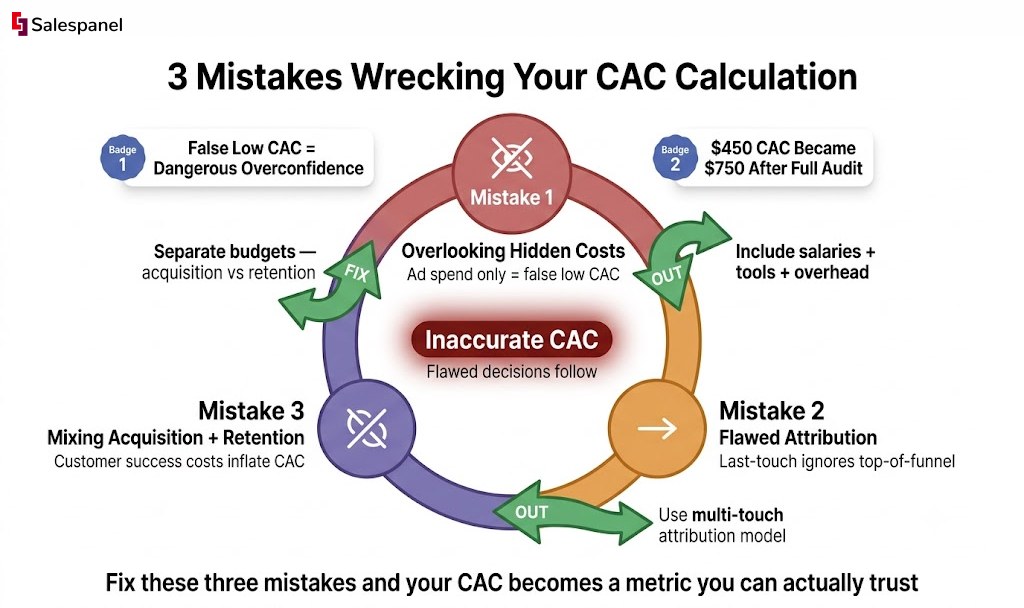
This is, by a significant margin, the most common and damaging error. It is tempting to sum up advertising spend and consider the calculation complete, but this provides an incomplete financial picture. Your true acquisition cost must include every dollar invested in winning a new customer.
Ignoring these “hidden” costs means you are operating with incomplete data. A marketing channel might appear highly effective on the surface, but a full cost analysis could reveal it to be a slow drain on your budget. Your CAC will look artificially low, creating a dangerous false sense of security.
Ensure your cost analysis includes:
- Your Tech Stack: Every software subscription is a direct cost. This includes your CRM, marketing automation platform, analytics tools, and any other technology your team uses to attract and close deals.
- Team Salaries: This is a major expense. You must factor in the fully-loaded cost (salaries, commissions, benefits) for your entire sales and marketing personnel.
- Overhead: A proportional share of general business expenses—such as office rent and utilities—must be allocated to your acquisition efforts.
Practical Example: A SaaS startup was celebrating a $450 CAC, based solely on ad spend and software fees. A more rigorous audit that included the salaries of their two content marketers and one SDR revealed the true CAC was $750. This single adjustment exposed that their pricing model was fundamentally unsustainable.
Using Flawed Attribution Models
How do you assign credit for a new customer? Many companies default to a last-touch attribution model. It is simple: the final touchpoint a user interacts with before converting receives 100% of the credit.
While simple, this model is dangerously misleading.
Last-touch attribution systematically overvalues bottom-of-the-funnel activities, like branded search ads, while completely ignoring the top-of-funnel content, social media campaigns, or events that introduced the customer to your brand. This often leads to cutting budgets for the very channels that are filling your sales pipeline.
The solution is to adopt a more holistic perspective. A multi-touch attribution model distributes credit across the various touchpoints in a buyer’s journey. This provides a more accurate representation of how your marketing channels work in concert, leading to far smarter budget allocations.
Mixing Up Acquisition and Retention Costs
This may seem obvious, but it is a frequent error. The capital spent to acquire a new customer is distinct from the capital spent to retain an existing one. Combining these costs will inflate your CAC and make your growth engine appear less efficient than it actually is.
For example, the budget for your customer success team or a loyalty program is a retention expense, not an acquisition expense. These costs must be segregated.
To correct this, you must be surgical with your budgeting. Create distinct line items for acquisition-focused activities (e.g., lead generation campaigns, sales outreach) and retention-focused activities (e.g., customer support, upsell campaigns). This separation is critical for understanding the true cost of growth.
Using Technology for a More Accurate CAC
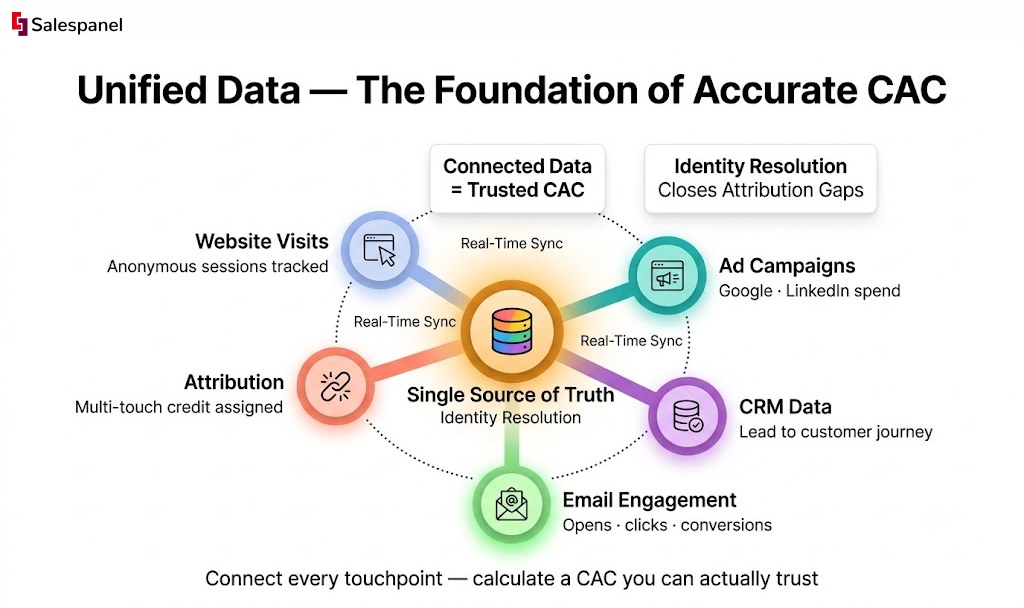
Attempting to calculate customer acquisition cost manually in a spreadsheet is not just tedious; it is a process fraught with potential for error. The fundamental challenge is data fragmentation. Advertising spend resides in one system, sales data in your CRM, and user behavior data in a separate analytics platform.
Manually stitching together these disparate data sources is a recipe for significant attribution gaps and a CAC figure that cannot be trusted. The key to precision lies in unifying your data. When you can visualize the entire customer journey, from the first ad click to the final purchase, your calculations become grounded in empirical reality.
Creating a Single Source of Truth
The only way to achieve a truly accurate understanding of acquisition costs is through technology that consolidates all your first-party data. By tracking a user’s entire lifecycle, you can move beyond flawed, high-level channel reporting to a precise, person-based CAC. This involves connecting the dots between an anonymous website visit and an eventual paying customer—a critical link that manual analysis almost always fails to establish.
For example, website visitor tracking from Salespanel is engineered to solve this exact problem. It performs identity resolution to link an anonymous journey across multiple sessions to a known lead in your CRM, thereby creating a single source of truth for the customer’s entire journey.
For businesses where direct customer interaction is a key acquisition channel, technology can also streamline operations. Tools like advanced call center software for acquisition cost management help manage and track these critical cost centers with greater efficiency.
By connecting every touchpoint, you eliminate guesswork. You can confidently attribute a new customer to the specific campaigns that influenced them, rather than relying on simplistic last-touch models that distort your true marketing performance.
Beyond Spreadsheets to Strategic Action
Once your data is unified, you can automate complex calculations that are nearly impossible to maintain manually. This not only saves time but also unlocks a deeper, more granular level of analysis. You can begin to segment your CAC by specific campaigns, lead sources, or customer personas with complete confidence.
This is where true strategic value is realized. Imagine knowing with certainty that leads generated from your webinar series convert at half the cost of those from paid search. This is a powerful, actionable insight that directly impacts your bottom line.
While selecting the right tools for your top-of-funnel activities is important (you can review effective email outreach tools in our guide), the ultimate advantage comes from this unified data foundation. At Salespanel, our philosophy is that this integrated approach is what transforms CAC from a backward-looking metric into a strategic tool that guides future decisions.
A Few Common Questions About CAC
Even with a firm grasp of the formulas, practical questions inevitably arise during implementation. Here are answers to some of the most common queries from marketers and founders.
How Often Should I Calculate My CAC?
The optimal frequency depends entirely on your sales cycle length.
For most B2B and SaaS companies, a monthly calculation is ideal. It is frequent enough to capture trends from new campaigns. This should be supplemented with a more in-depth review each quarter to smooth out anomalies and account for longer sales cycles.
For e-commerce or B2C businesses, the pace is much faster. A weekly calculation can be a game-changer, especially during high-stakes periods like holiday seasons. This allows for agile budget reallocation to capitalize on real-time performance.
What Is a Good LTV to CAC Ratio?
The industry-standard target is a 3:1 ratio. This is widely considered the benchmark for a healthy, sustainable business model. In simple terms, for every dollar you spend to acquire a customer, you generate three dollars in return over their customer lifetime value.
- A 1:1 ratio indicates a critical problem. You are spending a dollar to make a dollar, which means you are not generating a profit from acquisition. This is an unsustainable position.
- A ratio of 5:1 or higher, while seemingly positive, may suggest underinvestment in marketing. It could be a sign that you are not being aggressive enough and are leaving significant growth opportunities untapped.
What Are the Best Strategies to Lower My CAC?
Lowering CAC is not about finding a single solution but about making incremental, intelligent improvements across the entire marketing and sales funnel.
To achieve a meaningful reduction, focus your efforts on these four strategic areas:
- Improve Conversion Rates: This is the most direct lever. Focus on optimizing your website, landing pages, and all other conversion points. Small improvements in conversion rates have a compounding effect on lowering CAC.
- Optimize Channel Spend: Conduct a rigorous data analysis to identify your most and least efficient channels. Reallocate budget from high-CAC channels to those that deliver customers more cost-effectively.
- Enhance Customer Retention: This is a crucial, often overlooked strategy. Longer customer tenure and increased spending directly improve LTV, making the initial acquisition cost a more valuable investment. Focus on retention and creating upsell opportunities. To understand what drives churn, invest in identifying risk signals early.
- Leverage Organic Marketing: Do not underestimate the power of SEO and content marketing. While they require a greater upfront investment of time and effort, these channels deliver compounding returns and significantly drive down your blended CAC over the long term.
At Salespanel, our philosophy is built on the belief that accurate data is the only foundation for a profitable growth engine. Our platform is designed to connect every point in the customer journey, eliminating attribution guesswork so you can calculate a CAC that you can trust to make critical business decisions. Explore our resources to learn more.