For years, the B2B growth playbook was simple: inject more capital at the top of the funnel, and more customers would inevitably emerge at the bottom. When digital advertising was nascent and less saturated, this volume-based strategy was viable. That era has definitively concluded. Today, that same equation is not merely inefficient—it is a direct threat to profitability and long-term corporate viability.
The core issue is the escalating cost of capturing a potential customer’s attention. Analysis of nearly every major B2B channel, from paid search to social media, reveals that acquisition costs have surged by nearly 50% in recent years. This is not a temporary market fluctuation; it is a fundamental structural shift. Competition is relentless, buyers are more discerning, and the “growth at all costs” mandate has been supplanted by a demand for sustainable, profitable expansion.
Persisting with the old model traps a business in a damaging cycle of diminishing returns, where escalating spend is required merely to maintain lead velocity, eroding profit margins with every closed deal. This article provides a technical framework for transforming your customer acquisition cost from a reactive expense into a proactive, strategic advantage. It is about architecting a resilient, scalable marketing engine that is not dependent on brute-force expenditure but on data-driven precision.
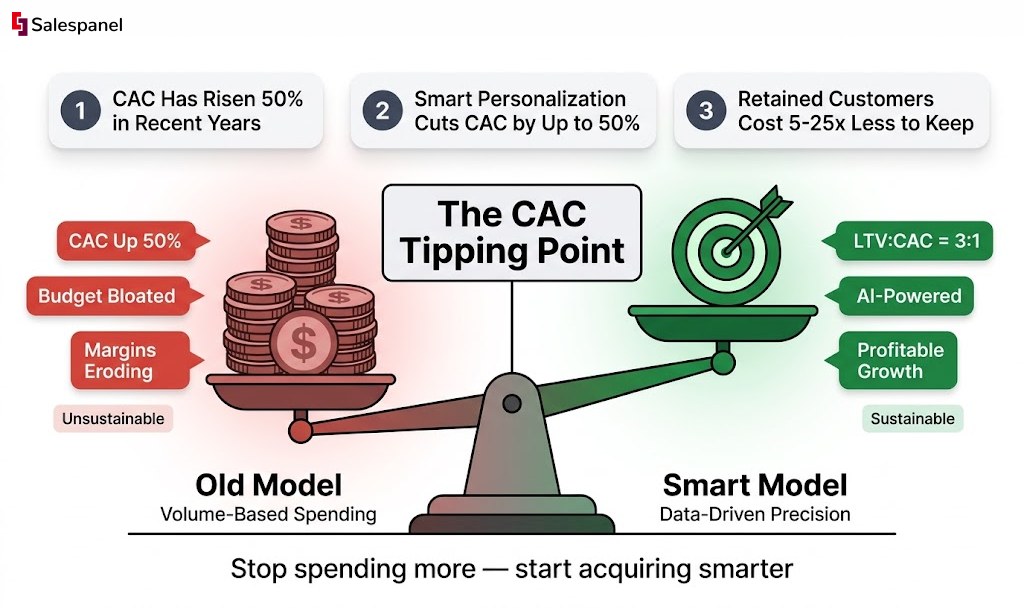
Why Your Customer Acquisition Cost Is A Ticking Time Bomb
The consequences of ignoring this shift are severe. If you’re still running the old playbook, you’re stuck in a damaging cycle that compounds over time — spending more and more just to maintain the same number of leads, while profit margins shrink with every deal you close. Look at almost any major B2B channel, from paid search to social media, and you’ll see that acquisition costs have shot up by nearly 50% in the last few years alone. This isn’t some temporary blip. It’s a fundamental market shift. Competition is ruthless, buyers are savvier than ever, and the “growth at all costs” mantra has been replaced by a demand for sustainable, profitable growth.
The Old Model Is Broken
If you’re still running the old playbook, you’re stuck in a damaging cycle. You find yourself spending more and more just to keep the same number of leads coming in, which shaves off your profit margin with every single deal you close. This isn’t just a line item on a spreadsheet; it’s a massive strategic weakness.
Companies that don’t adapt get left behind with:
- Bloated Marketing Budgets: Spending climbs while revenue flatlines.
- Sales Team Burnout: Your reps are wasting precious time chasing low-quality leads that were never going to convert anyway.
- Misaligned KPIs: The team celebrates vanity metrics like lead volume instead of the one thing that actually matters—profitable customer growth.
This guide is about more than just trimming your ad spend for a quarter to make the numbers look good. We’re going to explore how to turn your CAC from a reactive expense into a proactive, strategic weapon. It’s all about building a resilient, scalable marketing engine that doesn’t rely on brute-force spending.
The Takeaway: Getting your acquisition economics right is no longer a “nice to have.” You have to fundamentally re-architect your entire approach. It needs to be driven by smart data, precise targeting, and a relentless focus on customer value. That’s how you ensure every dollar you spend contributes directly to profitable growth.
Conduct a Rigorous Funnel and Cost Audit
You can’t fix a problem you don’t fully understand. Before you can dream of strategically slashing your customer acquisition cost, you have to get brutally honest about your current performance. This isn’t about glancing at a top-line metric; it’s about conducting a forensic audit of your entire acquisition funnel and every single cost associated with it.
Think of it as creating a data-driven map of your business. This map will show you every point of friction, every leaky bucket, and every dollar of wasted spend. The goal is to diagnose your acquisition engine with precision, pinpointing exactly where your efforts are hitting the mark and where they’re falling flat. A simple “total marketing spend divided by new customers” calculation just won’t cut it anymore.
You need to get granular. Dissect your CAC by channel, by campaign, even by customer persona. Is that expensive LinkedIn campaign actually delivering your most valuable, highest LTV customers? Is the cheap-and-cheerful SEO traffic churning out two months later? These are the tough questions a proper audit answers, turning vague assumptions into cold, hard, actionable facts.
Mapping the Entire Customer Journey
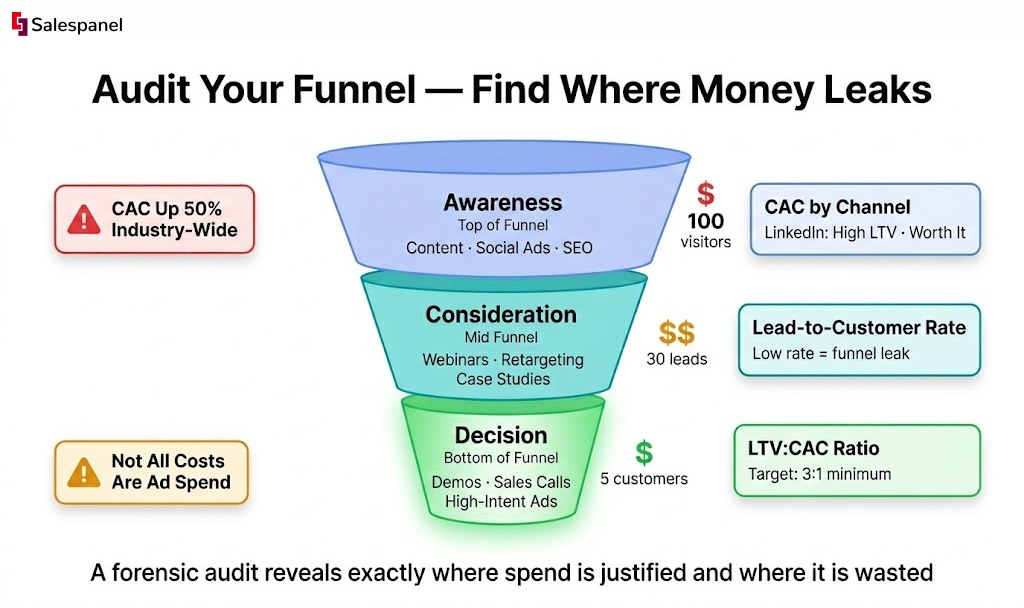
First things first: you need to visualize the complete path a prospect takes, from their very first interaction with your brand all the way to signing on the dotted line. Mapping the entire customer journey means identifying every touchpoint and—crucially—assigning costs to each stage.
- Awareness: This is your top-of-funnel spend. Think content creation, social media ads, and your ongoing SEO efforts.
- Consideration: Here, you’ll account for expenses like webinars, case study promotions, and those essential retargeting campaigns.
- Decision: This is the bottom of the funnel. Factor in the costs of sales demos, consultations, and your high-intent ad campaigns.
By tying costs to each stage, you can finally see where prospects are dropping off and whether the investment at that point is actually justified by the conversion rate to the next step.
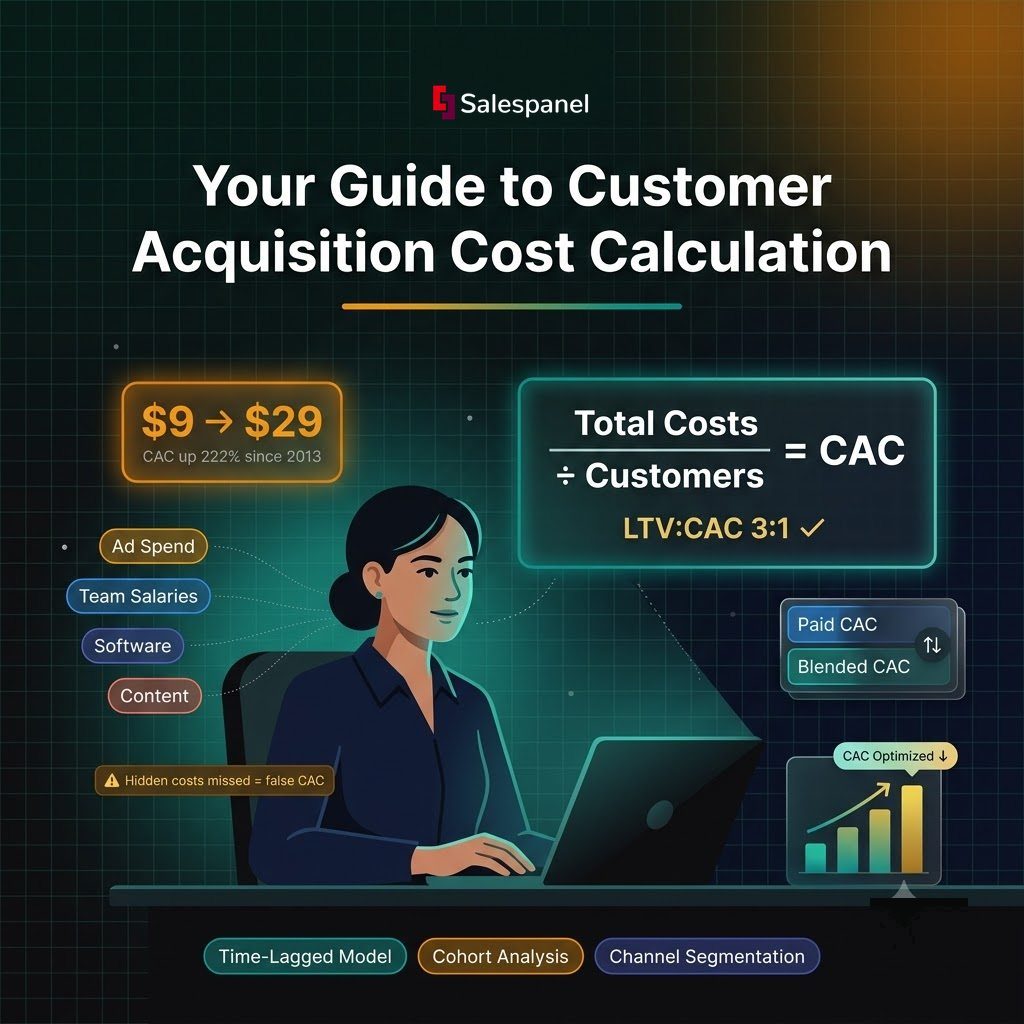
A critical piece of the puzzle that many companies miss: not all acquisition costs are direct ad spend. To get a true picture of your investment, you absolutely must account for the prorated salaries of your marketing and sales teams, all your software subscriptions, and any creative production expenses.
Calculating Your True CAC
With your funnel mapped out, it’s time to run the numbers. As part of a rigorous audit, it’s essential to use a customer acquisition cost calculator to accurately assess your spending. Don’t just trust the numbers inside your ad platforms. Consolidate all related expenses for a set period (monthly or quarterly works best) and divide that total by the number of new customers you brought in during that same window.
To help you get started, here are the core metrics you should be tracking in your audit. This table breaks down what to look at, what it tells you, and where to find the data.
| Metric | What It Tells You | Example Calculation/Source |
|---|---|---|
| Total Marketing & Sales Spend | The full investment in acquiring customers, including salaries and tools. | Sum of ad spend + team salaries + software costs. |
| New Customers Acquired | The outcome of your acquisition efforts for a specific period. | Pulled directly from your CRM or billing system. |
| CAC by Channel | Which channels are most cost-effective at bringing in new business. | (Spend on Channel X) / (New Customers from Channel X) |
| Lead-to-Customer Rate | The efficiency of your sales process in converting qualified leads. | (New Customers / Total Leads) * 100 |
| Funnel Drop-off Rates | Where the biggest leaks are in your customer journey. | (Visitors at Stage 1 – Visitors at Stage 2) / Visitors at Stage 1 |
| LTV to CAC Ratio | The long-term profitability and sustainability of your acquisition model. | (Lifetime Value / Customer Acquisition Cost) |
This process isn’t just about finding numbers; it’s about finding opportunities. By digging into these metrics, you’ll start to see a clear path forward for optimization.
This kind of audit is the first step in a necessary strategic shift—moving away from a simplistic, cost-heavy model to a more intelligent, data-driven approach.
As the visual shows, escalating costs will eventually force a change. You have to evolve from simply throwing money at the problem to strategically investing in intelligent systems that improve efficiency. Your audit is the foundation for making that leap. The main goal here is to walk away with a clear, actionable diagnosis of your marketing spend, highlighting the specific, high-impact areas ripe for immediate improvement.
Optimize Your Marketing Channels and Creative
Now that you have hard data from your audit, it’s time to move from diagnosis to action. This is where the rubber meets the road—where you turn those analytical insights into real, tangible drops in your customer acquisition cost. We’re not talking about guesswork or blindly slashing budgets here. This is a methodical process of reallocating and refining everything at the top of your funnel.
The core idea is brutally simple: do more of what works and stop doing what doesn’t. Your audit showed you which channels are actually bringing in profitable customers and which are just expensive hobbies. Now you have to act on that intelligence, shifting your spend from the underperformers to your highest-ROI channels.
For example, maybe your audit for a B2B SaaS company revealed that while LinkedIn Ads have a high cost-per-lead, the lifetime value (LTV) of customers from that channel is 3x higher than those from generic display ads. The smart move isn’t to cut the “expensive” channel. It’s to double down, refining your creative and targeting to make it even more efficient.
Strategic Budget Reallocation
Think of your marketing channels like an investment portfolio. Each one has its own risk and return profile, and your job is to rebalance it for maximum returns.
- Identify Your Winners: Pinpoint the top 2-3 channels delivering the best LTV:CAC ratio. These are your workhorses, and they deserve the biggest slice of your budget.
- Starve the Losers: Any channel that consistently fails to produce a positive return needs its budget cut—drastically. Don’t fall for the sunk cost fallacy. Money you’ve already spent doesn’t justify wasting more.
- Test and Validate: Set aside a small, controlled portion of your budget—around 10-15% is a good starting point—to experiment with new channels. This lets you innovate without putting your core acquisition engine at risk.
This disciplined approach ensures every marketing dollar is working as hard as it can for your bottom line. It transforms your budget from a static line item into a dynamic tool for driving profitable growth.
A Continuous Loop of Creative Optimization
Once your money is flowing to the right places, the next lever you can pull to lower CAC is improving the performance of your creative assets. This means systematically testing and iterating on everything from ad copy and landing pages to calls-to-action (CTAs). One of the most direct ways to make your channels more effective is to focus on how you can improve website conversion rates by creating a smoother user experience.
Optimization isn’t a one-and-done task. It’s a continuous feedback loop of testing, learning, and iterating. Seemingly small, incremental gains in conversion rate can lead to massive reductions in your overall CAC over time.
Let’s walk through a practical scenario for a B2B software company running Google Ads:
- The Ad Copy: Start by testing a benefit-driven headline (“Automate Invoicing in 5 Minutes”) against a feature-driven one (“Advanced Invoicing Software”). Keep a close eye on click-through rates (CTR) to see which message actually gets people to click.
- The Landing Page: Once they click, A/B test the landing page. Version A could feature a short demo video right at the top, while Version B uses a powerful customer testimonial instead. Measure which one gets more demo requests.
- The CTA: Even the button text matters. Test “Request a Demo” against something like “See It in Action” or “Get Started for Free.” A tiny change here can often create a surprising lift in conversions.
Every successful test chips away at the cost to acquire a lead from that campaign. When you apply this rigor across all your high-performing channels, these small wins compound into a major reduction in your blended CAC. This is how you remove subjectivity and ensure your creative decisions are always backed by cold, hard data, turning an expensive funnel into an efficient, scalable customer acquisition machine.
Use Automation for Smarter Lead Management
Generating a steady stream of leads is only half the battle. So many B2B companies end up bleeding cash—and driving up their customer acquisition cost—in the messy, inefficient middle of the funnel.
This is where a curious prospect is supposed to become a qualified, sales-ready opportunity. But too often, it’s a chaotic mess of manual processes, slow follow-ups, and inconsistent messaging.
The answer isn’t just to throw more people at the problem. It’s about using technology to bring order to that mid-funnel chaos. Marketing automation is the engine that can dramatically cut the manual effort and cost of lead nurturing, turning it from a time-suck into a scalable, data-driven process.
Automate Your Nurturing Process
At its heart, lead nurturing is about building relationships and trust by delivering valuable content over time. But trying to do this manually for hundreds or thousands of leads? Impossible. This is exactly where automated email sequences become your best friend.
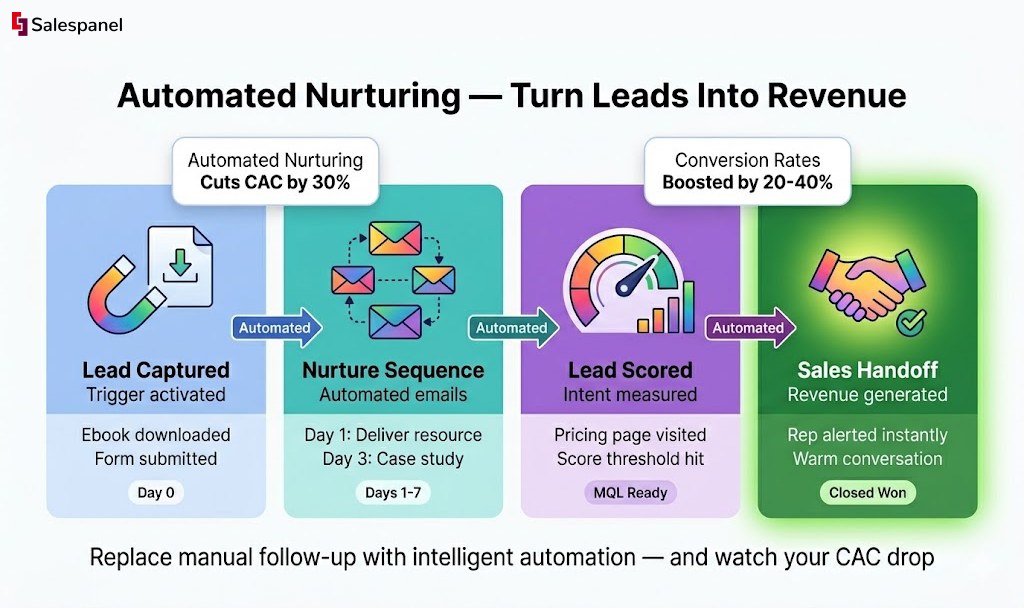
Instead of blasting out generic emails, you can build workflows that serve up personalized, relevant content triggered by a lead’s specific actions. Let’s say a prospect downloads your ebook on “Server-Side Tracking.” Your automation platform can kick off a three-part email series that:
- Immediately delivers the ebook and points them to a related blog post.
- Follows up three days later with a case study showing how a similar company used the tech.
- A week later, invites them to a webinar on privacy-first data capture.
This approach keeps you top-of-mind and educates the prospect systematically, nudging them closer to a sale without any direct intervention from your team. This kind of efficiency is a direct hit on a high CAC. In fact, businesses that nail this have seen their acquisition costs drop by up to 30%. We’ve also seen automated nurturing workflows boost conversion rates by 20–40% for many companies.
Build a Rock-Solid Lead Scoring Model
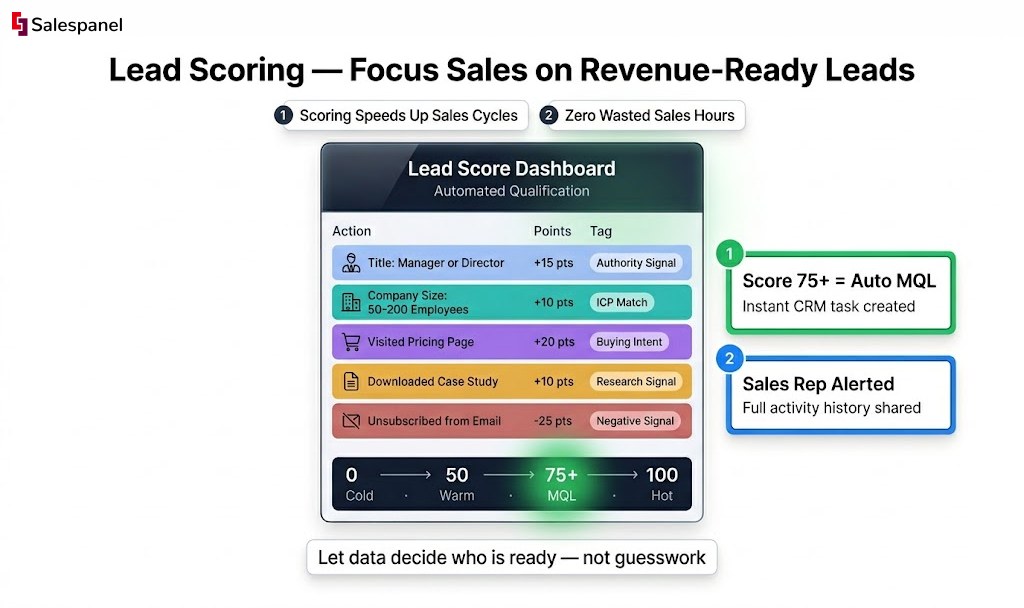
The most expensive mistake any B2B company can make is wasting its sales team’s time. Every single hour a salesperson spends chasing a tire-kicker is a direct blow to your bottom line. A solid lead scoring model is the gatekeeper that prevents this, making sure your sales team only spends their valuable time on prospects who are actually ready to talk.
Lead scoring is simply a way to rank prospects on a scale that represents their value to your business. The final score determines which leads get passed to sales and in what order of priority.
A well-implemented lead scoring system acts as the perfect filter between your marketing efforts and your sales team. It’s the mechanism that ensures marketing isn’t just delivering a high volume of leads, but a high volume of revenue-ready opportunities.
For instance, Salespanel’s lead scoring framework allows you to assign points based on a mix of demographic, firmographic, and behavioral data. This gives you a complete picture of each prospect’s fit and intent.
Here’s what that might look like in practice:
| Action or Attribute | Assigned Points | Rationale |
|---|---|---|
| Title contains “Manager” or “Director” | +15 | Indicates decision-making authority. |
| Company Size: 50-200 Employees | +10 | Aligns with your ideal customer profile (ICP). |
| Visited Pricing Page | +20 | Strong signal of buying intent. |
| Downloaded a Case Study | +10 | Shows deep interest in your solution’s impact. |
| Unsubscribed from Email | -25 | Negative signal indicating a poor fit or timing. |
Once a lead hits a set threshold—let’s say 75 points—the system can automatically flag them as a Marketing Qualified Lead (MQL). From there, it can create a task in your CRM for immediate sales follow-up.
This data-driven handoff is seamless and instant. It speeds up sales cycles and ensures your most expensive resources are focused where they’ll have the biggest impact. For teams looking to build out these nurture sequences, exploring a variety of powerful email outreach tools can provide the necessary foundation for success. This systematic approach to qualification directly lowers your CAC and makes your entire acquisition engine more profitable.
Drive Down CAC with Personalization and AI
Let’s be blunt: in the B2B world, generic outreach is the fastest way to set your budget on fire. Blasting the same message to everyone is a surefire way to overspend reaching people who were never going to buy from you anyway. This is where personalization and AI stop being buzzwords and become your sharpest tools for surgically cutting down customer acquisition costs.
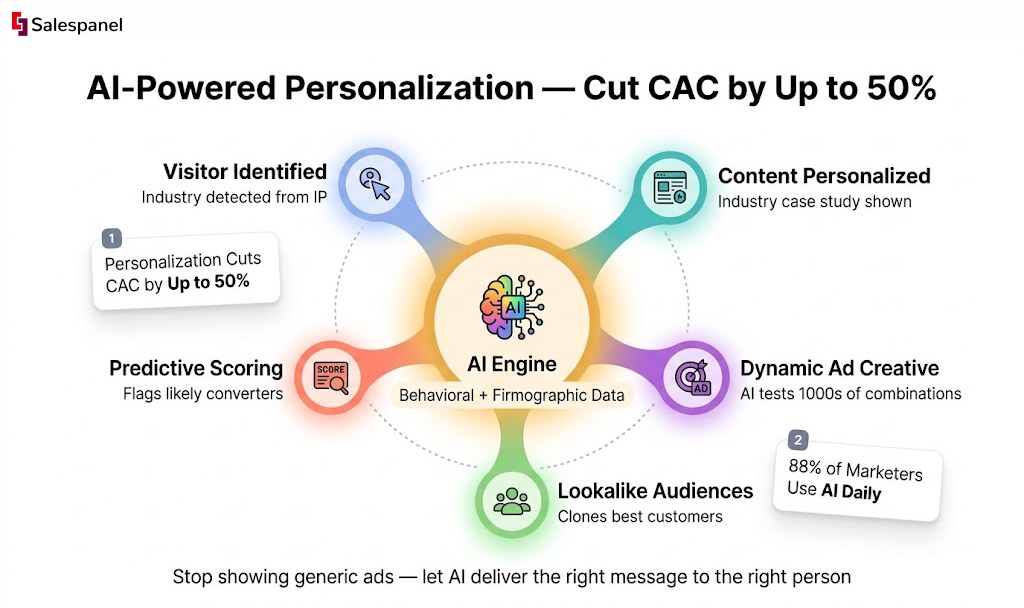
We’ve moved way beyond just dropping a {% raw %}{{first_name}}{% endraw %} token into an email. Real personalization today is about using a mix of behavioral insights, firmographic data, and predictive analytics to create hyper-targeted campaigns that actually connect. AI is the engine that makes this possible, optimizing ad spend on the fly, finding high-value lookalike audiences with surprising accuracy, and even changing your website’s content for individual visitors.
From Generic to Hyper-Relevant
The idea here is simple. Getting the right message to the right person at the right time dramatically boosts your chances of conversion and kills wasted spend. When you stop showing generic ads to prospects who don’t fit, your CAC can’t help but go down.
Think about a B2B tech company. Instead of a broad campaign for its software, it can use AI-powered tools to slice its audience with incredible precision. For example, by using website visitor tracking from Salespanel, the system can figure out an anonymous visitor’s industry just from their IP address and on-site behavior.
Once identified, the website can instantly show a case study that’s super relevant to that visitor’s industry. Someone from manufacturing sees a success story from a major manufacturer, not a generic one from a bank. This kind of targeted experience sends demo request rates soaring because the content speaks directly to their world.
The Financial Impact of Intelligent Targeting
This isn’t just a nice theory; the numbers are real and significant. Smart personalization is a game-changer for CAC. A recent analysis found that advanced personalization can slash CAC by up to 50% and lift revenue by 5–15%.
On top of that, companies using AI for personalization get campaigns out the door 80% faster, letting them react quickly to market changes. It’s no surprise that 88% of marketers now report using AI tools every day. You can find more on how marketers are reducing acquisition costs with these modern tactics.
This is how marketing moves from a volume game to a precision sport.
Practical AI-Powered Plays to Lower CAC
Putting this into action is about more than just buying a new tool—it’s a change in how you think. Here are a few practical plays you can run to make AI and personalization start working for you:
- Predictive Lead Scoring: Ditch the old, static point systems. AI can crunch thousands of data points—website engagement, firmographics, past conversions—to predict which leads are actually likely to close. This frees up your sales team to spend their valuable time on the opportunities that matter most.
- Dynamic Ad Creative: Instead of A/B testing a few ad variations, let AI test thousands of combinations of headlines, images, and calls-to-action. It learns in real-time what resonates with different audience segments and funnels your budget to the winners, constantly pushing for a lower cost per conversion.
- Lookalike Audience Refinement: AI can analyze the DNA of your best customers and build incredibly accurate lookalike audiences on platforms like LinkedIn. This expands your reach to new prospects who look just like your most profitable clients, making your ads way more relevant and cutting down on wasted impressions.
By bringing these intelligent technologies into your process, you’re not just trimming a little fat. You’re building a smarter, more resilient acquisition engine. You stop guessing what works and start letting data guide every single dollar you spend.
Make Every Dollar Count: Focus on LTV and Retention
It’s easy to get trapped in a constant cycle of optimizing the top of your funnel, tweaking ad spend and chasing new leads. But the most powerful lever you can pull to manage acquisition costs isn’t at the top—it’s at the bottom. The real magic happens when you increase the total value you get from each customer you’ve already won.
This isn’t just about spending less; it’s about making each acquisition worth more. When you shift your focus from front-end spending to long-term profitability, you fundamentally change the entire economic engine of your business.
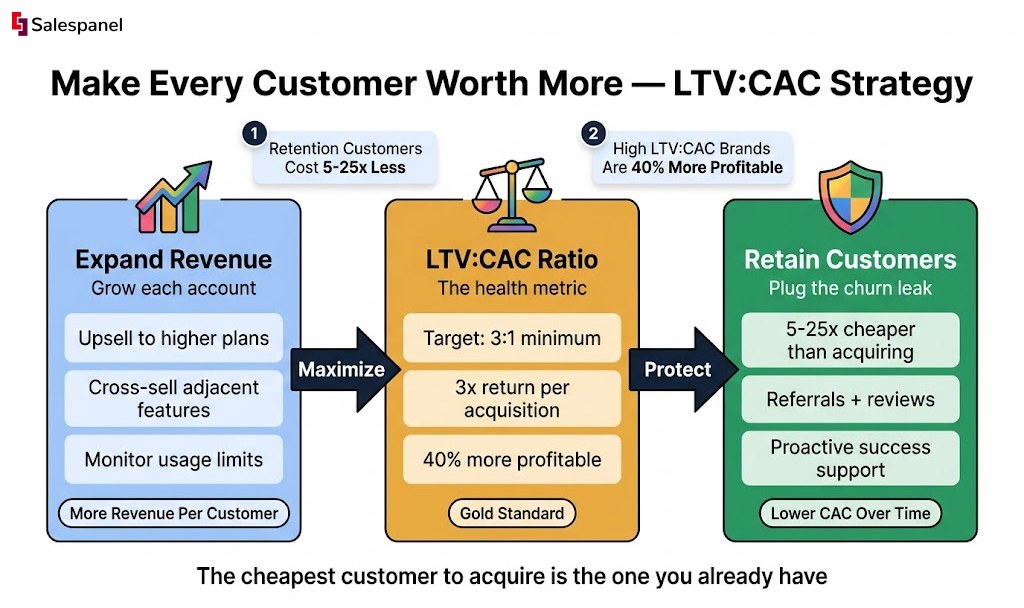
The ultimate health check for any B2B company isn’t just a low CAC. It’s a strong Lifetime Value to Customer Acquisition Cost (LTV:CAC) ratio. This is the metric that tells you if you have a real business or just a leaky bucket. While every industry is different, a 3:1 ratio is the gold standard for sustainable growth. It means for every dollar you put into acquiring a customer, you get three dollars back.
From First Sale to Full Expansion
Landing a new customer is the starting line, not the finish line. A healthy LTV:CAC ratio is built on what happens after the initial sale. This is where deliberate expansion strategies turn a one-time win into a long-term revenue stream.
- Upselling: Keep an eye on how your customers are using your product. Are they constantly bumping up against usage limits or asking about features in higher-tier plans? Those are clear buying signals. Proactively guide them to the plan that truly fits their growing needs.
- Cross-selling: What adjacent problems can you solve for your customers? Introducing complementary products or features doesn’t just add a new revenue line; it embeds your solution deeper into their daily operations, making you indispensable.
- Building Loyalty: This goes beyond just a good product. It means investing in standout customer service, proactive support, and a thriving community. Happy, loyal customers aren’t just less likely to churn—they’re also less sensitive to price increases and competitor offers.
This mindset transforms your customer base from a static list of logos into a dynamic engine for recurring and expanding revenue.
Retention is Your Secret Growth Engine
A rock-solid retention strategy does more than just plug churn. It creates a powerful, self-fueling growth loop that directly slashes your acquisition costs over time. After all, study after study confirms that acquiring a new customer is anywhere from 5 to 25 times more expensive than keeping an existing one.
And the payoff is huge. Research from our friends at Growth-Onomics shows customer acquisition trends indicating that brands with high LTV:CAC ratios are a whopping 40% more profitable than their peers.
Your happiest, most successful customers will eventually become your best and cheapest acquisition channel. They provide predictable recurring revenue, and they also generate powerful social proof through referrals, glowing reviews, and compelling case studies.
When you invest heavily in the post-purchase experience, you directly fight churn. This lessens the constant, expensive pressure to cram the top of your funnel with net-new leads. Every customer you keep is one less you have to acquire from scratch, fundamentally lowering the pressure on your entire go-to-market team.
Still Have Questions About Reducing CAC?
We get it. Driving down customer acquisition cost is a hot topic, and a lot of the advice out there is pretty generic. Let’s tackle some of the most common questions we hear from B2B marketers.
What Is a Good Customer Acquisition Cost, Really?
Honestly, there’s no magic number. A “good” CAC is completely relative to your customer lifetime value (LTV). Chasing some universal benchmark is a fool’s errand.
What you really need to obsess over is your LTV:CAC ratio. For most B2B and SaaS companies, the sweet spot for sustainable growth is a ratio of at least 3:1. This means for every dollar you spend to get a customer, you’re getting three dollars back over their lifetime. That’s a healthy business.
How Quickly Can I Actually Lower My CAC?
You can see some quick wins, for sure. Tweaking ad creative or shifting budget away from channels that are clearly underperforming can show results in just a few weeks. Think of these as the low-hanging fruit.
But the real, game-changing reductions? Those come from the bigger plays. Things like SEO, a solid content marketing engine, and smart automation take time to build momentum. You should expect to see a significant, sustainable impact on your numbers in about 3-6 months.
Which Marketing Channel Has the Lowest CAC?
In the long run, the channels with the lowest CAC are almost always the organic ones. We’re talking about SEO, content marketing, and good old-fashioned word-of-mouth referrals.
Yes, they require a hefty upfront investment of time and resources instead of just ad dollars. But once they get going, the ongoing cost to acquire customers through these channels trends toward zero. That’s how you build a truly efficient and sustainable growth machine.
Ready to stop guessing and start converting? Salespanel gives you the visitor intelligence and automation you need to spot high-intent prospects and personalize their journey, directly driving down your CAC.
Explore our resources and see how you can build a smarter acquisition engine. Find out more here.