For decades, the standard procedure for tracking email opens was mechanically simple: embed a tiny, invisible 1×1 pixel image. When a recipient’s email client loaded images, it requested that pixel from a server, logging an ‘open.’ This technique, the bedrock of email marketing analytics, is now systematically failing. The shift is driven by a profound and irreversible push for user privacy, fundamentally altering the data landscape. In an ecosystem where over 361 billion emails were sent daily in 2023, and where open rates have artificially inflated to over 40% due to privacy proxies, relying on this legacy method is no longer just inaccurate—it’s a strategic liability. This guide dissects the technical breakdown of modern email tracking, explores its current vulnerabilities, and provides a clear, actionable framework for navigating this new, privacy-first reality.
The Shifting Landscape of Email Open Tracking
Email open rates were once a gold-standard Key Performance Indicator (KPI) for sales and marketing teams. As a straightforward signal of audience engagement, a rising open rate was a reliable indicator of a healthy email list and resonant messaging. Today, that metric’s journey has transformed it from a dependable signal into a complex, often misleading, figure that demands a much more critical and technical interpretation. The central theme we will explore is how to move from tracking ambiguous machine-generated events to capturing definitive human-driven engagement.
The ground began to shift tectonically with the rise of privacy-first technologies. These tools are engineered to shield user data by masking online activities, and their effect on email analytics has been seismic. Continuing to interpret open rates through a traditional lens means making critical business decisions based on faulty, machine-inflated data.
The Privacy Push and Its Impact
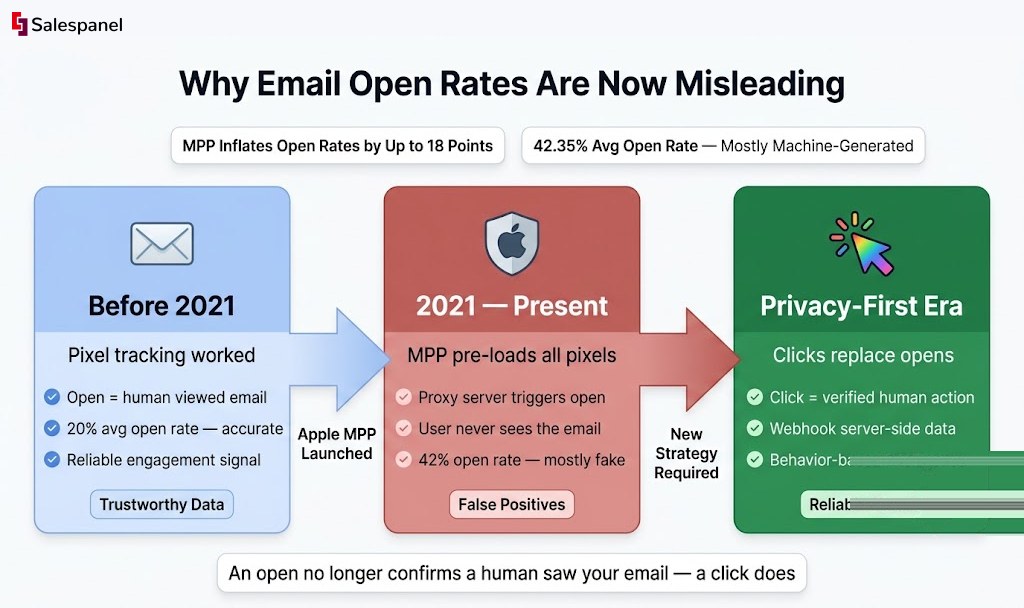
The most significant disruptor has been Apple’s Mail Privacy Protection (MPP), introduced in 2021. This feature, enabled by default for Apple Mail users, automatically pre-loads all email content—including tracking pixels—on a proxy server. This action triggers an “open” event regardless of whether the user ever actually viewed the message.
The result is a massive, artificial inflation of open rates. The average global email open rate now hovers around 42.35%, a significant jump from the 20% range observed just a few years prior. Some analyses show MPP alone can inflate these figures by as much as 18 percentage points, making it nearly impossible to separate genuine human engagement from automated server pings.
This shift introduces several critical operational challenges for marketers:
- Data Inaccuracy: Your open rates might appear robust on paper, but they could be concealing dangerously low engagement from a large segment of your audience.
- Flawed Segmentation: Using “opens” to trigger marketing automations or to clean your contact list may lead to miscategorizing engaged Apple users or failing to remove genuinely inactive contacts.
- Misleading A/B Tests: Relying on open rates to determine the winning subject line in an A/B test can lead to fundamentally incorrect conclusions about audience preference.
The bottom line is this: an “open” no longer confirms that a human has seen your email. It only confirms that a machine—often a proxy server—has accessed its content.
While we dissect the mechanics of tracking, it’s equally crucial to focus on how to increase email open rates to maximize the chances of your messages being genuinely seen. To adapt, you must look past the simple open rate and embrace more robust tracking methods that focus on undeniable signals of interest, like clicks and subsequent on-site behavior. That is how you will generate real sales and marketing intelligence in a world that values privacy.
How Email Open Tracking Actually Works
To understand today’s tracking challenges, one must first grasp the classic mechanism that has powered this metric for years. The method is fundamentally based on a simple, invisible image commonly referred to as a tracking pixel.
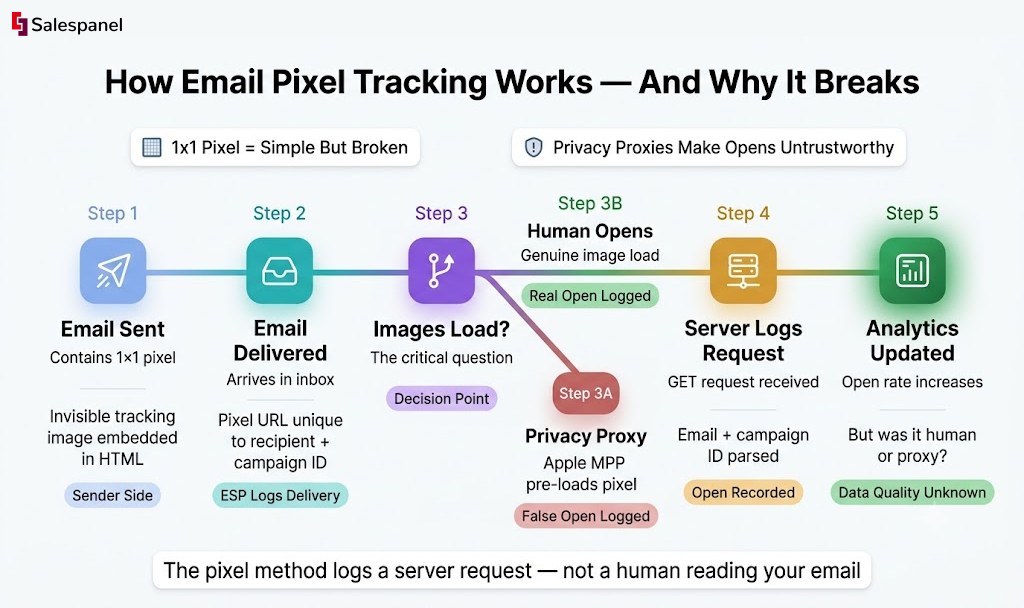
This pixel is typically a transparent 1×1 GIF or PNG file embedded within the email’s HTML code. Its minuscule, invisible nature ensures it does not interfere with the email’s design. The critical component is not the image itself, but the HTTP request the recipient’s email client makes to load it. When an email client like Gmail or Outlook is configured to display images, it automatically sends requests to remote servers to download all embedded visual content—including the invisible pixel. That request is the trigger that logs an ‘open’ event on the sender’s analytics platform.
The Technical Breakdown
Each tracking pixel is assigned a unique URL containing specific identifiers, such as the recipient’s email address or a campaign ID. When the email client requests this URL, the server performs two functions: it sends back the transparent image and, more importantly, it logs the details from the request.
Here’s a practical example of the HTML for a tracking pixel:
<img src=”https://yourtrackingserver.com/[email protected]&campaign_id=123″ width=”1″ height=”1″ border=”0″ alt=””>
When John Doe’s email client attempts to render this <img> tag, it sends a GET request to yourtrackingserver.com. The server parses the request, notes that the user associated with [email protected] from campaign 123 has triggered the pixel load, and records this event. This server-side log entry is the raw data that populates open rate reports.
This method’s simplicity has been its strength for decades. With projections showing over 392 billion emails will be sent daily in 2025 and open rates floating between 35% and 42%, even small gains in accuracy can reveal a lot about campaign performance. You can dive deeper into these email traffic stats over at CloudHQ’s blog. However, this simple mechanism is also its greatest weakness in the modern, privacy-focused landscape.
Inherent Flaws in the Pixel Method
The reliability of pixel-based tracking is eroding due to a few widespread factors. Understanding these technical limitations is the first step toward building a more resilient tracking strategy.
The two main technical culprits are:
- Image Blocking: Many email clients and corporate firewalls block images by default for security reasons. If the recipient does not explicitly click “Display images,” the pixel never loads. An open event is never logged, even if the recipient read the entire email.
- Privacy Proxies: This is the most significant issue. Services like Apple’s Mail Privacy Protection proactively pre-load all images through a proxy server the moment the email arrives. This triggers your pixel and registers an “open”—whether the user ever saw the message or not. The result is a flood of false positives that inflate open rates.
The core takeaway here is that a pixel-based “open” is no longer a reliable sign of human engagement. It just tells you an image was requested. That request could have come from a real person, a bot, or a privacy proxy. You just don’t know.
This flawed foundation makes it critical to look beyond the pixel. Truly effective tracking must connect email activity with definitive user actions, like link clicks and subsequent website visits. This is where tools become essential. For example, Website Visitor Tracking from Salespanel shifts the focus from a flimsy “open” to linking an email click directly to a user’s entire on-site journey. This provides a far more accurate and actionable picture of their genuine interest. That holistic view is where real engagement intelligence is found.
Grappling With Email Privacy Features and Image Proxies
The most significant challenge in tracking email opens today is not your internal tech stack; it is the privacy-first ecosystem your emails are delivered into. Features designed to shield user data have disrupted traditional pixel-based tracking, creating a fog of war around your most fundamental engagement metrics. To achieve clarity, one must understand the technical adversaries and adjust the strategic game plan.
The two primary mechanisms are Apple’s Mail Privacy Protection (MPP) and Gmail’s image proxy servers. Both interfere with the “request-and-log” mechanics of a tracking pixel, but they operate in distinct ways.
Breaking Down Apple’s Mail Privacy Protection
Apple’s MPP is the most aggressive disruptor. Instead of waiting for a user to open an email, Apple’s servers proactively download all remote content—including your tracking pixel—the moment the email is delivered. This process is routed through a proxy server that masks the user’s real IP address.
This creates two major problems for marketers:
- A Surge of False Positives: Your server receives the pixel request and logs an “open,” even if the recipient never interacts with the email. This can severely inflate open rates, painting a misleadingly positive picture of campaign performance.
- Vanishing Data: Because the request originates from an anonymous Apple proxy, you lose valuable metadata. You can no longer reliably determine the recipient’s device type, geographic location, or the precise moment of engagement.
Here’s the bottom line: an MPP-triggered open is technically just a delivery confirmation to an Apple device. It says nothing about genuine human interest. If you’re using that signal alone to segment your audience or kick off an automation, you’re making decisions based on faulty intelligence.
How Gmail’s Image Caching Works
Gmail has utilized image proxies for years, but its system differs from Apple’s. When a user opens an email for the first time, Gmail’s servers download and cache all images, including your tracking pixel. Subsequent views of that email by the user will load the images from Google’s cache, not your server.
This still logs the initial open but clouds the data similarly to MPP. The request comes from a Google IP, masking the user’s true location and device details. Furthermore, any subsequent opens of that same email will likely not trigger another request, making it impossible to track repeat engagement with the same message.
Smart Strategies for Messy Data
With these technical roadblocks, the strategic imperative is to de-emphasize open rates and prioritize more concrete signals of engagement. It is about working smarter with imperfect data.
Your new primary metric is the click-through rate (CTR). A click is an explicit, user-driven action that no proxy can fake. It is undeniable proof that someone viewed your email and was interested enough to act. It has become the most reliable indicator of real engagement available.
Beyond that, you must leverage unique link tracking to measure interest. Every link in your email should be tagged with unique parameters for each recipient. When a link is clicked, you know precisely who clicked it and what content they were interested in. This click data—not a nebulous “open”—should become the primary trigger for follow-up sequences, lead scoring adjustments, and sales alerts. This is precisely where tools that bridge the gap between email activity and website behavior become so critical, turning a simple click into a rich, detailed profile of genuine user intent.
Moving Beyond Pixels for More Reliable Data
When standard tracking pixels produce a distorted picture, it is time to deploy more robust methods. The objective is to move past ambiguous “opens” and capture signals of undeniable engagement. This involves upgrading your tracking toolkit to bypass the client-side roadblocks that invalidate traditional pixels. The most powerful strategic shift is from tracking opens to tracking clicks. A link click is a clear, deliberate action from a user. It is a signal no privacy proxy can fake, and it reveals far more about genuine interest than a pixel that may have been loaded automatically. This means treating every link in your email as a valuable data collection point.
This approach is especially critical now with privacy proxies becoming the norm.
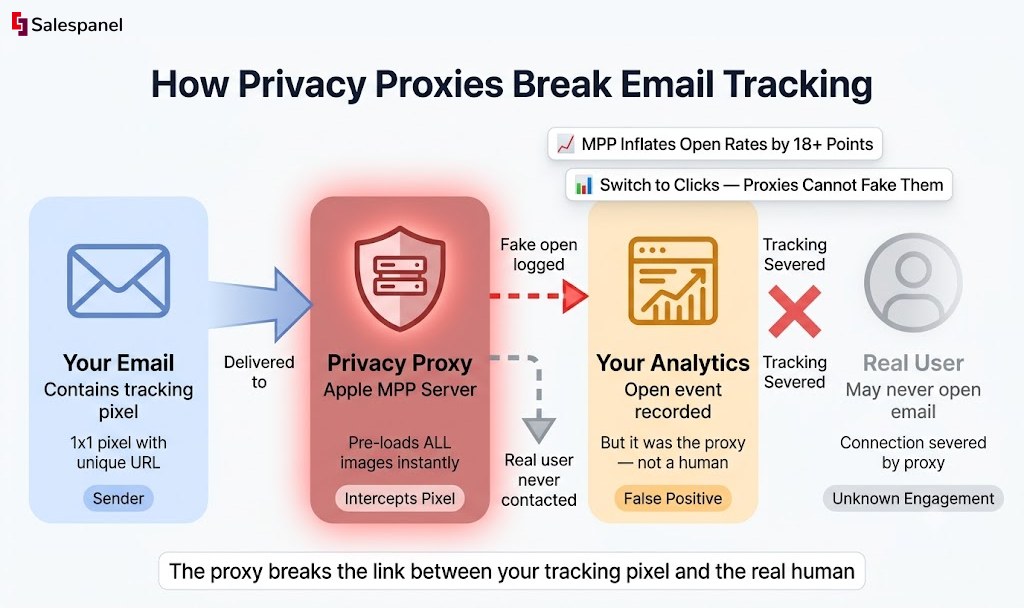
As the diagram illustrates, the proxy server acts as an intermediary, severing the direct connection between your tracking pixel and the end user. This completely obscures the engagement data you aim to capture.
Adopting Server-Side Tracking with Webhooks
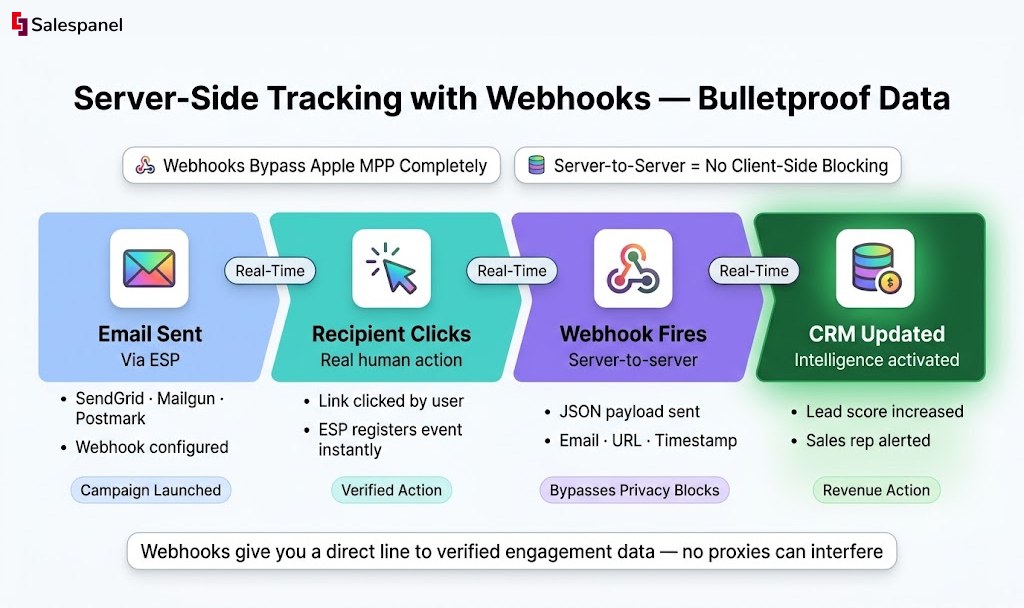
For a truly bulletproof tracking implementation, the focus must shift to server-side data exchange. Integrating directly with your Email Service Provider (ESP) using webhooks is a game-changing technical solution. A webhook is an automated, server-side tracking message sent when a specific event occurs—in this case, an email event. Instead of waiting for a fragile pixel request from a user’s device, your ESP’s own servers can inform your system exactly what happened with your email.
Here’s the technical breakdown:
- How it Works: You configure your ESP (such as SendGrid, Postmark, or Mailgun) to send a real-time HTTP POST request to a URL you control whenever an email’s status changes.
- What You Capture: This method provides rich, server-verified data—including deliveries, hard and soft bounces, clicks, and even spam complaints.
Using webhooks essentially creates a direct, private line of communication between your ESP and your own database. It completely bypasses the recipient’s email client and all its privacy features, giving you a much more reliable source of truth.
What Webhook Integration Looks Like in Practice
Imagine you send a campaign through Mailgun. When a recipient clicks a link, Mailgun’s servers register that click instantly. If you have configured a webhook for “clicked” events, Mailgun immediately sends a payload of JSON data to your specified endpoint.
That data packet will contain everything you need to know:
- The recipient’s email address
- The exact URL they clicked on
- A precise timestamp of the click
- The campaign ID
Your server can then parse this information and use it to update a user’s profile in your CRM, increase their lead score, or trigger an automated follow-up sequence. Because this is all server-to-server communication, it is completely immune to Apple’s MPP or image blocking. It’s an exceptionally reliable way to measure real interaction. The core philosophy at Salespanel is built around this principle of capturing definitive actions. We believe that true intelligence comes from verifiable data points.
When you combine this reliable click data with on-site activity, the magic happens. For example, Website Visitor Tracking from Salespanel connects that server-verified email click to a prospect’s entire journey on your website. Suddenly, you don’t just know they were interested—you know exactly what they were interested in. This fusion of reliable email data and behavioral analytics is where you’ll find truly actionable intelligence.
Turning Engagement Data Into Actionable Intelligence
Tracking data is useless if it merely populates a dashboard. Its value is only realized when it drives intelligent, automated action. Raw numbers on opens and clicks do not generate revenue; translating that behavior into a rich, unified user profile is what creates a strategic asset. This is the central takeaway: transforming fleeting signals of engagement into a durable, long-term system for growth.
The goal is to move beyond isolated metrics like “email opened” and build a holistic view of each prospect. When you connect email activity to what people are actually doing on your website, a simple click begins to tell a powerful story. A prospect who clicks a pricing link in your email is sending a clear, high-intent buying signal. But the real intelligence lies in what happened after that click. Did they bounce immediately, or did they spend ten minutes examining your integrations page and watching case studies?
From Raw Data to Rich Profiles
This is where having the right platform is non-negotiable. For instance, Website Visitor Tracking from Salespanel can take an initial email click and connect it to the prospect’s entire journey on your website. It performs identity resolution to stitch together every touchpoint, painting a complete picture of their interest from start to finish. This unified view provides the context behind the click, which is infinitely more valuable than the click itself. It offers a much deeper understanding of the user’s needs and their stage in the buying process.
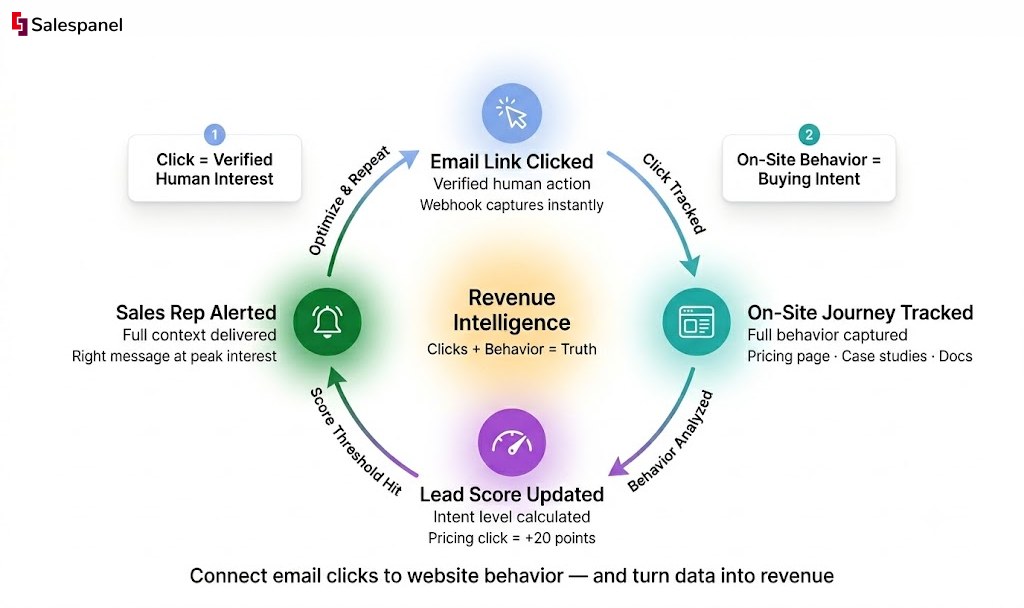
A platform like this visualizes a lead’s entire journey, combining their email engagement with the specific pages they visited and the actions they took on your site. The real power is seeing these separate events as one cohesive narrative of genuine interest.
Automating the Response
Once this unified data is available, you can build powerful, responsive workflows that act on these engagement signals instantly. This intelligence can fuel automated and personalized actions that move prospects through your funnel more efficiently.
- Trigger Automated Workflows: A practical example: a click on a specific product link can automatically enroll a prospect into a targeted lead nurturing sequence that highlights relevant features and case studies. No manual intervention is required.
- Personalize Follow-Up: Sales representatives can receive instant alerts, armed with the full context of the prospect’s on-site activity. This enables a highly relevant and timely conversation instead of a generic “just checking in” email.
- Dynamically Adjust Lead Scores: That click on the pricing page should immediately increase their lead score, prioritizing them for sales outreach over less-engaged contacts. Salespanel’s lead scoring framework allows you to automate this process with precision.
The core idea is simple: every action a prospect takes is a piece of a bigger puzzle. By connecting email engagement to website behavior, you assemble that puzzle in real-time and can respond with absolute precision. You’re turning passive tracking into active, revenue-driving intelligence.
Of course, once you’re successfully tracking email opens and analyzing engagement, you’ll want to implement strategies to improve email deliverability to keep feeding this intelligence engine. Explore our resources to learn more about sharpening your campaigns.
Common Questions About Email Tracking
Navigating email open tracking can be complex, especially with privacy changes reshaping the data landscape. Here are answers to the most frequent technical and strategic questions.
Is Email Open Tracking Still Worth It?
Yes, but its function has evolved. It should be viewed less as a precise metric and more as a directional signal.
Due to technologies like Apple’s Mail Privacy Protection, the raw “open rate” is no longer a reliable measure of engagement. It cannot be taken at face value. However, it remains useful for spotting high-level trends. For example, a sudden and dramatic drop in open rates could indicate a deliverability issue, such as your domain being blacklisted.
The key is to use it as one component of a larger analytical puzzle. Always evaluate it alongside more concrete metrics like click-through rates and subsequent website activity.
Can People Tell I’m Tracking Their Emails?
Generally, no. The tracking pixel is a 1×1 transparent image, completely invisible to the naked eye. A recipient would need to inspect the email’s raw HTML source code to discover it, an action the vast majority of users never perform.
However, some privacy-focused email clients or browser extensions may flag emails that contain trackers. So, while the mechanism is covert, transparency is a sound policy.
The modern approach is to assume some level of tracking is expected, but to always prioritize user privacy. Ensure your approach aligns with GDPR and other relevant regulations, and invest in proper consent management practices. Your primary focus should be on tracking actions that demonstrate genuine interest—like clicks—not simply counting opens in the background. Collecting first-party data through transparent means builds trust while still delivering actionable intelligence.
How Can I Make My Tracking More Accurate?
The single most effective action you can take to improve accuracy is to shift your primary focus from opens to clicks. A click is an undeniable user action. It represents a real person showing genuine interest and cannot be faked by a privacy proxy.
The next technical step is to integrate your Email Service Provider directly with your analytics platform using webhooks. This method relies on server-verified data that completely bypasses client-side privacy blockers, providing a much more reliable record of events.
By combining these approaches, you gain a clearer view. You might use the high-level open rate to gauge a subject line’s appeal, but you would rely on verifiable click data to trigger sales workflows or adjust a lead score. It is this layered, technically-sound strategy that enables smart decisions based on signals you can actually trust.
At Salespanel, we believe true marketing intelligence comes from connecting every dot in the customer journey. Our platform moves beyond fuzzy metrics by linking reliable email engagement signals to real-time website behavior, giving you a complete and actionable view of every prospect. Explore our resources to learn more.