The digital marketing landscape is undergoing a tectonic shift. For over a decade, marketers operated on a diet of third-party cookies, inferring customer intent from a trail of digital breadcrumbs across the web. This model, while effective for broad targeting, was built on a foundation of ambiguity and carried significant data privacy baggage. That era is over. The dual forces of stringent privacy regulations like GDPR and CCPA, combined with the technical deprecation of third-party cookies by major browsers, have rendered the old playbook obsolete.
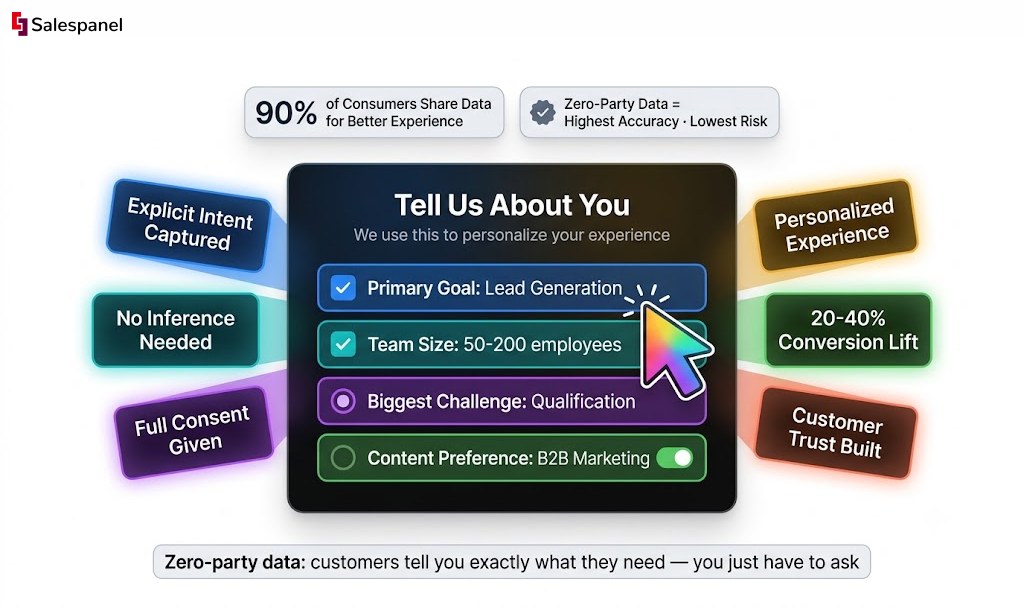
This is not a fleeting trend; it is a fundamental reset. The future of marketing is not about finding clever workarounds to track users, but about building direct, transparent relationships based on consent and mutual value. At the core of this new paradigm lies zero-party data: information a customer intentionally and proactively shares with a brand. The statistics underscore this transition: while 90% of consumers are willing to share data for a better experience, they demand trust and transparency in return. Companies that have embraced direct data collection through quizzes, preference centers, and interactive tools are reporting conversion rate increases of 20% to 40%. The message is clear: in a privacy-first world, trust is the new currency, and zero-party data is the most valuable and ethical fuel for creating personalized experiences that resonate with modern B2B buyers. This guide provides an in-depth analysis of how to navigate this critical transition.
What Exactly Is Zero-Party Data?
Zero-party data is information that customers consciously and voluntarily provide to a brand. It is not scraped, inferred from behavior, or purchased from aggregators. It is data given with explicit consent, creating a direct line of communication between the consumer and the business.
Consider a practical B2B scenario: a visitor browses several feature pages for your project management software. Based on this first-party behavioral data, you might infer they are interested. This is an educated guess. In a zero-party data approach, you could present an interactive quiz asking for their team size and greatest workflow challenge. The first method is an inference; the second is a direct statement of need from the source. This is the technical and strategic power of zero-party data.
The Gold Standard of Customer Insight
The term, coined by Forrester Research, describes data a customer proactively shares to define their preferences, purchase intentions, or personal context. This data is powerful because it is both explicit and consensual, making it the most reliable foundation for personalization. You can read more about zero-party data’s foundational principles to understand its strategic importance. This direct exchange eliminates the ambiguity inherent in interpreting behavioral signals alone.
Zero-party data eliminates the guesswork. Instead of inferring intent, you’re getting it straight from the horse’s mouth. This lets you act with confidence and precision.
Here are some technical applications:
- Interactive Quizzes: A SaaS company uses a quiz titled “What’s your primary business goal?” The answers (e.g., “lead generation,” “customer retention”) are used to dynamically recommend the most relevant software package.
- Preference Centers: A user navigates to their account settings and selects checkboxes to receive emails only about “B2B marketing” and “analytics,” providing clear segmentation data.
- Onboarding Forms: A new user for a CRM platform specifies their job role (“Sales Manager”) and industry (“Manufacturing”). This data is then used to customize their initial product dashboard and tutorials.
In each instance, the customer provides valuable context in exchange for a more relevant and efficient experience. This “value exchange” is the central theme of a robust zero-party data strategy, fostering a relationship built on mutual benefit rather than covert tracking.
Comparing Zero, First, and Third Party Data
To fully grasp the strategic significance of zero-party data, it is crucial to understand its technical distinctions from the other primary data types. Marketers have traditionally relied on a mix of zero-, first-, and third-party data, but their utility, accuracy, and ethical implications vary dramatically in the current privacy-centric environment. These differences don’t just shape marketing tactics; they define the customer relationship.
A Technical Comparison: Zero vs. First vs. Third Party
A side-by-side comparison illuminates the key attributes that differentiate each data category, from its origin to its reliability and associated risks.
| Attribute | Zero-Party Data | First-Party Data | Third-Party Data |
|---|---|---|---|
| Source | Directly and proactively shared by the user. | Collected passively from your own properties (website, app). | Purchased from external aggregators who collect it from many sources. |
| Example | A user fills out a quiz, answers a survey, or sets preferences in their account. | A user’s browsing history on your site, downloads, or items added to a cart. | Demographic or behavioral data bought from a data broker. |
| Accuracy | Highest. It’s what the customer explicitly tells you. | High, but requires inference. You’re interpreting their actions. | Lowest. Often outdated, inaccurate, or irrelevant. |
| Privacy Risk | Lowest. It’s collected with full consent and transparency. | Low to Medium. Consent is needed, but collection is passive (e.g., cookies). | Highest. Often collected without direct user consent, facing heavy regulation. |
| Customer Trust | Builds trust through a transparent value exchange. | Neutral. Generally expected, but can feel intrusive if not handled well. | Erodes trust. Feels like being spied on; it’s the reason ad blockers exist. |
Zero-party data occupies a unique position, excelling in both accuracy and its capacity to build trust.
The Power of Explicit Intent
The core advantage of zero-party data lies in its ability to eliminate analytical guesswork. For example, your first-party analytics may show a visitor repeatedly viewing enterprise-level software pages. You can infer they work for a large company. However, with a zero-party data mechanism, that same visitor can directly state through a form: “I manage a 500-person marketing team, and my biggest challenge is lead qualification.”
This single data point is exponentially more valuable. It transitions your understanding from inference to explicit, actionable context, enabling highly targeted and relevant marketing and sales outreach. The diagram below illustrates the core characteristics that define zero-party data’s integrity.
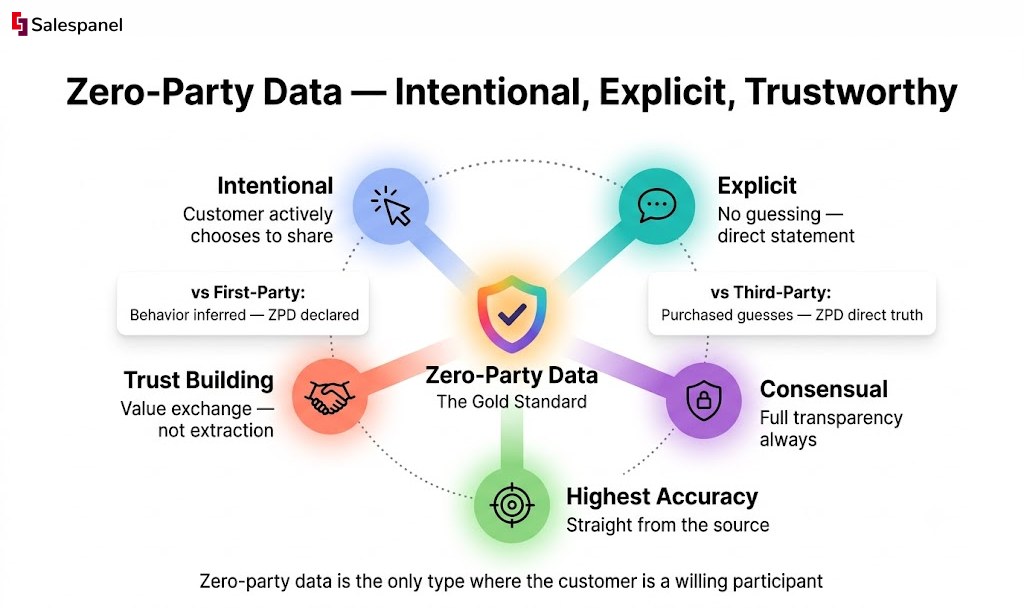
This direct flow from the customer establishes a foundation of trust that other data types cannot replicate.
Why This Distinction Is Strategically Critical
Understanding these data distinctions is not merely an academic exercise; it is a strategic imperative. Third-party data is becoming obsolete due to accuracy issues and regulatory pressures. First-party data remains valuable for understanding behavior, but it still requires interpretation.
Zero-party data provides the direct line. It is customers articulating their needs in their own words. This shift improves the customer experience and optimizes the entire marketing and sales funnel for greater efficiency. As the digital ecosystem adapts to the post-cookie era, a strategy built on transparent and consensual data collection is the only sustainable path forward. You can discover more insights about zero and first-party data strategies to explore this foundational shift further.
How to Collect Zero Party Data Effectively
Understanding the concept of zero-party data is the initial step; the technical execution of collecting it without creating friction is the real challenge. The methodology is anchored in a core principle: the value exchange. Users will willingly share information if they receive immediate and tangible value in return, such as personalized recommendations, relevant content, or an improved product experience.
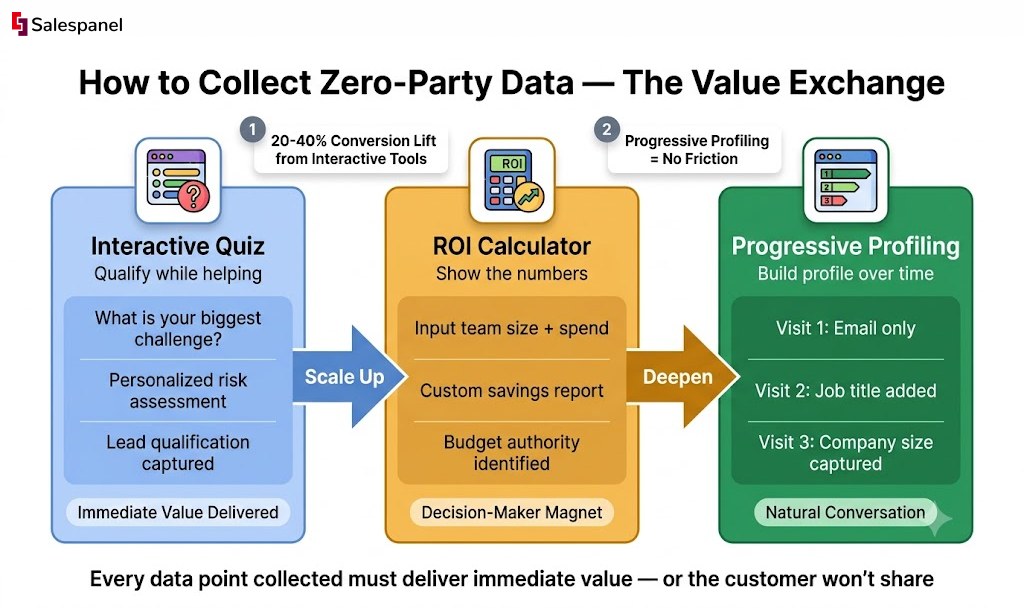
This approach reframes data collection from a one-sided corporate demand into a collaborative, two-way dialogue. Instead of relying on static forms, the objective is to create engaging experiences that deliver instant utility, making the process feel helpful rather than invasive.
Implement Interactive and Engaging Methods
To execute this effectively, marketers must move beyond basic “Contact Us” forms. Interactive tools not only make data collection more engaging but also provide immediate value, solidifying the value exchange and converting passive visitors into active participants.
Here are high-impact B2B strategies with practical examples:
- Interactive Quizzes: A cybersecurity firm could deploy a “What’s Your Biggest Security Vulnerability?” quiz. By asking targeted questions about current protocols, team size, and industry, the firm can collect valuable qualifying data while providing the user with a personalized risk assessment and service recommendation.
- Product Configurators and Calculators: A SaaS company can offer an ROI calculator. A prospect inputs variables like team size, current software expenditure, and efficiency goals. The tool processes this data to provide a customized report on potential cost savings, simultaneously capturing key lead qualification metrics.
- Multi-Step Forms: Instead of a long, intimidating form, break the data collection process into smaller, logical steps. This reduces cognitive load and allows for the capture of high-intent data early. For instance, Step 1 could ask, “What is your primary business challenge?” and Step 2 could ask, “Which integrations are mission-critical for your team?”
These methods are not just data-gathering tools; they are real-time lead qualification mechanisms. Upon completion, you possess a rich, contextual profile of a prospect’s specific needs and intentions.
Focus on Progressive Profiling
It is not necessary to collect all information at once. Progressive profiling is the technical practice of gathering data incrementally across multiple user interactions. This approach respects the user’s time and builds trust gradually.
A customer’s first visit might only require an email for a newsletter. On their second visit, you could ask for their job title to tailor content. This gradual approach makes data collection feel like a natural conversation rather than an interrogation.
For example, a first-time blog visitor might provide an email to download an ebook. On a subsequent visit, a pop-up could ask for their company size to unlock a more advanced industry report. This layered approach enriches the user profile over time without feeling intrusive. This philosophy of building a complete picture, where declared insights are combined with behavioral data, is central to effective lead nurturing. Tools like Website visitor tracking from Salespanel can merge these explicitly shared data points with observed on-site behavior to create a unified and powerful customer view.
Putting Your Zero-Party Data to Work
The collection of zero-party data is only the first stage. The true ROI is realized when this data is activated within your marketing and sales technology stack. Integrating this voluntarily-provided customer information enables the creation of hyper-personalized journeys that drive conversions and foster loyalty.
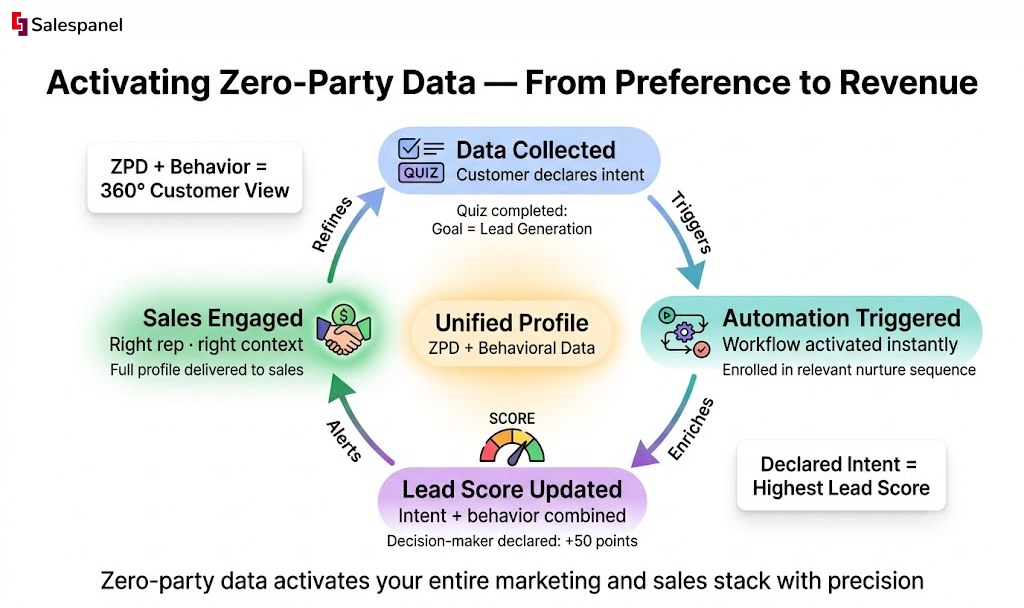
As a practical example, imagine a prospect completes an on-site quiz and identifies their primary challenge as “improving conversion rates.” This data point can trigger an automation that enrolls them in a specialized nurture sequence delivering case studies and guides focused specifically on conversion optimization. Your outreach is instantly transformed from a generic broadcast into a relevant, one-to-one consultation.
Creating a Unified Customer View
The full potential of zero-party data is unlocked when it is integrated with other data sets, particularly first-party behavioral data. By blending what prospects explicitly tell you with what their actions show you, you construct a comprehensive, 360-degree profile of each individual. This unified view transforms anonymous visitors into known contacts with clearly defined needs and behavioral patterns. For instance, Website visitor tracking from Salespanel can correlate a visitor’s on-site behavior—such as viewing a pricing page—with the zero-party data they provided in a form, creating a rich, multi-dimensional lead profile.
When you combine what someone says they want with what their actions show they want, you close the gaps in your understanding. This holistic view is the bedrock of sharp, effective marketing and sales alignment.
Prioritizing Leads with Precision
This unified data is a significant force multiplier for sales teams. When integrated into a lead scoring system, zero-party data allows for highly accurate lead prioritization.
Consider this technical scoring model:
- A lead visits key product pages: +10 points.
- The lead also downloads a whitepaper: +15 points.
- The lead then self-identifies in a form as a “decision-maker” with “budget authority”: +50 points.
This is precisely how a sophisticated lead scoring system operates. At Salespanel, we believe in this philosophy, and Salespanel’s lead scoring framework is designed to help you assign higher scores to leads who not only demonstrate behavioral interest but also explicitly declare their buying intent and authority. This enables your sales team to focus their efforts on prospects with the highest probability of converting, directly improving sales cycle efficiency and closure rates. To scale this effectively, it’s beneficial to integrate with various email outreach tools that can leverage this rich data.
Building Trust in a Privacy-First World
Adopting a zero-party data strategy represents a fundamental philosophical shift from data extraction to data collaboration. In the contemporary digital environment where privacy is paramount, trust is the most valuable corporate asset. The era of inferring customer needs is being replaced by an era of direct, transparent dialogue.
By transparently requesting information and using it to deliver demonstrable value, you cultivate a loyal customer base. This approach builds relationships founded on mutual respect, transforming data collection from a covert process into a positive and collaborative interaction. Upholding transparent privacy considerations is no longer just a best practice; it is essential for maintaining brand integrity as consumer data literacy grows.
The Path to Sustainable Growth
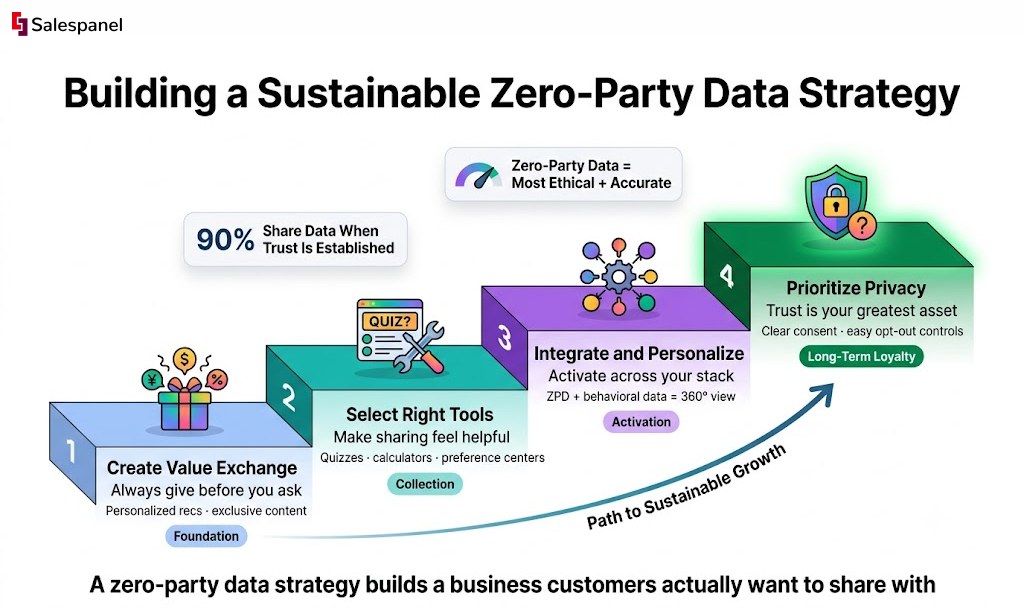
The successful implementation of a zero-party data strategy is the key to building a sustainable, ethical, and high-performance marketing engine. The strategy requires a committed, methodical approach:
- Create a Clear Value Exchange: Never ask for data without offering something tangible in return, such as personalized recommendations, exclusive content, or a streamlined user experience.
- Select Appropriate Tools: Employ engaging collection methods like interactive quizzes, calculators, and progressive profiling to make the experience feel helpful, not intrusive.
- Integrate and Personalize: Synthesize zero-party data with behavioral insights to create a unified customer profile, enabling hyper-relevant experiences at every touchpoint. Leveraging identity resolution is key to connecting these data streams seamlessly.
- Prioritize Customer Privacy: Be explicit about data usage and provide simple, accessible controls for customers to manage their preferences and consent.
The ultimate takeaway is that the future of marketing does not lie in inventing new surveillance techniques. It lies in providing compelling reasons for customers to tell you what they need directly. A zero-party data mindset not only prepares your business for a post-cookie world but also builds a more trusted, resilient, and effective organization.
Frequently Asked Questions
Migrating to a zero-party data strategy is a sound strategic decision, but it often raises technical and practical questions. Here are answers to some of the most common inquiries.
Is Zero-Party Data Compliant with GDPR and CCPA?
Yes, absolutely. Zero-party data is inherently the most compliant form of data under privacy regulations like GDPR and CCPA. Because the user is explicitly and voluntarily providing their information with clear intent, the collection method aligns perfectly with the core principle of informed consent that underpins these laws.
The process is transparent by design. The user understands they are sharing data and what they will receive in return. To maintain compliance, it is critical to remain transparent about data usage and provide easily accessible mechanisms for users to modify or revoke their consent.
How Is Zero-Party Data Different from Survey Data?
This is a key distinction. While a survey is one possible tool for collecting zero-party data, the two concepts are not interchangeable.
Survey data is typically collected for the company’s benefit, such as for market research or customer feedback. Zero-party data, by definition, is information a customer intentionally shares to directly enhance their own experience with the brand.
The collection mechanism could be an interactive quiz, a product configurator, or a preference center. The defining characteristic is not the tool but the customer’s proactive intent to receive a more personalized and valuable journey.
How Can I Convince Customers to Share Their Data?
The motivation for customers to share data is rooted in a clear and compelling value exchange. The key is to demonstrate the immediate, tangible benefit they will receive for providing their information.
This “value” can be delivered in several forms:
- Personalized Recommendations: “Tell us your biggest challenge, and we’ll show you the exact solution.”
- More Relevant Content: “Which topics interest you most? We’ll send you guides that actually help.”
- Exclusive Offers: “Let us know your role, and we’ll send you a discount tailored for your team.”
- A Smoother Experience: Customizing what they see on your site to match their stated needs.
When this reciprocal relationship is built on a foundation of trust, you are not merely collecting data points; you are building a durable customer relationship.
Ready to build a complete customer picture with unified data? At Salespanel, we help you combine behavioral insights with zero-party data to identify and prioritize your best leads with precision. Explore our resources to learn more.