
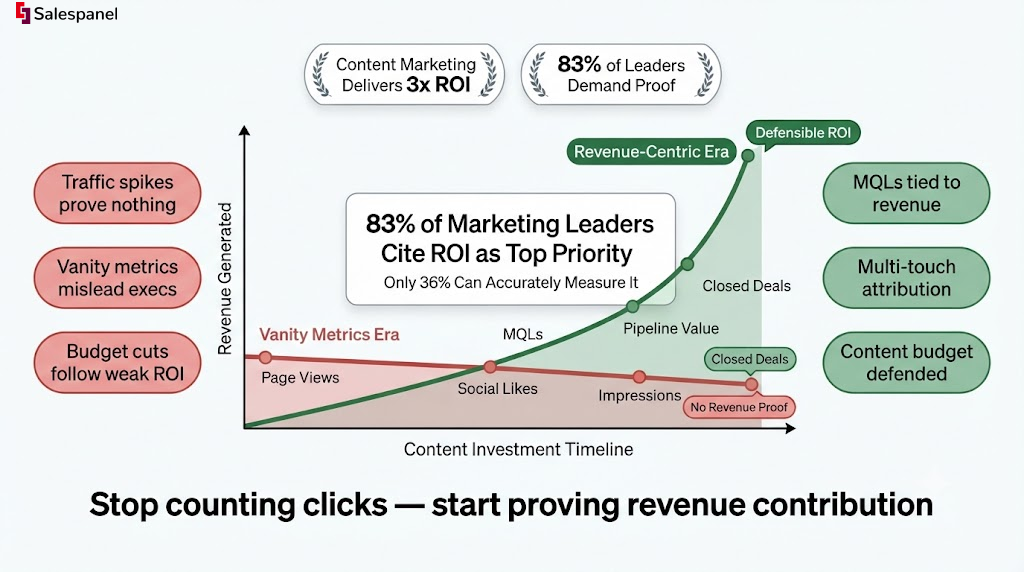
In the past, content marketing’s success was measured in page views and social shares—metrics that felt good but rarely tied directly to revenue. Today, that model is obsolete. The C-suite now demands cold, hard proof of financial return, scrutinizing content budgets with the same rigor as product development. This shift isn’t a trend; it’s the future. In fact, a staggering 83% of marketing leaders now cite demonstrating ROI as their top priority. The challenge? Only about 36% feel they can accurately measure it. This guide provides a technical, journalistic framework to bridge that gap, drawing a straight line from every piece of content directly to business growth and equipping you with a defensible case for your budget.
Why Proving Content ROI Became a B2B Imperative
The conversation surrounding content marketing has fundamentally changed. It is no longer a “nice-to-have” peripheral for brand awareness; it is now a core component of the revenue engine, expected to perform and be accountable. Executives require a clear, data-driven narrative explaining how a blog post, whitepaper, or webinar translated into a closed deal or improved customer retention. This is the new operational reality for B2B marketers: content must be a quantifiable contributor, not just an abstract brand-building tool.
Establishing a clear content marketing return on investment is no longer optional. It is the mechanism by which you secure budget, validate your team’s strategic value, and inform future resource allocation. The era of justifying efforts with a temporary traffic spike has definitively ended.
The Expectation vs. Reality Gap
This new reality has created a significant operational challenge. While demonstrating ROI has ascended to the top of the priority list for marketers globally, a substantial capability gap persists. With 83% of marketing leaders focused on ROI, the fact that only ~36% of teams feel confident in their ability to measure it accurately highlights a critical disconnect between executive expectation and analytical execution. For a deeper dive into these numbers, you can read the full research about marketing measurement priorities.
This measurement struggle exists despite clear evidence of content’s profound impact. Analysis of marketing channels consistently shows that email and SEO—both heavily reliant on strong content—deliver exceptional returns. This proven potential is why organizations continue to invest heavily in content-driven strategies, even while grappling with the complexities of attribution.
From Vanity Metrics to Revenue Contribution
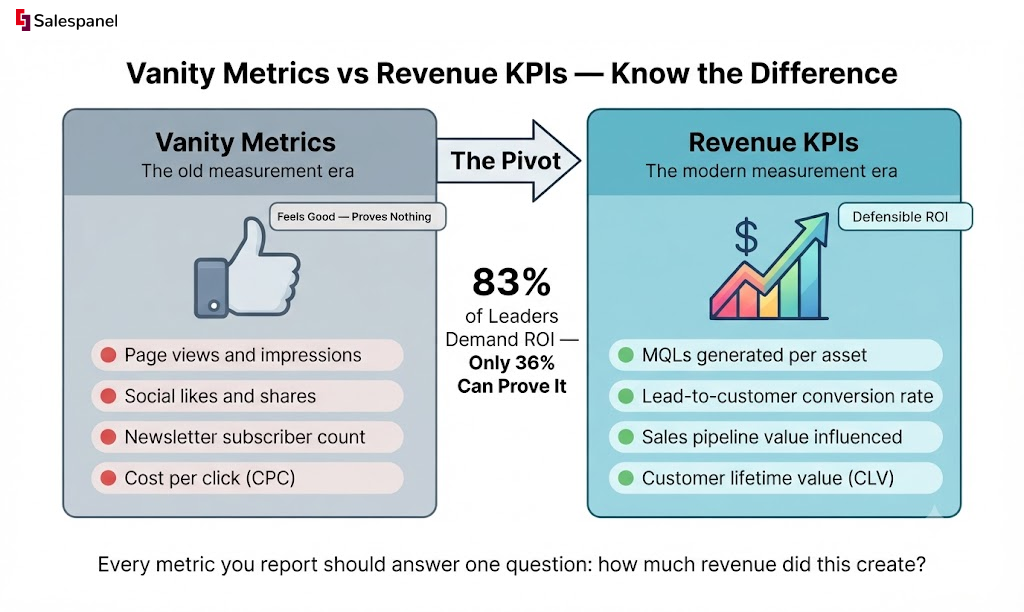
The central theme of this evolution is a strategic pivot from superficial engagement metrics to key performance indicators (KPIs) that directly impact the bottom line. It requires drawing a clear distinction between the vanity metrics of the past and the revenue-centric KPIs that define success today. This is not merely a change in reporting; it’s a change in philosophy.
This evolution is about transitioning from counting clicks and likes to measuring tangible financial impact. The table below illustrates this critical shift in measurement priorities.
The Shift in Content Marketing Measurement
| Metric Category | Traditional Approach (The Past) | Modern Approach (The Future) |
|---|---|---|
| Audience Engagement | Page Views, Social Likes, Time on Page | MQLs Generated, Lead Score Increases |
| Lead Generation | Total Form Fills, Newsletter Subscribers | Lead-to-Customer Conversion Rate |
| Sales Impact | Vague “Brand Awareness” Claims | Sales Pipeline Value Influenced by Content |
| Financial Value | Cost Per Click (CPC), Cost Per Lead (CPL) | Customer Lifetime Value (CLV), Revenue per Asset |
The focus has unequivocally moved from counting audience volume to quantifying financial value. It is a more demanding but infinitely more valuable operational standard. This guide is designed to provide the frameworks, tools, and workflows necessary to close the measurement gap. We will move beyond theory to present an actionable plan for calculating, proving, and ultimately increasing your content marketing’s financial contribution.
Building Your B2B Content ROI Calculation Framework
Anyone can plug figures into the standard ROI formula: (Return – Investment) / Investment * 100. The complexity in B2B content marketing lies not in the arithmetic, but in the precise definition and quantification of “Return” and “Investment.” The challenge is compounded by long sales cycles and multi-stakeholder decision-making processes, where a single content asset rarely triggers an immediate sale. Therefore, the central theme we must pursue is the creation of a robust financial model that methodically connects every dollar of investment to a tangible business outcome.
Deconstructing Your Total Investment
A credible ROI calculation begins with a comprehensive accounting of all costs. “Investment” extends far beyond a freelance writer’s invoice or a specific ad campaign’s budget. A complete picture requires cataloging every resource allocated to the content program.
Your total investment must account for:
- Content Production Costs: This includes the direct costs of creation—salaries or fees for writers, designers, videographers, and strategists. Critically, it must also include the prorated salaries of any team members who contribute to the content process, even for a fraction of their time. For example, if a product manager spends 10% of their time reviewing technical articles, that portion of their salary is a content investment.
- Distribution and Promotion Spend: This category encompasses all expenditures made to amplify content reach. This includes paid social advertising, search engine marketing (SEM) budgets, influencer collaboration fees, and subscriptions to content distribution platforms.
- Software and Tool Licenses: Sum the monthly or annual costs for the entire technology stack that underpins your content operations. This includes marketing automation platforms, SEO tools like Ahrefs or Semrush, analytics software, and the Content Management System (CMS).
Accurately calculating this denominator is non-negotiable. Underestimating it leads to inflated ROI figures and a dangerously false sense of success.
Quantifying the Financial Return
This is the most critical and challenging component. Reporting website traffic or social shares as a “return” is a relic of an older, less accountable marketing era. The objective is to assign a specific dollar value to the actions your content inspires, effectively mapping the customer journey from initial engagement to closed revenue.
This progression—from views to leads to revenue—is the core principle of a sound ROI framework. To calculate this, you must prioritize metrics with a direct, demonstrable link to sales outcomes.
The most effective ROI models shift focus from what content costs to what it earns. This requires the discipline to track the entire customer journey, from the first touchpoint to the final contract, assigning financial value at each critical stage.
Here are the return metrics that truly matter:
- Lead Value: Calculate the average value of a lead generated by a specific content asset. Practical example: A whitepaper generates 100 leads. Historical data shows that leads from this channel convert to customers at a rate of 5%, and the average customer lifetime value is $20,000. The value of each lead from that whitepaper is therefore $1,000 (5% of $20,000), and the total return from that asset is $100,000.
- Customer Lifetime Value (CLV): Segment your customer base to compare the CLV of customers who engaged with content versus those who did not. A demonstrably higher CLV in the content-engaged cohort is a powerful indicator of long-term return.
- Sales Pipeline Influence: Utilize attribution software to quantify the value of the sales pipeline that has been “touched” by your content. By assigning a percentage of this pipeline value to content’s influence, you create a direct link to potential revenue.
By meticulously tracking both the investment and return sides of this equation, your content ROI calculation transforms from a speculative estimate into a credible, data-backed metric that commands executive attention.
Choosing Metrics and Attribution Models That Matter
To accurately measure your content marketing ROI, two technical components are essential: tracking the correct KPIs and implementing an appropriate attribution model. Failure in either of these areas renders your analysis inconclusive. You might be busy, but you will be unable to connect your team’s labor to tangible business results. The central theme here is moving beyond vanity metrics to adopt a measurement framework that speaks the language of the C-suite: revenue.
Metrics That Directly Influence Revenue
Your reporting must zero in on KPIs that signify meaningful progress through the buyer’s journey. Each metric should tell a piece of the financial story, demonstrating how content transforms anonymous visitors into qualified sales opportunities and, eventually, customers.
Prioritize these core metrics:
- Marketing Qualified Leads (MQLs) Generated: This is not merely a count of form submissions. It is the number of leads generated from a specific content asset (e.g., a webinar) that meet the predefined criteria for sales-readiness. Practical example: Tracking MQLs from a technical whitepaper on “API Security” provides a direct signal that the content is attracting a high-quality, relevant audience.
- Lead-to-Customer Conversion Rates: This metric measures the percentage of MQLs from a content source that ultimately become paying customers. A high conversion rate indicates that your content is not just attracting leads, but attracting leads with high purchase intent.
- Pipeline Value Influenced by Content: This is a crucial metric for demonstrating strategic impact. It calculates the total dollar value of all sales opportunities that interacted with a piece of content at any stage. This proves that content is not just a top-of-funnel tool but a critical asset for nurturing deals throughout a complex sales cycle.
Shifting focus to these KPIs changes the entire conversation from “How many people saw our content?” to “How much sales pipeline did our content help create?”
Demystifying B2B Attribution Models
With the right metrics identified, the next challenge is assigning credit. The B2B customer journey is rarely linear; it is a complex web of interactions occurring across multiple channels and over extended periods. Attribution models provide the technical framework for distributing credit for a conversion among these various touchpoints.
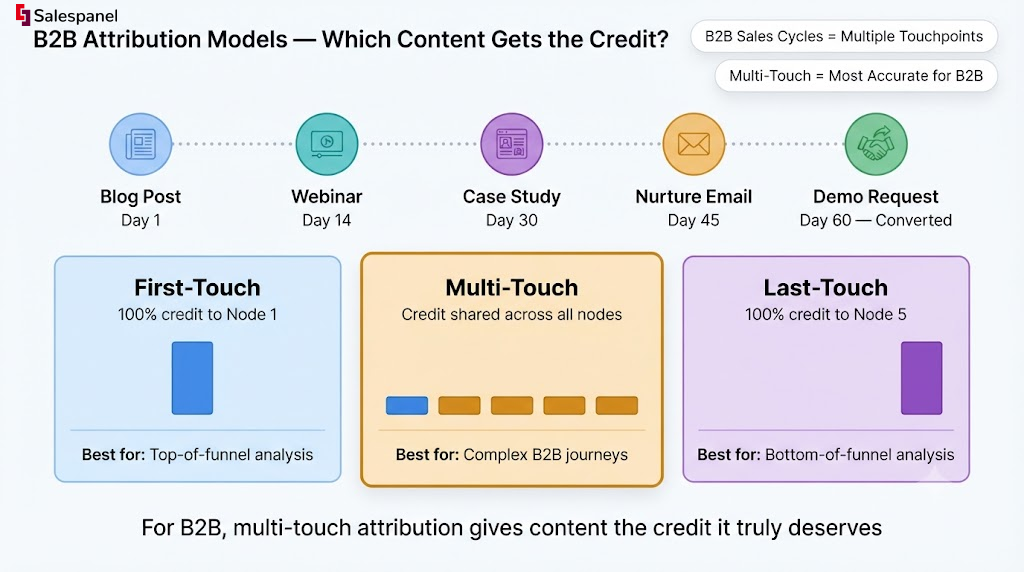
The choice of attribution model directly impacts which marketing activities receive credit for a sale, thereby fundamentally shaping your ROI calculations and future strategic decisions.
Choosing an attribution model is a strategic, not just a technical, decision. The model you select will dictate which content formats you prioritize, which distribution channels receive investment, and how your entire marketing organization defines success.
Here’s a breakdown of the primary models:
- First-Touch Attribution: Assigns 100% of the credit to the first interaction a lead had with your brand. Practical use case: Ideal for identifying which top-of-funnel content (e.g., blog posts, infographics) is most effective at generating net-new audience engagement.
- Last-Touch Attribution: Assigns 100% of the credit to the final touchpoint before conversion. Practical use case: Useful for identifying high-converting, bottom-of-funnel content like case studies or demo request pages that effectively “close” the marketing journey.
- Multi-Touch Attribution: Distributes credit across multiple touchpoints, providing the most realistic view for complex B2B sales. Variations include the Linear model (equal credit to all touches) and the Time-Decay model (more credit to recent interactions). This approach acknowledges the cumulative impact of content over time.
For any B2B organization with a sales cycle exceeding a few days, a multi-touch model is almost always the superior choice. It properly credits the entire sequence of content—from the initial awareness-stage blog post to the final consideration-stage case study—providing the most accurate and defensible measure of content’s total contribution to revenue.
Your Modern Data Stack for Accurate ROI Tracking
Calculating a precise content marketing return on investment is contingent upon the quality of the underlying data. Traditional data collection methods are becoming increasingly unreliable due to privacy regulations and the deprecation of third-party cookies. To succeed, B2B marketers must transition to a model built on first-party data ownership. The central theme is building a resilient data infrastructure that ensures accuracy and completeness.
This necessitates a shift away from client-side tracking, which is vulnerable to ad blockers and browser privacy settings, toward more robust technologies like server-side tagging. Server-side tagging processes tracking information on a secure server before forwarding it to analytics platforms. This creates a more reliable data pipeline, ensuring that the data you analyze accurately reflects user behavior.
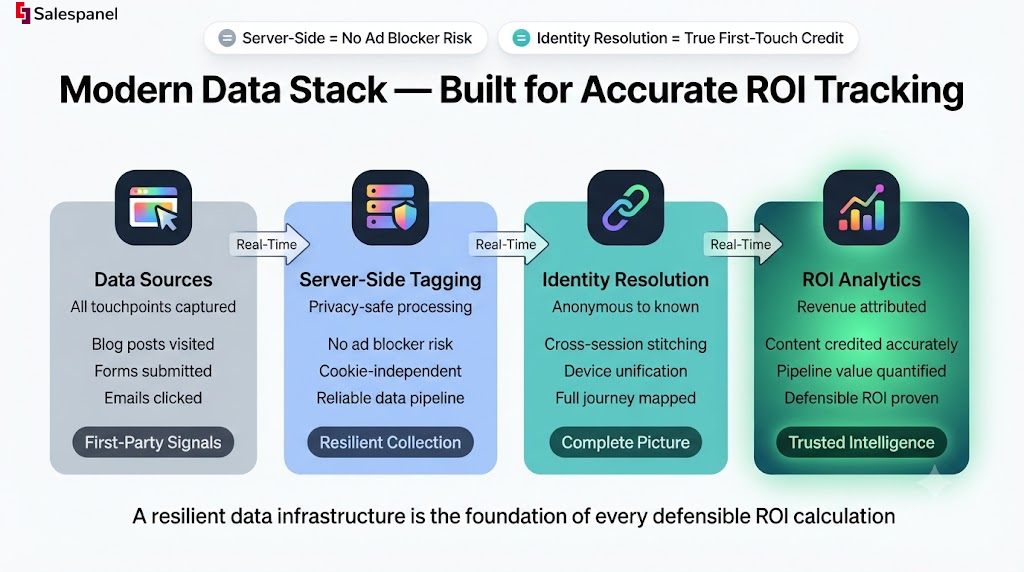
This modern architecture is designed to maximize the accuracy and completeness of the data used for ROI calculations, providing a foundation of trust for your marketing performance analysis.
The Cornerstone of B2B ROI: Identity Resolution
Identity resolution is the most critical component of this modern data stack. Consider a typical B2B prospect who interacts with multiple content assets—blog posts, case studies, webinars—anonymously over several months and from different devices before finally submitting a form. The technical challenge is to connect all of those preceding anonymous touchpoints to the single identified individual.
Without this capability, attribution is fundamentally flawed. You will incorrectly assign all credit to the final “Request a Demo” form fill, completely overlooking the crucial content that nurtured the prospect for months. This is a primary reason why many marketers fail to prove content’s true strategic value.
Effective identity resolution transforms your analytics from a series of disconnected events into a coherent narrative of the entire customer journey. It’s the technology that finally allows you to give credit to the content that truly influenced a buying decision, not just the content that captured a name.
This process involves stitching together a user’s cross-session activity, linking their anonymous digital footprint to a unified profile the moment they provide an identifier like an email address.
Mapping the Full Journey with Visitor Tracking
This is where specialized tools become essential. For example, Website visitor tracking from Salespanel functions as the engine for identity resolution. It works in the background to identify visiting companies, even before a form fill, and meticulously tracks their on-site behavior. When a visitor eventually converts, the platform automatically links their entire anonymous browsing history to their newly created contact profile.
This capability fundamentally alters the approach to ROI tracking:
- Complete Journey Mapping: You gain a full, chronological record of a lead’s journey, from their first anonymous visit to their final pre-conversion action. Every content asset they engaged with is recorded and factored into attribution.
- Accurate First-Touch Attribution: You can identify the true first touch—often a top-of-funnel blog post discovered via organic search that traditional analytics would have missed.
- Enriched Lead Profiles: The pre-conversion behavioral data enriches the lead’s profile, providing the sales team with immediate, actionable context on their specific interests and pain points.
By implementing such a system, you are not merely collecting data; you are building an intelligence layer. This ensures every blog post, whitepaper, and case study receives the credit it deserves, enabling a far more accurate and defensible calculation of your content marketing return on investment.
A Practical Workflow for Measuring and Improving ROI
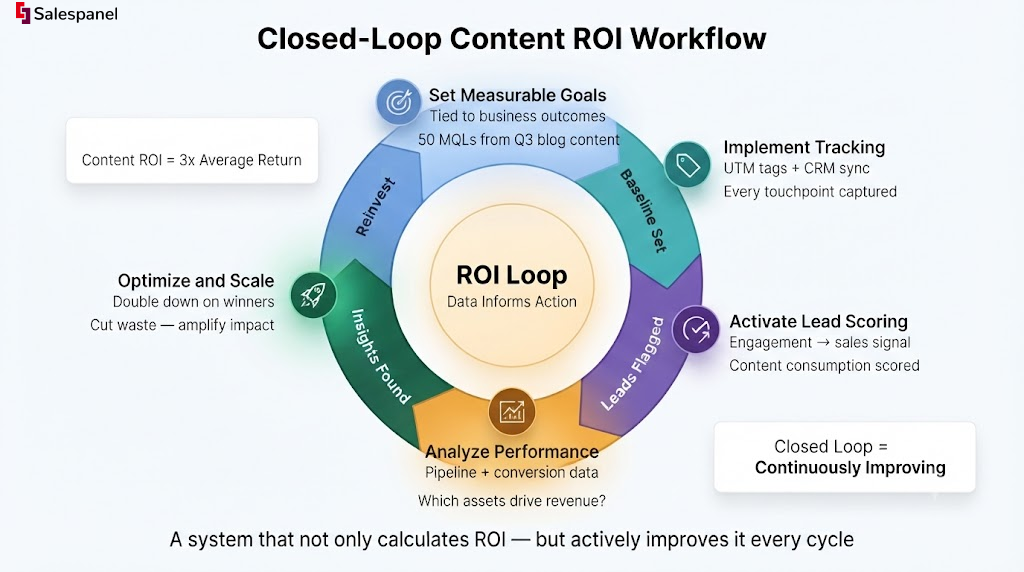
Theoretical frameworks and data stacks are only valuable when put into practice through a clear, repeatable workflow. The transition from abstract concepts to tangible results requires a disciplined process that connects content creation directly to sales outcomes. This is how you move from estimating value to proving it. The central theme of this workflow is the creation of a closed-loop system where data informs action.
The process begins not with tracking, but with specific, measurable objectives. Vague goals like “increase traffic” are insufficient. An effective goal must be tied to a business outcome. Practical example: A clear, actionable goal is: “Generate 50 new Marketing Qualified Leads (MQLs) from our Q3 blog content, with a target lead-to-customer conversion rate of 5%.” This establishes a clear benchmark for success.
Implementing Your Tracking Framework
With a goal established, the next step is to ensure every interaction is captured with precision. This relies heavily on meticulous UTM parameter implementation across all promotional channels. A consistent UTM structure is foundational; it allows for granular segmentation in your analytics, revealing exactly which campaigns, channels, and content assets are driving conversions.
Your tracking framework must include these non-negotiables:
- UTM Tagging Discipline: The entire team must adhere to a strict naming convention for utm_source, utm_medium, and utm_campaign. This prevents data fragmentation and ensures clean, reliable reporting.
- Conversion Goal Setup: Clearly define conversion events within your analytics and marketing automation platforms. This could range from a newsletter subscription (a micro-conversion) to a demo request (a macro-conversion).
- CRM Integration: This is the critical link. Ensure that when a lead is created, the original UTM source data is passed directly into your CRM. This allows you to trace a closed-won deal all the way back to the initial marketing touchpoint.
A key part of improving ROI is optimizing the content itself to drive action. It is essential to explore data-driven conversion rate optimisation strategies to maximize the value of your existing traffic.
Activating Data Within the Sales Process
Data collection is only half the process; the data must be activated to drive improvement. This involves bridging the gap between marketing analytics and daily sales operations. Lead scoring is a powerful mechanism for this. It quantifies a prospect’s engagement and signals their sales-readiness.
For instance, the lead scoring framework in Salespanel allows you to assign points based on content consumption and other high-intent behaviors. Practical example: A prospect who reads three articles on “enterprise security” and then downloads a related case study can have their lead score automatically increased. Once a predefined threshold is met, they are flagged as a hot lead and routed to the sales team. This workflow transforms passive content engagement into an active sales signal.
This integration does more than just prove value—it makes the sales team more efficient. By handing them leads who have already educated themselves with your content, sales can jump into more relevant, timely conversations. That directly impacts conversion rates and helps shorten the sales cycle.
This structured workflow creates a powerful feedback loop. You can analyze which content assets contribute to the highest lead scores and, ultimately, to closed deals. This data tells you precisely what is working, allowing you to double down on effective strategies. It’s a system that not only calculates ROI but actively helps you improve your content marketing return on investment.
Industry surveys often find that content marketing brings in about $3 for every $1 invested, mostly because of the compounding value of organic search. To get a more detailed breakdown, you can discover more insights about content ROI statistics. You can also discover new channels for content distribution with our guide on email outreach tools.
Common Pitfalls in ROI Measurement and How to Avoid Them
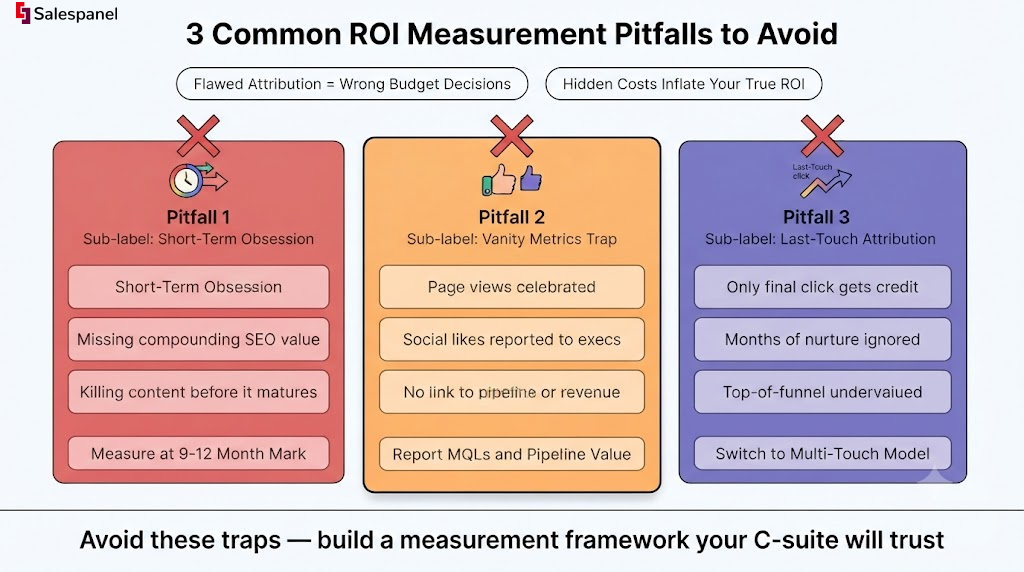
Even with a modern data stack and sound methodology, calculating an accurate content marketing return on investment is fraught with potential errors. Several common pitfalls can skew your data, leading to flawed conclusions and misguided strategies. The central theme here is maintaining analytical rigor by being aware of these traps and actively avoiding them.
A primary mistake is the obsession with short-term results. The pressure to demonstrate immediate impact often leads marketers to undervalue content assets with long-term value. A comprehensive whitepaper or a cornerstone blog post may take six months to gain SEO traction, but its compounding value over several years can far exceed that of a short-lived social media campaign.
Mistaking Vanity for Value
Another classic error is conflating engagement metrics with business impact. Page views, social likes, and impressions are easily measured and reported, but they rarely correlate directly with revenue. A piece of content can achieve viral status, generating thousands of shares, without producing a single qualified lead. This is not business impact; it is audience noise.
The solution is to tie every content asset to a tangible business outcome. Instead of celebrating page views, track the lead-to-customer conversion rate for traffic originating from that specific article.
A truly effective ROI calculation cuts through the noise and locks onto the signals that actually predict revenue. It takes discipline to look past the flashy metrics and zero in on the data that proves you’re making a financial contribution.
The Last-Touch Attribution Trap
For B2B companies, relying on a last-touch attribution model is a critical analytical error. This model assigns 100% of the credit to the final action before conversion, such as clicking a “Request a Demo” button. It systematically ignores the months of preceding content engagement—the blog posts, webinars, and case studies—that built the necessary trust and education for that final click to occur.
This is analogous to crediting only the final goal-scorer for a championship victory, ignoring the contributions of the entire team throughout the season.
To achieve a more accurate assessment, a multi-touch attribution model is necessary. This approach distributes credit across the entire customer journey, providing a more realistic view of how different content assets collaborate to close a deal. It ensures that top-of-funnel and mid-funnel content receive appropriate credit for building the sales pipeline.
Overlooking Hidden Costs
Finally, many ROI calculations are invalidated by an incomplete accounting of investments. While direct costs like freelance invoices or ad spend are easily tracked, hidden costs are often overlooked. An honest calculation must be comprehensive.
Ensure the “investment” side of your equation includes:
- Prorated Team Salaries: The portion of salaries for the marketing team members involved in content strategy, creation, editing, and promotion.
- Software and Tool Subscriptions: The costs for your CMS, SEO tools, analytics platforms, and marketing automation software.
- Overhead Costs: A proportional allocation of general business expenses, such as office space and utilities, to the marketing department.
By actively avoiding these common pitfalls—short-term focus, vanity metrics, flawed attribution, and incomplete cost accounting—you can build a more resilient and defensible framework for measuring your content marketing return on investment. Your calculations will then evolve from mere numbers on a spreadsheet into a true reflection of your content’s strategic value to the business.
Frequently Asked Questions
Calculating the financial return of content marketing can be a complex undertaking. This section addresses some of the most common technical and strategic questions that arise when marketers begin the process of proving their content marketing return on investment.
Clarifying these points provides a solid operational roadmap, ensuring your measurement plan is not only accurate but also grounded in business reality.
How Long Does It Take to See a Positive Content Marketing ROI?
The answer is that content marketing is a long-term investment, not a short-term tactic. Unlike paid advertising, which can generate immediate results, the primary value of content marketing is derived from its compounding effect over time, driven largely by organic search.
As a general guideline, initial positive signals may appear within 3 to 6 months. However, a substantial, measurable financial return often takes 9 to 12 months or longer to materialize, particularly for strategies focused on SEO.
Patience is a strategic asset in content marketing. A single, well-optimized evergreen article can continue to generate leads and revenue for years, delivering a compounding return that is impossible to achieve with short-term campaigns.
What Is a Good ROI for B2B Content Marketing?
While industry and business models cause significant variation, a frequently cited benchmark suggests that content marketing can deliver an average return of approximately $3 for every $1 invested. However, a “good” ROI is one that outperforms your other marketing channels and contributes effectively to your overall business objectives.
The most practical approach is to establish an internal benchmark based on your own data. If your paid search campaigns yield a 2:1 return, and your content program achieves a 3:1 return over a 12-month period, that represents a clear success. The goal is to continuously improve upon this internal benchmark.
How Do You Measure the ROI of Different Content Types?
Different content formats serve different strategic purposes within the sales funnel, and their ROI should be measured accordingly. A one-size-fits-all approach is ineffective.
- Top-of-Funnel (e.g., Blog Posts): The primary objective is audience attraction and initial engagement. Measure their success using metrics like MQLs generated and pipeline influence. Practical measurement: Track how many new contacts originated from a blog post and subsequently entered the sales pipeline within a specific timeframe.
- Bottom-of-Funnel (e.g., Case Studies, Webinars): These assets are designed to facilitate conversion. Their ROI is more direct. Measure the lead-to-customer conversion rate for prospects who engaged with these assets. You can often draw a direct line from a webinar attendee to a closed-won deal, making for a clean ROI calculation.
By aligning your measurement methodology with the strategic purpose of the content, you can develop a much more nuanced and accurate understanding of how each asset contributes to the bottom line.
Ready to build a data stack that proves your content’s true value? Salespanel provides the identity resolution and visitor tracking needed for accurate ROI calculations. Explore our resources to learn how to connect every content touchpoint directly to revenue.