In the not-so-distant past, the primary goal of email marketing was simply to get the message out. Volume was king, and open rates were the celebrated metric. Today, that model is fundamentally broken. The digital landscape has evolved into a sophisticated ecosystem where inbox providers like Gmail and Microsoft act as discerning gatekeepers, scrutinizing every sender’s identity and intent. This shift from a “send and hope” past to a “trust and verify” future makes mastering email deliverability the most critical, non-negotiable pillar of modern digital communication.
The stakes have never been higher. According to recent industry data, nearly 15-20% of legitimate marketing emails never reach the intended inbox. This isn’t just a technical glitch; it’s a direct drain on revenue and brand credibility. With customer acquisition costs steadily rising, every email that lands in spam represents wasted marketing spend and lost opportunity. Consider the volatility: in a single quarter, major providers like Amazon SES and Mailchimp managed to boost their deliverability by a massive 17.86% and 14.33% respectively, while others saw their rates decline. This proves that inbox placement is not a lottery; it is an earned outcome. Getting it right means every other marketing metric—from click-through rates to conversions—has a chance to succeed. Getting it wrong renders them worthless.
This guide provides a journalistic, in-depth framework for navigating this complex environment. We will move beyond a simple checklist to establish a central theme: that exceptional deliverability is the result of a deliberate, holistic strategy built on earning trust. We will dissect the four core pillars that define this strategy:
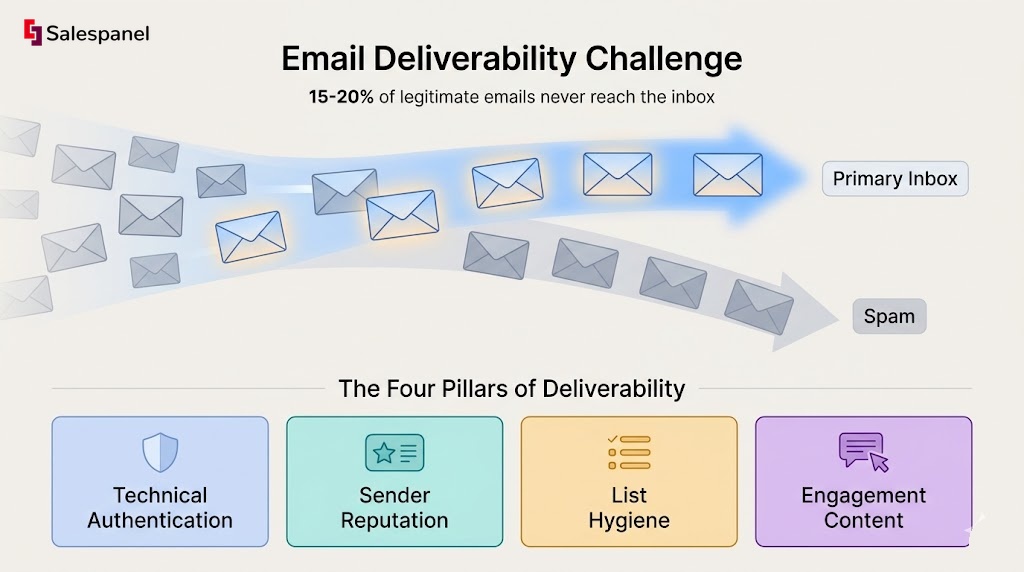
- Robust Technical Authentication: Establishing your digital identity as a legitimate, verifiable sender.
- Impeccable Sender Reputation: Building and protecting your “credit score” with inbox providers.
- Pristine List Hygiene: Ensuring you’re communicating with a clean, engaged, and consenting audience.
- Engagement-Driven Content: Crafting messages that recipients want to open and interact with.
By mastering the technical and strategic principles outlined here, you will gain a clear, actionable plan to build a trusted sending program, ensuring your messages are not just sent, but seen and acted upon. The central takeaway for every reader is this: your goal is to transition from a sender that asks for attention to one that has earned it.
Secure Your Technical Foundation
Before a single word of copy is written, the technical infrastructure of your email program must be flawless. This is the non-negotiable bedrock upon which all successful deliverability is built. Without it, even the most compelling message is destined for the spam folder. This is the harsh, binary reality of modern email security.
Think of email authentication as your domain’s digital passport. When you cross a border, officials check your passport to confirm your identity. Inbox providers perform an identical function, scrutinizing every incoming email for authentication records to verify the sender is who they claim to be. An email arriving without proper authentication is like a traveler with no ID—instantly suspicious and almost certain to be denied entry. These protocols are not optional best practices; they are the baseline requirement for being recognized as a legitimate sender.
Demystifying the Core Authentication Protocols
The email ecosystem relies on three core protocols working in concert: SPF, DKIM, and DMARC. Each plays a distinct role in verifying your identity and protecting your brand from being used in phishing or spoofing attacks. Understanding their function is critical.
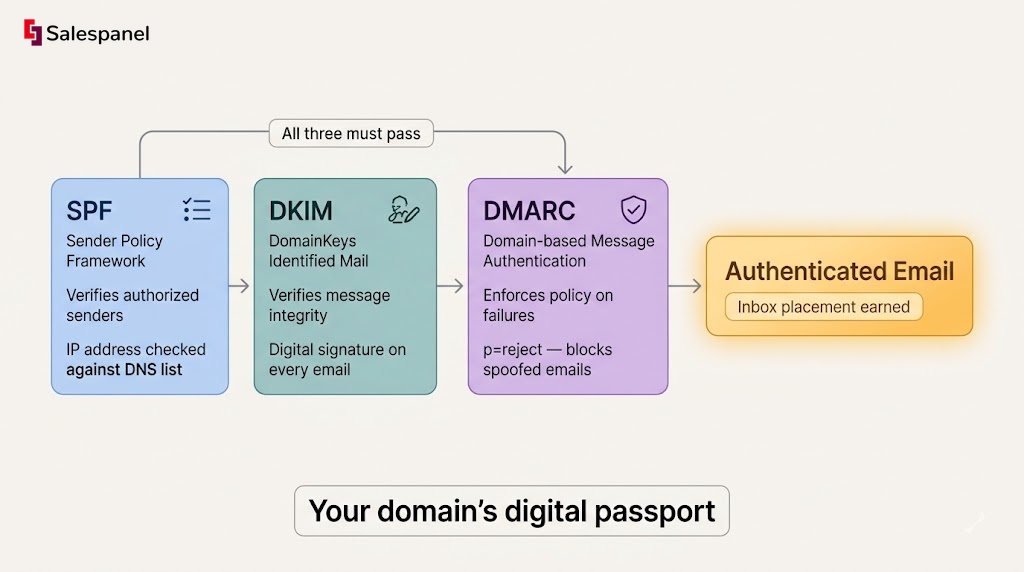
Let’s break down what each one actually does, providing a practical example for each.
Sender Policy Framework (SPF): This is the foundational layer. An SPF record is a public list, published in your DNS, of all the IP addresses and third-party services authorized to send email on behalf of your domain.
Practical Example: When an email from yourcompany.com arrives, the recipient’s server queries the SPF record for yourcompany.com. If the email was sent from an IP address listed in that record, it passes the check. If it comes from an unauthorized server, it fails, flagging it as potentially fraudulent.
DomainKeys Identified Mail (DKIM): Where SPF verifies the sender, DKIM verifies the message. It attaches a unique, encrypted digital signature to the email’s header, acting as a tamper-proof seal.
Practical Example: The receiving server uses a public key (published in your DNS) to decrypt and validate this signature. If the signature is valid, it proves two things: the email genuinely originated from your domain and its content has not been altered in transit.
Domain-based Message Authentication, Reporting, and Conformance (DMARC): This protocol acts as the enforcer, tying SPF and DKIM together. A DMARC record instructs receiving servers on how to handle emails that fail either SPF or DKIM checks. You can set a policy to do nothing (p=none), send it to spam (p=quarantine), or reject it outright (p=reject).
Practical Example: With a policy of p=reject, if a phisher tries to spoof your domain from an unauthorized server (failing SPF) without a valid signature (failing DKIM), the DMARC policy tells Gmail or Outlook to block the email completely, preventing it from ever reaching the user’s inbox.
Putting Authentication into Practice
Let’s examine a real-world scenario. A B2B SaaS company, “InnovateTech,” uses a third-party marketing platform to send its monthly newsletter. Without authentication, these emails appear suspicious to receiving servers because they originate from IPs not associated with InnovateTech’s own domain.
To resolve this, InnovateTech’s IT team implements the three protocols:
- SPF: They add a simple TXT record to their DNS, including the marketing platform’s sending domain (e.g., include:sendgrid.net). This gives the platform official permission to send on their behalf.
- DKIM: They configure the platform to attach its unique digital signature to every outgoing newsletter, proving the message’s integrity.
- DMARC: They publish a DMARC record with a policy of p=reject. Now, if a scammer tries to impersonate InnovateTech with a fake invoice from an unverified server, the email fails authentication, and the DMARC policy instructs receiving servers to reject it.
This technical setup does more than just stop fraud; it actively builds trust. By implementing these protocols, InnovateTech sends a powerful signal to all inbox providers that they are a responsible, security-conscious sender, which directly improves their chances of landing in the primary inbox. This is the first, essential step in earning deliverability.
Build an Unbreakable Sender Reputation
Your sender reputation is, for all intents and purposes, the credit score of your email program. It’s a simple but powerful analogy: a high score grants you preferred access directly to the inbox, while a low score flags you as a risk and results in your messages being relegated to the spam folder. This is not an abstract concept; Internet Service Providers (ISPs) like Gmail and Yahoo are actively calculating this score by tracking hundreds of signals associated with your sending domain and IP address.
This score is the ultimate arbiter of whether your messages get seen or buried. Let’s move past theory and examine the practical actions that either construct or dismantle this critical asset. Our central theme of earning trust is most evident here, as every email sent is a transaction that either builds or erodes your reputational capital.
The Anatomy of Your Sending Score
A sender’s reputation is a composite score, assembled from behavioral data over time. One of the most significant red flags for ISPs is erratic sending volume. Sending 1,000 emails one day and 100,000 the next is characteristic of a spammer who has just acquired a list. Consistency in volume and frequency demonstrates predictability and legitimacy.
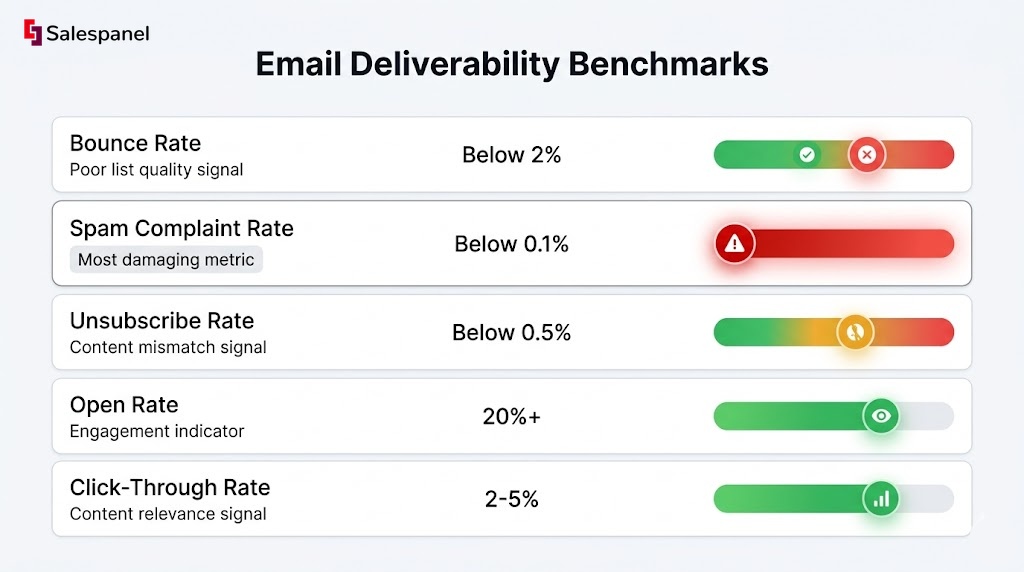
High bounce rates and spam complaints are direct torpedoes to your reputation. A hard bounce rate consistently above 2% indicates poor list hygiene to ISPs. Even more damaging is a spam complaint rate exceeding 0.1%; this is a glaring signal that your content is unwanted. According to 2026 email marketing benchmarks, maintaining these thresholds is essential for achieving an inbox placement rate of 95% or higher.
The direct impact of list hygiene on deliverability metrics is undeniable, as illustrated by the improvements seen after a thorough list cleaning.
The data clearly shows that reducing invalid addresses and bounces directly correlates with healthier open rates, validating the unbreakable link between a clean list and a strong sender reputation.
To provide a clear roadmap, here is a breakdown of the key metrics mailbox providers monitor, alongside the industry benchmarks for a healthy sending program.
Email Deliverability Metrics and Industry Benchmarks
| Metric | Industry Benchmark | Impact on Deliverability |
|---|---|---|
| Bounce Rate | Below 2% | High bounces suggest poor list quality and can damage your IP/domain reputation. |
| Spam Complaint Rate | Below 0.1% | Exceeding this is a major red flag, signaling that recipients find your emails unwanted. |
| Unsubscribe Rate | Below 0.5% | A high rate indicates a mismatch between your content and audience expectations. |
| Open Rate | 20%+ (varies by industry) | Low opens signal low engagement, which ISPs interpret as a sign of unwanted mail. |
| Click-Through Rate | 2-5% (varies by industry) | A strong CTR shows that your content is relevant and engaging to your subscribers. |
Adherence to these benchmarks is non-negotiable for maintaining long-term deliverability and demonstrates the health of your email program.
Dedicated vs. Shared IPs: A Strategic Choice
A critical decision affecting your reputation is the choice between a dedicated and a shared IP address. This choice dictates the level of control you have.
- Shared IP: You are one of several senders using the same IP address. This is a cost-effective solution, but your reputation is affected by the practices of your “neighbors.” If another company on the IP engages in spamming, your deliverability can be negatively impacted.
- Dedicated IP: You have exclusive use of an IP address. This provides complete control over your reputation but also places 100% of the responsibility for building and maintaining it on you. It is a higher-stakes approach requiring disciplined management.
For most serious B2B senders, a dedicated IP is the superior long-term strategy, as it isolates your reputation from the behavior of others. However, it comes with a critical requirement: proper IP warm-up.
Mastering the IP Warm-Up Process
Attempting to send 50,000 emails from a new IP or domain overnight is the most common and damaging mistake a sender can make. A sudden, high-volume broadcast from an unknown source is the textbook definition of spammer behavior, and ISPs will block it almost instantly.
The warm-up is a methodical, phased process for building trust. It involves gradually increasing your sending volume over several weeks, allowing you to demonstrate to ISPs that you are a legitimate sender with an engaged audience.
A strong sender reputation is not bought or inherited; it is meticulously built, message by message, through consistent, responsible sending practices. Rushing this process is the fastest way to get blacklisted.
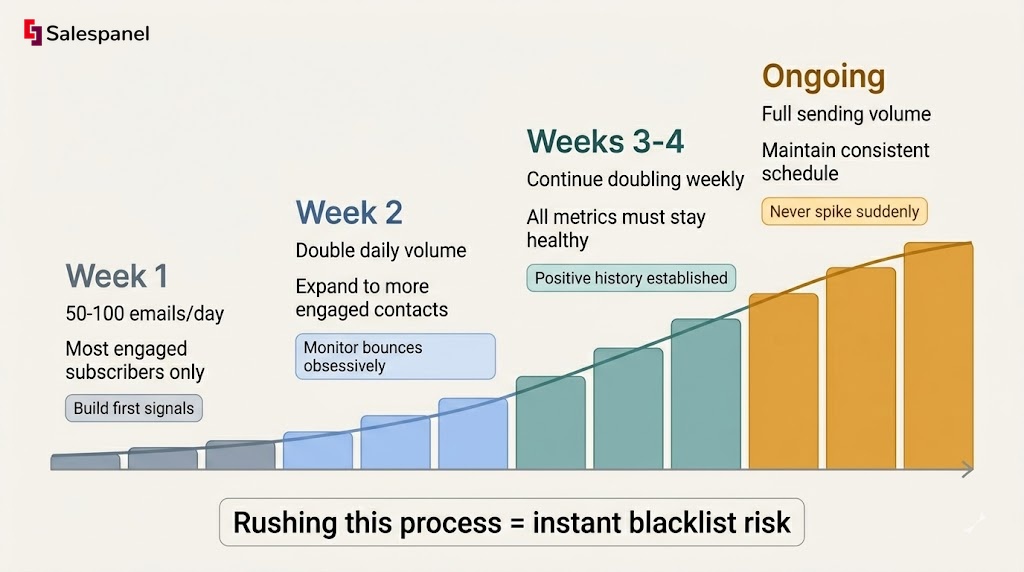
Here is a practical, phased schedule for a successful warm-up:
- Week 1: Begin with a small volume, sending no more than 50-100 emails per day exclusively to your most engaged subscribers (recent opens or clicks). The objective is to generate immediate positive engagement signals.
- Week 2: Double the daily volume, expanding the segment to include more engaged contacts. Monitor bounce and complaint rates obsessively; any spike requires an immediate reduction in volume.
- Weeks 3-4: Continue to double the volume weekly, provided all metrics remain healthy. By the end of the first month, a solid, positive sending history will be established.
- Ongoing: After the initial warm-up, consistency is paramount. Maintain a predictable sending schedule and avoid large, sudden spikes in volume.
This deliberate process demonstrates responsible behavior and effectively “teaches” ISP algorithms to associate your new domain and IP with wanted mail. For anyone serious about how to improve email deliverability, this is a non-negotiable rite of passage.
Mastering Proactive List Hygiene
Your email list is your most valuable digital asset, but its value is directly proportional to its health. Sending to invalid, dormant, or unengaged contacts actively poisons the sender reputation you have meticulously built, signaling to Internet Service Providers (ISPs) that you are a low-quality sender.
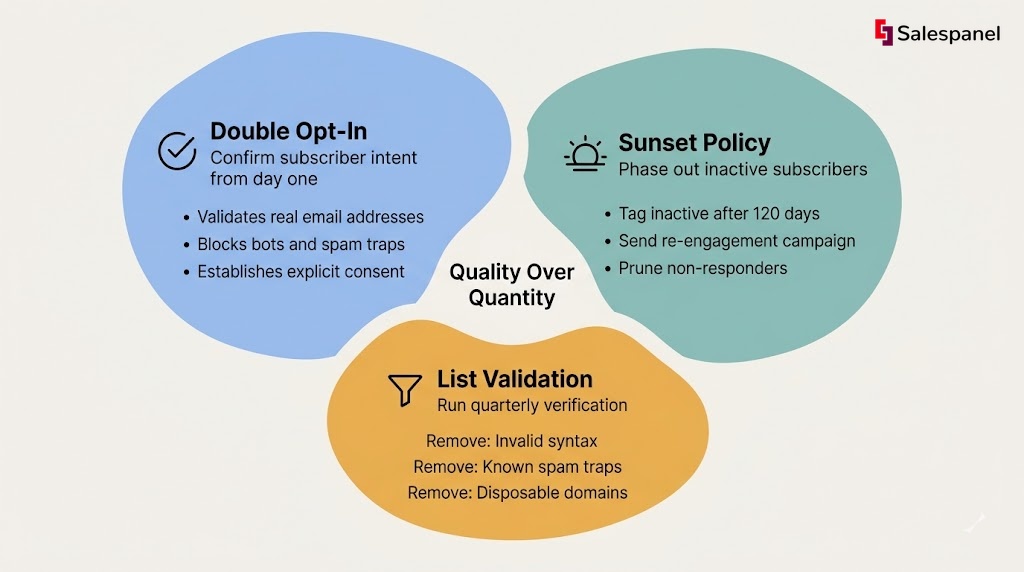
The core principle here is quality over quantity. A large, neglected list is akin to shouting into an empty room; a smaller, hyper-engaged list facilitates a meaningful conversation with your best customers. ISPs consistently reward the latter, prioritizing senders who demonstrate respect for their audience’s inboxes. This section provides a technical playbook for maintaining a pristine list that mailbox providers trust.
Confirm Subscriber Intent From Day One
Your first line of defense against poor list quality is a confirmed or double opt-in process. When a user subscribes, they receive a confirmation email requiring them to click a link to be added to the list. This simple, automated step is non-negotiable for serious senders.
Its practical benefits are numerous and critical:
- It validates email addresses. Typos and fake emails are filtered out at the point of entry, preventing data pollution.
- It blocks automated bots and spam traps. Malicious scripts cannot perform the action of clicking a confirmation link, protecting you from hitting hidden traps designed to identify spammers.
- It establishes explicit consent. You create a clear, documented record that each subscriber actively wants to receive your communications, which is a powerful defense against spam complaints.
While this adds a minor step to the sign-up process, the long-term deliverability benefits far outweigh the risk of losing a few uncommitted contacts.
Implement a Systematic Sunset Policy
Subscriber engagement naturally wanes over time. Continuously emailing inactive contacts sends negative engagement signals to ISPs, harming your reputation. A “sunset policy”—a systematic, automated process for identifying and phasing out inactive contacts—is therefore essential.
First, you must define “inactive” based on your sending cadence. For a daily newsletter, this might be 30 days without an open or click. For a monthly update, a 90 or 180-day window may be more appropriate.
The key is to create a clear, automated rule that identifies subscribers who are no longer listening. A smaller list of active, interested readers consistently outperforms a bloated list of dormant contacts in the eyes of mailbox providers.
The practical application involves a simple, automated workflow:
- Identify Inactive Subscribers: Automatically tag contacts who meet your pre-defined inactivity criteria (e.g., “no open/click in 120 days”).
- Launch a Re-engagement Campaign: Send a final, compelling campaign with a subject line like, “Is this goodbye?” The goal is to prompt a click that signals continued interest.
- Systematically Prune: If a subscriber does not engage with the re-engagement campaign, they should be removed from your active sending list. This action alone can dramatically improve engagement rates and sender score.
Leverage Professional List Validation
Even with a double opt-in process, email lists degrade naturally over time as people change jobs or abandon old addresses. Before any major campaign, and at least quarterly, it is critical to run your list through a professional validation and verification service.
These services scrub your list for toxic elements that severely damage your ability to improve email deliverability. A quality validation tool will identify and flag:
- Invalid Syntax: Malformed addresses (e.g., missing the “@” symbol).
- Role-Based Accounts: Generic addresses like info@ or support@, which often have low engagement and higher complaint rates.
- Known Spam Traps: Email addresses created by ISPs and blocklist operators specifically to catch spammers. Hitting one can have immediate, severe consequences for your reputation.
- Disposable Domains: Temporary, throwaway email addresses that are quickly abandoned.
Regularly cleaning your list is not about shrinking your audience; it is about refining it into a powerful asset that drives real engagement and builds deep, quantifiable trust with mailbox providers.
Crafting Content for Positive Engagement
With your technical foundation secure and your list pristine, the final pillar is the content itself. A perfectly authenticated email sent to a valid address can still fail if the message does not resonate. This is where the strategic art of communication intersects with the science of deliverability.
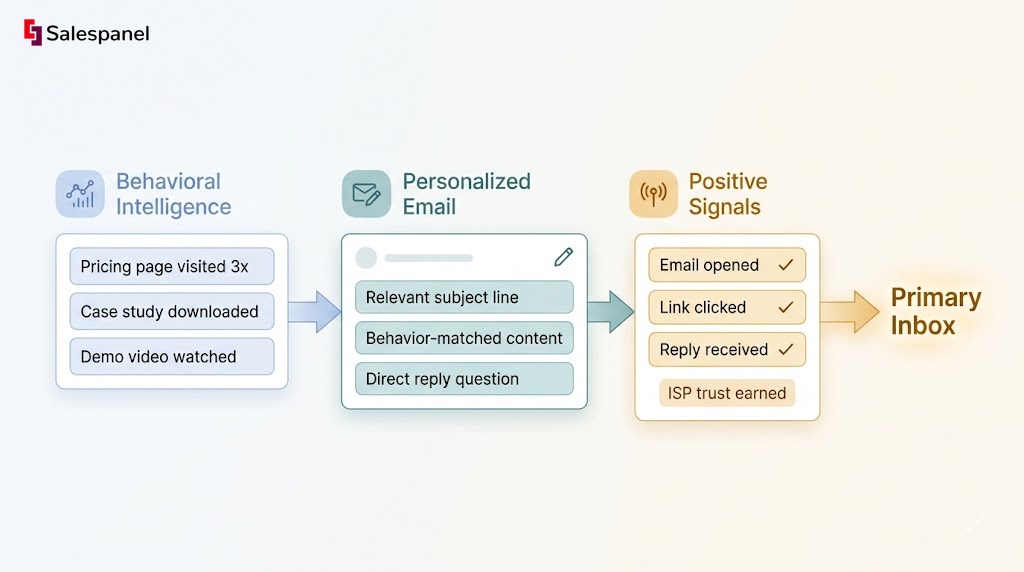
Inbox providers like Gmail and Outlook have evolved far beyond simple keyword scanning. Their algorithms are now laser-focused on measuring positive engagement signals. Every open, click, forward, or reply is a vote of confidence from the recipient. These actions are the most potent signal you can send that your emails are wanted, directly reinforcing your place in the primary inbox.
Moving Beyond Spam-Trigger Keywords
The era of obsessively avoiding words like “free” or “offer” is largely over. While overtly deceptive phrases and ALL CAPS subject lines should still be avoided, modern filters are far more sophisticated. They analyze the complete context: your sender reputation, the recipient’s past engagement with your emails, and the message’s overall structure.
This demands a strategic shift. Instead of merely avoiding negative triggers, you must proactively create positive ones. The guiding question is no longer, “Will this get past the filter?” but rather, “Is this content so valuable that my audience will be compelled to interact with it?”
It is also crucial to recognize that deliverability varies geographically. Global email deliverability benchmarks for 2025-2026 reveal significant regional differences. Europe, for example, has an average inbox placement rate of around 91%, while the Asia-Pacific region is closer to 78%. These figures underscore that strategies may need to be adapted based on local ISP regulations and user behavior.
The Power of Relevance and Personalization
Positive engagement is earned through relevance. Generic, one-size-fits-all email blasts are the primary driver of audience apathy and, ultimately, spam complaints. True personalization extends beyond a {{first_name}} merge tag; it involves leveraging behavioral data to tailor the message. This is where understanding your leads’ digital body language becomes a strategic advantage. For instance, Website visitor tracking from Salespanel provides insight into which product pages a lead has viewed or the content they’ve consumed.
Armed with this insight, you can move from mass communication to meaningful conversation. An email that addresses a user’s specific, demonstrated interest is far more likely to be opened and clicked, directly boosting the engagement metrics that improve your deliverability across the board.
A practical example would be an automated follow-up triggered after a lead downloads a specific case study, offering a demo of the featured solution. Or sending a targeted offer for a product a prospect has viewed three times in the past week. This is not intrusive marketing; it is helpful, contextual communication that earns the clicks and replies that mailbox providers value. By combining behavioral insights with lead scoring, you can prioritize your most engaged prospects and send them the most relevant content at the perfect time.
Optimizing for Positive Interaction Signals
Beyond the copy, the structure of your email can be engineered to encourage interactions that bolster your reputation. Your email should function less as a static advertisement and more as a catalyst for conversation.
Here are several practical, technical tactics to implement immediately:
- Explicitly Request Replies: A simple yet effective technique. End your email with a direct question, such as, “What are your thoughts on this approach?” or “Does this align with your current priorities?” This can significantly increase reply rates, a powerful positive signal for ISPs.
- Maintain a Balanced Image-to-Text Ratio: An email composed of a single large image is a classic spam filter trigger. Ensure a healthy amount of HTML text accompanies any visuals to improve accessibility and satisfy filters.
- Use Clean, Reputable Links: Always link directly to your own domain or other well-established sites. URL shorteners can appear suspicious to filters as they obscure the final destination URL. Transparency is key.
- Optimize Preheader Text: The snippet of text displayed after the subject line is critical real estate. Do not let it default to “View this email in your browser.” Use it to provide compelling context that complements the subject line and encourages opens.
Your Top Email Deliverability Questions, Answered
Even with a robust strategy, email deliverability can present complex challenges. In practice, specific technical questions often arise. This section addresses the most common queries from a journalistic, problem-solving perspective.
Why Are My Emails Going to Spam Even With Good Open Rates?
This is a frequent and frustrating scenario. High open rates suggest success, yet a significant portion of emails land in spam. This paradox arises because open rates have become an unreliable metric.
With technologies like Apple’s Mail Privacy Protection, opens are often pre-fetched and artificially inflated. More importantly, inbox providers analyze a holistic set of signals, and opens are just one component.
The likely technical culprits are:
- Low Click-Through Rates: If users open but do not engage further, it signals to providers that the content is not compelling.
- Post-Open Spam Complaints: A user opening an email and then marking it as spam is one of the most damaging negative signals you can generate.
- Hidden Spam Traps: Your list may contain a “pristine” spam trap—an email address that has never opted into anything. Hitting one is an immediate and severe red flag for ISPs.
- Technical Authentication Errors: A subtle misconfiguration in your DMARC or DKIM records can silently undermine your efforts.
- Content and Formatting Issues: While less common now, an imbalanced image-to-text ratio or an excessive number of links can still trigger legacy spam filters.
The key is to look at your metrics as a complete picture. Fixating on open rates alone can blind you to deeper issues that are actively tanking your sender reputation. The takeaway is to prioritize clicks, replies, and low complaint rates over inflated open metrics.
How Long Does It Take to Repair a Bad Sender Reputation?
Repairing a damaged sender reputation is a methodical process, not an instant fix. The timeline varies based on the severity of the issue. Minor problems may be resolved in a few weeks, while recovering from a major blocklisting event can take several months.
The recovery process requires patience and a disciplined approach. It begins with an immediate cessation of the problematic activity (e.g., sending to an unverified list). From there, trust must be rebuilt from the ground up through consistent, positive sending behavior.
A practical recovery plan includes these steps:
- A Deep List Cleanse: Perform a thorough audit of your entire list. Use a verification service to identify and remove all invalid, dormant, and high-risk addresses.
- Confirm Technical Integrity: Triple-check that your SPF, DKIM, and DMARC records are correctly configured and aligned. There is no margin for error.
- Initiate a Slow Re-Warm-Up: Begin a new warm-up process, sending very low volumes exclusively to your most engaged subscribers to generate positive signals.
Over time, as inbox providers observe high engagement, low bounces, and near-zero complaints, they will gradually restore trust in your domain. Discipline is paramount.
What Is the Difference Between Deliverability and Delivery?
These terms are often used interchangeably, but they represent two fundamentally different concepts. Understanding the distinction is critical for accurate diagnosis of email performance.
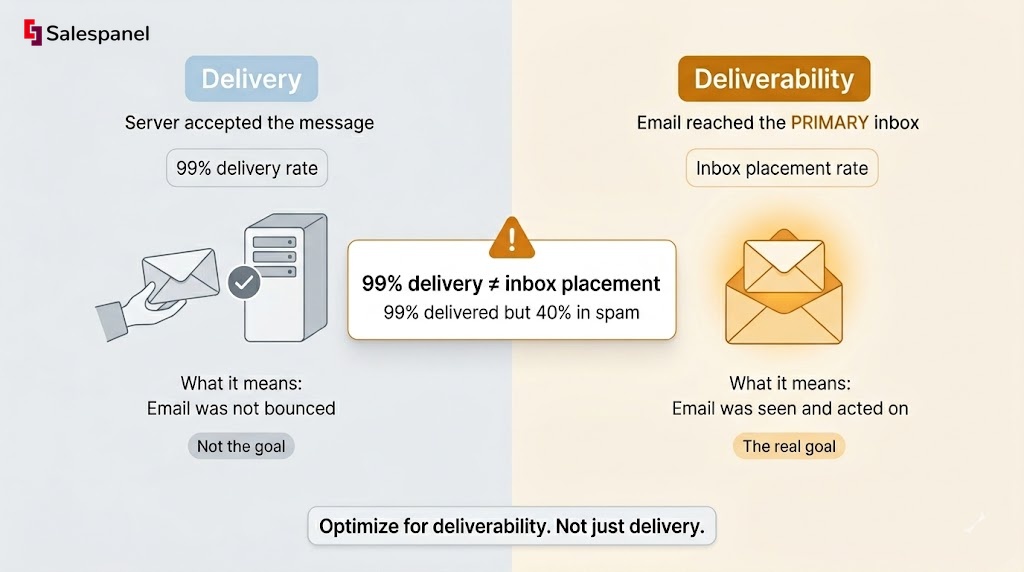
Delivery is a server-level metric. It simply confirms that the receiving email server accepted the message. The email did not hard bounce. A high delivery rate (e.g., 99%) only means the message was successfully handed off; it says nothing about its final placement.
Deliverability is the true measure of success. It refers to where the email actually landed: the primary inbox, the promotions tab, or the spam folder. The ultimate goal is inbox placement, as this is the only location where a message is likely to be seen and acted upon.
A sender can have a 99% delivery rate but a 40% deliverability (inbox placement) rate. This means that while nearly all emails were accepted by the server, the majority were filtered directly to spam. The central objective of any email program must be to improve deliverability, not just chase a high delivery rate.
Should I Use a New Domain for Cold Outreach?
Using a brand-new, un-warmed domain for any email campaign, particularly cold outreach, is an extremely high-risk strategy. New domains have no sending history and therefore zero reputation. From an ISP’s perspective, this is a massive red flag, as it is a common tactic used by spammers to cycle through domains and evade filters.
Launching a high-volume campaign from a new domain will almost certainly result in it being flagged and potentially blocklisted immediately.
If a separate domain is required for outreach, the technically sound approach is to use a subdomain of your primary, trusted domain (e.g., outreach.yourcompany.com). Alternatively, if a new domain must be used, it must undergo a proper and patient warm-up process over several weeks, starting with extremely low-volume, high-engagement sends before any scaling occurs.
Understanding and nurturing every lead is central to building the positive engagement that drives deliverability. At Salespanel, our philosophy is that data-driven personalization is the key to earning a place in the inbox. By identifying anonymous website visitors and tracking their behavior, you can send emails that are not just delivered, but are genuinely welcomed. Explore our full suite of resources to build a smarter, more effective marketing strategy. Find out more at https://salespanel.io/resources.