Email marketing has undergone a quiet revolution. Once a digital version of direct mail, its evolution from simple broadcast messages to sophisticated, data-driven engines of growth is undeniable. While emerging channels command headlines, email remains the bedrock of B2B strategy, a direct and controllable line of communication in an era of unpredictable algorithms. Today, the global email marketing market is valued at over $10 billion and is projected to more than double by 2031. This isn’t a channel on the decline; it’s a discipline entering a new phase of precision and intelligence. This guide provides a technical and strategic framework for harnessing modern lead generation email marketing, moving beyond newsletters to construct a predictable pipeline of qualified leads. The central theme is this: success lies not in the volume of sends, but in the strategic integration of data, psychology, and automation to create timely, relevant conversations that drive measurable action.
Why Email Is Still Your B2B Growth Engine
In a digital landscape characterized by ephemeral social media trends and opaque platform algorithms, the email inbox remains a uniquely stable and powerful asset. It represents a direct, consent-based communication channel that has transformed from a simple messaging tool into a complex system for revenue generation. While new platforms emerge constantly, a methodically executed email strategy consistently delivers quantifiable results, providing a level of control and predictability that other channels cannot match.
The fundamental advantage of lead generation email marketing is the direct ownership of the audience relationship. Unlike social media, where reach is mediated by third-party algorithms, an email list is a proprietary asset. This grants marketers a direct conduit to individuals who have explicitly opted-in, creating an unparalleled opportunity for deep engagement and relationship-building.
The Unbeatable ROI of Email
The most compelling technical argument for prioritizing email is its exceptional return on investment. The empirical data is conclusive. Nearly half of all marketers (48%) identify email as their primary tactic for lead acquisition.
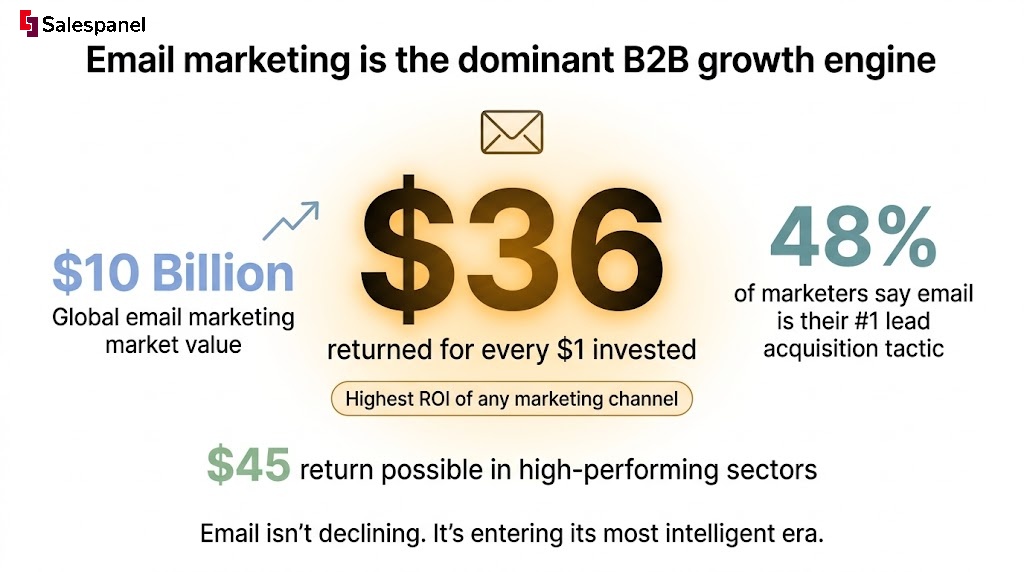
The financial validation is even more striking: for every $1 invested in email marketing, the average return is $36. This ROI significantly outperforms most other marketing expenditures. In certain sectors, this return can escalate to as high as $45 for every dollar spent.
The objective is not merely to send communications; it is to architect a system that consistently supplies the sales pipeline with high-quality, engaged B2B leads. A sophisticated email strategy is no longer an optional component of a marketing plan—it is a mandatory one.
A great email strategy does more than just find leads. It builds your authority in the market, nurtures genuine relationships with prospects, and creates a revenue stream you can actually count on. It turns a simple contact list into one of your most valuable business assets.
Building a Foundation for Success
The central premise is that a strategic approach to email marketing underpins a robust sales pipeline. Achieving this requires a system that integrates every touchpoint, from initial website interaction to the final sales engagement. This necessitates a granular focus on user behavior and intent signals.
This is where a platform like Salespanel provides a technical advantage. It enables visibility into post-click behavior, tracking how leads interact with your website after engaging with an email. This data provides a more complete understanding of their interests and buying stage.
This capability facilitates several critical functions:
- Lead Scoring: Quantify engagement levels to prioritize follow-up.
- Audience Segmentation: Group contacts based on behavior for highly relevant messaging.
- Automated Workflows: Trigger personalized, timely sequences based on user actions.
Ultimately, a world-class email program is measured not by opens and clicks, but by its ability to convert initial interest into qualified sales opportunities, transforming the inbox into a reliable engine for business growth.
Building Your Lead Capture Foundation
A high-performing lead generation email marketing campaign does not originate within an email composition tool. Its success is determined long before a subject line is written. The foundational work lies in constructing a robust system for capturing high-quality leads. This initial interaction is the digital handshake that sets the precedent for the entire relationship and directly influences the quality of the email list.
The core principle is a value exchange: offer a resource of genuine utility in return for a prospect’s email address. In the B2B context, generic appeals such as “Subscribe to our newsletter” are insufficient. The entry points for lead capture must be as strategic and well-engineered as the email campaigns themselves.
Crafting Irresistible Lead Magnets
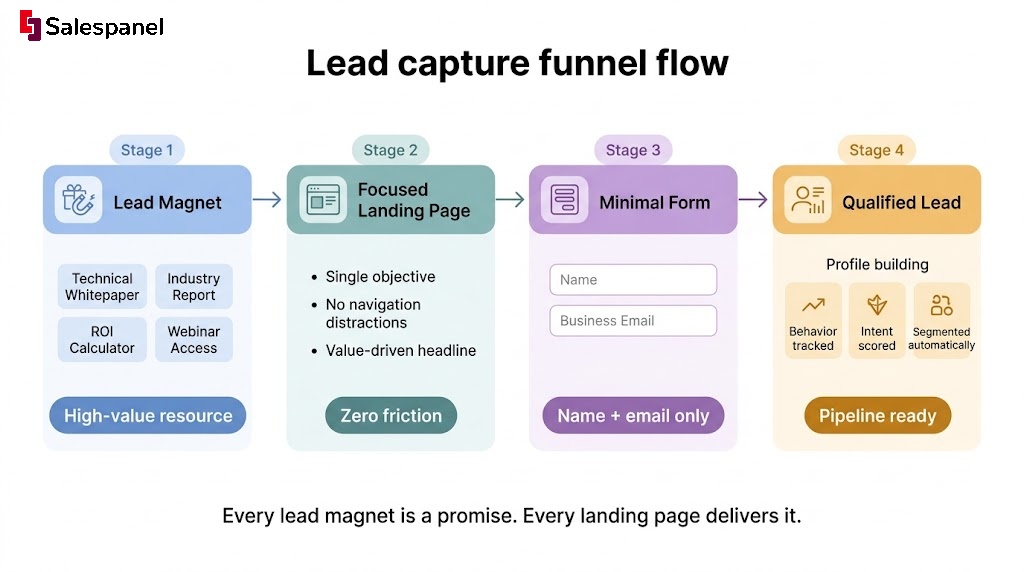
At the nucleus of an effective lead capture system is the lead magnet—a complementary, high-value resource engineered to solve a specific problem for a target persona. The objective is to create an asset so compelling that prospects willingly provide their contact information. For B2B audiences, this requires substantive content that goes beyond simple checklists.
Here are practical examples of effective B2B lead magnets:
- Technical Whitepapers: These are not blog posts. They are in-depth analyses of complex industry challenges, substantiated with data and expert commentary. This format establishes thought leadership and attracts technically-minded decision-makers. Example: A cybersecurity firm offering a whitepaper on “Mitigating Zero-Day Vulnerabilities in Enterprise Networks.”
- Proprietary Industry Reports: Offer exclusive data and insights unavailable elsewhere. Example: A MarTech company publishing a “State of B2B Marketing Automation in 2026″ report, filled with original survey data, becomes a go-to resource and generates highly qualified leads.
- Interactive ROI Calculators: Allow prospects to input their own data and quantify the potential financial impact of your solution. This is a powerful tool for bottom-of-funnel prospects evaluating purchasing decisions.
- Exclusive Webinar Access: A live session with an industry expert provides immediate value and direct engagement, effectively capturing leads actively seeking knowledge on a specific topic.
The critical takeaway is that the lead magnet must directly address a pain point that your product or service resolves. This ensures you are not just collecting email addresses, but are building a list of prospects who have implicitly signaled interest in your solution space.
Designing High-Conversion Entry Points
With a compelling lead magnet developed, the next step is to engineer a frictionless delivery mechanism. This is where landing pages and opt-in forms become critical conversion points. A poorly designed entry point can negate the value of even the most superior content.
Your landing page must be singularly focused on one objective: compelling the visitor to complete the form. This requires removing all distractions, such as site navigation or sidebars. The copy should be concise and focused on the benefits and outcomes of the resource, not merely its features.
Practical Example: Instead of a headline like “Download Our 20-Page Report,” use a value-driven headline like “Get the 2026 Data That Will Shape Your Marketing Budget.” Employ bullet points to make key takeaways scannable and immediately understandable.
The most effective landing pages function like a persuasive argument with a single, logical conclusion. Every element—from the headline and imagery to the social proof and call-to-action—should guide the user toward the form.
The opt-in form itself is a crucial variable. Each additional field introduces friction and is likely to decrease the conversion rate. Request only the essential information needed at this stage. For a top-of-funnel whitepaper, a name and business email are typically sufficient. Additional data can be progressively captured as the lead is nurtured.
This is where an integrated system demonstrates its value. Upon capture, tools like Salespanel can begin tracking the lead’s subsequent behavior on your site. The data point evolves from a simple name and email into an intelligent profile, showing which pages they visit and what content they consume post-download. This contextual data is the foundation for highly personalized and effective email campaigns.
Writing B2B Emails That Drive Action
The lead has been acquired and is now within your marketing ecosystem. The subsequent challenge is to craft B2B emails that command attention in an oversaturated inbox. This is not a matter of chance; it is a discipline combining psychological principles with data-driven best practices. Every email sent is an opportunity to either build credibility or be relegated to the archive. The outcome often hinges on a few critical components, beginning with the first element the recipient sees.
Mastering the Subject Line
The subject line functions as the gatekeeper to your email’s content. An ineffective subject line renders even the most brilliantly crafted email obsolete before it is read. The data supports this assertion: 47% of recipients open an email based on the subject line alone.
Personalization is a key tactic. This extends beyond simple mail-merge tags like [First Name]. Effective B2B personalization involves referencing the recipient’s industry, a specific professional challenge, or recent engagement with your content.
Practical Example: A generic subject line like “Our New Software Update” is easily ignored. In contrast, “[Name], a new way for SaaS firms to reduce churn” is specific, relevant, and implies a solution to a significant business problem.
Your subject line needs to make a clear promise of value. It has to answer their silent, ever-present question: “What’s in it for me?” Curiosity is great, but in the B2B world, clarity and relevance almost always win the day.
Another effective technique is to signal the content format. Including the word “video” in a subject line has been shown to increase open rates by 19% and click-through rates by 65%. This is because it sets a clear expectation of engaging, easily consumable content.
A/B testing of subject lines is a non-negotiable best practice. It is the most direct method for empirically determining what resonates with your specific audience.
Subject Line A/B Test Framework
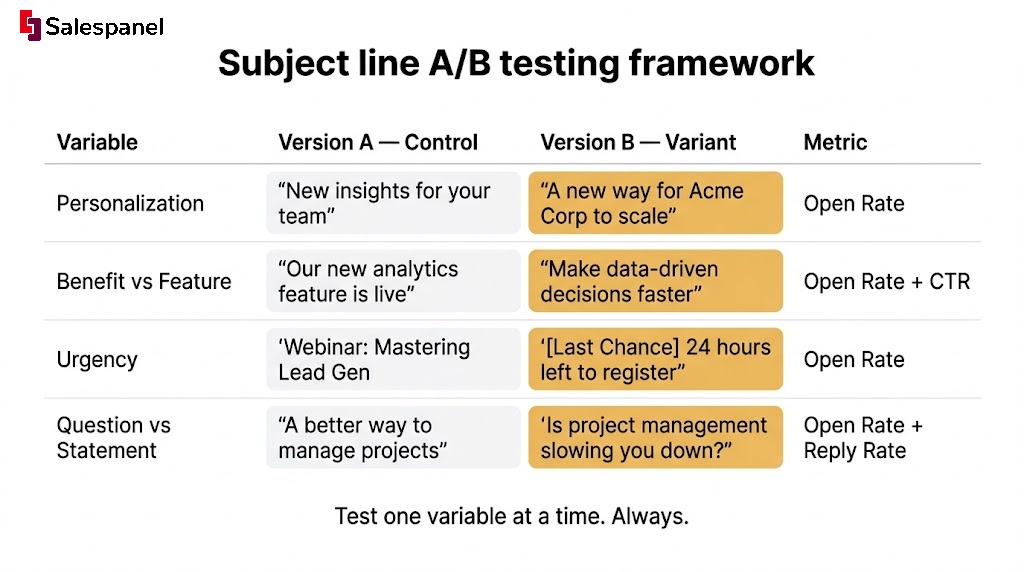
This framework provides a structured approach for testing subject line variables. The goal is to move from assumption-based to evidence-based optimization.
| Variable to Test | Example A (Control) | Example B (Variant) | Primary Metric to Track |
|---|---|---|---|
| Personalization | New insights for your team | A new way for [Company Name] to scale | Open Rate |
| Benefit vs. Feature | Our new analytics feature is live | Make data-driven decisions faster | Open Rate & Click-Through Rate |
| Urgency/Scarcity | Webinar: Mastering Lead Gen | [Last Chance] 24 hours left to register | Open Rate |
| Question vs. Statement | A better way to manage projects | Is project management slowing you down? | Open Rate & Reply Rate |
Test one variable at a time. Once a statistically significant winner is identified, it becomes the new control for subsequent tests. This iterative process drives continuous improvement.
Crafting Compelling Body Copy
Having earned the open, the email body must deliver on the promise of the subject line efficiently. B2B professionals are scanners; dense blocks of text are a primary cause for deletion. The copy must be structured for scannability.
- Short sentences and paragraphs: Maintain conciseness. Every sentence must serve a purpose.
- Bullet points: Ideal for breaking down complex information into digestible segments.
- Bold text: Use strategically to emphasize key phrases or data points, guiding the reader’s eye.
Instead of a direct sales pitch, employ a narrative framework like Problem-Agitate-Solve (PAS). This structure first identifies a reader’s problem, then elaborates on the negative consequences of that problem, and finally presents your solution.
Practical Application of PAS:
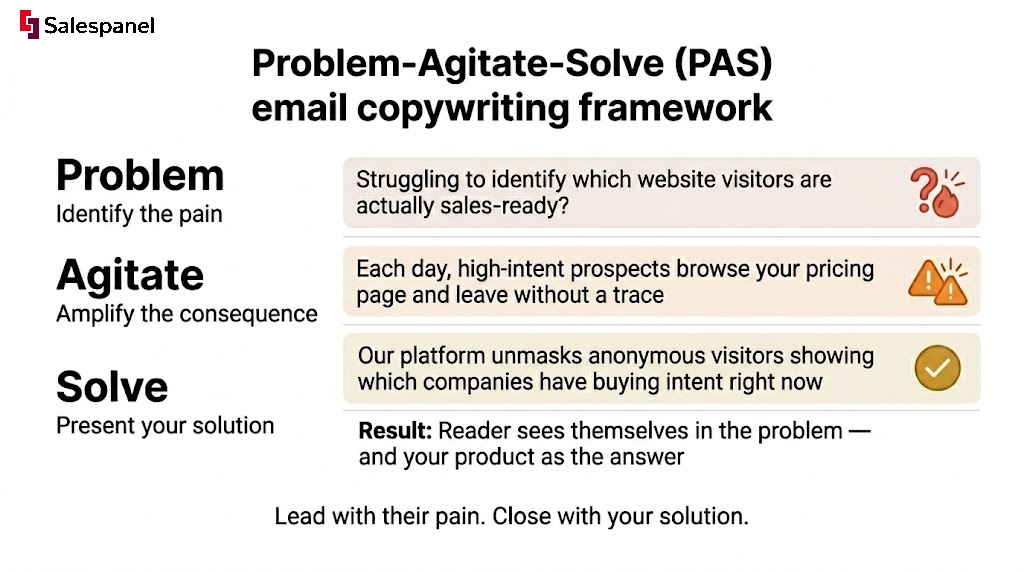
- Problem: “Struggling to identify which website visitors are actually sales-ready?”
- Agitate: “Each day, high-intent prospects browse your pricing page and leave without a trace, slipping right through the cracks.”
- Solve: “Our platform unmasks those anonymous visitors, showing you which companies are showing buying intent right now.”
This technique establishes resonance with the reader’s challenges before introducing your product, framing the conversation around their needs, not your features.
The Psychology of a Strong Call-to-Action
Every email in your lead generation email marketing strategy must have a single, unambiguous purpose, encapsulated by its call-to-action (CTA). The CTA must be specific, logical, and low-friction. Vague CTAs like “Click Here” or “Learn More” are ineffective due to their lack of specificity. Use action-oriented language that clearly communicates the outcome of the click.
Practical Comparison:
- Weak CTA: Learn More
- Strong CTA: Get the 5-Point Checklist
- Weak CTA: Read Our Case Study
- Strong CTA: See How We Grew ACME’s Revenue by 40%
The stronger examples eliminate ambiguity, reducing cognitive load and increasing click-through rates. For a platform like Salespanel, which is designed to track the full customer journey, an effective CTA guides a lead to a high-value page, such as pricing or a demo request. The click then becomes a powerful intent signal, providing sales teams with crucial context for their follow-up. Each interaction should be designed to be both meaningful and measurable.
Automating Your Way to Smarter Nurturing
The era of undifferentiated email blasts is over. The efficacy of modern lead generation email marketing is not determined by volume but by intelligence. Automation should be leveraged not just for efficiency, but to deliver hyper-relevant messages at the precise moment of maximum impact. Delivering the right message at the wrong time is as ineffective as delivering the wrong message. Automation bridges this timing gap, transforming a prospect’s behavior into a trigger for a relevant, automated conversation. This is the mechanism for moving beyond simple welcome emails to sophisticated nurturing workflows that adapt to each lead’s unique journey.
From Static Lists to Dynamic Segments
The foundation of intelligent automation is robust segmentation. Traditional segmentation based on static firmographic data (industry, company size) is merely a starting point. True efficacy is achieved by layering in dynamic, behavioral data. Prospects continuously send signals through their actions that tell a story of their intent.
- Firmographic Data: The baseline—company size, industry, location, job title. This answers who they are.
- Behavioral Triggers: The game-changer. Which pages have they visited? Which assets have they downloaded? This reveals what they are interested in.
- Engagement History: Their interaction with past emails. Are they clicking on specific topics? This indicates their level of interest.
By combining these data layers, you can create highly predictive segments. Practical Example: Instead of a broad segment for “all marketing managers,” you create a dynamic segment for “marketing managers in the SaaS industry who have viewed the pricing page twice in the last week.” The latter group has demonstrated significantly higher buying intent and requires a completely different communication strategy.
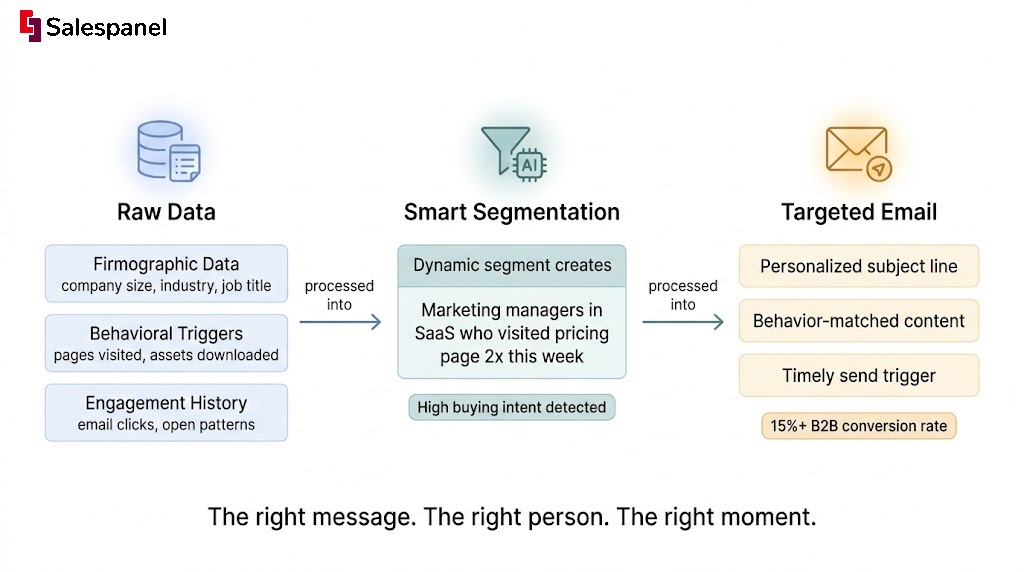
This visualization illustrates the process of converting raw data into targeted, effective communication.
This flow underscores a critical point: effective automation is not a “set it and forget it” tool. It requires a systematic approach to data collection, segmentation, and action.
Designing a High-Impact Nurturing Workflow
Let’s operationalize this with a practical scenario. A Director of Sales at a mid-sized tech company downloads your whitepaper, “The Ultimate Guide to Outbound Prospecting.” A basic automation would send a thank-you email. An intelligent automation executes a multi-touch sequence.
Here is a technical breakdown of a potential workflow:
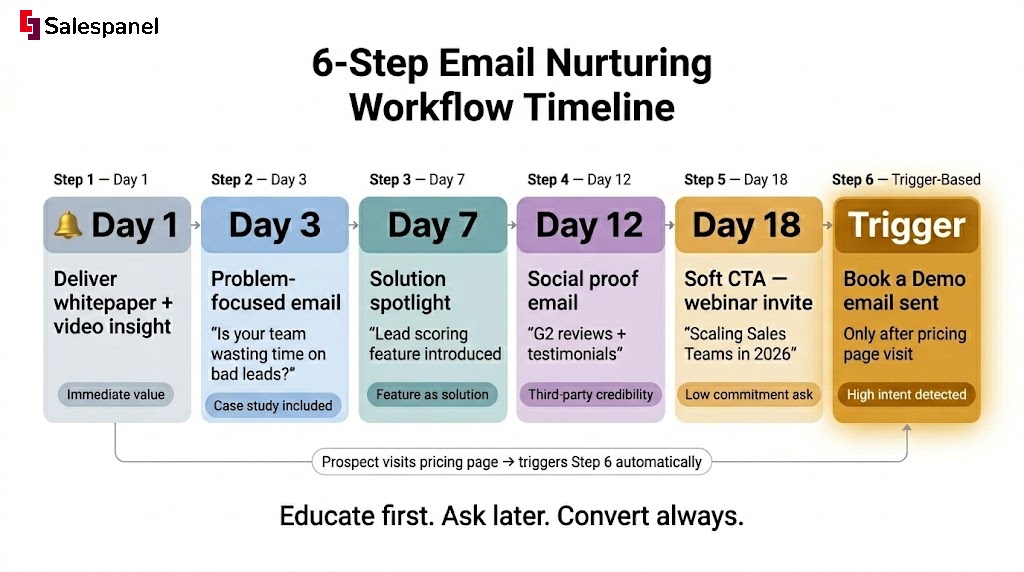
- Immediate Follow-Up (Day 1): Deliver the whitepaper. Also, include a link to a short video from your Head of Sales discussing a key insight from the report. This adds a human element and immediate, easily digestible value.
- Problem-Focused Content (Day 3): Send an email with a subject line like “Is Your Team Wasting Time on Bad Leads?” Link to a case study demonstrating how a similar company improved lead quality by 30% using your solution. This connects their initial interest to a tangible business outcome.
- Solution-Oriented Spotlight (Day 7): Introduce a specific feature, such as lead scoring. Frame it not as a feature, but as the solution to the problem discussed in the previous email.
- Social Proof and Credibility (Day 12): Share a link to a third-party review site like G2 or a collection of customer testimonials. This validates your claims with unbiased sources.
- The Soft CTA (Day 18): Offer a lower-commitment, high-value asset, such as an invitation to an exclusive webinar on “Scaling Sales Teams in 2026.”
- The Direct Ask (Trigger-Based): The “Book a Demo” email is sent only after the lead demonstrates further intent, such as visiting your pricing or integrations pages. The request is now timely and contextually relevant.
This sequence works because it respects the buyer’s journey. It educates and builds trust long before it ever asks for a sale. By the time that sales conversation happens, the lead is informed, engaged, and genuinely interested.
This is precisely where the philosophy of a unified platform like Salespanel becomes critical. It is about connecting these behavioral dots. By tracking website activity, you can create rules that dynamically move leads between nurturing tracks. If a prospect visits the pricing page after email #3, the system can automatically exit them from the nurture sequence and create a task for a sales representative. This ensures automation handles nurturing while sales focuses on closing high-intent leads.
How to Measure and Optimize Your Campaigns
Deploying a campaign is the starting point, not the conclusion. Significant gains in lead generation email marketing are not achieved through a single campaign but through a continuous, iterative cycle of measurement, analysis, and optimization. If a metric cannot be measured, it cannot be improved. This section shifts focus from the creative aspects of email marketing to the analytical framework that drives sustainable growth. It is easy to become fixated on vanity metrics like open rates, but these do not directly correlate with revenue. True optimization requires focusing on metrics that connect email activities to sales pipeline and business outcomes.
Moving Beyond Vanity Metrics
The first step in meaningful analysis is to shift focus to metrics that indicate genuine engagement and purchase intent. Open rates have become less reliable due to privacy features like Apple’s Mail Privacy Protection. Instead, analysis should be anchored to key performance indicators (KPIs) that reflect tangible action.
Key metrics to track include:
- Click-Through Rate (CTR): The percentage of recipients who clicked at least one link. This is a direct measure of your message’s and CTA’s effectiveness.
- Click-to-Open Rate (CTOR): This compares unique clicks to unique opens, providing a clearer indication of content engagement among the audience who viewed the email.
- Conversion Rate: The percentage of recipients who completed the desired goal post-click (e.g., demo request, content download). This metric links marketing efforts to tangible business objectives.
- Email-Attributed Revenue: The ultimate performance indicator. This tracks the actual revenue generated from leads sourced or nurtured by email campaigns.
A campaign with a 50% open rate and a 1% CTR is a failure. On the other hand, a campaign with a 20% open rate and a 15% CTR is a massive success. Always prioritize the actions that pull prospects deeper into your funnel, not just those that grab initial attention.
This KPI dashboard provides a quick reference for essential metrics.
Email Lead Generation KPI Dashboard
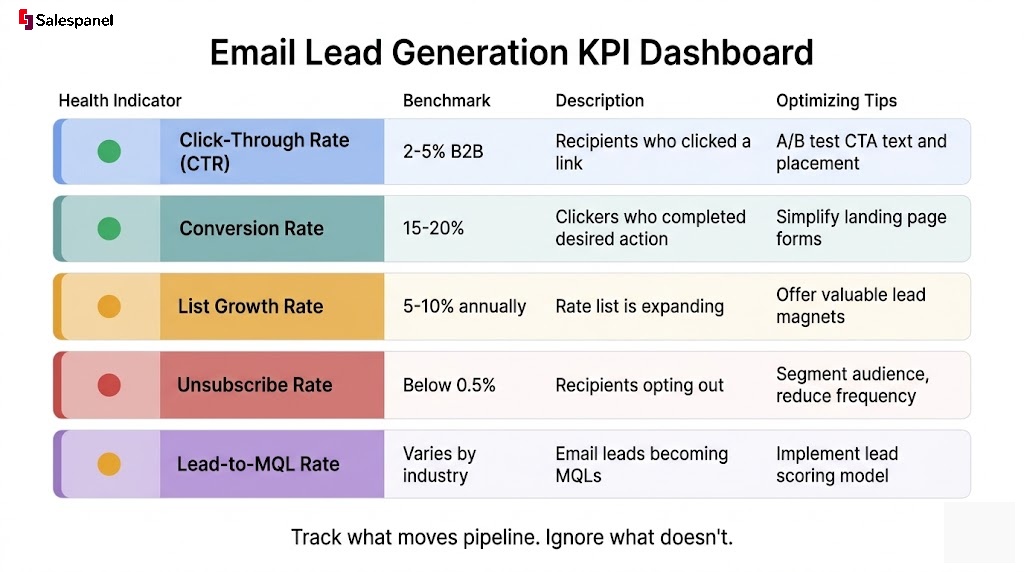
This table breaks down the essential Key Performance Indicators (KPIs) for measuring the success of your email lead generation efforts.
| KPI | What It Measures | Industry Benchmark | Optimization Tactic |
|---|---|---|---|
| Click-Through Rate (CTR) | The percentage of recipients who clicked a link in the email. | 2-5% (B2B) | A/B test your call-to-action (CTA) text, color, and placement. |
| Conversion Rate | The percentage of clickers who completed the desired action (e.g., form fill). | 15-20% | Simplify landing page forms and ensure message consistency between email and page. |
| List Growth Rate | The rate at which your email list is expanding. | 5-10% annually | Offer valuable lead magnets like ebooks, webinars, or exclusive content. |
| Unsubscribe Rate | The percentage of recipients who opt out of your list. | < 0.5% | Segment your audience to send more relevant content; don’t over-email. |
| Lead-to-MQL Rate | The percentage of leads generated from email that become Marketing Qualified Leads. | Varies widely | Implement a lead scoring model based on email engagement and website behavior. |
Tracking these metrics provides a clear, data-backed view of campaign performance and informs optimization priorities.
The Iterative Optimization Loop
Effective optimization is a continuous process, not a singular event. The most successful marketing teams operate on a four-step loop: Analyze, Hypothesize, Test, and Implement. This framework transforms raw data into actionable improvements.
Practical Example: You have launched a nurture campaign with a high CTOR, but the conversion rate on the associated landing page is low.
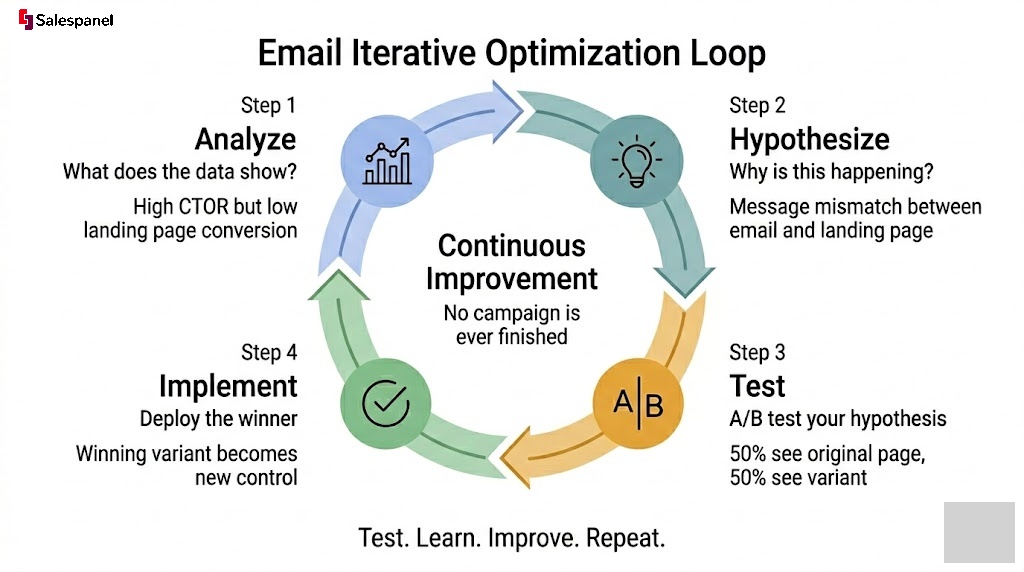
- Analyze the Data: The data indicates the email successfully generated a click, but the conversion failed post-click.
- Form a Hypothesis: The hypothesis could be a message mismatch. The email promised “A Quick 5-Point Checklist,” but the landing page headline reads “Comprehensive Guide to Industry Best Practices.” This incongruence may be causing friction.
- A/B Test Your Hypothesis: Create a variant of the landing page with a headline that mirrors the email’s promise. Direct 50% of email traffic to the original page (control) and 50% to the new variant.
- Implement the Winner: If the variant shows a statistically significant increase in conversions, it becomes the new control. The optimization loop then begins again, perhaps testing form length or CTA button color next.
This iterative methodology replaces conjecture with empirical evidence, ensuring that every modification has a measurable, positive impact on performance.
Connecting Email Data to the Full Customer Journey
The final component of optimization is to connect email engagement data with website behavior. A lead’s journey is not confined to the inbox; it spans your entire digital ecosystem. Understanding this holistic journey is critical. Statistically, this integrated view is why email marketing yields an average B2B conversion rate of 15.22%, significantly outperforming social media or paid search. Automated email campaigns, while constituting only 2% of sends, generate 37% of all email-driven sales, demonstrating the power of linking email triggers to user behavior.
This is where the Salespanel philosophy becomes so powerful. By tracking post-click behavior, you can identify if a lead who clicked a case study link subsequently browsed your pricing page. This behavioral data is a strong buying signal. It allows for accurate lead scoring and triggers timely sales follow-up, effectively bridging the gap between marketing engagement and sales action.
Common B2B Email Marketing Questions
Executing a strategy often raises practical questions. This section addresses some of the most frequent technical and tactical queries from B2B marketers implementing email programs.
How Often Should I Email My B2B Leads?
This depends on the lead’s stage in the lifecycle. For a new lead who recently downloaded a top-of-funnel asset, a higher frequency—perhaps an email every 2-4 days for the first two weeks—is appropriate to build initial momentum. Following this initial sequence, the cadence should decrease to a weekly or bi-weekly communication to avoid list fatigue.
The most reliable guide, however, is engagement data.
- Rising Unsubscribe Rates: This is a clear signal of excessive frequency. Reduce the cadence.
- Consistently High Click-to-Open Rates: This indicates strong content resonance and may permit a slight increase in frequency.
The best practice is to let behavioral triggers justify sending. A visit to a high-intent page (e.g., pricing, demo request) is a green light for an immediate, targeted follow-up. A/B testing sending frequency with a small list segment is the most effective way to determine the optimal cadence for your specific audience.
What Is the Difference Between Lead Generation and Nurturing?
These terms represent two distinct and sequential functions within the marketing funnel.
Lead generation emails are top-of-funnel instruments. Their sole objective is to convert an anonymous visitor into a known lead by offering a high-value asset in exchange for contact information. The call-to-action is focused on acquisition.
Example CTA: “Download the Full Industry Report” or “Register for the Exclusive Webinar.”
Lead nurturing emails are directed at existing contacts within your database. The goal is no longer acquisition but relationship-building and progression through the funnel. This is achieved by providing ongoing value, establishing trust, and guiding the lead toward sales-readiness through educational content and lead qualification.
Example Content: A drip campaign that shares relevant case studies, technical tips, or customer success stories over several weeks.
Think of it this way: Lead generation is opening the door. Lead nurturing is inviting them in, showing them around, and making them confident they’ve found the right place. You need both, but you can’t swap one for the other.
How Do I Keep My Emails Out of the Spam Folder?
Email deliverability is a technical prerequisite for success. Ensuring inbox placement requires a proactive approach to email infrastructure and list hygiene.
First, maintain a clean email list. This is non-negotiable. Regularly purge inactive subscribers and immediately remove hard bounces. A high bounce rate is a primary negative signal to Internet Service Providers (ISPs) like Gmail and Outlook.
Second, authenticate your sending domain. This is a technical necessity. Properly configuring SPF (Sender Policy Framework), DKIM (DomainKeys Identified Mail), and DMARC records cryptographically proves to receiving servers that you are a legitimate sender. This is a crucial step in building sender reputation.
Third, analyze your content. Avoid using spam-trigger words in subject lines (e.g., “free,” “winner,” “act now”) and avoid excessive capitalization or punctuation, as these are common heuristics for spam filters.
The most critical factor, however, is driving genuine engagement. Consistent opens, clicks, and replies send powerful positive signals to ISPs. This demonstrates that your emails are valued by recipients, which is the most effective long-term defense against being filtered into the spam folder.
At Salespanel, we believe that understanding the full customer journey is the key to smarter marketing. Our platform connects your email campaigns to real-time website behavior, giving you the insights to personalize follow-ups, score leads accurately, and turn engagement into revenue. Explore our resources at Salespanel to build a more intelligent lead generation engine.