The sales profession is standing at a pivotal moment, a transition as profound as the shift from rolodexes to CRMs. For decades, sales was a game of brute force—a relentless grind of cold calls, manual list-building, and generic email blasts, governed by rule-based software that could only execute predefined scripts. That era is definitively over. The future, now rapidly becoming the present, belongs to autonomous systems.
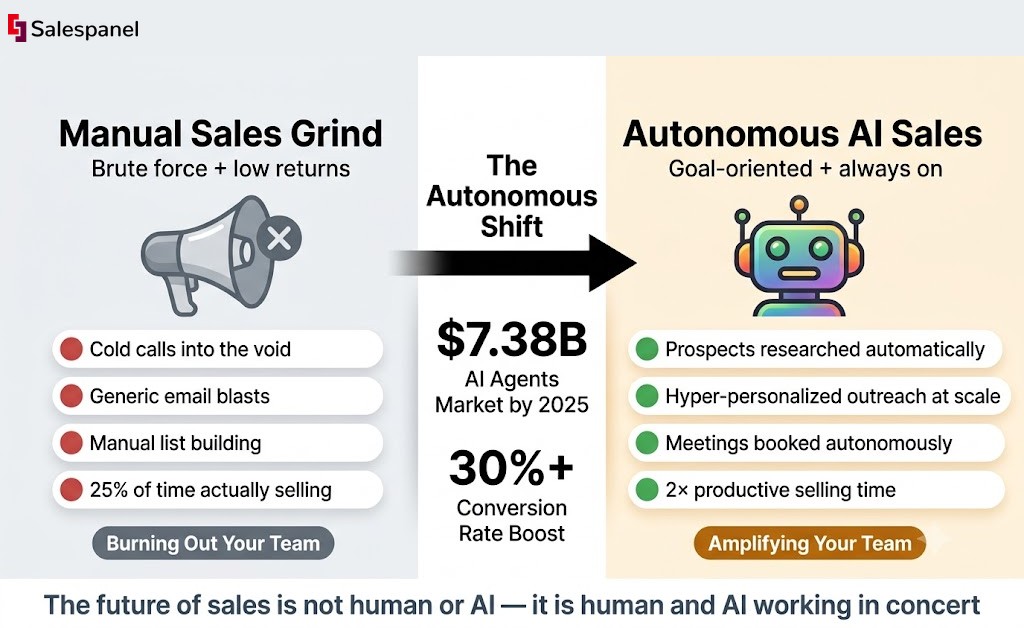
We are witnessing the dawn of the autonomous sales team, where AI agents for sales are no longer a futuristic concept but a practical, deployable reality. These intelligent systems are not just tools; they are proactive partners. A marketsandmarkets report projects the AI agents market will reach a staggering $7.38 billion by 2025, driven by a compound annual growth rate of 44.8%. This isn’t abstract growth; it’s fueled by tangible results. According to Bain & Company, salespeople spend a mere 25% of their time on actual selling activities. AI agents have the potential to double that productive time while boosting conversion rates by over 30%.
This guide is your definitive resource for navigating this seismic shift. The central theme we will explore is the transition from manual execution to strategic oversight—empowering your human team by delegating tactical grunt work to intelligent machines. We will dissect the core mechanics of how these agents operate, provide practical use cases across the entire sales funnel, and offer a strategic roadmap for implementation. By the end, you will have a clear, actionable takeaway: a blueprint for transforming your sales operation into an augmented, autonomous force ready to dominate the next era of B2B sales.
The Dawn of the Autonomous Sales Team
The entire world of sales is being fundamentally rewired. For decades, prospecting was a manual, high-volume numbers game with diminishing returns. It was all about cold calls and generic email blasts, powered by clunky, rule-based software that could only follow a script. That old model isn’t just creaky; it’s collapsing.
We’re now walking into an era where AI agents for sales aren’t some far-off concept from a sci-fi movie—they’re a real tool you can use today. These autonomous systems are rewriting the playbook for modern sales teams. They can independently research prospects, enrich lead data with fresh insights, personalize outreach at a massive scale, and even book qualified meetings directly onto a salesperson’s calendar.
This is a seismic shift. We’re moving from passive tools to proactive, goal-oriented partners.
From Manual Grind to Intelligent Automation
The real game-changer here is autonomy. Traditional sales tools are like a hammer—effective, but they need a human to aim and swing for every single nail. An AI sales agent, on the other hand, is like a skilled apprentice. You can give it a high-level goal, like “find and engage with 50 marketing VPs in the SaaS industry this week,” and it will figure out the steps to get it done.
This shift from manual to autonomous isn’t just a small tweak; it’s driving massive changes in the market and how companies operate. Let’s look at the evolution.
The Evolution From Manual Tools To Autonomous Agents
The table below breaks down just how different the day-to-day reality of sales is becoming. It’s a move from repetitive, low-impact tasks to strategic, high-value work, all thanks to AI shouldering the load.
| Sales Function | Traditional Approach (Manual or Rule-Based) | AI Agent Approach (Autonomous and Adaptive) |
|---|---|---|
| Prospecting | Manual list building, buying static contact lists. | Discovers and vets ideal prospects in real-time based on dynamic criteria. |
| Lead Qualification | Reps manually check leads against a static ICP checklist. | Scores and qualifies leads instantly using behavioral and firmographic data. |
| Outreach | Generic, one-size-fits-all email templates and call scripts. | Crafts and sends hyper-personalized messages based on individual triggers. |
| Scheduling | Back-and-forth emails to find a meeting time. | Intelligently coordinates calendars and books meetings autonomously. |
| Data Enrichment | Time-consuming manual research on LinkedIn and company websites. | Enriches profiles with up-to-date data from dozens of sources automatically. |
What this table really shows is a transfer of responsibility. The grunt work that used to burn out sales reps is now handled by an intelligent system, freeing up humans to do what they do best: build relationships and close deals.
This transition is fueling massive market growth. You can discover more insights about the rapid adoption of AI agents and their impact on sales processes. The takeaway is clear: the operational model for sales is changing, and the underlying technology is creating a significant competitive advantage for early adopters.
How AI Sales Agents Actually Work
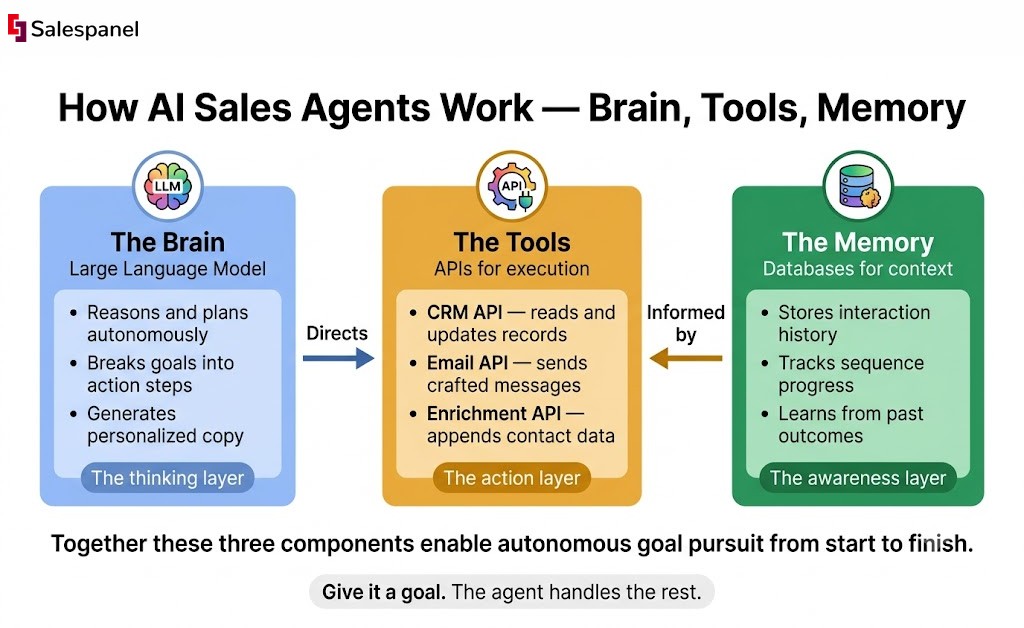
To understand an AI agent for sales, one must move beyond the concept of software and instead envision an autonomous entity architected to achieve goals. It functions less like a program and more like a junior sales representative that operates 24/7 with perfect efficiency. When a human sales rep is tasked with a goal—for example, “Identify and nurture software companies that have visited our pricing page”—they leverage their reasoning, tools, and memory. An AI sales agent is constructed on a parallel framework of three core, interdependent components.
The Brain: Large Language Models (Reasoning)
At the heart of every AI agent lies its cognitive engine: a Large Language Model (LLM). This is the “brain” responsible for reasoning, planning, and language generation. When presented with a high-level objective, the LLM deconstructs it into a logical sequence of actionable steps.
Practical Example: Given the goal “Nurture pricing page visitors,” the LLM’s reasoning process would be:
- Identify the target cohort from website analytics data.
- Analyze each prospect’s firmographic data to determine fit.
- Formulate a multi-touch email sequence.
- Generate personalized copy for each email, referencing their demonstrated interest.
- Execute the sequence via the appropriate tool.
This demonstrates the agent’s ability to create a strategic plan from a simple command.
The Tools: APIs for Action (Execution)
An agent’s ability to reason is inert without the means to interact with its environment. This is accomplished through Application Programming Interfaces (APIs), which serve as the agent’s “hands.” These tools allow the agent to connect with and command other software platforms to execute its plan.
- CRM API: To pull lead data, log activities, and update records (e.g., Salesforce, HubSpot).
- Email Platform API: To send the emails it has composed (e.g., Gmail, Outlook).
- Data Enrichment API: To append missing firmographic or contact data (e.g., Clearbit, ZoomInfo).
Practical Example: When the agent’s plan requires sending an email, it doesn’t simulate keystrokes in a web browser. It makes a direct, programmatic call to the Gmail API, passing the recipient, subject, and body content for instant, reliable execution.
The Memory: Databases for Context (State-awareness)
For an agent to perform complex, multi-step tasks over time, it requires memory. This is provided by databases that store both long-term knowledge (e.g., interaction histories, successful templates) and short-term, contextual information (e.g., the status of a current email sequence). This memory layer ensures the agent maintains state, learns from past interactions, and avoids redundant or contradictory actions.
Practical Example: The database records that “Prospect X” from “Company Y” has already received the first two emails in a nurture sequence. When the agent next runs, it consults this memory and correctly sends the third email, rather than restarting the sequence. This state-awareness is crucial for coherent, multi-touch engagement.
Key Takeaway: The functional autonomy of an AI sales agent is derived from the integration of three distinct components: an LLM for reasoning and planning, APIs for executing actions in the digital world, and databases for maintaining context and memory. This architecture is the foundation that enables these systems to pursue complex sales objectives from initiation to completion.
Real-World Use Cases Across The Sales Funnel
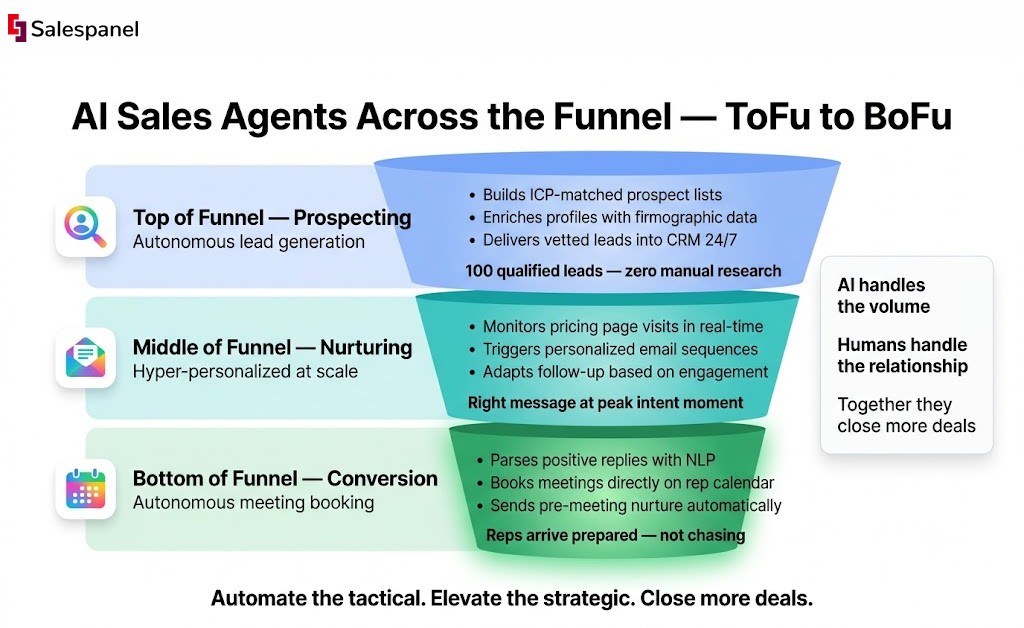
The theoretical framework of AI agents becomes tangible when applied to the distinct stages of the B2B sales funnel. Here, AI agents for sales transition from an abstract concept to a tactical asset that generates pipeline, nurtures interest, and accelerates conversions. Their primary function is to assume the high-volume, data-intensive tasks that consume human capital, thereby liberating sales professionals to focus on relationship-building and closing complex deals.
The core theme remains consistent: automating the tactical to elevate the strategic.
Top of Funnel: Autonomous Prospecting and Enrichment
The top of the funnel (ToFu) has traditionally been defined by laborious, manual prospecting. AI agents automate this entire stage with a level of precision and speed unattainable by human teams.
A sales leader can provide a high-level directive: “Build a list of 100 VPs of Engineering at Series B fintech companies in North America with verified contact information.”
The agent’s autonomous workflow is as follows:
- Data Aggregation: It queries data sources like LinkedIn Sales Navigator, corporate databases (e.g., Crunchbase), and industry news sites to compile a preliminary list of target individuals and companies.
- Profile Enrichment: The agent then uses API calls to data enrichment services to append crucial data points: verified email addresses, direct-dial phone numbers, company tech stack, and recent funding announcements.
- ICP Validation: Finally, it programmatically cross-references each enriched profile against the Ideal Customer Profile (ICP) stored in its memory, filtering out any contacts that do not meet the precise criteria (e.g., company size, specific technologies used).
The result is a continuous, 24/7 flow of highly qualified, pre-vetted leads delivered directly into the CRM, transforming the sales team’s morning routine from a research project into an actionable call list.
Middle of Funnel: Hyper-Personalized Nurturing
Once a lead is identified, the middle of the funnel (MoFu) focuses on cultivating interest and demonstrating value. This is where AI agents leverage real-time behavioral data to execute hyper-personalized outreach at scale.
Practical Example: An agent integrated with a tool like website visitor tracking from Salespanel can monitor on-site behavior. When a prospect from a target account visits the pricing page three times in a single week, this action serves as a high-intent trigger.
- The agent is activated with a new goal: “Nurture this high-intent lead with a personalized email sequence.”
- The LLM crafts an email that is not just personalized with the prospect’s name and company, but contextualized with their behavior. The copy might reference their specific interest in a particular feature tier.
- The agent continues to monitor engagement (opens, clicks) and adapts the follow-up messaging accordingly, creating a dynamic, responsive conversation.
This approach replaces generic email blasts with timely, relevant communication that significantly increases the probability of conversion.
Bottom of Funnel: Autonomous Conversion and Scheduling
At the bottom of the funnel (BoFu), the objective is to convert interest into a concrete sales action, typically a booked meeting. AI agents eliminate the administrative friction that plagues this stage.
When a prospect responds positively to an outreach email (e.g., “Yes, I’d be interested in a demo”), the agent takes over the final steps:
- Intent Recognition: The agent uses Natural Language Processing (NLP) to parse the reply and confirm positive intent.
- Autonomous Scheduling: It accesses the sales representative’s calendar via API, identifies available time slots, and presents them to the prospect. Upon selection, it automatically books the meeting on both calendars.
- Pre-Meeting Nurture: The agent sends the calendar invitation, a confirmation email with a meeting agenda, and automated reminders containing relevant case studies or resources, which drastically reduces the no-show rate.
This workflow ensures that sales representatives spend their time conducting high-value meetings, not managing their calendars.
Your Strategic Implementation Roadmap
Implementing AI agents for sales is not a simple software installation; it is the integration of a new, autonomous workforce. The success of this initiative hinges on a strategic, data-first approach. The central theme here is that an agent’s intelligence is a direct function of the quality of the data it consumes. An AI operating on incomplete or inaccurate data will produce flawed outcomes.
This data-centric philosophy is the bedrock of modern marketing technology. The core purpose of a feature like website visitor tracking from Salespanel is to build that pristine data layer, capturing behavioral signals that, when unified with firmographic and CRM data, create the rich customer profiles necessary for an AI agent to operate effectively.
Define Clear and Measurable Goals
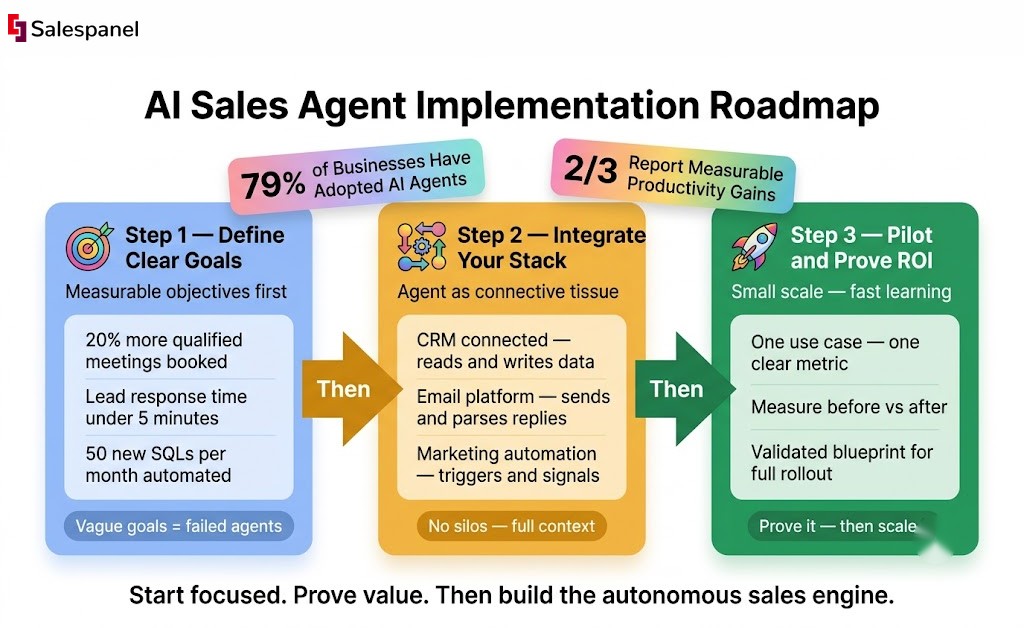
The first step is to define the agent’s purpose with quantifiable objectives. A vague goal like “improve sales” is unactionable. An AI agent requires a precise, measurable directive to orient its actions and to allow for ROI calculation.
Practical Examples of Well-Defined Goals:
- Increase qualified meetings booked by 20% in the next quarter by tasking an agent with autonomously engaging website visitors who match our ICP.
- Reduce average lead response time to under five minutes for all inbound demo requests submitted via the corporate website.
- Generate 50 new Sales Qualified Leads (SQLs) per month from our target account list by automating the initial research, data enrichment, and outreach sequence.
These goals provide the agent with a clear “prime directive” and establish concrete benchmarks for success.
Integrate Workflows for Seamless Automation
An AI agent’s value is maximized when it is deeply integrated into the existing sales and marketing technology stack. It cannot operate in a silo. The objective is to create a seamless, autonomous system where the agent acts as the intelligent connective tissue between platforms.
This requires direct API connections to core systems:
- CRM (e.g., Salesforce, HubSpot): The agent must be able to read lead data, update contact records with new information, log its activities for reporting, and create follow-up tasks for human representatives.
- Marketing Automation Platform: It must be able to trigger and be triggered by marketing campaigns, using data points like email opens, clicks, and content downloads as signals for its next action.
- Communication Channels (e.g., Gmail, Outlook): The agent requires API access to send emails, parse replies for intent, and manage the flow of conversation within a prospect’s inbox.
A properly integrated agent can execute complex workflows autonomously. For instance, upon identifying a high-fit lead, it can enrich the contact in the CRM, initiate a personalized email sequence, and schedule a follow-up task for a sales rep—all in one fluid, instantaneous motion. An AI automation agency can be instrumental in architecting such integrated systems.
Start with a Pilot Project to Prove Value
Resist the temptation for a full-scale, “big bang” rollout. This approach introduces unnecessary risk and makes it difficult to isolate variables and measure impact. A more prudent strategy is to begin with a focused pilot project.
Takeaway: Select a single, well-defined use case with a clear success metric. For example, deploy one AI agent with the sole task of qualifying and scheduling meetings from a single inbound channel, such as webinar sign-ups.
This controlled environment allows for rapid testing, iteration, and learning. A successful pilot accomplishes two critical objectives:
- It provides hard, quantitative data to build a compelling business case for wider adoption, demonstrating tangible ROI to stakeholders.
- It allows the team to develop the internal processes and expertise required to manage and scale an autonomous salesforce effectively.
Once value is proven on a small scale, you have a validated blueprint for expansion.
Measuring The ROI Of Your AI Sales Agents
Deploying an AI agent for sales is a strategic investment that demands rigorous performance measurement. To justify this investment, analysis must move beyond vanity metrics (e.g., “emails sent”) and focus on Key Performance Indicators (KPIs) that directly correlate to business impact. The core of ROI calculation is connecting the agent’s autonomous activities to measurable improvements in operational efficiency and net new revenue.
The framework for calculating Return on Investment is a straightforward comparison of the value generated against the costs incurred. This value is categorized into two primary buckets: efficiency gains (cost savings) and revenue generation (new income).
Defining Your Key Performance Indicators
Accurate ROI measurement begins with tracking the right metrics from day one. These KPIs should be directly tied to the specific goals established during the implementation phase, creating a clear before-and-after analysis of the agent’s impact.
Essential KPIs to Monitor:
- Lead Response Time: The time elapsed from an inbound lead’s creation to the agent’s first engagement. A significant reduction is a direct indicator of improved efficiency and often correlates with higher conversion rates.
- Cost Per Acquired Lead (CPL): By automating top-of-funnel activities, AI agents can dramatically reduce the labor costs associated with lead generation.
- SQL-to-Meeting Conversion Rate: This measures the agent’s effectiveness. Of the leads the agent qualifies, what percentage are successfully converted into a booked meeting for the sales team?
- Sales Cycle Length: The average time from initial contact to a closed deal. AI-driven automation in follow-up and scheduling should shorten this cycle.
The ultimate takeaway is to establish a direct causal link between these operational improvements and revenue. With robust analytics tracking the full customer journey, attributing new deals to the AI’s efforts becomes a data-driven exercise rather than speculation.
A Simple Framework For Calculating ROI
While specific inputs will vary, a universal formula provides a clear method for quantifying the value delivered by an AI sales agent.
ROI (%) = [ (Efficiency Gains + New Revenue Generated) – Investment Cost ] / Investment Cost * 100
- Efficiency Gains ($): Calculate the monetary value of reclaimed human hours. Practical Example: If an agent saves each of five SDRs 10 hours per week (50 hours total) and the fully-loaded cost of an SDR is $50/hour, the weekly efficiency gain is $2,500. This is time that can now be reallocated to high-value selling activities.
- New Revenue Generated ($): Directly attribute closed-won deals that were sourced, nurtured, or scheduled exclusively by the AI agent.
- Investment Cost ($): Sum the total cost of ownership, including software subscription fees and any one-time implementation or integration costs.
The business case for AI agents is being built on these calculations. A reported 79% of businesses have adopted AI agents in some capacity, with two-thirds reporting measurable productivity gains. For sales, Bain estimates that AI can relieve sellers from 75% of their non-selling tasks, effectively doubling their capacity for strategic engagement.
Key Performance Indicators For AI Sales Agents
To truly understand the value your AI agents bring to the table, you need to track a mix of metrics. Some will show immediate efficiency improvements, while others will tie directly to the bottom line. This table breaks down the essential KPIs to monitor, helping you build a clear picture of performance and justify the investment in your AI-powered sales pipeline initiatives.
| Metric Category | Specific KPI | Why It Matters For AI Agents |
|---|---|---|
| Efficiency & Speed | Lead Response Time | Measures how quickly the agent engages new leads. A lower time often correlates directly with higher conversion rates. |
| Efficiency & Speed | Sales Cycle Length | Tracks the time from initial contact to close. AI automation should shorten this by accelerating follow-ups and scheduling. |
| Cost Savings | Cost Per Acquired Lead (CPL) | Shows how much you’re spending to get a qualified lead. AI should lower this by automating outreach and qualification. |
| Cost Savings | SDR/AE Time Saved | Quantifies the human hours reclaimed from repetitive tasks, which can be reallocated to strategic selling activities. |
| Effectiveness & Conversion | Lead-to-SQL Rate | Assesses the quality of leads the AI is identifying. Are they actually meeting the criteria to become a sales-qualified lead? |
| Effectiveness & Conversion | SQL-to-Meeting Conversion Rate | A direct measure of the agent’s ability to not just qualify, but successfully book meetings for the sales team. |
| Revenue Impact | AI-Sourced Pipeline Value | Tracks the total potential revenue from opportunities that were initiated or significantly advanced by the AI agent. |
| Revenue Impact | AI-Influenced Revenue | Measures the final closed-won revenue from deals where the AI agent played a key role in the sales process. |
By closely monitoring these metrics, you can make data-driven decisions to optimize your AI strategy and maximize its impact on the sales pipeline and overall revenue.
The Future Is Human-AI Collaboration In Sales
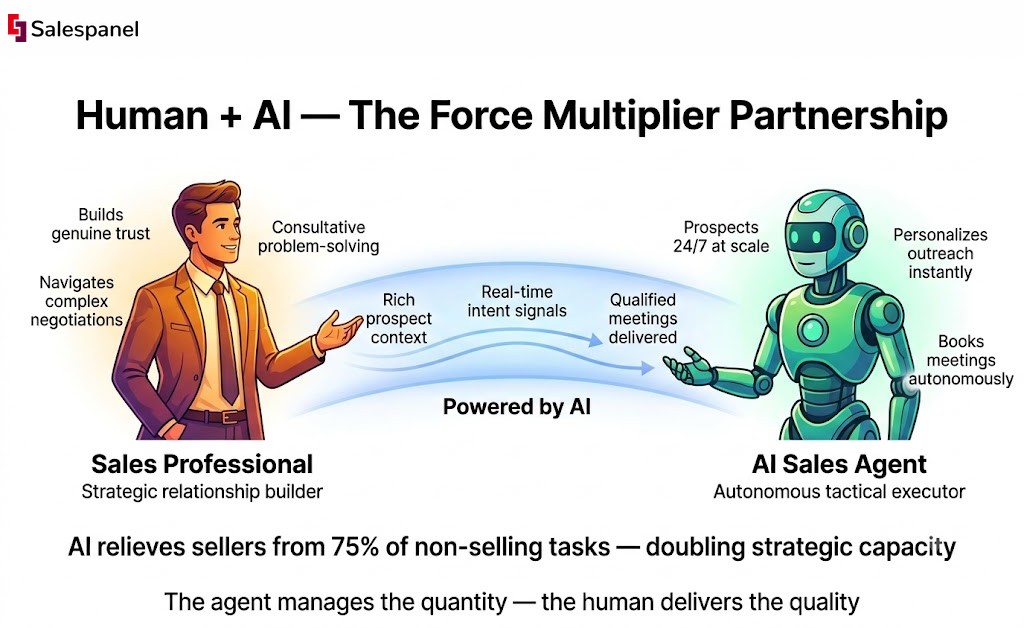
The narrative that AI agents for sales will render human salespeople obsolete is a fundamental misinterpretation of their function. This technological evolution is not about replacement; it is about augmentation. The central theme of the future sales organization is a symbiotic partnership between human and machine intelligence.
AI agents are designed to handle the operational backbone of sales—the high-volume, data-intensive, repetitive tasks—with superhuman efficiency. This systematically removes the administrative burden from sales professionals, allowing them to evolve from transactional executors to strategic relationship architects.
The New Role of the Sales Professional
As AI automates prospecting, initial outreach, and scheduling, the value proposition of the human salesperson shifts dramatically toward uniquely human competencies that AI cannot replicate.
- Building Genuine Trust: An AI can personalize an email based on data points, but it cannot build the deep, authentic rapport required to close a complex, high-stakes enterprise deal. This remains the exclusive domain of human interaction.
- Navigating Complex Negotiations: Successful negotiation requires reading social cues, understanding unspoken political dynamics within a client’s organization, and devising creative compromises—skills rooted in empathy and situational awareness.
- Strategic Problem-Solving: Elite salespeople function as expert consultants. They diagnose nuanced business challenges and co-create solutions with their clients. This level of consultative thinking is far beyond the scope of current AI.
A Force Multiplier, Not a Replacement
The most accurate way to frame the role of an AI sales agent is as a force multiplier. It does not replace the human team; it amplifies its effectiveness. By autonomously managing the top of the funnel, the agent delivers a consistent stream of highly qualified, engaged opportunities. This allows human sales reps to enter the conversation at the most impactful moment, armed with rich context and prepared for a strategic discussion.
The core takeaway is one of empowerment. This technology is an indispensable partner for achieving unprecedented levels of growth and efficiency. By integrating AI agents, sales teams can offload the tactical grind to focus on strategic, relationship-driven selling.
This synergy is entirely dependent on a solid data foundation. An AI agent is only as effective as the data it’s fed. Salespanel’s philosophy is built around this principle; features like website visitor tracking from Salespanel are designed to construct that pristine data layer first, ensuring every action the AI agent takes is informed by accurate, real-time intelligence.
The path forward is clear. The sales organizations that will dominate the next decade are those that master the art of blending the analytical power of AI with the irreplaceable value of human connection. The future is not human or AI; it is human and AI, working in concert to redefine the limits of performance.
Got Questions About AI Sales Agents?
Adopting any new technology introduces critical questions. Here are concise answers to the most common inquiries regarding AI agents for sales.
How Are AI Agents Different from Regular Automation?
The fundamental distinction is autonomy versus instruction.
Traditional automation is rule-based and procedural. It operates on a strict “if this, then that” logic that must be explicitly programmed by a human. For example: IF a form is submitted, THEN send email template #1. It cannot deviate from its script.
An AI agent is goal-oriented and autonomous. You provide a high-level objective, such as “book meetings with qualified leads from our last webinar.” The agent then independently determines the necessary steps—researching leads, composing personalized emails, and conducting intelligent follow-up—to achieve that goal. It thinks and adapts, whereas traditional automation only executes.
What Kind of Technical Skills Do We Need?
The required technical expertise varies by platform. While some advanced systems may require engineering resources for custom API integrations and model training, a growing number of platforms feature no-code interfaces designed for business users.
For most teams, the critical skills are strategic, not technical:
- Goal Definition: The ability to set clear, measurable objectives for the agent.
- Process Acumen: A deep understanding of your sales process to identify ideal workflows for automation.
- Data Hygiene: Ensuring clean, structured data in your CRM and other systems for the agent to use effectively.
A sales operations professional with strong logical thinking can often manage the entire implementation without writing a single line of code.
Will AI Agents Replace Our Sales Team?
The consensus among industry analysts is that AI agents will cause an evolution, not a replacement, of sales roles like SDRs and BDRs.
AI agents excel at the repetitive, high-volume tasks that characterize the top of the sales funnel: lead research, mass personalization, and initial qualification. They execute these tasks with unparalleled speed and efficiency.
The powerful takeaway is this: the agent automates the monotonous work, which liberates the human team to concentrate on high-value, strategic activities. Instead of spending hours prospecting, your SDRs can dedicate their time to conducting in-depth discovery calls, nurturing key accounts, and solving complex customer problems—tasks where human creativity, empathy, and strategic thinking are irreplaceable. The agent manages the quantity, enabling your team to deliver superior quality.
Ready to build the data foundation your AI agents need to succeed? Salespanel provides the robust tracking and identity resolution to power your anonymous traffic conversion engine. Explore our resources to learn how to turn anonymous traffic into actionable intelligence.