B2B First-Party Data Collection: Methods, Examples, and Activation
The B2B Marketing Playbook for Third-Party Data Is Now Irrelevant.
For over a decade, marketers have been renting data as they operated in a landscape dominated by third-party cookies. Third-party cookies are being phased out. Due to regulatory shifts, a 2021 Merkle report states that 88% of marketers say collecting first-party data is a priority, yet many are unprepared. First-party data collection strategies define B2B marketing today. This guide is a practical technical framework.
The End of an Era for B2B Marketing
The use of third-party cookies has been phased out. This alters the entire digital landscape when it comes to advertising and targeting audiences. This is a huge shift, and a long-standing B2B marketing practice is now rendered invalid. Not adapting and enhancing first-party data collection will cause severe operational blindness. There will be an inability to track, personalize, and convert prospects. The key moving forward will be the change from rented, probabilistic data to owned, deterministic data.
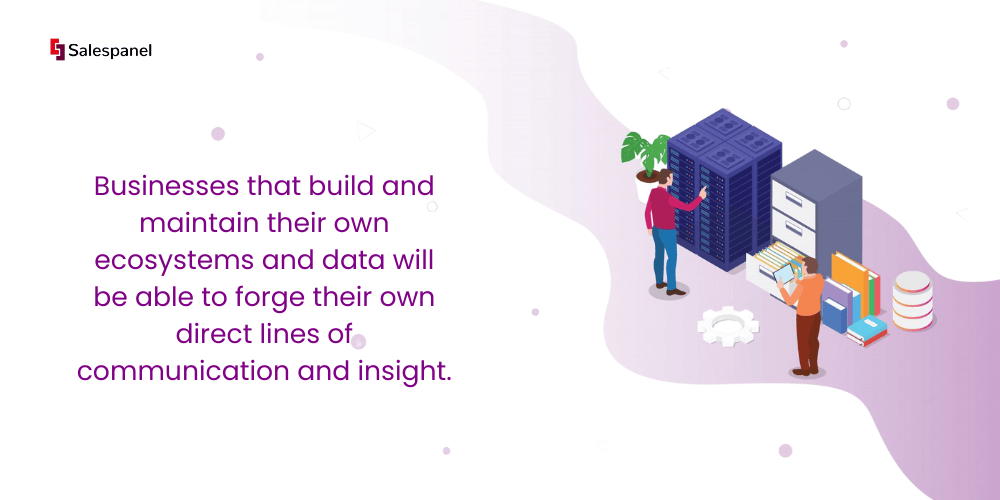
Businesses that build and maintain their own ecosystems and data will be able to forge their own direct lines of communication and insight.
The Shift from Borrowed to Owned Data
At its core, this industry-wide pivot forces a move from “renting” audiences on external platforms to developing direct, consent-based relationships. The previous model that relied on third-party tracking was inefficient and often opaque, creating a data model that potentially misrepresented the buyer’s journey. The new paradigm, built on direct interaction, provides a far more complete and accurate understanding of buyer intent and behavior. This isn’t just checking a box or complying with regulations. This is a competitive advantage. Prioritizing first-party data allows companies to:
- Build Deeper Customer Profiles: Create reliable and multi-faceted personas for customers and prospects from their active interactions with your digital properties.
- Improve Targeting and Personalization: Stop relying on broad demographic buckets and target customers with intuitive experiences based on their behavioral data and declared interests.
- Future-Proof Your Marketing Strategy: Build a data asset that is yours to control and proprietary. It won’t be disrupted by changes to browsers and regulations related to privacy.
In a world of privacy regulations, knowing customers and anticipating their needs to drive growth depends on first-party data.
Fueling the Next Generation of Marketing
This transition coincides with the rise of AI-powered marketing technologies. Marketing and advertising are fueled by AI technologies. Advanced AI and large language models (LLMs) require clean, high-quality, permission-based data to function effectively. First-party data is projected to be the foundational layer for all marketing and research by 2026. Only first-party data provides the context-rich and reliable information the sophisticated systems need to make marketing and advertising more optimal with accurate predictions and personalized outputs.
Unlike scraped or third-party data, first-party data is free from the biases and gaps that cause bad business intelligence that results in the loss of customer trust. To appreciate the complexity of AI and signal loss, we encourage you to learn more about how the interplay is shaping first-party data.
For B2B marketers hoping to develop trustworthy and reliable revenue-generating customer relationships, mastering first-party data collection is more than a requisite. This guide contains a detailed and actionable blueprint to that end.
What First-Party Data Actually Looks Like in B2B
First-party data is the heart of an organization in that it is the collection of all activities initiated by potential clients and customers interacting with the brand. Potential clients and customers create data points every time they click on the website, submit a form, and open an email, revealing the narrative of their journey with the brand. This is the most reliable form of business intelligence for any organization.
In a business case, the sales cycle is generally long and involves several parties. A fully integrated first-party data strategy lets marketers stitch together seemingly isolated data points, building a complete picture of a buying committee, their pain points, and a solutions gap. This is the fuel of a highly adaptive, smart marketing engine.
The Three Main Flavors of B2B First-Party Data
To manage first-party data successfully, it is helpful to classify it by source and type. In a B2B setting, data generally comes in one of three primary forms, each adding a different dimension to the customer profile.
- Behavioral Data: Behavioral data examines how users interact with your platform, including data points like website clicks, time spent on each page, content engaged with, and features used, and can indicate user intent and interest. This type of data examines user engagement and can indicate whether a user is near a buying decision, like in the case of a user who significantly frequents the site’s pricing page.
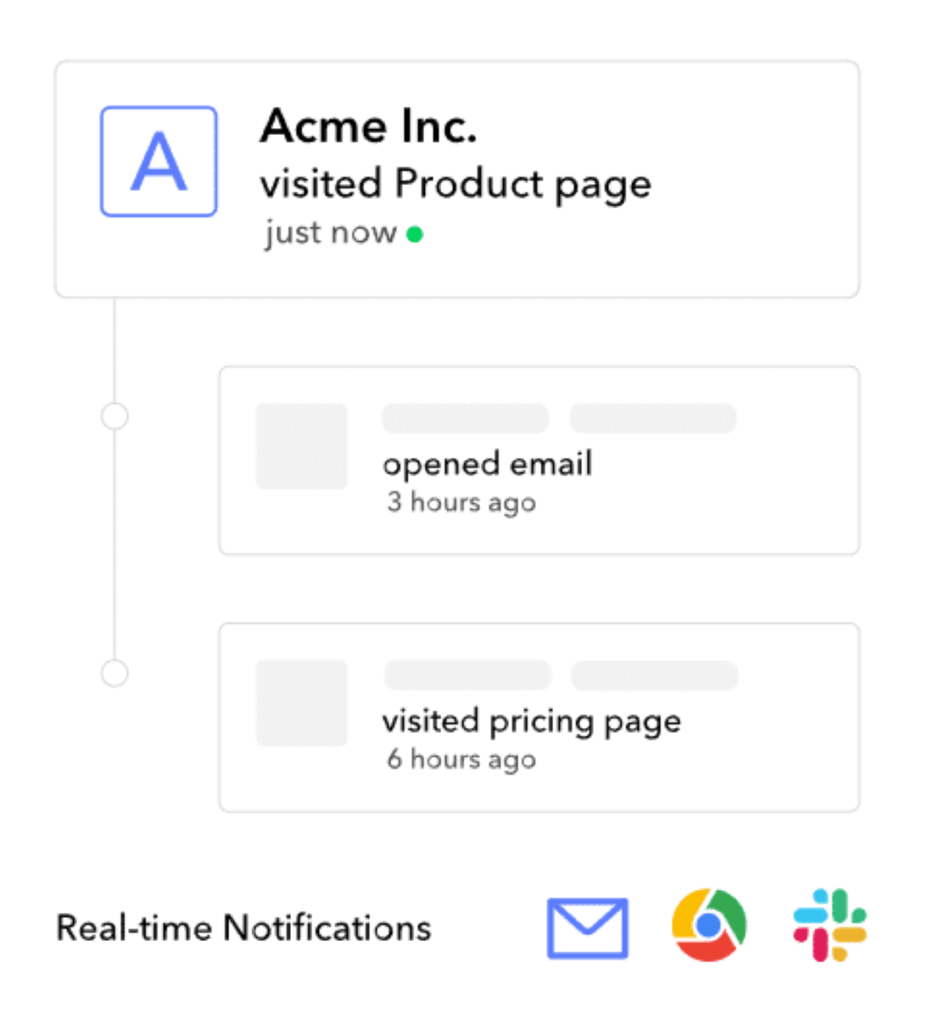
- Declared Data: Declared data is when users voluntarily provide information and is also referred to as ‘zero-party data’. Examples of this data layer would be the responses to forms and surveys, and include information, for instance, like a user’s name, company name, job title, and the business challenges they are encountering in contact forms or webinar registrations.
- Transactional Data: This data includes the user’s overall activity and commercial engagements with the company, including product usage, subscription status, and purchase history. This is critical data to monitor product adoption, inform on likely product churn, and recognize upsell opportunities.
Real-World Examples from a B2B Sales Cycle
Applying this, consider an Operations Manager at a mid-sized manufacturing company conducting research to source a new inventory management solution.
Self-Situation: An Operations Manager requires a more efficient system for inventory management.
- Initial Discovery (Behavioral Data): The manager discovers and reads your blog post, “5 Signs Your Inventory Management is Costing You Money.” They then click through to a related case study. Your web analytics platform records this digital journey, logging the URLs visited, time on page, and content topics engaged with. This is the first verifiable signal of intent.
- Gated Content (Declared Data): The manager completes the form with their name, email, company, and job title to get access to your “Ultimate Guide to Inventory Optimization.” This converts them into a known lead, linking their expressed name to the behavior profile created in the first step.
- Deeper Engagement (Behavioral & Declared Data): A week later, the same user returns to review product features and the pricing calculator. Simultaneously, another visitor from the same company’s IP address begins browsing similar pages. Thanks to Salespanel’s website visitor tracking, these separate sessions can be associated with the same account, revealing the formation of a buying committee. This user has deeply engaged by registering for a webinar, adding to the data we have on this user.
You’re no longer marketing to a faceless ghost, but instead, a concrete, identifiable active buying group with a specific set of needs and a distinctly defined decision-making process. You’ve been piecing together their online behavior and understanding their needs in order to build a detailed profile.
Thanks to the integration of intelligence into the marketing ecosystem, it is no longer a one-way communication, but rather a stream of actions taken by marketers in response to the data received. A marketing account can be dropped into a nurture sequence, have a sales rep assigned with the current context, or a personalized website experience can be served the next time they visit. Such is the operational muscle of first-party data.
How First-Party Data Fuels B2B Growth
Having first-party data is like having a high-resolution, clear picture, while having third-party data is more like looking at a blurry picture. B2B marketing has historically relied on borrowed data and probabilistic models, which resulted in shooting arrows in the dark. First-party data, on the other hand, gives a deterministic, factual account of customer intent based on actions taken on your digital assets.
This allows for more clarity, which means a more pronounced shift from assumption-based marketing to data-driven decision-making. It is the core component that draws the line between the leading players in the market and the rest, making it possible for the marketing function to go from a cost center to a revenue-generating powerhouse.
Supercharging Lead Scoring and Prioritization
The effectiveness of a model to score leads is greatly determined by the quality of input data. First-party behavioral data is the best type of data for these models, enabling lead scoring based on actual actions taken, rather than static demographics.
Someone who downloads a white paper is a potential customer. But there is a big difference between that and someone who downloads a white paper, goes to the pricing page, and then watches a demo. Salespanel is designed to capture these sorts of things with this scoring framework.
Using first-party data granularity increases a lot:
- Action-Based Triggers: Point values can be assigned to actions that are considered to have a higher intent, such as engaging with an ROI calculator or viewing a case study that’s specific to a particular industry.
- Engagement Velocity: Keep track of the frequency and recency of actions. If an account becomes very active all of a sudden, that may mean they are doing research and trying to move things along.
- Content Affinity: Try to track the specific collateral or features a particular account uses to determine the main challenges they have that will need to be addressed in the first conversation with a sales rep.
Driving Hyper-Targeted ABM Campaigns
Account-Based Marketing (ABM) is predicated on delivering bespoke experiences to the highest value target accounts. First-party data allows this approach to be operationally feasible. Instead of sending a blast to an entire organization, you can customize your outreach to account for specific employee behavior.
Picture this: There’s a key decision-maker at a target account, and they just spent five whole minutes on your integrations page. Your outreach changes entirely from a cold, “Here’s what our product does” to a much warmer and relevant, “I noticed you were researching our Salesforce integration—here’s how we solve that specific challenge.”
This shows a much better type of marketing and clear empathy for the prospect’s situation. As the graphic below shows, the strategic advantages of cumulative ROI and trust from the customers are a huge gain.
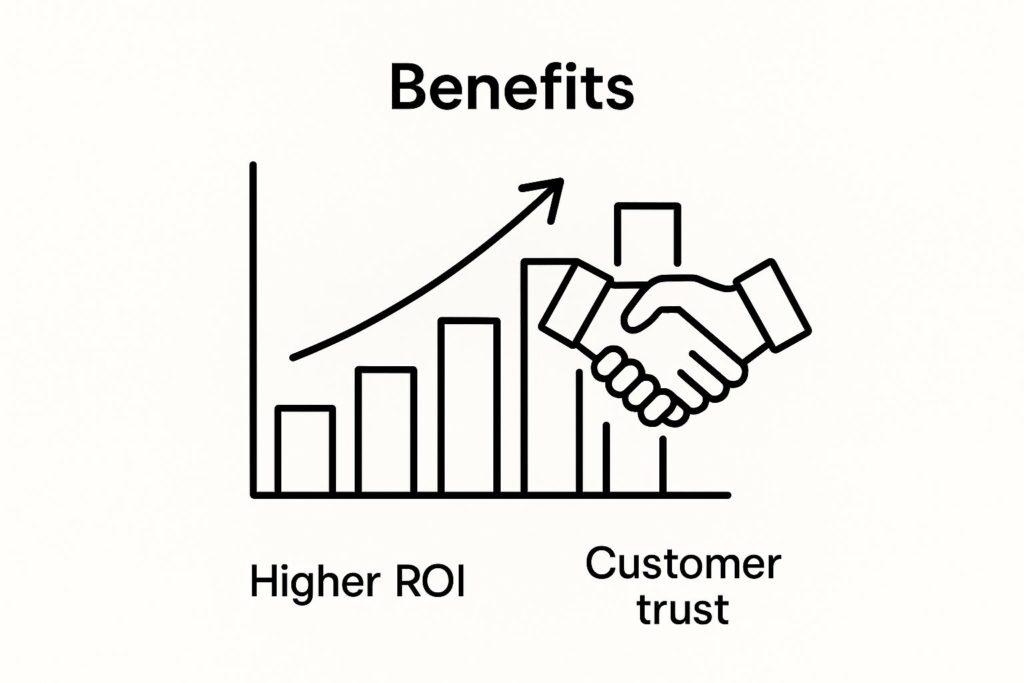
The takeaway is clear: First-party data strategies allow businesses to build firmer connections, which can be directly translated into profits.
Radically Lowering Customer Acquisition Costs
The money value of first-party data strategies is always positive and always evident. Companies using this approach get results like increased efficiency, better conversion rates, and a lower cost of customer acquisition (CAC) by up to 30%.

How does this happen? Less waste. In marketing, money is spent on a larger audience, which might be uninterested. When marketing is focused on a smaller audience, who have actually expressed interest, resources get used better.
Below is a table outlining the benefits of this focused marketing approach.
Impact of First-Party Data on B2B Marketing KPIs:
| Metric | Without First-Party Data Strategy | With a First-Party Data Strategy |
|---|---|---|
| Lead Quality | Low to moderate; based on demographics | High, based on demonstrated behavior and intent |
| Conversion Rate | Industry average (for example, 2–3%) | Up to 2× higher than baseline |
| Customer Acquisition Cost (CAC) | Highly significant ad spend on cold audiences | Up to 30% lower due to improved targeting |
| Personalization | Generic, segment-based messaging | 1:1 personalization at scale |
| Sales Cycle Length | Longer; the sales team educates from scratch | Shorter; sales teams engage already informed buyers |
In the end, we must meet the expectations of the modern customer. Now more than ever, buyers want a more personalized experience, so we ought to have the knowledge to provide that experience.
To view the full breadth of this topic, you can investigate the impact of first-party data on B2B demand generation. Growth will be best when you own your data, making your marketing engine more predictable, efficient, and lucrative.
Building Trust Through Data Transparency
In the B2B context, trust is a valuable commodity. Having first-party data means you have a responsibility to act as a trustworthy and ethical guardian of that data. This is around ethics and responsibilities, but it is also about compliance, which is changing the dynamics of how businesses interact with their customers.
Trust can be lost easily, and the damage is severe. Trust can also be gained easily and the dead weight of compliance is transformed into a competitive advantage. Having a relationship where your data practices and compliance are communicated clearly demonstrates a level of trust that is the starting point of any meaningful business relationship.
From Legal Hurdle to Marketing Advantage
The EU General Data Protection Regulation (GDPR) and the California Consumer Privacy Act (CCPA) have changed the rules on how businesses collect data, including regulations on the collection of sensitive information and direct marketing practices, which makes the use of third parties in marketing data options no longer compliant (EU GDPR). There has been a pivot to using first-party data. Marketers are encouraged to master the use of first-party data in their marketing strategies.
The goal no longer lies in setting up new ways to covertly track the users’ movement, but to track their focus in order to create a strong and irresistible value offering that makes them willingly share their details.
Crafting a Clear Value Exchange
The collection of first-party data ethically lies in the value exchange system. It is about how to offer something of value, and in exchange that your audience gives their data to your business. This value exchange should be apparent, visible, and beneficial to both parties.
In order to build Trust, three main aspects must be observed.
- Radical Transparency: Your privacy policy must be accessible and written in plain language. Statistically, most explanations of how data is used are difficult to read, very verbose, legally caveated, and therefore, very unclear. A documented privacy policy of a business should explain plainly: What data is it collecting? How do you intend to use the data? And how will the data enhance the user experience?
- User Control: Give your users control over their data. Allow people to manage their communication preferences, pick topics to receive information about, and easily unsubscribe through your preferences center. Having this control builds agency and trust.
- Demonstrable Benefit: If you are going to collect data in order to customize someone’s experience, you need to customize their experience. Show your users the personalization that comes from the data they share with you, and make it clear to them that it is more relevant content, product recommendations, or an efficient sales process.
Users will be more likely to share their data when they are able to experience a more relevant, customized experience. Compliance then becomes an outcome of a positive user experience and the marketing process without any friction.
In the end, marketing outcomes are improved as a result of transparency and control over their data. Respecting user data builds robust relationships, generates quality leads, and fosters an aligned reputation.
Your Playbook for High-Quality Data Collection
Having acknowledged the strategic value, we are getting down to the practical side of things. A solid first-party data collection program does not have one single tool but an integrated collection of techniques to capture intent signals across all digital touchpoints. A primary principle should be a defining value exchange: every mechanism of data collection should offer some value to the user and thus motivate them to share their data.
This playbook takes you all the way from basic approaches to advanced techniques and details a systematic approach. The aim is to scale a data ecosystem in which customers are profiled, and every single touch on your system, from a page view to a form submission, gives sales and marketing teams something to work on.
Foundational Building Blocks: The Value Exchange
The simplest way to kick off first-party data collection is to offer something of high value in exchange for contact details. This is a classic B2B approach, and it is very effective because both customers and suppliers benefit.
The key methods for this exchange are gated content and interactive events, which appeal to prospects in search of solutions.
- Gated Content (Ebooks, Whitepapers, and Reports): These are detailed documents that tackle particular issues your ideal customer profile faces. The ebook, “A Technical Guideline to Reducing Costs in Supply Chain for SMBs,” beats any generic product brochure. When a user fills out a form to retrieve the ebook, you obtain a strategically in-demand contact, not just an email.
- Interactive Webinars and Workshops: You can provide your audience with an in-depth analysis of any topic of your choosing using a webinar. There is also the opportunity to obtain considerable information. There is an opportunity to gather qualifying data through registration, such as company size and technology utilized. Post-session surveys are ideal for identifying new issues and collecting valuable information for the audience. The fact that someone took the time to show up to an activity is usually a strong indicator that they care about the subject.
Leveling Up Your On-Site Data Capture
On-site data capture is a method for collecting user data. There are basic ways of doing this, and in this instance, more complex ways are needed to gather information without user friction. These techniques primarily focus on enriching and expanding the data profile.
This iterative process begins by collecting just a name and email. First-time users can be confronted with forms that require a lot of information. Through collecting users’ information in steps with smart forms that recognize users and pull current information in from your company’s database, you can start building a more robust profile. This primary, iterative approach minimizes user friction and respects time by having users submit a form over their many visits.
This process must be seamless. As users interact with the company’s brand, collecting their information in a data-structured, iterative way makes users feel they are taking steps in their relationship with your brand.
Uncovering Intent from On-Site Behavior
On-site behavior gives a more detailed, telling picture of a user’s intent. While forms and the data they hold are valuable for collection, there are many times users exhibit behavior that indicates their intent. Buying signals, for example, are often not explicitly stated, but demonstrated through behavior. This becomes possible through a powerful system for tracking user behavior on your site.
Salespanel can provide a good starting point for this purpose. It analyzes the steps of individual users and entire accounts on your website instead of just the total number of your visitors. This goes way beyond aggregate analytics. Overall, it allows you to provide a more personalized and valuable experience to your users. Here is a practical workflow for turning anonymous visits into actionable leads.
- Recognize Anonymous Companies: In some cases, IP intelligence can identify the visitor’s company before a form is filled out. Observing several visitors from a target account engaging with product pages is a major purchasing signal. At that point, anonymous traffic can be qualified as an ABM opportunity.
- Monitor Patterns of Engagement: Track the pages that are visited, the session length, and whether any content is downloaded. It is a strong signal of interest and should trigger an immediate sales alert if a prospect from a target account spends 8 minutes on the pricing page and then looks at a case study for the industry.
- Map the Buying Committee: Rarely is a single individual the sole decider of a B2B purchase. By tracking multiple visitors from the same company, you can start to map the buying committee. If a technical user and a finance person are active at the same time, it means that the deal is likely moving to a purchase decision.
Putting these methods into place builds a first-party data collection system that not only captures leads but also enriches them with valuable behavioral data to turn your website into an exceptional data collection asset.
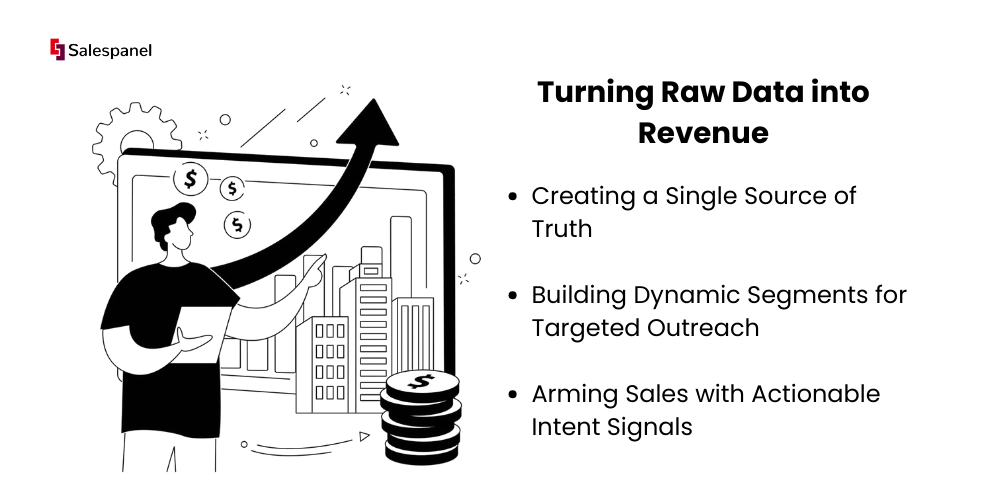
Turning Raw Data into Revenue
Having first-party data is like having access to unrefined ore; it has potential, but true value only comes after it has been refined. Data is activated by forming a coordinated set of actions from the various digital engagement and contact data. If there is no clear strategy to turn the collected inactive data into actions that work for your business, all you have is a collection of data.
The first step is unifying the data. Your website analytics, CRM, and marketing automation platforms are all a part of the data you have collected. Integrating these sources to create a single, clear view of each customer is the foundational step, and from there, a unified profile grants the ability for the sales and marketing teams to align their offers.
Creating a Single Source of Truth
A Single Customer View (SCV) is a business record that shows every interaction a customer has with your company. It pulls together behavioral data (e.g., downloaded content, pages visited) with data that contains firmographics and demographics (e.g., job title, company size). It is impossible to implement effective marketing and sales strategies without an SCV.
To achieve that, you’ll need to integrate your fundamental data sources. One universal technical approach is linking your website tracking tool to your CRM. For instance, when a lead fills a form, their entire previous on-site behavioral history should be automatically added to their contact record. This gives sales the complete scope of the lead’s research journey, instead of just a name and an email.
Building Dynamic Segments for Targeted Outreach
Once you have a complete customer view, you can move from lists for marketing that don’t change to more flexible segmentation. This allows you to categorize potential customers according to their current behaviors and attributes, thereby generating more relevant audiences for marketing campaigns. This is the operational foundation of effective Account-Based Marketing (ABM).
Let’s discuss how data segmentation can be applied in the following scenarios:
- High-Intent Accounts: One possible scenario is to create a dynamic segment consisting of companies with multiple stakeholders who have interacted with your pricing page in the last 14 days. This segment can easily become the target of a focused digital ad campaign or for direct sales outreach.
- Industry-Specific Nurturing: You can work on segmenting the prospects by industry (data can be captured via forms or enrichment through a third-party service) and implement automated email workflows with tailored case studies and relevant content to the specific industry vertical.
- Churn Risk Customers: Automated alerts to the customer success team can be triggered if a segment is formed of existing customers who have significantly declined their product usage over the previous 30 days.
A well-defined segment is ultimately not just a list. It is a singular audience that has a specific and urgent need. You can utilize your first-party data to identify and address such needs as they arise by ensuring that your communication is timely and relevant.
Arming Sales with Actionable Intent Signals
The main goal of activating data is to improve sales outcomes. Sales can stop doing gross cold outreach and start contacting leads with real, recent, and valid buying signals. That way, their outreach is not a nuisance, but rather a timely and helpful conversation. An advanced lead scoring system is one of the most powerful tools to make this happen.
Salespanel’s lead scoring system automatically processes and weighs both firmographic data and on-site behavior to figure out leads that are most worthy of your sales effort. The system can be fine-tuned to allocate points for varied actions of different and custom-defined values. These include, but are not limited to:
- Viewing the pricing page (+10 points)
- Downloading an industry-specific case study (+15 points)
- Requesting a demo (+50 points)
Once a lead’s score crosses a certain point, they get automatically assigned the status of Marketing Qualified Lead (MQL) and are sent to the right sales rep with a full timeline of their activities. This way, sales resources go only to accounts with definite buying intent, perfectly connecting your first-party data collection strategy to revenue growth.
Got Questions About First-Party Data? We’ve Got Answers.
Shifting to a first-party data strategy is an important step for any business, but it can also bring up a lot of questions regarding the technical and operational sides of things. This is a collection of the most common questions we get from B2B marketers.
How Can I Start Collecting First-Party Data on a Shoestring Budget?
You do not need a big budget to get started. Make the most of the tools you probably already have.
First, make sure you have some sort of free analytics tool, such as Google Analytics 4, set up and functioning on your website. This step is the foundation of any effort to understand user behavior. Then, use your website’s built-in form tools to provide some free, low-cost content that is valuable for an email submission, such as an industry checklist or a short research report. If you are tracking your leads and accounts on a B2B focused website, we highly recommend Salespanel.
Another tool you probably already have is your email marketing platform. If you have a subscriber base, you can get basic data on click-through rates, which is a form of interest, or you can do basic surveys. The main goal is to provide value, and in return, users will provide data.
What’s the Real Difference Between First-Party and Zero-Party Data?
These terms are similar but technically different.
First-party data refers to the information that you obtain from tracking the activities of users and their behavior. Things like what pages they visit, how long they stay on the site, their buying behavior, and how they interact with the content. You are predicting what they might want based on their behavior.
Zero-party data is a portion of first-party data that users are willing and consciously share with you. This is information they specifically state regarding their likes, wants, and needs. This can be in the form of quiz answers, survey responses, or what they choose in a preference center.
A helpful way to remember the difference is: First-party data is observing what a person does, while Zero-party data is understanding what a person says.
How Do I Keep My First-Party Data Clean and Accurate?
Data collection is not the only important thing to do. Data hygiene is essential for the success of a first-party data collection program. When data analytics is bad, the decisions made from it will be bad.
Start with the most fundamental best practices: creating form validations. This is to ensure that information such as email address or phone number is taken in the proper format. Set a cleanup frequency for your CRM and for your Marketing Lists with activities such as Deduplication, record merging for incomplete records, and contact information trimmed of old users.
Use progressive profiling on your web forms to improve user experience while still collecting their information. Instead of capturing all of a user’s information at the same time, capture their information a little at a time over a series of interactions. This will collect a lot of data over time without causing user friction. Most importantly, keep your data in a centralized data management system to ensure all areas of the information are consistent.
We hope you liked what we shared. If you have any feedback or want to learn more about first party data collection, please feel free to get in touch with us!
Sell more, understand your customers’ journey for free!
Sales and Marketing teams spend millions of dollars to bring visitors to your website. But do you track your customer’s journey? Do you know who buys and why?
Around 8% of your website traffic will sign up on your lead forms. What happens to the other 92% of your traffic? Can you identify your visiting accounts? Can you engage and retarget your qualified visitors even if they are not identified?