Outsourcing Lead Generation: A Buyer’s Guide for B2B Teams
What You’ll Be Able to Do Before You Outsource Lead Generation
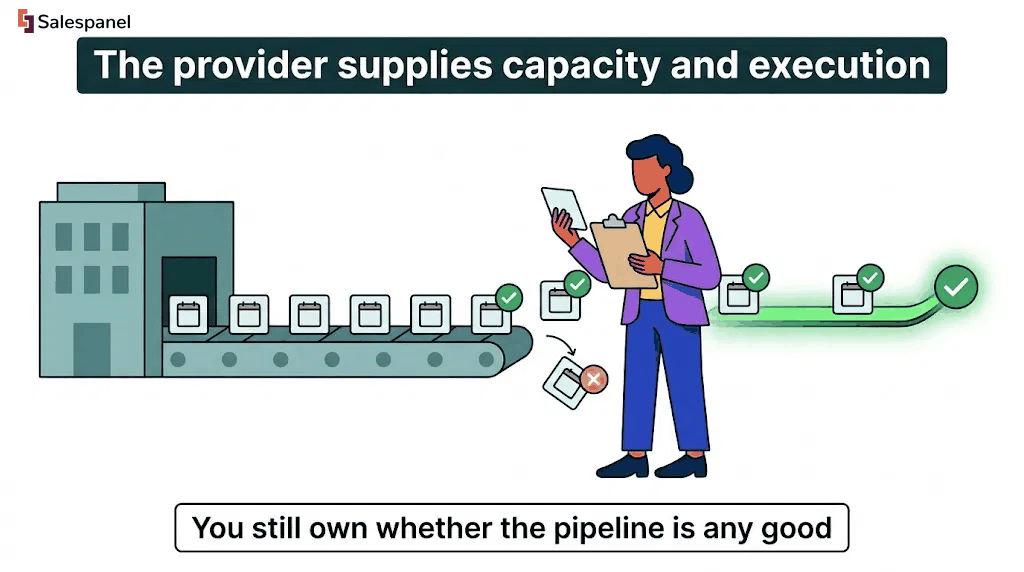
Outsourcing lead generation means hiring an external provider to run some or all of your prospecting work — account research, list building, outreach, appointment setting, or inbound qualification — while you keep ownership of your ICP, positioning, pipeline rules, and revenue accountability. The provider supplies capacity and execution. You still own whether the pipeline is any good.
I would like to talk about this as an operating-model decision rather than a shopping trip. Most guides on this topic open with a list of agency categories, which is useful only after you already know which part of your motion is broken. If your targeting is wrong, a provider with 40 SDRs will simply reach the wrong people faster.
By the end of this guide you should walk away with five artifacts: a documented scope, a shortlist of evaluation criteria, a pricing model you can defend internally, a pilot plan with a stop-or-scale rule, and a reporting scorecard that goes past booked meetings. That’s the output. A vendor list is the easy part.
This is written for B2B marketing, sales ops, RevOps, and growth teams buying the service — not for agencies selling it. We’ll move in sequence: diagnose the bottleneck, decide what to outsource, select and vet a provider, contract a pilot, then govern the results. If you want the broader context first, start with our guide to B2B lead generation.
Step 1: Confirm That Outsourcing Is the Right Fix
Outsourcing works when you already have a defined market and a sales motion that converts, and what you lack is repeatable capacity or a specialist skill you don’t want to hire for. It will not repair an unclear ICP, a weak offer, or a sales team that takes four days to call a booked meeting back.
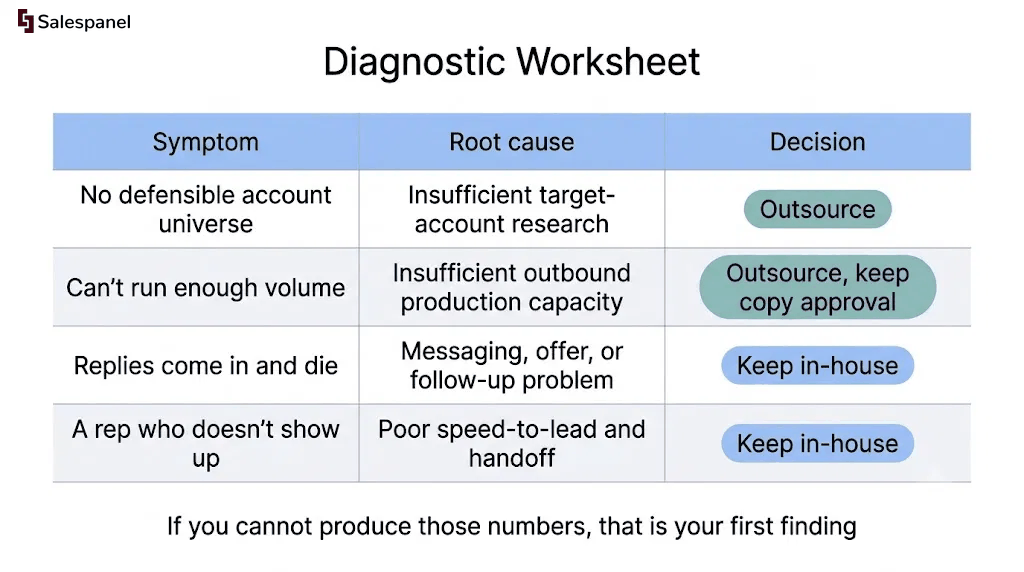
If we look at the teams that get burned, the pattern is usually the same: they diagnosed “we need more leads” when the actual constraint sat somewhere else in the funnel. There are four bottlenecks worth separating, and each has a different fix.
Insufficient target-account research. You know the segment but nobody has built a defensible account universe with the right contacts in it. This outsources well — research and data work is labor-shaped and quality is checkable.
Insufficient outbound production capacity. Messaging works, sequences convert, and you simply can’t run enough volume. Also outsources well, provided you keep copy approval.
Poor conversion from engaged accounts to booked meetings. Replies come in and die. That is usually a messaging, offer, or follow-up problem. Handing it to a provider rarely fixes it, because the provider will inherit the same offer.
Poor speed-to-lead and handoff after a meeting is booked. Entirely internal. No vendor can fix a rep who doesn’t show up.
Before you contact anyone, pull the last 30–60 days of pipeline data and count six things: target accounts worked, contacts reached, positive replies, meetings held, opportunities created, and sales-accepted leads. If you cannot produce those numbers, that is your first finding.
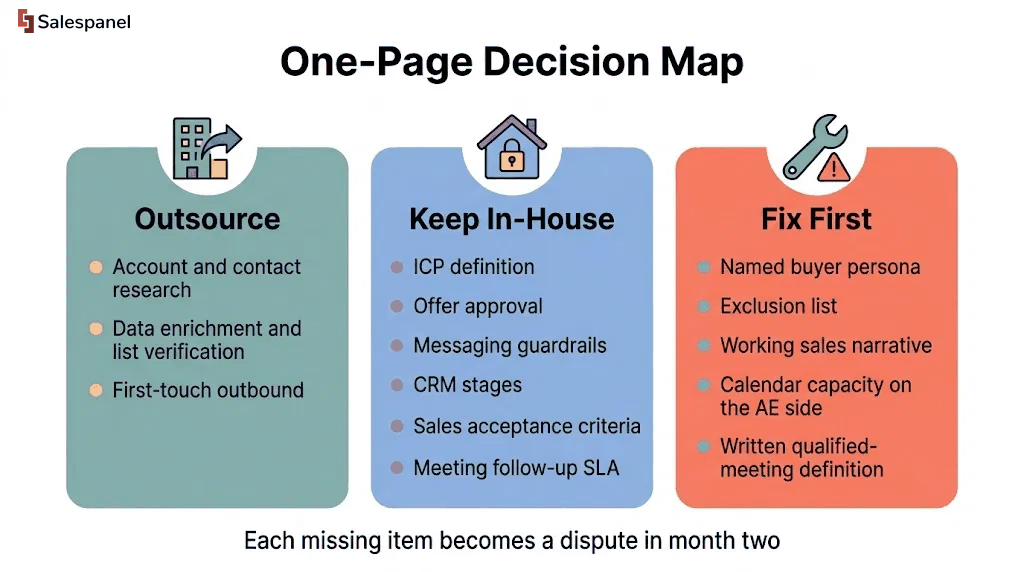
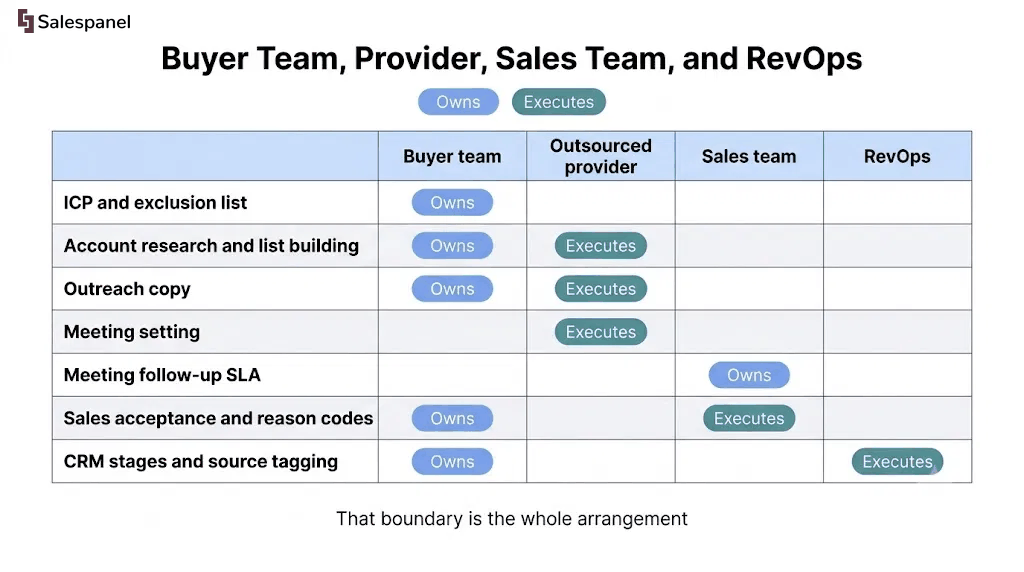
Now, what stays with you regardless of who you hire: ICP definition, offer approval, messaging guardrails, CRM stages, sales acceptance criteria, and the meeting follow-up SLA. A provider can propose changes to any of these. They should not own them.
Do not outsource yet if you have no named buyer persona, no exclusion list, no working sales narrative, no calendar capacity on the AE side, or no written agreement on what counts as a qualified meeting. Each missing item becomes a dispute in month two.
Watch out for: treating appointment volume as proof of demand. A calendar can be full and still produce zero opportunities when targeting and qualification are loose. That is the single most expensive misread in this category.
For the targeting foundation, see our ideal customer profile (ICP) guide. If email is part of the plan, read the FTC CAN-SPAM compliance guide before anyone writes a sequence.
Audit Your Existing Funnel Before You Buy
Export a flat file from your CRM with these minimum fields: lead source, account segment, owner, meeting date, meeting status, opportunity creation date, and closed-won status. Seven columns. If any of them are empty for most records, you’ve found a data hygiene problem that will corrupt your pilot measurement later.
Then calculate three ratios:
- Meeting show rate = held meetings ÷ booked meetings
- Sales acceptance rate = accepted leads ÷ submitted leads
- Opportunity rate = opportunities ÷ held meetings
Resist the urge to look up industry benchmarks here. Show rates and acceptance rates swing wildly by segment, deal size, and how strict your reps are about accepting anything. Your own trailing baseline is the only honest comparison, because when the provider’s numbers land you need to know whether they beat your normal, not a blended average from someone’s 2023 benchmark report.
Decide Whether You Need a Service, a Contractor, or a Hiring Plan
An outsourced provider, a freelance SDR, a recruiting firm, and an internal hire solve overlapping problems at very different costs and speeds.
A provider gives you a running system — tooling, data, management, and backup coverage — but you buy their process more than their people. A freelance SDR is cheaper and more flexible, and you manage them directly, which means you absorb the management load. A recruiting firm just hands you a candidate; you still build everything. An internal SDR takes the longest to ramp and costs the most upfront, and is the only option that compounds proprietary market knowledge inside your company.
Five factors should decide it: ramp time you can tolerate, management capacity you actually have, how much proprietary market knowledge the role needs, data-security constraints in your contracts, and how tightly you want to control messaging. Teams selling into regulated buyers often find that the data-security requirement alone eliminates half the provider market.
Step 2: Define the Exact Work You Will Outsource
The most reliable outsourcing arrangements buy a narrow, testable scope. Handing “pipeline generation” to a provider without defining inputs or acceptance criteria is how both sides end up arguing about effort instead of results.
Break the work into five purchasable components, and decide for each one whether it leaves the building:
- Account and contact research — building the account universe, mapping the buying committee, finding the right titles.
- Data enrichment and list verification — appending firmographics and technographics, validating emails, catching job changes.
- Outbound messaging and multichannel outreach — sequence writing, sending infrastructure, LinkedIn, calling, ad retargeting support.
- Inbound lead qualification and routing — working form fills, chat, and demo requests, then routing by rule.
- Meeting setting and nurture follow-up — booking, confirming, rescheduling no-shows, and recycling the “not now” accounts.
A worked example. A mid-market SaaS company doing $14K average contract value keeps positioning, sales narrative, and all discovery calls in-house. It outsources components 1, 2, and the first-touch portion of 3 — account research, verified contact data, and initial outbound — then takes over the moment a prospect replies positively. The provider never runs a discovery call, never changes the offer, and never owns a CRM stage past “meeting booked.” That boundary is the whole arrangement.
Now the part most buyers skip. Write down what a qualified lead or qualified meeting actually is, in fields, before you talk pricing. At minimum: company fit (size, segment, geography), buyer role and seniority, stated need in the prospect’s own words, current solution or status quo, timing signal, and consent or opt-in status where the channel requires it. If a meeting arrives missing three of those six, it isn’t qualified, and you’ve now got an objective basis to say so.
Service labels are close to meaningless at the buying stage. “Full-service lead generation” tells you nothing about who writes the copy, who approves the list, or who gets blamed when a meeting no-shows. Buy a measurable workflow with explicit acceptance criteria and named handoff points instead.
Supporting reading: our lead scoring guide for turning fit and engagement into a numeric threshold, and the B2B lead qualification framework for structuring the criteria above.
Build a One-Page Outsourcing Brief
One page. Not a 20-slide deck. The brief is what you send to every candidate provider so their proposals are comparable, and it’s what you hand to the winning team on day one.
Include:
- ICP and excluded accounts — including customers, competitors, partners, and anything with an open opportunity
- Target geography and languages
- Buyer titles and buying committee roles — economic buyer, champion, technical evaluator, blocker
- Core pain points and approved proof points — with any claims legal has already cleared
- Channels permitted — email, phone, LinkedIn, direct mail, and what is off-limits
- Monthly volume limits — per domain, per account, per contact
- CRM and calendar workflow — which objects get created, which fields are required
- Qualified-meeting definition — the six fields from above
- Sales follow-up SLA — response time and owner
Copy this template. Paste the nine headings into a doc, fill each with two to four lines, cap it at one page, and attach it to every provider conversation. If a provider’s proposal ignores half the brief, that is useful information about how they’ll handle your campaign.
Choose the Right Outsourcing Model
The four types of outsourcing commonly used in business classification are professional outsourcing, IT outsourcing, business-process outsourcing (BPO), and manufacturing outsourcing. Lead generation generally falls under BPO when a provider runs a repeatable prospecting process, or professional outsourcing when you’re buying specialist strategy and research expertise rather than headcount.
In practice, B2B buyers encounter four arrangements:
- Managed SDR team — dedicated reps working your accounts under the provider’s management, closest to a BPO model.
- Appointment-setting agency — paid largely on booked meetings, usually email-and-phone heavy, highest variance in quality.
- Fractional demand-generation specialist — a senior operator for 10–20 hours a month who designs the program while your team or tools execute it. Professional outsourcing in the classic sense.
- Outsourced inbound qualification desk — a team that works form fills, chat, and trial signups within minutes, often across time zones you don’t cover.
Labels drift between providers. Two companies calling themselves “appointment setting agencies” can have completely different cost structures and quality controls, so read the scope and the accountability model rather than the category name.
Step 3: Find and Vet Outsourced Lead Generation Providers
A credible provider can walk you through its targeting method, data sources, outreach controls, qualification process, and reporting structure before it ever quotes a meeting number. If the first conversation opens with “we’ll get you 20 meetings a month,” you are talking to a sales script.
Source three to five candidates — no more. Good sources: referrals from operators who sell into a similar motion, sector-specific Slack and community groups, partner directories of the tools you already run, and targeted search for providers who publish actual process detail. A 15-vendor RFP blast produces 15 near-identical decks and burns a month of your calendar.
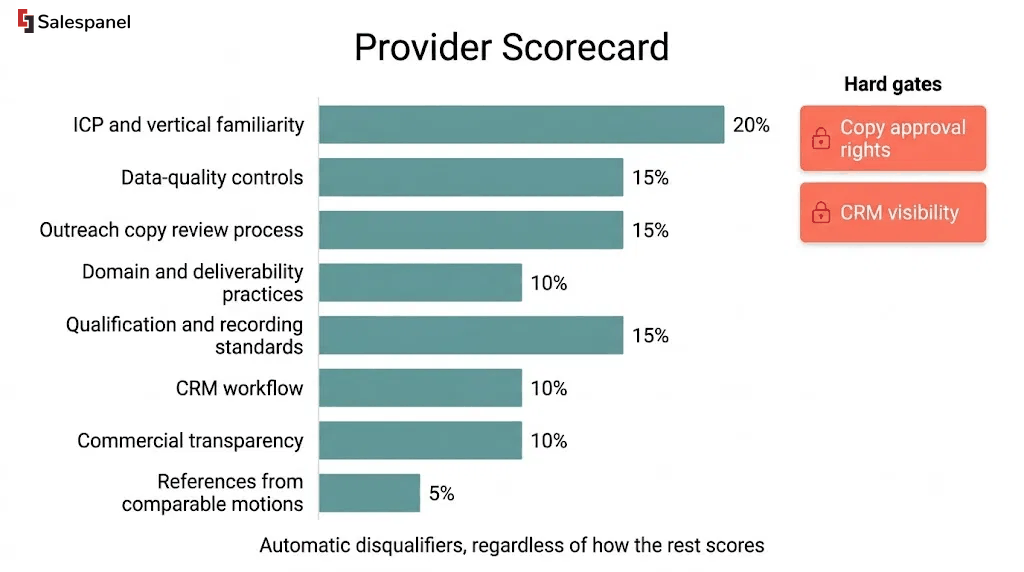
Score them against weighted criteria rather than impressions. A workable split:
| Criterion | Weight | What a pass looks like |
|---|---|---|
| ICP and vertical familiarity | 20% | Names real buyer titles and objections unprompted |
| Data-quality controls | 15% | Describes verification steps and job-change handling |
| Outreach copy review process | 15% | You approve before send; revision cadence is defined |
| Domain and deliverability practices | 10% | Separate sending domains, warm-up, volume caps |
| Qualification and recording standards | 15% | Notes or recordings available for every meeting |
| CRM workflow | 10% | Specifies fields they require, create, and update |
| Commercial transparency | 10% | Explains what the fee covers, including data costs |
| References from comparable motions | 5% | Similar ACV, cycle length, and buyer type |
Set two hard gates before weighting anything: no copy approval rights and no CRM visibility should both be automatic disqualifiers, regardless of how the rest scores.
Ask for anonymized artifacts, not logos. A campaign setup document, three real qualification notes with names redacted, and one weekly report from a live account tell you more than any case study. Providers who can’t produce these usually can’t produce them for you either.
On reference calls, skip “were you happy?” Ask what was promised versus delivered, how long ramp actually took, how the reference defined qualified, what went wrong, and — this is the one that separates partners from vendors — how the provider responded the first time the buyer said the meetings were bad. Constructive handling of negative feedback predicts the second quarter of the engagement far better than first-quarter results do.
Watch out for: providers whose reporting stops at emails sent, contacts sourced, and meetings booked. Those are production metrics. They tell you the machine ran. They say nothing about whether the output was accepted by your sales team, and a provider that has never been measured past “booked” has no internal muscle for quality control.
For teams targeting the UK or EU, read the ICO direct marketing guidance before approving any list. On the data side, our B2B data enrichment guide covers what verification actually involves.
Questions to Ask on the First Call
Six questions, and the vague-answer tell for each.
“Which data sources do you use, and how do you verify job changes and invalid emails?” A strong answer names providers, describes a verification step, and gives a bounce threshold. Vague answer: “we use multiple premium databases.”
“Who approves copy before launch, and how often can we revise it?” Strong: you approve, revisions weekly, here’s the workflow. Vague: “our copywriters are experienced and handle that.”
“How do you protect sending domains and manage opt-outs?” Strong: separate domains per client, warm-up period, per-domain daily caps, suppression list synced across campaigns. Vague: “we follow best practices for deliverability.”
“Can we review call recordings or qualification notes?” Strong: yes, here’s the format. Vague: “we can share summaries.”
“What CRM fields do you require, create, and update?” Strong: a named list. Vague: “we’ll work with whatever you have.”
“Which results do you measure after a meeting is held?” Strong: show rate, acceptance rate, opportunity rate, and they already track them. Vague: “that’s really on your sales team.”
That last vague answer is the most common one in the category, and it’s the one worth walking away from.
Validate Their Claims With a Short Working Session
Before you sign anything, run a 45–60 minute working session. Give the provider your ICP and ask for two deliverables live or within 48 hours: a sample list of 25 target accounts with named contacts, and three distinct message angles with the reasoning behind each.
This surfaces more than any proposal. You’ll see whether their research goes beyond firmographic filters, whether they understand the difference between your champion and your economic buyer, and whether the three angles are genuinely different or three rewrites of the same pain statement. Providers who lean on generic scripts tend to produce angles that could be sent by any vendor in your category — swap your logo out and nothing breaks. That’s the signal.
Some providers charge a small fee for this. Pay it. It’s cheaper than month one of a bad retainer.
Step 4: Compare Pricing and Build a Pilot Budget
What you should pay for lead generation depends on scope, market complexity, channels used, and whether the price covers research, data, outreach, qualification, and account management or only some of those. Rather than comparing headline cost per meeting, compare total cost per sales-accepted lead and per opportunity created. That is the number that survives contact with your P&L.
Five commercial models dominate:
- Monthly retainer — fixed fee for an agreed scope and activity level.
- Pay per qualified meeting — you pay only for meetings that clear a definition.
- Pay per lead — usually lower-commitment, often lower-intent.
- Hybrid retainer plus performance fee — base covers operations, bonus tied to accepted meetings or opportunities.
- Dedicated SDR / FTE-style monthly fee — you rent named headcount at a monthly rate.
Each has a failure mode worth naming. Pure pay-per-meeting contracts put all the provider’s economics on volume, which quietly pushes qualification standards down — the provider gets paid for the booking, not for whether your AE thought it was worth the hour. Retainers remove that pressure and fund better research, but only work if activity and quality reporting is transparent enough that you’d notice a slow quarter. Hybrids are usually the cleanest for a first engagement, because they cover the provider’s fixed operating cost while tying upside to a quality threshold you both agreed on in writing.
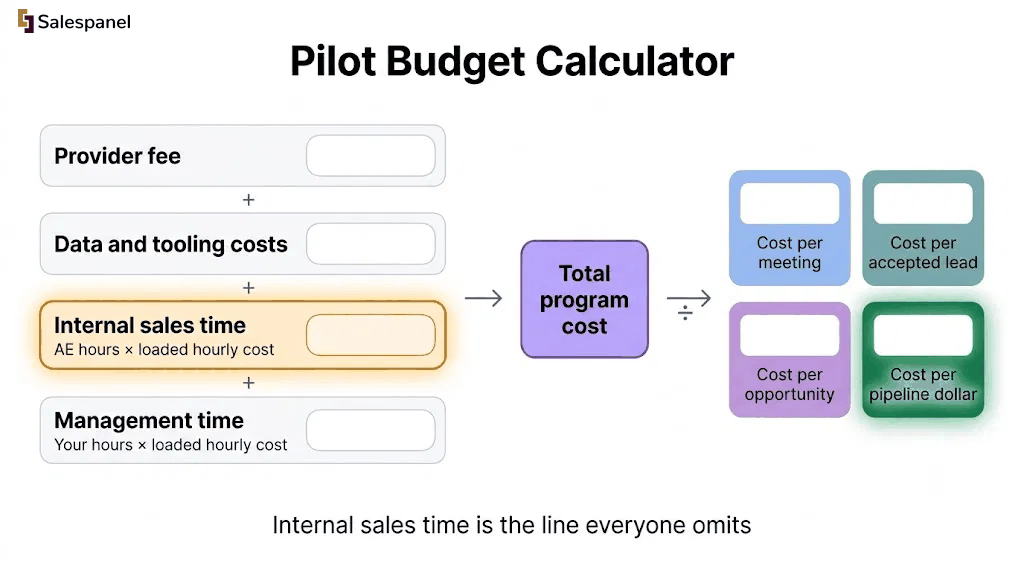
Now the budget math. Most buyers compute provider fee ÷ meetings and stop. The honest formula:
Total program cost = provider fee
                   + data and tooling costs
                   + internal sales time (AE hours × loaded hourly cost)
                   + management time (your hours × loaded hourly cost)

Then divide by: sales-accepted leads
                opportunities created
                pipeline dollars created
Internal sales time is the line everyone omits, and it’s the one that makes cheap meetings expensive. If your AE spends 90 minutes per meeting including prep, the call, notes, and follow-up, 20 low-fit meetings a month consume roughly 30 hours of selling capacity. A provider charging less per meeting but delivering half the fit rate can cost more in total than the expensive one.
Size the pilot so it can run long enough to test four things in sequence: list quality, message response, follow-up handling, and meeting quality. One outreach sequence against one small cohort tests precisely one of those. Budget for iteration cycles, not a single send.
Pair this with our customer acquisition cost (CAC) guide so the program cost lands in the same model as the rest of your acquisition spend.
Put Quality Protections in the Contract
Terms worth negotiating before signature, roughly in order of how often they cause disputes:
- Qualified-meeting definition — written into the contract itself, not a shared doc that can be edited later
- Replacement policy — what happens with no-shows, cancellations, and out-of-ICP meetings, and within what window you must flag them
- Lead ownership and data ownership — every contact, note, and recording generated is yours
- CRM access and data export rights — including a full export at termination in a usable format
- Opt-out handling — how suppressions are captured, synced, and honored across all provider campaigns
- Approval rights for copy and target lists — explicit, with a turnaround commitment on both sides
- Termination notice — 30 days is common; anything past 90 on a first engagement deserves pushback
- Confidentiality and data-processing terms — including subprocessors and where data is stored
Have counsel review the agreement, particularly when personal data moves between regions or when the provider uses offshore teams or subprocessors you haven’t vetted.
Step 5: Launch a Controlled Pilot and Set Up Measurement
A pilot should test one audience, one offer, and one defined handoff. Run three segments against four message variants in month one and you will get results you cannot attribute to anything — which means you’ll make the scale-or-kill decision on vibes.
Here is a 30-day launch sequence that holds up:
- Days 1–3: Approve the ICP, the exclusion list, and the contact criteria. The exclusion list matters more than people expect — customers, competitors, partners, and any account with an open opportunity.
- Days 3–5: Approve messaging, channel rules, and daily volume caps.
- Days 5–7: Test a data sample. Take 50 contacts from the provider’s list and verify them yourself. Check titles, company size, and email validity.
- Days 7–10: Launch a limited cohort — one segment, capped volume.
- Days 10–18: Review early replies and qualification notes. Not metrics yet. Read the actual words prospects sent back.
- Days 18–28: Assess held meetings and sales acceptance.
- Days 28–30: Decide: iterate, expand, or stop.
The scorecard runs the full funnel, and every stage needs an owner:
| Metric | Definition | Owned by |
|---|---|---|
| List acceptance rate | Accounts you approve ÷ accounts submitted | Buyer |
| Valid-contact rate | Deliverable, correct-role contacts ÷ total | Provider |
| Positive-reply rate | Positive replies ÷ contacts reached | Provider |
| Booked-to-held rate | Meetings held ÷ meetings booked | Shared |
| Sales acceptance rate | Accepted ÷ submitted | Buyer |
| Opportunity creation rate | Opportunities ÷ meetings held | Buyer |
| Pipeline created | Dollar value of opportunities | Buyer |
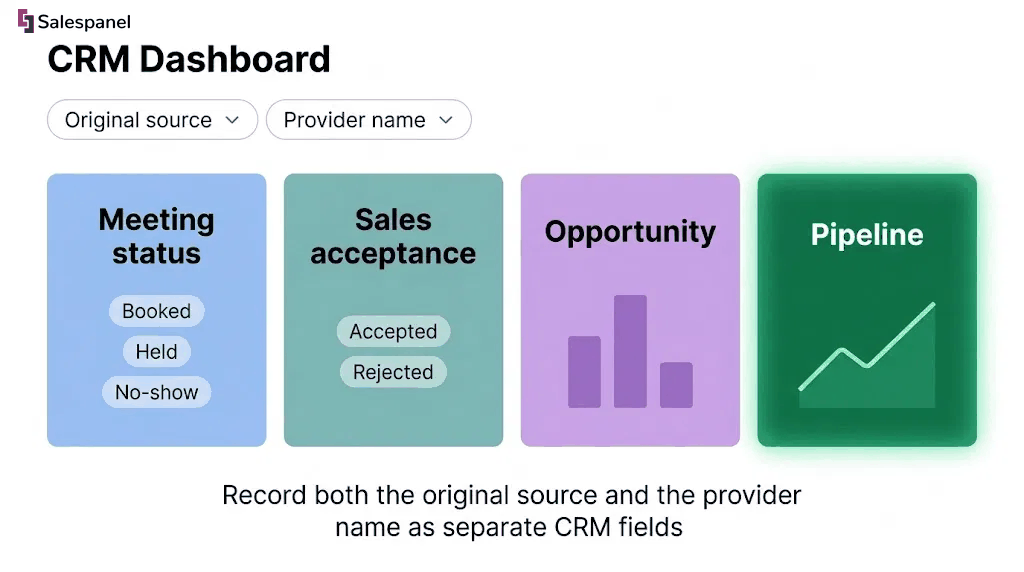
Tagging is where pilots quietly fall apart. Record both the original source and the provider name as separate CRM fields. If you only use a single source field, the next touch — a form fill, a webinar registration, a retargeting click — will overwrite it, and three months later you’ll have no way to prove which opportunities the provider influenced. Our lead source attribution guide covers the field structure in more detail.
Governance: a 30-minute weekly operating review, a shared decision log that records every targeting and copy change with a date, and one named escalation owner on each side. The decision log sounds bureaucratic until week six, when you’re trying to work out which change caused reply rates to drop.
Where website engagement feeds qualification, Salespanel can identify account-level visitor activity and score fit signals before sales follows up — useful when an outsourced provider books a meeting and you want to know whether that account has been reading your pricing page for two weeks or has never visited the site at all. Treat it as optional instrumentation that sharpens your own acceptance decisions, not as a replacement for the provider’s qualification work. See our visitor identification guide and lead scoring guide for how the two signals combine.
Establish a Sales Follow-Up SLA
No provider controls opportunity conversion. If a meeting gets booked on Tuesday and the AE confirms on Friday, the show rate drops and the provider wears the blame for an internal failure.
Agree in writing on four things: who owns the first response to a booked meeting, how fast that response must happen, which disposition fields get filled after every meeting, and the specific reasons a lead can be rejected. Spell out the rejection reasons as a picklist — wrong title, wrong company size, no stated need, no budget authority, already a customer, competitor, no-show. Free-text rejection reasons produce 40 unique strings and zero usable patterns.
Then close the loop. Sales must supply a reason code for every rejected meeting inside your internal review window, and that code goes back to the provider weekly. A rejection without a reason is just a complaint.
Review Quality, Not Just Volume
During the pilot, read or listen to five meeting records per week. Five is small enough that someone will actually do it and large enough to show a pattern inside a month.
For each one, check six things: company fit against the ICP, buyer seniority, whether a problem was stated in the prospect’s own language, enough context to run discovery, a clear agreed next step, and — the one that catches the most damage — whether the prospect understood what they’d booked. A prospect who thought they were getting a free industry report will not become an opportunity, and that failure belongs to the messaging, not the AE.
Repeated rejection reasons should change something specific. Wrong seniority three weeks running means the targeting filter moves. “No stated need” clustering in one segment means the qualification questions need a required field. Rejections that cluster by industry mean the ICP was broader on paper than it is in reality. Patterns that don’t change anything are just reporting.
Common Mistakes When Outsourcing Lead Generation
The biggest mistake in lead generation is optimizing for volume before defining fit, qualification, and sales follow-up. Volume metrics make a weak campaign look productive — emails sent, meetings booked, leads delivered all climb — while the sales team burns hours on accounts that cannot buy or will not buy this year.
Seven operational mistakes show up repeatedly, each with a fix that takes less time than the damage.
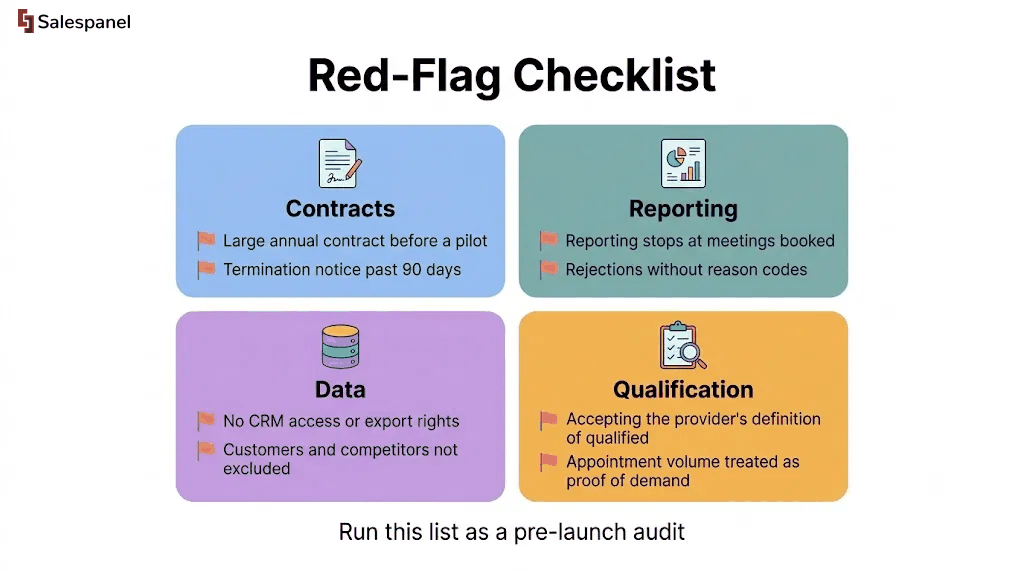
Buying a large annual contract before a controlled pilot. Fix: structure the first engagement as a defined pilot with a documented stop-or-scale rule and a short termination notice.
Accepting the provider’s definition of a qualified meeting. Their definition is tuned to their payment model. Fix: write your own, in fields, and put it in the contract.
Withholding product knowledge and then expecting strong messaging. Providers who never get a product walkthrough, a recorded discovery call, or a competitor teardown will write generic copy. Fix: budget two hours of enablement in week one and record it.
Failing to exclude customers, competitors, partners, and open opportunities. This one creates real internal damage — an AE finds out their active deal got a cold email. Fix: build the suppression list before launch and refresh it monthly from the CRM. Our CRM data hygiene guide covers keeping that list accurate.
Measuring booked meetings but not held meetings or opportunities. Fix: the full-funnel scorecard from Step 5, reported weekly.
Letting sales reject leads without reason codes. Fix: required picklist, enforced in the CRM, reviewed weekly.
Ignoring consent, opt-outs, and regional privacy obligations. Fix: a documented suppression workflow and a review of the FTC CAN-SPAM compliance guide before the first send.
Run this list as a pre-launch audit. Six of the seven are fixable in a week; the first one is only fixable before you sign.
Legal and Data-Handling Checks Before You Sign
Outsourcing lead generation is generally legal in the United States. The buyer and the provider must still comply with applicable rules for commercial email, telemarketing, privacy, data processing, and contractual confidentiality. Legal duties depend on the channels used, where the audience sits, and how personal data is collected and processed.
The distinction that matters is between legal outsourcing and noncompliant outreach, which are two separate questions. Commercial email falls under CAN-SPAM, which requires accurate header and subject information, a valid physical postal address, a clear opt-out mechanism, and opt-out processing within the required window. Calling and texting pull in additional federal rules and a patchwork of state-level requirements — see the FTC telemarketing guidance if phone is part of the plan.
On the data side, settle four questions before signature: who controls the data, where it is stored and processed, how opt-outs are transmitted between the provider’s systems and yours, and what happens to the data at contract end — exported, deleted, or retained, and on what timeline.
This section is operational guidance, not legal advice. Have counsel review your specific arrangement, particularly where personal data crosses regions.
Decide Whether to Scale, Reset, or End the Engagement
Scale only when the provider consistently produces sales-accepted meetings and early opportunity evidence inside the agreed scope. Rising activity volume is not a reason to increase spend; it’s a reason to check the acceptance rate.
Three outcomes, three sets of evidence:
- Scale. Target accounts are valid, meetings hold, sales accepts them at or above your baseline, and opportunities are appearing. Expand volume or segments one variable at a time.
- Reset. Engagement is real — replies, held meetings — but targeting, offer, or qualification needs revision. Rewrite the brief, adjust the acceptance criteria, and run another defined cycle before adding budget.
- End. Data quality, compliance handling, communication, or meeting fit stays poor after you’ve documented at least two iteration cycles. Documented is the key word; ending without a written record of what you asked for teaches you nothing.
Whatever you decide, push the learning back into your own assets: tighten the ICP with the disqualification patterns you found, keep the rejection reason distribution, and move every message angle that earned replies into your internal messaging library. Those survive the vendor relationship.
An outsourced program works when it operates as a measurable extension of your revenue process, with ownership named on both sides and a scorecard neither party can argue with. If part of that measurement depends on knowing which accounts are already engaging with your site, see how Salespanel surfaces account-level visitor intent and scores leads alongside whatever your provider sends over.
FAQ
How much should you pay for lead generation?
Lead-generation pricing should be evaluated as total program cost, including provider fees, data and tooling, sales follow-up time, and management time. Compare the resulting cost per sales-accepted lead, per opportunity, and per pipeline dollar created. A low per-meeting price becomes expensive when the meetings fall outside the ideal customer profile or fail to convert into opportunities.
What are the four types of outsourcing?
Four common outsourcing categories are professional outsourcing, IT outsourcing, business-process outsourcing, and manufacturing outsourcing. Outsourced lead generation usually fits business-process outsourcing when a provider runs repeatable prospecting workflows such as research, outreach, and appointment setting. It fits professional outsourcing when the engagement centers on specialist strategy, market research, and campaign design rather than execution volume.
What is the biggest mistake in lead generation?
The biggest lead-generation mistake is prioritizing lead volume over buyer fit and sales acceptance. Qualification criteria should be defined in writing before campaigns launch, held meetings and opportunity creation should be tracked alongside booked meetings, and sales teams should document a reason code for every rejected lead. Those controls stop activity metrics from concealing low-quality demand.
Is outsourcing lead generation legal in the US?
Outsourcing lead generation is generally legal in the United States, provided both the buyer and the provider follow applicable email, telemarketing, privacy, and data-processing requirements. Commercial email must meet CAN-SPAM requirements including accurate headers, a physical address, and a working opt-out. Calling and texting may involve additional federal and state rules, so legal counsel should review channel-specific compliance.
How long should an outsourced lead generation pilot run?
An outsourced lead-generation pilot should run long enough to test targeting, message response, qualification, sales follow-up, and early opportunity creation — typically several outreach cycles rather than a single sequence. Use a defined account cohort, documented success criteria, weekly quality reviews of actual meeting notes, and a stop-or-scale decision based on sales-accepted leads and pipeline evidence rather than email volume.
Sell more, understand your customers’ journey for free!
Sales and Marketing teams spend millions of dollars to bring visitors to your website. But do you track your customer’s journey? Do you know who buys and why?
Around 8% of your website traffic will sign up on your lead forms. What happens to the other 92% of your traffic? Can you identify your visiting accounts? Can you engage and retarget your qualified visitors even if they are not identified?