Sales Methodologies: 7 Frameworks and How to Choose One
Most teams pick sales methodologies the way people pick restaurants in an unfamiliar city — whatever name they recognize. A VP who ran MEDDICC at their last company installs MEDDICC. A board member mentions Challenger, so Challenger gets bought. The framework itself is rarely the problem. The mismatch between the framework and the actual shape of the deals is.
By the end of this guide you’ll have a way to match a methodology to three things: deal complexity, how your buyers actually buy, and how much coaching capacity your managers genuinely have. That last one kills more rollouts than anything else.
Practically, you will walk away able to shortlist two or three frameworks, score them against your real sales motion rather than an idealized one, run a limited pilot on a defined segment, and track both adoption behavior and revenue-stage metrics so you can tell whether anything actually changed.
One definition before we start, because this gets muddled constantly. A sales methodology is a repeatable framework for buyer conversations and deal evaluation. It is not your ICP, not your territory model, not your comp plan, and not your CRM workflow. If your B2B lead qualification criteria are undefined, no methodology will fix that — you’ll just have better-structured conversations with the wrong accounts.
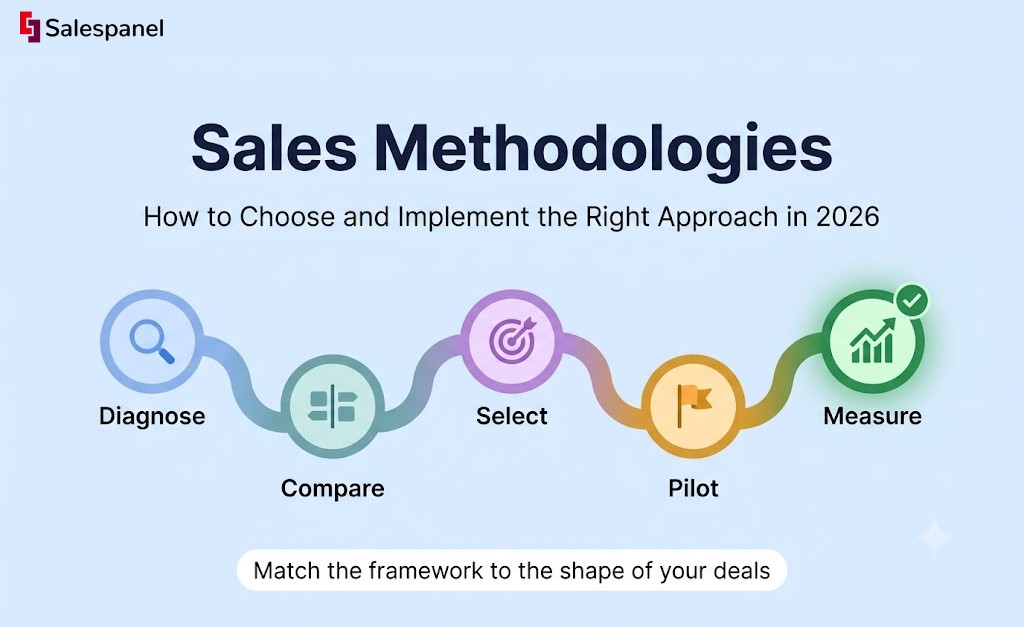
The sequence is: diagnose the motion, compare frameworks by the job they do, select one and define what good looks like, operationalize it in CRM and coaching, then measure it. Along the way I’ll flag where each framework breaks down, because the honest failure conditions are what most “top 12 methodologies” lists leave out.
Step 1: Diagnose the Sales Motion Before Comparing Sales Methodologies
The right methodology depends far more on deal shape and buyer process than on industry trend or a sales leader’s previous playbook. That sounds obvious written down. It’s violated constantly.
Consider what happens when an enterprise framework gets dropped into a high-velocity motion. You now have eight qualification fields on a deal that closes in eleven days. Reps fill them in retroactively, on Friday, before the forecast call. New hires take three extra weeks to ramp because they’re learning vocabulary before they learn the product. Managers stop inspecting the fields because inspecting them costs more time than the deals are worth. The methodology is technically live and functionally dead.
So before comparing anything, build a one-page diagnostic. Two halves: what your deals look like, and what’s currently breaking.
Map the Five Inputs That Determine Fit
Five inputs do most of the work in a selection decision:
- Average contract value and gross-margin room for rep time. How many hours of selling can a deal actually afford?
- Sales-cycle length and number of meetings. A three-meeting cycle cannot support a framework designed for twelve touchpoints.
- Buying committee size, and whether a champion is structurally required. Some products are bought by one person with a corporate card. Some need five.
- Problem clarity. Is the buyer arriving with a known, named pain, or does someone need to surface a problem they haven’t recognized yet?
- Product complexity. A straightforward product sale behaves nothing like a technical implementation involving security review, data migration, and an IT sponsor.
Two illustrative scenarios, to make the spread concrete.
A $3,000 annual SaaS plan that closes in 14 days needs speed and a consistent discovery sequence — nothing beyond that. The cost of over-processing it is real and immediate.
A $120,000 annual platform sale with a security questionnaire, a procurement gate, and four stakeholders needs stakeholder mapping, a mutual action plan, and hard qualification discipline. Skipping those is how deals reach month five and die at legal.
These are illustrative, not benchmarks. Your $3,000 product might involve a compliance review; your $120,000 deal might close in six weeks through an existing relationship. Use the inputs, not my example numbers.
Audit What Is Actually Breaking in the Current Process
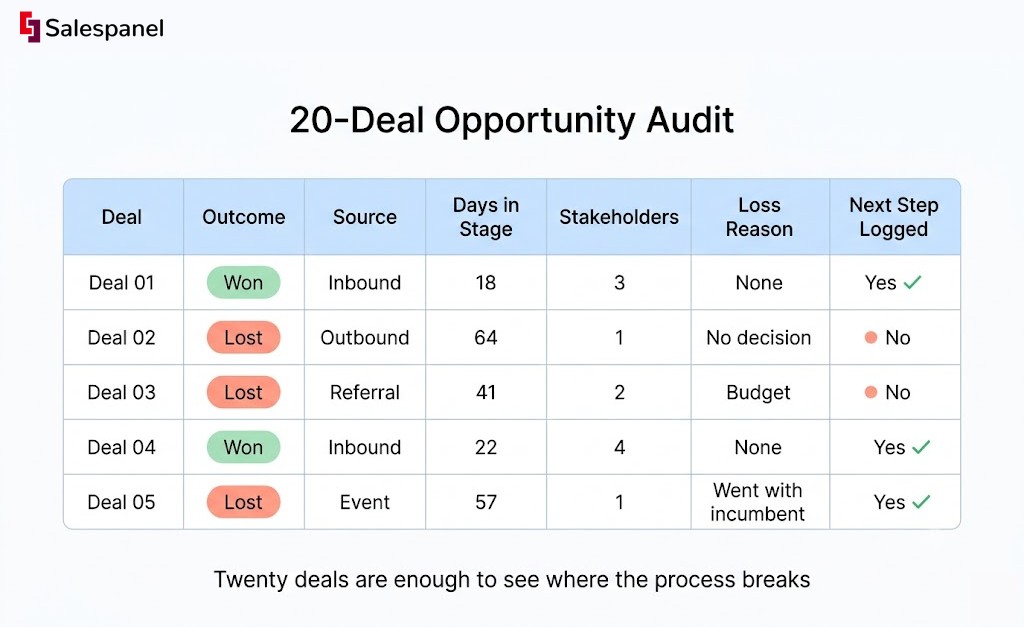
Now pull 20 recently closed opportunities — roughly ten won, ten lost. Twenty is enough to see patterns and small enough that a RevOps person can do it in an afternoon.
For each one, capture: initial source, time in each stage, the stated pain in the buyer’s own words, every stakeholder involved, the loss reason (the real one, not the CRM picklist), the competitor if any, and whether a documented next step existed at every stage.
The diagnostic logic is fairly direct once the sheet is filled in:
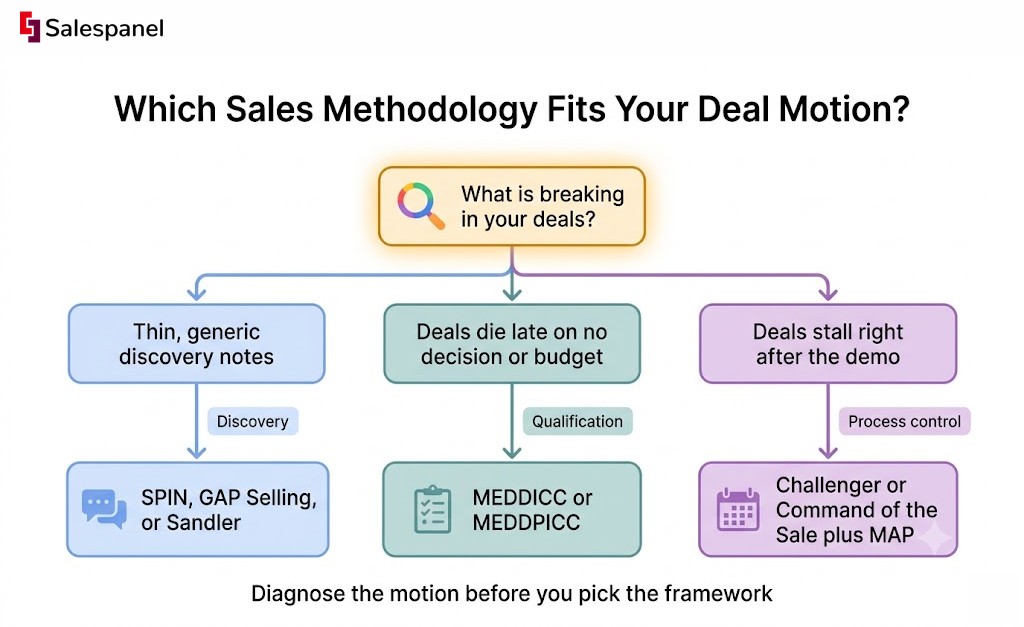
- If discovery notes are thin or generic across the board — “wants to improve efficiency” — the constraint is discovery quality. Look at SPIN, GAP Selling, or Sandler.
- If deals look healthy through demo and then die at the end, and your loss reasons cluster around “no decision,” “budget,” or “went with incumbent,” the constraint is qualification. Look at MEDDICC or MEDDPICC.
- If deals consistently stall right after the demo, with the buyer going quiet, the constraint is commercial teaching and process control. Look at Challenger, Command of the Sale, or simply a real mutual action plan.
A related check: run a sales funnel analysis on the same cohort to see where time actually accumulates. And if half the fields in your audit are empty, pause the methodology project and fix CRM data hygiene first. You cannot inspect evidence that was never recorded.
Step 2: Compare the Major Sales Methodologies by Job to Be Done
Sales methodologies are not interchangeable products competing on the same axis. They solve different jobs — discovery, qualification, insight creation, stakeholder alignment, closing discipline — and comparing them as if they were substitutes is how teams end up buying the wrong one.
Here they are mapped against the evidence each one should leave behind in your CRM. That last column matters more than the definition. If a framework can’t produce observable deal evidence, you can’t coach it and you can’t inspect it.
| Methodology | Strongest use case | Deal motion | Core rep behavior | CRM evidence to capture | Common misuse |
|---|---|---|---|---|---|
| SPIN Selling | Structured discovery | Mid-velocity, 2–6 meetings | Sequenced questioning toward implication | Buyer-stated problem, consequence of inaction, desired outcome | Running it as a rigid question script |
| Challenger | Differentiated offers, unrecognized cost of status quo | Considered purchase, 6+ weeks | Teach, tailor, take control | Insight delivered, buyer reaction, reframed criteria | Provocation without a credible insight asset |
| MEDDICC / MEDDPICC | Multi-stakeholder enterprise deals | 90+ days, procurement involved | Evidence-based qualification and deal inspection | Named economic buyer, validated champion, decision process, paper process | Used as a discovery replacement |
| Sandler | Teams that discount early or chase unqualified deals | Any, especially SMB/mid-market | Upfront contracts, mutual disqualification | Agreed next step, budget conversation, decision path | “Negative reverse” used as manipulation |
| Solution / Consultative | Problem-to-capability mapping | Broad | Diagnose before presenting | Confirmed problem statement before demo | Too vague to inspect without exit criteria |
| GAP Selling | Quantified operational or financial outcomes | Complex B2B | Current state → future state → gap sizing | Measured current state, target state, cost of the gap | Seller-invented numbers presented as buyer data |
| Command of the Sale + MAP | Deals slipping at legal, procurement, exec approval | Enterprise | Joint timeline ownership | Milestones with named buyer and seller owners | Seller-only close plan renamed a MAP |
SPIN Selling: Structure Discovery Around Need and Value
Neil Rackham’s SPIN framework moves a conversation through four question types: Situation, Problem, Implication, Need-payoff. The sequence matters more than the labels. Implication is where most reps stop short — they surface a problem and immediately pitch, rather than letting the buyer articulate what the problem costs.
SPIN fits teams whose calls jump to a demo within eight minutes. If your 20-deal audit showed discovery notes that could have been written before the call happened, this is your gap.
The operational test is simple. After a discovery call, the CRM should contain three things in the buyer’s language: the problem they stated, the consequence of doing nothing, and the outcome they want. If all three aren’t there, discovery didn’t happen — a meeting did.
Where it fails: treating SPIN as a fixed script. Senior buyers disengage fast when a rep asks situation questions that a two-minute look at the company website would have answered. Research replaces situation questions. It does not replace implication questions.
Challenger Sale: Reframe the Buyer’s Understanding of the Problem
The Challenger approach, associated with Matthew Dixon and Brent Adamson, centers on three behaviors: teach the buyer something about their own business, tailor the message to the individual stakeholder, and take control of the commercial conversation. The underlying claim from their CEB research is that top performers reframe rather than simply respond. If you cite adoption or performance figures internally, pull them from the original Challenger source along with the publication year, because the research dates to 2011 and the market has moved.
Challenger works when your offer is genuinely differentiated and buyers systematically underestimate what their current process costs them.
The part teams skip: “teaching” requires an actual commercial insight — tied to that role, backed by data, honest about alternatives. Provocation without substance reads as arrogance, and you only get one shot at it with a VP. Before asking reps to run Challenger conversations, build role-specific insight briefs. One for the operations leader, one for finance, one for the technical evaluator. Reps cannot invent credible insight on a Tuesday afternoon between calls.
MEDDICC and MEDDPICC: Qualify Complex Deals With Evidence
MEDDICC covers Metrics, Economic Buyer, Decision Criteria, Decision Process, Identify Pain, Champion, and Competition. MEDDPICC adds Paper Process — the contract, security, and procurement path that quietly consumes six weeks at the end of enterprise deals.
It belongs in deals with procurement gates, legal review, security questionnaires, and several decision-makers who have never met each other.
The value lives entirely in evidence quality. Some standards worth enforcing:
- Economic buyer means a named person plus the business priority they are measured on. A senior title in the contacts list is not an economic buyer.
- Champion is validated by three observable things: access they give you, influence they hold internally, and active work they do to advance the deal when you’re not in the room. Someone who likes your product is a supporter.
- Paper process means the specific steps — security review, MSA redlines, procurement approval, signature authority — each with a named owner and an expected duration.
MEDDPICC is a qualification and inspection system. It does not generate compelling discovery. Teams that adopt it hoping to fix shallow conversations usually end up with well-documented shallow conversations.
Sandler Selling System: Establish Equal-Business-Stature Conversations
Sandler is built around upfront contracts, pain, budget, decision, and post-sell — with the rep behaving as a peer rather than a supplicant. If your reps discount before being asked, keep unqualified deals alive to protect pipeline coverage, or end calls with “I’ll follow up next week,” Sandler addresses that directly.
An upfront contract is worth spelling out, because it’s the most portable piece. At the start of a call: state the purpose, confirm the time available, walk through the agenda, ask what they want to cover, and explicitly give permission for either side to say this isn’t a fit. Then agree what happens at the end of the call before the call starts.
Where it goes wrong: “negative reverse selling” used as a manipulation tactic. Pulling away only works if the rep is genuinely willing to disqualify. Buyers detect the difference quickly, and the technique ages badly with sophisticated procurement teams.
Solution Selling and Consultative Selling: Link Problems to Capabilities
Both share a core loop: diagnose the business need, quantify the impact where the data allows, then connect specific capabilities to the outcome the buyer wants. The discipline is ordering — the buyer’s problem must be confirmed, in their words, before anything gets presented.
Feature-led demos fail this test by design. A rep who opens a demo environment before minute 25 of a first call has decided what the buyer needs.
The honest limitation is that consultative selling is an approach rather than a system. It gives managers nothing specific to inspect. If you adopt it, you have to manufacture the missing structure yourself: defined stage-exit criteria, a set of required discovery outputs, and coaching prompts managers use on call reviews. Otherwise “be consultative” becomes a value statement nobody can measure.
GAP Selling: Quantify the Distance Between Current and Future State
Keenan’s model asks the rep to document the buyer’s current state in measurable terms, the future state they want, and the gap between them — including what the gap costs. It’s an effective antidote to generic pain questions, because “what keeps you up at night” produces answers you cannot put a number on.
A worked example from marketing ops. Current state: inbound demo requests route through a manual queue and average 19 hours to first contact, with two people spending part of each morning on assignment. Future state: sub-five-minute routing for target-account leads, no manual assignment. Gap: 19 hours of decay on every high-intent lead, plus roughly 8 hours of coordinator time weekly.
Now the important part. Every number in that paragraph must be traceable to the buyer. If the rep estimated the 19 hours, it’s an assumption, and it should be labeled as one in the CRM. Seller-generated math presented as buyer data collapses the moment a CFO asks where it came from.
Command of the Sale and Mutual Action Plans: Control the Buying Process Without Forcing It
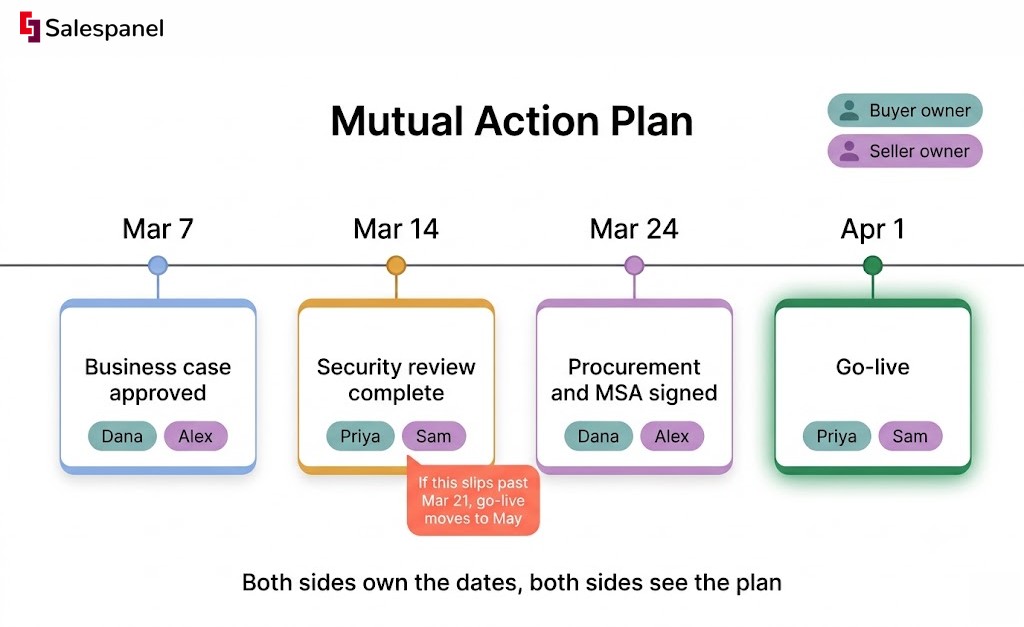
A mutual action plan is a jointly owned timeline of commitments — buyer and seller both have tasks, both have dates, both can see it. A close plan that the seller writes alone and emails over is a different artifact wearing the same name.
This approach earns its keep in deals that repeatedly slip at legal, procurement, implementation planning, or final executive approval. If your audit showed deals sitting 40+ days in a late stage, start here.
Required fields for each row: milestone, buyer owner, seller owner, due date, dependency, and the consequence if the date moves. That last column is what makes it a real plan. “Security review completes by March 14, owned by Priya; if it slips past March 21, the April 1 go-live date moves to May.”
Supplemental signal helps with timing. Account engagement tracking can tell you that three new people from the buying organization visited your pricing and security pages last week, which is useful context for a check-in. Treat those buying signals as prompts for a conversation, never as confirmation of the decision process. Only the buyer can confirm the buyer’s process.
Step 3: Select One Core Framework and Define What “Good” Looks Like
Pick one core methodology — the one that addresses your largest revenue constraint — and add only the components needed to support it.
Stacking is the standard failure. A team adopts MEDDPICC in Q1, adds Challenger insight training in Q2, brings in a Sandler workshop in Q3, and layers GAP Selling questions onto the discovery template. Each addition was individually defensible. Together they produce reps who apply different fragments inconsistently, CRM data that can’t be compared across deals, and managers who quietly revert to asking “so, is it going to close?”
A weighted scorecard keeps the decision honest:
| Criterion | Weight |
|---|---|
| Fit with deal shape (ACV, cycle, committee, complexity) | 30% |
| Addresses the current revenue bottleneck | 25% |
| Manager coaching capacity to sustain it | 20% |
| CRM readiness | 15% |
| Enablement effort required | 10% |
Score each shortlisted framework 1–5 per criterion. Adjust the weights if your situation demands it — a team with three brand-new frontline managers should probably weight coaching capacity above 20% — but write down why you changed them. Undocumented weight changes are how the incumbent VP’s preferred framework wins a rigged evaluation.
Build a Minimum Viable Methodology
Define four things, and nothing more, before launch:
- The 3–5 behaviors reps must actually perform.
- The CRM fields that prove those behaviors occurred.
- Stage-exit criteria managers will inspect.
- One coaching rubric for call reviews.
A team adopting MEDDPICC might launch with four elements — Pain, Champion, Decision Process, Paper Process — because those four map directly to the losses in their audit. The other four get added in month three, once the first four are consistently good. Launching all eight at once guarantees that all eight are filled badly.
A methodology is implemented when it changes how deals are inspected and how calls are coached. Distributing a slide deck and running a half-day workshop is announcement, not implementation.
Assign Ownership Across Sales, RevOps, and Enablement
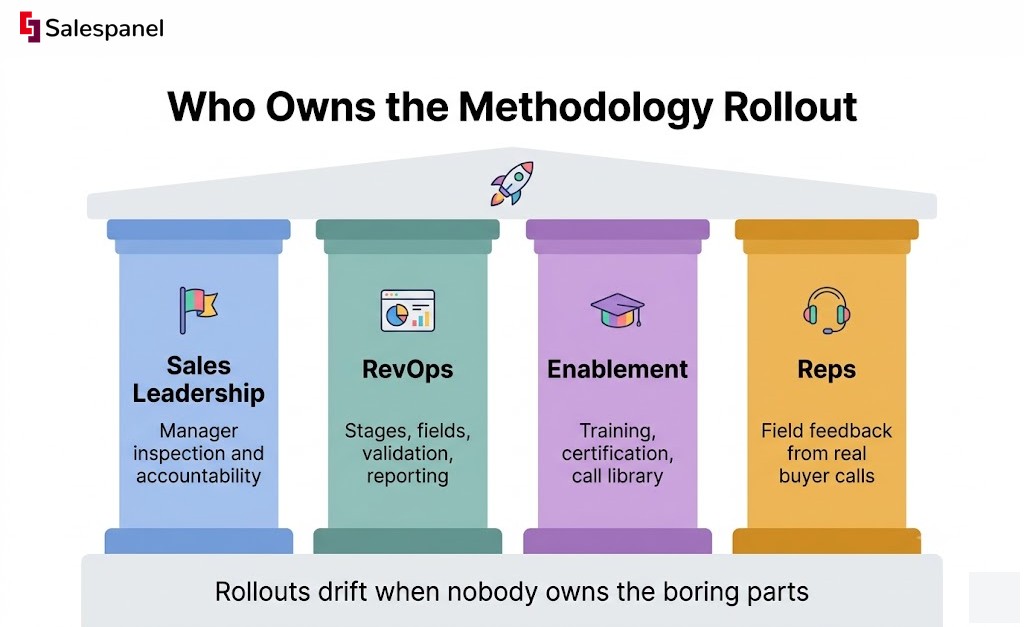
Rollouts drift when nobody owns the boring parts.
- Sales leadership owns manager inspection and accountability — including what happens when a manager skips deal reviews for three weeks.
- RevOps owns stage definitions, field design, validation rules, reporting, and workflow changes.
- Enablement owns training assets, certification, the call library, and reinforcement past week two.
- Reps own feedback on whether fields are usable and whether the language survives contact with real buyers.
That last one is not a courtesy. Reps will tell you within ten days which field nobody can fill in honestly.
Step 4: Pilot the Methodology in CRM, Calls, and Manager Coaching
A 30–45 day pilot on a defined segment surfaces adoption problems while they’re still cheap to fix. Org-wide launches surface the same problems three months later, after everyone has already decided the methodology doesn’t work.
Choose one team, one segment, or one deal type. Resist the instinct to pilot with your three best reps — they succeed with any framework, which tells you nothing. A representative group, including at least one rep who is struggling, produces a usable signal.
Pull baseline metrics from the comparable prior period before day one. Without a baseline you’ll be arguing about whether things improved based on vibes and one memorable deal.
Configure the CRM Around Evidence, Not Checkbox Completion
Add only the fields managers will genuinely open during a deal review. Every other field is tax.
Field quality standards need examples, because “be specific” is not a standard:
- Weak: Pain = efficiency.
- Strong: VP of Operations estimates 2 coordinators spend 12 hours weekly reconciling manual reports; target is under 2 hours by Q2. Confirmed on call, Feb 6.
The second version can be challenged, verified, and used in a business case. The first cannot be used for anything.
Go light on stage validation. Requiring seven populated fields before a stage change reliably produces seven populated fields containing nothing — reps copy the same sentence into all of them. One or two hard gates at the stages where you actually lose deals is enough.
Run a weekly report covering four things: field completion rate, a sampled evidence-quality read, stage aging, and next-step hygiene. If you’re already running lead scoring, keep it separate from methodology fields — scoring predicts fit and interest, qualification evidence proves deal viability. Mixing them produces a number nobody trusts. The same separation applies to your broader sales pipeline management reporting.
Train With Real Calls and Real Opportunities
A sequence that works better than a workshop:
- Explain the buyer problem the framework solves. Not the acronym — the problem.
- Demonstrate it using one recorded call from your own team, or a mock deal built from a real account.
- Have reps practice one behavior at a time. Implication questions this week. Champion validation next week.
- Require every manager to review one live opportunity using the same rubric reps were taught.
Skip certification that tests terminology. A rep who can recite what the P in MEDDPICC stands for has demonstrated nothing. Assess one real discovery call recording and one real CRM record against the rubric instead.
Run Weekly Deal Inspections
Format: pick 3 active opportunities, review the evidence against the methodology criteria, identify one gap, agree on one buyer-facing action to close it, and set the next inspection date. Thirty minutes, three deals, done.
The manager’s job in that meeting is to challenge assumptions, not to confirm that fields contain text. “You’ve listed Dana as the economic buyer — what has Dana said about her own priorities, and when?” is an inspection question. “Is the economic buyer field filled?” is an audit.
Engagement data belongs in this meeting as context and nothing more. Website activity can tell you an account went quiet, or that four new people from the same company started reading implementation documentation — useful for prioritizing follow-up and for spotting stakeholders reps haven’t met. Salespanel provides that account-level engagement context alongside CRM records. It cannot prove budget, authority, or decision process. Rep-verified discovery remains the only source for those.
Step 5: Measure Adoption, Deal Quality, and Revenue Impact
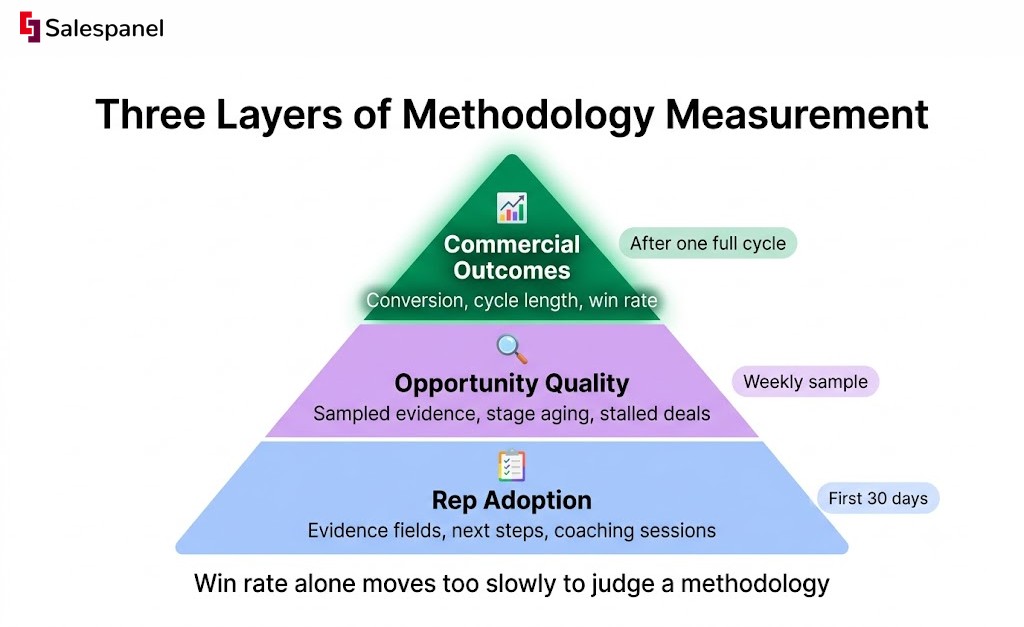
Measure three layers: rep adoption, opportunity quality, and commercial outcomes. Win rate alone moves too slowly and absorbs too many other variables to serve as your read on whether a methodology is working.
Compare pilot results against either a matched control segment or the pre-pilot baseline, and document everything else that changed during the window. Pricing adjustments, a territory reshuffle, two new hires ramping, a doubled campaign spend — any of these will move your numbers, and if you don’t record them you’ll credit the methodology for someone else’s work.
Track Leading Indicators in the First 30 Days
Four indicators are visible early:
- Percentage of open opportunities carrying evidence-based qualification fields.
- Percentage of meetings ending with a documented, mutually agreed next step.
- Manager coaching sessions completed per rep per month.
- Stage aging and count of stalled deals.
Field-completion rate is the seductive metric here, and it is close to meaningless on its own. A team can reach 95% completion with 95% junk. Pull a random sample of ten records each week, read them against the quality standard, and listen to two of the associated call recordings. Completion tells you reps are compliant. The sample tells you whether the conversation changed.
Review Commercial Outcomes After a Full Selling Cycle
After one full cycle, look at stage-to-stage conversion, cycle duration, forecast variance, average discount, closed-lost reason distribution, and win rate.
Segment before you conclude anything — by deal size, source, market, and rep tenure. Two unusually large enterprise deals will distort a quarter’s win rate badly enough to produce the wrong decision. Tenure matters too: a methodology that lifts new-rep performance while doing nothing for veterans is still a win, but you’ll miss it in the blended number.
Publish a one-page readout: hypothesis, sample size, adoption evidence, commercial changes, confounding factors, and a recommendation. Six lines. The discipline of writing “confounding factors” honestly is what separates a real pilot from a post-hoc justification.
For building the reporting itself, the vendor documentation is more current than any third-party tutorial — see Salesforce report builder documentation or HubSpot’s reporting knowledge base.
Common Mistakes When Implementing Sales Methodologies
Most methodology rollouts fail for the same underlying reason: the team adds terminology and CRM fields without changing manager behavior, buyer conversations, or stage definitions. The vocabulary changes. The selling doesn’t.
Treating Methodology Training as a One-Time Event
A kickoff workshop generates two weeks of enthusiasm and then decays. Reps revert under quota pressure, because the old way is faster and nobody is checking. Six months later a new cohort joins and never hears about the framework at all.
Fix: embed methodology checks into weekly pipeline reviews and into the new-rep ramp plan. If it isn’t in the onboarding curriculum by month two, it will not survive the next hiring wave.
Forcing One Framework on Every Motion
Inbound SMB deals, outbound mid-market, and strategic enterprise accounts carry different risk and different buyer behavior. Requiring full MEDDPICC evidence on a self-serve upgrade wastes rep time. Requiring nothing on a $200,000 multi-year deal loses money.
Fix: keep shared definitions — one meaning of “champion” across the org — but scale the process requirements to deal complexity and risk. Same language, different depth.
Confusing Activity Data With Buyer Evidence
Email opens, page visits, and meeting counts indicate interest. They validate nothing about a champion, a business pain, or decision criteria. A deal with high engagement and no named economic buyer is still an unqualified deal, and it will look healthy on a dashboard right up until it disappears.
Fix: require a source and a date on every critical opportunity claim. “Confirmed by CFO, call Feb 12” is evidence. “Highly engaged account” is a signal.
Adding Too Many Required CRM Fields
The outcome is predictable enough to forecast: incomplete records, identical text pasted across multiple fields, and a burst of updates thirty minutes before the forecast call. Data volume rises. Data value drops.
Fix: launch with a limited evidence set, then run a quarterly cull — any field no manager has referenced in a deal review gets removed. Removing fields is unglamorous and it does more for data quality than most enablement programs.
Next Step: Run a Focused 30-Day Methodology Pilot
Identify the single constraint costing you the most pipeline movement, choose the framework built for that constraint, and test it with one defined group for 30 days.
Four actions, in order: audit 20 recently closed deals to find the actual break point, score two or three methodologies against your sales motion using the weighted scorecard, configure the minimum CRM evidence managers will genuinely inspect, and review adoption weekly with a sampled quality check rather than a completion percentage.
If the pilot works on that segment, expand it deliberately — one segment at a time, with the same measurement discipline. If it doesn’t, you’ve spent 30 days and one team’s attention instead of a year and the organization’s credibility.
One supporting piece worth considering as you build the evidence layer: rep-verified discovery tells you what the buyer said, while account-level website engagement tells you what the wider buying committee is doing between meetings. Salespanel surfaces that second stream — which accounts are active, which new stakeholders have appeared, what they’re reading — so your team can prioritize follow-up without mistaking activity for qualification. The two together give managers a fuller picture during deal inspection than either provides alone.
FAQ
What are sales methodologies?
Sales methodologies are repeatable frameworks that guide how salespeople discover needs, qualify opportunities, engage stakeholders, and advance deals. Examples include SPIN Selling, MEDDICC, Challenger Sale, Sandler, and GAP Selling. A methodology should define observable rep behaviors and the evidence managers use to assess deal quality, rather than acting as a vocabulary layer over an unchanged sales process.
Which sales methodology is best for B2B sales?
The best B2B sales methodology depends on deal complexity and the team’s primary constraint. MEDDPICC suits multi-stakeholder enterprise deals with procurement gates, SPIN improves structured discovery, Challenger supports insight-led selling for differentiated offers, and Sandler helps teams qualify earlier. Teams should choose based on their actual sales motion rather than adopting the most popular framework.
Can a sales team use more than one sales methodology?
A sales team can combine methodologies when each has a distinct role. For example, SPIN can structure discovery conversations while MEDDPICC qualifies complex opportunities. Teams should still designate one core framework, define shared CRM evidence standards, and avoid combining so many models that reps apply fragments inconsistently and managers cannot compare deals.
How long does it take to implement a sales methodology?
A sales methodology pilot can begin in 30–45 days when a team limits scope to one segment, a small set of CRM fields, and weekly manager coaching. Measuring revenue impact usually takes at least one full sales cycle, because win rates and sales-cycle length change far more slowly than adoption behavior and field quality.
What is the difference between a sales process and a sales methodology?
A sales process defines the stages and actions used to move an opportunity from prospecting to close. A sales methodology defines how a salesperson conducts conversations and evaluates deal quality within those stages. For example, a CRM may use discovery and proposal stages while reps apply MEDDPICC evidence standards to progress an opportunity through them.
Sell more, understand your customers’ journey for free!
Sales and Marketing teams spend millions of dollars to bring visitors to your website. But do you track your customer’s journey? Do you know who buys and why?
Around 8% of your website traffic will sign up on your lead forms. What happens to the other 92% of your traffic? Can you identify your visiting accounts? Can you engage and retarget your qualified visitors even if they are not identified?