How to Maximize B2B Sales
If you want to know how to maximize sales in a B2B business, the honest answer is that growth comes from improving the entire revenue path — the accounts you target, the demand you capture, the deals you execute, and the customers you keep. More leads is only one of four levers, and usually not the broken one.
By the end of this guide you’ll have a seven-step operating process, a weekly revenue scorecard, and specific fixes for the bottlenecks that quietly suppress revenue. It’s written for B2B marketers, sales leaders, RevOps teams, and growth operators working with a finite budget and a pipeline that already exists.
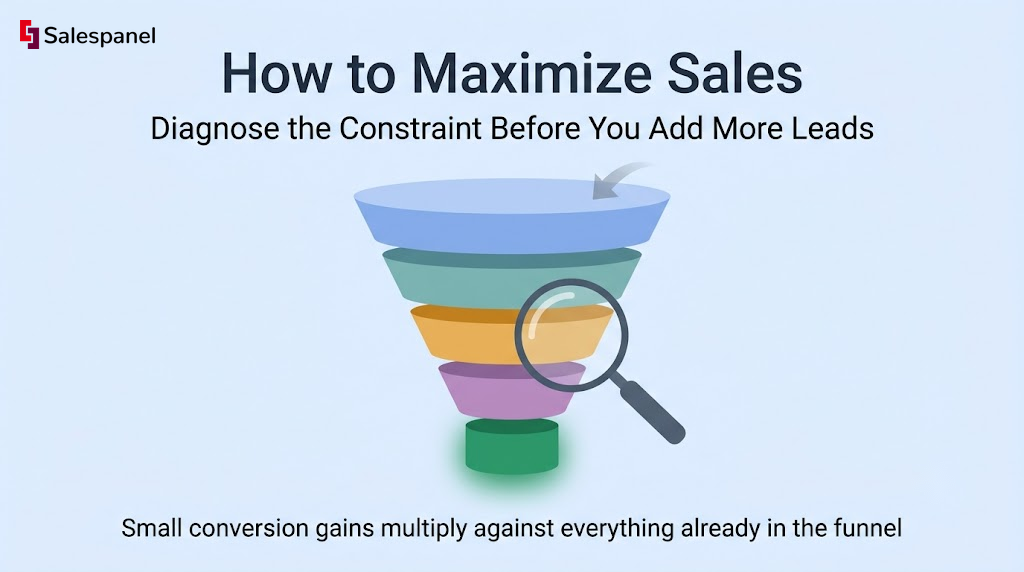
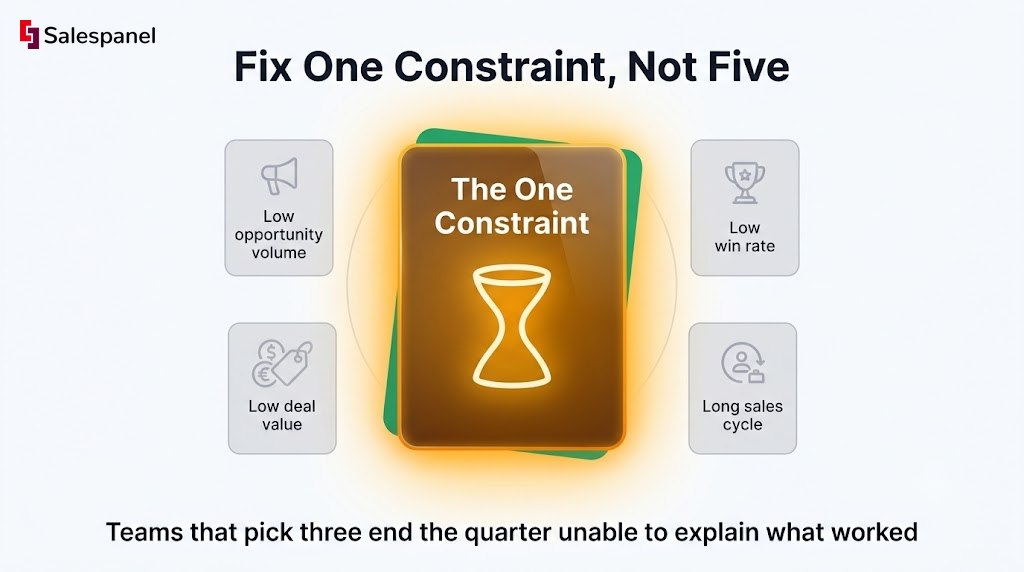
The diagnostic underneath all of it is simple. Revenue moves through four measurable levers: more qualified opportunities, a higher win rate, a larger average deal value, and stronger retention or expansion. Most “sales tips” articles list tactics for all four at once. This one helps you decide which constraint to fix first, because fixing the wrong one costs a quarter.
If your constraint turns out to be genuine demand volume, start with our B2B lead generation guide instead and come back here afterwards.
Start With a Revenue Baseline Before Trying to Maximize Sales
Before you attempt to increase sales, measure five things: qualified opportunity volume, opportunity-to-win rate, average contract value, sales cycle length, and retention. Without those baselines you cannot tell whether a new initiative fixed the constraint or simply generated more activity that looks like progress in a dashboard.
The default response to a revenue miss is “we need more leads.” Sometimes that’s right. Often it isn’t. If your lead-to-opportunity rate is 3%, doubling lead volume doubles the workload of a team that is already failing to convert what it has. A long sales cycle produces the same illusion — pipeline looks healthy, revenue arrives two quarters late, and nobody can point to the stage where deals decay.
Pull the last full quarter, or the previous 90 days if your quarter boundary is awkward, and build the baseline from that.
1. Calculate the five numbers that show where revenue is leaking
| Metric | Formula |
|---|---|
| Qualified opportunities created | Count of opportunities meeting your documented qualification bar |
| Opportunity-to-win rate | Closed-won deals ÷ total closed opportunities |
| Average contract value (ACV) | Closed-won revenue ÷ number of won deals |
| Sales cycle length | Average days from qualified opportunity to closed-won |
| Net revenue retention / renewal rate | Applies where revenue is recurring |
Now run the arithmetic. A team creating 100 qualified opportunities per quarter, winning 20% of them, at a $12,000 ACV, produces $240,000 in new revenue. Push the win rate from 20% to 24% and the same 100 opportunities produce $288,000. That’s $48,000 in additional revenue with zero additional demand generation spend.
That is the key idea. Small movements on conversion multiply against everything already in the funnel, while new lead volume has to be paid for every single month.
One warning before you compare periods: your CRM must use a consistent opportunity definition. If reps created opportunities on first call in Q1 and after discovery in Q2, your conversion trend is measuring a process change, not performance.
2. Find the one constraint to address first
| What the baseline shows | Where to work first |
|---|---|
| Low qualified opportunity volume | Targeting, intent capture, lead qualification |
| High opportunity volume, low win rate | Discovery, qualification rigour, deal process |
| Good win rate, low ACV | Packaging, pricing, expansion motions |
| Long sales cycles | Approval, follow-up, and stakeholder bottlenecks |
| High churn | Onboarding, adoption, and customer fit before scaling acquisition |
Pick one. Teams that pick three end the quarter unable to explain what worked.
If you need help building the report, both major CRMs document this well — see HubSpot’s reporting documentation or Salesforce report builder docs.
Step 1: Define the Accounts and Buying Situations Most Likely to Close
The best prospects share observable signals — firmographic fit, behavioural engagement, and a buying context that makes the purchase timely. Find those patterns in your own closed-won data and prioritise them over persona documents built from assumption. Fit tells you who can buy; context tells you who will buy now.
An ICP that stops at company size, industry, and geography is a filter, not a strategy. Plenty of perfectly-sized companies in your target vertical will never buy, because nothing in their business has changed. The trigger belongs in the ICP definition itself.
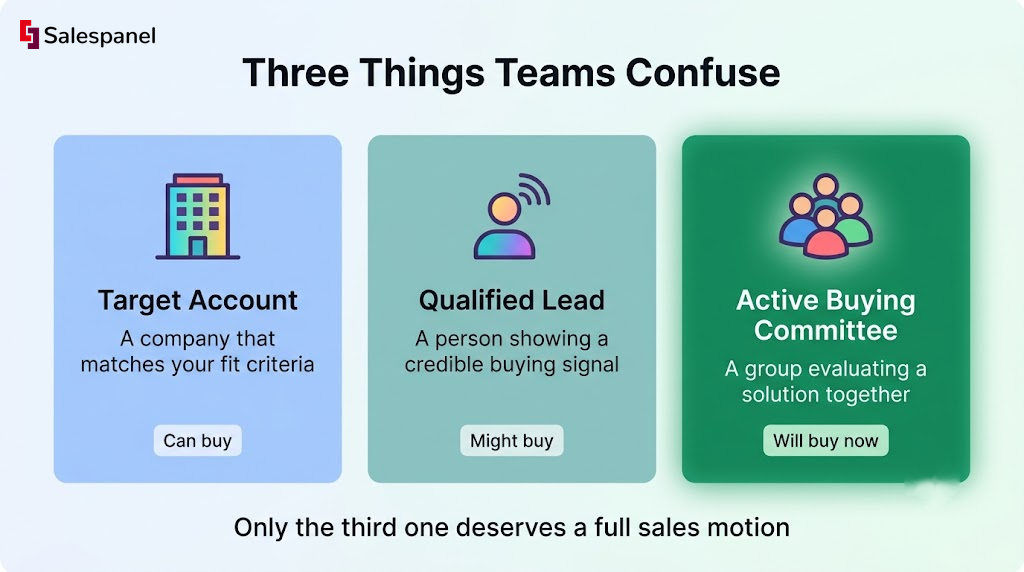
Three things get confused constantly, so let’s separate them. A target account is a company that matches your fit criteria. A qualified lead is a person from that company showing a credible buying signal. An active buying committee is a group of people from that company evaluating a solution together — and only the third one deserves a full sales motion.
1. Build an ICP from closed-won and closed-lost data
Review at least 20 closed-won and 20 closed-lost deals if your volume allows it. For each, capture industry, company size, geography, tech stack, primary use case, deal source, cycle length, ACV, the stakeholder roles involved, and the documented loss reason.
You’re looking for what separates fast, profitable wins from slow, discounted, painful ones. Deals that closed in 30 days often share a trigger the slow deals lacked.
If you’re early and don’t have 20 wins, that’s fine — start with founder and first-rep interviews, write down the hypothesis, and revisit it after every 10 closed deals. An ICP built on 8 deals is a draft, and treating it as fact is how teams over-invest in a segment that never repeats.
2. Document buying triggers your team can observe
Observable triggers in B2B usually include:
- A job posting for a role that owns your problem area
- A funding announcement or leadership change
- Expansion into a new market or region
- A technology migration or a competitor renewal window
- Repeat visits to pricing or integration pages
- Sustained content consumption around a known problem
A trigger is only useful when it connects to a message. Knowing that an account raised a Series B means nothing if your outreach doesn’t reference what that funding makes newly possible for them.
Suppose there is an account that visited your pricing page twice and your Salesforce integration page once, all within nine days. That account should hear about implementation effort and commercial fit. A first-time blog reader from the same company should hear nothing beyond a relevant follow-up piece of content.
3. Turn the ICP into routing rules
Define three tiers — priority accounts, nurture accounts, and disqualified accounts — and make them CRM fields, not slide content. At minimum, document: account tier, fit score, intent score, owner, next action, and disqualification reason.
The disqualification reason field is the one most teams skip and the one that improves the model fastest.
More detail in our ideal customer profile (ICP) guide and lead scoring guide.
Step 2: Capture and Qualify Demand Before It Goes Cold
Most B2B buyers research extensively before filling out any form. To convert more of the demand you already have, identify meaningful engagement, check it against account fit, and route it while the signal is still current. Recency matters as much as the signal itself.
This is a gap between marketing activity and sales action, and it is not an argument for chasing every visitor who lands on your homepage. Roughly speaking, most of your traffic is students, competitors, job seekers, and curious peers. The work is separating the small evaluating cohort from the rest.
1. Define high-intent actions on your website
Worth tracking: pricing-page visits, demo-form starts, deep product-page sessions, integration-page visits, case-study views, competitor comparison pages, return visits, and multiple sessions from different people at the same company.
Separate educational activity from evaluation activity. One blog article view is a reader. A return visit to pricing 11 days later is a buyer.
A starter model to test — treat these numbers as a hypothesis, not a standard:
| Signal | Score |
|---|---|
| Pricing page | +10 |
| Demo page | +15 |
| Case study | +5 |
| Repeat visit within 14 days | +8 |
| ICP account match | +20 |
| Student, competitor, or irrelevant geography | Exclude or reduce |
2. Set a practical sales-alert threshold
There is no universal score at which an account becomes sales-ready. Your threshold is a function of two things: how many accounts your reps can genuinely work per week, and what your historical conversion looks like at each score band.
Start narrow. Route a small cohort, review quality with the reps every week, and only adjust the model after 20–30 routed accounts — before that, you’re tuning on noise.
Every alert should carry the company, the pages viewed, recency, account fit, and a recommended next action. An alert that says “Acme Corp visited your site” creates work. An alert that says “Acme Corp, 4 sessions, pricing + Salesforce integration, ICP tier 1, suggested play: implementation-focused outreach” creates a conversation.
3. Use visitor intelligence only where it improves a human follow-up
First-party data intelligence — which in practice means account reveal and behavioural scoring on your own website — is useful precisely when it changes what a rep says. Salespanel is one B2B visitor intelligence tool that connects website behaviour, lead scoring, and CRM workflows for this purpose.
The tool is not the point. The point is that a rep opens a record and immediately understands why this account is worth contacting and which message is relevant today.
Two related resources: website visitor tracking and B2B intent data. Before you deploy anything, review your consent and analytics configuration against your own legal guidance and the official documentation for your consent management platform — requirements differ by jurisdiction and we’re not offering legal advice here.
Curious what this looks like on your own traffic? Salespanel identifies the companies visiting your site, scores their behaviour, and pushes qualified accounts into your CRM in real time.
Step 3: Improve First Response, Discovery, and Qualification
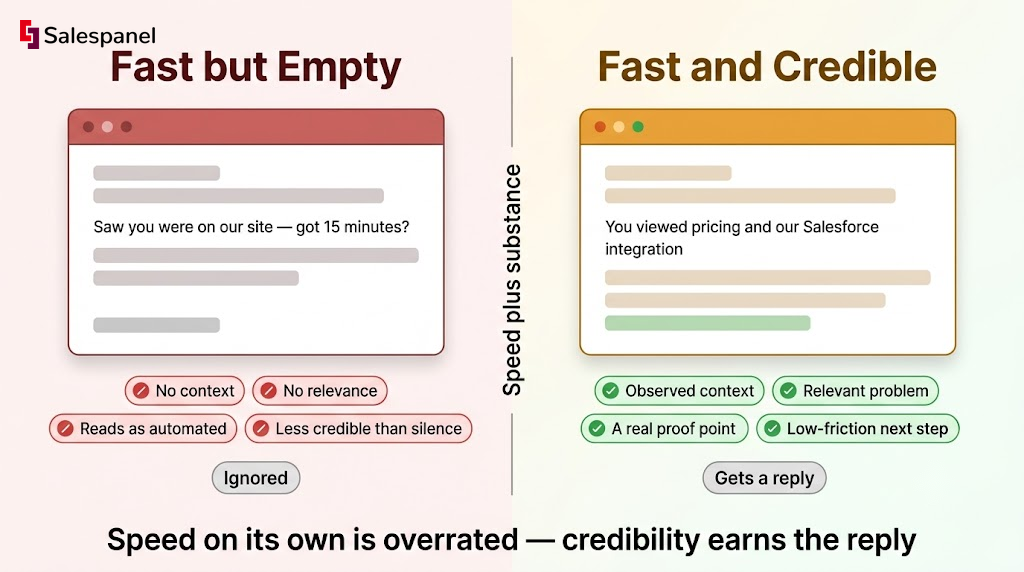
Conversion improves when fast follow-up meets disciplined qualification. Speed connects a verified buying signal to a live evaluation before the prospect disengages or talks to a competitor. Discipline ensures the conversation reaches a real business problem rather than a product walkthrough.
Speed on its own is overrated. A two-minute response that says “Saw you were on our site, do you have 15 minutes?” is faster than the competition and less credible than silence.
1. Create response plays for each intent level
High intent. Personalised outreach that references the likely evaluation topic — implementation, integration, pricing structure — plus a direct meeting CTA.
Medium intent. A relevant resource, one targeted question, and an invitation to discuss a specific use case.
Low intent. Nurture. Forcing SDR outreach onto a first-time reader burns the account for later.
A workable outreach structure: observed context → relevant problem → a proof point you can actually substantiate → low-friction next step.
Do not invent personalisation from incomplete data. If all you know is the company name and two page views, say something intelligent about the problem, not something fake about their strategy.
2. Run discovery around a problem worth solving
Discovery checklist:
- What changed recently that made this a priority?
- What does leaving the problem unresolved cost, in money or time?
- Who owns that outcome internally?
- What process, tool, or budget covers this today?
- What has to happen for them to choose a vendor at all?
- What is the decision timeline, and what drives it?
Good discovery ends with a mutually confirmed next step on a specific date. Product interest is not a next step.
3. Apply qualification consistently
Adopt MEDDICC, SPICED, or BANT — whichever fits your deal complexity. Enterprise motions with procurement and security review need MEDDICC’s rigour; a 21-day transactional cycle does not.
What matters is the operational output, and it’s the same regardless of framework. Every qualified opportunity should contain documented pain, named stakeholders, an understood decision process, a timeline, and a scheduled next meeting. If a field is blank, the opportunity isn’t qualified — it’s hopeful.
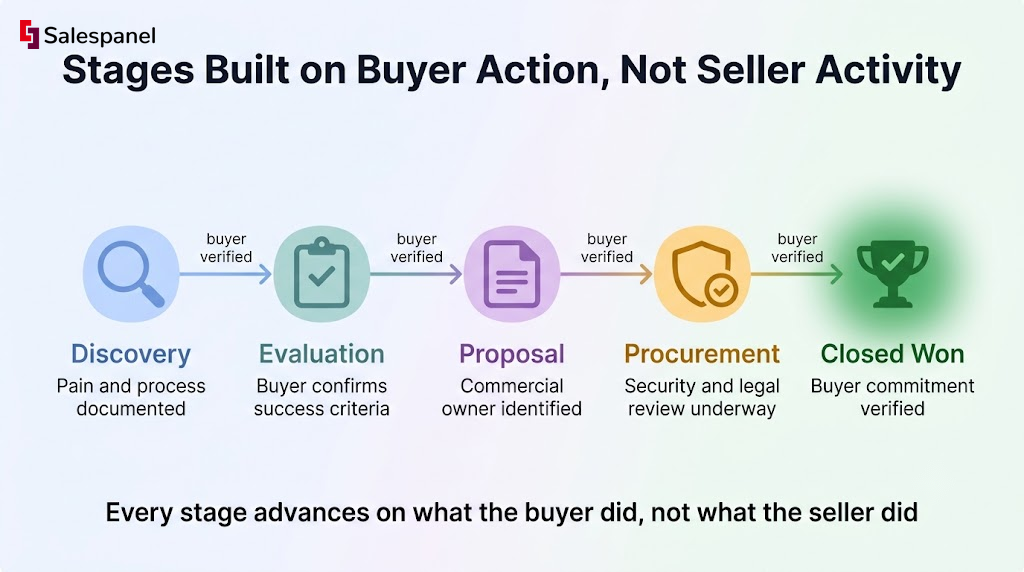
Win rate rises when teams identify the full stakeholder set early, surface and resolve risk instead of avoiding it, and advance stages based on verified buyer commitments. Optimistic rep sentiment is not evidence. Buyer action is.
Look at how your stages are named. “Demo completed” describes what your seller did. “Security review initiated” describes what the buyer did. Stages built on seller activity produce forecasts that collapse in week 11 of the quarter, because nothing in them proves the buyer is moving.
1. Define exit criteria for every pipeline stage
Write buyer-verifiable exit criteria for discovery, evaluation, proposal, procurement, and closed-won. Each criterion should be answerable with yes or no by someone who wasn’t on the call.
Example: no proposal leaves the building until the commercial owner, the decision process, and the buyer’s stated success criteria are documented. That single rule tends to reduce the volume of proposals sent and increase the percentage that close.
Every open opportunity carries a mandatory next step with a date. No exceptions.
2. Build a mutual action plan for complex deals
A mutual action plan is a shared document listing stakeholders, the business case owner, technical validation steps, security and legal review, commercial review, the target decision date, and who is responsible for each item.
Use it for multi-stakeholder deals, enterprise procurement, or any deal running longer than your team’s normal cycle. If your average is 45 days and a deal hits day 60, it needs a plan, not another check-in email.
3. Review stalled deals by evidence, not rep sentiment
Define “stalled” numerically — stage age relative to your baseline, not a feeling. Then ask one question: has the buyer completed a meaningful action recently? Invited another stakeholder, shared requirements, scheduled a technical review, introduced procurement.
If the answer is no across four weeks, the deal is not slipping. It’s lost, and pretending otherwise distorts every forecast behind it.
See our sales pipeline management guide for stage design detail.
Step 5: Increase Average Deal Value Through Packaging and Expansion
Revenue per customer grows when packages, add-ons, and expansion offers are tied to a measurable customer outcome. Treating upsell as a last-minute negotiation tactic produces discount pressure and churn. Expansion should follow demonstrated value, which means it belongs in the customer lifecycle, not the closing call.
Upselling a poor-fit customer is actively harmful. You collect more revenue from an account that was already at risk, and the churn arrives with a larger number attached.
1. Package around outcomes, not feature checklists
Tiers should map to something the buyer recognises about themselves: a use case, a capacity level, a support requirement, the number of user groups, or implementation complexity. Feature-list tiers force buyers to guess which row matters.
Go back through your closed-won deals and look for repeated custom requests. Three customers asking for the same thing in a quarter is an add-on. Six is a tier.
2. Create expansion triggers with customer success
Useful triggers: seat utilisation crossing a threshold, adoption of the core workflow, a new business unit launching, approaching usage limits, and the renewal planning window.
Both teams need a shared account plan. Nothing damages an expansion conversation faster than a customer receiving a CS check-in about an open support issue and an AE upsell email on the same morning.
Related: customer retention strategies.
Step 6: Build a Weekly Revenue Operating Rhythm
Sustained growth comes from a weekly review that keeps marketing, sales, and RevOps looking at the same funnel constraint, with changes tested against measurable outcomes. One-off results come from heroics. Repeatable results come from rhythm.
Thirty minutes, same time each week:
- Qualified opportunity volume and source quality
- Speed-to-lead and follow-up completion rates
- Stage conversion and stage aging
- The top stalled or at-risk deals
- One experiment and one named owner for the coming week
Keep a scorecard with weekly and monthly views covering pipeline, conversion, speed, ACV, and retention. Weekly numbers catch operational breakdowns; monthly numbers show whether the constraint actually moved.
Change one major variable at a time — the routing threshold, the messaging, or the qualification criteria. If you change all three and revenue improves, you’ve learned nothing you can repeat next quarter.
Common Mistakes That Prevent Teams From Maximizing Sales
The most frequent failure in B2B is diagnosing a revenue problem as a top-of-funnel problem. Teams add lead volume while weak qualification, slow follow-up, poor pipeline hygiene, or churn stays exactly where it was. The funnel gets wider at the top and no wider anywhere else.
Mistake 1: Measuring activity instead of buyer progress
Emails sent and demos booked measure effort. Qualified opportunities, stakeholder engagement, next-step completion, and closed-won revenue measure progress. A team can hit every activity target in a quarter and miss the number, and usually does.
Mistake 2: Sending every lead to sales
Sales attention is finite. Route low-fit leads for long enough and reps stop opening marketing-sourced records at all — which means the good ones die too.
Fix: explicit fit and intent thresholds, plus a monthly audit of false positives that reached a rep.
Mistake 3: Treating a demo as qualification
A demo request proves curiosity. It does not prove budget, authority, or timing.
Fix: require documented pain, decision process, stakeholders, and a dated next step before the opportunity advances.
Mistake 4: Ignoring existing customers while chasing new pipeline
Net revenue retention and new bookings live in the same P&L. They rarely live in the same meeting.
Fix: put renewal risk and expansion signals on the same weekly revenue scorecard as new pipeline.
Mistake 5: Changing five things at once
Fix: one bounded experiment, with a start date, an expected outcome, a named owner, and a review date on the calendar before it launches.
Your 30-Day Plan to Maximize Sales
The fastest practical start is 30 days spent establishing funnel baselines, choosing one constraint, implementing a single focused change, and reviewing results weekly. Resist the temptation to fix everything visible in week one — the diagnosis is worth more than the first tactic.
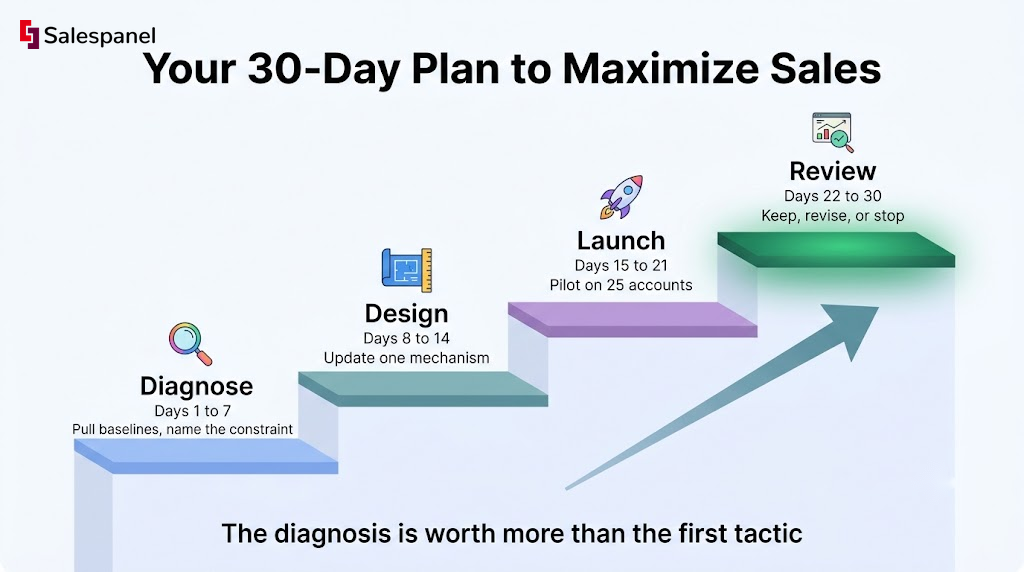
Days 1–7: Diagnose
Pull the five baseline metrics. Audit 20 closed-won and 20 closed-lost deals. Name the largest constraint and write it somewhere the whole team can see.
Days 8–14: Design
Update whichever mechanism the constraint points to — ICP criteria, scoring thresholds, routing rules, or pipeline exit criteria. One mechanism.
Days 15–21: Launch
Train marketing and sales on the revised workflow, then test it on a limited cohort. A 25-account pilot surfaces the broken parts faster than a full rollout.
Days 22–30: Review and refine
Compare against the original baseline. Keep it, revise it, or stop it — all three are acceptable outcomes, and stopping is often the correct one.
Then do the smallest possible next thing: pick one funnel metric, assign one owner, and put the first weekly review on the calendar.
See which accounts are showing buying intent on your site. Start with Salespanel and turn anonymous traffic into scored, routable opportunities.
FAQ: How to Maximize Sales
Maximizing sales starts with diagnosis, not tactics. The four answers below cover the questions B2B teams ask most often when deciding where to spend the next quarter of effort.
What is the fastest way to increase B2B sales?
The fastest route is usually improving conversion within existing demand — faster follow-up, sharper qualification, and clear documented next steps — because those changes affect prospects already evaluating a purchase. Before choosing tactics, compare qualified opportunity volume, win rate, average deal value, and sales-cycle length to identify which metric is actually limiting revenue.
Should I focus on getting more leads or improving conversion?
Focus on the weaker part of the funnel. More leads help when qualified opportunity volume is low relative to sales capacity. Conversion work matters more when opportunities exist but stall or lose. Baseline funnel metrics — volume, stage conversion, win rate, cycle length — reveal which investment is likely to produce more revenue per dollar spent.
How do I know if a sales lead is qualified?
A qualified B2B sales lead has both account fit and a credible buying signal. Qualification should document the prospect’s problem, the relevant stakeholders, the decision process, a likely timeline, and an agreed next step. A form submission or demo request on its own indicates interest, not sales readiness, and should not advance a pipeline stage.
What metrics should I track to maximize sales?
Track qualified opportunities created, opportunity-to-win rate, average contract value, sales-cycle length, pipeline stage conversion, and retention or renewal rate. Read together, these six metrics show whether revenue is constrained by demand quality, deal execution, pricing and packaging, sales speed, or customer retention — which determines where the next improvement should go.
Sell more, understand your customers’ journey for free!
Sales and Marketing teams spend millions of dollars to bring visitors to your website. But do you track your customer’s journey? Do you know who buys and why?
Around 8% of your website traffic will sign up on your lead forms. What happens to the other 92% of your traffic? Can you identify your visiting accounts? Can you engage and retarget your qualified visitors even if they are not identified?