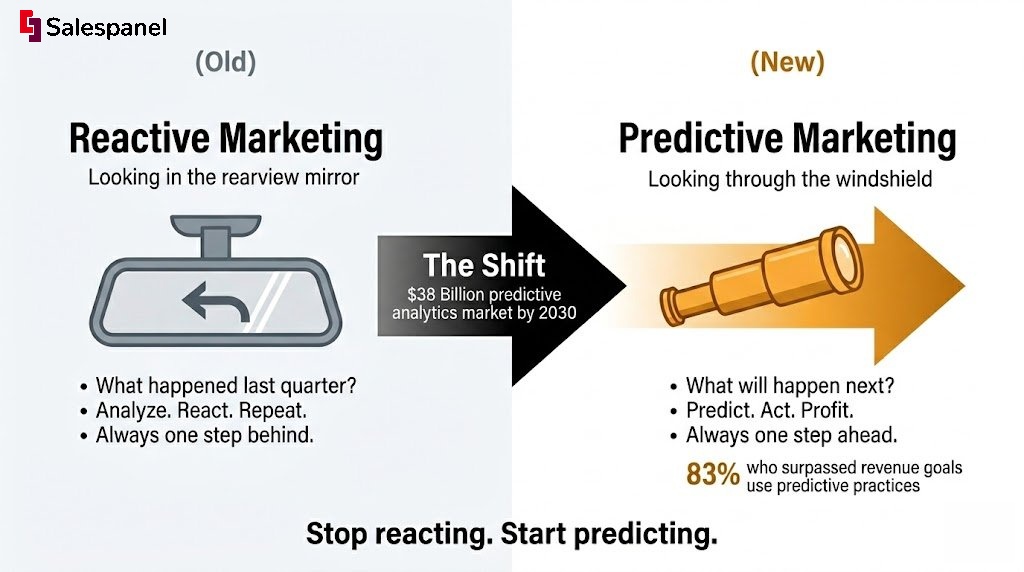
For decades, marketing operated on hindsight. Campaigns were launched based on historical data, intuition, and a fair amount of educated guesswork. Marketers would analyze last quarter’s results to plan for the next, essentially driving their strategy by looking in the rearview mirror. This reactive approach was the standard, but it was inherently flawed—slow, often inefficient, and always a step behind the customer.
That era is over. The central theme of modern marketing is the radical shift from reaction to prediction. We are moving from asking “What happened?” to the far more powerful question, “What will happen next, and what should we do about it?” This is the domain of predictive analytics for marketing, a discipline that leverages historical data, statistical algorithms, and machine learning to forecast future outcomes with remarkable accuracy. The global predictive analytics market is projected to surge to over $38 billion by 2030, according to a report from Marketsandmarkets, underscoring the monumental shift in strategy and investment. This guide is your takeaway—a deep dive into the technical principles and practical applications that will empower you to build a marketing function that doesn’t just report on the past but actively shapes the future.
The Inevitable Shift to Predictive Marketing
The old cycle of “launch, wait, analyze, repeat” is obsolete. In an economy powered by vast digital datasets and sophisticated AI, the competitive benchmark has moved from reaction to anticipation. This is not a fleeting trend but a fundamental re-engineering of how successful organizations drive growth and forge customer relationships. The central theme we will explore is this transition from a reactive to a proactive marketing posture.
From Past Performance to Future Prediction
At its technical core, this shift is about redefining the questions we ask of our data. Traditional analytics provides descriptive insights, telling you, “What happened?” It’s a historical report card on past performance.
Predictive analytics, in contrast, delivers prescriptive intelligence by answering, “What is most likely to happen next?”
Consider the strategic advantage this provides. While competitors are dissecting last quarter’s campaign reports, your team is already acting on validated predictions about which leads are on the verge of converting, which customers are at risk of churning, and which messaging will resonate most powerfully next month. The numbers validate this approach: recent research found that a staggering 83% of marketers who surpassed their revenue goals had fully integrated predictive practices into their daily operations.
The real power of predictive analytics for marketing isn’t just about knowing what happened—it’s about knowing what’s going to happen. It allows you to move from a “spray and pray” approach to a “predict and profit” model.
Why This Matters for Your Career
For any ambitious marketer, mastering this technology is no longer optional. The ability to use data to forecast outcomes is rapidly becoming the defining skill that separates strategic leaders from tactical executors. Grasping the principles of predictive analytics enables you to make smarter resource allocations, justify ROI with quantitative evidence, and deliver results that drive tangible business growth.
This guide is engineered to demystify predictive marketing, stripping away the dense academic jargon. We will cover:
- How it actually works, explained in plain English.
- Real-world applications that you can use to boost ROI, from smarter lead scoring to keeping your customers happy.
- A practical roadmap to help you start bringing these capabilities into your own team.
By the end, you will have a clear, in-depth understanding of why predictive analytics is the new operational standard in marketing and how you can leverage it to shape the future of your campaigns, instead of merely reacting to the past.
How Does Predictive Analytics Actually Work?
Let’s deconstruct the mechanics of predictive analytics without the opaque, academic jargon. The most effective analogy is to think of it as a highly sophisticated weather forecast for your business.
Meteorologists don’t rely on a crystal ball; they use vast historical datasets—past weather patterns, temperature shifts, atmospheric pressure—to model the probability of rain tomorrow. Similarly, marketers utilize historical customer data and advanced algorithms to forecast future outcomes, such as which lead is most likely to convert or which customer is at risk of churning.
At its core, predictive analytics for marketing is about identifying statistically significant patterns in your existing data to make educated projections about future events. It systematically connects the dots between past customer behaviors and probable future actions, allowing you to transition from reacting to market shifts to proactively anticipating them.
The Core Components Explained
To truly grasp its functionality, you must understand its foundational pillars. These are not mere buzzwords; they are the technical components that enable the entire process.
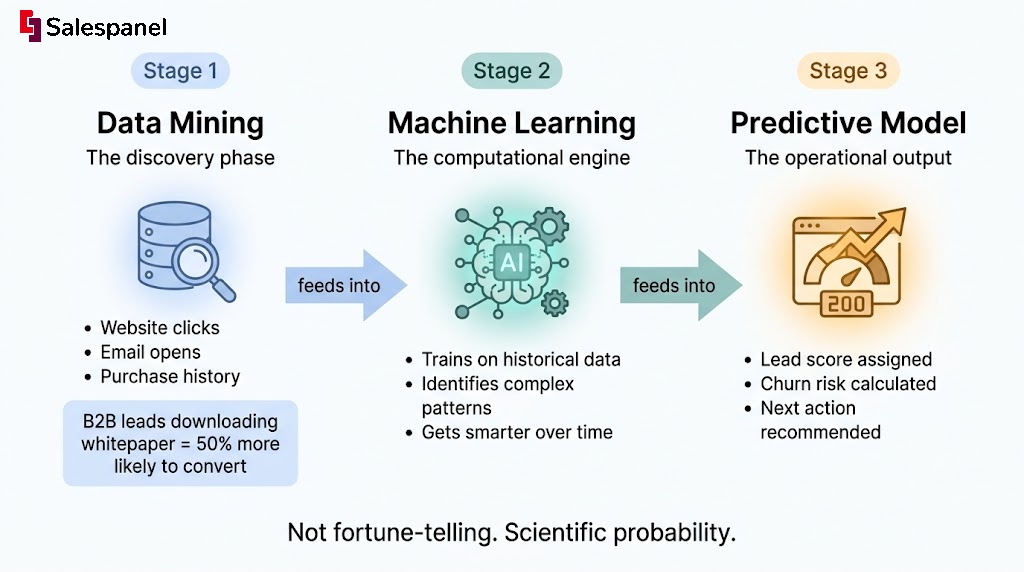
Data Mining: This is the discovery phase. Imagine a massive, unstructured repository of customer data—every website click, email open, and purchase history. Data mining is the process of systematically sifting through this data to extract valuable, non-obvious patterns and correlations.
Practical Example: Through data mining, you might discover that B2B leads from the manufacturing sector who download a specific technical whitepaper are 50% more likely to convert to a sale within 30 days. This is a quantifiable insight, not an intuition.
Machine Learning: This is the computational engine that automates pattern recognition and learning. Machine learning algorithms are “trained” on your historical data, which teaches them to identify complex patterns independently. The more data they process, the more accurate their predictive capabilities become. They are not static; they adapt and refine their models over time.
Predictive Modeling: This is the final, operational output. A predictive model is a statistical formula or a set of rules generated by the machine learning algorithm. This model takes new, incoming data (like a fresh lead’s website activity) and applies its learned patterns to produce a prediction, such as a numerical lead score or a churn risk percentage.
Practical Example: A predictive lead scoring model is a classic marketing application. The model learns the combination of demographic and behavioral signals most correlated with a closed-won deal, then assigns a score to new leads in real-time.
Predictive analytics isn’t about fortune-telling. It’s a scientific method for calculating the most probable outcomes based on evidence, allowing you to place smarter, data-backed bets on where to focus your efforts.
The Four-Step Predictive Process
The implementation of predictive analytics follows a logical, systematic workflow. While the underlying technology is complex, the process itself can be segmented into four distinct stages.
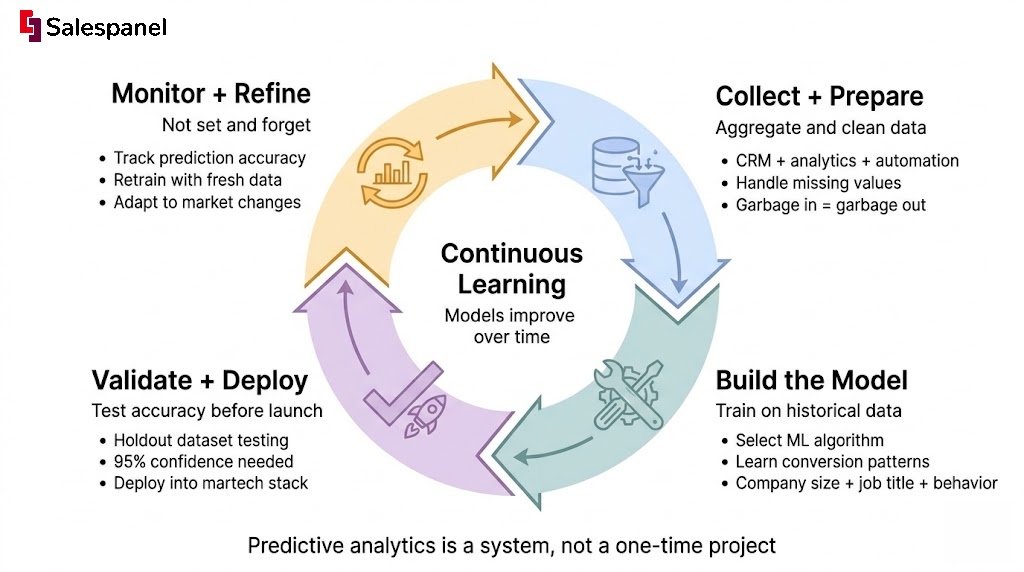
- Data Collection and Preparation: The process begins with aggregating historical data from disparate sources—your CRM, website analytics, marketing automation platform, and support systems. This raw data is then “cleaned” and prepared. This involves handling missing values, correcting inaccuracies, and standardizing formats. The quality of your predictions is directly proportional to the quality of your input data. Garbage in, garbage out.
- Building the Model: With a clean dataset, data scientists or specialized software select an appropriate machine learning algorithm for the business objective. The historical data is then used to “train” the predictive model. During this phase, the model learns the intricate relationships between various input variables—for instance, how company size, a lead’s job title, and their engagement with specific web pages all correlate with a successful conversion.
- Validation and Deployment: Before a model is operationalized, its predictive accuracy must be rigorously tested. This is achieved by using a separate “holdout” dataset that the model has never seen, confirming its reliability in real-world scenarios. Once validated, the model is deployed into your marketing technology stack, where it can begin analyzing new data as it arrives.
- Monitoring and Refinement: A predictive model is not a “set it and forget it” asset. Its performance must be continuously monitored to ensure its predictions remain accurate as market conditions and customer behaviors evolve. The model is periodically retrained with fresh data to maintain its efficacy, ensuring your marketing efforts are always guided by the most current and relevant insights.
The AI and Machine Learning Engine Driving Prediction
At the heart of modern predictive analytics lies a powerful synergy between artificial intelligence (AI) and machine learning (ML). AI provides the broad framework for systems to simulate intelligent behavior and learn, while ML supplies the specific algorithms that execute the data analysis. These algorithms sift through massive datasets to identify complex patterns and correlations that are impossible for a human analyst to detect manually.
This is not merely about accelerating old marketing tasks; it’s about unlocking entirely new capabilities. It enables data-backed decision-making at a scale and speed previously unimaginable. The market reflects this transformation; the global AI in marketing sector is projected to reach $47.32 billion by 2030, a significant jump from $12.05 billion in 2020. This trend represents a fundamental paradigm shift. This technological duo is the engine that moves marketers from hindsight to foresight.
Core Machine Learning Models in Marketing
To gain an in-depth understanding of predictive analytics for marketing, it’s essential to be familiar with the ML models that perform the heavy lifting. Each model is a specialized statistical tool designed to answer a specific type of business question. Think of them as different analytical lenses, each providing a unique perspective on your data.
There are three primary model types every marketer should know, each mapping directly to a critical marketing function.
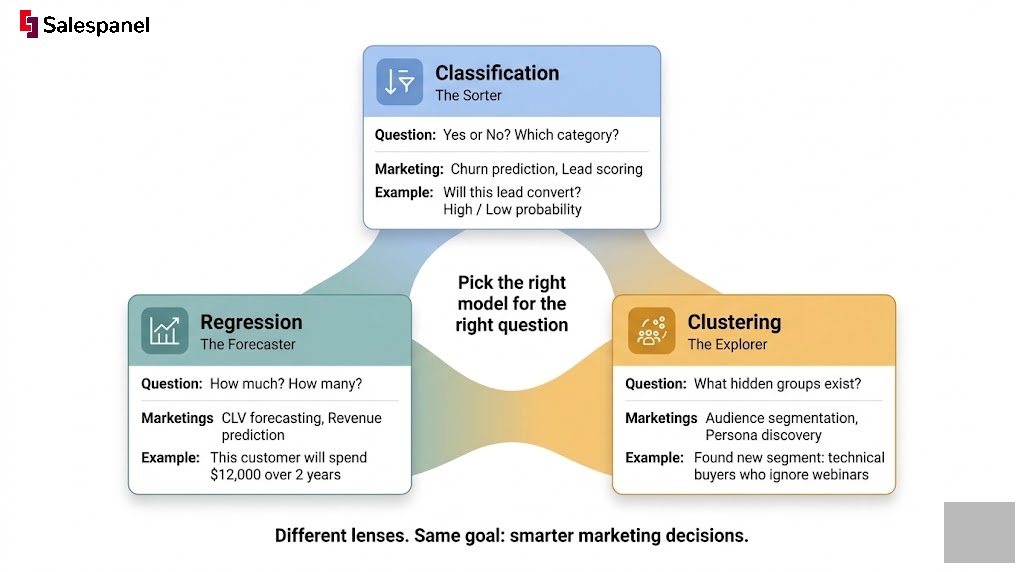
- Classification Models: These models function as sorters. They are designed to answer binary or categorical questions (“yes/no,” “churn/no churn,” “high-value/low-value”) by assigning data points to predefined categories.
- Regression Models: When the objective is to predict a continuous numerical value—such as revenue, customer lifetime value, or a specific count—regression models are the appropriate tool. They answer “how much?” or “how many?” by identifying the mathematical relationship between input variables.
- Clustering Models: These models are exploratory in nature. They analyze data without predefined categories to identify natural groupings or segments within your audience, answering the question, “What hidden structures exist in my data?”
Let’s examine how these models are applied to solve real-world marketing challenges, transforming abstract algorithms into tangible business outcomes.
Tying Models to Marketing Jobs
The true value of these models is realized when they are applied to specific, everyday marketing tasks. They are not merely academic constructs; they are practical problem-solvers that directly enhance efficiency and ROI.
1. Predicting Customer Churn with Classification
A classification model can analyze historical customer behavior—variables like login frequency, feature usage patterns, and support ticket volume—to identify accounts with a high probability of churning.
Practical Example: The model flags an account with a high churn probability score. This can trigger an automated retention workflow, such as enrolling the customer in a re-engagement campaign or alerting a customer success manager to proactively address potential issues before they escalate.
2. Forecasting Customer Lifetime Value with Regression
A regression model analyzes variables such as a customer’s initial purchase amount, their firmographic data (e.g., company size), and their early engagement with your product to forecast their total future spending over their entire lifecycle.
Practical Example: This allows you to identify potential high-value customers from day one. Armed with this foresight, you can strategically allocate premium resources—like personalized onboarding and dedicated support—to nurture these relationships and maximize their long-term value.
3. Discovering Audience Segments with Clustering
A clustering model can process diverse datasets—including website behavior, content consumption, and demographic data—to uncover distinct audience personas that were not previously apparent.
Practical Example: The model might identify a new segment of users from a specific industry who consistently engage with technical case studies but ignore marketing webinars. This insight enables the creation of a highly targeted email nurture sequence focused exclusively on case study content, directly addressing their observed interests and improving engagement.
By applying the right model to the right problem, marketers can shift from broad, generalized campaigns to precise, individualized actions that resonate deeply with each customer’s unique journey and intent.
How Predictive Analytics Actually Drives Marketing ROI
Understanding the theory is one thing; witnessing its real-world application is another. This is where complex data models translate into tangible, revenue-generating actions. Predictive analytics is not about identifying interesting patterns for their own sake; it’s about operationalizing those insights to solve concrete business problems and deliver a measurable return on investment.
Let’s move from the conceptual to the practical by examining specific B2B marketing scenarios where predictive models become the engine of efficiency and growth.
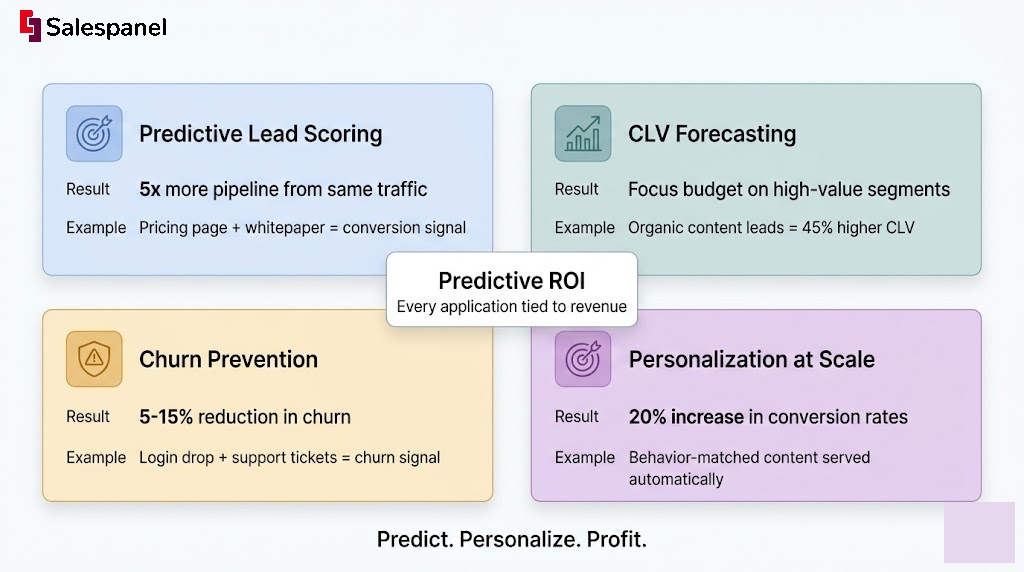
Predictive Lead Scoring to Spot High-Intent Buyers
Frankly, traditional lead scoring is often arbitrary. A marketer might assign 10 points for a C-suite title and 5 points for a whitepaper download. While better than nothing, this rigid, rules-based system frequently misses the nuanced buying signals buried within behavioral data.
Predictive lead scoring completely inverts this approach. It doesn’t rely on human intuition. Instead, it employs a classification model to analyze the attributes and behaviors of all past leads—both won and lost. The model learns what a high-quality lead truly looks like based on historical outcomes, identifying complex correlations a human would never detect.
Here’s how it works: A model might discover that leads who visit the pricing page twice, watch a specific product demo, and work at companies with 50-200 employees have a 75% higher conversion rate. This data-driven insight empowers the sales team to stop wasting cycles on low-propensity leads. They can focus their efforts exclusively on prospects demonstrating genuine buying intent, dramatically increasing their efficiency and close rates.
Forecasting Customer Lifetime Value
Not all customers are created equal. Some will make a single, small purchase and never return. Others will evolve into long-term partners, generating significant, recurring revenue. Using a regression model, you can forecast the future Customer Lifetime Value (CLV) of a new customer from their very first interaction.
The model analyzes early indicators—such as the value of their first transaction, their industry vertical, or their initial product usage patterns—to predict their long-term spending potential. This gives marketing teams the quantitative clarity to allocate resources where they will yield the greatest impact.
By spotting future high-value customers early, you can justify giving them the white-glove treatment—like personalized onboarding, dedicated support, or exclusive content—because you know they’ll deliver the greatest long-term return.
Proactively Stopping Customer Churn
It is far more costly to acquire a new customer than to retain an existing one. Predictive analytics serves as your most effective defense against customer attrition. By analyzing behavioral data—such as a decline in product usage, reduced login frequency, or an increase in support tickets—a classification model can flag at-risk accounts before they make the decision to leave.
This early warning system provides customer success and marketing teams with a critical window of opportunity to intervene and mitigate the risk.
Here’s how it works: The model flags an account with a high churn score. This action instantly triggers a pre-defined retention workflow. A customer success manager is alerted to schedule a proactive check-in call, while the marketing automation system enrolls the account in a targeted campaign highlighting new features relevant to their usage patterns. You’ve just converted a potential loss into a retained relationship.
To truly understand how these models impact the bottom line, let’s break down some common challenges and their predictive solutions.
Key Applications of Predictive Analytics in Marketing
The table below connects everyday marketing struggles with specific predictive models, showing how data-driven insights lead to concrete business wins.
| Marketing Challenge | Predictive Analytics Solution | Expected Business Outcome |
|---|---|---|
| Sales team wasting time on low-quality leads. | Predictive Lead Scoring (Classification Model): Analyzes historical data to identify attributes of high-converting leads. | Increased sales efficiency, higher MQL-to-SQL conversion rates, and shorter sales cycles. |
| Uncertainty about where to invest marketing budget for long-term growth. | Customer Lifetime Value (CLV) Forecasting (Regression Model): Predicts the future revenue potential of new and existing customers. | Optimized resource allocation, improved customer retention, and higher long-term profitability. |
| Losing valuable customers unexpectedly. | Churn Prediction (Classification Model): Identifies behavioral patterns of at-risk customers before they leave. | Reduced customer churn, increased customer loyalty, and improved net revenue retention. |
| Generic messaging fails to engage different audience segments. | Content Personalization (Clustering/Recommendation Models): Predicts which content or offers will resonate with individual users in real-time. | Higher engagement rates, increased on-site conversions, and a better overall customer experience. |
Each of these applications demonstrates a clear, quantifiable path from data to decision to dollar, elevating marketing from a cost center to a predictable revenue driver.
Predictive analytics also makes it possible to create highly personalized campaigns that boost both ROI and customer loyalty. Marketing campaigns can be expensive, and predictive models help you manage that spend by focusing on potential high-value customers with messages tailored to them. This targeted approach pays off. For example, MasterCard saw a 144% increase in click-through rates in its partnership awareness campaigns after implementing predictive analytics.
Dynamic Content Personalization
Finally, predictive models can elevate personalization to a new level of sophistication. Forget broad audience segmentation by industry or job title. A model can predict, in real-time, the specific piece of content or messaging most likely to resonate with an individual visitor at that precise moment.
By analyzing a user’s on-site behavior, the model can dynamically alter website content, recommend relevant articles, or adjust calls-to-action to align with their immediate interests. This is how you create truly adaptive and relevant customer experiences that feel personal, drive conversions, and build lasting brand loyalty.
Your Roadmap to Implementing Predictive Analytics
Transitioning from theory to practice requires a clear, structured implementation plan. Adopting predictive analytics in your marketing function is not an overnight change; it is a deliberate process of transforming a powerful concept into a tangible business asset. Success hinges on a methodical approach that begins by targeting a specific problem and then scaling systematically.
This roadmap outlines the journey in five manageable steps, providing a framework for building a sustainable, data-driven marketing capability.
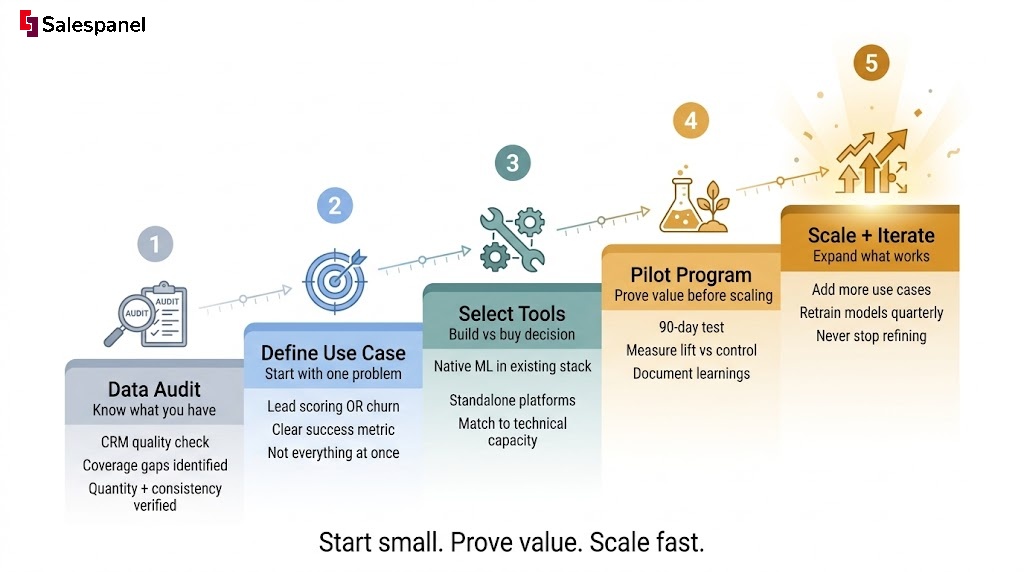
Step 1: Define Your Business Objective
Before considering data or technology, you must answer one critical question: What specific business problem are you trying to solve? A vague goal like “improve marketing” is a recipe for failure. Any successful predictive analytics project begins with a focused, high-impact objective.
For B2B marketers, a prime starting point is lead qualification. The objective is precise and measurable: “Use predictive analytics to identify and prioritize leads most likely to convert, thereby increasing sales efficiency by 20%.” This provides the project with a sharp focus and a quantifiable benchmark for success.
Step 2: Assess Your Data Readiness
Predictive models are only as accurate as the data they are trained on. This step involves a thorough audit of your data ecosystem to ensure you have the necessary fuel. You cannot predict the future with incomplete or inaccurate historical data.
The core idea here is that high-quality, clean first-party data is the bedrock of accurate predictions. Understanding the full customer journey—from the first anonymous website visit to the final purchase—is non-negotiable for building models that actually work.
Ask these critical questions:
- Is our data accessible? Can you easily consolidate information from your CRM, marketing automation platform, and website analytics into a unified repository?
- Is our data relevant? Does it contain the variables likely to influence outcomes, such as behavioral actions, firmographics, and historical engagement patterns?
- Is our data clean? Are there significant gaps, duplicates, or inconsistencies that could corrupt the model’s learning process?
This infographic illustrates the high-level workflow from raw data to optimized marketing campaigns.
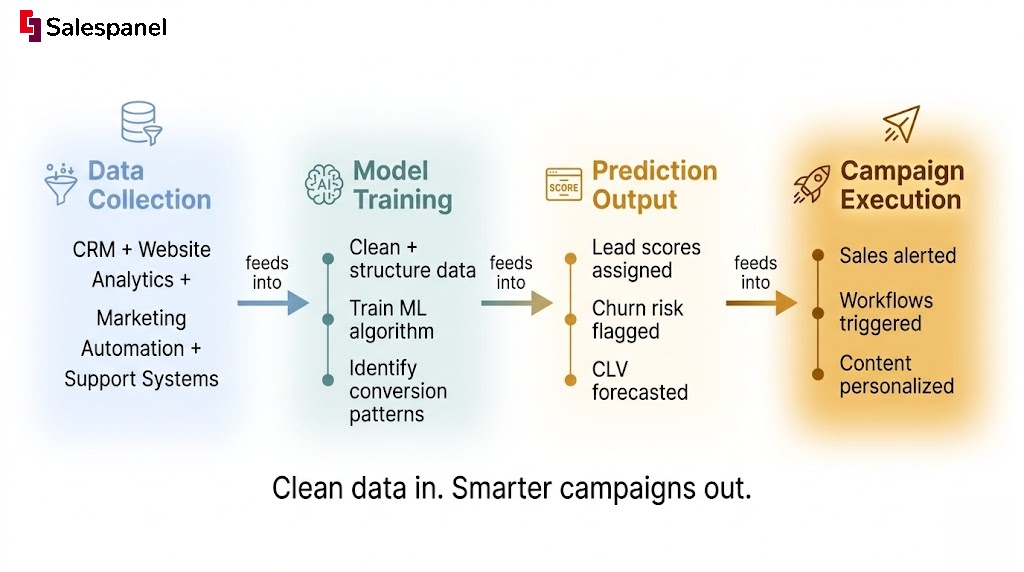
As shown, effective implementation requires a seamless flow from data collection and model training through to campaign execution.
Step 3: Choose the Right Tools
Next, you will confront the classic “build vs. buy” decision.
- Build: This route offers maximum customization but requires a dedicated team of data scientists, significant time, and a substantial budget. It is typically best suited for large enterprises with unique, complex data challenges.
- Buy: For most marketing teams, this is the most practical path. Many modern marketing platforms now offer built-in predictive features for tasks like lead scoring or churn analysis. This approach delivers value much faster and eliminates the need for an in-house data science team to get started.
When evaluating tools, prioritize platforms that integrate seamlessly with your existing technology stack and present insights in a clear, actionable format that doesn’t require a Ph.D. in statistics to interpret.
Step 4: Launch a Pilot Program
Do not attempt to overhaul your entire marketing strategy at once. This is a common pitfall that leads to failure. Instead, launch a small-scale pilot program that is laser-focused on the business objective defined in step one. A pilot serves as a proof-of-concept, demonstrating the value of predictive analytics with minimal risk.
For example, apply a predictive lead scoring model to a single product line or geographic region. Run this model in parallel with your existing scoring method for one quarter. This allows you to directly compare the results and build a robust, data-backed business case for wider adoption.
Step 5: Scale Your Success
Once your pilot program delivers measurable wins—such as a higher MQL-to-SQL conversion rate or a shorter sales cycle—it’s time to scale. This involves methodically deploying the validated model to other areas of the business.
Scaling is about more than just technology; it’s about people and processes. You must train your sales and marketing teams on how to interpret and act on the new predictive insights, integrating the scores into their daily workflows. It is also crucial to establish a feedback loop for continuous model refinement. Getting this right transforms a one-off project into an embedded, ongoing capability that consistently drives superior marketing outcomes.
Wrapping It Up: Your Predictive Marketing Journey
As we conclude this in-depth guide, remember that the central theme of adopting predictive analytics for marketing is about making consistently smarter, more empathetic decisions. This is not merely a technological upgrade; it is a fundamental strategic shift that transforms marketing from a reactive cost center into a predictable revenue engine. The ultimate goal is to anticipate customer needs before they are even articulated.
Everything we have covered provides the foundational knowledge. To ensure it translates into action, here is a final takeaway—a core checklist to guide your implementation.
Your Foundational Checklist
- Start with a Clear Question. Don’t try to boil the ocean. Zero in on a single, high-impact business problem you want to solve, like improving the quality of your leads or figuring out which customers are about to churn. A focused goal gives you clarity and a real benchmark for success.
- Prioritize Data Quality Over Quantity. The predictions you get are only as good as the data you feed the machine. Concentrate on gathering clean, structured, and relevant first-party data that truly maps out the customer’s path. This is the bedrock of any accurate model—there are no shortcuts here.
- Adopt a Test-and-Learn Mindset. Your first predictive model won’t be your last, and that’s okay. Treat this whole process as an iterative loop. Kick things off with a small pilot program, measure the results, and use what you learn to refine your approach and scale up.
Technology is the tool that enables your strategy, not a replacement for it. The most advanced predictive model is useless without a clear business objective and a team prepared to act on its insights.
Ultimately, this journey is about moving from hindsight to foresight. It’s about being equipped to act with confidence, guided by data-driven predictions rather than past performance reports. The philosophy of proactive, data-first marketing is central to achieving this, ensuring that every decision is informed and intentional. This aligns with the approach of platforms like Salespanel, which prioritize capturing the high-quality first-party data essential for fueling these advanced analytical models.
Got Questions? We’ve Got Answers
Stepping into predictive analytics can feel a bit like learning a new language. It’s normal to have questions. To help clear things up, here are some straightforward answers to the questions we hear most often.
What Kind of Data Do I Need for Predictive Marketing?
Think of it like building a puzzle. The more pieces you have, the clearer the final picture. Your best predictive models will come from a rich mix of data sources.
You’ll start with your own first-party data—this is the gold standard. It includes historical behavioral info like website visits, content downloads, and past purchases. Then, you’ll layer on firmographic details like company size, industry, and location to add context.
For an even sharper image, you can bring in third-party intent data. The most important thing? The data has to be clean and structured. It needs to tell an accurate story of the customer journey, which is why a tool that captures reliable first-party data is absolutely non-negotiable.
Do I Need a Team of Data Scientists to Start?
Not necessarily, especially not right out of the gate. While having a dedicated data science team is a huge asset for building custom models from the ground up, you don’t need one to get started.
Many modern marketing platforms now come with predictive features baked right in. Tools offering predictive lead scoring or churn risk analysis use pre-built models that are designed for marketers, not statisticians. A great approach is to start with one of these more user-friendly tools to prove the concept and show some early ROI.
Once your strategy gets more sophisticated and your needs grow, that’s the time to think about bringing in data science experts to create bespoke solutions.
How Is Predictive Analytics Different from Business Intelligence?
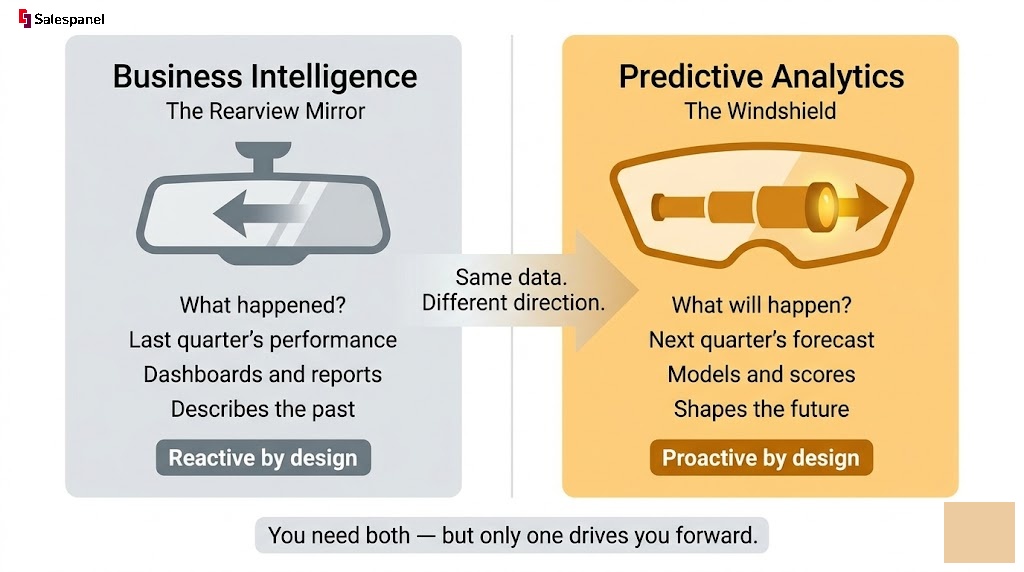
This is a great question, and the answer comes down to the direction you’re looking.
Business Intelligence (BI) is all about looking in the rearview mirror. It answers questions like, “What happened last quarter?” and “Why did our numbers dip in May?” BI uses dashboards and reports to paint a clear picture of past performance.
Predictive analytics, on the other hand, is like looking ahead through the windshield. It uses all that historical data from your BI tools to answer the question, “What is likely to happen next?” For instance, a BI report will show you last quarter’s sales figures. A predictive model takes that same data and tells you which of your current leads are most likely to become this quarter’s sales.
In short, BI reports on the past, while predictive analytics anticipates the future.
A solid predictive marketing strategy is built on a foundation of clean, reliable data. Salespanel helps you capture and organize the first-party customer data you need to fuel your models and uncover growth opportunities. Explore our resources at Salespanel to see how you can future-proof your data strategy.