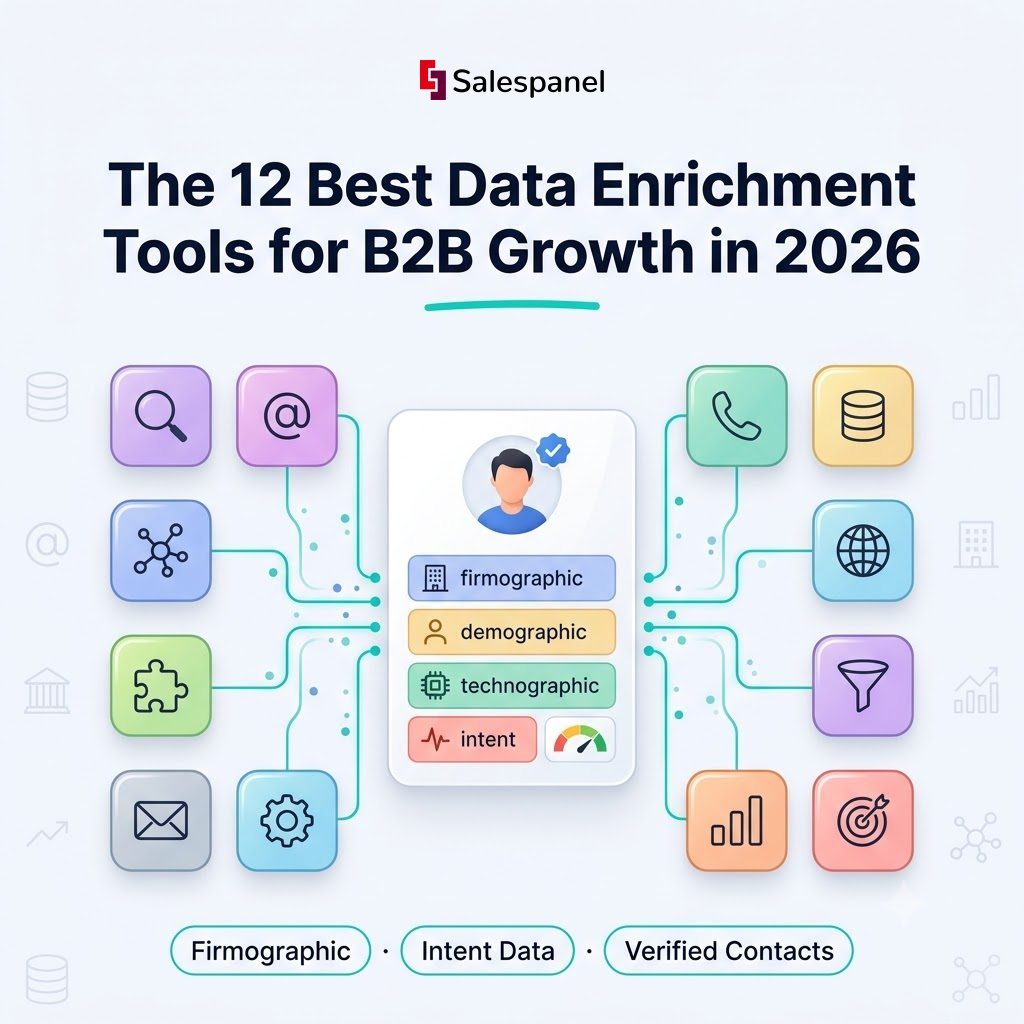
In the last decade, B2B marketing has undergone a seismic shift. We’ve moved from an era of incomplete information—where a lead was often just an email address and a prayer—to a data-driven present where every action must be informed by intelligence. The global data enrichment solutions market, valued at USD 2.39 billion in 2023 and projected to hit USD 6.27 billion by 2033, underscores this new reality. This isn’t just a trend; it’s a fundamental rewiring of how B2B companies find, engage, and win customers. In a future where artificial intelligence and predictive analytics dominate, the quality of the underlying data will be the single greatest differentiator between market leaders and laggards. This guide is your blueprint for navigating this critical transition, transforming fragmented data points into the actionable intelligence that fuels predictable growth.
The Unseen Force Driving B2B Success
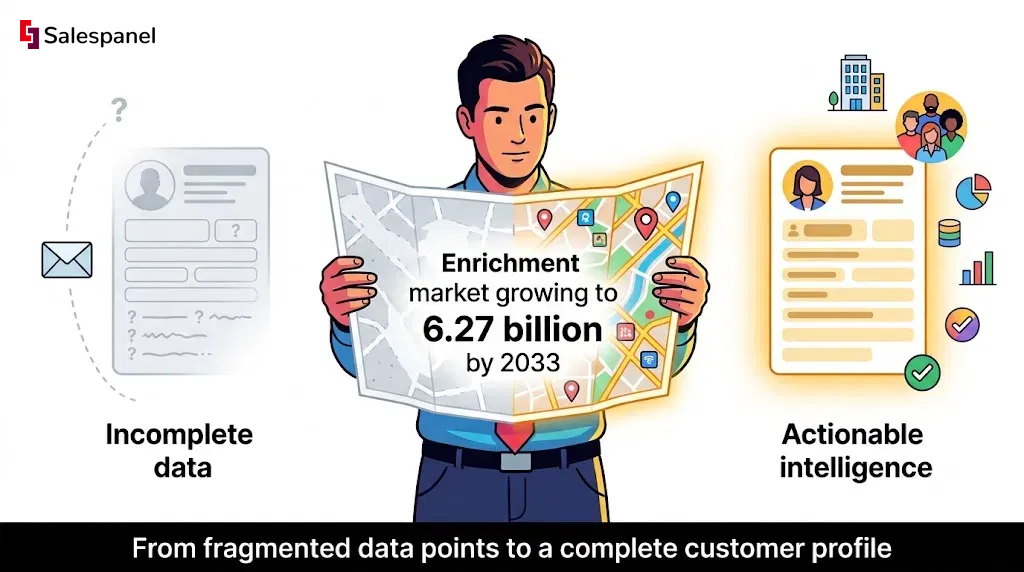
Ever tried to navigate a new city with a map that’s missing half its streets? For years, that’s exactly what B2B marketing and sales teams were forced to do. We worked with sparse, incomplete data, treating new leads as digital ghosts with no real context.
In today’s hyper-competitive landscape, this partial view is no longer an inconvenience; it’s a critical failure point. Incomplete data leads directly to wasted ad spend, generic outreach that falls flat, and sales cycles that stall. The central theme is clear: success is now impossible without turning fragmented data points into a cohesive, intelligent profile for every single prospect and customer.
From Incomplete Data to Actionable Intelligence
Data enrichment is the technical process that bridges the gap between knowing a lead’s email address and truly understanding their business context. It is the essential function of augmenting raw, fragmented information with verified third-party data to create the actionable intelligence that powers modern sales and marketing engines.
Let’s examine this in a practical context:
- A raw email address ([email protected]) is instantly transformed into a complete professional profile, including Jane’s job title, seniority level, and corporate location. This allows for immediate persona-based segmentation.
- A simple company name (“Acme Corp”) is expanded into a detailed firmographic record, providing its industry classification (e.g., SaaS), employee count (e.g., 501-1000), and annual revenue figures. This validates ICP fit.
- A website visit from an anonymous IP address can be reverse-engineered to reveal the visitor’s company, its technology stack, and even recent buying signals, flagging integration opportunities or competitive threats.
This transition moves an organization from a reactive posture to a predictive one. You stop merely identifying who a lead is and start understanding what they need and why they are a viable prospect. This foundational shift is what separates high-growth companies from those still operating with an incomplete map.
Let’s be clear: data enrichment isn’t just a technical buzzword. It’s a strategic imperative. It’s the core mechanism for creating predictable growth by ensuring every sales and marketing action is grounded in complete, accurate, and relevant data.
The Market’s Acknowledgment of a Critical Need
The rapid growth in this sector validates its importance. The global data enrichment solutions market is expanding at a compound annual growth rate (CAGR) of 10.13%. This financial momentum is a direct result of organizations recognizing that contextually rich customer data is no longer optional for survival and growth. You can discover more insights about this growing market.
This guide is engineered for B2B leaders who are ready to move beyond guesswork. We will deconstruct what data enrichment services are, detail their operational mechanics, and provide a framework for integrating them into your operations to drive measurable results.
Understanding The Layers Of Enriched Data
Data enrichment is not a monolithic action but a multi-layered process. The objective is to construct a complete, multi-dimensional model of your ideal customer, systematically adding layers of information to a foundational data point, such as an email address.
Each layer provides a new analytical vector, a different perspective on a prospect. When combined, a simple contact record is transformed into a powerful, actionable profile that facilitates a deep understanding of the entity and their likely commercial behavior.
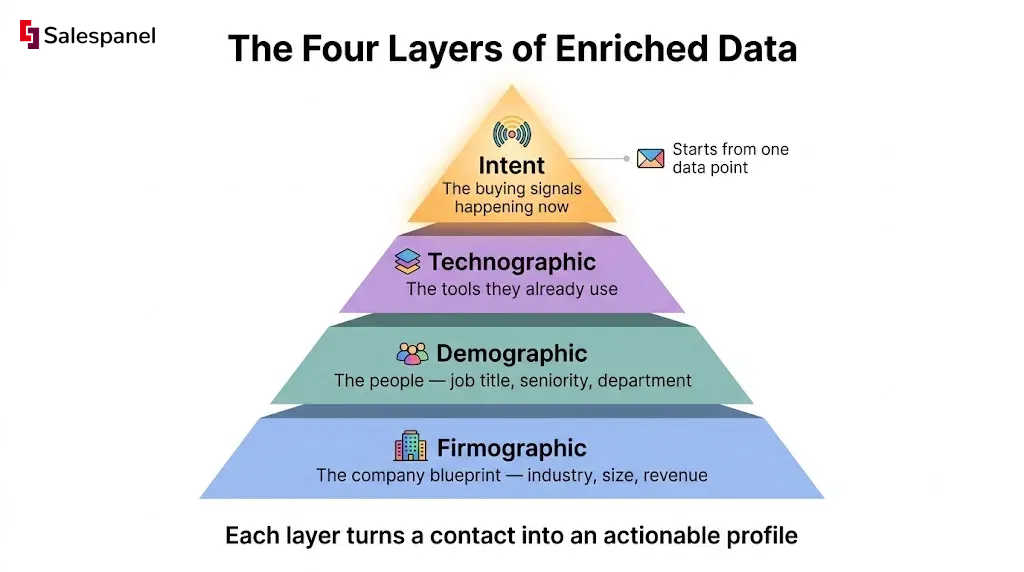
Specialized data enrichment services are the engines that execute this layering process, moving you beyond a basic contact to understand the full context of a business and its key personnel.
Firmographic Data: The Company Blueprint
Firmographic data forms the bedrock layer, providing essential attributes about the company itself. It answers the critical question: “What is the structural and financial profile of this organization?” This data is non-negotiable for accurate market segmentation, defining your Total Addressable Market (TAM), and ensuring sales resources are focused exclusively on accounts that fit your Ideal Customer Profile (ICP).
Key firmographic data points include:
- Industry: The company’s vertical (e.g., SaaS, Manufacturing, Healthcare).
- Company Size: Typically measured by employee count or annual revenue.
- Location: Headquarters and office locations for geographic targeting.
- Funding Status: Recent investment rounds often signal growth and budget availability.
Practical Example: A B2B software company sells logistics solutions to mid-market manufacturers. Using firmographic enrichment, they can take a raw list of 10,000 leads and instantly filter it down to 500 high-potential accounts that are verifiably in the manufacturing sector, have 200-1000 employees, and are located in North America. This data-driven filtering saves hundreds of hours of manual qualification and misdirected outreach.
Demographic Data: The People Behind The Business
While firmographics describe the company, demographics focus on the individuals within it. This layer is essential for pinpointing the decision-makers, champions, and end-users who must be influenced. It answers the question, “Who are the key players I need to engage?”
Important demographic attributes are:
- Job Title and Seniority: Is this a C-level executive, a manager, or an individual contributor?
- Function or Department: Are they in Marketing, IT, Operations, or somewhere else?
- Professional Experience: Sometimes includes specific skills or years in a role.
Practical Example: A cybersecurity firm knows its solution is purchased by the CISO but championed by the IT Director. With demographic enrichment, they can identify both personas within a target account from a single inbound lead. This allows for a bifurcated engagement strategy: an ROI-focused message for the CISO and a technical feature-benefit analysis for the IT Director.
Technographic Data: The Technology Stack
Technographic data provides a detailed map of the software and hardware a company utilizes. For B2B technology companies, this is one of the most powerful layers, as it reveals competitive vulnerabilities, integration opportunities, and technology adoption maturity. It answers the crucial question: “What tools are they already using?”
This layer is a direct signal of a company’s tech sophistication and potential compatibility. Knowing a prospect uses a complementary CRM or marketing automation platform can instantly qualify them for an integration-focused sales pitch.
This data exposes a company’s entire digital footprint, from their CRM and marketing automation platform to their cloud provider and specific analytics tools.
Intent Data: The Buying Signals
Intent data is the most dynamic layer, capturing behavioral signals that indicate a prospect is actively researching a solution like yours. It is a game-changer for prioritizing sales efforts. This data is aggregated by tracking online behavior, such as content downloads on third-party sites, keyword searches, and visits to competitor or review websites.
It answers the most valuable question of all: “What are they looking to buy right now?”
Bringing It All Together
The following table summarizes how these data types function in a real-world B2B context.
| Data Type | Key Data Points | Practical B2B Use Case |
|---|---|---|
| Firmographic | Industry, Company Size, Revenue, Location, Funding | Segmenting a market to focus sales efforts exclusively on companies matching a pre-defined Ideal Customer Profile (ICP). |
| Demographic | Job Title, Seniority, Department, Skills | Identifying and personalizing outreach to different buying committee members within a target account (e.g., the economic buyer vs. the technical user). |
| Technographic | CRM, Marketing Automation, Cloud Provider, Analytics Tools | Discovering accounts using a competitor’s product or a technology that integrates perfectly with yours, creating a warm and contextually relevant sales opportunity. |
| Intent | Topic Searches, Content Downloads, Competitor Visits | Prioritizing outreach to accounts actively demonstrating purchase intent, ensuring engagement occurs at the moment of peak interest. |
These layers are the foundational components of a predictive and proactive go-to-market strategy.
For instance, Website Visitor Tracking from Salespanel can capture the initial visit of an anonymous user. By enriching that single interaction with firmographic, technographic, and intent data, an anonymous visitor is de-anonymized into a known account. You instantly understand who they are, what company they work for, what technology they use, and if they are in an active buying cycle. This transforms your strategy from reactive to truly predictive, enabling you to engage the right person, from the right company, with the right message, at the exact right moment.
How Do Data Enrichment Services Actually Work?
The transformation of a single data point, like an email address, into a rich customer profile is not magic but a highly systematic, high-speed technical process. The core function of data enrichment services is to use an initial piece of information as a key to unlock a trove of associated details from massive, curated external databases.
This exchange typically occurs in near real-time via an Application Programming Interface (API). When a new lead is captured—for instance, through a website form submission—your system sends an API request to the enrichment service with the lead’s email or company domain. Within milliseconds, the service queries its data sources, identifies a match, and returns a structured data payload containing firmographic, demographic, and technographic information.
This high-speed data exchange is foundational to modern go-to-market strategies, enabling immediate lead scoring, routing, and personalization. The efficacy of this process, however, depends entirely on the matching methodology employed.
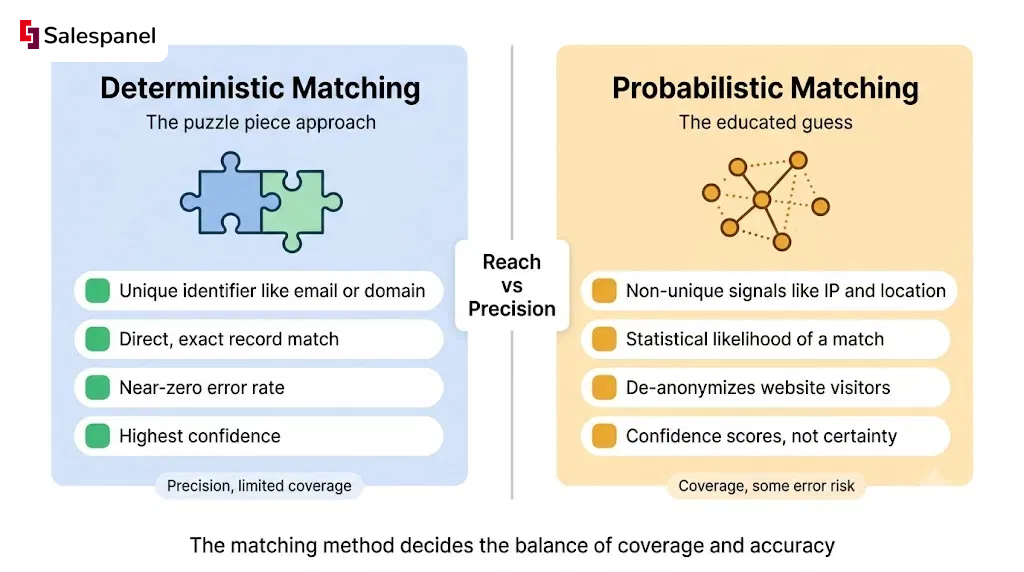
Deterministic Matching: The Puzzle Piece Approach
Deterministic matching represents the gold standard for accuracy. It relies on a unique, unambiguous identifier to link a record in your system to a corresponding record in the provider’s database. In a B2B context, the most common unique identifiers are a corporate email address or a company domain. The match is direct and highly reliable, leaving almost no room for error.
- How it works: Your CRM sends the identifier [email protected] to the enrichment service’s API.
- The result: The service locates the exact record tied to that email address and returns verified data for Jane Doe at Acme Corp, including her job title, seniority, and Acme’s industry, size, and revenue.
The primary advantage is confidence. You can be certain the appended data belongs to the correct entity, which is critical for accurate segmentation and personalized outreach. The main limitation is coverage; if the provider’s database does not contain that specific identifier, no match is returned.
Probabilistic Matching: The Educated Guess
Probabilistic matching is employed when a unique identifier is unavailable. This method uses algorithms to infer a connection based on a combination of non-unique data points, such as an IP address, device ID, geographic location, and browsing behavior. It calculates the statistical likelihood that two records from different datasets refer to the same entity.
Probabilistic matching is highly effective for expanding data coverage, particularly for de-anonymizing website visitors based on their IP address. However, it operates on confidence scores, not certainties, introducing a trade-off between reach and precision.
While this method can significantly increase your match rate, it carries an inherent risk of error. A 95% confidence score from a provider is strong, but it still implies a 5% potential error rate. When selecting a service, it is crucial to understand this balance between maximizing data coverage and maintaining data precision.
The Ecosystem of Data Sources
Ultimately, an enrichment service’s value is a direct function of the quality and breadth of its data sources. Providers build and maintain colossal databases by aggregating information from a diverse array of inputs in a continuous cycle of data acquisition and verification.
Common data sources include:
- Public Records: Government filings, official business registries, and corporate disclosures.
- Third-Party Data Compilers: Large-scale data brokers who aggregate information from thousands of sources.
- Web Scraping and Crawling: Automated systems that constantly scan the public web, extracting information from company websites, news articles, and press releases.
- Social and Professional Networks: Publicly available information and APIs from platforms like LinkedIn provide a continuous stream of updated professional data.
Leading data providers are relentless about cleaning, verifying, and cross-referencing this data to ensure its timeliness and accuracy. This rigorous, behind-the-scenes data hygiene is what enables the reliable transformation of a single email into a complete, actionable customer profile.
Integrating Enrichment into Your Go-to-Market Stack
Data enrichment services function as a force multiplier for your go-to-market (GTM) technology. While valuable in isolation, their true power is unleashed only when they are deeply integrated into your core operational systems, such as your CRM and marketing automation platform.
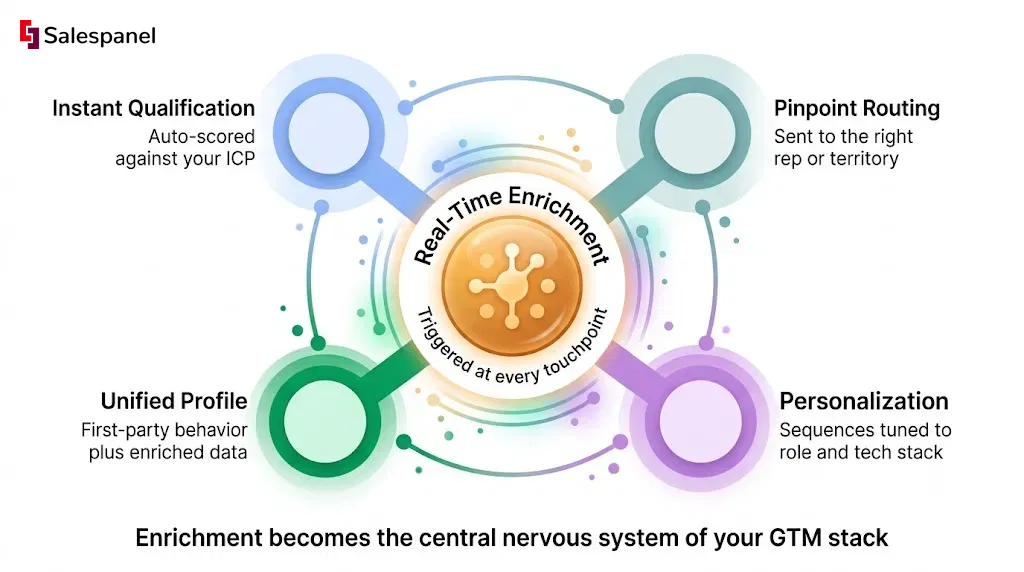
Isolated enriched data is a missed opportunity. When woven into your GTM stack, it becomes the central nervous system of your entire sales and marketing operation. The objective is to move beyond periodic list cleanups to a state of continuous, real-time enrichment that is triggered automatically at every customer touchpoint.
How a Connected GTM Stack Actually Works
Technically, this integration is managed through APIs. When a “trigger” event occurs—such as a new lead submitting a demo request—an API call is automatically sent to your data enrichment service. The service returns a data payload almost instantly, which is then mapped to the appropriate fields in your CRM or marketing platform. This automated workflow ensures that every new contact is fully profiled from the moment of entry.
The operational benefits are immediate:
- Instant Lead Qualification: New leads are automatically appended with firmographic and technographic data, allowing for on-the-spot qualification against your Ideal Customer Profile (ICP) without manual intervention.
- Pinpoint Lead Routing: Enriched geographic and company data enables leads to be automatically routed to the correct sales territory or account executive, eliminating delays that can jeopardize deals.
- Next-Level Personalization: Marketing automation workflows can trigger hyper-relevant email sequences based on a contact’s job function or their company’s existing technology stack.
Creating a Unified Customer View with Salespanel
To make this tangible, let’s analyze how a platform like Salespanel facilitates a unified customer journey view by combining first-party behavioral data with third-party enriched data. This synthesis creates a complete profile that drives intelligent, automated actions.
The process begins with the first interaction. Website Visitor Tracking from Salespanel captures critical first-party behavioral data from every visitor, including anonymous ones. This server-side tracking logs the initial signals—pages viewed, content engagement, and referral sources.
This initial behavioral data serves as the perfect trigger for enrichment. Instead of passively waiting for a form fill, you can proactively enrich a visitor’s IP address to identify the company, transforming an anonymous clickstream into a known account.
This approach fundamentally shifts the prospecting model from a passive game of waiting for prospects to self-identify to an active, real-time intelligence-gathering operation.
Powering Lead Scoring with Enriched Profiles
Once this unified profile is established within Salespanel, its true value emerges in applications like lead scoring. A basic scoring model might assign points for page views or email opens, but it lacks critical business context.
By layering in enriched data, a far more sophisticated and accurate scoring model can be constructed. Salespanel’s lead scoring framework can be configured to assign values based on this complete data profile, aligning sales focus with genuine business opportunities.
Here is a practical workflow:
- An anonymous visitor’s IP address is identified by Salespanel’s tracking script.
- An enrichment API call is triggered, revealing the visitor works for a 500-person SaaS company (firmographics) that uses a competitor’s CRM (technographics).
- The lead scoring model instantly processes this new intelligence: +20 points for being in the target “SaaS” industry; +15 points for fitting the “250-1000 employees” ICP parameter; +30 points for using a competitor’s technology, flagging a high-value sales opportunity.
This enriched score provides the sales team with a crystal-clear, prioritized list of the most promising prospects—those who not only demonstrate behavioral interest but also perfectly match the profile of your best customers. This deep integration elevates enrichment from a simple data utility to the foundational intelligence that drives your entire GTM strategy.
Choosing the Right Data Enrichment Partner
Selecting a data enrichment partner is a critical strategic decision. The right partner can act as a force multiplier, transforming fragmented data into actionable intelligence. The wrong partner can pollute your systems with inaccurate information, erode team trust in your CRM, and waste significant budget.
A thorough evaluation must extend beyond a surface-level comparison of feature lists. It requires a deep dive into a vendor’s data sourcing methodologies, hygiene processes, and delivery mechanisms. This is about finding a partner whose technology, compliance standards, and business model align with your operational needs and strategic goals.
As depicted in the typical data flow, the process hinges on a seamless API connection that transforms raw data inputs into usable, structured profiles.
Your Vendor Evaluation Checklist
To cut through marketing jargon, focus on these critical evaluation criteria during vendor discussions.
- Data Accuracy and Verification: “What are your specific data verification processes, and what is your data refresh cadence?” A transparent vendor should be able to provide metrics for their average match rate and data accuracy percentage. Crucially, ask, “What is your process for handling non-matches or low-confidence results?”
- Data Coverage: “What is your data coverage for our target industries and geographical regions?” A provider with robust data for North America may have significant gaps in EMEA or APAC, which could impede international expansion.
- Processing Speed and Integration: “Do you offer real-time API enrichment or only batch processing?” Confirm that they provide pre-built integrations for your existing CRM and marketing automation platforms. A lack of real-time capabilities will introduce critical delays between lead capture and sales action.
- Data Compliance: “How do you ensure compliance with regulations like GDPR and CCPA?” Ask for a detailed explanation of their data sourcing ethics. A trustworthy partner will be fully transparent about their privacy practices and data governance processes.
A vendor’s reluctance to provide clear answers regarding their data sources and compliance practices is a significant red flag. Data governance is a shared responsibility, and a partner’s non-compliant practices can create substantial legal and reputational risk for your organization.
Demystifying Pricing Models
Pricing for data enrichment services typically falls into two main models. Understanding their mechanics is key to forecasting costs accurately.
- Per-Record Pricing: You pay a fixed cost for each record you enrich. This model is suitable for ad-hoc projects or companies with low and unpredictable lead volume. However, costs can scale unpredictably as lead volume grows.
- Subscription Plans: You pay a flat recurring fee (monthly or annually) for a specified volume of enrichments or API calls. This model offers budget predictability and is generally more cost-effective for organizations that plan to enrich data continuously as part of their standard operating procedures.
When evaluating pricing, calculate the total cost based on your projected data processing volume. A low per-record price may seem attractive initially, but a subscription plan will likely offer superior economic value at scale.
How to Measure the ROI of Data Enrichment
Investing in data enrichment is a critical first step, but without a clear framework for measuring its return, its value remains anecdotal. To justify the investment and secure ongoing budget, you must connect the dots between enriched data and tangible business outcomes. The goal is to demonstrate how this technology makes your entire go-to-market motion faster, more efficient, and more profitable.
The market’s trajectory validates this focus on ROI. The data enrichment tool market is projected to grow from approximately USD 5 billion in 2025 to over USD 15 billion by 2033. This growth is driven by businesses banking on quality data to sharpen their CRM and marketing campaigns, making ROI measurement a non-negotiable requirement. You can explore the full market projections to understand this accelerating trend.
Foundational and Business-Impact KPIs
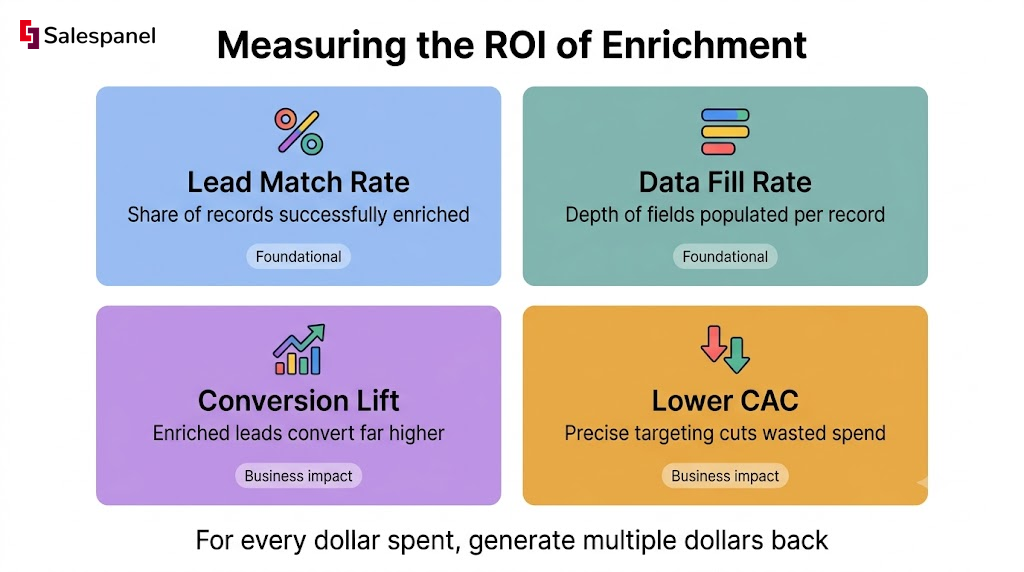
A robust ROI case requires tracking both foundational metrics (technical performance) and business-impact KPIs (financial performance). The former confirms the tool is working as intended, while the latter demonstrates how it contributes to revenue.
Foundational KPIs to Track
These are diagnostic metrics that validate the service’s core functionality.
- Lead Match Rate: What percentage of your incoming records is the service successfully identifying and enriching? A match rate below 50% could indicate poor data quality from the vendor or a misalignment between their database and your target market.
- Data Fill Rate: For the records that are successfully matched, what percentage of key data fields (e.g., company size, industry, job title) are being populated? This metric measures the depth and completeness of the data you are receiving.
While essential, these metrics only tell part of the story. The true ROI is revealed by measuring the impact of this enriched data on core business functions.
Tying Enrichment Directly to Revenue
This is where data enrichment proves its strategic value. The most critical metrics are those that draw a direct line from enriched data to sales and marketing performance. These are the numbers that capture leadership attention and justify continued investment in data enrichment services.
Key Business-Impact KPIs
- Improved Lead-to-Opportunity Conversion Rate: High-quality data enables more accurate lead scoring and prioritization. Track the conversion rate of enriched leads versus non-enriched leads. If enriched leads convert to opportunities at a rate of 15% while non-enriched leads convert at 5%, that 10-point delta is a direct measure of ROI.
- Accelerated Sales Cycle (MQL Velocity): Measure the time it takes for a Marketing Qualified Lead (MQL) to become a Sales Accepted Lead (SAL). When sales representatives receive leads pre-populated with full firmographic and technographic data, they can bypass manual research and proceed directly to contextualized outreach, thereby shortening the sales cycle.
- Lower Customer Acquisition Cost (CAC): Better data leads to more precise targeting, reducing wasted advertising spend. It also increases sales team efficiency by focusing their efforts on the highest-potential accounts from the outset. By calculating the reduction in marketing and sales costs per acquired customer, you can demonstrate a clear financial return.
The ultimate goal is to build a dashboard that clearly demonstrates that for every dollar spent on enrichment, you are generating multiple dollars back through faster sales cycles, higher conversion rates, and more efficient operations.
When you can articulate this data-backed narrative, your enrichment platform is no longer perceived as a discretionary tool but as a core component of your revenue engine.
Frequently Asked Questions About Data Enrichment
Navigating the implementation of data enrichment services often raises practical questions. Below, we address some of the most common inquiries to provide clarity.
How Do Data Enrichment Services Handle Privacy Regulations?
Reputable data enrichment providers build their services on a foundation of compliance. They source data primarily from publicly available channels and from sources where consent for data sharing has been explicitly granted. For B2B data, processing often falls under the “legitimate interest” provision of regulations like GDPR.
During vendor evaluation, directly inquire about their data sourcing methodologies, their process for handling data subject access requests (DSARs), and their framework for maintaining compliance with GDPR and CCPA. A transparent partner will readily provide documentation on their compliance and data privacy policies.
What Is the Difference Between Data Enrichment and Data Cleansing?
While often performed in conjunction, data enrichment and data cleansing are distinct processes with different objectives.
Data cleansing focuses on correcting and standardizing the data you already possess. This includes fixing typographical errors (e.g., correcting “Acme Cor” to “Acme Corp”), standardizing address formats, and removing duplicate records. It is an act of internal data hygiene.
Data enrichment, conversely, is the process of appending your clean data with new information from external sources. For example, cleansing corrects a company name. Enrichment then takes that correct name and adds its industry, employee count, and annual revenue. A comprehensive data strategy requires both.
Can Data Enrichment Happen in Real Time?
Yes, and this capability is a significant competitive advantage. Modern data enrichment services utilize APIs to deliver data in real time, enabling immediate action. This is critical for use cases like personalizing a website for a first-time visitor or instantly routing a high-value lead to the appropriate sales representative.
When a prospect submits a form, an API call can augment their profile with complete firmographic and technographic data within seconds. This allows for immediate scoring and assignment, enabling your team to engage while purchase intent is at its peak. This stands in stark contrast to batch enrichment, which operates on a delayed schedule and introduces a lag between data capture and action.
At Salespanel, our philosophy is that enriched, real-time data is the bedrock of any proactive B2B growth strategy. By combining your proprietary first-party behavioral data with rich third-party profiles, you achieve a complete, actionable view—the who, what, and why behind every digital interaction.
Ready to build a smarter, data-driven GTM engine? Explore our resources to see how it all comes together.