
Before intent data, B2B marketing was largely a game of educated guesses. Marketers cast wide nets, hoping to catch the attention of a few interested buyers in a sea of indifference. This reactive approach, built on static lead lists and cold outreach, was notoriously inefficient. Today, we stand at a pivotal junction. The global B2B Buyer Intent Data Tools market, valued at approximately $1.2 billion in 2023, is projected to surge to nearly $4.8 billion by 2032. This explosive growth signals a fundamental paradigm shift: the future of B2B marketing isn’t about finding leads; it’s about identifying active buying cycles as they happen.

This guide provides an in-depth analysis of what intent data is, its technical underpinnings, and the practical methodologies for integrating it into your revenue operations. The central theme we will explore is the transition from assumption-based marketing to a proactive, evidence-based strategy that intercepts buyers at the moment of peak interest. Understanding and leveraging these digital footprints is no longer a competitive advantage—it is a strategic necessity.
The End of Guesswork in B2B Marketing
For decades, the B2B marketing playbook relied on a high-volume, low-precision model. Teams launched broad campaigns, purchased static lead lists, and executed cold calling blitzes, all based on the hope of stumbling upon the right person at the right time. This methodology was a numbers game, governed by gut feelings and broad firmographic assumptions.
The inefficiency of this model was profound. Significant capital and human resources were expended pursuing leads with no current interest or need for the product. This resulted in low engagement metrics, wasted advertising spend, and sales team burnout. The core deficiency was a lack of visibility into the buyer’s journey until they explicitly raised their hand by filling out a form.
The Shift to Proactive Engagement
Intent data fundamentally inverts this model. Instead of waiting for a prospect to signal their interest, you can now observe their research behavior across the digital landscape. It is the technical equivalent of shifting from waiting for a knock on the door to seeing someone walking up your driveway, clearly looking for your house number.
This visibility allows marketing and sales teams to transition from a reactive to a proactive posture. By identifying which accounts are exhibiting verifiable signs of purchase intent, organizations can:
- Focus sales outreach on accounts with the highest probability of closing.
- Tailor marketing messaging based on the specific topics and pain points a prospect is actively researching.
- Optimize advertising spend by targeting only in-market buyers, dramatically increasing ROAS.
A Market Built on Certainty
This shift toward certainty is not a niche trend; it is a significant market transformation. The global B2B Buyer Intent Data Tools market was valued at around $1.2 billion in 2023 and is on track to hit nearly $4.8 billion by 2032. This growth trajectory underscores a critical business imperative: companies are abandoning guesswork in favor of data-driven decision-making.
The following table provides a comparative analysis of the operational differences between traditional and intent-driven B2B marketing frameworks.
The Shift from Traditional to Modern B2B Marketing
| Marketing Approach | Traditional Method (Without Intent Data) | Modern Method (With Intent Data) |
|---|---|---|
| Lead Sourcing | Buying static lists, cold outreach, broad net casting. | Identifying in-market accounts based on real-time behavior. |
| Targeting | Based on firmographics (company size, industry). | Based on behavioral signals (topics researched, content consumed). |
| Engagement Timing | Reactive; waits for the prospect to make the first move. | Proactive; engages when research activity peaks. |
| Messaging | Generic, one-size-fits-all campaigns. | Personalized messages based on specific interests and pain points. |
| Sales Focus | Volume of calls and emails. | Quality of conversations with prioritized, high-intent leads. |
| Efficiency | Low engagement, high resource waste on uninterested leads. | High engagement, efficient use of budget on likely buyers. |
It’s clear that relying on intent signals isn’t just an improvement—it’s a fundamental change in strategy. You’re no longer just talking at people; you’re joining a conversation that’s already in progress.
Intent data gives you the why behind a buyer’s actions. It’s the closest we can get to understanding what a prospect is actually thinking, which lets us engage with relevance and, most importantly, empathy.
This guide is here to pull back the curtain on what intent data is, how it really works, and how you can start putting it to use. The main takeaway is simple: it’s time to stop guessing and start knowing.
How Digital Footprints Become Intent Data
Every time a prospect executes a search query, downloads a whitepaper, or visits a competitor’s website, they leave a digital breadcrumb. Individually, these are discrete data points. However, when aggregated and analyzed, these breadcrumbs form a coherent narrative that reveals a buyer’s true intentions.
This process is analogous to a detective’s forensic analysis. A single fingerprint is insufficient to solve a case. But when combined with witness statements, surveillance footage, and motive, a complete story emerges. Similarly, intent data analysis transforms scattered digital signals into a cohesive profile that indicates a high propensity to buy. This process begins by collecting data from three primary sources.
The Three Core Sources of Intent Data
Not all intent signals are created equal. They are typically categorized based on their origin, with each type offering a distinct level of insight into the buyer’s journey.
Let’s dissect the different types of intent data, their sources, and the specific signals associated with each.
Types of Intent Data Sources and Signals
| Data Type | Source | Example Signals |
|---|---|---|
| First-Party | Your own website, CRM, and marketing tools. | Visiting your pricing page multiple times, downloading a case study, spending a long time in product docs, filling out a contact form. |
| Second-Party | Data acquired from a direct partner. | Webinar attendance lists from an industry publication, engagement data from a co-marketing partner’s event. |
| Third-Party | Aggregated from a vast network of B2B websites. | A company’s employees researching specific keywords across the web, reading reviews on sites like G2 or Capterra. |
As illustrated, each source provides a unique piece of the puzzle, ranging from direct interactions with your brand to broader market research activities.
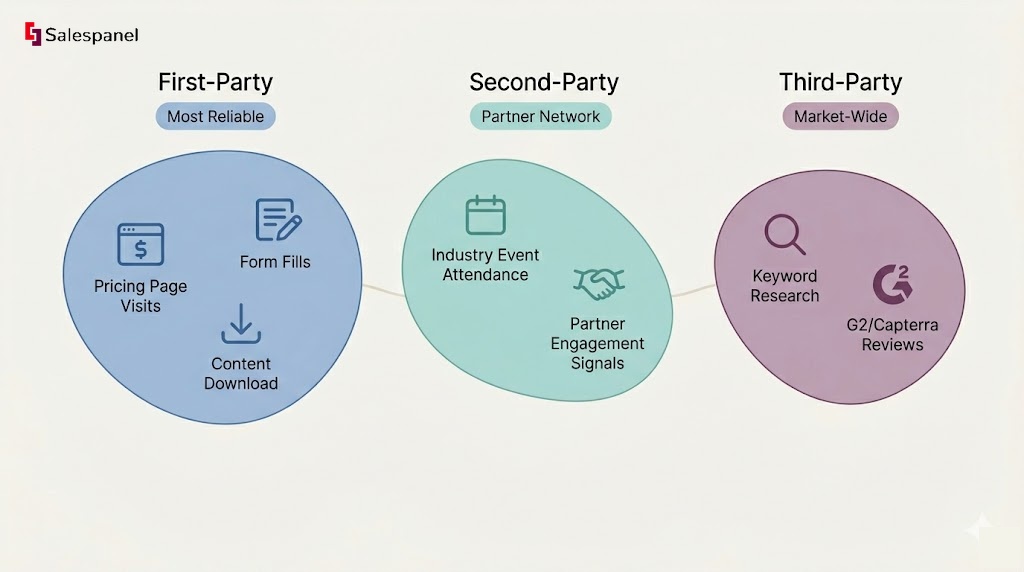
Here is a more detailed examination of each source:
First-Party Data: This is the most valuable and reliable data set. It is information you collect directly from your owned digital properties—your website, CRM, and marketing automation platform. These signals, such as repeat visits to a pricing page or extended time spent on technical documentation, provide unequivocal evidence of interest in your specific solution. Capturing these signals with a tool like website visitor tracking from Salespanel offers a direct view into which prospects are exhibiting the strongest buying signals.
Second-Party Data: This is another entity’s first-party data that you acquire through a direct partnership. A practical example is obtaining the attendee list from a webinar hosted by an industry publication on a topic highly relevant to your product. It serves as an effective method for identifying new audiences that have demonstrated interest in your niche but may not yet be aware of your brand.
Third-Party Data: This data is aggregated by external providers from a vast network of B2B websites, industry publications, and other online sources. It provides a macro-level view of market activity, revealing which companies are researching specific topics and keywords across the web. This is particularly powerful for identifying in-market accounts that are early in their buying journey and have not yet discovered your solution.
This infographic does a great job of showing how these scattered data points are gathered, enriched, and finally turned into clear, actionable intelligence for your team.
What the visual makes clear is the critical journey from raw noise to meaningful insight. It’s not just about collecting data; it’s about systematically filtering it until you have something you can actually act on.
A Practical Example of Data in Action
Let’s trace a practical application of this data synthesis. Consider a mid-sized company, “Innovate Corp,” which begins researching new “cybersecurity solutions.”
- An IT manager from Innovate Corp initiates a Google search for “best endpoint security software” (Third-Party Signal).
- The manager then navigates to a popular software review site and begins evaluating several vendors (Third-Party Signal).
- Subsequently, they visit your website and download an e-book titled “The 2024 Guide to Threat Detection” (First-Party Signal).
- Finally, another team member from Innovate Corp’s IP address visits your pricing page (First-Party Signal).
By correlating these digital footprints, you can conclude with high confidence that Innovate Corp is a high-intent account. You not only know they are in the market but also have specific intelligence regarding their pain points. This collective insight transforms random online behavior into a powerful strategic asset.
Turning Raw Signals into Actionable Intelligence
In its raw form, intent data is a high-volume stream of noise. An isolated keyword search, a single article click, or a brief page view provides minimal insight. The true value is unlocked when these billions of disparate behavioral signals are processed and translated into actionable intelligence.
This process is akin to assembling a complex puzzle. One can analyze each piece individually or develop a system to recognize the overarching image they collectively form. The objective is not data collection, but pattern recognition. This is a domain where artificial intelligence and machine learning technologies excel.
The Power of AI and Machine Learning
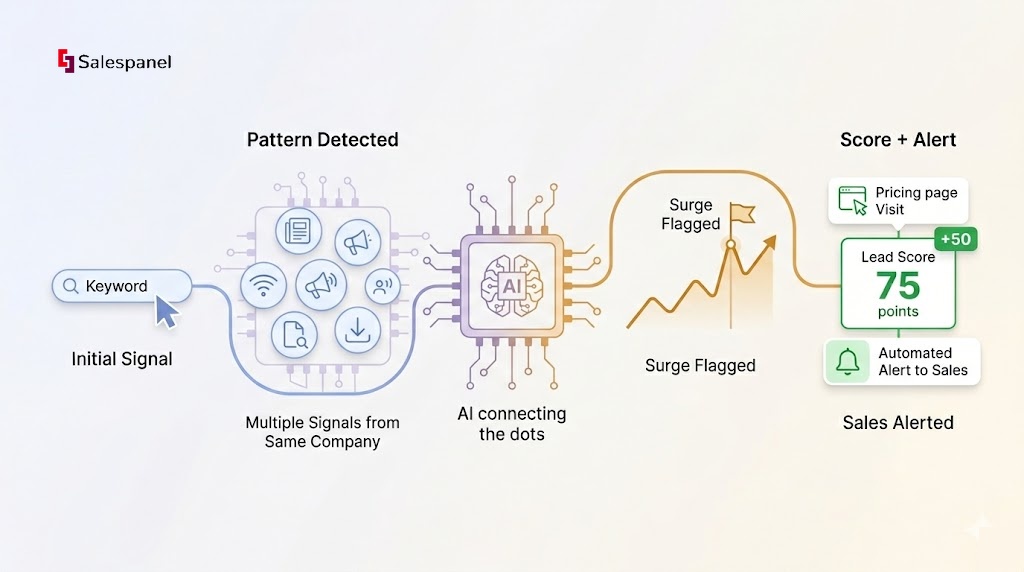
AI algorithms are designed to perform what is humanly impossible: analyze massive datasets at computational speeds. They sift through terabytes of behavioral data to identify statistically significant patterns, detecting “surge signals” when a company’s research activity on a specific topic suddenly intensifies. Ultimately, these models predict which companies are genuinely progressing through a buying cycle.
This is what transforms a chaotic feed of signals into a prioritized list of sales opportunities. An AI model can differentiate between a university student researching a topic for an academic paper and a team of decision-makers from a target account researching the same topic with clear commercial intent. Context is the critical variable.
The combination of buyer intent data and AI is reshaping how sales and marketing get done. In fact, the AI marketing space is expected to hit $107.5 billion by 2028. It’s no surprise, given that companies using this approach are seeing 26% better ad targeting and 32% higher conversion rates.
From Signal to Score
How is this process operationalized? Let’s trace the path from scattered data points to a high-intent score that triggers sales engagement.
- The Initial Signal: An employee at a target company clicks on an article about “cloud migration strategies.” This is a raw, third-party data point.
- Pattern Recognition: Over the following week, the system detects several other employees from the same company reading software reviews and visiting competitor websites related to cloud infrastructure. The AI connects these individual activities at the account level.
- Surge Detection: The system flags this cluster of activity as a “surge,” indicating that this topic has become a high-priority initiative for that account.
- First-Party Correlation: An anonymous visitor from that same company’s IP range then lands directly on your pricing page. This powerful first-party signal confirms direct interest in your commercial offering.
This is where the data converges into a single, actionable metric. A platform where Salespanel lets you assign specific point values to each of these signals is crucial. A third-party keyword surge might add 15 points to an account’s score, but that definitive first-party pricing page visit could add 50 points.
Once an account’s cumulative score crosses a predefined threshold, it is automatically flagged as a product-qualified lead (PQL). An alert is sent to the sales team, enabling immediate and context-aware outreach. This systematic process ensures that sales resources are allocated exclusively to accounts demonstrating serious buying intent, thereby converting abstract data into tangible revenue.
Putting Intent Data to Work in Your Business
Understanding the theory of intent data is the first step. The critical phase is its practical application—translating data into measurable business outcomes. The real value is realized when you move from passive knowledge to active implementation.
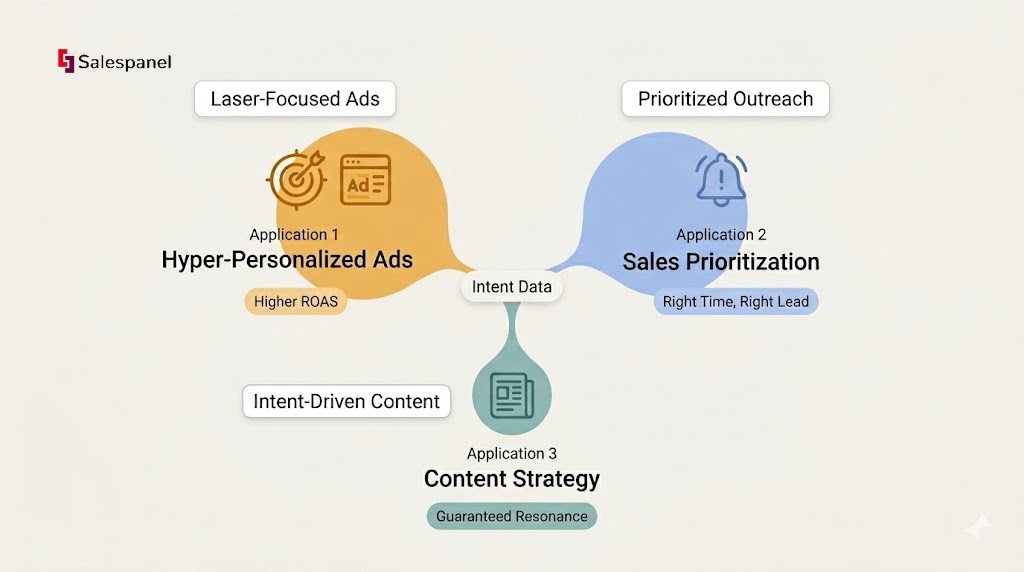
By integrating intent signals into your sales and marketing workflows, you transition from broad communication to precise, meaningful conversations with prospects who are already actively seeking solutions. This represents a shift from prioritizing based on static lists or intuition to prioritizing based on real-time evidence of buying behavior. This is not merely an efficiency gain; it is a fundamental re-architecture of the revenue generation process. The results are compelling: companies that leverage buyer signals have reported a 232% increase in ROI.
Hyper-Personalized Advertising Campaigns
The most immediate application is the optimization of advertising spend. Generic, “spray-and-pray” campaigns are a primary driver of budget inefficiency. Intent data rectifies this by enabling the creation of highly specific audiences composed exclusively of accounts that are actively researching your competitors, solution category, or the problems you solve.
Consider a company that sells project management software. Instead of targeting the entire technology industry, you could use intent data to identify businesses searching for “Gantt chart software alternatives” or “agile workflow automation.” This allows for the execution of laser-focused ad campaigns with copy that directly addresses the prospect’s immediate needs, resulting in higher click-through rates, lower customer acquisition costs, and minimal wasted ad spend.
Empowering Sales with Prioritized Outreach
Time is the most valuable asset for a sales team. Intent data functions as a real-time prioritization engine, flagging accounts that are exhibiting peak interest now, ensuring that sales representatives focus their efforts on conversations with a high probability of conversion.
For instance, when an account on a target list suddenly begins researching a competitor’s pricing or a problem your solution is known to solve, an automated alert can be sent to the designated sales representative. This alert provides not just the “who” (the company) but the “why” (the specific topics they are researching). Armed with this context, the representative can craft a perfectly timed and highly relevant outreach message, significantly increasing the likelihood of securing a meeting.
You’re essentially turning a firehose of raw signals into a clean, prioritized list of in-market accounts. Your sales team can finally stop making cold calls and start solving problems for people who are actively looking for a solution.
Guiding Your Content Strategy
Finally, intent data provides invaluable intelligence for your content strategy. It offers a direct line of sight into the topics, challenges, and questions that are top-of-mind for your target audience, enabling you to create content with a guaranteed resonance.
By analyzing aggregated intent topics across your market, you can identify content gaps and strategic opportunities with high confidence.
- Blog Posts and Articles: A detected spike in searches for “data compliance regulations” indicates a clear need for a comprehensive guide on the topic, attracting a relevant, high-value audience.
- Webinars and Events: Consistent, high-volume interest in “improving sales efficiency” provides the ideal theme for your next webinar, ensuring high registration and engagement.
- Case Studies and Whitepapers: If accounts are frequently researching a specific competitor, this is a clear signal to develop a detailed comparison guide or a case study highlighting your unique value proposition.
Integrating Intent Data into Your Marketing Stack
Acquiring intent data is only the initial step. Its true power is unlocked when it is seamlessly integrated into your existing technology stack. An isolated intent data feed is analogous to a high-performance engine sitting in a crate—the potential is there, but it is not connected to the drivetrain.
The primary objective is to eliminate data silos. The goal is to create a single, unified view of every prospect and customer, rather than having fragmented information distributed across disparate platforms. This begins with a strategic plan that bridges the gap between insight and action.
Before implementing any technology, a clear strategy is paramount. You cannot effectively act on intent signals without a rigorously defined Ideal Customer Profile (ICP). Understanding who you are trying to reach and their core business challenges is the foundational prerequisite for any successful intent-driven strategy.
Building a Closed-Loop System
Once your ICP is defined, the next step is to map the specific topics and keywords that signal an active research phase. This is not a generic list; it must be precisely aligned with your product offerings and the problems they solve. For a cybersecurity firm, this might include terms like “endpoint detection and response” or “zero-trust security models.”
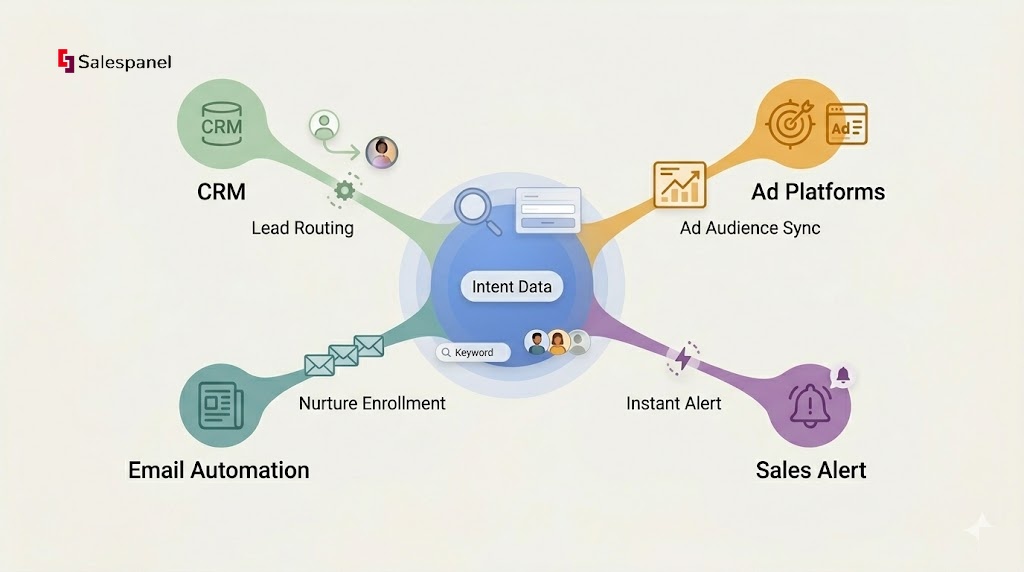
With these topics identified, you can configure your systems to listen for these buying signals. The core of this integration is connecting your intent data provider directly to your CRM and marketing automation platform. This establishes a powerful, closed-loop system where data flows seamlessly, triggering automated actions without manual intervention. This architecture creates a single source of truth for all customer activity. At Salespanel, our philosophy is centered on this principle—fusing our proprietary first-party website visitor tracking with third-party signals to construct a complete, high-fidelity picture of the buyer’s journey.
You can see below how a platform can bring all this data together in a way that your teams can actually use.
A dashboard like this takes complex visitor and account data and boils it down into a clear, prioritized view. Your sales and marketing teams can look at it and know exactly what to do next.
From Data to Revenue
With all systems interconnected, the final step is to build automated workflows that convert these insights into action. These workflows are the engine of your strategy, ensuring that no high-intent lead is ever missed.
Here’s a practical look at these automated workflows:
- Lead Routing: An account exhibiting a sudden spike in intent is automatically routed to the appropriate salesperson for immediate follow-up.
- Ad Audience Syncing: Companies actively researching your competitors are dynamically added to highly targeted advertising campaigns on platforms like LinkedIn or Google.
- Nurture Campaign Enrollment: Prospects are automatically enrolled in specific email nurture sequences based on the topics they are researching.
The bottom line is that integration isn’t just a nice-to-have; it’s non-negotiable. By connecting intent data to your core sales and marketing systems, you create an intelligent, automated machine that turns abstract buying signals into predictable revenue. It’s the last—and most critical—step in moving from simply knowing what intent data is to making it a core part of how you grow your business.
Got Questions About Intent Data? We’ve Got Answers.
Adopting an intent data strategy inevitably raises several questions. This is a positive sign, as obtaining clear answers is the first step toward building an effective program. Let’s address some of the most common technical and practical inquiries.
How Reliable Is Third-Party Intent Data?
This is a critical question, and the answer is that reliability varies significantly by provider. Reputable providers employ sophisticated methodologies to filter out noise and validate signals from a vast network of sources. However, even the highest quality third-party data is not infallible on its own.
The real magic happens when you blend the two. Think of third-party data as the market-wide rumor mill and your own first-party data as the confirmed intel from your own turf.
When you observe a company researching solutions like yours (third-party) and then see them actively browsing your pricing page (first-party), you have a much clearer, more reliable picture of genuine buying intent.
What Is the Difference Between Intent and Engagement?
This is a crucial distinction, and the concepts are straightforward.
Engagement data pertains to how prospects interact directly with your owned assets. This includes email opens, webinar attendance, and website navigation. Engagement occurs on your digital property.
Intent data, conversely, captures research behavior across the entire internet. It provides visibility into a prospect’s interest in a topic, solution category, or even your competitors before they have any direct interaction with your brand. It offers a much earlier and broader view of their journey, enabling a proactive rather than reactive stance.
How Can I Start with Intent Data on a Limited Budget?
A large budget is not a prerequisite for entering the world of intent data. The most strategic starting point is to maximize the value of the data you already possess: your website traffic.
Begin by performing a deep analysis of your website visitor behavior. While tools like Google Analytics provide a high-level overview, a more powerful solution is needed to identify the specific companies behind the traffic. Using a solution that offers website visitor tracking from Salespanel helps de-anonymize visiting companies and track their on-site activities. This effectively transforms your website into a proprietary source of first-party intent data.
Once you have demonstrated a clear ROI from your own data, you can strategically layer in third-party data to expand your reach and market visibility.
Ready to stop guessing and start knowing who your in-market buyers are? Salespanel provides the tools to unify first-party and third-party data, giving you actionable insights to drive revenue. Explore our guides and resources to build your strategy.
Discover more at Salespanel