Customer Data Integration: 8 Best Practices for a Single Customer View
Not too long ago, a customer’s value was recorded on a simple, digital ledger. Now, customer value is recorded and perceived through a complex, multidimensional framework and myriad, continuously unfolding, deep, and interconnected multidimensional signals whose elements layer upon one another. Gartner has estimated the cost of poorly managing the dimension of complexity at $12.9 million per year. Spending resources while obscuring the understanding of the customer constitutes a poorly integrated, reactive, and fragmented approach. However, the challenge of the future will not be the more proficient collection of data, but rather the integrated use of dynamically sophisticated, seamless states of data fusion.
In the current business landscape, the challenge is more complex than simple data aggregation. The harmony of real-time data collection and the ever-growing customer sentiment of expected real-time personalization, coupled with the ever-increasing global privacy regulations of GDPR and CCPA, and the profound impact of third-party cookie deprecation, creates a business imperative. The potential of every business that survives will depend on the organization’s ability to unify disparate data streams— from the tracking of anonymous website visitors to the sale and post-sale customer support processes—into a usable, actionable, and compliant single customer view.

In this article, we have tried to cover the customer data integration best practices. We will identify the underpinning architectural patterns, data governance, and technology that framed the shift from untenable customer data liability to customer data asset.
The core topic we will address is achieving ‘Data Fluidity’, the ability for organizations to have, in real time, accurate, secure customer information that flows seamlessly throughout the organization. Establishing a single source of truth and implementing robust identity resolution practices will create a cohesive and actionable roadmap. The key takeaway will be a blueprint designed to break free from the chaos of data and ultimately gain customer clarity, giving every team and every decision made the power of accessible, reliable, and integrated data.
1. Establish a Single Source of Truth (SSOT)
A core SSOT principle of modern data management practices is to have one data repository and designate it as the primary, authoritative, and definitive source of customer information. This centralized approach allows all divisions within the organization, including marketing, sales, customer support, and product, to utilize the same data, and only the same, continuously updated, accurate data. The focus of this approach is to remove data silos that reside in disparate systems such as CRMs, email platforms, and analytics tools in order to eliminate conflicting and fragmented customer information.
A complete view enables the organization to appreciate the customer journey tracking and design tailored marketing efforts, streamline sales, and offer customer service, and enables personalized marketing efforts, sales to be streamlined, and customer service to be offered proactively. This technique is one of the most effective best practices in the field of customer data integration in directly addressing the data chaos that makes strategic decision-making almost impossible.
Why It’s a Foundational Practice
Every business nowadays is a data business; it is therefore imperative to maintain and derive meaning from business data. As a data company, it is non-negotiable to establish a well-curated SSOT that builds a foundation of trust and reliability in your data. An SSOT resolves discrepancies caused when different teams use different data, preventing a disjointed customer experience.
An example is T-Mobile, which utilized Salesforce Customer 360 to unify data from its sales, service, and marketing channels. This consolidated all customer information and allowed service agents to have full context during support calls and marketers to send tailored offers. This significantly improves customer satisfaction and operational efficiency.
Actionable Implementation Steps
Successfully creating an SSOT requires a strategic, phased approach and must be approached in a gradual manner.
- Start with Critical Data Points: Identify and integrate critical customer touchpoints to develop your initial phase. This could be data from a CRM, website analytics, and helpdesk tools. For instance, integrating website visitor tracking from Salespanel with your CRM data to gain insights into how top-of-funnel engagement translates into sales opportunities.
- Establish Data Governance and Stewardship: Before centralization, define clear rules on data quality, structure, and upkeep. Data stewards or teams must be appointed responsible for the accuracy and integrity of the customer data and its accuracy and integrity from all or their respective domains.
- Prioritize Real-Time Synchronization: Use APIs to sync data between systems in real-time or close to real-time, if possible. This is far more effective than periodic batch uploads, which cause data latency or decisions based on outdated information
2. Implement Real-Time Data Synchronization

Real-time data synchronization updates and propagates customer data across all connected systems in real time with no time lags. The old way of using periodic batch upload is no longer functional; rather, it’s more useful to utilize a continuous, event-driven flow of information. This guarantees that it reflects the real-time state of customer data. This is especially useful and helpful to manage and deliver experiences to customer needs in a precise way.
Real-time synchronized data provides systems with actions and insights based on what a customer is doing right now and triggers actions based on the customer’s actions in the moment, rather than time-delayed actions. This is especially useful to customize website visit experience in real time and trigger a relevant follow-up from sales teams based off triggers customers’ actions.
Why It’s a Foundational Practice
Using stale data sets sets the stage for disengaged and out-of-sync interactions with your customers. Real-time data synchronization eliminates data latency and opens the gateway for proactive engagement and hyper-personalization to take place, which results in more personalized experiences for your customers. This also empowers your teams to act on critical buying signals the second they occur, which results in improved conversion rates and customer satisfaction. Real-time data synchronization is a foundational practice for all teams.
An illustrative case that exemplifies this greatly is e-commerce. Suppose a business-to-business prospect downloads a whitepaper from the company’s website. In this case, real-time sync can immediately update that prospect’s lead score in the CRM and notify a sales rep. Potentially interested prospects can be reached immediately instead of waiting for notifications. It is a different case than waiting for a 24-hour batch update, which can easily lead to a missing opportunity.
Actionable Implementation Steps
Implementing a real-time data pipeline requires a focus needed to implement a real-time data pipeline performance, reliability, and strategic prioritization.
- Prioritize Critical Data Flows: Real-time data integration is a resource-intensive task and some data is not needed in real-time. Initial integration efforts should focus on the highest-impact events, such as a new lead submission, support ticket creation, or e-commerce purchase. Maximizing return on investment is always a focus.
- Leverage Event-Streaming Platforms: When building a real-time data pipeline, Apache Kafka or AWS Kinesis are technologies used for. They are designed to handle high volumes of real-time data events from multiple sources and reliably delivers it to multiple destinations. They are the best in class for a central nervous system that handles multiple data streams.
- Monitor Data Latency and Quality: Continuously monitor the time it takes for data to travel from the source to the destination of the data. Set up alerts for significant delays or failures to notify the appropriate teams of a slowdown or blocking failure in the tributaries of data. While active data pass-through systems can impact compliance, these systems should not alert for data that has low risk to a compliance-controlled system.
3. Data Quality Management and Validation
Customer data needs to be monitored throughout its lifecycle and kept to a standard of being accurate, reliable, consistent, and complete. Data cannot just be collected; rather, it needs to be cleansed, verified, and standardized while being transferred between different systems. This methodology employs automated validation rules, data cleansing procedures, and continuous monitoring to resolve data quality issues.
If data quality management does not meet a necessary standard, an SSOT can be a complete failure. This principle is easy to understand; it is a manifestation of the garbage-in, garbage-out principle. Integration of customer data entails a number of best practices, and none can be more important than the high-quality data is essential, given that it is essential for reliable analytics, effective personalization, and trustworthy decision making.
Why It’s a Foundational Practice
Every customer-facing strategy relies on data, and Inaccurate or incomplete data leads to poor customer experiences and overall customer-facing strategies, evidenced by issues like bounced emails, poorly targeted campaigns, incorrect sales forecasts, and miscalculations. By incorporating data quality monitoring into your workflows, you establish a certain level of trust in your data, and you enable teams to act on that data.
Take, for instance, how Capital One uses real-time data quality monitoring to detect fraud in its systems. As soon as a transaction takes place, details such as location, amount, and vendor are compared to a customer’s spending history. Data quality anomalies may indicate possible fraud, and the system can block the transaction in milliseconds.
Actionable Implementation Steps
Integrating impeccable management of data quality requires an in-depth, multiple-tiered approach where data is treated as an invaluable business asset.
Constant measurement and definition of data quality. Data Quality KPIs need to be established. Completeness percentage (e.g., the percentage of contacts that have a phone number), accuracy rate (e.g, the percentage of email addresses that are valid), and duplication rate are some of these metrics.
Implement validation at multiple points until the data is in a central storage system. Validation rules need to be captured at the point of entry (e.g., web forms), during data movement from one application to another (ETL/ELT processes), and in the end system itself.
Systems need to be built that allow business users the ability to report issues they encounter in data quality. This is invaluable feedback, and weak points in the system that have not been efficiently captured or integrated will be shown. This cyclical system of feedback should allow a myriad of improvements to be made one after the other.
4. Privacy-First Integration Architecture

Privacy-First Integration Architecture embeds data protection into the foundation, as data protection is integrated into the very systems of your data. Data customer integration processes are designed with privacy as a core, non-negotiable requirement. This is more than a simple regulation beyond compliance with GDPR and CCPA, etc. This approach underscores a focus on decreased data collection, data anonymization, transparent control over their data, and transparency throughout the integration process.
In this model, every data flow, storage decision, and integration point is evaluated through a privacy lens. Build a system that is inherently secure and respectful of user consent. Privacy is a critical component of modern customer data integration best practices will significantly enhance brand value as consumer awareness of data protection and privacy issues increases. Read more: https://salespanel.io/resources/privacy-impact-assessment-template/
Why It’s a Foundational Practice
No legitimate business can ignore data protection and privacy compliance. Building with a privacy-first mindset will give a brand a clear competitive edge, especially in fragmented markets and industries facing data protection regulations. Companies that genuinely protect data and privacy within their business processes and frameworks will be able to manage their reputation with effective data privacy and protection, resulting in a strong reputational brand position. Privacy frameworks integrated within compliance data protection will provide greater operational freedom and less exposure to reputational losses through data protection non-compliance.
A practical example of a privacy-preserving technique is Apple’s implementation of differential privacy. Apple can track general data for their business through the collection of different data, but the data is stored with a different name, anonymizing that point of data collection and allowing Apple to track business data without being able to directly accumulate the users’ data for their business.
Actionable Implementation Steps
Integrating privacy-first architecture requires intentional integration of both the technological and process design.
- Implement ‘Privacy by Design’ Principles: It is highly recommended to incorporate the Privacy by Design Framework by Ann Cavoukian into the Project Management Framework as an iterative process throughout the entire lifecycle of the projects – from design to maintenance and deployment. This process would also mean performing Privacy Impact Assessments (PIAs) before going live with new integrations.
- Use Tokenization and Pseudonymization: For sensitive fields such as name, email, and phone number, use tokenization and pseudonymization or pseudonyms. This helps you to analyze and do some processing on the data without having to expose the raw PII to all the systems in the stack.
- Regularly Audit Data Flows for Compliance: Document every system in which customer data resides and is flowing through, and conduct periodic audits to identify potential gaps in compliance or security weaknesses. Data should only be shared with third-party solutions that comply with the privacy requirements you have set, and consent should seamlessly be managed across all the systems.
5. Implement Robust Customer Identity Resolution

Customer identity resolution is the process of consolidating all the disparate pieces of customer information about a customer into one complete profile. It is a process that allows businesses to accurately identify unique customers as they engage with the business from different channels, devices, and platforms. It can be from the business’s website, the business’s mobile app, third-party social media sites, or from a physical visit to a business location. It involves combining different identifiers such as emails, phone numbers, cookie IDs, and device IDs into one unique profile.
Having no identity resolution allows one customer to show up as different customers, resulting in ineffective analytics, ineffectual marketing efforts, and an incoherent customer journey. This is among the customer data integration best practices as it achieves the transformation from raw and uncoordinated data points to a coherent, actionable data profile that can be used to achieve personalization and accurate marketing attribution.
Reasons for Its Importance in Practice
Identity resolution helps to make sure that you are communicating and analyzing the behavior of one unique person instead of a collection of anonymous data points. It gets to the heart of the frequent scenario where a customer searches for something on their mobile device, then adds something to their online shopping cart on their laptop, and ends up making a purchase in-store. Resolving this conundrum allows you to genuinely understand a customer on their individual journey.
A pertinent example would be large retail companies that are able to perform identity resolution to analyze customer behaviors across different channels. A customer who views a certain product on the company’s mobile application (who can be tagged by a device ID) can be matched to their in-store purchase of the same item (who can be identified by a loyalty card number or credit card). This consolidated approach helps the retail company to measure marketing influence accurately and avoid sending remarketing ads to consumers who have already purchased the item, resulting in wasted ad impressions.
Actionable Implementation Steps
A proper execution of identity resolution needs a strong ideal plan and a sophisticated approach to technology.
- Use Multiple Matching Criteria: Start with deterministic matching at the top level with exact matches, like a customer ID or verified email address. Then, with non-unique attributes like IP address, device, or browsing patterns, apply a probabilistic matching method.
- Implement Confidence Scoring: Matches are not one-and-done. Based on the volume and match strength, assign a confidence level to each resolved identity and let your marketing and analytics systems focus on the high confidence profiles for the key tasks, while lower confidence profiles get put in a review bucket.
- Regularly Validate and Update Rules: An email change, a lost device, or a customer move means your customer data will change. So should your identity resolution rules. Periodic re-evaluation of your matching logic, in response to new data streams and updated customer actions, should be used to sustain accuracy over time.
- Balance Resolution with Privacy: Always keep privacy compliance standards (CCPA, GDPR, and others) at the forefront of your identity resolution process. The data you collect should be transparent to your customers, and opt-out capabilities must be simple. Built-in trust mechanisms allow for ethical solutions, and also fulfill the requirements for sustainability.
6. Adopt an API-First Integration Strategy

An API-first Integration Strategy focuses on API integration as the primary method of interconnecting systems and exchanging customer data within the framework of customer data integration. API-first integration strategies convert the need to create excessive point-to-point integrations to a product strategy where API’s are treated as first-class products and are developed to be reusable, documented, and secure, creating a flexible and scalable data exchange structure between your CRM, marketing automation, systems, and analytic platforms.
This method allows you to easily add new applications or data sources to your ecosystem. By standardizing how data is accessed and updated, an API-first approach is one of the most powerful customer data integration best practices for building an agile and future-proof technology stack.
Why It’s a Foundational Practice An API-first strategy is essential as it is what decouples systems, allowing each of their components to progress on their own without additional system integrations breaking other systems. This promotes innovation by making data securely accessible to different teams and tools, allowing smaller teams to construct new customer experiences or analytical models, which encourages a higher degree of innovation on a technical level. The opposite is a combination of hard-coded integrations, which are brittle, inflexible, and costly to maintain.
A good example of this is Stripe. Stripe builds their entire business around a solid, developer-friendly API. It helps millions of businesses incorporate complicated payment-processing systems into their apps. Stripe highlights the potential of a good API to facilitate the transfer of seamless integration without the need for complicated inter-system integrations.
Actionable Implementation Steps
Implementing an API-first strategy means offering the same level of understanding to your internal and external data connections as you would to a product that is going to the market.
- Design APIs with Clear, Consistent Standards: Pick a design API for an architectural style and stick with it: REST (Representational State Transfer). Design your API to use constant URLs, and let us use standard HTTP methods (GET, POST, PUT, DELETE). They will be so much easier for your colleagues to work with and will be simple to understand.
- Leverage API Gateways for Management: Set an API gateway as a single point of entry for all of your API calls. An API gateway can be used to manage authentication, rate limiting, and monitoring, which is an operational oversight that can simply be set outside of a single service.
- Prioritize Comprehensive Documentation: The saying, “Your API is only as good as its documentation,” rings more true than anything else. Make use of Swagger, Postman, or other similar solutions to build interactive, machine-readable documentation that provides good detail on your API’s endpoints, requests, responses, and authentication protocols. This drastically reduces the amount of time developers will spend integrating your tool.
7. Adopt Incremental Data Loading and Change Data Capture (CDC)
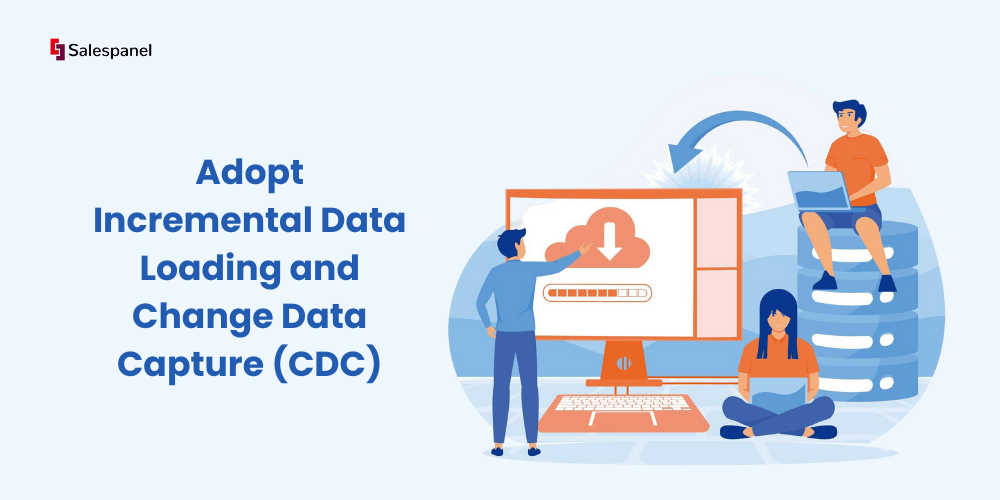
Instead of reloading entire datasets, it is desirable to meet the operational and analytical efficiency of data systems. Spending computational and network resources to reload entire data sets is a waste of your resources. Incremental data loading (i.e., data that has changed from the last data load) and Change Data Capture (CDC) techniques identify, capture, and deliver these changes of data that gets loaded, thus decreasing the processing time and network load. Minimizes network load and ensures data freshness by reducing system processing time. However, the data loaded is still relevant and accurate, as the value of data freshness is uncovered.
Moves away from inefficient, resource-intensive batch processing of moves to a near-real-time data flow. This is a component of modern customer data integration, allowing companies to respond to customer behaviour in a timely fashion and to have an up-to-date view of their audience without performance limits.
Why It’s a Foundational Practice
Slow, costly, and unsustainable full data reloads are the operational status quo from a business perspective. CDC provides a scalable and efficient alternative by focusing only on the delta. This is because operational and analytical near-real-time gets to be a reality. The downstream systems are updated to the moment a customer record is created, updated, or deleted in a source system. A practical example is LinkedIn, which uses incremental updates to synchronize member profile changes across its vast ecosystem. When a user changes their job title, one update change is sent via a CDC pipeline to their recommendation engines and search services. ensures content and search results reflect the new information almost immediately for users looking for search content. Without having to wait for a nightly batch job to process millions of profiles, process updates for users’ searches, like job searches, to update and provide the user with updated search content when marketing their job profile to search for recruiters.
Actionable Implementation Steps
Incorporating a CDC involves having a change in mindset, as it needs to shift from batch to event-driven processing. Modern tools like Debezium and Kafka Connect have made this highly accessible.
- Utilize Database Transaction Logs: When implementing Watermarks of Progress Tracking, as they are the Most Reliable Method for CDC logging. With a production that is a database. Without this impacting performance, every change is spilled, and logs are intact from altering the production database.
- Implement Watermarking for Progress Tracking: Watermarks like timestamps are used to track processing for logging cycles and progress. This way, Integration systems ensure that duplicate data and loss of data are avoided.
- Monitor CDC Latency and Processing Metrics: Monitor the time it takes from the change made in the source system to the change being reflected in the target system. If the time lag is too high, it will defeat the purpose of the near-real-time integration, so it is an essential measurement to manage.
8. Data Governance and Lineage Tracking
The essence of data governance is the establishment of comprehensive oversight for customer data. This is done by defining policies, roles, and processes that determine the availability, usability, integrity, and security of the customer data. This is done alongside data lineage, which is the documentation that organizations can build trust in their data assets. The two form an accountable framework for all the customer data that is coupled for use. With this, the data that comes from multiple sources, possibly your own website, CRM, support tools, and is transformed into a repository, is governed and managed with a unique, controllable process.
When an organization is able to put in place robust governance with lineage, customers trust the organization. This is the essence of customer data integration best practices since it is the foundation that is required in order to ensure data accuracy, mitigate customer data fraud, protect customer privacy, and comply with regulations like GDPR and CCPA. This changes the organization from a body that from a reactive, chaotic process to a proactive, controlled discipline.
Why It’s a Foundational Practice
When it comes to risk and value when it comes to your data, effective management and control is a necessity. Without it, you may never answer some questions in a confident manner, such as, “Where did this customer data come from?” “Who has access to it?” That uncertainty can bring a host of negative consequences, such as compliance breaches, bad decisions from untrustworthy data, and customer distrust.
Consider an example of a global financial institution like JPMorgan Chase, which has developed and employs effective data governance in order to control customer-sensitive financial data. strict access controls, data quality checks, and complete lineage tracking to satisfy BCBS 239 and prevent fraud. This system ensures full data governance and control from the time a customer first interacts with the institution to the time data is used in a model.
Actionable Implementation Steps
Having a governance and lineage program designed is no small task, so it is best to embrace a well-defined, simple, and systematic manner.
- Establish Clear Data Stewardship Roles: Assign ownership of data domains like marketing data, sales data. These data stewards are responsible for defining quality rules, managing access, and ensuring compliance for the data as well as management. This allows the organization to operate in a decentralized manner while maintaining central oversight.
- Automate Lineage Capture Where Possible: Tracking data flows in the data landscape manually is difficult and unsustainable. Automatically capture and visualize data lineage or open-source tools like Apache Atlas to visualize systems without having to do anything manually, making the process easier to maintain.
- Implement Regular Governance Audits: Audits of your data governance policies and access control are beneficial on a semi-regular basis. Gaps in your policies will be found with these audits, and policies will be enforced, and your framework will become dynamically adaptable to business and regulatory changes.
8 Key Practices Comparison Matrix
| Item | Implementation Complexity | Resource Requirements | Expected Outcomes | Ideal Use Cases | Key Advantages |
|---|---|---|---|---|---|
| Establish a Single Source of Truth (SSOT) | High – involves multiple legacy systems and organizational change | Significant upfront investment, data stewards | Consistent, accurate, unified customer data | Organizations unifying data silos across teams | Eliminates inconsistencies, improves decisions, unified customer view |
| Implement Real-Time Data Synchronization | High – event-driven architecture and error handling required | High infrastructure and system resources | Immediate data updates, real-time analytics | Use cases requiring instant data freshness | Enables timely personalization and real-time decisions |
| Data Quality Management and Validation | Medium – ongoing rule management and monitoring | Skilled analysts and data quality tools | High data accuracy and reliability | Organizations needing trusted, clean data | Reduces bad data costs, improves trust and decisions |
| Privacy-First Integration Architecture | High – complex security and compliance requirements | Higher development and maintenance costs | Regulatory compliance and customer trust | Privacy-sensitive industries (e.g., healthcare) | Reduces legal risk and builds long-term trust |
| Customer Identity Resolution | High – sophisticated matching algorithms required | Advanced technology and data science expertise | Unified customer profiles across devices | Multi-channel customer engagement strategies | Improves targeting, personalization, and attribution |
| API-First Integration Strategy | Medium – strong API governance needed | Skilled developers and API management tools | Flexible and scalable system integrations | Modular and scalable integration environments | Faster integrations and easier maintenance |
| Incremental Data Loading and CDC | Medium to High – complex CDC setup | Setup expertise and monitoring systems | Efficient processing and near real-time updates | Large datasets with frequent changes | Reduces load, speeds processing, improves freshness |
| Data Governance and Lineage Tracking | High – extensive documentation and tooling | Dedicated governance teams and metadata tools | Compliance, audit readiness, accountability | Highly regulated industries | Improves trust, traceability, and issue resolution |
Your Blueprint for Data Fluidity and Future Growth

Mastering customer data integration is not a journey with an end; it is the endless pursuit of refinement. Eight customer data integration best practices facilitate this journey. From building an SSOT foundation to enduring perpetual integrity, data governance, and lineage tracking, each practice is a key support pillar for a central, guiding, transformative goal: Data Fluidity. True data fluidity is not merely having a single, connected ecosystem; it is the secure and intelligent movement of customer data throughout the organization. Data fluidity is the essence of the organization.
The key beneficial aspect of data fluidity is the ability to shift from reactive to predictive and proactive marketing. With frictionless data flows, your teams can anticipate customer needs and interactions while also complex regulatory landscape. Fluid datasets allow you to effortlessly personalize customer interactions at scale. A fragmented view and a unified one pave the way for more accurate predictions of customer needs. It enables the organization to know and anticipate the customer’s next action.
From Theory to Action: Your Implementation Roadmap
To turn these best practices into a reality, you must adopt a careful and tactical approach. The transition from fractured data silos to a unified ecosystem is a marathon, not a sprint. The next step is to do a frank self-assessment of your current data integration maturity against the discussed principles.
Key Action Items to Prioritize:
- Audit Your Architecture: Where are the most significant data silos, and which ones drive the most revenue? Start from a full map of customer touchpoints to identify where data inconsistencies and delays are in a customer’s journey. This first map will show the most necessary parts of implementing an SSOT or API-first approach.
- Evaluate Data Quality: At the point of entry, automated data quality checks will become a critical step. Is the data you are entering clean, consistent, and complete? Data quality issues will compromise the most complete and sophisticated integration architecture. Start with the most critical data assets aligned with your business objectives, e.g., lead contact and firmographic data.
- Assess Identity Resolution Gaps: How easily and quickly can you knit together your anonymous website visitor’s journey and their identity as a qualified lead? Lack of robust identity resolution will typically be the most significant barrier to building a true 360-degree customer view.
Salespanel is built around the theory of a fluid, unified customer narrative. Using cutting-edge server-side tracking and AI identity resolution, Salespanel enables B2B organizations to consolidate behavioral data of website visitors with known leads into a single, cohesive profile. Salespanel’s lead scoring system ensures your teams can respond to this integrated information in real time, so your sales and marketing teams can be completely aligned around the same goals.
Momentum is gained by closing these critical gaps one at a time. These customer data integration best practices are compounding investments. You are not just creating an optimized data system; you are creating a resilient, agile, customer-centric organization, and ready to tackle future challenges.
Do you want to integrate your customer data, unmask your website visitors, and create a predictable revenue pipeline? Check out the best practices Salespanel offers in one integrated platform for lead scoring and real-time data activation to visitor identification. Read the Salespanel data-driven strategy materials for more information.
Sell more, understand your customers’ journey for free!
Sales and Marketing teams spend millions of dollars to bring visitors to your website. But do you track your customer’s journey? Do you know who buys and why?
Around 8% of your website traffic will sign up on your lead forms. What happens to the other 92% of your traffic? Can you identify your visiting accounts? Can you engage and retarget your qualified visitors even if they are not identified?