In the landscape of digital marketing, the ground is fundamentally shifting. For years, B2B growth was fueled by a seemingly endless supply of third-party data—aggregated, purchased, and often opaque information that powered programmatic advertising and lead generation. This era is drawing to a definitive close. With Google phasing out third-party cookies by the end of 2024, a move impacting over 60% of web browsers, the marketing playbook is being rewritten in real-time. This isn’t merely a technical update; it’s a paradigm shift driven by privacy regulations like GDPR and a clear demand from customers for transparency. The central theme for survival and growth is clear: businesses must pivot from renting generic data to owning a proprietary, consent-based asset. This article provides an in-depth guide on navigating this transition, validating the technical differences with practical examples, and equipping you with a takeaway strategy to build a resilient, future-proof marketing engine.
Navigating The Great Data Shift in B2B Marketing
A person working at a desk with multiple monitors displaying data charts and graphs, symbolizing the shift in data strategy.
The B2B marketing world is at a critical juncture. For what feels like an eternity, demand generation and targeting strategies were propped up by the shaky foundation of third-party data. This entire model, which leans on aggregated datasets purchased from external brokers, is not just becoming obsolete—it’s becoming a liability.
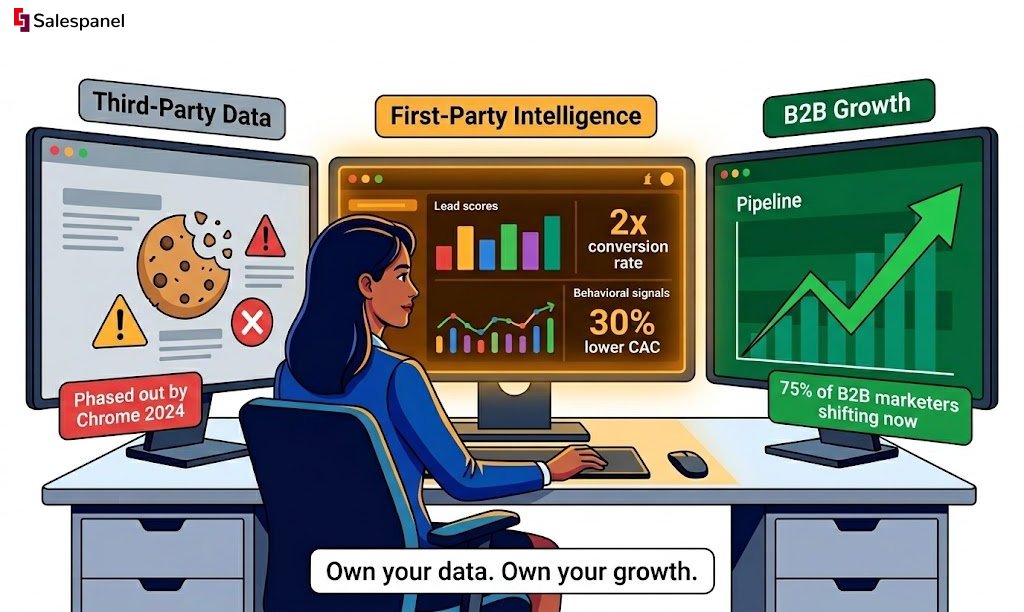
This is not a trend; it’s a fundamental restructuring driven by both regulatory crackdowns and customers demanding greater privacy. With browsers methodically pulling the plug on third-party cookies, the core architecture of the ad-tech industry is crumbling. If you’re not adapting, you’re not just risking ineffective campaigns—you’re facing serious compliance penalties. The future is being built on trust, transparency, and the high-fidelity insights that only first-party data can provide. This transition is the central challenge—and opportunity—for every modern marketer.
The Urgency of Adopting a First-Party Mindset
This isn’t a far-off prediction anymore. It is happening right now. According to Gartner, a staggering 75% of B2B marketers are already shifting their strategies toward first-party data to sidestep risks and achieve superior results.
The performance gap between marketing teams leveraging their own data versus those buying it is widening into a chasm. Businesses that lean into their first-party data are seeing a 2x increase in conversion rates and a 30% reduction in customer acquisition costs. Learn more about how first-party data is reshaping B2B demand generation.
The message is loud and clear: inaction is a significant strategic error. Waiting for the old system to completely collapse means you’ll be playing catch-up to competitors who are already building robust, consent-based data assets that fuel their growth. The central task now is to build that asset.
Key Differences at a Glance
To fully grasp why this matters, you must understand the fundamental distinctions between these two data types. This table breaks down the core attributes that define the first-party vs. third-party data debate.
| Attribute | First-Party Data | Third-Party Data |
|---|---|---|
| Data Source | Collected directly from your audience (website, CRM, product). | Purchased from external data aggregators and brokers. |
| Accuracy | High; it reflects direct, real interactions with your brand. | Variable; it’s often packed with inaccuracies and outdated info. |
| Compliance Risk | Low; consent is clear and obtained directly from the user. | High; you have zero transparency into how it was collected. |
| Personalization | Deep; allows for truly relevant, behavior-based engagement. | Broad; good for general segmentation, but lacks precision. |
| Competitive Edge | High; this data is your proprietary secret weapon. | Low; any of your competitors can buy the exact same dataset. |
Understanding Your Core Data Assets
To gain a strategic advantage in today’s data-driven environment, you must first achieve absolute clarity on your foundational assets. “First-party data” and “third-party data” are frequently used terms, but the operational distinction lies in ownership, consent, and strategic value. Mastering this distinction is the first step toward building a marketing operation with long-term viability.
First-party data is the information you collect directly from your own audience, with their explicit consent. Consider it your proprietary intelligence, gathered from digital properties you own and control. This data is born from genuine interactions, reflecting real user interest and intent related to your brand.
In contrast, third-party data is information you purchase from data brokers, aggregated from countless external sources. You have no direct relationship with these individuals and zero visibility into how their information was originally collected. It’s a commodity, available to any market participant—including your direct competitors.
How This Plays Out in the Real World
The strategic difference between first-party vs. third-party data becomes tangible when examined through practical examples:
- Practical First-Party Example: A prospect from a target account lands on your website, views three product pages, and downloads a technical whitepaper by providing their business email. Each of these actions constitutes a first-party data point. A tool like Website visitor tracking from Salespanel captures this behavior, tying it directly to a user profile that you own and can analyze for intent signals.
- Practical Third-Party Example: Your team purchases a list from a data vendor containing contact information for 10,000 individuals with the job title “marketing manager” in the software industry. The list claims they are “in-market,” but you have no verifiable evidence of where this data originated, when it was last updated, or if consent was properly obtained. The data is generic and lacks behavioral context.
The core difference isn’t just the source—it’s the story. First-party data tells a story of direct engagement. Third-party data is just a disconnected profile.
This understanding is foundational. If you cannot clearly distinguish between the data you own and the data you rent, you cannot make informed decisions on personalization, maintain compliance, or plan for sustainable growth. Your first-party data is the bedrock of any modern B2B marketing strategy, and the central asset you must cultivate.
A Strategic Comparison for B2B Decision Makers
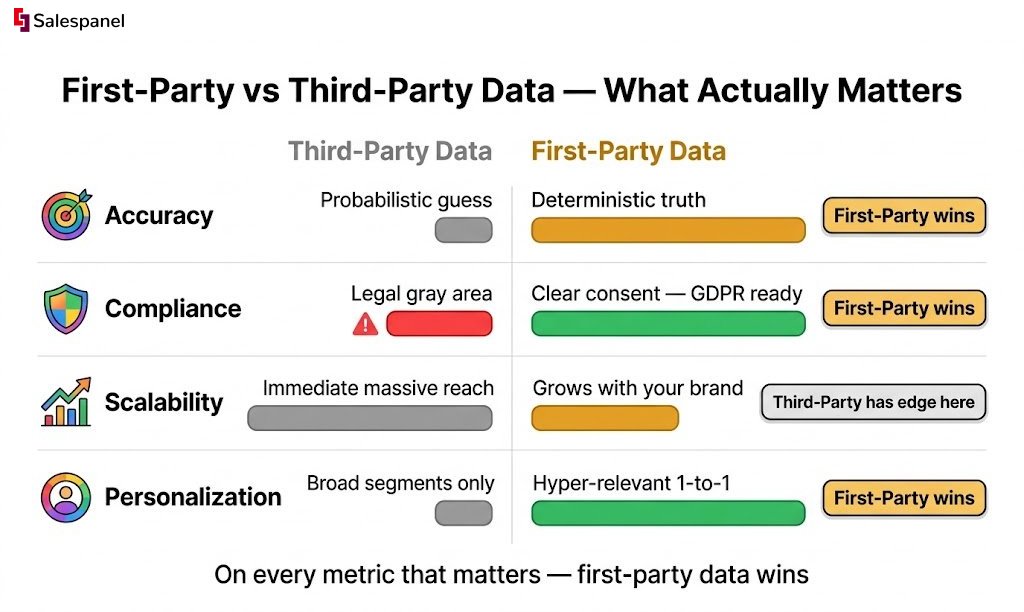
Let’s move beyond textbook definitions to what truly matters for B2B marketers. To understand the operational difference between first-party and third-party data, we must compare them on the metrics that directly impact business outcomes: accuracy, compliance, scale, cost, and personalization.
Think of it this way: first-party data is a strategic asset you build and own, while third-party data is a tactical commodity you rent. This distinction dictates the entire approach to modern marketing.
Accuracy and Reliability
This is where the difference is most stark. First-party data originates directly from your audience. It is the information collected from website interactions, CRM entries, or product usage. It is, unequivocally, your single source of truth about how real prospects and customers are engaging with your brand.
Third-party data, conversely, is a collection of information aggregated from myriad external sources, often with little to no verification. Its reliability degrades rapidly as it is packaged, resold, and circulated. You are basing critical business decisions on data that is, at best, a probabilistic guess.
Practical Example: First-party data shows a specific lead visited your pricing page three times in one week. This is a deterministic, high-intent signal. Third-party data might label the same person as “interested in financial software” based on their browsing history across unrelated websites—a probabilistic, low-confidence inference.
Compliance and Customer Trust
In an environment governed by privacy laws like GDPR and CCPA, data origin is not a technicality—it is a significant compliance issue. First-party data collection is built on a foundation of direct consent management. When a user completes a form or accepts your cookie policy, you have a clear, auditable relationship.
Third-party data frequently exists in a legal gray area. You have no visibility into how consent was obtained, or if it was obtained at all. This lack of transparency exposes your business to serious legal and financial risks, not to mention the reputational damage from using data collected without proper consent.
Scalability and Reach
Historically, this has been the primary argument for third-party data. It offers immediate and massive scale. You can purchase datasets with millions of profiles to fuel broad, top-of-funnel campaigns and explore new markets almost instantly. For a closer look at how marketers approach this, check out this strategic guide to third-party data.
First-party data, however, grows at the speed of your brand’s own reach. Building a substantial dataset requires time, effort, and a robust content strategy. But here’s the crucial takeaway: the asset you build is far more valuable and sustainable. Every data point represents a real relationship you own, not just a name on a rented list.
Personalization and Cost-Effectiveness
Effective B2B personalization demands a deep understanding of a prospect’s specific needs and behaviors.
- First-Party Data enables truly relevant engagement. You can create campaigns based on the exact pages a prospect visited, the whitepaper they downloaded, or the product features they explored. This precision leads directly to higher conversion rates and a superior ROI.
- Third-Party Data only supports broad segmentation. You can target by job title or industry, but you lack the granular behavioral insights needed for genuine, one-to-one personalization.
While purchasing a third-party list may seem cheaper upfront, the hidden costs accumulate quickly. Factoring in low engagement, poor data quality, and potential compliance fines often makes it the more expensive strategy in the long run. Investing in channels that generate first-party data builds a proprietary asset that only grows more valuable over time.
To help you visualize these trade-offs, here’s a quick-glance comparison table that breaks down the key attributes of each data type.
First-Party vs. Third-Party Data: A Comparison of Key Attributes
| Attribute | First-Party Data | Third-Party Data |
|---|---|---|
| Source | Collected directly from your own audience (website, CRM, app) | Aggregated from multiple external sources and data brokers |
| Accuracy | High. Based on verified, direct interactions with your brand | Low to moderate. Often outdated, inaccurate, or based on models |
| Compliance Risk | Low. Based on direct user consent (e.g., form fills, cookie consent) | High. Consent is opaque and difficult to verify, posing GDPR/CCPA risks |
| Cost | “Earned” through marketing efforts; lower long-term cost | “Rented” or purchased; seems cheap but has hidden costs |
| Personalization | High. Enables hyper-relevant messaging based on behavior | Low. Limited to broad demographic or firmographic segments |
| Scalability | Slower to build, limited to your own audience reach | High. Provides immediate access to large, new audiences |
| Competitive Edge | High. A proprietary asset that your competitors cannot access | Low. The same data is available for purchase by anyone |
Ultimately, this table highlights a fundamental choice: are you building a long-term, defensible marketing asset, or are you renting a short-term solution with diminishing returns? For modern B2B marketers, the answer is becoming increasingly clear.
Putting Your First-Party Data to Work for B2B Growth
A B2B marketer analyzing a dashboard showing customer journey data and conversion funnels, symbolizing the activation of first-party data.
Understanding the distinction between first-party and third-party data is one thing. Activating that knowledge to drive tangible B2B growth is where strategic value is realized. This is the essence of “data activation”—the shift from passively collecting information to proactively using it for smarter engagement.
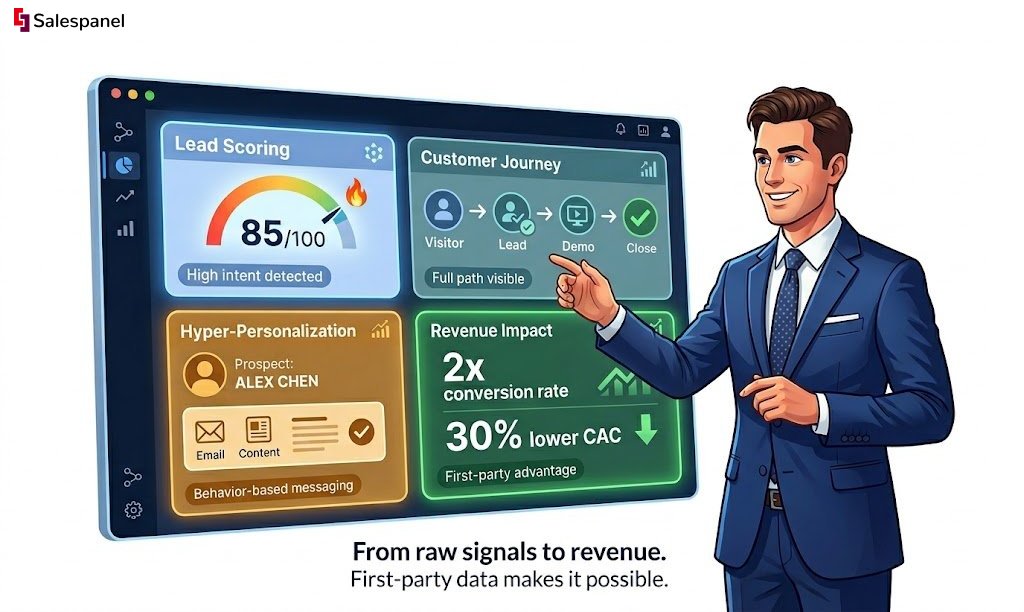
This is the moment you start converting raw behavioral data signals into revenue. Instead of making broad assumptions based on a third-party profile, you’re using a prospect’s direct interactions with your brand to guide them through their buying journey. It’s a far more effective approach that also builds a foundation of trust that third-party data cannot replicate.
Building Predictive Lead Scoring Models
One of the most powerful applications of first-party data is the creation of a sophisticated lead scoring model. By analyzing direct user behavior on your site, you can assign scores based on actions that signal genuine buying intent, moving far beyond basic firmographics.
Practical Example: A prospect who visits your pricing page three times in a week and watches a product demo is exhibiting strong intent. Website visitor tracking from Salespanel captures these granular interactions, allowing you to automatically increase a lead’s score and trigger a real-time alert for the sales team. This data-driven approach ensures your sales reps focus exclusively on the most qualified, sales-ready leads, dramatically boosting efficiency.
By tracking direct behavioral data, you transform lead scoring from a static, attribute-based system into a dynamic, intent-driven engine that predicts a prospect’s likelihood to convert.
Crafting Hyper-Personalized Campaigns
Generic email blasts are ineffective. First-party data enables the creation of deeply personalized campaigns that resonate with your prospects. Imagine automatically triggering an email with a specific case study moments after a prospect downloads a related whitepaper from your site.
That level of relevance is only achievable with your own data. You can segment audiences based on criteria like:
- Content Consumed: Targeting users who have shown interest in a specific product category.
- Website Journey: Customizing offers for prospects who have visited certain pages.
- Engagement Level: Nurturing colder leads with educational content while sending bottom-of-funnel offers to highly engaged prospects.
The quality of this data is also essential for emerging marketing technologies. The rise of large language models (LLMs) in marketing depends on high-quality, bias-free data to generate useful output. We’re already seeing brands that use their own permissioned first-party data achieve remarkable results, including a 55% uplift in ad revenue, because it provides a more reliable foundation for these advanced models.
To truly activate your first-party data, you need a solid plan to attract prospects and convert them into known contacts. Digging into effective content marketing strategies is an excellent place to start building that pipeline. Ultimately, activating your data isn’t just a technical task; it’s a strategic imperative that builds meaningful customer relationships and drives sustainable growth.
Building Your First Party Data Collection Engine
Knowing you need first-party data is the first step. Building a systematic engine to collect and use it is what separates market leaders from laggards. Implementing a first-party data collection engine is not a one-time task; it’s a deliberate process of defining valuable information, deploying the right technology, and providing a fair value exchange to your audience.
This is a strategic shift from renting generic audiences to owning a valuable, proprietary asset. The central objective is to create a repeatable system that captures high-intent signals directly from your prospects, converting anonymous visitors into known contacts with a clear path to becoming customers.
Identifying High-Value Data Points
Before collecting data, you must define what actually matters. A robust first-party data strategy begins with mapping your buyer’s journey and pinpointing the digital interactions that signal genuine interest. Not all data is created equal; focus on the signals that directly correlate with sales readiness.
For B2B, these high-value data points typically include:
- Behavioral Data: Which product pages a prospect visits, the time they spend on your pricing page, or the specific case studies they download.
- Engagement Data: The emails they open and click, their attendance at a webinar, or their interactions with your chatbot.
- Declared Data: Information a prospect willingly provides, such as their job title, company size, or specific pain points listed on a contact form.
This approach aligns perfectly with the goal of unifying sales and marketing intelligence. By tracking these specific actions, you build a much clearer, more actionable customer profile that informs every subsequent interaction.
Choosing the Right Technology Stack
Your tech stack is the machinery that powers your data engine. It must be capable of capturing, unifying, and activating the high-value data points you’ve identified. A modern B2B stack does more than basic analytics—it creates a single source of truth for every prospect.
Key components usually include:
- Customer Data Platform (CDP): A Customer Data Platform functions as the central hub. It ingests customer data from disparate sources—your website, CRM, email platform—and stitches it into a single, persistent profile for each individual.
- Marketing Automation: This is where data is operationalized. You use it to trigger personalized email nurtures, segment audiences for targeted campaigns, and score leads based on their real-time behavior.
- Analytics and Tracking Tools: Platforms that provide Website visitor tracking from Salespanel are vital. They are essential for capturing the granular, on-site behavioral data that fuels the entire system.
The right technology doesn’t just collect data; it makes it usable. Your stack should empower you to go from simply watching what users do to actively influencing their next move with timely, relevant communication.
Creating a Compelling Value Exchange
People will not provide their information without a compelling reason. The most effective data collection strategies are built on a clear and transparent value exchange. You must offer something genuinely useful to earn their data.
This extends beyond simply gating a PDF. It’s about providing real solutions and insights that help your audience perform their jobs better.
- Insightful Webinars: Offer expert analysis on a problem that is a key priority for them.
- Exclusive Reports: Share original research and data that cannot be easily found elsewhere.
- Interactive Tools: Build a free calculator, assessment, or configurator that solves a specific, nagging pain point.
When you consistently offer tangible value, you build trust. This creates a natural incentive for prospects to share their information, transforming a simple data transaction into the beginning of a genuine customer relationship. That is the foundation of any modern B2B data strategy.
Making the Right Data Choice for Your Business
So, where does this leave us in the first-party vs. third-party data debate? The conclusion is clear: while the immediate scale of third-party data may seem tempting for specific, short-term tasks, first-party data is the undisputed champion for building sustainable growth and earning customer trust.
If you are serious about deep personalization, accurate lead scoring, customer acquisition, and maintaining compliance with privacy laws, then first-party data isn’t just an option—it’s essential. It is the only way to build a proprietary asset that truly reflects your customers’ needs and intent. Third-party data may have a limited role in broad market analysis or audience discovery, but it must always be used with extreme caution regarding its accuracy and consent mechanisms.
A Decision Framework for Your Data Strategy
Choosing the right data approach requires a critical evaluation of your goals, technology stack, and the value you offer prospects in exchange for their information. This decision tree outlines the key questions every B2B marketer should ask when designing their data strategy.
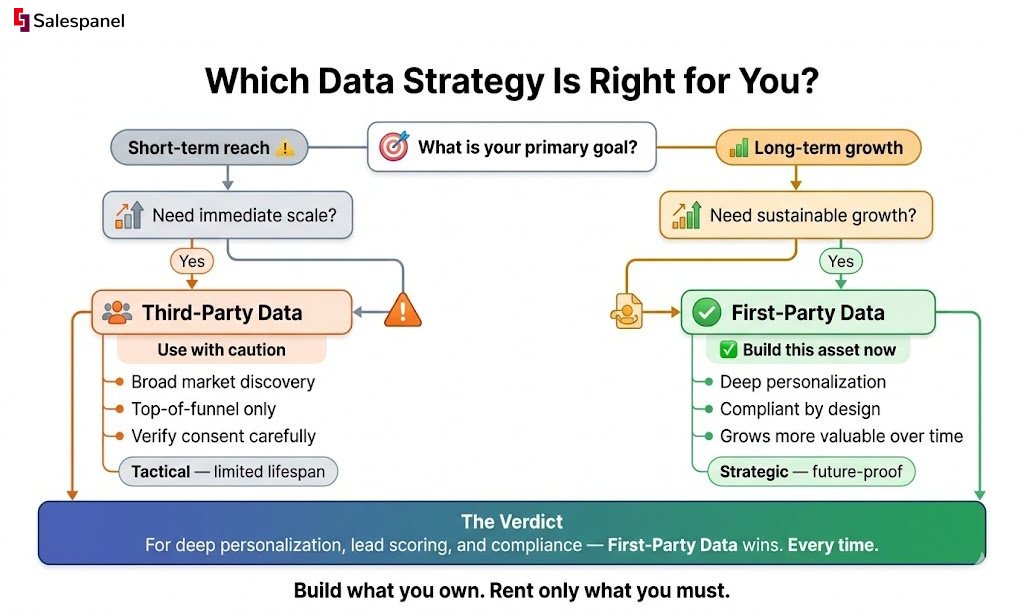
Infographic decision tree for choosing between first party and third party data
The visual reinforces a critical point: the marketing outcomes you truly desire are directly linked to building your own data assets. This requires a solid technology stack and a value exchange that resonates with your audience.
The key takeaway is this: make building your first-party data asset your absolute priority. Treat it as your single source of truth for every strategic decision. In the long run, it is the only path to creating a marketing engine that is resilient, compliant, and genuinely effective.
Common Questions About Data Strategy
Pivoting your data strategy is a significant undertaking, and it naturally raises important questions. Let’s address some of the most common challenges B2B marketers face when they begin to focus on first-party data.
What About Second-Party Data? Where Does It Fit In?
You’ve likely heard of second-party data. It is essentially another company’s first-party data that you acquire through a direct partnership. A practical example is a B2B software company and an industry publication co-hosting a webinar; when they agree to share the attendee list and insights, that’s second-party data in action.
So, where does it fit within the first-party vs. third-party framework? It occupies a middle ground.
- More trustworthy than third-party data: You know the exact source of the data, which means you can have much higher confidence in its accuracy.
- Less scalable than first-party data: Your reach is limited by the number of suitable partners you can find and the agreements you can negotiate. It is not an asset you can build on your own terms.
Second-party data can be a valuable supplement to your efforts, but it is no substitute for building your own proprietary data asset.
How Can I Start Collecting First-Party Data If My Budget is Tight?
You don’t need an enterprise-level budget to begin. The best starting point is with the digital assets you already own and control.
The strategy revolves around creating a fair value exchange. Start by using free tools like Google Analytics to understand user behavior on your website. Then, create simple lead magnets—checklists, short industry reports, templates—that request an email in return. Even engaging your audience on social media with polls and questions is a surprisingly effective, low-cost method.
The fundamental principle is to offer something genuinely useful in exchange for their information.
Is Third-Party Data Going to Disappear Completely?
The third-party cookie is being deprecated, but the concept of third-party data will likely persist, albeit in a much more limited capacity. Its role in enabling granular, individual-level targeting is ending due to new privacy laws and a lack of transparency that users no longer tolerate.
That said, it may still have a function in broad market trend analysis or for anonymized data enrichment where consent is explicit and verifiable. But make no mistake, the future of intelligent, effective B2B marketing is built squarely on first-party and zero-party data.
At Salespanel, our philosophy is that owning your data is the only path to sustainable growth. Our platform is engineered from the ground up to help you capture, analyze, and act on high-intent signals from your own audience. We believe in turning your website into a powerful engine for collecting first-party data, and our lead scoring framework allows you to prioritize efforts effectively.
Ready to build a data strategy that gives you a competitive edge? Explore our resources.