Sales used to be an art form, a discipline built on firm handshakes, gut feelings, and a meticulously guarded Rolodex. Success was dictated by intuition. Then came the CRM, digitizing the Rolodex and bringing a semblance of order through data entry. But the core grind—prospecting, qualifying, nurturing—remained a manual, time-consuming slog. Today, we are in the midst of a third wave, a fundamental re-architecture of the sales process driven by intelligent algorithms. The artificial intelligence sales assistant has arrived, not as a futuristic concept, but as a practical, revenue-generating engine.
The market is moving at a breakneck pace. Global spending on AI sales assistant software is projected to surge from USD 2.9 billion in 2025 to over USD 20.5 billion by 2035, a compound annual growth rate of 21.6%. You can explore more data on this expanding market. This isn’t just investment; it’s a clear signal that the operational model for B2B sales is being rewritten in real time. Companies that fail to integrate this technology risk being outmaneuvered by competitors who can identify, engage, and qualify leads with machine-like speed and precision. This guide provides a technical and practical deep dive into how these systems function, their real-world applications, and how to integrate one into your existing workflow to gain a decisive competitive advantage. The central theme is clear: in modern sales, the winning formula is augmenting human talent with artificial intelligence.
From Handshakes to Algorithms: The New Sales Reality
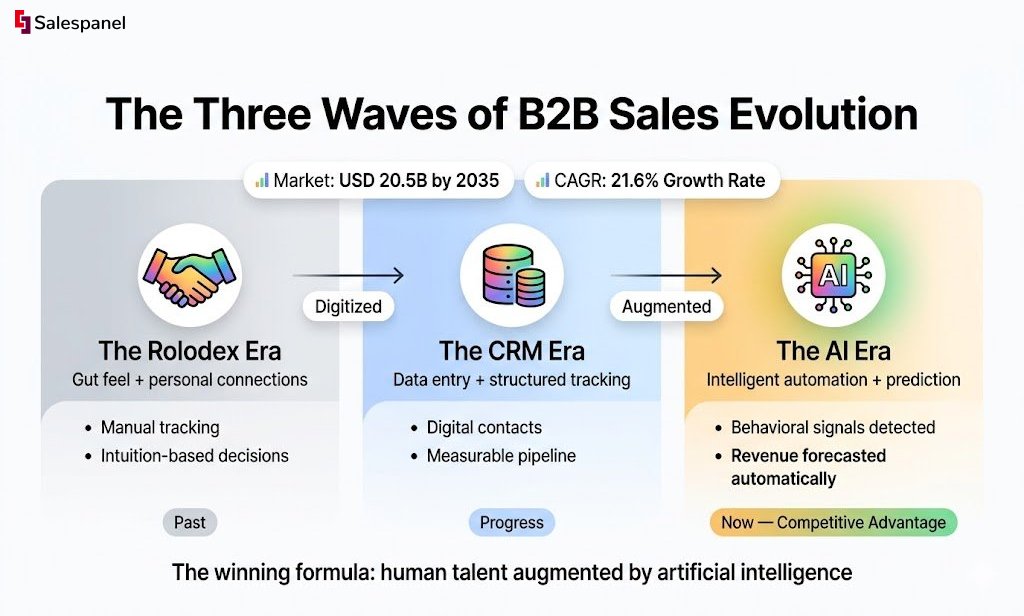
Not long ago, B2B sales was a world that ran on personal connections and pure intuition. Success was all about firm handshakes, a meticulously guarded rolodex, and that gut feeling a salesperson got about a prospect. That relationship-first model built empires and defined entire careers.
Then, the first real disruption hit: the Customer Relationship Management (CRM) platform. Suddenly, the rolodex was digital, contacts were organized, and you could actually track your interactions in a structured way. For the first time, sales became a more measurable, data-informed game. But even with CRMs, the core grind—prospecting, qualifying, and nurturing—was still a very manual, time-sucking process.
The Rise of Intelligent Automation
We’re now in the middle of the next great leap forward, one powered by algorithms and predictive models. The artificial intelligence sales assistant marks a huge shift from just recording data to actively interpreting and acting on it. It spots buying signals across the digital world with a speed and scale no human team could possibly match.
This technology isn’t here to replace the art of selling. It’s designed to perfect the science behind it. By automating the most tedious parts of the job, it frees up your sales pros to do what they do best: build real relationships, think strategically, and navigate complex deals.
The future of sales isn’t a showdown between humans and machines. It’s a powerful partnership—skilled salespeople working hand-in-hand with intelligent assistants to hit levels of efficiency and success we’ve never seen before.
A Market Moving at Full Speed
This isn’t some far-off trend; it’s happening right now, backed by massive investment and widespread adoption. The global AI sales assistant software market is expected to blow past USD 2.9 billion in 2025. From there, it’s on a rocket ship trajectory to hit over USD 20.5 billion by 2035, growing at a blistering compound annual growth rate of roughly 21.6%. You can explore more data on this expanding market to see just how fast things are moving.
All that money pouring in sends a clear message. Companies that drag their feet on integrating AI into their sales process are going to get left in the dust. The question is no longer if you should adopt an artificial intelligence sales assistant, but how you can get one up and running to sharpen your competitive edge. This guide will show you the way.
How An AI Sales Assistant Actually Works
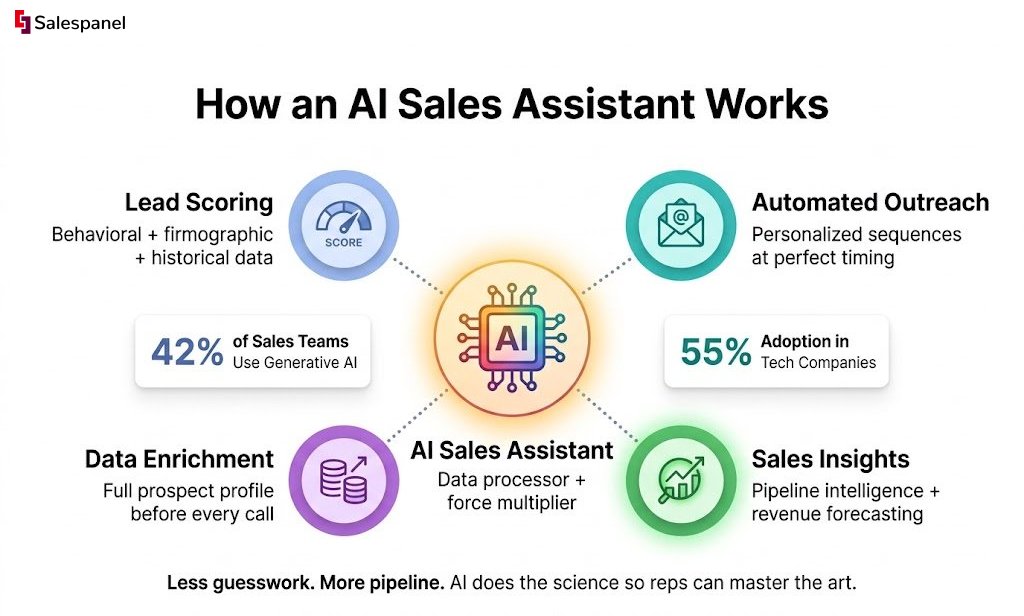
Let’s pull back the curtain on how an AI sales assistant really operates. It’s easy to get lost in the buzz around “AI,” but in practice, these tools are less about magic and more about math. Think of it as a powerful data processor and a force multiplier for your sales team, built to automate grunt work and deliver smart insights.
At its heart, the system runs on machine learning models that are constantly analyzing patterns, predicting outcomes, and executing tasks with a speed and precision no human could match. The part you see—its ability to communicate and interact—is often powered by the same kind of technology that’s behind tools like ChatGPT. To really get a feel for the mechanics, it’s worth understanding how Large Language Models (LLMs) work.
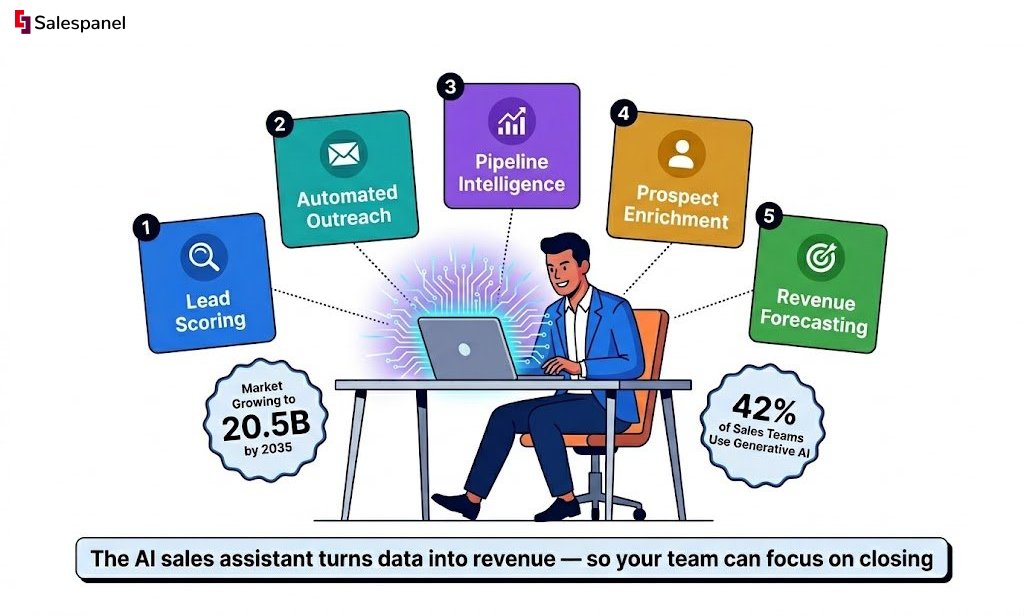
Ultimately, the work of an AI sales assistant boils down to three core jobs: finding your best leads, engaging them without missing a beat, and giving your salespeople the context they need to walk into any conversation fully prepared.
So, how does an AI sales assistant actually deliver on these promises? The table below breaks down the core functions that turn abstract “AI” into tangible business results for B2B sales teams.
| Capability | Technical Function | Business Impact |
|---|---|---|
| Intelligent Lead Scoring | Analyzes behavioral, firmographic, and historical data to assign a priority score to each lead. | Focuses sales efforts on the most promising opportunities, increasing conversion rates and preventing wasted time. |
| Conversation Automation | Uses LLMs and Natural Language Processing (NLP) to engage leads with personalized, timely outreach via email or chat. | Ensures every high-value lead gets an immediate response, nurturing them consistently until they’re ready to talk to a human. |
| Prospect Data Enrichment | Aggregates data from internal and external sources to create a comprehensive profile for each prospect. | Arms sales reps with deep insights before calls, leading to more relevant conversations and shorter sales cycles. |
These capabilities work together to create a system that not only automates tasks but also makes your entire sales process smarter and more effective.
Intelligent Lead Scoring and Prioritization
We all know that not all leads are created equal. But without AI, reps often spend far too much time chasing prospects who simply aren’t ready to buy. This is where an AI assistant acts like a digital body language reader, constantly scanning for the subtle cues that signal real buying intent.
A practical example is a prospect who visits your pricing page three times in a week, downloads a technical case study, and then watches a product demo. A human might connect those dots eventually, but an AI-driven system does it in real time. It assigns a weighted score to each action based on pre-configured rules, building a dynamic priority list that tells your team exactly who to call first. This clears the clutter from the sales pipeline and turns it into a simple, actionable roadmap.
The system pulls from multiple data streams to build this complete picture:
- Behavioral Data: Which website pages were viewed, how much time was spent on key content, email click-throughs, and webinar attendance.
- Firmographic Data: The AI automatically enriches profiles with details like company size, industry, location, and the tech they already use.
- Historical Data: It learns from every past win and loss to identify the common traits of your best customers.
Automated Outreach and Nurturing
Once you’ve identified your hottest leads, the clock starts ticking. An AI assistant automates the initial outreach, making sure no high-value prospect ever falls through the cracks because of a slow response. It can manage personalized email sequences, send follow-ups at the perfect time, and even handle the back-and-forth of scheduling a meeting.
This is far more sophisticated than a simple email blast. The AI tailors its messages based on the very data it used for scoring. For instance, a lead who downloaded an e-book about a specific product feature might get a follow-up email that directly speaks to that interest and suggests a relevant next step. That’s a level of personalization at scale that’s just not possible to do manually.
The real power here is consistency. An AI assistant never forgets to follow up, never has a bad day, and can engage thousands of prospects simultaneously, ensuring your pipeline is always being nurtured.
Data Enrichment and Sales Insights
Finally, a top-tier AI sales assistant ensures that when a salesperson does get on a call, they are armed with everything they need to succeed. The system becomes a pre-call research analyst, compiling all the crucial information into one easy-to-read brief.
Instead of a rep spending 30 minutes frantically Googling a prospect before a meeting, they get a full summary delivered right to their CRM. This brief includes the prospect’s recent website activity, their company’s background, key players on their team, and even relevant industry news. The AI transforms raw data into strategic insight, empowering your reps to have more meaningful and impactful conversations from the very first minute.
Where the Rubber Meets the Road: AI Sales Assistants in B2B
Theory is one thing, but the real magic of an artificial intelligence sales assistant happens when you see it in action. In the often messy world of B2B sales, these assistants are like a powerful filtration system, making sure your team’s valuable time is spent on the most promising deals. This isn’t just a shiny new toy anymore; it’s becoming a central piece of modern sales operations.
Adoption is picking up steam fast, especially in marketing and sales. A solid 42% of these teams are now regularly using generative AI. That number skyrockets to 55% in tech companies, which tells you that the folks on the bleeding edge are already all-in. You can see for yourself how quickly AI adoption is moving across the board.
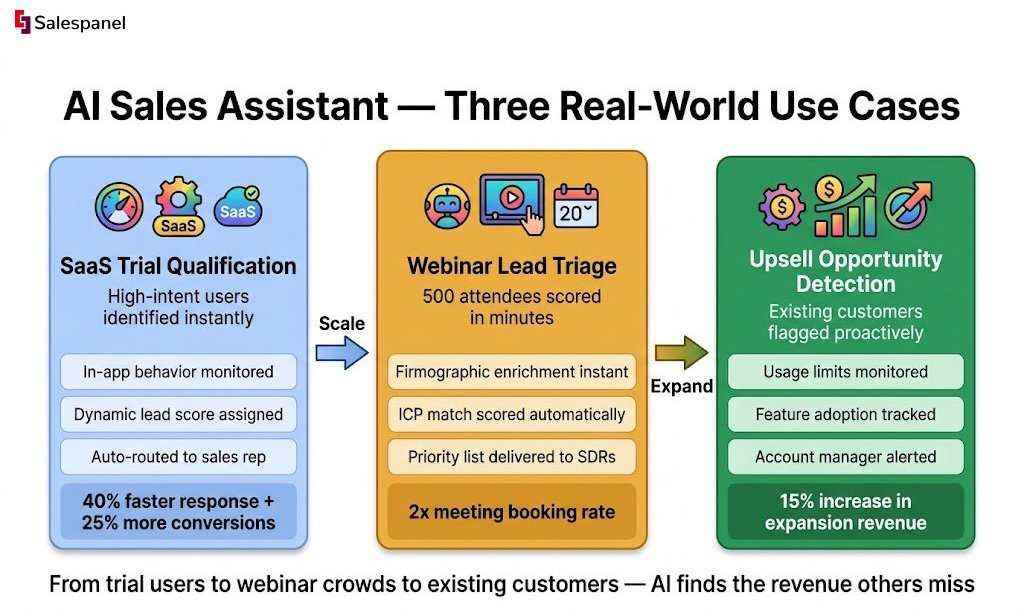
Let’s look at a few real-world examples where an AI assistant turns abstract data into actual revenue.
Use Case 1: High-Intent SaaS Trial Qualification
The Business Challenge: A fast-growing SaaS company was getting slammed with hundreds of sign-ups for its 14-day free trial every single day. Their small sales team was drowning, completely unable to tell the difference between the tire-kickers and the serious buyers who were actually evaluating the tool. High-value leads were simply falling through the cracks because no one could get to them in time.
The AI-Powered Solution: They implemented an AI sales assistant to monitor in-app user behavior. The assistant was configured to track key activation events—such as inviting a teammate, configuring an integration with a third-party service, or using a premium feature more than once. Based on this activity, it assigned a dynamic lead score to each trial user in real-time.
The Measurable Outcome: The second a lead’s score crossed a pre-defined “high-intent” threshold, they were automatically routed to a sales rep’s calendar for an immediate call. This simple change led to a 40% reduction in response time for their best leads and a 25% jump in trial-to-paid conversions in the first three months. The sales team could finally, and confidently, ignore the noise and focus only on users who were showing clear buying signals.
Use Case 2: Instant Webinar Lead Triage
The Business Challenge: A B2B marketing agency was great at pulling in crowds, consistently getting over 500 attendees for their monthly webinars. The problem? Manually digging through that list to find actual decision-makers was a nightmare. Their SDRs would spend days cold-calling a mixed bag of students, competitors, and junior-level staff. It was slow and incredibly inefficient.
The AI-Powered Solution: The agency set up an AI sales assistant to enrich the attendee list the moment the webinar ended. The AI took the email addresses and, in real-time, cross-referenced them with firmographic data to pull job titles, company sizes, and industries. It then scored every single lead based on their Ideal Customer Profile (ICP).
The system effectively answered the most critical sales question in seconds: “Who in this list of 500 people has the authority and budget to buy from us?”
The Measurable Outcome: Within minutes of the webinar wrapping up, the sales team had a prioritized list of every director-level and C-suite attendee from their target industries. They launched a highly relevant follow-up campaign while the topic was still fresh. This laser-focused approach doubled their meeting booking rate from webinars and made their follow-up far more potent. This process can be made even smoother with the right email outreach tools.
Use Case 3: Proactive Upsell Opportunity Identification
The Business Challenge: An enterprise software company was sitting on a goldmine of existing customers but struggled to find upsell and cross-sell opportunities. Account managers relied on periodic check-in calls, which meant they often missed the subtle cues that a customer was outgrowing their current plan or was ready for a new feature.
The AI-Powered Solution: They integrated an AI assistant with their CRM and customer success platform. The AI was programmed to constantly monitor customer usage data—support ticket volume, specific feature adoption rates, and API call frequency. When a customer’s activity showed they were pushing the limits of their current plan or exploring help documentation for features they didn’t have, the AI flagged it as a prime upsell opportunity.
The Measurable Outcome: Account managers started getting automated alerts like, “Heads up: Customer XYZ has hit 95% of their data limit for three weeks straight.” Armed with this kind of proactive insight, they could start timely, relevant conversations about upgrading. This data-first strategy led to a 15% increase in expansion revenue and even improved customer retention by solving needs before they became pain points.
The Data Engine Fueling Your AI Sales Assistant
An AI sales assistant might feel like a magic box, but its intelligence isn’t conjured out of thin air. It’s built, refined, and sharpened by one thing: data. Lots of it.
Think of the AI model as a high-performance engine. The data is the high-octane fuel that makes it run. Without a constant, clean supply of that fuel, even the most advanced engine will just sputter and stall.
It’s a simple truth: the performance of your AI assistant is a direct reflection of the quality and depth of the data you feed it. “Garbage in, garbage out” isn’t just a saying; it’s the fundamental law of machine learning. A truly effective artificial intelligence sales assistant runs on a sophisticated tech stack that fully unlocks the power of data and AI.
This whole system is built on two core types of data: behavioral and firmographic. Let’s break those down.
Capturing Digital Body Language with Behavioral Data
Behavioral data is the digital footprint every prospect leaves behind as they move across your website. It’s the online version of reading someone’s body language in a store. Are they just browsing, or are they circling back to look at a specific product for the third time?
This is the raw, real-time information that fuels things like AI-powered lead scoring and personalization. For AI models to work their magic, they need a steady stream of these granular details, which is where collecting your own first-party data is so important. For example, website visitor tracking from Salespanel provides this essential raw material by capturing exactly how users interact with your digital storefront.
Here’s what the AI is actually looking at:
- Pages Visited: Did they land on a blog post, or did they spend ten minutes digging through your pricing and technical docs? This tells you where they are in their buying journey.
- Content Engagement: Someone who downloads an in-depth case study is sending a much stronger signal than someone who just skims the homepage.
- Interaction Frequency and Recency: A visitor who comes back three times in a single week is clearly more engaged than someone who last stopped by six months ago.
- Session Duration: Longer sessions usually mean deeper interest and more serious research.
When an AI puts all these signals together, it starts to paint a surprisingly clear picture of buying intent. It spots patterns a human might miss, separating the casually curious from the truly motivated buyers.
Building Context with Firmographic Data
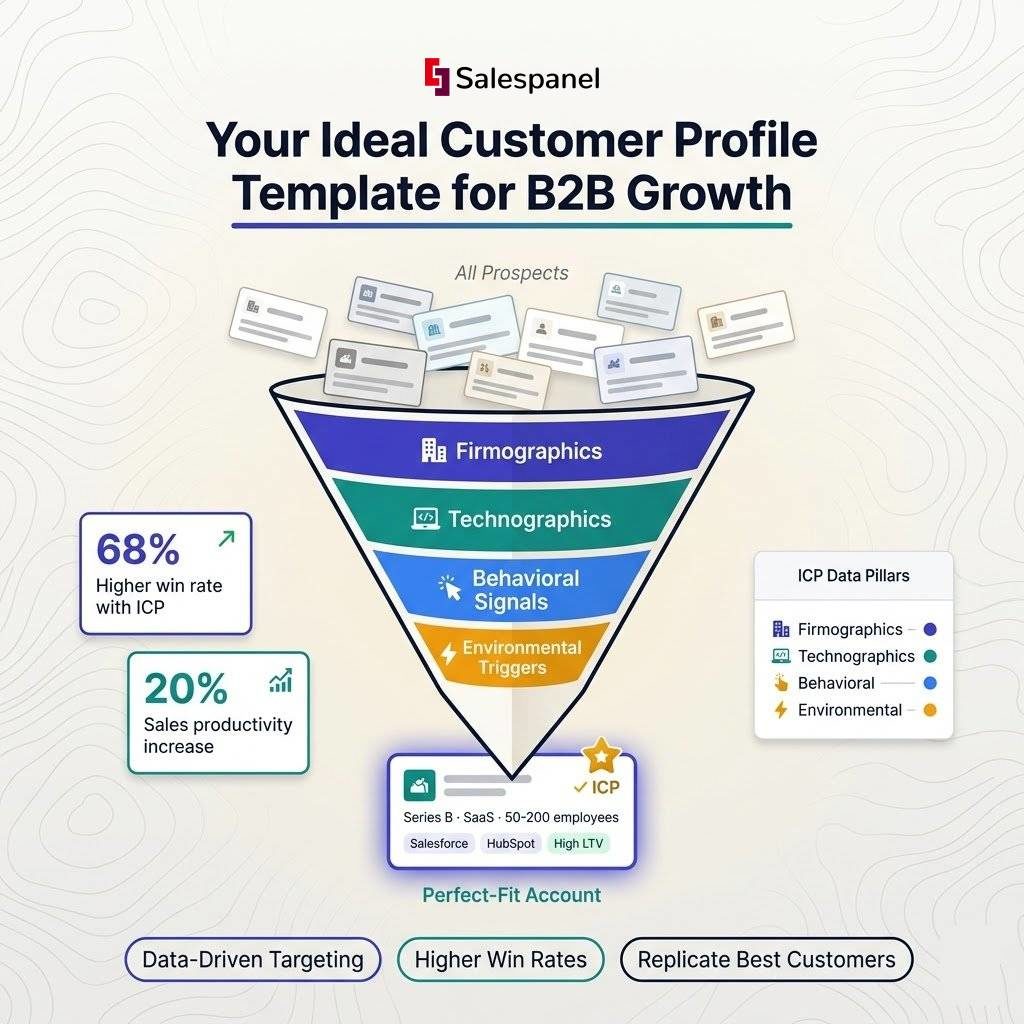
So, behavioral data tells you what a prospect is interested in. Firmographic data tells you who they are. This is the business context that’s absolutely critical for qualifying an account and making sure your sales team is talking to companies that actually fit your Ideal Customer Profile (ICP).
An AI assistant without firmographic data is like a salesperson who knows a prospect is interested but has no idea if they work for a tiny startup or a Fortune 500 company. The context is everything.
An artificial intelligence sales assistant handles this automatically by enriching lead profiles with this info, turning a simple email address into a detailed business snapshot.
Key firmographic data points include:
- Company Size: Number of employees.
- Industry: The market they operate in (e.g., SaaS, manufacturing, healthcare).
- Annual Revenue: A solid indicator of their budget and buying power.
- Geographic Location: Where they’re based.
- Technographic Data: The other software and tools they’re already using.
By layering this firmographic context on top of the behavioral signals, the AI can make incredibly sharp judgments. It knows to prioritize a director from a 500-person tech company who viewed your pricing page over a student who happened to download the same whitepaper. This combination of behavioral and firmographic data is what turns a massive flood of information into a clean, actionable priority list for your sales team.
Integrating an AI Sales Assistant into Your Workflow
Bringing an artificial intelligence sales assistant into your team isn’t like flipping a switch. It’s a strategic move, and the success of that move depends just as much on careful planning as it does on the tech itself. A rushed rollout often leads to frustrated users and lackluster results, turning a potentially powerful tool into another piece of shelfware.
To sidestep those common pitfalls, you need a structured approach. Breaking the process down into manageable phases is the key. This ensures the assistant actually aligns with your business goals, plays nicely with your existing tech, and empowers your team instead of burying them in complexity. Think of it as a strategic project—one that, when done right, pays for itself many times over.
This isn’t just a niche trend; it’s part of a much bigger wave. The broader market for AI agents is expected to hit USD 7.63 billion in 2025, a massive jump from USD 5.4 billion in 2022. And with 85% of enterprises planning to use AI agents by 2025, it’s clear this is quickly becoming a business necessity. You can discover more about the rapid adoption of AI agents to get a sense of how fast the ground is shifting.
Defining Your Business Objectives
Before you even glance at a single vendor’s website, you have to answer one crucial question: what problem are you actually trying to solve? Without a clear goal, you have no way to measure success.
Are you trying to book more qualified meetings? Slash your lead response times? Or maybe you want to tighten up the accuracy of your sales forecasts. Your goals need to be specific, measurable, and realistic. For instance, a solid objective would be: “Reduce the time SDRs spend on manual lead nurturing by 30% within six months.” That kind of clarity will be your North Star for every decision that follows, from picking the right tool to setting up its workflows.
This infographic gives you a simple visual of how the AI’s “brain” works, fueled by two key data streams.
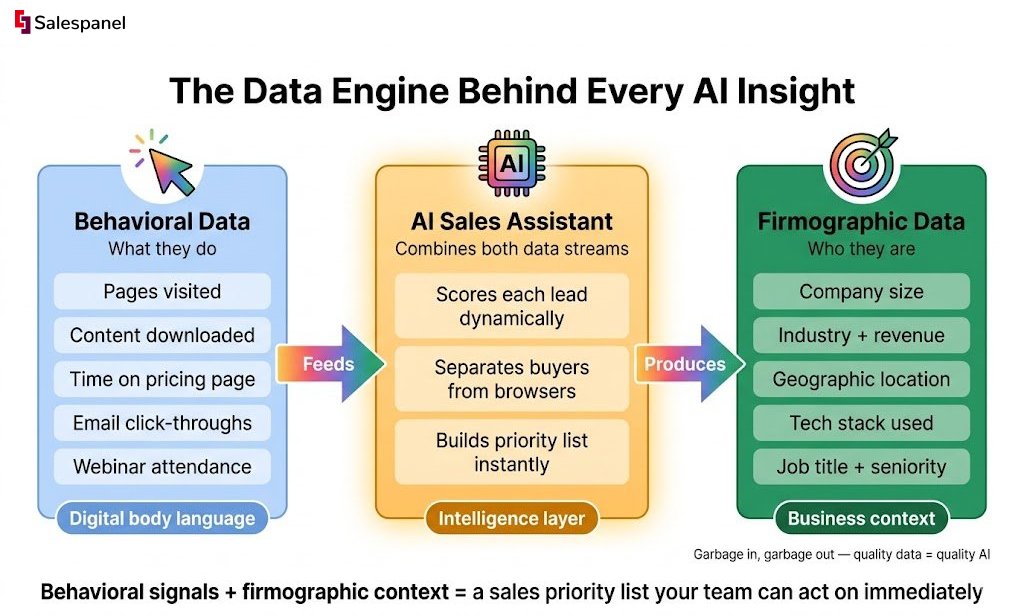
It really boils down to combining what people do (behavioral data) with who they are (firmographic data) to produce genuinely intelligent insights.
Ensuring Data Readiness and CRM Integration
Here’s the hard truth: an AI sales assistant is only as smart as the data you feed it. That means your next step is a data audit. Your CRM has to be clean and well-organized because it’s going to be the AI’s single source of truth.
This is the time to standardize data entry, hunt down and merge duplicates, and make sure your historical deal info is accurate. Then comes the integration part, which is absolutely non-negotiable. The AI assistant must be able to pull data from your CRM and, just as importantly, push data back into it. This creates a feedback loop where things like lead scores, engagement history, and conversation logs are automatically updated right on the contact record.
Selecting and Customizing Your Tool
Once you have your goals and data sorted, you can start looking at vendors. You’re looking for a tool that not only checks all your functional boxes but also fits your team’s technical comfort level. A super-powerful platform is worthless if your team can’t figure out how to manage it.
After you’ve made your choice, it’s time to customize. This is where you configure the AI’s workflows to mirror your specific sales process. Key steps include:
- Defining Lead Scoring Rules: What actions (like visiting your pricing page) and attributes (like a “Director” title) should get the most points?
- Building Nurture Sequences: What automated messages will you send to leads at different points in their journey?
- Setting Up Routing Logic: When a lead hits that “sales-qualified” threshold, who on your team gets the notification?
Training Your Team and Measuring Success
Ultimately, the success of this whole project rests on your team. You need to provide real training that goes beyond just the “how-to” and explains the “why.” Show your reps how this AI is going to free them up from mind-numbing tasks so they can spend more time on what they do best—building relationships and closing deals.
Kick things off with a pilot program. Pick a small group of your most adaptable reps and let them run with it. Their feedback will be gold for fine-tuning the system before you roll it out to everyone. And all along the way, keep a close eye on the metrics you defined back in step one. That data will tell you what’s working, what’s not, and where to tweak things to make sure your AI sales assistant becomes a core part of your revenue engine.
The Future of Sales Is an Augmented Workforce
The story around artificial intelligence sales assistants often gets twisted into a tale of human versus machine. But that’s a false choice. This isn’t about replacement; it’s about creating an augmented salesforce.
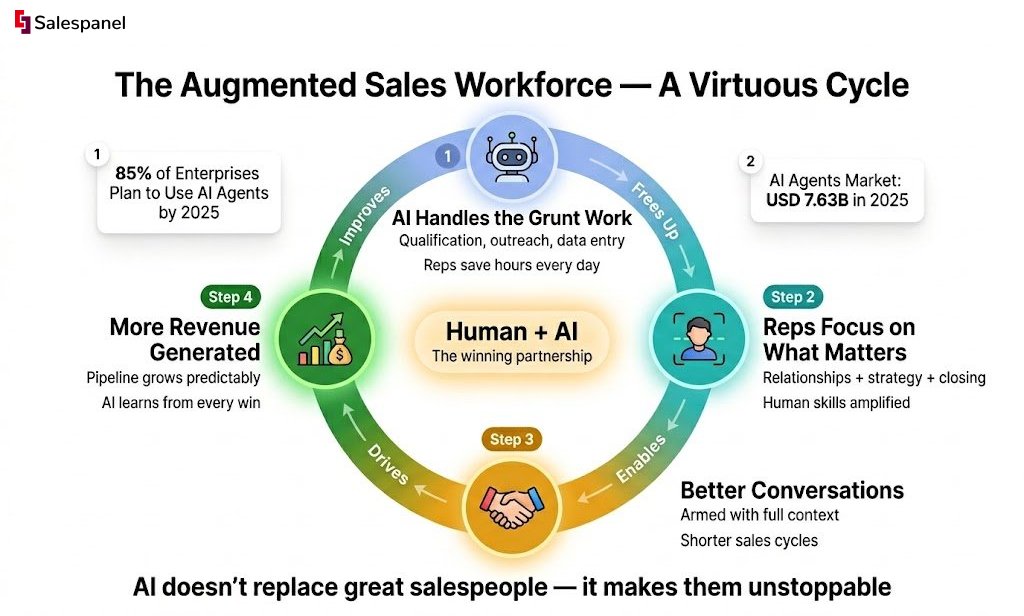
Think of it this way: technology takes on the repetitive, data-heavy grunt work, freeing up salespeople to double down on what they do best. When an AI is managing lead qualification, drafting initial outreach, and handling data entry, reps get back countless hours. Time they can now pour into strategic thinking, building genuine relationships, and navigating the tricky, human nuances of closing a big deal. The goal is to elevate the role of the salesperson, not make it obsolete.
The New Focus: Human-Centric Selling
When you automate the operational grind, the skills that make a salesperson truly great become even more valuable. An AI sales assistant can tell you who to talk to and what they likely care about, but it can’t fake the empathy, build the trust, or come up with the creative solution that actually seals a partnership.
The future of sales will be defined by a renewed emphasis on:
- Consultative Strategy: Moving beyond just talking about product features to becoming a trusted advisor who genuinely understands a client’s business challenges.
- Relationship Building: Forging strong, lasting connections that a machine simply can’t replicate. This is where long-term customer value comes from.
- Complex Negotiation: Handling the intricate give-and-take of high-stakes contracts, a process that demands emotional intelligence and strategic finesse.
Hyper-Personalization and Predictive Insight
Looking ahead, AI’s role is only going to get more sophisticated. We’re quickly moving toward hyper-personalization at scale, where an AI assistant can tailor outreach to an individual’s specific pain points and engagement history with incredible precision. Imagine an AI not only flagging a key prospect but also suggesting the perfect case study to send them based on their recent website activity and industry news.
On top of that, predictive forecasting will become the norm. AI assistants will analyze pipeline data, historical win rates, and market trends to deliver startlingly accurate revenue projections. This allows sales leaders to shift from reactive management to proactive strategy, making smarter calls on where to allocate resources long before the end of the quarter.
The ultimate takeaway is a vision of a more intelligent, efficient, and profoundly more human sales profession. By taking on the robotic work, AI empowers people to be better people.
This is the philosophy that drives modern sales tools. For example, Salespanel’s lead scoring framework is built to translate an overwhelming amount of behavioral and firmographic data into a simple, actionable priority list. It tells reps exactly where to focus their uniquely human talents, so they can engage with confidence and build the relationships that actually drive revenue. The AI provides the “who” and “why,” freeing up the salesperson to master the “how.”
Got Questions? We’ve Got Answers.
When you’re looking into something like an AI sales assistant, it’s natural for a few questions to pop up. Here are some of the most common ones we hear, with straightforward answers to help you see the full picture.
Will an AI Sales Assistant Replace My Sales Team?
Not a chance. The real goal here is to supercharge your sales team, not replace it. The AI is built to take over the repetitive, time-sucking tasks—think initial lead qualification, sending out the first wave of emails, and endless data entry.
This clears the deck for your reps to double down on what they do best: building relationships, thinking strategically, and closing those big, complex deals that need a human touch. It’s less about replacement and more about giving your team the powerful assistant they’ve always wanted.
How Difficult Is It to Integrate with Our Existing CRM?
This is probably easier than you think. Most modern AI sales assistants are designed to play nicely with major CRMs like Salesforce and HubSpot. Forget about needing a team of developers; the integration is usually handled through simple, API-based connections.
The best platforms are built with the user in mind, making setup a breeze. The whole point is to get data flowing smoothly between the AI and your CRM, so you have one single source of truth for every customer interaction—no more data silos or confusion.
What Kind of Data Does an AI Sales Assistant Need?
An effective AI sales assistant thrives on two main types of data: behavioral and firmographic. The simple rule is this: the better the quality and quantity of the data you feed it, the smarter it gets at scoring leads and personalizing outreach.
- Behavioral Data: This is all about how a prospect interacts with you. What pages are they visiting on your site? Did they download that new whitepaper? How long are they sticking around?
- Firmographic Data: This is the company-level stuff. What industry are they in? How many employees do they have? What’s their annual revenue and where are they located?
This is exactly why building a strong foundation of your own first-party data is so important. The AI is a mirror; it can only reflect the quality of the data it’s given. Good data in, good results out.
Can We Customize the AI’s Scoring and Nurturing Rules?
Absolutely. In fact, if you can’t, you’re looking at the wrong tool. Customization is non-negotiable. You should have full control to tweak the AI’s rules so they perfectly match your sales process and your Ideal Customer Profile (ICP).
This means you get to decide what actions signal real buying intent, which company details make a lead a priority, and what automated messages go out at each stage of the journey. It ensures the AI works as a true extension of your strategy, not some generic, one-size-fits-all bot.
At Salespanel, we believe the best technology is the kind that empowers your team by turning messy data into clear, actionable steps. Explore our resources to see how you can build a smarter, more efficient sales process.
Discover more B2B strategies in our resources.