An effective ideal customer profile template is not merely a document to be completed and archived; it is the strategic compass for an entire go-to-market motion. The traditional approach of using static, semi-fictional buyer personas—a necessary simplification in an era of data scarcity—is now obsolete. A recent study indicates that companies with a strong, data-driven ICP can see a 68% higher account win rate. Clinging to outdated methods is a direct route to wasted ad spend and stalled sales cycles. This guide provides a functional template and, more critically, a clear methodology to construct an ICP that systematically identifies, acquires, and retains your most valuable customers.
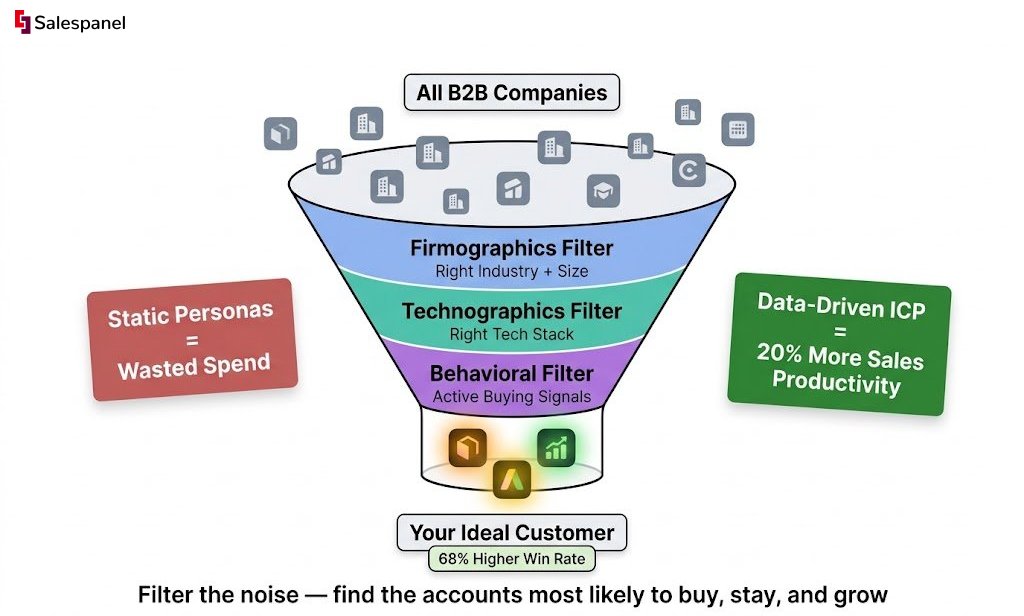
Why Static Personas No Longer Work in B2B
The old playbook of using generalized characters like “Marketing Mary” or “Startup Steve” is fundamentally broken in the modern B2B landscape. These profiles, often assembled from assumptions and educated guesses, were a product of a time when customer data was sparse. Today, B2B operations are data-rich environments, rendering such guesswork a significant liability. The companies achieving market leadership have pivoted from these fictional personas to a dynamic, data-validated Ideal Customer Profile (ICP).
An ICP is a living blueprint of your perfect-fit accounts, not just individuals. This is not a semantic distinction; it is a fundamental strategic shift from qualitative fiction to quantitative fact.
This paradigm shift moves the focus from the individual employee to the specific, measurable attributes of the company that is structurally positioned to achieve maximum value from your product. The central theme is this: we are seeking to replicate our best customers through a systematic, data-driven process.
The Financial Cost of a Flawed Focus
When targeting is imprecise, the financial damage is systemic. Sales teams expend resources pursuing leads that lack genuine potential. Marketing campaigns fail to resonate. Product development can be misguided by feedback from ill-fitting customers. The result is a cascade of inefficiency that erodes profitability.
Conversely, organizations with a precise ICP report substantially higher conversion rates and customer lifetime value. This outcome is logical: every marketing dollar and sales hour is invested in acquiring accounts with the highest probability of long-term success and advocacy. The objective is not merely to acquire any customer; it is to systematically replicate the characteristics of your best customers.
From Guesses to Data-Driven Decisions
A rigorous ICP process replaces abstract characteristics with concrete, verifiable attributes. Instead of speculating on a persona’s pain points, you analyze the documented business challenges your most successful customers faced immediately prior to engagement.
This modern methodology necessitates a deep dive into empirical data:
- Firmographics: Define the non-negotiable company attributes, such as industry, employee count, and annual revenue. These are the initial qualifying parameters.
- Technographics: Catalog the existing technology stack of your best customers. This data provides strong signals regarding integration opportunities and operational maturity.
- Behavioral Signals: Analyze how ideal prospects engage with your digital assets. Tracking these actions is the mechanism for identifying active buying signals.
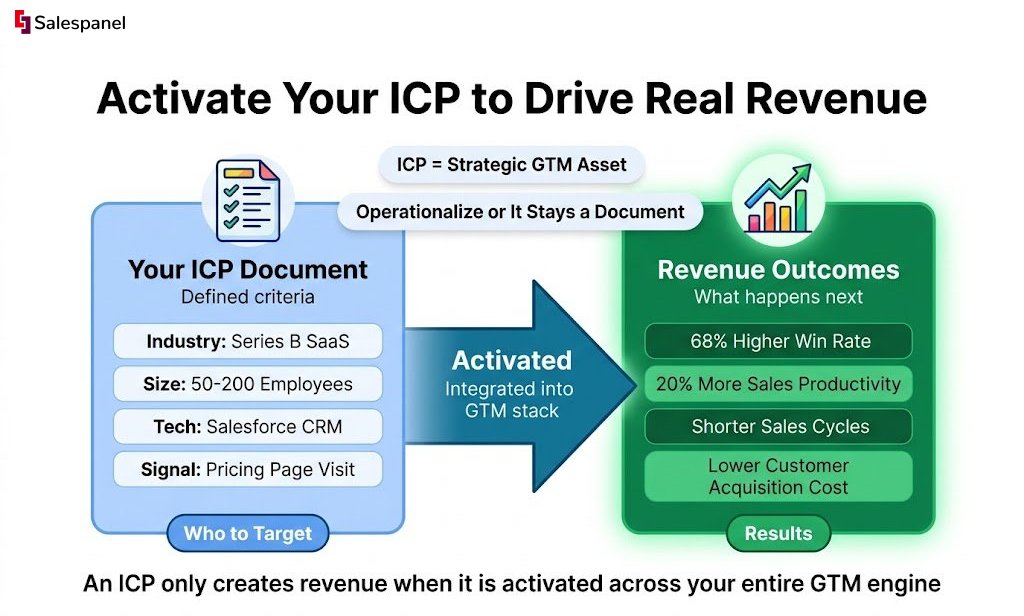
A practical example: a marketing automation provider might discover its optimal target is not simply “SaaS companies.” A data-driven analysis could reveal the ICP to be “Series B SaaS companies with 50-200 employees, using Salesforce, and demonstrating a 30% increase in website traffic over the last quarter.” This level of granularity is unattainable with traditional personas but forms the core of an effective ICP, transforming go-to-market strategy from an art into a science.
The Anatomy of a High-Impact ICP Template
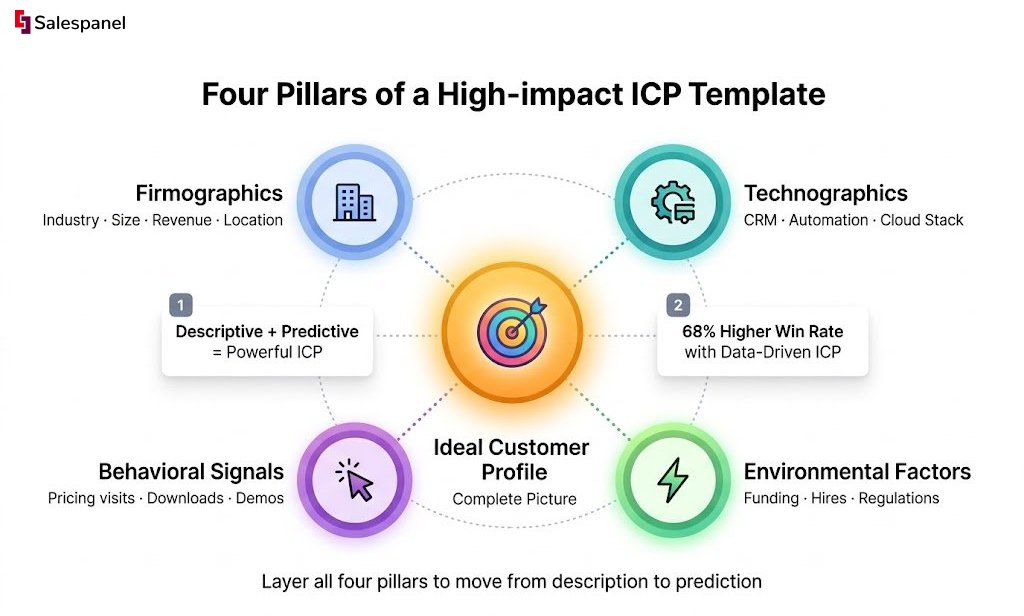
A truly effective Ideal Customer Profile is not a simple checklist. It is a multi-layered composite of data that creates an unambiguous portrait of a target account. It must extend far beyond basic firmographics to capture the complete context of what constitutes a perfect fit.
This involves integrating firmographic, technographic, behavioral, and environmental data. Firmographics serve as the foundation, encompassing factual data like industry, company size (for example, mid-market companies with $10 million or more in revenue), and growth trajectory. This is then layered with psychographics—motivations and pain points—which are increasingly quantified through business metrics. More on this framework can be found in resources like this template from Asana on building customer profiles.
To construct an ICP with genuine utility, it is essential to build upon four distinct but interconnected data pillars. Each pillar contributes a critical layer of insight, elevating the profile from a vague description to a predictive model for customer acquisition.
The Four Pillars of a Comprehensive ICP
| Data Pillar | Key Attributes to Collect | Strategic Importance |
|---|---|---|
| Firmographics | Industry/Vertical, Company Size (Employees/Revenue), Geographic Location, Growth Stage (Startup, Mid-Market, Enterprise), Business Model (B2B, B2C). | Establishes the foundational, non-negotiable criteria. This is your first, broadest filter to ensure you’re talking to the right type of company from the get-go. |
| Technographics | CRM (e.g., Salesforce, HubSpot), Marketing Automation Platform, Analytics Tools, Cloud Infrastructure (AWS, Azure), Specific Competitor Products. | Reveals their operational maturity, potential integration opportunities, and competitive vulnerabilities. Knowing their tech stack is a shortcut to understanding their needs. |
| Behavioral Signals | Website pages visited (Pricing, Case Studies), Content downloads (Whitepapers, Webinars), Email engagement (Opens, Clicks), Demo requests. | This is your intent data. It separates companies that simply fit your profile from those that are actively looking for a solution right now. It’s the key to timely outreach. |
| Environmental Factors | Recent Funding Rounds, New Regulatory Requirements (GDPR, CCPA), Key Executive Hires, Market Trends (e.g., Shift to Remote Work), Mergers & Acquisitions. | Provides the “why now” context. These external triggers often create the urgency and budget for a purchase, turning a good-fit account into a hot lead. |
By systematically collecting and analyzing data across these four pillars, you create an ICP that is not just descriptive but predictive. It becomes a primary strategic asset for the entire GTM organization.
Pillar 1: Firmographics – The “Who”
Firmographics are the non-negotiable, objective, and easily identifiable facts about a business that form the first layer of qualification. Consider them the baseline entry requirements for sales and marketing engagement.
Key firmographic data points include:
- Industry/Vertical: Specify the sectors that derive maximum value from your product (e.g., FinTech, SaaS, Healthcare IT).
- Company Size: Define this by employee count (e.g., 50-250 employees) or annual revenue (e.g., $10M-$100M ARR).
- Geographic Location: Identify regions or countries where your best customers are concentrated, impacting sales territories and compliance.
- Growth Stage: Differentiate between startups, established mid-market players, or large enterprises, as their needs and procurement processes differ significantly.
This infographic effectively illustrates the strategic migration from ambiguous personas to the precise, data-backed ICPs that directly correlate with higher conversion rates.
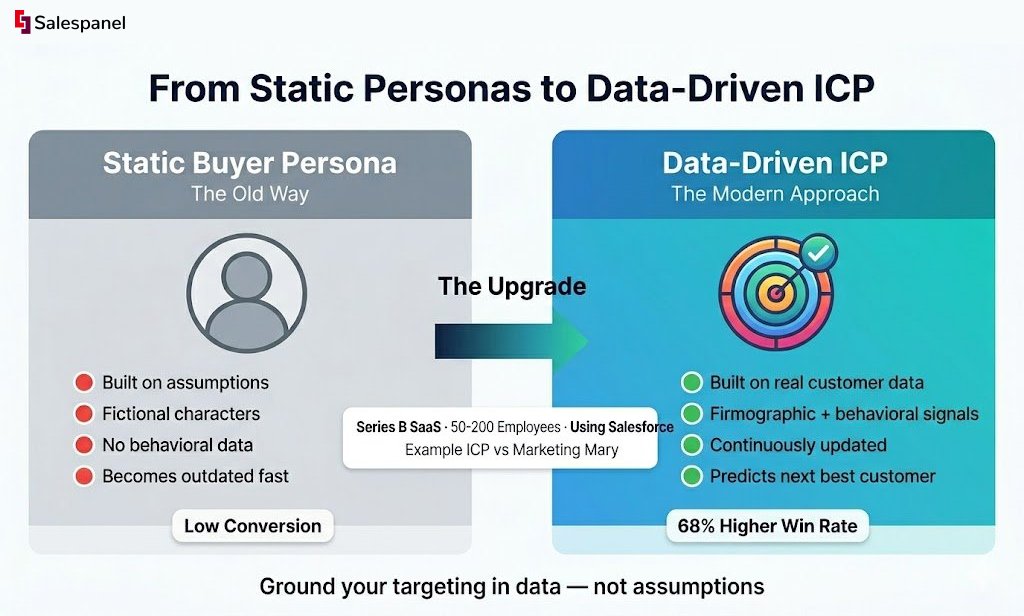
The primary takeaway is that grounding targeting in a robust, data-validated ICP is the most direct path to optimizing marketing and sales performance.
Pillar 2: Technographics – The “What They Use”
Understanding a company’s technology stack provides a critical layer of intelligence. It informs on operational maturity, potential integration requirements, and existing solution deficiencies.
As a practical example, if your marketing analytics tool integrates seamlessly with HubSpot, a company that has already adopted HubSpot is a significantly more qualified lead than one utilizing a competing CRM. This data enables hyper-personalized outreach that aligns directly with their existing workflow.
Pillar 3: Behavioral Signals – The “What They Do”
This is the pillar that transforms the ICP from a static document into a dynamic tool. Behavioral signals are the observable actions a prospect takes that indicate a transition from passive fit to active buyer. These digital footprints signify that an account is actively researching a solution to a problem you solve.
Behavioral data is the closest proxy to understanding a prospect’s intent. It distinguishes companies that merely fit the profile from those that are ready to buy.
This data is derived from tracking their digital interactions with your brand:
- Website Engagement: Analyze which pages they visit. Time spent on a pricing page or deep dives into specific case studies are strong indicators.
- Content Consumption: Note downloads of technical whitepapers or webinar registrations on specific topics.
- Email Interaction: Monitor open and click-through rates on emails related to particular feature sets.
A tool that provides website visitor tracking like Salespanel can identify anonymous companies that match your ICP and are exhibiting these buying signals, converting passive web traffic into an active pipeline of qualified accounts.
Pillar 4: Environmental Factors – The “Context”
Finally, environmental factors supply the crucial context for an ideal customer. These are the external conditions that can create immediate urgency or a compelling need for your solution. This is the “why now” component of the qualification puzzle.
This category includes triggers such as:
- Regulatory Changes: A new compliance mandate like GDPR or CCPA can create sudden demand for data privacy solutions.
- Market Trends: A major industry shift, such as the transition to remote work, can increase demand for collaboration tools.
- Funding Events: A recent funding round often signals available budget and a mandate to invest in new technologies for growth.
By integrating these four pillars, you move beyond a simple description to create a comprehensive and actionable Ideal Customer Profile. It becomes a predictive model for identifying your next best customer.
How to Build Your ICP from Your Best Customers
An Ideal Customer Profile template is only as valuable as the data it contains. The most effective ICPs are not conceived in a boardroom; they are reverse-engineered from your existing successful customers. The process is one of internal analysis to discover the blueprint for future growth.
A team collaborating around a desk with data charts, symbolizing the analysis of customer information to build an ICP.
The initial, critical step is to identify your “champion” customers. This designation extends beyond those with the largest contracts. True champions exhibit high lifetime value (LTV), low churn rates, and function as advocates through referrals and case studies. They are the organizations that have fully integrated your product and are realizing significant, measurable results.
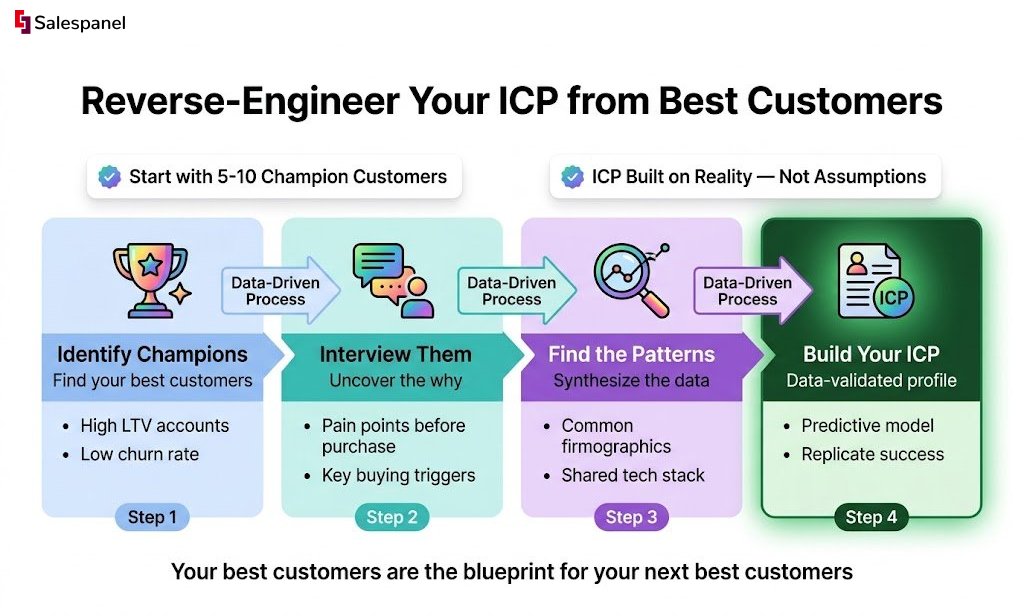
Identify Your Champion Customers
Before analysis can begin, you must establish a clear, multi-faceted definition of what constitutes a “best” customer for your business. This involves a combination of quantitative metrics and qualitative feedback. Begin by interrogating your CRM and billing systems to isolate a cohort of customers who excel across several key dimensions.
Seek accounts demonstrating these consistent traits:
- High Lifetime Value (LTV): They have a long and profitable history with your company.
- Low Acquisition Cost (CAC): Their sales cycle was efficient, indicating a natural product-market fit.
- High Product Adoption/Usage: They are power users who have deeply integrated your solution into their core operations.
- Expansion Revenue: They have consistently upgraded, added seats, or purchased additional services.
- Willingness to Advocate: They are willing to provide testimonials, participate in case studies, or refer new business.
By focusing on this elite group, you base your ICP on proven success, not speculation. You are modeling what already works, transforming it into a reliable guide for all subsequent go-to-market activities.
Conduct Structured Customer Interviews
Once you have a shortlist of 5-10 champion customers, the next step is direct engagement. Quantitative data reveals what they are, but only qualitative interviews can uncover why they are a perfect fit. The objective is to document their narrative—their challenges, objectives, and the specific value they derive from your solution.
Frame the outreach as an opportunity for them to contribute expertise and help improve your product, not as a sales interaction. This positions them as valued partners.
Prepare a set of open-ended questions designed to extract the necessary details for your ICP.
Sample Interview Questions to Ask:
- “Before implementing our solution, what was your day-to-day process for addressing [problem X]?”
- “What was the specific trigger or tipping point that compelled you to seek a new solution?”
- “During your evaluation of different options, what were your most critical decision criteria?”
- “How does your team measure the success or ROI derived from our product?”
- “What other tools or platforms are essential to your team’s workflow?”
These questions probe beyond surface-level information to uncover deep-seated pain points, critical buying triggers, and the technological ecosystem they operate in—all essential components of a robust ideal customer profile.
Synthesize and Find the Patterns
With interview data collected, the task is to synthesize the information and identify common patterns and recurring themes across your champion customers. This is the analytical step where your ICP solidifies from a concept into a concrete, data-driven asset.
Organize your findings according to the four data pillars:
- Firmographics: Did all champions fall within a specific revenue range, such as $20M-$75M ARR, or a particular employee count? Were they concentrated in a niche sub-industry?
- Technographics: Was a specific CRM, marketing automation platform, or cloud provider consistently mentioned in interviews?
- Behavioral Signals: Did you observe that they all downloaded a specific whitepaper or attended the same webinar prior to purchase?
- Pain Points & Goals: What were the common business challenges and strategic objectives that emerged repeatedly?
As you analyze this synthesized data, a clear profile will emerge. This profile is not a guess but a reflection of reality, constructed from the shared attributes of your most valuable customers. A well-defined ICP is a cornerstone of building a modern customer segmentation strategy that fuels sustainable growth. This data-driven model becomes the foundation for every subsequent marketing and sales decision.
Putting Your ICP to Work and Driving Real Revenue
An Ideal Customer Profile that remains a static document within a spreadsheet is a wasted asset. Its strategic value is realized only when it is actively integrated into the entire go-to-market engine. It should function less as a static reference and more as a dynamic operational tool for revenue generation. The objective is to operationalize the ICP within the marketing and sales platforms used daily, enabling smarter, more efficient targeting.
A split-screen image showing an ICP document on one side and a business intelligence dashboard with upward-trending graphs on the other, symbolizing the connection between a well-defined profile and revenue growth.
This operationalization is about leveraging technology to animate the profile. A well-defined ICP should serve as the control center for all GTM activities—from keyword targeting in ad campaigns to account prioritization for the sales team. When ICP criteria are integrated into automation tools, the entire GTM motion achieves a new level of efficiency. You eliminate guesswork and concentrate resources exclusively on prospects with the highest probability of closing and generating long-term value.
Turn Website Traffic Into a Qualified Pipeline
One of the most potent applications of an ICP is identifying which target companies are already demonstrating interest by visiting your website. A significant portion of website traffic is anonymous, but this does not mean it is unidentifiable. Many of these visitors are employed by companies that perfectly match your newly defined ICP.
Here, the right technology provides a significant competitive advantage. For example, Website Visitor Tracking from Salespanel can de-anonymize site visitors, revealing the companies that are browsing your pages. By filtering this traffic against your ICP criteria—such as industry, company size, and location—you can convert passive web traffic into a real-time pipeline of high-fit accounts.
This methodology fundamentally redefines the role of your website. It transitions from a passive digital brochure to an active prospecting instrument. It surfaces ideal customers who are already in a research phase, enabling your sales team to engage at the optimal moment.
This allows for proactive, relevant outreach. Instead of making cold calls, your team can engage with the knowledge that the company has already shown interest, making for a much more productive initial conversation.
Automate Lead Qualification with Scoring
Beyond identification, activating your ICP involves systematically prioritizing accounts based on both fit and intent. This requires a robust lead scoring framework. A static ICP defines who to target; an activated ICP helps pinpoint who to target right now.
Salespanel’s lead scoring framework enables you to establish rules that automatically assign points to prospects based on their alignment with your ICP. The true power lies in layering firmographic data (“fit”) with behavioral data (“intent”).
ICP Fit Scoring: Assign high scores for attributes that align perfectly with your ideal profile.
- +20 points for companies in the “SaaS” industry.
- +15 points for companies with 50-250 employees.
- +10 points for visitors from your key geographic regions.
Intent Signal Scoring: Add points for actions that signal active buying interest.
- +10 points for visiting the pricing page.
- +15 points for downloading a case study.
- +25 points for requesting a demo.
This dual-scoring system ensures the sales team focuses its time and energy on accounts that both match the ICP and are actively exhibiting buying behavior. This systematic approach automatically surfaces the highest-value opportunities in your pipeline.
Power Personalized Outreach at Scale
Finally, an activated ICP is the foundation for personalized communication that drives engagement. With a clear understanding of your ideal customer’s industry, challenges, and objectives, your marketing and sales teams can craft messages that resonate on a technical and business level.
This extends far beyond simple tokenization like {company_name}. It involves creating industry-specific content, tailoring ad copy to address known pain points, and equipping the sales team with talk tracks that address the specific challenges of your ideal customers. To manage this effectively, explore various email outreach tools that streamline communication without sacrificing personalization.
To measure the impact of your ICP and connect it directly to revenue, robust data analysis is essential. It is advisable to explore examples of business intelligence dashboards to understand how leading companies visualize performance. By linking your ICP-driven initiatives to clear business outcomes, you can continuously refine your profile and prove its value across the organization.
Common ICP Mistakes and How to Avoid Them
Constructing a robust Ideal Customer Profile is a strategic imperative, but the process is fraught with potential errors. A flawed ICP can be more detrimental than having no ICP at all, as it can misdirect the entire go-to-market organization. Avoiding these common pitfalls is critical to building a profile that genuinely drives revenue.
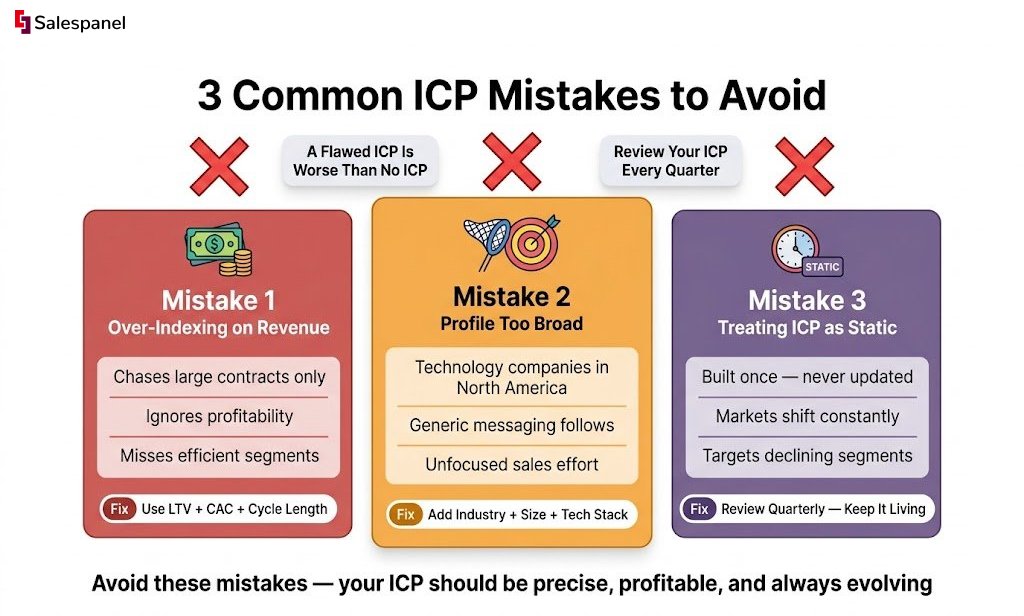
A prevalent mistake is defining “best” customers based on a single metric: revenue. While large contracts are appealing, this narrow focus can obscure significant liabilities, such as excessive support costs, low profit margins, and protracted sales cycles that drain resources.
Mistake 1: Over-Indexing on Revenue Alone
Consider a SaaS company in the project management sector that defined its ICP as any enterprise with over 5,000 employees. After securing a few large contracts, the underlying issues became apparent. These clients demanded extensive customizations, consumed a disproportionate amount of customer support resources, and had a sales process that extended beyond a year.
In contrast, their mid-market customers—companies with 200-1,000 employees—closed within 60 days, required minimal support, and achieved high value from the standard product offering. By pursuing high-revenue contracts, the company was incurring losses on low-profitability accounts while neglecting a more lucrative and efficient market segment.
How to Avoid This: Define “best” customer using a balanced scorecard. Analyze a blend of metrics: Customer Lifetime Value (LTV), sales cycle length, product adoption rates, and net profitability. This provides a comprehensive view of an account’s true value.
Mistake 2: Creating a Profile That Is Too Broad
Another common error is creating an ideal customer profile template that is so general as to be strategically useless. A profile targeting “technology companies in North America” is not a profile; it is a directory. Such a broad approach results in generic marketing messages and an unfocused sales effort.
Effective targeting requires precision. Instead of “technology companies,” a superior ICP would be “Series B FinTech companies in the US with 50-200 employees using Salesforce as their CRM.” The specificity enables hyper-relevant messaging and surgical prospecting. The ICP must function as a filter, not a net.
The results of this precision are significant. Companies with precise ICPs can increase sales productivity by up to 20% and reduce their sales cycle by approximately 15%. A practical starting point is to analyze your top 10–20 customers, looking beyond revenue. For further reading, review these insights on ICP template development.
Mistake 3: Treating the ICP as a Static Document
Perhaps the most critical mistake is treating the ICP as a one-time project that is subsequently archived. Markets are not static. Products evolve. Customer needs change. An ICP developed two years ago may now be directing your team toward a declining market segment.
For example, a company whose ICP was centered on businesses reliant on in-person events saw its pipeline evaporate in 2020. The organizations that adapted were those that quickly updated their ICP to target businesses transitioning to virtual models. They identified new pain points and adjusted their strategy accordingly.
To maintain the relevance and utility of your ICP, it must be treated as a living document:
- Schedule Regular Reviews: Institute a quarterly or bi-annual ICP review meeting with stakeholders from sales, marketing, and customer success.
- Monitor Your Metrics: Continuously track win rates, sales cycle length, and churn rates for your target segments. A decline in performance may signal the need for an ICP refresh.
- Gather Feedback Continuously: Your sales and customer success teams are your primary sources of market intelligence. Establish a formal process for them to report on customer successes and failures.
By avoiding these common errors, you can transform your ideal customer profile template from a static document into a dynamic strategic asset that actively drives business growth.
Got Questions About Your ICP? We’ve Got Answers.
As you prepare to implement your new ideal customer profile, several questions typically arise. Addressing these common queries will provide the clarity needed to proceed with confidence.
How Often Should I Update My Ideal Customer Profile?
Your ICP should be treated as a living document, not a static artifact. It must evolve in tandem with your business and the market.
A comprehensive review at least once a year is a recommended baseline. However, you must be prepared to revise it more frequently in response to significant business events.
Such triggers for an immediate ICP review include:
- The launch of a major new product or a significant feature set.
- Expansion into a new geographic territory or industry vertical.
- The emergence of a new customer segment that is achieving exceptional success with your product.
Maintaining open communication channels with your sales and customer success teams is the most effective way to monitor for these shifts. They are on the front lines and will be the first to detect market changes or the appearance of a new high-fit customer profile.
What Is the Difference Between an ICP and a Buyer Persona?
This is a critical distinction that is often misunderstood.
Your Ideal Customer Profile (ICP) is focused on the company. It defines the attributes of the perfect account to target, using firmographics like industry, employee count, revenue, and technology stack. The ICP answers the question, “Which companies should we target?”
A Buyer Persona is focused on the people within that ideal company. It is a detailed characterization of the decision-makers, champions, and influencers involved in the purchasing process. The persona answers the question, “Who are the individuals we need to influence, and what are their motivations and pain points?”
The two are complementary and essential. Your ICP identifies the right companies to target, while your buyer personas inform the messaging and engagement strategy for the key individuals within those companies. A successful strategy requires both.
Can a Company Have More Than One Ideal Customer Profile?
Yes, and in many cases, it is strategically necessary. Attempting to consolidate diverse market segments into a single, generic profile will result in ineffective, diluted marketing.
Multiple ICPs are typically required when a business serves distinct market segments or when its products solve different problems for different industries.
For instance, a software company might sell to both agile mid-market technology startups and large, highly-regulated enterprise financial institutions. The ICPs for these two segments would be fundamentally different. Their core pain points, buying committees, procurement processes, and success metrics would vary dramatically.
The proper approach is to develop a distinct, highly detailed ICP for each target segment. This provides the necessary clarity for your marketing and sales teams to design and execute strategies that resonate effectively with each specific audience.
Ready to turn your ideal customer profile into a revenue-generating machine? At Salespanel, we help you identify, score, and engage the high-value prospects visiting your website. Explore our resources to learn how to build a smarter GTM strategy. Find out more at https://salespanel.io/resources.