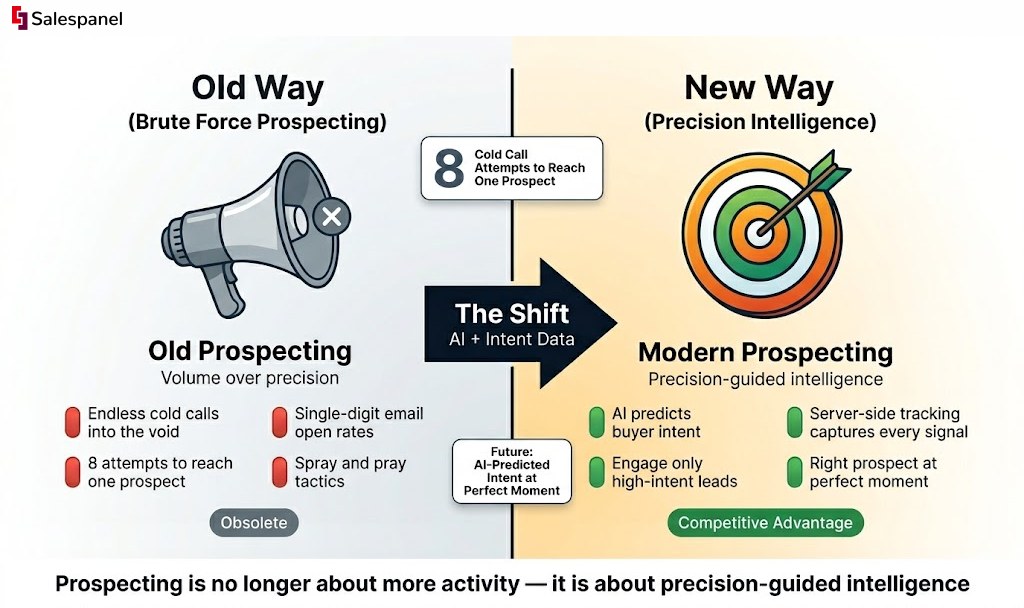
Five years ago, sales prospecting was a game of brute force: endless spreadsheets, cold calls into the void, and email blasts with single-digit open rates. According to industry reports from that era, it took an average of eight cold call attempts just to reach a prospect. Today, that landscape is almost unrecognizable. The convergence of artificial intelligence, stringent privacy regulations like GDPR, and sophisticated buyer behavior has rendered those old tactics obsolete.
Prospecting is no longer about more activity; it is about precision-guided intelligence. The future, driven by AI that predicts buyer intent and server-side tracking that captures every digital signal, promises a world where sales teams engage only the most qualified, high-intent leads at the perfect moment. As prospecting rapidly evolves towards these intelligent systems, understanding AI’s role is crucial. For further reading on leveraging artificial intelligence to boost your sales, explore advanced AI-powered lead generation strategies.
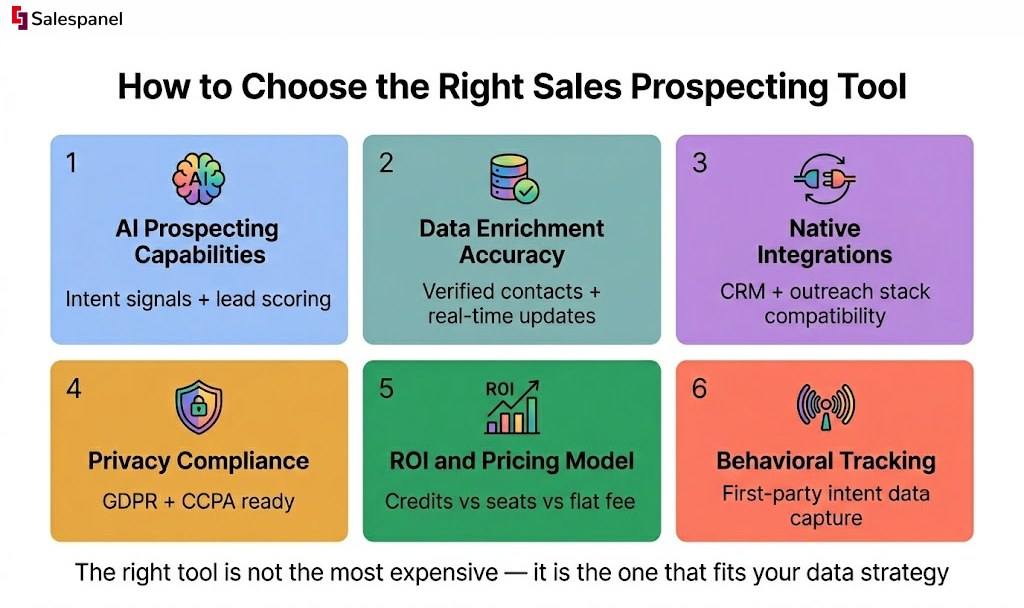
This guide is your roadmap to navigating that shift. Our central theme is the transition from manual, volume-based outreach to an intelligent, data-driven prospecting discipline. We will dissect the technical capabilities of the 12 best sales prospecting tools, providing a journalistic analysis of how they function, their practical applications, and which platforms are truly built for the future of intelligent, privacy-first sales. We will move beyond marketing copy to deliver a technical breakdown, comparing core features like AI prospecting capabilities, data enrichment accuracy, and native integrations.
Your key takeaway will be a framework for selecting, implementing, and maximizing the ROI of your chosen tool. Our goal is to equip you with the deep insights needed to transition from outdated manual processes to a modern, data-driven prospecting engine that delivers a consistent, high-quality sales pipeline. Let’s begin.
1. Salespanel
Salespanel secures the top spot in our list of the best sales prospecting tools by directly addressing the most critical challenge B2B teams face today: obtaining reliable, actionable intelligence in an era of data privacy and tracking restrictions. It moves beyond traditional prospecting methods by building its foundation on a privacy-first, server-side tracking architecture. This technical approach is crucial as it mitigates data loss from browser-side limitations (like ITP) and ad-blockers, ensuring sales and marketing teams receive a high-fidelity picture of visitor activity.
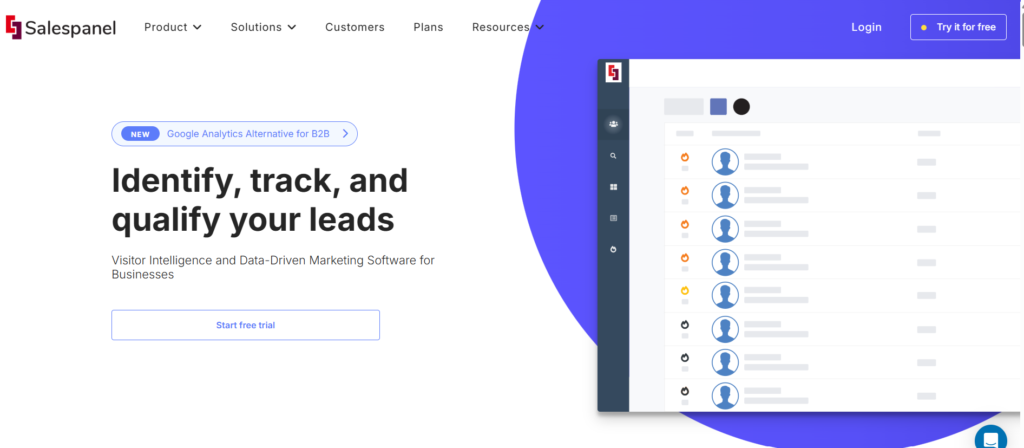
The platform’s core strength lies in its ability to consolidate signals from cookies, pixels, and embedded scripts to perform sophisticated identity resolution. This process transforms anonymous website behavior into identified, high-value prospects. For a sales team, this means seeing which companies are browsing your pricing page or a key case study, even before they fill out a form. The system then layers AI-driven lead scoring on top of this data, automatically prioritizing the accounts most likely to convert. This allows sales reps to focus their energy on warm leads with demonstrated intent, dramatically improving efficiency and outreach relevance.
Why It Stands Out
What makes Salespanel a standout choice is its dual focus on resilient data capture and intelligent sales activation. While many tools specialize in one or the other, Salespanel integrates both into a cohesive workflow. It’s built for modern B2B teams who need to not only identify prospects but also understand their complete journey in a compliant manner.
Use Case Spotlight
A SaaS company can use Website visitor tracking from Salespanel to identify an anonymous visitor from a target enterprise account. The system can score the account’s engagement based on pages visited and time spent, then trigger an alert for the assigned sales representative. The rep receives a rich profile of the prospect’s interests, enabling highly personalized and timely outreach instead of a generic cold call.
Pros & Cons
| Pros | Cons |
|---|---|
| Privacy-First Tracking: Server-side architecture ensures reliable data capture despite browser restrictions and privacy regulations. | No Public Pricing: Requires contacting the sales team for a demo or quote, which can slow down evaluation. |
| Integrated Identity Resolution: Effectively converts anonymous visitor behavior into actionable company and contact-level leads. | Technical Implementation: Server-side setup may require developer resources, unlike simpler client-side scripts. |
| AI-Powered Lead Scoring: Automates the prioritization of high-intent prospects, focusing sales efforts where they count most. | |
| Rich Educational Resources: The platform is supported by an extensive blog and resource hub that provides deep expertise on tracking, compliance, and B2B strategy. |
Pricing
Pricing details for Salespanel are not publicly available. Teams must contact them directly for a customized quote or to schedule a demo.
Visit Salespanel
2. LinkedIn Sales Navigator
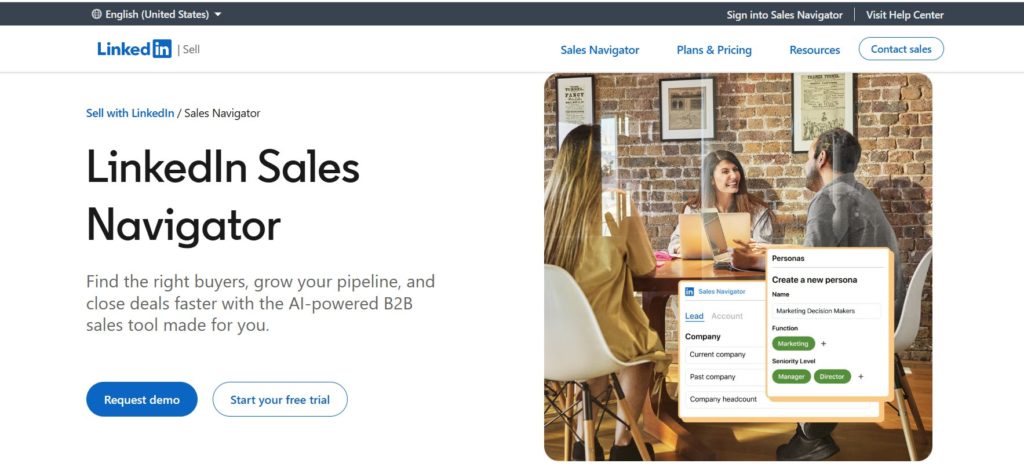
LinkedIn Sales Navigator is a dedicated B2B prospecting tool built into the world’s largest professional network. With over 900 million members, it surfaces fresh leads and account insights in real time. This makes it one of the best sales prospecting tools for social selling motions.
Key Features
- Advanced Lead and Account Search: 20+ filters including industry, seniority, and company size
- Real-Time Alerts: Job changes, published posts, and mentions
- InMail and Smart Links: Track engagement on customized outreach
- TeamLink and Relationship Mapping: Uncover warm introductions on higher tiers
Pros and Cons
Pros: Massive, up-to-date B2B data. Native reach where buyers already engage. High ROI in social selling campaigns.
Cons: Limited bulk data export. Seat costs accumulate for large teams.
Pricing and Access
LinkedIn offers three tiers: Core ($80/user/month), Advanced ($120/user/month), and Plus ($150/user/month). Annual commitments unlock CRM sync with Salesforce or Microsoft Dynamics. Access requires an individual LinkedIn account and company validation.
Tactical Tips
- Save lead lists for weekly review to catch job moves
- Use Smart Links to A/B test pitch formats
- Integrate with Salespanel webhooks for visitor tracking and lead scoring
- Combine Navigator alerts with additional LinkedIn prospecting strategies for deeper outreach
This platform stands out by blending professional network data with proactive alerts. Implementation is straightforward with native CRM connectors and API access for martech stacks. It earns its spot among the best sales prospecting tools by driving targeted connections and measurable pipeline growth.
Learn more at LinkedIn Sales Navigator.
3. ZoomInfo SalesOS
ZoomInfo SalesOS is an enterprise-grade B2B intelligence platform known for its vast database of company and contact information. It provides sales teams with direct dials, verified email addresses, and organizational charts to accelerate outreach. The platform’s depth of data makes it one of the best sales prospecting tools for high-volume outbound and strategic account planning.
Key Features
- Large B2B Database: Access to millions of direct dials and verified work emails
- Intent and Account Insights: Tracks topics companies are actively researching online
- CRM and Engagement Integrations: Connects with Salesforce, HubSpot, Outreach, and Salesloft
- Data Enrichment: Cleans and enhances existing CRM data via the OperationsOS module
Pros and Cons
Pros: Deep, accurate dataset with extensive filtering. Powerful for territory planning and building account lists. Strong integration ecosystem with major sales tools.
Cons: Pricing is quote-based and can be a significant investment. Annual contracts are standard, limiting flexibility.
Pricing and Access
ZoomInfo operates on a custom, quote-based pricing model, with costs depending on the number of licenses, data credits, and add-on features like Intent data or Chorus.ai. Access typically requires an annual contract and is tailored to the needs of mid-market and enterprise organizations.
Tactical Tips
- Build Ideal Customer Profiles (ICPs) using advanced firmographic and technographic filters
- Create automated workflows to enrich new CRM leads with accurate contact data
- Use Intent data to prioritize outreach to accounts showing active buying signals
- Combine ZoomInfo contact data with website visitor tracking from Salespanel to identify and engage anonymous buying committees
This platform excels by offering a comprehensive, all-in-one solution for data acquisition, enrichment, and sales orchestration. Its robust dataset and seamless integrations justify its position as a top-tier tool for sales organizations focused on scaling their outbound efforts and improving data hygiene.
Learn more at ZoomInfo.
4. Apollo.io
Apollo.io is a unified prospecting and engagement platform that consolidates a massive B2B database with powerful sales execution tools. By combining lead data, sequencing, a dialer, and analytics into one interface, it offers an end-to-end workflow. This all-in-one approach makes it one of the best sales prospecting tools for SMBs and mid-market teams seeking high value and operational efficiency.
Key Features
- B2B Database: Access to over 270 million contacts with verified emails and phone numbers
- Sales Engagement: Built-in sequencing, dialer, and a LinkedIn workflow extension
- CRM Integrations: Native sync with Salesforce and HubSpot, plus robust API access
- Credit-Based System: Flexible model for data acquisition and exporting contacts
Pros and Cons
Pros: Exceptional value with a generous free tier. All-in-one platform reduces tool switching. Transparent and accessible pricing plans.
Cons: Credit and export limits require careful management. Advanced features are gated behind higher-priced tiers.
Pricing and Access
Apollo offers a free plan with 60 mobile and 120 export credits annually. Paid plans start at the Basic tier ($39/user/month), followed by Professional ($79/user/month) and Organization ($99/user/month) tiers with increased credit allowances and features. Annual billing provides a discount.
Tactical Tips
- Use the free Chrome extension to enrich LinkedIn profiles and find contact data on the fly.
- Build multi-step sequences combining email, calls, and LinkedIn tasks to maximize touchpoints.
- Prioritize high-intent leads from your website by integrating Apollo with visitor identification tools like Salespanel.
- Regularly clean your CRM data by using Apollo’s enrichment features to update outdated contact information.
Apollo.io secures its place by democratizing access to enterprise-grade sales intelligence and engagement tools. Its integrated workflow allows teams to find, engage, and convert prospects without leaving the platform, streamlining the entire top-of-funnel process.
Learn more at Apollo.io.
5. HubSpot Sales Hub
HubSpot Sales Hub integrates sales prospecting, engagement, and reporting directly into the HubSpot CRM platform. It provides a unified system for teams that want marketing, sales, and service tools to work together seamlessly. This makes it one of the best sales prospecting tools for businesses seeking an all-in-one front-office solution.
Key Features
- Prospecting Workspace: A centralized command center for managing daily prospecting activities.
- Sequences and Meeting Links: Automate outreach and simplify scheduling.
- Deal and Ticket Pipelines: Visual tools for tracking progress and managing tasks.
- Conversation Intelligence: AI-powered call analysis and coaching in higher tiers.
Pros and Cons
Pros: Excellent usability and extensive onboarding resources. Scales from powerful free tools to enterprise-level features. Large app marketplace for extensive integrations.
Cons: Advanced features are gated behind expensive higher tiers. Mandatory paid onboarding for Professional and Enterprise plans.
Pricing and Access
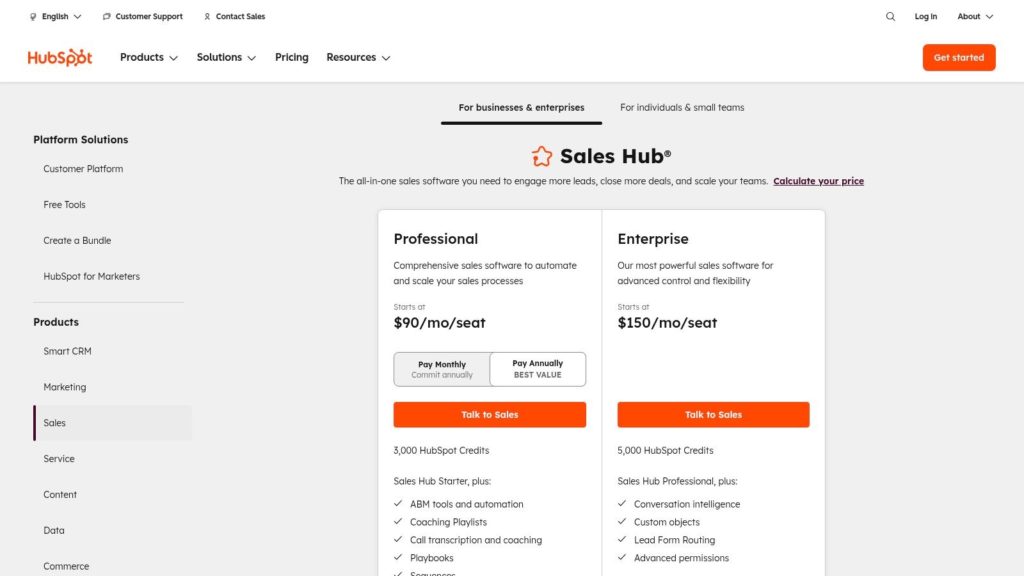
HubSpot Sales Hub offers a free tier with basic tools. Paid plans start at $45/user/month (Starter), moving to Professional ($450/month for 5 users) and Enterprise ($1,500/month for 10 users). Annual commitments are often required for better pricing. Access is managed through a central HubSpot account.
Tactical Tips
- Use the Prospecting Workspace to organize and prioritize daily outreach tasks.
- Create multiple meeting links for different call types (e.g., 15-min discovery, 30-min demo).
- Leverage the extensive HubSpot Academy for free sales training and certifications.
- Integrate with other powerful email outreach tools to supplement HubSpot’s native sequencing capabilities.
HubSpot Sales Hub stands out by offering a highly usable, integrated platform that grows with your business. Its strength lies in consolidating the entire customer journey into one system, making it a top choice for teams that prioritize alignment and ease of use.
Learn more at HubSpot Sales Hub.
6. Outreach
Outreach is a mature enterprise sales engagement platform designed for complex, high-volume sales organizations. It excels at orchestrating multichannel outreach sequences, enforcing sales process governance, and providing deep analytics. This focus on control and scalability makes it one of the best sales prospecting tools for revenue operations teams that need to manage large teams effectively.
Key Features
- Multichannel Sequences: Govern and automate outreach across email, phone, and social tasks
- Analytics and RevOps Controls: Deep reporting on team performance and sequence effectiveness
- Outreach Voice: Integrated dialer with local presence and call recording capabilities
- Deep CRM Integrations: Robust, bi-directional sync with platforms like Salesforce and Microsoft Dynamics
Pros and Cons
Pros: Mature, enterprise-grade platform for complex sales motions. Strong analytics and process controls for managers. Reliable and scalable for large teams.
Cons: License pricing is quote-based and not publicly listed. Requires annual contracts and a dedicated implementation effort.
Pricing and Access
Outreach pricing is tailored to each organization and requires a direct sales consultation. Contracts are typically annual and involve implementation and onboarding fees. Access is managed through user licenses assigned by an administrator.
Tactical Tips
- Use A/B testing on sequence steps to optimize messaging and call-to-action effectiveness.
- Leverage the analytics dashboard to identify top-performing reps and replicate their successful workflows.
- Integrate Outreach with website visitor tracking from Salespanel to trigger sequences when a target account shows intent.
- Explore other powerful email outreach tools if your needs are simpler or you require more transparent pricing.
Outreach stands out for its ability to enforce structured sales processes at scale. Its deep CRM integration and powerful analytics provide the visibility and control that large sales organizations need to drive predictable revenue.
Learn more at Outreach.
7. Salesloft
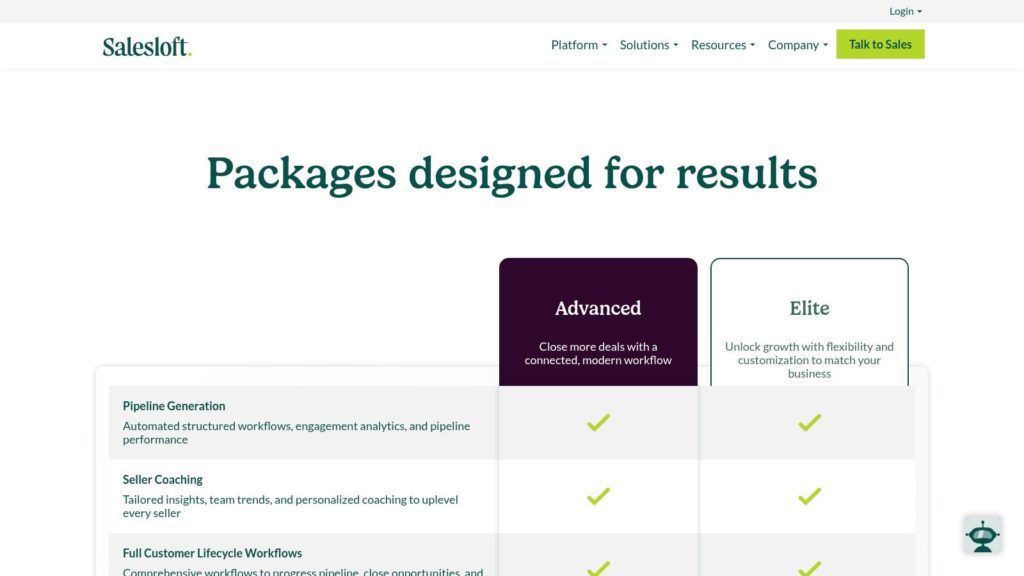
Salesloft is a comprehensive revenue orchestration platform designed for mid-market and enterprise sales teams. It combines sales engagement, conversation intelligence, and deal management into a single interface, enabling reps to execute full-cycle sales motions efficiently. This makes it one of the best sales prospecting tools for organizations needing strong governance and pipeline visibility.
Key Features
- Cadences and Dialer: Build and execute multi-channel prospecting sequences with integrated calling and texting.
- Conversation Intelligence: Record, transcribe, and analyze sales calls to identify coaching opportunities and winning talk tracks.
- Bi-Directional CRM Sync: Deep, reliable integration with Salesforce and Microsoft Dynamics ensures data hygiene and workflow automation.
- AI-Assisted Workflows: Includes Rhythm, an AI-powered workflow that prioritizes a seller’s daily actions for maximum impact.
Pros and Cons
Pros: All-in-one platform for the entire sales cycle. Strong enterprise security and data governance. Excellent for coaching and rep performance analysis.
Cons: Pricing is quote-based and tailored to enterprise budgets. Maximum ROI often requires adopting multiple modules.
Pricing and Access
Salesloft does not publish its pricing publicly. Access requires contacting their sales team for a custom quote based on team size and the specific packages needed (Engage, Converse, Forecast). It is primarily built for teams with established sales processes and CRM infrastructure.
Tactical Tips
- Use Cadences to A/B test email subject lines and call-to-action effectiveness.
- Leverage Conversation Intelligence to build a library of best-practice calls for new hire onboarding.
- Set up automation rules to move prospects into different Cadences based on their engagement level.
- Integrate with a visitor identification tool like Salespanel to trigger a Cadence when a target account visits key pricing or demo pages.
Salesloft stands out by unifying top-of-funnel prospecting with down-funnel deal management and forecasting. Its robust governance and coaching tools justify its place among the best sales prospecting tools for large, sophisticated revenue teams.
Learn more at Salesloft.
8. Lusha
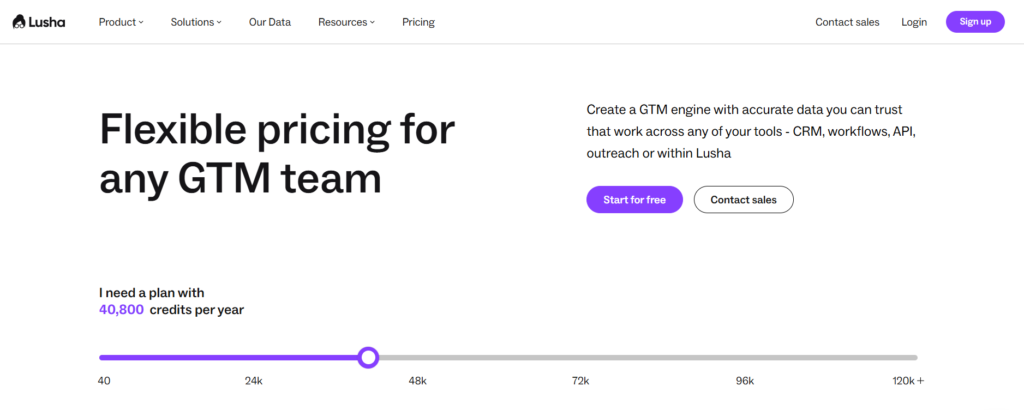
Lusha is a popular B2B contact-finding platform designed for speed and simplicity. It operates primarily through a browser extension that allows sales reps to instantly reveal verified emails and direct-dial phone numbers while browsing LinkedIn profiles or company websites. Its credit-based model makes it one of the best sales prospecting tools for teams that need quick access to contact data without a complex enterprise commitment.
Key Features
- Browser Extension: Reveals contact data directly on LinkedIn profiles and corporate websites.
- Credit-Based Data Reveals: Simple system for unlocking direct dials and verified work emails.
- List Building and Export: Create prospect lists within Lusha and export them to your CRM.
- CRM Integrations: Connects with popular platforms like Salesforce, HubSpot, and Pipedrive.
Pros and Cons
Pros: Very user-friendly and easy to deploy. Generous free plan for testing and small-scale use. High accuracy on direct-dial phone numbers.
Cons: Phone numbers consume more credits than emails. Database is less comprehensive than larger data providers.
Pricing and Access
Lusha offers a free starter plan with five monthly credits. Paid plans include Pro ($29/user/month), Premium ($51/user/month), and a custom Scale plan for large teams. Plans vary by the number of credits and access to features like bulk enrichment and CRM integrations. Access is gained by signing up and installing the Chrome extension.
Tactical Tips
- Use the free plan to test Lusha’s data quality in your specific niche before upgrading.
- Prioritize using credits on high-value prospects where a direct dial can make a significant impact.
- Combine Lusha’s contact data with website visitor tracking from Salespanel to know exactly when a prospect you’ve uncovered is actively browsing your site.
- Export small, targeted lists directly to your CRM to trigger automated outreach sequences immediately.
Lusha excels by removing friction from the contact discovery process. Its straightforward interface and reliable browser extension allow SDRs to enrich profiles in real time, making it a highly efficient tool for top-of-funnel activities.
Learn more at Lusha.
9. Cognism
Cognism is a global B2B sales intelligence platform renowned for its commitment to data compliance, particularly with GDPR and CCPA. It provides access to a massive database of contacts and companies, with a key differentiator in its phone-verified mobile numbers, known as Diamond Data®. This makes it one of the best sales prospecting tools for teams that prioritize accuracy and compliance in their outreach.
Key Features
- Diamond Data®: Manually phone-verified mobile numbers to ensure high connection rates
- Global B2B Database: Extensive contact and company data covering North America, EMEA, and APAC
- Intent and Technographic Data: Integrations with providers like Bombora to identify accounts actively in-market
- Compliance Engine: A robust framework to check contacts against global Do-Not-Call (DNC) lists
Pros and Cons
Pros: Strong emphasis on GDPR and CCPA compliance. High-quality, human-verified mobile data. Excellent live chat support and onboarding process.
Cons: Pricing is quote-based and not transparent. Full feature set depends on the purchased package.
Pricing and Access
Cognism does not list public pricing and operates on a custom quote model based on data access needs, user seats, and credit requirements. Access typically includes a structured onboarding program to ensure teams can effectively utilize the platform and its CRM integrations like Salesforce and HubSpot.
Tactical Tips
- Prioritize Diamond Data® contacts for outbound calling campaigns to maximize connect rates.
- Use the browser extension to enrich prospect profiles directly from LinkedIn or corporate websites.
- Build targeted lists using a combination of technographic and Bombora intent signals to find accounts with immediate needs.
- Filter prospect lists against DNC registries within the platform to maintain compliance, especially for EU and UK outreach.
Cognism’s unique value lies in its dual focus on data accuracy and international compliance. For sales teams running global campaigns where reliable mobile numbers and legal adherence are critical, it stands out as a powerful and trustworthy tool for building pipeline.
Learn more at Cognism.
10. Seamless.AI
Seamless.AI positions itself as a real-time B2B search engine designed to find verified cell phones, direct dials, and email addresses. Its core value is providing fresh contact data on demand, making it one of the best sales prospecting tools for teams that prioritize speed and immediate access to prospect information. The platform is built for rapid deployment and quick wins.
Key Features
- Real-Time Search Engine: Discovers contact and company data in real-time to reduce data decay.
- AI Assistant: An AI-powered “Researcher” helps automate list building and data discovery tasks.
- Data Enrichment and Intent: Optional add-ons provide deeper company insights, buyer intent signals, and job change alerts.
- Broad Integrations: Connects with popular CRMs like Salesforce, HubSpot, and outreach tools like Salesloft.
Pros and Cons
Pros: Quick to pilot with a functional free tier. Flexible add-ons allow the platform to scale with needs. Real-time search provides up-to-the-minute data.
Cons: Add-on features can significantly increase the total cost. Real-time search results benefit from manual validation.
Pricing and Access
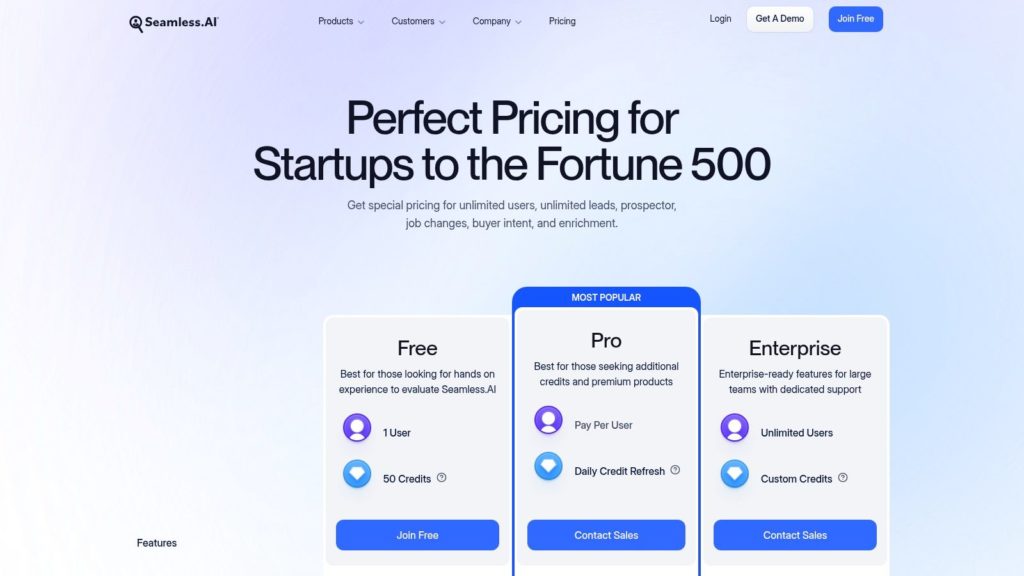
Seamless.AI offers four main plans: Free, Basic, Pro, and Enterprise. The free plan includes 50 credits. Paid plans unlock more credits, integrations, and features like job change alerts. Pricing for paid tiers is customized and requires a demo with their sales team for a quote.
Tactical Tips
- Use the free credits to validate data quality for your specific target market before committing.
- Build small, targeted lists with the real-time search and cross-verify high-value contacts.
- Integrate with your CRM to automate contact creation and prevent duplicate data entry.
- Combine the buyer intent data add-on with website visitor tracking from Salespanel to identify and prioritize accounts showing active interest.
This platform excels by offering a low-friction entry point for sales teams to access real-time data. Its modular design allows companies to start small and add advanced capabilities like intent data as their prospecting motion matures, securing its spot among the best sales prospecting tools for growing businesses.
Learn more at Seamless.AI.
11. UpLead
UpLead is a B2B lead intelligence platform focused on providing high-accuracy contact and company data. It delivers verified emails and direct-dial phone numbers, making it a reliable choice for SMBs and sales teams that prioritize data quality over sheer volume. This focus on validated information makes it one of the best sales prospecting tools for reducing bounce rates and improving connect rates.
Key Features
- Real-Time Email Verification: Guarantees 95% data accuracy on contact information at the point of export.
- Technographics and Advanced Filters: Identify prospects based on the technology they use, alongside firmographic data like revenue and employee count.
- Chrome Extension and API Access: Prospect directly from LinkedIn profiles and company websites or integrate UpLead data into custom workflows.
- Intent Data: Uncover companies actively searching for solutions like yours, available on higher-tier plans.
Pros and Cons
Pros: High data accuracy with a 95% guarantee. Simple, transparent credit-based pricing. User-friendly interface ideal for smaller teams.
Cons: Smaller overall database compared to enterprise data providers. Core team management features are limited to more expensive plans.
Pricing and Access
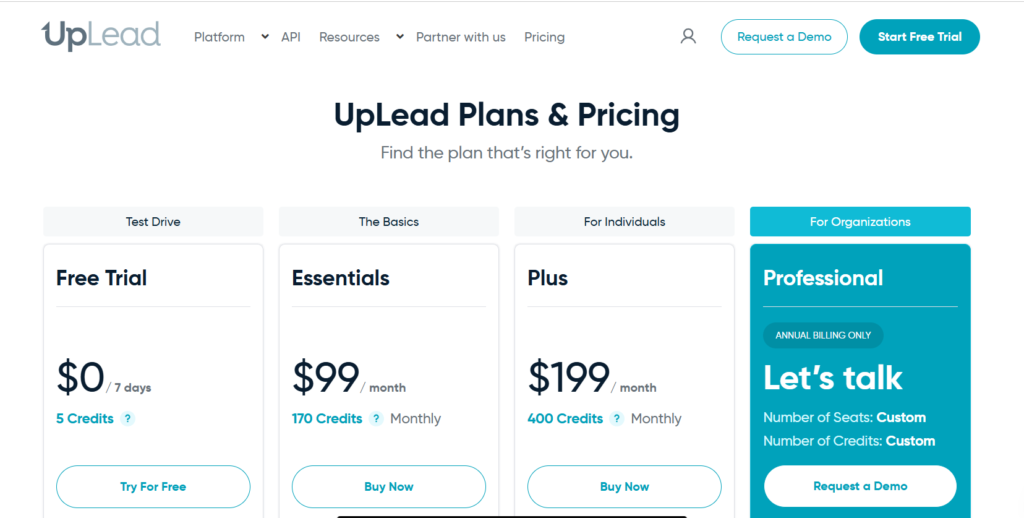
UpLead offers a free trial with 5 credits. Paid plans include Essentials ($74/month for 170 credits), Plus ($149/month for 400 credits), and Professional ($299/month for 1000 credits). All plans include CRM integrations, verified emails, and mobile numbers, with annual commitments offering additional credits.
Tactical Tips
- Use the Chrome Extension on a target company’s website to quickly find key decision-makers.
- Build lists using technographic filters to find users of a competitor’s software.
- Export targeted lists and enrich them with visitor tracking data from tools like Salespanel to prioritize outreach.
- Regularly check the intent data module to find in-market accounts before they publicly announce a need.
UpLead’s strength lies in its simplicity and commitment to data accuracy. It provides a straightforward, effective solution for sales teams needing reliable contact information without the complexity or cost of enterprise-grade platforms.
Learn more at UpLead.
12. Hunter.io
Hunter.io specializes in finding and verifying professional email addresses, making it a foundational tool for list building and outreach hygiene. Its straightforward interface allows users to quickly find contact information associated with any domain, individual, or bulk list. This focus on email accuracy makes it one of the best sales prospecting tools for teams prioritizing deliverability and direct contact.
Key Features
- Domain Search and Email Finder: Uncovers email patterns and verified contacts for any company website.
- Bulk Email Verifier: Processes large lists to scrub invalid addresses and improve deliverability rates.
- Campaigns Feature: A lightweight tool for sending simple, personalized email outreach sequences.
- Browser Extension and API: Chrome extension for on-the-fly prospecting and an API for custom integrations.
Pros and Cons
Pros: High accuracy with transparent confidence scores. Simple, affordable credit-based pricing. Excellent for ensuring data hygiene and deliverability.
Cons: Lacks phone number data. Outreach features are basic compared to dedicated sales engagement platforms.
Pricing and Access
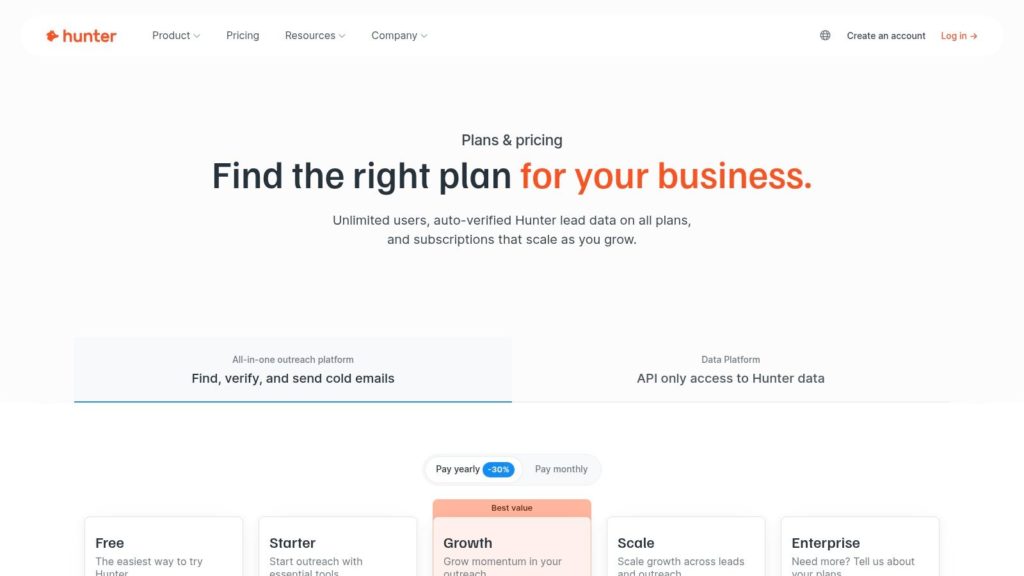
Hunter.io offers a free plan with 25 monthly searches. Paid plans start at $34/month for 500 searches and 1,000 verifications, scaling up based on usage needs. All tiers provide access to the core features, with higher plans offering more credits and premium support.
Tactical Tips
- Use the Bulk Email Verifier before launching any major campaign to reduce bounce rates.
- Install the Chrome extension to find contacts while browsing company websites or LinkedIn profiles.
- Leverage the API to integrate email verification directly into your lead capture forms.
- Combine Hunter’s verified emails with data from specialized email outreach tools to run more sophisticated campaigns.
Hunter.io earns its place by being an efficient and highly reliable source for B2B email data. It excels at the critical first step of prospecting: finding a valid way to contact a lead. While not an all-in-one platform, it perfectly complements broader sales stacks by ensuring outreach efforts are built on a foundation of accurate data.
Learn more at Hunter.io.
Top 12 Sales Prospecting Tools Comparison
| Product | Core features | Target audience | Unique selling points | Pricing & value |
|---|---|---|---|---|
| Salespanel (Recommended) | Server-side tracking, consent management, identity resolution, AI prospecting, lead scoring | B2B Marketing Managers, Sales Ops, Prospecting teams, Privacy/Compliance, Digital Analysts | Privacy-first high-fidelity visitor intelligence; AI-driven prospecting; deep resource hub | Contact for pricing; positioned for privacy-first, enterprise-grade value |
| LinkedIn Sales Navigator | Advanced lead/account search, alerts, InMail, TeamLink | SDRs, AEs, social sellers | Native professional graph and in-network engagement | Seat-based subscriptions; effective ROI for social selling, can be costly at scale |
| ZoomInfo SalesOS | Large B2B database, direct dials, intent signals, enrichment | Enterprise sales, RevOps, ABM teams | Deep dataset, intent insights, Ops/enrichment ecosystem | Quote-based pricing; strong for high-volume outbound and account planning |
| Apollo.io | B2B database, sequences, dialer, CRM integrations, analytics | SMBs and mid-market SDR/AE teams | All-in-one prospecting + engagement with public pricing | Transparent pricing, free tier/credits; good cost-to-value for small teams |
| HubSpot Sales Hub | CRM-native prospecting, sequences, calling, pipelines, analytics | Teams wanting unified CRM + sales/marketing stack | Excellent usability, onboarding, large app marketplace | Free to Enterprise tiers; advanced features/onboarding cost extra |
| Outreach | Multichannel sequences, analytics, integrated dialer, CRM sync | Complex sales orgs, enterprise RevOps | Mature governance, deep analytics and process controls | License pricing negotiated; annual contracts and implementation effort |
| Salesloft | Sequencing, dialer, conversation intelligence, CRM sync | Mid-market and enterprise sales teams | End-to-end revenue orchestration with strong security/governance | Quote-based pricing; best ROI when multiple modules enabled |
| Lusha | Email & phone reveals, Chrome extension, CRM sync, credits model | Reps using LinkedIn/company sites, SMB teams | Simple credit model and easy free plan test | Credit-based pricing with free plan; phone reveals cost more credits |
| Cognism | Global contacts, phone-verified “Diamond Data”, technographics, compliance | Global teams requiring verification and EU/UK compliance | Compliance-forward data, phone verification, fast onboarding support | Quote-based pricing; feature availability varies by region/package |
| Seamless.AI | Real-time contact search, enrichment, AI assistant, integrations | Growth teams, quick pilots, SDRs | Real-time discovery and flexible add-ons | Free tier available; add-ons can raise total cost |
| UpLead | Verified emails/phones, technographics, bulk export, CRM integrations | Small teams, SMBs needing reliable leads | Transparent pricing, validated data, simple credit access | Transparent, SMB-friendly plans and credit model |
| Hunter.io | Email finder, bulk verification, domain search, API | List builders, deliverability engineers, marketers | Affordable verification and deliverability hygiene tools | Affordable monthly/annual plans; email-first (no phone focus) |
Your Takeaway: Prospecting Is Now a Data Science Discipline
Navigating the landscape of modern B2B sales can feel like assembling a complex puzzle. After reviewing a dozen of the best sales prospecting tools, from comprehensive platforms like ZoomInfo and HubSpot to specialized solutions like Lusha and Hunter.io, a central theme emerges with undeniable clarity: prospecting has fundamentally transformed. It is no longer an art form mastered through charisma alone; it is a science, meticulously executed with data.
The era of high-volume, low-information outreach is definitively over. Success today and in the coming years is not about having the longest contact list. It’s about having the smartest one, enriched with behavioral data, buying intent signals, and a deep understanding of your prospect’s journey before the first email is even sent. The tools we’ve explored are not just digital rolodexes; they are sophisticated engines designed to turn raw data into actionable intelligence.
Shift Your Mindset: From Tools to Strategy
The most crucial takeaway is the need for a mental shift. Instead of searching for a single “silver bullet” tool that promises to solve all your prospecting challenges, your focus should be on building a cohesive, data-driven strategy. This strategy forms the foundation, and the tools are the essential components you layer on top to execute it effectively. Your tech stack should not be a random collection of subscriptions; it should be an integrated ecosystem where data flows seamlessly from one stage to the next, empowering your sales team at every touchpoint.
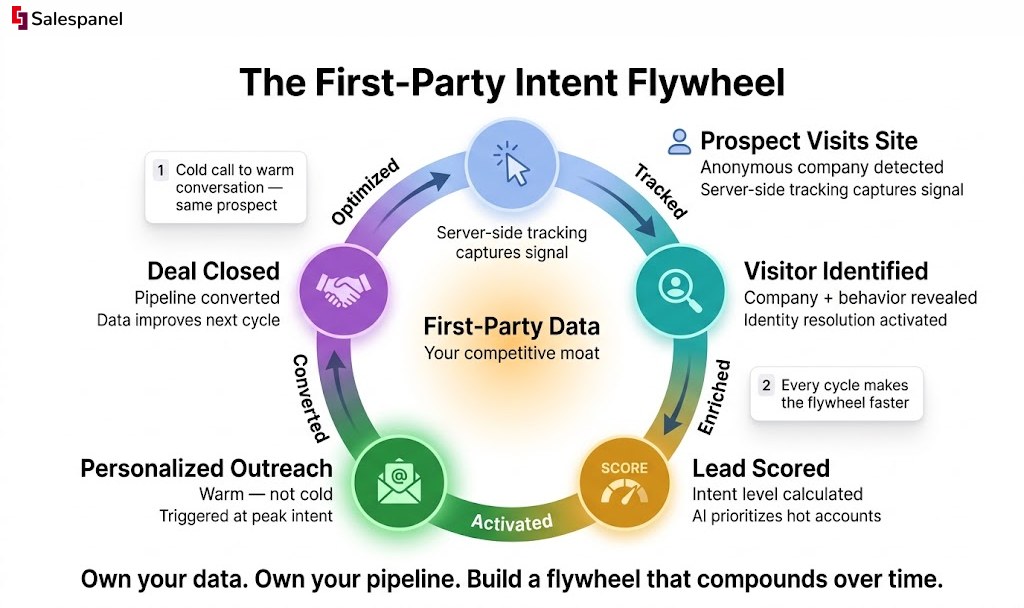
This strategic approach begins with a critical question: Where is your most valuable, yet often overlooked, source of high-intent leads? The answer is your own website. The anonymous companies visiting your pages, exploring your pricing, and reading your case studies are not just traffic; they are future customers signaling their interest.
The Foundation: First-Party Intent Data
Building a robust prospecting engine starts with capturing and activating this foundational data layer. The philosophy at Salespanel is built around this principle: unlocking the value of first-party intent. By leveraging privacy-compliant website visitor tracking, you can de-anonymize the companies actively researching your solution. This transforms your entire prospecting motion from reactive to proactive and from cold to warm.
Consider these practical implications:
- Prioritization: Instead of guessing which accounts from a static list to target, Salespanel’s lead scoring framework allows your sales team to prioritize outreach to companies that have already demonstrated interest by visiting your site. This is the difference between a cold call and a timely, relevant conversation.
- Personalization: Knowing which pages a prospect from a target account has viewed allows for hyper-personalized messaging. You can reference their specific interests, address their likely pain points, and align your value proposition with their demonstrated needs.
- Efficiency: A focus on high-intent, inbound-aware prospects dramatically improves connect rates and reduces the time wasted on unqualified leads. Your team spends less time searching and more time engaging in meaningful sales conversations.
Ultimately, the best sales prospecting tool for your organization is the one that best integrates into a coherent data strategy. Whether you choose an all-in-one platform like Apollo.io or a specialized data provider like Cognism, its effectiveness will be magnified when powered by a real-time stream of high-intent signals from your own digital properties. The journey from raw data to signed contracts begins with capturing the highest quality data possible, right from your own front door.
Ready to turn your website visitors into your best prospects? See how Salespanel identifies anonymous company traffic and tracks buyer intent to fuel your sales pipeline with warm, sales-ready leads. Explore our resources to learn how to build a data-first prospecting strategy today.