In a business landscape awash with data, the line between insight and chaos is governance. For years, organizations relegated data management to the IT department—a reactive fix when a report went wrong or a compliance auditor came knocking. That era is definitively over. The future belongs to companies that treat data not as a byproduct, but as their most critical strategic asset. Implementing data governance today is the central theme of that transition; it’s the formal framework of policies, roles, and processes that ensures your data is accurate, secure, and ready to drive innovation.
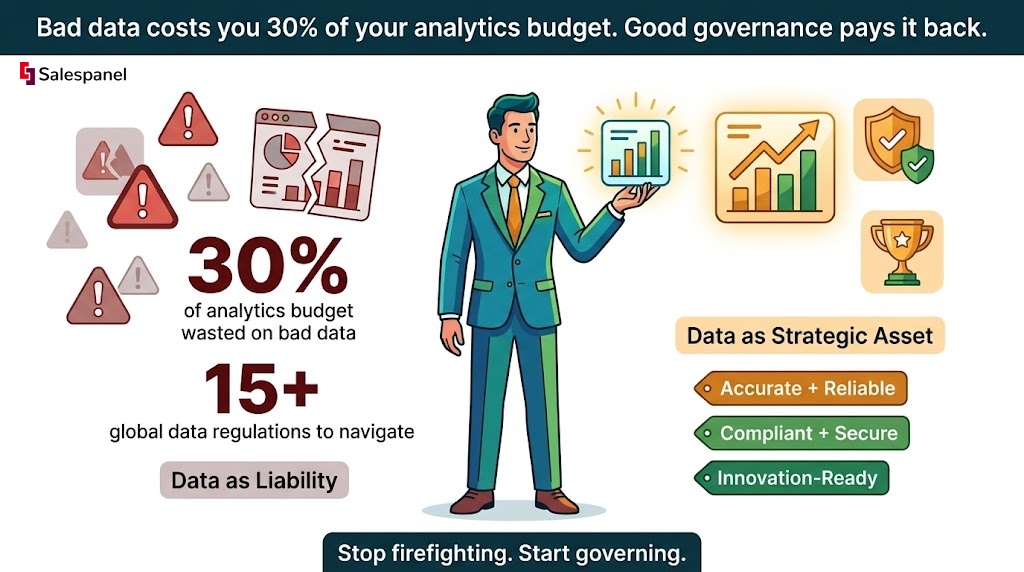
The stakes have never been higher. Bad data isn’t just an inconvenience; it’s a massive financial drain. Research shows organizations waste a staggering 30% of their analytics budget just cleaning up and validating poor-quality data. Simultaneously, businesses are navigating a tangled web of over 15 global data regulations. Attempting this without a formal governance structure is like sailing into a storm without a rudder. This guide provides a practical, technical roadmap to move beyond firefighting and build a data governance program that unlocks real competitive advantage.
Why Data Governance Is Your New Competitive Edge
Implementing data governance isn’t merely about dodging fines; it’s a core business strategy that directly impacts market leadership, operational efficiency, and the ROI of your technology investments. Without it, trust in data erodes, decisions slow down, and strategic initiatives like AI and machine learning are built on a foundation of sand.
The challenge is only getting tougher. The old ways of managing data are failing because the complexity and volume of information have exploded. Businesses need a systematic approach to ensure the data fueling their decisions is reliable and compliant.
Before diving into the “how-to,” it’s helpful to see the big picture. These are the foundational components that every effective data governance program is built upon.
The Core Pillars of a Modern Data Governance Program
| Pillar | Objective | Key Activities |
|---|---|---|
| Data Quality | Ensure data is accurate, complete, and consistent. | Data profiling, cleansing, validation rules, monitoring dashboards. |
| Data Security | Protect data from unauthorized access and breaches. | Access controls, encryption, data masking, threat monitoring. |
| Data Stewardship | Assign ownership and accountability for data assets. | Defining data stewards, establishing roles & responsibilities. |
| Policy & Standards | Create clear rules for how data is managed and used. | Drafting data policies, defining data standards, creating glossaries. |
| Compliance & Privacy | Adhere to legal, regulatory, and ethical requirements. | Data mapping for regulations (GDPR, CCPA), privacy impact assessments. |
| Metadata Management | Document data lineage, definitions, and business context. | Building a data catalog, tracking data lineage, creating a business glossary. |
These pillars aren’t just theoretical concepts; they are the active ingredients that make your data reliable, secure, and ready to use. This transformation is the central theme we will explore: turning data from a liability into a strategic asset.
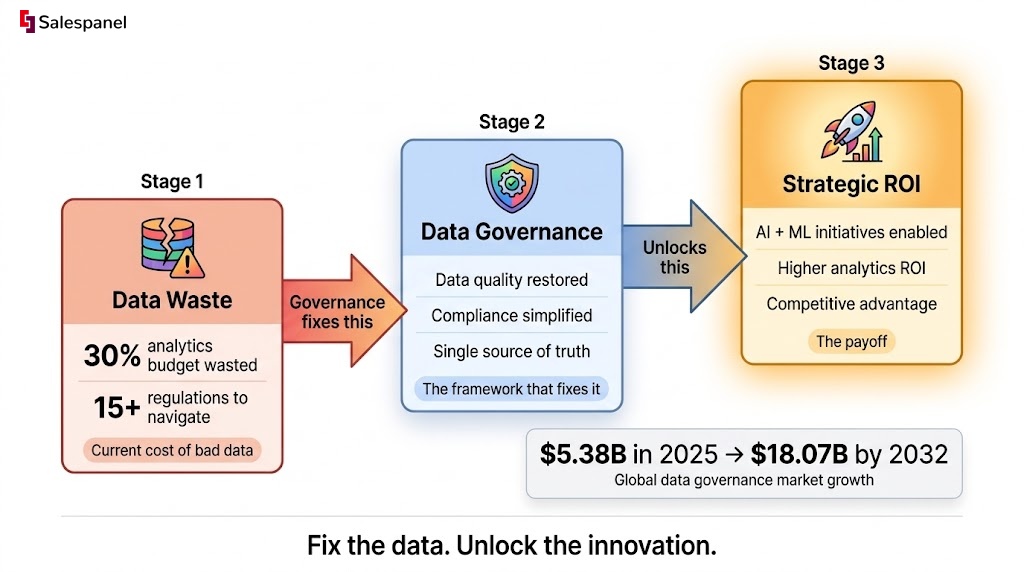
This infographic breaks down the journey from quantifying data waste and navigating those regulations to actually unlocking a significant return on your tech investments.
As you can see, there’s a direct line from fixing data quality and compliance issues to getting a much higher ROI on strategic initiatives like AI. This shift is what’s fueling the market’s explosive growth, with projections estimating the global data governance market will jump from $5.38 billion in 2025 to $18.07 billion by 2032. You can discover more projections on the data governance market growth to see just how big this is becoming.
Ultimately, data governance transforms data from a potential liability into your most valuable strategic asset. It’s not about locking things down; it’s about empowerment. It’s about ensuring the information fueling your business is reliable, compliant, and ready to drive real innovation.
When you build a solid foundation of trustworthy data, you create the perfect conditions for sustainable growth and a real competitive advantage. The rest of this guide will give you a practical roadmap to build that foundation, step by step.
Building Your Data Governance Framework
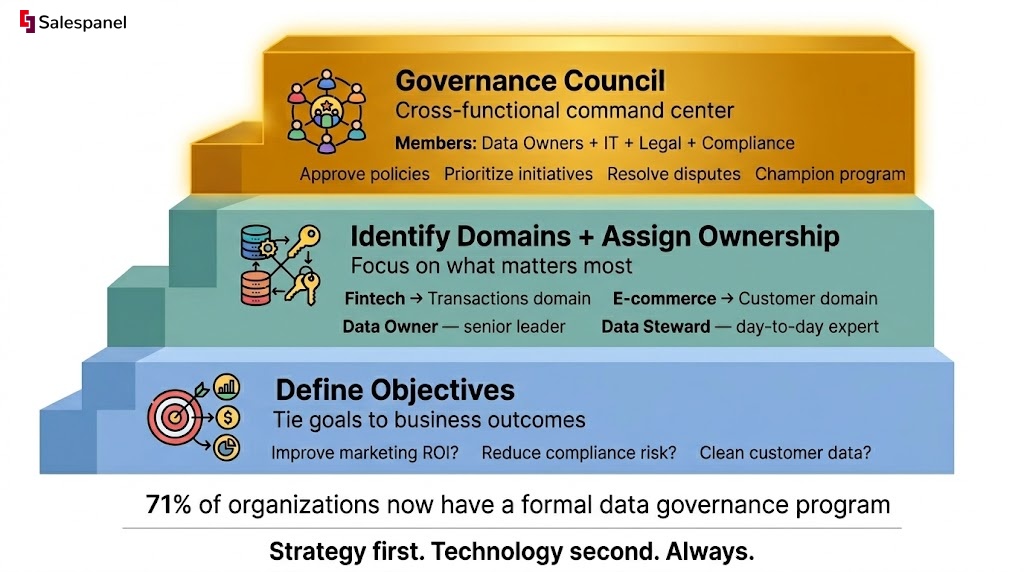
A successful data governance program is a strategic, business-led initiative, not a software purchase. The first step is to move from abstract theory to practical execution by defining objectives tied directly to business goals. Are you trying to improve marketing ROI by cleaning up customer data, or is the priority reducing compliance risk in financial reporting? Your objectives will dictate which data is most critical to govern first, allowing you to gain early momentum and prove the program’s value.
Identify Domains and Assign Ownership
With clear goals, you must pinpoint the critical data domains that support them. A data domain is a high-level category of data, such as “Customer,” “Product,” “Supplier,” or “Employee.” Resist the urge to govern everything at once. Focus only on the domains directly impacting your key objectives. This focus is your primary takeaway for this section.
Practical examples validate this approach:
- A fintech company will almost certainly prioritize the “Transactions” domain. This requires standardizing transaction codes, ensuring data accuracy for fraud detection, and maintaining clear data lineage for regulatory audits.
- An e-commerce brand will likely focus on the “Customer” domain. The objective is to create a single, unified view by merging data from the CRM, website, and marketing platforms to power personalization and enhance customer service.
This laser-focused approach is catching on, with 71% of organizations now having a formal data governance program in place. The top reported benefits are better analytics quality (58%) and enhanced data accuracy (58%), underscoring the value of a structured plan. You can read the full research on data governance adoption to see how other businesses are finding success.
Once domains are identified, assign clear ownership. This is not just an IT task. Data Owners should be senior business leaders accountable for the quality and use of data within their domain. They are supported by Data Stewards, the subject matter experts responsible for day-to-day management, defining rules, and resolving quality issues.
Assemble a Cross-Functional Council
To provide authority to your framework, assemble a cross-functional data governance council. This group acts as the command center and should include Data Owners, key business stakeholders, and representatives from IT, legal, and compliance.
The council’s primary functions are to:
- Approve data policies and standards.
- Prioritize governance initiatives.
- Resolve cross-departmental data disputes.
- Champion the program across the entire organization.
A governance council acts as the central nervous system for your framework. It ensures that decisions are made collaboratively and are aligned with the broader business strategy, preventing the initiative from becoming siloed within one department.
This structure transforms data governance from a restrictive, IT-led project into a business-driven program that empowers the organization. By starting with a clear blueprint—defining objectives, assigning ownership, and establishing a governing body—you create a foundation that is built to last and deliver tangible results.
Crafting Policies That Actually Work
With your framework in place, it’s time to establish the rules. A well-crafted policy is not a bureaucratic rulebook; it’s a practical guide that empowers employees to handle data correctly and confidently. Effective policies are specific and set clear expectations for how data should be handled, forming the “what” and “why” of your program.
For policies to be enforceable, they must be supported by standards (the specific criteria data must meet) and procedures (the step-by-step instructions for implementation). The key takeaway here is that a policy without standards and procedures is merely a suggestion, destined to be ignored.
This distinction is technically critical. Consider this practical example:
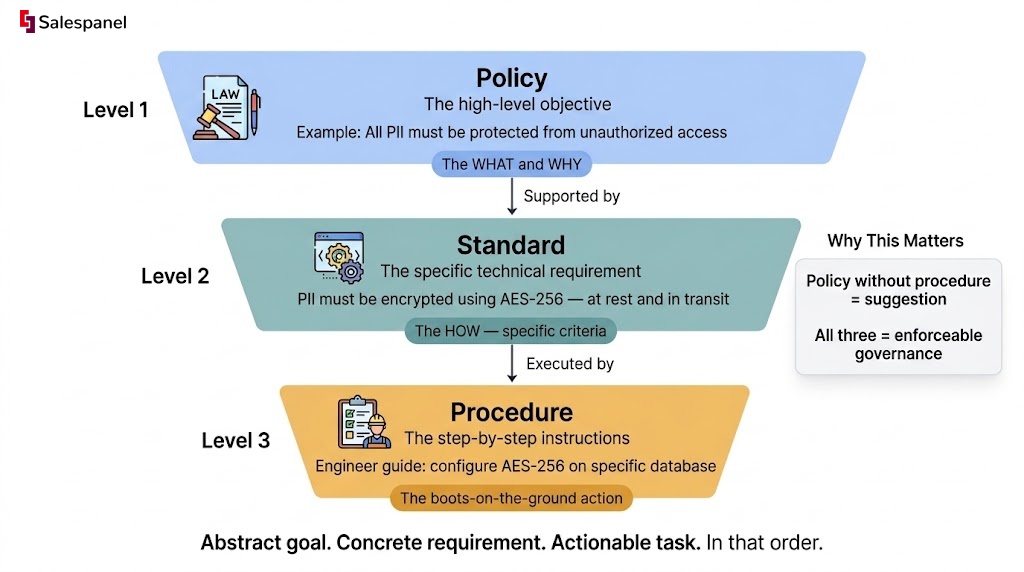
- Policy: “All Personally Identifiable Information (PII) must be protected from unauthorized access.” (The high-level objective).
- Standard: “PII must be encrypted using AES-256 encryption, both at rest and in transit.” (The specific technical requirement).
- Procedure: A detailed, numbered guide for an engineer explaining exactly how to configure AES-256 encryption on a specific database. (The boots-on-the-ground instructions).
This progression moves from an abstract goal to an actionable task, making governance tangible and real.
From Principles to Practical Rules
Your next task is to translate high-level governance principles into tangible, everyday rules. This involves defining clear standards for critical aspects of data management. A practical starting point is defining data quality attributes with concrete metrics. For instance, a “timeliness” standard for sales data might be that 95% of all new lead records must be entered into the CRM within 24 hours of initial contact. This makes an abstract concept measurable.
You also need to establish data security classifications. A tiered system—such as Public, Internal, Confidential, and Restricted—is a common and effective approach. This framework dictates handling procedures based on data sensitivity, ensuring the marketing team can share public content freely while HR rigorously protects employee PII. This becomes increasingly complex for global companies. While 98 out of 109 surveyed countries have data protection laws, only 46% offer robust protections, creating a patchwork of compliance requirements. You can discover more insights about global data governance laws to see what this entails.
A Practical PII Policy Example
Let’s walk through an effective policy for handling customer PII that any employee can understand and follow. The policy would begin by clearly defining what your company considers PII (e.g., name, email, phone number, IP address). Then, it would establish specific standards:
- Access Control: Access to raw PII is limited to specific job roles and requires a documented request approved by the data owner.
- Data Minimization: Only collect PII that is absolutely necessary for a clearly stated business purpose. Prohibit “just in case” data collection.
- Retention: PII will be automatically anonymized or deleted after 24 months of customer inactivity.
When you create policies that are clear, concise, and directly linked to operational procedures, you build a culture of shared responsibility. Good governance becomes the path of least resistance, making it easy for everyone to do the right thing with data.
Choosing and Integrating Your Governance Tech Stack
Technology enables your data governance strategy; it does not define it. With your framework and policies established, the next step is to select tools that bring them to life. This is not about acquiring the latest technology but making pragmatic choices that align with your business goals and existing workflows.
The market is crowded, but most governance tech stacks are built around a few core categories. A technical understanding of each is key to avoiding redundant software and making informed investments.
Core Tool Categories
Evaluate tools based on how they solve the specific problems you defined in your framework, not on a vendor’s feature checklist. Here are the main categories:
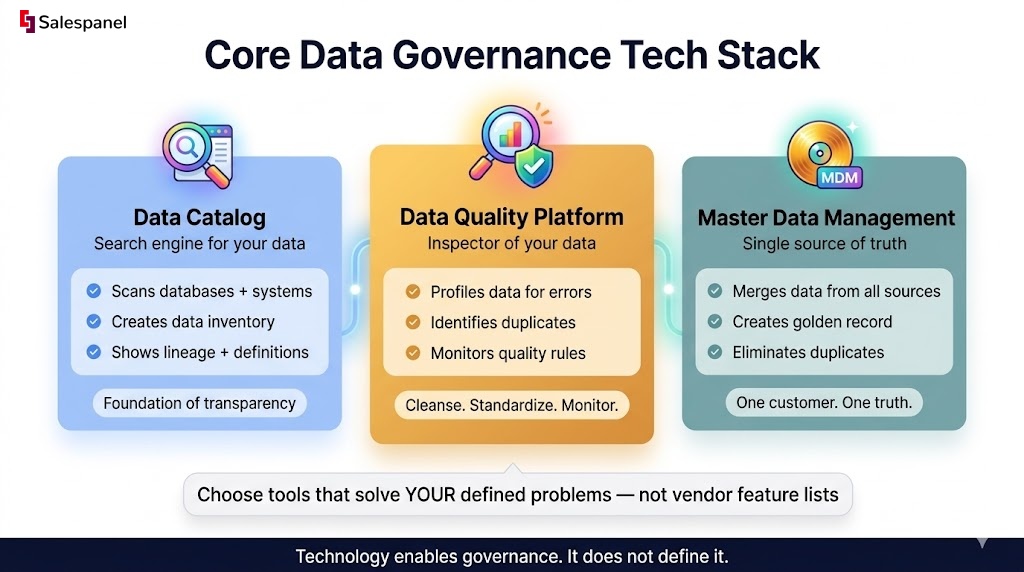
- Data Catalogs: These function as a search engine for your company’s data. They scan databases and systems to create an inventory, helping users discover data, understand its lineage, and find its business definition. They are the foundation of data transparency.
- Data Quality Platforms: These tools act as inspectors. They profile data to identify errors, inconsistencies, and duplicates, then provide the means to cleanse, standardize, and monitor data quality against your defined rules.
- Master Data Management (MDM): MDM tools establish the definitive source of truth for critical data domains like “Customer” or “Product.” They create a single “golden record” by merging and deduplicating information from various sources, ensuring universal consistency.
Preventing Garbage In, Garbage Out
A common mistake is treating governance as a reactive cleanup crew. This is inefficient and expensive. The most effective programs ensure data quality at the source—the moment of creation. This “shift-left” approach embeds governance directly into daily workflows. Your takeaway is to prioritize proactive quality control over reactive cleanup.
Consider the data from your website, the first touchpoint for new leads. If this initial data is inaccurate or non-compliant, the problem will cascade through your entire ecosystem, from the CRM to analytics platforms. This is where Salespanel’s philosophy of capturing high-quality data from the very beginning aligns perfectly with a proactive governance model.
The real win in data governance comes from making compliance and quality the path of least resistance for your teams. Technology should make it easier to do the right thing, not harder.
Integrating tools at the point of data entry is a game-changer. For example, using first-party Website visitor tracking from Salespanel ensures that lead data flowing into your funnels is clean, consented, and accurate from the start. By capturing high-quality data at the source, you reduce the burden on downstream systems and eliminate the classic ‘garbage in, garbage out’ problem. This proactive integration provides a solid foundation for your governance efforts, making your entire data ecosystem more reliable and trustworthy.
Driving Adoption and Proving Your ROI
A perfectly designed data governance framework is useless if no one follows it. Once policies are written and technology is implemented, the critical human element begins. Driving adoption requires change management, clear communication, and demonstrating tangible value. Without genuine buy-in, your initiative will be perceived as another layer of corporate bureaucracy.
To win over stakeholders, you must connect governance to their daily realities. The central theme here is shifting the perception of governance from a restrictive chore to a powerful enabler that makes their jobs easier. This is the crucial takeaway: frame governance in terms of benefits, not rules.
From Compliance to Empowerment
The key to company-wide adoption is translating abstract policies into concrete, department-specific benefits. You must answer the “What’s in it for me?” question for every employee, from the C-suite to the front lines. Training should be practical and use their language.
A practical example of this approach:
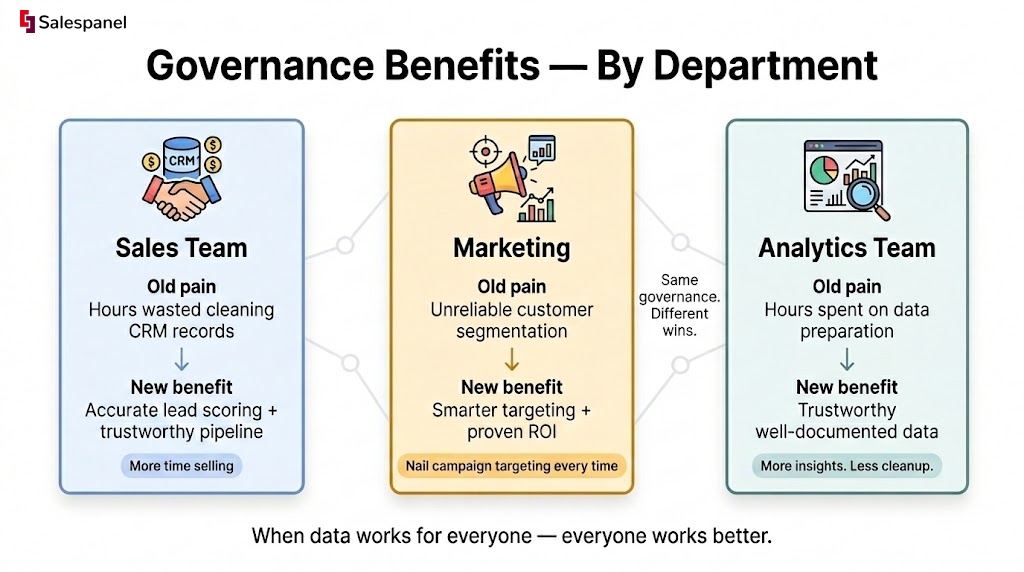
- For the Sales Team: Don’t talk about “data standardization.” Talk about eliminating hours wasted cleaning messy CRM records. The benefit is more accurate lead scoring and a trustworthy pipeline.
- For the Marketing Department: Frame governance as the key to reliable customer segmentation. The benefit is smarter campaign targeting, true personalization, and a clear path to proving ROI.
- For the Analytics Team: The benefit is “trustworthy, well-documented data.” This means less time on data preparation and more time generating insights.
This approach transforms governance from an IT-led burden into a business-led advantage. When teams see how good data helps them achieve their targets, adoption becomes a natural outcome.
Defining and Tracking KPIs
To maintain momentum and secure long-term investment, you must prove that your data governance program is a value driver, not a cost center. This means moving beyond operational metrics (e.g., number of policies written) to KPIs that demonstrate tangible business impact.
The ultimate goal is to connect every governance activity to a bottom-line result. By quantifying the cost of poor data before you start and tracking improvements over time, you build an undeniable business case for the program’s continuation and expansion.
Your KPIs should be clear, measurable, and directly tied to the initial problems you set out to solve.
Key Metrics for Measuring Data Governance ROI
| Metric Category | Example KPI | Business Impact |
|---|---|---|
| Operational Efficiency | Reduction in time spent on manual data reconciliation. | Frees up employee time for higher-value activities, reducing operational costs. |
| Revenue Growth | Increase in lead conversion rates due to improved data quality. | Directly links governance to sales effectiveness and top-line revenue growth. |
| Cost Reduction | Decrease in marketing spend on campaigns targeting duplicate or invalid contacts. | Demonstrates tangible savings and more efficient use of the marketing budget. |
| Risk Mitigation | Reduction in data-related compliance fines or audit findings. | Proves the program’s value in protecting the company from financial and reputational damage. |
By consistently tracking these metrics and sharing the results with stakeholders, you create a powerful feedback loop. This not only justifies the initial investment but also builds the political capital needed to embed data governance into your company’s culture, turning a project into a lasting strategic asset.
Got Questions? We’ve Got Answers.
When implementing a new data governance program, many questions arise. Below are answers to common hurdles teams face, serving as a practical guide to avoid typical pitfalls.
Where Should We Start with Limited Resources?
Start small, but aim for a big impact. Do not try to govern everything at once. Select one critical data domain that is causing significant business pain—for many, this is “customer data.” Focus all initial efforts on that single domain. Define ownership, establish a few non-negotiable quality rules, and create a simple data dictionary. A quick, focused win provides tangible proof of value, making it easier to secure the budget and buy-in needed for expansion. A successful pilot project is your most powerful tool.
How Do You Get Business Users to Care About Governance?
Make it about them. Stop using abstract terms like “policies” and “compliance.” Instead, communicate how governance solves their daily frustrations and helps them achieve their goals. When you connect governance directly to their work, they move from mere compliance to active ownership.
Frame the benefits in their language:
- For Marketing: “Nail your campaign targeting every time.”
- For Sales: “Spend less time cleaning up CRM records and more time selling.”
- For Finance: “Pull reports you actually trust in minutes, not hours.”
What’s the Difference Between Data Governance and Data Management?
This is a frequent point of confusion. A practical analogy clarifies the distinction:
Think of data governance as the city council. It is the strategic body that creates the laws, sets policies, and establishes the overall framework for data. It answers the question: What should be done?
Data management, in contrast, is the city’s public works, police, and sanitation departments. These are the operational teams executing and enforcing those laws daily—handling data storage, security, and integration. In short, governance is the strategy; management is the execution.
The bottom line is this: Data governance sets the rules of the road for your data. Data management is everything you do to drive on those roads safely and efficiently. You absolutely need both for a healthy data ecosystem.
By addressing these common questions proactively, you build a more resilient data governance program. Each question is an opportunity to clarify purpose and align everyone toward the central theme: transforming data into a reliable strategic asset.
At Salespanel, we believe great governance is built on a foundation of high-quality data right from the source. Our platform helps you capture clean, compliant, and ready-to-use B2B data from the very first touchpoint. This gives your governance framework the rock-solid start it needs to succeed. To see how our tools can support your strategy, explore our resources here.