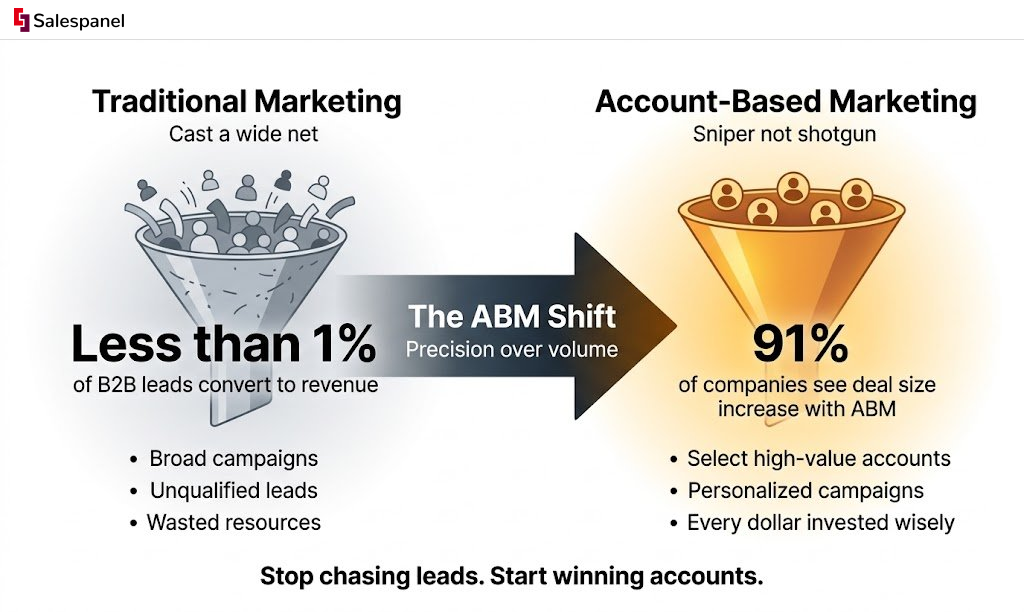
For decades, B2B marketing operated on a volume-based premise: cast a wide net with broad campaigns and sift through the catch for qualified leads. This model is now failing. According to Forrester, less than 1% of B2B leads ever convert into revenue-generating customers, a statistic that signals a fundamental inefficiency in the traditional demand generation funnel. This approach wastes significant resources engaging audiences with no purchase intent, a problem that Account-Based Marketing (ABM) is engineered to solve. Looking forward, the future of B2B engagement is not about generating more leads, but about generating the right engagement within a select group of high-potential accounts.
ABM inverts the classic marketing funnel. It begins not with a broad audience, but with a meticulously selected list of high-value target accounts. From there, marketing and sales teams collaborate to orchestrate highly personalized, multi-channel campaigns designed to engage key decision-makers within those accounts. This strategic precision ensures that every marketing dollar and sales hour is invested where it can yield the highest return. The business case is compelling: according to the ABM Leadership Alliance, 91% of companies implementing ABM increase their average deal size, with a quarter of those seeing it more than double. This is not a theoretical shift; it is a proven revenue driver.
This article provides a deep, technical analysis of real-world account based marketing examples, moving beyond theory to dissect the precise strategies, technologies, and tactical plays that leading companies have used to win and expand major accounts. For each case study, you will receive:
- A breakdown of the campaign objectives and target account selection criteria.
- An analysis of the specific marketing and sales plays executed.
- A review of the measurable results and critical business impact.
- Actionable takeaways you can adapt to your own ABM initiatives.
By exploring these detailed examples from companies like GumGum, Snowflake, and Adobe, you will gain a practical playbook for executing high-performance ABM programs that deliver measurable growth. The central theme is clear: success in modern B2B marketing is achieved through precision, personalization, and strategic alignment.
1. GumGum’s ‘T-Rex’ Campaign for Target Account Takeover
When your target is a massive, market-leading company like Salesforce, standard outreach tactics are often dead on arrival. GumGum, an artificial intelligence company specializing in contextual intelligence, understood this challenge and orchestrated one of the most creative and memorable account based marketing examples in recent history. Their goal was simple yet audacious: secure a meeting with Salesforce, a notoriously difficult account to penetrate.
The campaign centered around a quirky and unforgettable character: a T-Rex. This wasn’t just a digital mascot; it was a multi-channel, hyper-personalized blitz designed to build brand affinity and drive a single, high-value action. The campaign demonstrates how audacious creativity, when backed by solid strategy, can break through the noise and capture the attention of even the most sought-after enterprise accounts.
Strategic Breakdown: How GumGum Captured Salesforce’s Attention
GumGum’s approach was a masterclass in combining high-impact physical marketing with targeted digital follow-up. They didn’t just send an email; they created an experience.
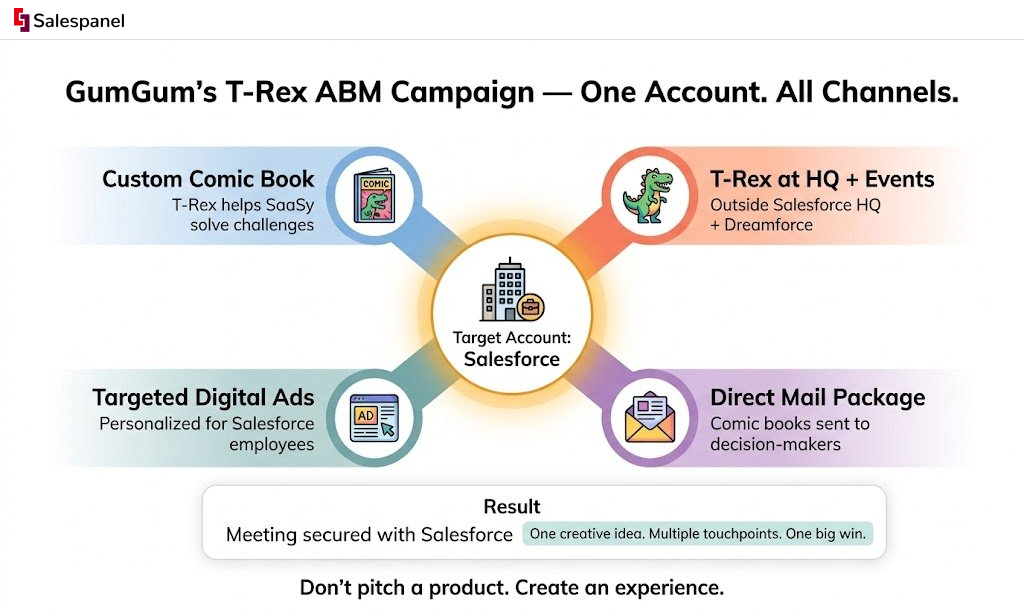
- The Comic Book: The campaign’s flagship asset was a custom comic book series. The hero was a T-Rex who helped Salesforce’s actual mascot, “SaaSy,” solve business challenges using GumGum’s technology. This was a practical example of aligning with the target’s brand culture, making the outreach feel familiar and welcome.
- The T-Rex in Real Life: GumGum took the character offline by creating a full-scale T-Rex costume. A GumGum employee dressed as the dinosaur and appeared outside Salesforce’s headquarters and at industry events like Dreamforce, creating a spectacle that was impossible to ignore. This physical activation generated significant social media buzz.
- Multi-Channel Execution: The physical elements were supported by a robust digital strategy. They launched targeted digital ads and personalized landing pages specifically for Salesforce employees, ensuring that once intrigued, the target audience had a clear path to learn more.
- Direct Mail: Key decision-makers at Salesforce received direct mail packages containing the personalized comic books and other branded merchandise, ensuring the message landed directly on their desks.
Key Strategic Insight: GumGum didn’t sell a product; they sold a story. By creating a character and narrative that resonated with Salesforce’s company culture, they transformed their outreach from a cold pitch into a memorable and engaging brand interaction.
Actionable Takeaways and Replicable Strategies
While not every company can afford a T-Rex costume, the underlying principles of GumGum’s campaign are highly replicable. This is a prime example of why ABM is so effective when executed with precision.
- Deep-Dive Account Research: The campaign’s success hinged on GumGum’s understanding of Salesforce’s culture, including its mascots and playful branding. Before launching a creative ABM play, invest time in researching your target account’s values, recent news, and brand personality.
- Integrate Physical and Digital: The T-Rex costume created buzz, but the personalized landing pages and digital ads captured the leads. A successful ABM campaign creates a seamless experience across multiple touchpoints, both online and offline.
- Secure Executive Buy-In: A high-investment, high-creativity campaign requires support from the top. GumGum’s leadership, including former CMO Phil Ranta, backed the unconventional idea, which was crucial for its execution.
- Align Sales and Marketing: This campaign required flawless coordination. The sales team needed to be ready to follow up the moment the marketing efforts generated a response. This alignment ensures that creative buzz translates into tangible business opportunities.
2. Snowflake’s Industry-Specific Content Hubs for Enterprise Accounts
In a crowded B2B SaaS market, generic messaging gets ignored. Snowflake, the cloud data platform giant, recognized that speaking the specific language of its enterprise targets was non-negotiable. Instead of a one-size-fits-all approach, they pioneered the use of highly specialized content hubs, creating a masterclass in scalable personalization and one of the most effective account based marketing examples for engaging distinct industry verticals.
This strategy moves beyond simple personalization like adding a name to an email. It involves building entire digital ecosystems tailored to the unique pain points, regulatory environments, and business objectives of key industries like financial services, healthcare, and retail. By doing so, Snowflake demonstrates a deep understanding of its target accounts’ worlds, transforming its value proposition from a general tool into an indispensable industry-specific solution.
Strategic Breakdown: How Snowflake Built a Hyper-Relevant Content Machine
Snowflake’s approach was to create a “choose your own adventure” experience for its high-value accounts, guiding them to content that felt custom-built for their needs. This built trust and accelerated the sales cycle by answering critical questions before they were even asked.
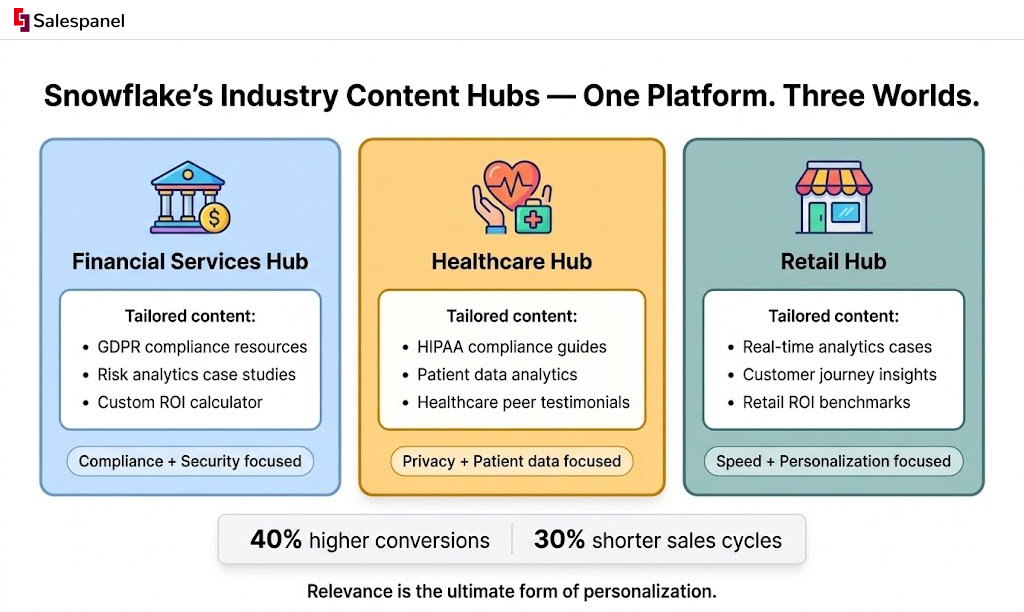
- Industry-Specific Microsites: The core of the strategy was creating dedicated microsites or content hubs for each target vertical. A hub for financial services would feature compliance-focused case studies and GDPR resources, while the healthcare hub would highlight HIPAA compliance and patient data analytics.
- Tailored Use Cases and Testimonials: Each hub showcased customer success stories from within that same industry. A retail prospect would see how a company like theirs used Snowflake for real-time analytics, making the benefits tangible and immediately relatable. This is a practical method for building social proof within a niche.
- Custom ROI Calculators: To move prospects from interest to evaluation, Snowflake included interactive elements like ROI calculators. These tools were tuned with industry-specific benchmarks, allowing a user to input their own data and see a personalized projection of the financial impact.
- Personalized Landing Pages: For their most strategic, named accounts (e.g., a Fortune 500 company), Snowflake would create bespoke landing pages. These pages would often reference the target company’s industry peers, showcasing a clear understanding of their competitive landscape.
Key Strategic Insight: Snowflake proved that relevance is the ultimate form of personalization. By investing in content that addressed the specific operational realities and compliance burdens of each industry, they built credibility and positioned themselves not just as a vendor, but as a strategic partner.
Actionable Takeaways and Replicable Strategies
The principle of building industry-specific content hubs is highly adaptable for any B2B company targeting distinct market segments. This approach shows why a deep, narrow focus is a powerful ABM tactic.
- Start with Deep Industry Research: Success depends on genuine expertise. Before building, conduct thorough research into your target industry’s trends, regulations, and unique challenges. Interview existing customers in that vertical to gather authentic pain points and success stories.
- Use Dynamic Content for Scalability: You don’t need a hundred different websites. Use dynamic content technology on your main site to personalize sections based on visitor data, such as industry or company size. This makes the experience feel custom without requiring massive overhead.
- Integrate with Your CRM for Sales Alerts: A content hub is a powerful lead-generation tool. Integrate it with your CRM so that when an employee from a target account engages with a specific resource (like downloading a healthcare compliance whitepaper), the assigned sales rep receives an immediate alert for timely follow-up.
- A/B Test Vertical-Specific Messaging: The language that resonates with a retail CMO is different from what engages a healthcare CTO. Continuously A/B test your headlines, calls-to-action, and case study angles for each industry to optimize engagement and conversion rates.
3. Terminus and LinkedIn Partnership Campaign for Strategic Account Targeting
What happens when an ABM platform wants to partner with one of the largest professional networks in the world? They use the target’s own tools against them in the most strategic way possible. Terminus, a leading account-based marketing platform, showcased the power of its own methodology by launching a hyper-targeted campaign to secure a strategic partnership with LinkedIn. This campaign is a masterclass in “drinking your own champagne” by using ABM tactics to engage a high-value, single-account target.
The objective was not just to generate leads, but to start a high-level conversation about a technology partnership. To do this, Terminus built a cohesive, multi-channel experience exclusively for LinkedIn employees, demonstrating the precision and impact of a well-executed ABM strategy. It stands as one of the most clever account based marketing examples because it proved the value of ABM on the very platform B2B marketers revere most.
Strategic Breakdown: How Terminus Engaged LinkedIn from the Inside Out
Terminus’s strategy was built on surgical precision, using LinkedIn’s advertising capabilities to isolate and engage its own employees. They created an “ABM echo chamber” where key decision-makers at LinkedIn were met with consistent, personalized partnership messaging across multiple digital touchpoints.
- Hyper-Targeted LinkedIn Ads: The core of the campaign involved running LinkedIn ads that were configured to be visible only to individuals who listed “LinkedIn” as their current employer. The ad copy spoke directly to them about a potential partnership with Terminus. This is a technical and practical execution of account-based advertising.
- Personalized Video Outreach: To add a human touch, Terminus’s then-CEO, Sangram Vajre, recorded personalized video messages addressed to specific LinkedIn executives by name. These videos were used in ads and direct outreach, breaking through the typical corporate noise.
- Customized Landing Pages: Clicks from the ads didn’t lead to a generic homepage. Instead, LinkedIn employees were directed to a custom landing page with content, case studies, and messaging tailored specifically to the value of a Terminus-LinkedIn partnership.
- Synchronized Sales and Marketing: As LinkedIn employees engaged with the ads and landing pages, the Terminus sales team was alerted. This triggered coordinated email sequences and social media engagement, timed perfectly to coincide with the peak ad exposure.
Key Strategic Insight: Authenticity is a powerful tool in ABM. By using its own platform’s principles and targeting LinkedIn with LinkedIn’s own ad tools, Terminus created a meta-campaign that was both impressive and impossible to ignore. They didn’t just tell LinkedIn they were ABM experts; they proved it.
Actionable Takeaways and Replicable Strategies
The Terminus campaign offers a blueprint for targeting high-value accounts with precision and creativity. While the specific tactic of targeting a platform’s own employees is unique, the underlying principles are universally applicable.
- Use Your Product as a Proof Point: If possible, demonstrate the value of your own product or service within the campaign itself. This “show, don’t tell” approach builds immense credibility and makes your outreach authentic.
- Map the Entire Buying Committee: Terminus didn’t just target one person. They identified and created messaging for various roles within LinkedIn, from marketing leaders to partnership managers. Before launching, map out every potential stakeholder in the decision-making unit.
- Coordinate Digital and Human Touchpoints: The automated ads created awareness, but the personalized videos and sales follow-ups created the conversation. Ensure your sales team knows exactly when marketing activities are generating engagement so they can follow up in real-time. This alignment is critical for converting ABM interest into opportunities.
- Invest in a Custom Account Experience: A generic journey kills an ABM campaign. The custom landing page was crucial because it showed LinkedIn that Terminus had invested real effort. Create bespoke content and dedicated web experiences for your top-tier target accounts.
4. Adobe’s Executive Engagement Program for Enterprise Digital Transformation
When selling complex, high-value solutions like digital transformation suites, the conversation must elevate from product features to strategic business outcomes. Adobe mastered this with its sophisticated ABM program targeting C-suite executives at Global 2000 companies. Their goal was to position Adobe not as a software vendor, but as an indispensable partner in navigating enterprise-wide digital change.
This program moves beyond standard marketing to create an exclusive, high-touch ecosystem for top-tier executives. Instead of a generic pitch, Adobe offers genuine strategic value through personalized insights, peer networking, and collaborative workshops. This long-term engagement model is a powerful showcase of how account based marketing examples can forge deep, resilient relationships with the most critical decision-makers in a target account.
Strategic Breakdown: How Adobe Engages the C-Suite
Adobe’s strategy is built on exclusivity, value, and personalization. They understood that to capture the attention of a CIO or CMO, the offering had to be more valuable than a sales call; it had to be an investment in the executive’s own success.
- Executive Roundtables and Summits: Adobe created invitation-only events, like its CMO Summit, bringing together leaders from target accounts. This facilitated peer-to-peer networking and positioned Adobe as a central thought leader in the industry.
- Personalized Benchmark Reports: Key executives received custom “digital maturity assessments.” These reports didn’t just sell Adobe; they provided tangible value by benchmarking the company’s digital performance against direct competitors and industry leaders, a practical example of value-first engagement.
- Custom Workshops and Co-Creation: For the highest-value accounts, Adobe offered private workshops at its headquarters. These weren’t product demos but collaborative sessions where Adobe strategists and client executives would co-create innovation roadmaps and solve specific business challenges.
- Tailored Engagement Plans: Each target account received a unique engagement plan based on its specific transformation stage, competitive pressures, and industry challenges. No two accounts were treated the same.
Key Strategic Insight: Adobe shifted the dynamic from selling to consulting. By providing unparalleled access to data, insights, and peer networks, they made engagement with their brand a strategic advantage for the executive, ensuring their seat at the table long before a purchasing decision was made.
Actionable Takeaways and Replicable Strategies
While Adobe operates on a massive scale, the core principles of its executive engagement ABM are adaptable for businesses targeting enterprise accounts.
- Lead with Value, Not Products: Your initial outreach to an executive should offer a tangible benefit. A custom benchmark report, an exclusive industry insight, or an invitation to a curated peer group is far more compelling than a product brochure.
- Create an Aura of Exclusivity: Position your high-touch programs as “invitation-only.” This increases their perceived value and makes executives more likely to participate. Scarcity and exclusivity are powerful motivators for senior leaders.
- Leverage Your Own Experts: You don’t need a massive events budget to succeed. Use your internal subject matter experts, like a CTO or Head of Strategy, to host small, private roundtables or “ask me anything” sessions for executives at your target accounts.
- Align Content with Executive Priorities: Research what your target executives care about. Read their LinkedIn posts, listen to their podcast interviews, and review their company’s annual reports. Tailor your insights and discussion topics to their publicly stated goals and challenges.
5. Demandbase’s Account-Based Advertising with Intent Data Integration
In the world of B2B marketing, timing isn’t just important; it’s everything. Demandbase, a leader and pioneer in the ABM technology space, practices what it preaches by leveraging one of the most powerful tools in modern marketing: intent data. Their strategy showcases how to move beyond simply identifying target accounts and engage them at the precise moment they are actively researching solutions.
This approach transforms advertising from a broad, speculative effort into a highly targeted, efficient engine for pipeline generation. By combining their own platform with rich intent signals, Demandbase creates campaigns that are not only personalized but also perfectly timed. This is a prime example of how data-driven strategy allows marketing and sales teams to focus their resources on accounts that are already in-market, dramatically increasing the odds of success.
Strategic Breakdown: How Demandbase Pinpoints In-Market Accounts
Demandbase’s methodology is a masterclass in using data to inform every stage of the ABM process. They don’t just guess who might be interested; they identify active buyers and tailor the entire customer journey to their specific needs and research behavior.
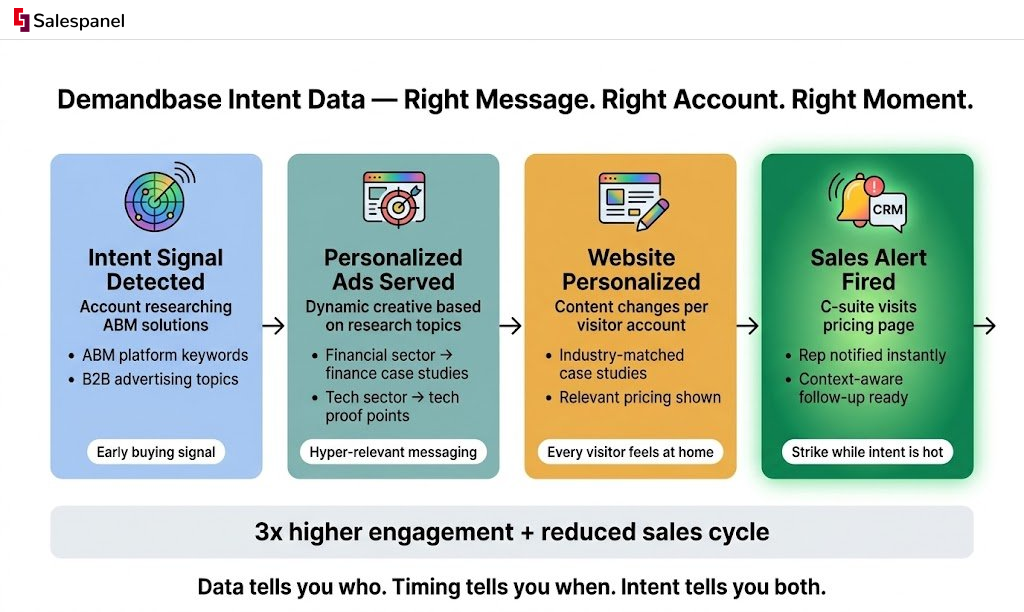
- Intent Data Foundation: The strategy begins by identifying companies that are actively researching keywords and topics related to ABM solutions, such as ‘account-based marketing platforms’ or ‘B2B advertising technology’. This technical process relies on aggregating third-party data from across the web to detect early buying signals.
- Personalized Ad Targeting: Once an account shows high intent, they are added to targeted advertising campaigns. The ad creative and messaging are dynamically tailored based on the specific topics the account is researching, making the ads hyper-relevant.
- Dynamic Website Experience: When a visitor from a high-intent account lands on the Demandbase website, the content they see is personalized. For example, a company in the financial services industry might see case studies from banks, while a tech company sees different proof points.
- Sales Action Triggers: The real power comes from sales and marketing alignment. High-value actions, like a C-level executive from a target account visiting the pricing page, trigger real-time alerts for the sales team, enabling immediate and context-aware follow-up.
Key Strategic Insight: Demandbase operationalizes the idea of “right message, right person, right time.” By using intent data as a trigger, they ensure that marketing spend and sales effort are concentrated only on accounts demonstrating clear buying signals, maximizing efficiency and ROI.
Actionable Takeaways and Replicable Strategies
While Demandbase uses its own advanced platform, the principles behind its data-driven ABM strategy are universally applicable. This is a powerful model for any B2B company looking to refine its targeting.
- Integrate First and Third-Party Data: The most complete picture of an account comes from combining external intent signals (what they research online) with your own first-party data (how they engage with your website and emails). For campaigns like Demandbase’s, which thrive on intent data for account-based advertising, leveraging powerful data-driven marketing insights is indispensable for success.
- Establish Actionable Thresholds: Don’t treat all intent signals equally. Define clear scoring thresholds that trigger specific actions. A low score might enroll an account in a nurturing sequence, while a high score with C-suite engagement should trigger an immediate sales call.
- Create Topic-Based Messaging Frameworks: Develop a matrix of messaging and content offers that align with different intent topics and buying stages. An account researching “ABM metrics” should receive different content than one researching “Demandbase competitors.”
- Train Sales on Using Intent Data: Coach your sales team on how to use intent signals to add context to their outreach without sounding intrusive. Instead of saying, “I saw you were researching us,” they can say, “As you evaluate solutions for your 2026 marketing goals, I thought this case study might be relevant.” This alignment ensures data is translated into meaningful conversations.
6. SAP’s Localized ABM Campaigns with Regional Customization
Global enterprise software giant SAP operates in over 180 countries, meaning a one-size-fits-all marketing approach is destined to fail. To effectively engage its diverse, high-value target accounts, SAP championed a global ABM strategy built on a foundation of regional customization. This approach acknowledges that while the core business challenges may be similar, the cultural context, regulatory landscape, and local market priorities vary dramatically.
SAP’s strategy is a powerful demonstration of how to scale ABM without losing the personalization that makes it effective. Instead of forcing a single global message, they empowered regional teams to adapt campaigns to resonate with local decision-makers. This model proves that for multinational corporations, one of the most effective account based marketing examples is one that thinks globally but acts locally, blending a consistent brand voice with hyper-relevant regional execution.
Strategic Breakdown: How SAP Balances Global Scale with Local Relevance
SAP’s success lies in its framework, which provides central guidance while encouraging local adaptation. This prevents brand dilution while ensuring that messaging connects with the nuanced realities of each market. They built a system where global strategy informs regional tactics, not dictates them.
- Region-Specific Content & Messaging: SAP’s campaigns are tailored to local pain points. For instance, campaigns in Europe often emphasize GDPR compliance and data sovereignty, critical concerns for financial institutions there. In contrast, North American campaigns might focus more on innovation and gaining a competitive edge. This is a practical example of geopolitical personalization.
- Localized Customer Proof: Rather than using a single global case study, SAP showcases local customer testimonials and partnerships with regional system integrators. This builds trust and shows prospects that SAP understands their specific market dynamics and has a proven track record of success with similar local companies.
- Culturally Adapted Engagement: The tactics themselves are localized. This includes hosting industry-specific events tailored to the maturity of the regional market, using culturally appropriate imagery, and adapting content for language and local business etiquette. A campaign in Latin America might highlight economic efficiency, while one in Asia-Pacific could focus on supporting regional expansion.
- Modular Content Frameworks: SAP develops core marketing assets and content modules at a global level. These are designed to be easily adapted, translated, and modified by regional teams. This approach maintains brand consistency and quality while significantly speeding up the time-to-market for local campaigns.
Key Strategic Insight: SAP understood that true personalization in a global context isn’t just about inserting a name into an email. It’s about respecting and reflecting a prospect’s entire business ecosystem, including their local culture, regulations, and competitive pressures.
Actionable Takeaways and Replicable Strategies
While SAP operates on a massive scale, the principles behind its localized ABM approach can be adapted by any company targeting accounts in different regions or even different domestic sub-cultures.
- Establish a “Global Core, Local Flex” Framework: Define your core brand message, value proposition, and non-negotiable brand guidelines. Then, clearly identify which elements (e.g., case studies, imagery, specific pain points, event topics) can and should be customized by regional teams.
- Invest in Local Market Intelligence: Don’t guess what matters in a target region. Invest in local market research, hire regional marketing experts, or consult with local partners to gain a deep understanding of the nuanced buying behaviors, cultural contexts, and business priorities.
- Empower Regional Champions: Create regional councils or teams responsible for adapting and executing ABM plays. Give them the autonomy to make decisions based on their local expertise, but ensure they have channels to share best practices and learnings with other regions.
- Use Adaptable Technology: Your marketing technology stack must support your strategy. Utilize platforms that allow for multi-language campaign management, regional segmentation, and easy content adaptation. For example, using a tool for website visitor tracking from Salespanel can help identify which regions are showing the most engagement, allowing you to prioritize localization efforts where they will have the most impact.
Account Based Marketing Examples Comparison
| Campaign Title | Implementation Complexity | Resource Requirements | Expected Outcomes | Ideal Use Cases | Key Advantages |
|---|---|---|---|---|---|
| GumGum’s ‘T-Rex’ Campaign for Target Account Takeover | High – Custom creative, physical & digital combined | High – Custom mascot, comic books, coordination | Secured multimillion-dollar deal, strong brand buzz | Single high-value strategic account | Memorable creativity, executive targeting, strong brand impact |
| Snowflake’s Industry-Specific Content Hubs | Moderate to High – Content creation & tech integration | High – Content teams, tech stack for personalization | 40% higher conversions, 30% shorter sales cycles | Enterprise accounts by industry vertical | Deep industry relevance, scalable template approach |
| Terminus and LinkedIn Partnership Campaign | High – Sophisticated tech, multi-channel orchestration | High – Ad targeting, video, sales coordination | Established strategic partnership, showcased platform | Tech companies targeting tech platforms | Precise targeting, cross-channel consistency, credibility |
| Adobe’s Executive Engagement Program | Very High – Custom events, reports, long-term engagement | Very High – Skilled personnel, event costs | Builds trust, larger deal sizes, strategic advisor role | C-suite executives at Global 2000 companies | Executive-level influence, relationship depth, strategic value |
| Demandbase’s Account-Based Advertising with Intent Data | High – Data integration, analytics, real-time alerts | High – Data sources, predictive tools, tech stack | 3x higher engagement, reduced sales cycle | In-market accounts showing purchase intent | Data-driven targeting, timely engagement, improved conversions |
| SAP’s Localized ABM Campaigns with Regional Customization | Very High – Global and local coordination | Very High – Multi-region teams, content variation | Increased regional resonance, regulatory compliance | Global enterprises targeting diverse regions | Cultural relevance, compliance alignment, local market leverage |
Your Blueprint for High-Impact ABM: From Strategy to Execution
The journey through these diverse account based marketing examples reveals a powerful, unifying theme: precision drives performance. From GumGum’s unforgettable ‘T-Rex’ campaign to SAP’s meticulously localized outreach, the most successful ABM initiatives abandon the wide-net approach in favor of a highly focused, value-driven strategy. These campaigns are not just creative ideas; they are intricate systems of data, technology, and cross-functional collaboration designed to engage and win high-value accounts. The key takeaway for every reader is that a well-executed ABM strategy is one of the most powerful engines for B2B growth, transforming how you engage your most important customers and drive predictable revenue.
The paragraphs we’ve explored demonstrate that modern ABM is a multifaceted discipline. It’s no longer enough to simply identify a target list. True success lies in the execution, which requires a deep understanding of the customer’s world, their specific pain points, and the industry-specific challenges they face. Snowflake’s content hubs exemplify this perfectly, offering tangible value long before a sales conversation ever begins. Similarly, Demandbase’s use of intent data showcases the critical role of technology in identifying opportunities at the exact moment of need, turning a reactive process into a proactive one.
Key Pillars for Your ABM Framework
As you construct your own ABM strategy, remember to build upon these core pillars, which are consistently present in the most effective campaigns:
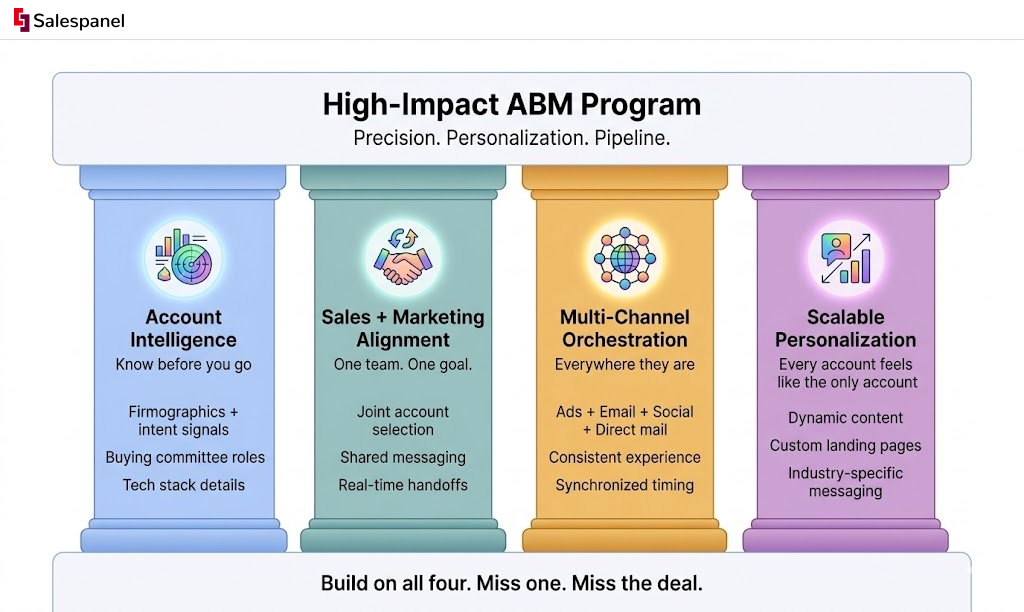
- Deep Account Intelligence: The foundation of any strong ABM program is granular insight. This goes beyond firmographics to include buying committee roles, tech stack details, and real-time intent signals. This is the bedrock upon which personalized experiences are built.
- Sales and Marketing Alignment: The synergy between sales and marketing is non-negotiable. As seen with Terminus and LinkedIn, a joint strategy for account selection, messaging, and outreach ensures a seamless, consistent buyer journey from the first touchpoint to the final signature.
- Multi-Channel, Multi-Touch Orchestration: Relying on a single channel is a recipe for failure. Effective ABM orchestrates a synchronized experience across advertising, email, social media, and direct mail. Adobe’s executive engagement program highlights how a blend of high-touch and digital tactics can captivate even the most senior stakeholders.
- Scalable Personalization: The challenge is to make every account feel like it’s your only account. This requires a blend of technology and strategy to deliver customized content, messaging, and creative at scale, avoiding a generic, one-size-fits-all approach.
Actionable Next Steps: Putting Insights into Practice
Moving from inspiration to implementation is the most critical step. Begin by auditing your current capabilities and identifying where to focus your initial efforts. Don’t feel pressured to launch a multi-tiered, global campaign overnight. Start small, prove the concept, and scale strategically.
First, solidify your Ideal Customer Profile (ICP) and tier your target accounts. Use this framework to pilot a one-to-one campaign for a single, high-value strategic account, or a one-to-few campaign for a small cluster of similar accounts. As you develop your blueprint for high-impact ABM, the execution phase demands effective communication. Implementing top email prospecting best practices can significantly enhance your targeted outreach to strategic accounts. This ensures your carefully crafted messages land with impact.
Finally, establish your measurement framework from day one. Track key metrics like account engagement, pipeline velocity, and deal size, not just vanity metrics like clicks and impressions. These performance indicators will provide the data needed to refine your approach, demonstrate ROI, and secure executive buy-in for future ABM investments. The account based marketing examples in this article prove that a well-executed strategy is one of the most powerful engines for B2B growth, transforming how you engage your most important customers and drive predictable revenue.
Ready to turn these ABM examples into your reality? Salespanel’s philosophy is built on providing the foundational data you need to execute precise, data-driven marketing. Website visitor tracking from Salespanel can identify high-intent accounts before they even fill out a form. Supercharge your ABM strategy by knowing which target accounts are on your site and what they care about most. Explore our resources to see how you can start today.