7 Plausible Analytics Alternatives for B2B Teams
Why Teams Look for Plausible Analytics Alternatives
The best Plausible Analytics alternatives depend on the job you need done. For privacy-first web reporting, Fathom, Simple Analytics, and Pirsch are the closest matches. For self-hosting, Matomo and Umami. For Google ecosystem measurement, GA4. For B2B teams that need account-level buying signals, Salespanel.
Plausible is built around a specific idea: lightweight, anonymous, aggregate web analytics with a small script and a readable dashboard. It counts pageviews, sources, and goals. It does not resolve visitor identity, score leads, or push anything into a CRM, and that is deliberate rather than a gap in the roadmap.
That design choice is exactly why teams start shopping. Some want self-hosting. Some want deeper event configuration. And a growing share of B2B teams want something different altogether — they want to know who is reading the pricing page three times a week, not just that the pricing page got 500 views.
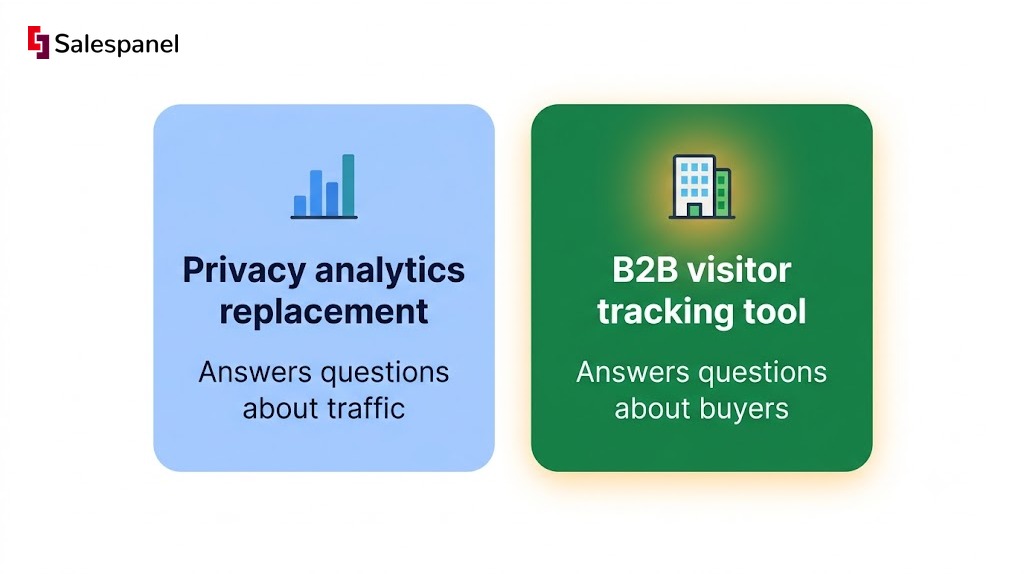
Those are adjacent jobs, not identical ones. A privacy analytics replacement answers questions about traffic. A B2B visitor tracking tool answers questions about buyers. Confusing the two is the most common mistake we see in this evaluation, and it usually ends with a team paying for a tool that reports beautifully on data nobody acts on.
Salespanel sits slightly outside the usual list. It can run in anonymous mode for event and traffic measurement, and it can move qualified visitors into identifiable workflows later, when consent and business context allow it. If you are a publisher or a personal site, that flexibility is overhead you do not need. If you are running demand gen against a named account list, it is the entire point.
Throughout this comparison we evaluate on seven dimensions: privacy model, data ownership, event tracking, visitor and account context, integrations, implementation effort, and cost model. The organizing question is simple — what can your team actually do after the dashboard shows a visit.
Quick Comparison Table: Plausible Analytics Alternatives at a Glance
The alternatives fall into four practical categories, and sorting them by tracking model prevents the most expensive mistake in this process: replacing Plausible with a tool built for a completely different workflow. Comparing by feature count will not surface that difference. Comparing by what the tool knows about a visitor will.
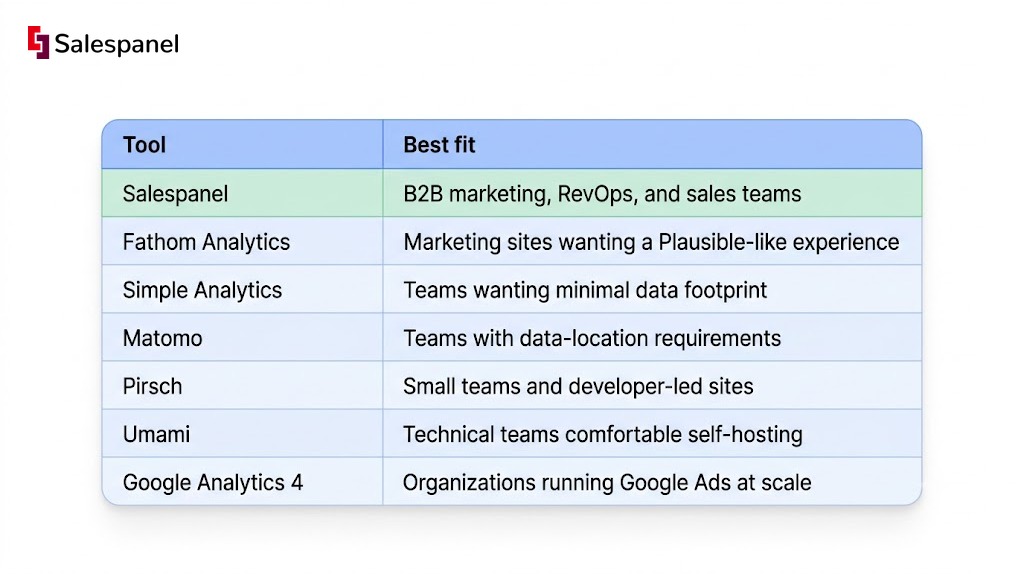
| Tool | Primary use case | Anonymous web analytics | Self-hosting option | Visitor / account context | Best fit | Key trade-off |
|---|---|---|---|---|---|---|
| Salespanel | B2B visitor intelligence + event tracking | Yes (anonymous mode) | No | Visitor-level and account-level, when configured for consented identification | B2B marketing, RevOps, and sales teams | More configuration than a minimal traffic dashboard |
| Fathom Analytics | Privacy-first web reporting | Yes | No | Aggregate only | Marketing sites wanting a Plausible-like experience | No B2B qualification layer |
| Simple Analytics | Privacy-first web reporting | Yes | No | Aggregate only | Teams wanting minimal data footprint | Limited depth for complex funnels |
| Matomo | Full-feature analytics with data control | Yes | Yes (on-premise) | Configurable, depends on deployment | Teams with data-location requirements | Operational ownership of the stack |
| Pirsch | Privacy-first, developer-friendly reporting | Yes | Yes (open source) | Aggregate only | Small teams and developer-led sites | Smaller ecosystem than larger vendors |
| Umami | Open-source web analytics | Yes | Yes | Aggregate only | Technical teams comfortable self-hosting | Engineering maintenance is on you |
| Google Analytics 4 | Ecosystem-wide measurement | Pseudonymous, configurable | No | Event/user-scoped within Google’s model | Organizations running Google Ads at scale | Configuration and governance overhead |
Pricing is deliberately absent from this table. Every vendor here has changed plans or billing units in the last two years, so check each official pricing page on the day you decide rather than trusting a number in a blog post.
Plausible Analytics Alternatives by Tracking Model
The right Plausible replacement comes down to how much identity and behavioral detail you need after a pageview or conversion fires. That is the first fork in the road, and most comparison articles skip it entirely in favor of feature grids.
“Privacy-friendly” is not a single product category either. It describes a spread of implementation choices: whether cookies are used at all, whether they are first-party, where data is physically stored, how IP addresses are processed or discarded, how long records are retained, and whether any of it can be tied back to an individual. Two tools can both market themselves as privacy-first and still have meaningfully different obligations attached to them depending on your jurisdiction and configuration.
So start from the data outcome. Write down the action you need to take after the data arrives — publish a traffic report, optimize a landing page, route an account to a rep — and work backwards to the tracking model that supports it. That ordering produces better decisions than any feature checklist.
Salespanel: Anonymous Analytics That Can Support B2B Qualification
Salespanel can run in anonymous mode, tracking web activity, sessions, and custom events without requiring visitor identification at all. Used that way, it behaves like a conventional analytics layer: traffic sources, page performance, goal completions.
The distinction worth being precise about is this. Plausible’s core use case is anonymous aggregate measurement, and it executes that cleanly. Salespanel becomes relevant when a B2B team may later need to connect consented activity to a person, a company, a lead score, a CRM record, or a sales workflow. If that need never arises, the extra machinery is cost without return.
Deployment is first-party. The tracking script runs on your own domain and uses first-party cookies, which matters both for data quality and for how the implementation is reviewed internally. From there, teams layer on website visitor tracking, lead scoring, and a Salesforce integration when the pipeline motion justifies it.
Of course, no tool removes your compliance responsibilities. Identification rules, consent capture, and retention settings all need review against the privacy obligations that apply to your organization and your markets. Configure first, then turn identification on.
Best for: B2B demand generation, RevOps, and sales teams that need campaign reporting now and qualified-account follow-up later.
Trade-off: it is not the simplest choice for a publisher, a blog, or a personal site that only wants a small anonymous traffic dashboard.
Fathom, Simple Analytics, and Pirsch: Privacy-First Reporting
These three sit closest to Plausible in both philosophy and daily experience. Small script, reduced data footprint, uncluttered reporting, and a deliberate refusal to collect more than the use case requires. If your frustration with Plausible is about pricing tiers, dashboard preferences, or a specific reporting feature rather than the underlying model, this is where you should look first.
Fathom and Simple Analytics are both hosted and positioned around minimal collection. Pirsch skews developer-friendly and is open source. Feature parity between the three shifts regularly, so verify current support for custom events, goals, custom domain proxying, data residency options, and team seat limits in each vendor’s own documentation before committing.
Best for: marketing sites that need traffic sources, page performance, and conversion goals without building a visitor identity layer.
Trade-off: none of them address B2B account qualification, CRM enrichment, or sales prioritization, and they are not trying to.
Matomo and Umami: Greater Control Through Self-Hosting
Self-hosting moves responsibility, it does not remove it. Deployment, version upgrades, security patching, database growth, retention policy, and reporting maintenance all become your team’s work.
Matomo offers an on-premise deployment path alongside its cloud product, and brings a considerably broader feature set than the minimal-analytics category. Umami is an open-source web analytics project designed to be self-hosted, with a lighter footprint and a simpler interface.
Best for: technical teams with firm infrastructure, data-location, or internal-governance requirements.
Trade-off: self-hosting is not automatically cheaper once you price engineering hours. A $0 license with four hours of monthly maintenance is not free, and that math catches teams by surprise in year two.
Google Analytics 4: Broad Ecosystem Reporting
GA4 stays on this list for one honest reason: if your team runs meaningful Google Ads spend, the native connection between campaigns, conversions, and audiences is hard to replicate elsewhere. Detailed event configuration and reporting across large multi-property estates also favor GA4.
The cost is work. Implementation, event taxonomy design, consent mode configuration, and ongoing governance require more effort than a lightweight privacy analytics tool, and usually more analyst time than teams budget for. Documentation lives in the Google Analytics Help Center.
Best for: organizations already operating inside Google’s advertising and measurement stack.
Privacy, Consent, and Data Control
Every tool on this list needs a privacy review, including the ones marketed as privacy-first. The useful questions are narrow and practical: does the implementation set cookies, where is data stored, how long is it retained, and can visitor activity become identifiable.
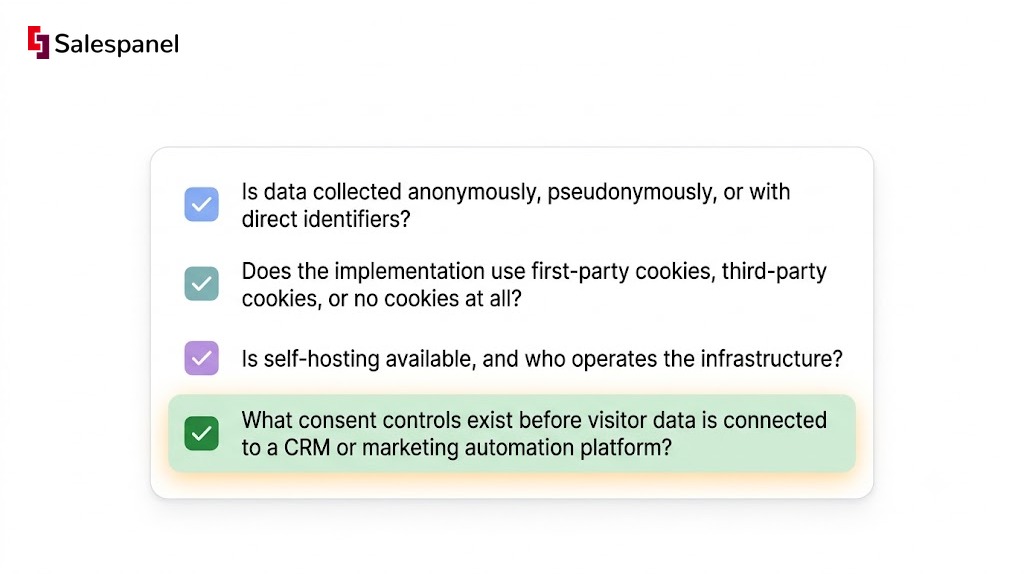
Rather than drawing legal conclusions — which depend on your jurisdiction, your sector, and your specific configuration — run vendors through four questions:
- Is data collected anonymously, pseudonymously, or with direct identifiers? These are three different categories with three different obligation sets.
- Does the implementation use first-party cookies, third-party cookies, or no cookies at all? Ask about the default and about what changes when you enable optional features.
- Is self-hosting available, and who operates the infrastructure? If the answer is “you,” confirm who internally owns patching and retention.
- What consent controls exist before visitor data is connected to a CRM or marketing automation platform? This is the question that gets skipped most often, and it is the one that matters most for B2B.
Salespanel’s position on these: tracking is first-party, and the anonymous-to-identified transition is configurable rather than automatic. Teams decide where consent is captured and which rules govern identification before activity flows into connected systems. Details on handling sit on the Salespanel data security page.
Being straight about it — if your team will never need identity resolution, a Plausible-style tool is the lower-complexity option, and lower complexity is a real privacy advantage, not a consolation prize. Fewer identifiers collected means fewer questions to answer. Teams in regulated markets should cross-check requirements against guidance from their own supervisory authority, such as the ICO’s guidance on storage and access technologies in the UK.
Event Tracking, Reporting, and Implementation Effort
Almost everything on this list can count a conversion. The difference shows up in how much engineering work it takes to define that conversion, validate that it fires correctly, and then actually use the resulting data somewhere downstream.
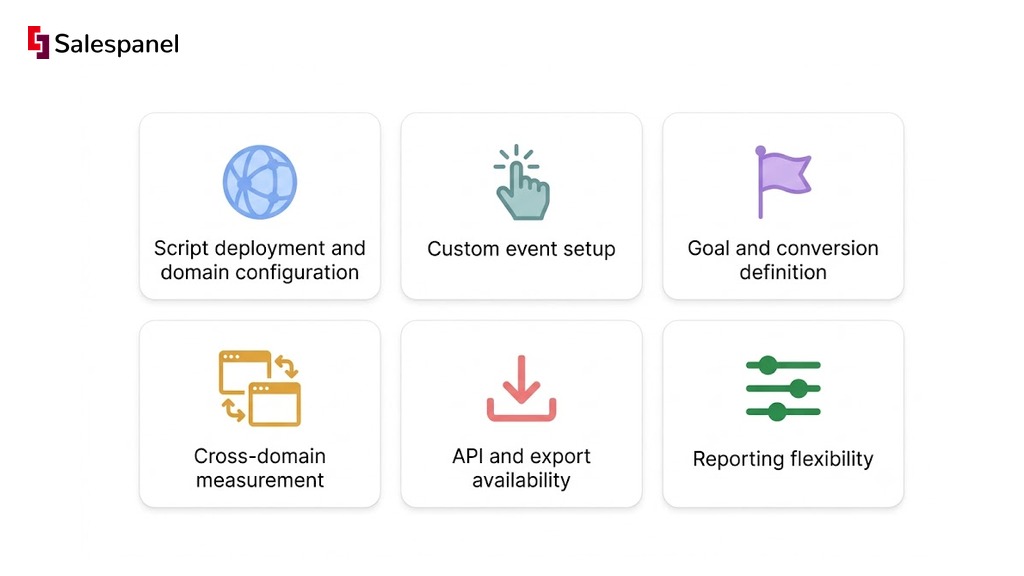
Six dimensions separate the tools in practice:
- Script deployment and domain configuration — whether you can serve the script from your own domain, and how proxying is handled.
- Custom event setup — code-level calls, data-attribute triggers, or tag manager integration.
- Goal and conversion definition — how goals are defined and whether historical data can be reprocessed.
- Cross-domain measurement — relevant for anyone running a marketing site, docs site, and app on separate domains.
- API and export availability — can you get raw data out without a support ticket.
- Reporting flexibility — segments, filters, and custom views.
Salespanel’s customizable tracking earns its complexity when the events you care about are B2B-shaped. Repeat pricing page visits. Integration documentation reads. Demo request abandonment. A sequence of three case-study views inside one session. Those behaviors mean something at the account level, and capturing them is a different exercise from counting a newsletter signup. Setup specifics live in the Salespanel event tracking documentation.
Fairly stated, the minimal tools win on speed to value. If your requirement list is “sessions, sources, three goals,” Plausible gets you there in an afternoon and its custom event documentation is genuinely short. GA4’s event setup will take longer and demands a taxonomy decision up front. Validate current event limits, retention windows, and API quotas in live vendor documentation — these change without announcement.
Pricing and Total Cost: Compare the Operating Model, Not Just the Subscription
The lowest subscription price is frequently not the lowest total cost. Self-hosting infrastructure, analyst hours, engineering maintenance, and the sales context you never captured all land on the same ledger, just in different columns.
Capture current plan prices and billing units directly from each vendor’s official pricing page before you decide — the figures in any comparison article, including this one, age badly.
| Category | Entry plan & billing unit | Usage-based pricing | Self-hosting infra cost | Engineering involvement | CRM / sales-workflow value |
|---|---|---|---|---|---|
| Privacy analytics (Plausible, Fathom, Simple Analytics, Pirsch) | Per site or per monthly pageview — verify current tiers | Yes, pageview-banded | None (hosted) | Minimal, one script | None |
| Self-hosted (Matomo, Umami) | License or free OSS | Varies by edition | Server, database, backups, monitoring | Ongoing — upgrades, patching, retention | None natively |
| GA4 | Free standard tier; 360 for enterprise | Event-volume limits apply | None | Moderate to high — taxonomy, consent mode, governance | Google Ads audiences only |
| Salespanel | Per-plan, verify current tiers | Tracked visitors / identified leads | None | Low to moderate, depends on scoring and CRM rules | Direct — scored leads and accounts in CRM |
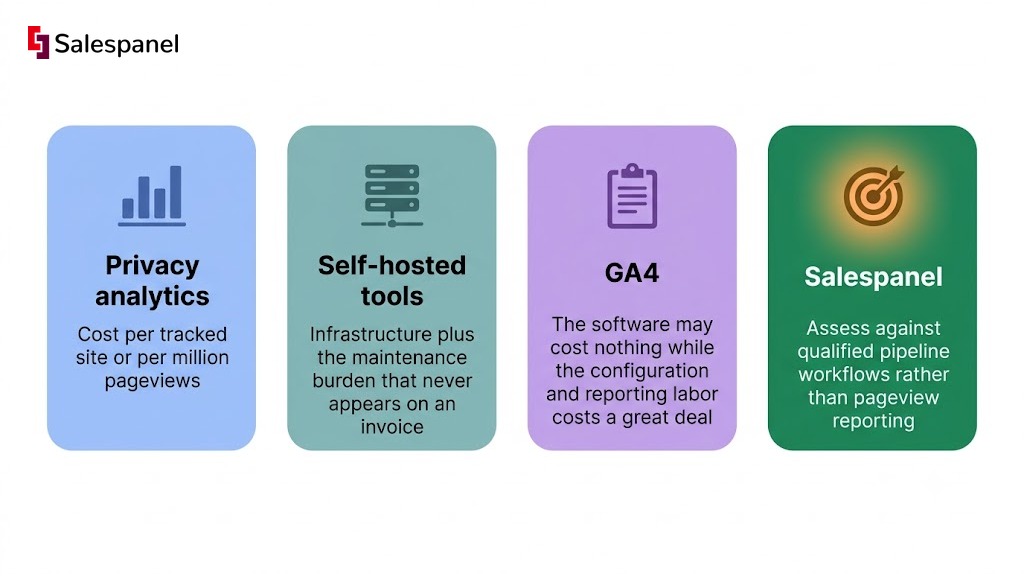
The relevant cost question changes per category. For privacy analytics, it is cost per tracked site or per million pageviews. For self-hosted tools, it is infrastructure plus the maintenance burden that never appears on an invoice. For GA4, the software may cost nothing while the configuration and reporting labor costs a great deal. For Salespanel, assess against qualified pipeline workflows rather than pageview reporting, because measured on cost-per-pageview it will always lose to a tool that only counts pageviews.
No tool here is “cheaper” in the abstract. Build a scenario with your real traffic volume, your real headcount, and your real pipeline value, then compare.
Which Plausible Analytics Alternative Should You Choose?
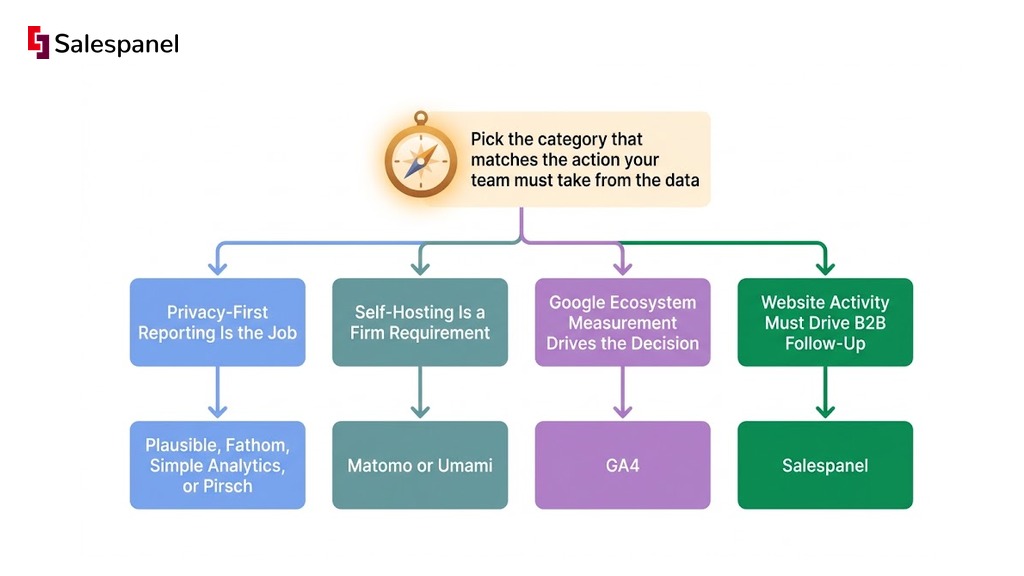
Pick the category that matches the action your team must take from the data. Feature lists are a distraction at this stage.
Choose Plausible, Fathom, Simple Analytics, or Pirsch When Privacy-First Reporting Is the Job
If your team needs traffic sources, page performance, and conversion tracking — and nothing beyond that — this is the right category and the cheapest path to a working setup. Worth saying plainly: if Plausible’s existing reporting already answers your questions, switching to a near-identical competitor is motion without progress.
Choose Matomo or Umami When Self-Hosting Is a Firm Requirement
Pick these when data location or infrastructure control is a stated requirement rather than a preference, and when you have a named owner for the deployment. The trade-off is permanent ongoing responsibility for upgrades, security, and retention.
Choose GA4 When Google Ecosystem Measurement Drives the Decision
GA4 makes sense for teams running substantial Google Ads programs or needing sophisticated event and audience reporting across large properties. Budget for governance and for someone who genuinely knows the platform — the free tier does not include the expertise it assumes.
Choose Salespanel When Website Activity Must Drive B2B Follow-Up
Pick Salespanel when you need anonymous behavior tracking, configurable event capture, lead and account scoring, and CRM-connected qualification in one place. The boundary stays the same: it is not positioned as a minimalist anonymous traffic dashboard, and it is the stronger fit when site activity has to influence what marketing and sales actually do next.
Verdict: The Best Plausible Alternative Depends on What Happens After the Visit
Plausible remains a sensible choice for anonymous, lightweight web measurement, and we would not argue a team off it if aggregate reporting is the whole requirement. Salespanel is the stronger alternative for B2B teams that need website behavior connected to qualification and revenue workflows.
- Closest Plausible-style alternatives: Fathom, Simple Analytics, Pirsch
- Best self-hosted paths: Matomo, Umami
- Best for Google-centric measurement: GA4
- Best for B2B visitor intelligence beyond aggregate reporting: Salespanel
The distinction holds across every scenario in this article. Anonymous analytics can show that demand exists. A B2B visitor intelligence workflow helps you decide which known leads and accounts deserve a human being’s attention this week — and that decision, more than the dashboard, is what moves pipeline.
If you are a B2B team, the low-risk way to test this is alongside what you already run. Start with anonymous event tracking, confirm the behavioral signals you care about are being captured correctly, then layer consented qualification on top once the data earns your trust.
See how Salespanel turns anonymous website activity into scored, sales-ready signals. Start a Salespanel trial or book a demo.
FAQ
Is Salespanel a direct replacement for Plausible Analytics?
Salespanel can track anonymous website activity and custom events, but it is not a like-for-like minimalist replacement for Plausible Analytics. Salespanel is built for B2B teams that may need lead scoring, account context, CRM workflows, and consented identification after anonymous visitors show high-intent behavior. Teams wanting only a small aggregate traffic dashboard are better served by Plausible-style tools.
What is the best self-hosted alternative to Plausible Analytics?
Matomo and Umami are the most common self-hosted Plausible Analytics alternatives. Matomo provides an on-premise deployment option and a broad analytics feature set, while Umami is an open-source web analytics project with a lighter footprint. The better choice depends on required reporting depth, internal technical capacity, and data-governance requirements, since both shift maintenance responsibility to your team.
Can a B2B company use anonymous website tracking?
A B2B company can use anonymous website tracking to measure pageviews, traffic sources, events, and high-intent content engagement before a visitor becomes known. Teams should define consent, cookie, retention, and identification rules before connecting website activity to CRM records, lead scores, or sales outreach. Anonymous measurement and identified qualification are separate stages with separate obligations.
When should a team choose GA4 instead of Plausible?
A team should choose Google Analytics 4 instead of Plausible when Google Ads measurement, complex event reporting, or ecosystem-wide reporting across large properties is central to its analytics workflow. Plausible is generally better suited to teams that prefer a lighter reporting experience, a smaller implementation footprint, and less ongoing configuration and governance work.
Sell more, understand your customers’ journey for free!
Sales and Marketing teams spend millions of dollars to bring visitors to your website. But do you track your customer’s journey? Do you know who buys and why?
Around 8% of your website traffic will sign up on your lead forms. What happens to the other 92% of your traffic? Can you identify your visiting accounts? Can you engage and retarget your qualified visitors even if they are not identified?