8 Matomo Alternatives for Web Analytics and B2B Visitor Tracking
Who This Comparison Is For
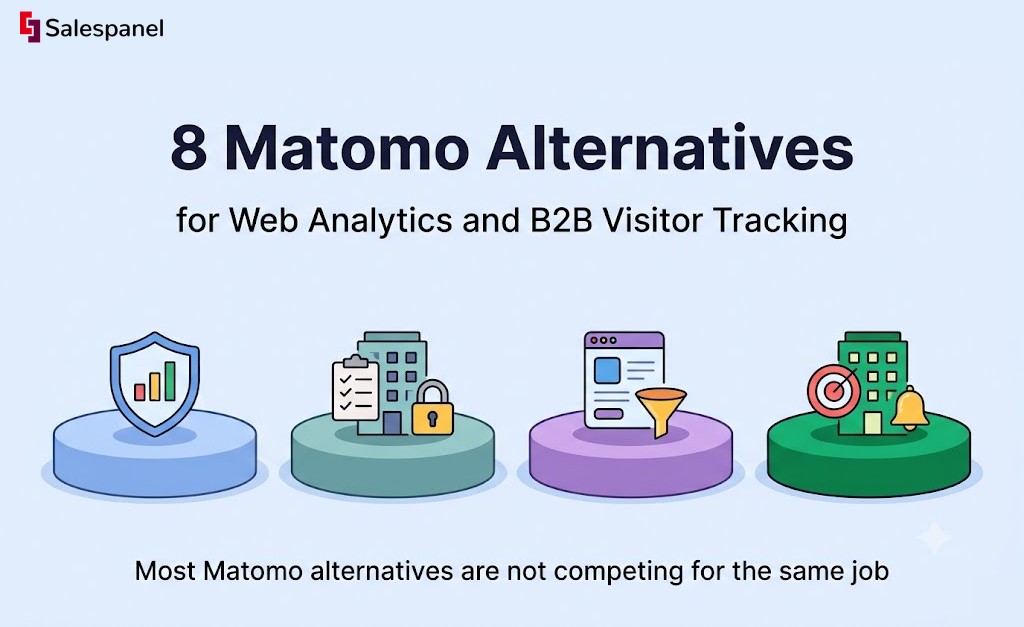
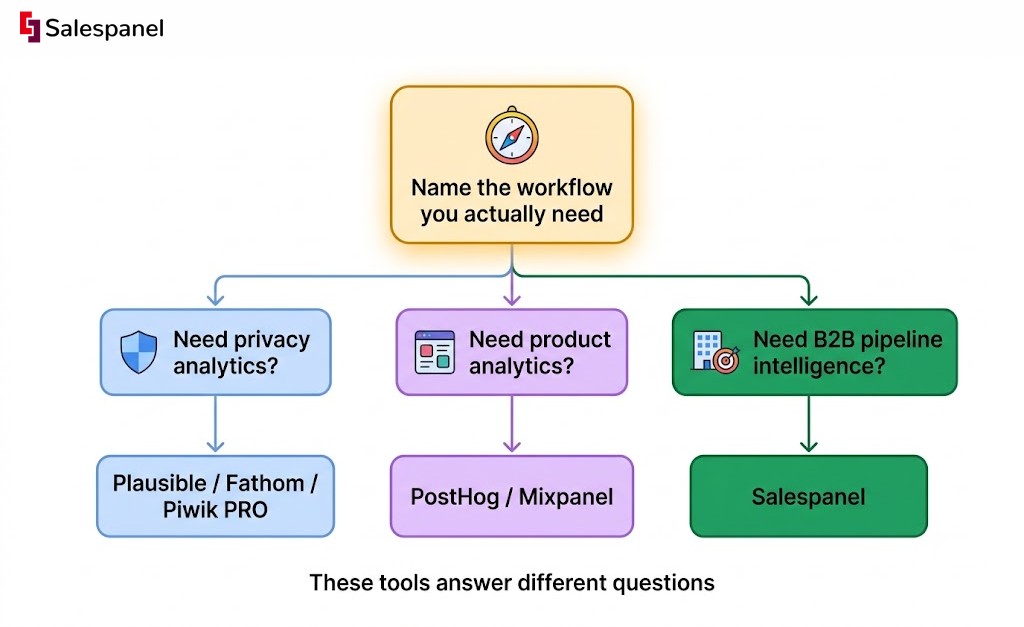
Most Matomo alternatives are not competing for the same job. One group measures traffic with as little data collection as possible. Another group governs analytics across a regulated enterprise. A third group analyzes product events inside a logged-in application. And a fourth group, which includes Salespanel, exists to tell a B2B revenue team which companies were on the pricing page last Tuesday. Picking the right replacement starts with naming the reporting and activation workflow you actually need, because these tools answer different questions and no amount of feature comparison will make them interchangeable.
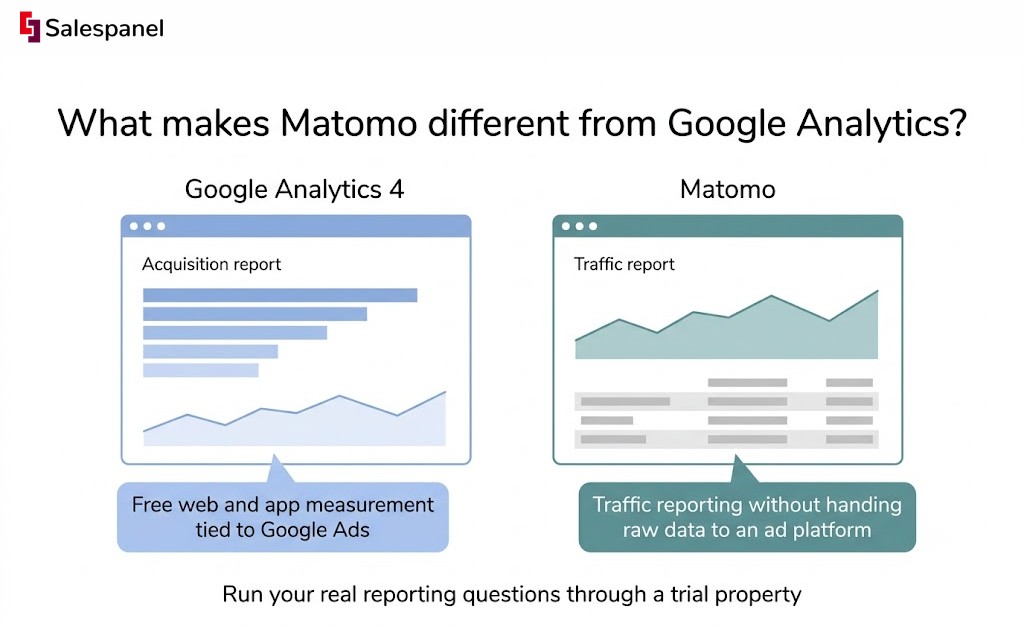
Matomo itself sits in a fairly specific spot. It is open-source web analytics, available as self-hosted On-Premise software or as a managed Cloud service, and it is usually chosen by teams who want traffic reporting without handing raw data to an ad platform. That is a legitimate requirement. The problem starts when a team asks Matomo to do something it was never built around — account-level identification, product event modelling, or enterprise consent governance — and then concludes the tool is weak. It is not weak. It is scoped.
This comparison is written for B2B marketers, RevOps and sales ops leaders, growth engineers, and privacy-conscious site owners who are actively shortlisting. If you are familiar with Matomo’s reporting and you are trying to work out what you gain or lose by switching, that is the decision we are mapping here.
Evaluation date: October 9, 2026. Pricing, hosting regions, plan limits, and feature availability change frequently across all eight tools below, so verify every number against the vendor’s live documentation before you sign anything. We have flagged the figures we could not confirm at the time of writing.
The criteria we used throughout: deployment control, consent and privacy model, event tracking depth, reporting flexibility, integrations, product analytics capability, B2B visitor identification, and cost structure. If you want the B2B identification angle specifically, our B2B visitor tracking resource covers how that layer works alongside conventional analytics.
Quick Comparison of the Top Matomo Alternatives
No tool on this list wins every category, and any article claiming otherwise is selling something. GA4 has the broadest free ecosystem and the deepest ad-platform connections. Plausible and Fathom strip reporting down until there is almost nothing to configure. Piwik PRO leans into governed, enterprise-grade analytics operations. PostHog and Mixpanel are built for product event analysis. Adobe Analytics serves large analyst teams. Salespanel sits outside the traffic-reporting race entirely and focuses on B2B pipeline visibility.
| Tool | Primary use case | Hosting / deployment | Privacy or consent emphasis | Product/event analytics depth | B2B company identification | Best fit |
|---|---|---|---|---|---|---|
| Google Analytics 4 | Free web + app measurement tied to Google Ads | Cloud only (SaaS) | Consent Mode, data retention controls; no self-hosting | Moderate — event-based model, funnel and path exploration | No (not a native function) | Google-centric acquisition reporting |
| Plausible Analytics | Lightweight traffic dashboard | Cloud (EU-hosted) or self-hosted (AGPL-3.0) | Cookieless by default; no cross-site tracking | Low — goals and custom events only | No | Content sites, small SaaS, simple reporting |
| Fathom Analytics | Simple privacy-first website analytics | Cloud only | Cookieless default, EU data isolation option | Low — events and goals | No | Teams that want one readable dashboard |
| Piwik PRO | Governed enterprise analytics + consent + tag management | Cloud (multiple regions) or on-premises | Built-in consent manager, data residency choices | Moderate — sessions, events, custom reports, CDP module | Limited / plan-dependent | Regulated industries, large teams |
| PostHog | Product analytics for engineering-led teams | Cloud (US/EU) or self-hosted | Self-host option, configurable PII handling | High — funnels, cohorts, retention, replay, flags, experiments | No | SaaS product teams with dev resources |
| Adobe Analytics | Enterprise measurement across Experience Cloud | Cloud (managed) | Enterprise governance, data controls, contractual terms | High — segmentation, attribution, Analysis Workspace | Via Adobe ecosystem / B2B edition, not standalone | Large enterprises with analyst capacity |
| Mixpanel | Behavioral product analytics | Cloud (US/EU) | Standard SaaS controls, EU residency option | High — funnels, retention, cohorts, impact analysis | No | Products with authenticated user activity |
| Salespanel | B2B visitor identification, scoring, CRM activation | Cloud | First-party tracking, configurable data handling | Moderate — visit and engagement events, not product telemetry | Yes — core function | B2B revenue teams running ABM or inbound follow-up |
Verify before buying. Plan ceilings, data retention windows, regional hosting availability, and per-feature gating shift between tiers and change release to release. Treat this table as a starting shortlist, then confirm against each vendor’s current pricing and documentation pages.
How We Evaluated Matomo Alternatives
A Matomo replacement should be measured against the workflow it has to take over, not against a generic feature checklist. If your Matomo install exists so the marketing lead can check weekly sessions by channel, a lightweight tool clears that bar in an afternoon. If it exists because legal demanded analytics data never leave an owned server, almost nothing on this list substitutes cleanly. Same product, completely different replacement decision.
We scored each tool on four axes, 1 to 5, with an evidence note attached to every score. Implementation effort is scored so that 5 means least effort — otherwise the direction of the number gets confusing halfway down a table.
| Tool | Privacy control | Implementation effort (5 = easiest) | Reporting flexibility | Activation into sales/marketing | Evidence basis |
|---|---|---|---|---|---|
| Matomo (baseline) | 5 | 3 | 4 | 2 | Matomo On-Premise docs; self-hosting requirements |
| Google Analytics 4 | 2 | 3 | 4 | 4 | Google Analytics Help; Consent Mode and BigQuery export docs |
| Plausible | 5 | 5 | 2 | 1 | Plausible data policy and self-hosting docs |
| Fathom | 5 | 5 | 2 | 1 | Fathom privacy and feature pages |
| Piwik PRO | 5 | 2 | 4 | 3 | Piwik PRO deployment, consent manager, and plan documentation |
| PostHog | 4 | 2 | 5 | 3 | PostHog docs on self-hosting, events, flags, replay |
| Mixpanel | 3 | 2 | 5 | 3 | Mixpanel implementation and data residency docs |
| Adobe Analytics | 4 | 1 | 5 | 4 | Adobe Experience League implementation guides |
| Salespanel | 3 | 4 | 3 | 5 | Salespanel product and help-center documentation |
Scores reflect our reading of current vendor documentation as of October 9, 2026, plus hands-on familiarity with implementation patterns. They are judgements, not benchmarks. Score them again yourself against your own stack.
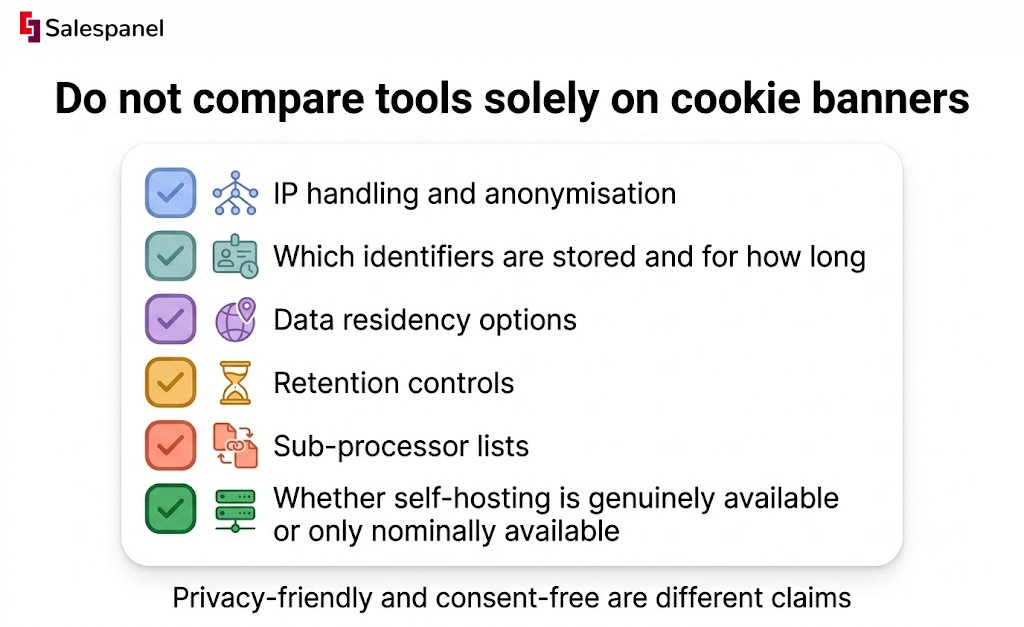
One correction worth making before you shortlist anything: “privacy-friendly” and “consent-free” are different claims, and vendors blur them constantly. Whether you need a consent banner depends on your jurisdiction, your actual tracking configuration, the identifiers you store, and advice from your own counsel — not on a marketing page that says cookieless. The UK ICO’s guidance on cookies and similar technologies is a reasonable starting read, and most EU regulators publish equivalents.
Do not compare tools solely on cookie banners. Review IP handling and anonymisation, which identifiers are stored and for how long, data residency options, retention controls, sub-processor lists, and whether self-hosting is genuinely available or only nominally available on an enterprise tier.
Google Analytics 4: Best for a Free Google-Centric Analytics Stack
Google Analytics 4 is usually the first Matomo alternative a team evaluates, and for a straightforward reason: it costs nothing at standard tier, it measures web and app in one property, and it plugs directly into Google Ads, Search Console, and BigQuery. If a meaningful share of your acquisition spend runs through Google, that connection does work that no independent analytics tool replicates.
Where GA4 is stronger than Matomo
The ecosystem position is the whole argument. GA4 conversions and audiences flow into Google Ads for bidding and remarketing, Search Console data appears inside GA4 reporting, and the BigQuery export is available to standard properties rather than being locked behind an enterprise contract. That last point matters more than it sounds. Raw event-level export means your data team can model attribution, join analytics events to CRM records, and build whatever reporting layer the business actually wants — without paying for an enterprise analytics SKU.
GA4’s measurement model is event-based throughout. Every interaction is an event with parameters, and web plus app streams live inside one property, which removes the awkward split that older setups carried. Attribution reporting supports data-driven models alongside last-click and other rule-based options.
Now, the honest caveat on implementation. GA4’s quality depends almost entirely on event taxonomy discipline and Google Tag Manager governance. If three people ship three different naming conventions for the same button click across two quarters, the reports will be technically correct and practically useless. Define the taxonomy first, document it, restrict publish rights in GTM, and review it quarterly.
Where GA4 is weaker than Matomo
No self-hosting. For organisations that chose Matomo On-Premise precisely because analytics data must stay on infrastructure they control, GA4 does not offer an equivalent path, and that single constraint ends the evaluation for some teams regardless of feature parity.
Practitioner complaints worth validating during your own trial rather than taking on faith: report customization feels restrictive compared with building a custom Matomo report, certain explorations can surface sampled or thresholded data depending on cardinality and identity settings, and non-technical marketers consistently need more onboarding time than they did with session-based tools. Run your real reporting questions through a trial property for two weeks before committing.
GA4 also does not identify anonymous B2B companies for sales follow-up. That is not a flaw; it is simply outside the product’s purpose. If someone on your team expects to open GA4 and see a list of accounts that viewed the integrations page, that expectation needs resetting early.
Plausible and Fathom: Best for Simple, Privacy-First Website Reporting
I would like to talk about the category most Matomo users actually land in when they switch. Plausible and Fathom both exist on the premise that the average website owner needs one readable dashboard, not a configurable analytics property with forty-six report templates. They deliberately remove configuration decisions. That is the product. If you want detailed user-level journey analysis, you are looking at the wrong shelf.
Plausible Analytics
Plausible delivers a single-page dashboard covering visitors, pageviews, sources, top pages, countries, devices, and goals, with a tracking script that is a fraction of the size of a conventional analytics tag. The software is open source and self-hostable, currently under AGPL-3.0, and the managed cloud service runs on EU infrastructure. Confirm license terms and the current self-hosted feature set directly in Plausible’s self-hosting documentation, because the gap between cloud and community editions has moved before.
Good fits: content and editorial teams, small SaaS marketing sites, landing-page measurement, agencies reporting to clients who will never log in twice a week, and organisations actively trying to reduce the number of trackers on a page.
Honest limitations. User-journey granularity is thin compared with Matomo’s visitor log and segment builder. There is no meaningful sales activation workflow — no scoring, no CRM routing, no account view. Custom event properties exist but you are not going to rebuild a behavioral analytics practice on top of them.
Fathom Analytics
Fathom occupies similar ground with a slightly different emphasis. The pitch is privacy-centered website analytics with a clean interface, cookieless tracking by default, and EU data isolation available for visitors in scope of GDPR. Unlike Plausible, Fathom is not open source, so self-hosting is not an option — worth knowing if infrastructure control was your original reason for running Matomo.
Where it works well: tracking campaigns with UTM parameters, monitoring referral sources, watching page-level performance, and recording basic conversions without standing up an analytics property that needs quarterly maintenance. Check the current capability list on Fathom’s features page before assuming parity with anything in this article.
Fathom is not a product analytics suite and it is not an account-identification database. It does not claim to be either.
When neither tool is enough
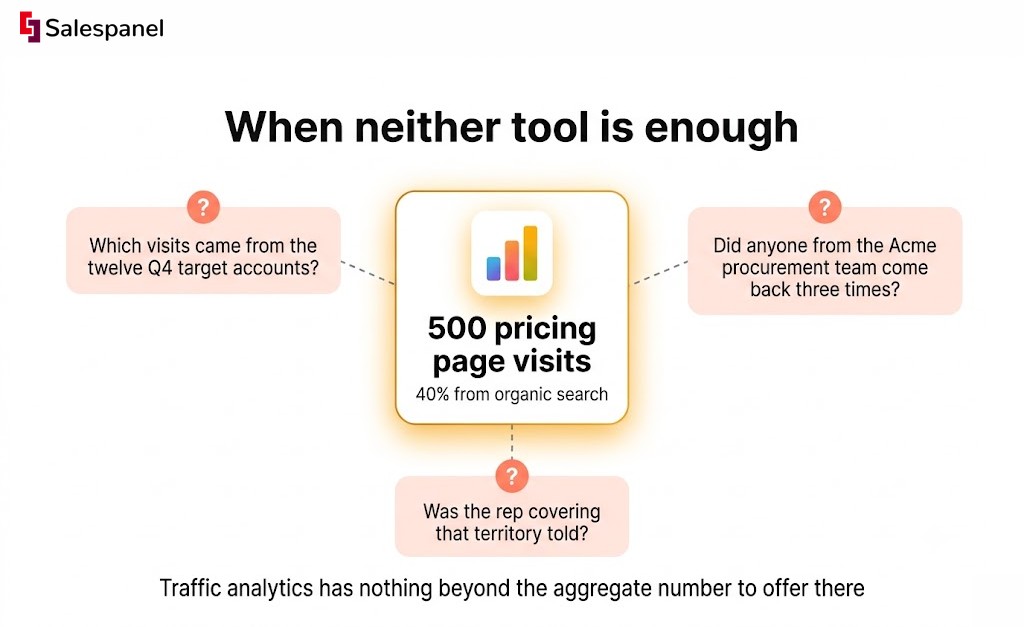
Privacy-first traffic analytics answer one question well: which pages and campaigns worked. They do not answer which target accounts engaged before a meeting got booked. For a lot of B2B teams, the second question is the one that funds the budget.
Suppose your pricing page recorded 500 visits last month. Plausible will tell you that cleanly, break it down by source, and show you that 40% came from organic search. Useful. Now the sales team asks which of those visits came from the twelve accounts in the Q4 target list, whether anyone from the Acme procurement team came back three times, and whether the rep covering that territory was told. Traffic analytics has nothing beyond the aggregate number to offer there. You need company matching, qualification rules, and CRM routing — a different category of tool, covered in our B2B website tracking guide.
Piwik PRO: Best for Enterprise Privacy Controls and Governance
Of all the tools here, Piwik PRO is the closest operational match for an organisation leaving Matomo. The lineage is shared, the reporting logic will feel familiar, and both products start from the position that you should control your analytics data. What Piwik PRO adds is the governance layer that enterprises keep asking Matomo for — consent management, tag management, user permissions, and deployment choices bundled into one administered suite.
Where Piwik PRO fits
Regulated industries are the obvious cluster: healthcare, financial services, government and public sector, pharma. These are environments where an analytics decision passes through legal, IT security, and procurement before anyone looks at a dashboard. Piwik PRO’s answer to that is a stack with a built-in consent manager, granular access control across multiple sites and teams, tag management inside the same platform, and a customer data module for building and syncing audiences.
Deployment matters here too. Piwik PRO offers cloud hosting across several regions as well as on-premises installation, which keeps the data residency conversation open in a way GA4 cannot. Verify the current region list, plan-level feature gating, and on-premises requirements in Piwik PRO’s official documentation — the free Core tier has carried an action-volume ceiling that has changed over time.
One realistic expectation to set: implementation needs more analytics governance than a lightweight tool. Someone has to own the consent configuration, the tag inventory, the user roles, and the data retention settings. If nobody owns those, you have bought enterprise controls and configured none of them.
Trade-offs against Matomo
There is no universal winner between these two, and the comparison sharpens once you frame it as an operational fit question.
Matomo stays ahead when the team specifically wants an open-source, self-hosted analytics stack it can inspect, extend with plugins, and run on its own terms, with no vendor relationship beyond optional premium features. Engineering-led organisations with existing infrastructure often prefer exactly this.
Piwik PRO pulls ahead when the organisation needs managed enterprise controls, formal support, consent and tag management in one administered place, and a vendor contract that procurement can evaluate. That combination is difficult to assemble on self-hosted Matomo without meaningful internal effort.
We are not publishing price comparisons here. Piwik PRO’s commercial tiers are quoted, and any figure quoted in a blog post ages badly. Request a current quote or read the published plan details directly.
PostHog and Mixpanel: Best for Product Analytics, Not Traditional Website Reporting
If the central analytics question in your company concerns what users do inside the product rather than how they arrived at the marketing site, Matomo was probably always the wrong tool and these two are the honest alternatives. PostHog and Mixpanel analyze events, funnels, cohorts, and retention for software products. Sessions on a brochure site are a side concern for both.
PostHog
PostHog bundles product analytics with feature flags, session replay, A/B experiments, surveys, and a data warehouse layer, depending on the plan you are on. The appeal for technical teams is that the whole thing is built around developer workflows — SDKs, an API-first approach, and the option to self-host for organisations that need it. Check current hosting, licensing, and plan inclusions in PostHog’s documentation; the open-source and cloud editions have diverged in capability over successive releases.
The engineering requirement is the part most teams underestimate. Event naming standards and identity resolution determine whether your product analytics is still usable after 6–12 months. We have seen the failure pattern repeatedly: events get added ad hoc during feature sprints, two teams instrument the same action differently, anonymous and identified sessions never stitch properly, and by the second quarter nobody trusts the funnel. Write the taxonomy down before the first SDK call ships. Decide your identity strategy — distinct IDs, aliasing, group analytics for accounts — at the same time.
Mixpanel
Mixpanel has been doing event-based behavioral analysis for longer and the reporting reflects that maturity. Funnels, retention curves, behavioral cohorts, impact analysis, and flexible breakdowns are all first-class. Analysts who live in Mixpanel tend to be fast in it.
The practical condition for value: Mixpanel pays off once a product has meaningful authenticated-user activity and a defined event schema. Pointing it at a pre-launch marketing site produces a worse version of what Plausible gives you in five minutes.
For B2B marketing teams specifically, there is a limitation worth stating plainly. Product behavior data tells you what existing users do. It does not qualify anonymous company-level website visitors who have never logged in, which is the population most B2B pipeline comes from. Mixpanel’s group analytics can roll user events up to an account, but only for accounts that already exist in your product.
Choosing product analytics over Matomo
A clean decision rule: choose PostHog or Mixpanel when the question you ask every week is “which product behavior predicts retention or conversion?” Stay with web analytics — Matomo, GA4, Plausible, Piwik PRO — when the question is “which channel or page brought visitors?”
If the question is actually “which of these anonymous visitors is worth a sales call,” neither category answers it, and you want a scoring layer instead. Our lead scoring documentation covers how behavioral and firmographic rules combine for that use case.
Adobe Analytics: Best for Large Enterprises With Mature Data Teams
Adobe Analytics is a viable Matomo alternative in a narrow set of circumstances: the organisation already runs Adobe Experience Cloud, there are analysts or an implementation partner on hand, and measurement is treated as a funded program rather than a dashboard someone checks on Mondays. Outside those conditions, it is the wrong recommendation almost every time.
The strengths are real. Analysis Workspace supports segmentation and ad-hoc analysis at a depth that most tools on this list cannot approach. Calculated metrics, virtual report suites, attribution modelling across channels, and governance over who can see which data are all mature. Integration with Adobe Experience Platform, Target, Campaign, and Real-Time CDP means analytics insight can move into activation inside the same ecosystem rather than being exported into a different vendor’s tool. Confirm any specific integration or feature claim against current Adobe Experience League documentation, since module names and packaging shift between releases.
Now the operational cost, stated honestly. Adobe Analytics requires structured implementation — a solution design reference, data layer work, tag deployment, report suite architecture — followed by ongoing administration and analyst capacity to turn the data into decisions. Licensing is enterprise-quoted and typically sits an order of magnitude above anything else in this comparison. Treating it as a plug-in replacement for a Matomo install is how organisations end up paying for a measurement platform that three people know how to use.
Who should not shortlist it: small and mid-sized teams wanting simple reporting, anyone whose core requirement is self-hosting, and any team that needs to be live within a month. Those requirements point to Piwik PRO, Matomo itself, or one of the lightweight tools.
Salespanel: Best for Turning B2B Website Engagement Into Sales Context
Salespanel is a Matomo alternative for B2B teams whose website reporting needs to end in a sales action. The job is connecting website activity to identified companies, lead scores, CRM records, and follow-up — rather than reporting pageviews and sessions well. If your weekly analytics review ends with “nice, traffic is up” and nobody does anything differently, this is the category that closes that gap.
What Salespanel adds beyond web analytics
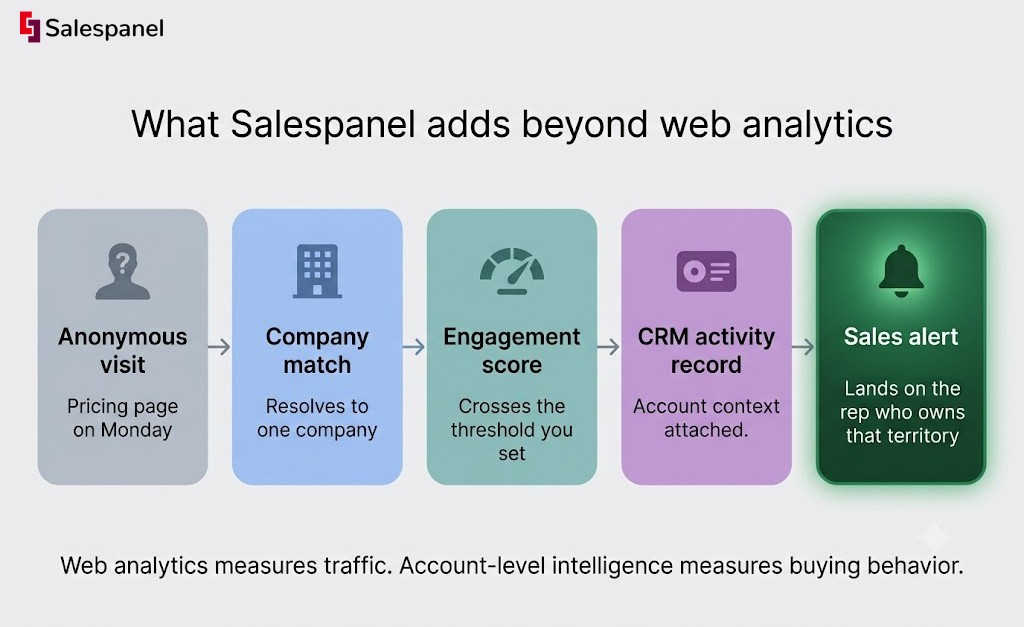
The workflow runs in four steps. Salespanel tracks visitor activity through first-party tracking, identifies the companies behind anonymous visits where matching data is available, scores leads and accounts against rules you define, and routes qualified activity into your CRM or marketing stack through native CRM integrations. Each of those capabilities is documented in the Salespanel product and help-center pages, and we would encourage you to read the identification coverage notes before building forecasts on it.
Here is the scenario that makes the difference concrete. A target account visits your pricing page on Monday, returns Wednesday to read the integrations page, and on Thursday someone from the same company opens a case study about their vertical. In Matomo, that is three sessions in a visitor log, possibly from three different IPs, with no account context attached. In Salespanel, that sequence resolves to one company, accumulates score across the defined window, crosses the threshold you set for high-intent behavior, and lands as an alert plus a CRM activity record on the rep who owns that territory. The individual visit matters less than what it implies at the account level — a buyer committee is forming, and multiple people are researching the same solution in parallel.
That is the key idea. Web analytics measures traffic. Account-level intelligence measures buying behavior, and those are different objects even when they come from the same tracking script.
A necessary limitation, stated directly: Salespanel does not promise person-level identification of every anonymous visitor, and no honest vendor in this space does. Company identification coverage depends on traffic composition, available matching data, visitor network and browser settings, and applicable privacy requirements in your jurisdiction. Residential ISP traffic and heavily proxied traffic resolve poorly across every provider in this category. Run a trial on your own traffic and measure your actual match rate rather than accepting an industry average.
Where Matomo may still be the better fit
Matomo remains the better choice when self-hosted web analytics is a hard requirement, when ownership of the analytics infrastructure is a compliance or philosophical commitment, or when the team genuinely needs broad website reporting with no sales activation attached. A university, a public-sector site, a media publisher measuring content performance — these are Matomo use cases, and Salespanel would be a poor substitute.
Plenty of teams run both. Matomo handles privacy-controlled traffic and content reporting for the marketing team; Salespanel handles company identification, lead scoring, and CRM routing for the revenue team. The two answer different questions and do not conflict on a page. If you are costing out that combination, Salespanel pricing is published openly.
Which Matomo Alternative Should You Choose?
Start from the question your team needs answered every week, then check it against two constraints: how much implementation capacity you actually have, and what your privacy and procurement requirements will allow. Teams that pick tools by feature count tend to end up with a platform nobody maintains. Teams that pick by weekly question tend to keep using what they bought.
Choose Google Analytics 4 if…
- You need free measurement across a website, an app, or both.
- Your acquisition reporting depends heavily on Google Ads, Search Console, or BigQuery.
- Someone on the team can own event definitions and GTM governance long-term.
Choose Plausible or Fathom if…
- You need straightforward website performance reporting that a non-analyst can read.
- Privacy simplicity and a low-maintenance dashboard matter more than granular behavioral analysis.
- You do not need CRM-based lead routing or account-level views.
Choose Piwik PRO if…
- You need enterprise governance, deployment flexibility across regions or on-premises, and managed analytics operations.
- Your organisation has privacy, procurement, or IT requirements that a lightweight tool cannot satisfy on paper.
- You want consent management and tag management administered in the same place as reporting.
Choose PostHog or Mixpanel if…
- Your key metrics are activation, feature adoption, retention, and in-product conversion.
- You have engineering resources to define and maintain an event taxonomy and identity model.
- Marketing-site traffic reporting is a secondary concern you can cover with a second, cheaper tool.
Choose Salespanel if…
- Your revenue team needs to know which companies engage with high-intent pages like pricing, integrations, and comparison content.
- You need account scoring, CRM context, and sales-ready signals rather than another dashboard.
- Intent signals need to reach a named owner — a rep, an SDR queue, a nurture workflow — within hours rather than at the end of a monthly reporting cycle.
One qualifier worth keeping in view: for most B2B teams, Salespanel complements traditional web analytics rather than automatically replacing it. If you still need channel-level traffic reporting, content performance, and SEO data, keep a web analytics tool running alongside. The two layers serve different people in the same company.
See which companies are engaging with your website and route qualified activity to your CRM. Start a free Salespanel trial and measure your own match rate on your own traffic before deciding.
Matomo Alternatives FAQ
What makes Matomo different from Google Analytics?
Matomo differs from Google Analytics because Matomo offers self-hosted deployment and a privacy-focused analytics model, while Google Analytics 4 is built around Google’s advertising and measurement ecosystem. Matomo can suit organizations seeking more infrastructure control over analytics data. GA4 suits teams whose reporting depends on Google Ads, Search Console, and BigQuery connections.
What is the best free web analytics tool?
Google Analytics 4 is often the most practical free web analytics tool for teams that need campaign reporting, Google Ads measurement, and broad documentation. Matomo On-Premise can also be evaluated by teams with technical hosting capacity, since the software itself is open source. The best choice depends on privacy requirements, implementation resources, and reporting complexity.
What can Matomo track?
Matomo can track website visits, pageviews, referrers, campaign parameters, conversions, site search, custom events, ecommerce activity, and custom dimensions when configured. Available tracking depth depends on the Matomo edition in use, installed plugins and extensions, consent settings, tag implementation quality, and the organization’s own privacy configuration choices.
Is Matomo analytics free?
Matomo On-Premise is available as open-source software that organizations can host and operate themselves at no license cost, while Matomo Cloud is a paid managed service. Self-hosting still creates real costs for servers, implementation, ongoing maintenance, security patching, and optional premium plugins. Confirm current plan details on Matomo’s official pricing page.
Can Salespanel replace Matomo?
Salespanel can replace Matomo for B2B teams whose main goal is identifying engaged companies, scoring website activity, and sending qualified signals to CRM or marketing workflows. Teams that need self-hosted traffic analytics, detailed privacy-controlled website reporting, or broad audience and content measurement often run Salespanel alongside Matomo rather than instead of it.
Sell more, understand your customers’ journey for free!
Sales and Marketing teams spend millions of dollars to bring visitors to your website. But do you track your customer’s journey? Do you know who buys and why?
Around 8% of your website traffic will sign up on your lead forms. What happens to the other 92% of your traffic? Can you identify your visiting accounts? Can you engage and retarget your qualified visitors even if they are not identified?