12 Best B2B Data Providers to Fuel Your GTM Strategy in 2026
Did you know that 28% of email addresses in B2B databases become outdated on an annual basis? This means that more than one-third of contact data loses value every year!
Imagine all the hours your sales team grinds to build your company’s contact database. Feels like such a waste of time, doesn’t it?
But that’s not all! Poor data quality can cost organizations $12.9 million a year on average, factoring in lost productivity, misallocated marketing budgets, and missed sales opportunities.
These stats highlight a seismic shift in the B2B data landscape—and the driving force behind it is the wave of digital transformation modernizing customer behaviors around the globe.
Think about it. Today’s tech-savvy customers have a world of information at their fingertips. Moreover, they are more aware of how businesses may use their personal information, which forces businesses to take user consent and preferences very seriously.
This makes yesterday’s strategy of simply buying static contact lists obsolete, rendered ineffective by privacy regulations like GDPR and the deprecation of third-party cookies. In short, companies need to move from static data acquisition to dynamic data intelligence.
This is where B2B sales intelligence database software (also known as B2B Data Providers) comes in.

In this article, we will provide a technical analysis of the leading B2B data providers, equipping you with the critical insights needed to build a resilient, future-proof go-to-market strategy.
Top 12 B2B Data Providers: Quick Comparison
Take a glance at the B2B contact database platforms we will review in this article:
| Platform | Target Audience | Value Proposition | Core Features | User Experience / Quality Metrics | Pricing |
|---|---|---|---|---|---|
| Salespanel | B2B marketers, lean sales teams | Future-proof B2B marketing platform supported by enriched, first-party data | – Real-time website & visitor tracking – B2B lead capture & enrichment – AI lead scoring & segmentation – CRM & marketing tool integrations + APIs – Real-time alerts & dashboards |
Accurate data beyond ad blockers, ideal for personalized engagement use cases | Plans start at $99/month (billed annually) |
| ZoomInfo | Enterprises, large sales teams | Comprehensive GTM data platform and workflows | – Large B2B database – Intent signals – B2B contact data enrichment – Sales engagement tools – CRM integrations, analytics & reporting |
Broad coverage with enterprise-grade delivery | Contact the sales team for personalized quotes |
| Dun & Bradstreet (D&B) | Large enterprises, regulated industries | Enterprise data lineage and risk solutions | – Global business data – D-U-N-S Number System – D-U-N-S identity resolution – Sales & marketing intelligence – Compliance & due diligence solutions |
Trusted, strong entity matching | Plans start at $49/month for 300 credits |
| Data Axle Salesgenie | SMBs and telemarketers (US) | Simple prospecting with compliance tools | – Large lead & contact database – Advanced filtering & segmentation – Lead management dashboard & tools – Built-in outreach support – CRM integrations |
Easy list exports, practical US coverage | Plans start at $99/month |
| Apollo.io | SMBs & mid-market sales teams | All-in-one sales platform for lean teams | – Comprehensive B2B contact database – Advanced prospecting filters – Sales sequences – CRM & integration support – Live buying signals & contact enrichment |
Competitive pricing, flexible CRM sync | Free plan offers 1,200 credits/month |
| Lusha | Sales development reps | Quick contact info via browser extension | – Verified B2B contact data – Advanced search & filtering – Integrations & API access – Browser extension for LinkedIn & company sites – Collaboration tools |
Fast extension workflows, good for SDRs | Free plan offers 40 credits/month |
| People Data Labs (PDL) | Developers, engineering teams | API-driven B2B data enrichment with clear pricing | – Extensive company datasets – Person/company enrichment APIs – Powerful search & segmentation – Data compliance & licensing – CRM integrations |
Developer-friendly with extensive docs | Free plan for testing APIs (up to 100 records) |
| Crunchbase | Marketers, researchers | Market research and target account insights | – Company profiles & insights – Sales prospecting tools – Funding & investment data – Advanced search & firmographics – Real-time alerts & updates |
Strategic account discovery for affordable market penetration | Plans start at $49/month (billed annually) |
| BuiltWith | Marketing teams targeting technology users | Technology stack insights and targeting | – Technographic data & exports – Lead generation & market analysis – Technology trends tracking – B2B competitor intelligence – CRM integrations & API access |
Focused technographic data with clear, published pricing | Plans start at $295/month (billed annually) |
| AWS Data Exchange | Cloud users, data buyers | Centralized cloud data subscriptions | – Broad data marketplace – AWS native delivery – Seamless integration with AWS services – Automated data updates – Usage-based pricing & controls |
Integrated cloud procurement, variable dataset quality | Pricing per dataset, plus AWS costs |
| Snowflake Marketplace | Snowflake users, data analysts | Query data without ETL | – Live, ready-to-query datasets – Integration marketplace – Secure & governed data access – Monetization for data providers – Diverse data & application listings |
Immediate access inside Snowflake, low data duplication | Credit-based pricing, Snowflake fees apply |
| HubSpot Breeze Intelligence | HubSpot CRM users | Built-in enrichment for HubSpot users | – B2B data enrichment – Buyer intent insights – Continuous record updating – Native HubSpot CRM integration – Auto-populated forms inside HubSpot |
Seamless HubSpot integration, credit usage tracking | Credit-based pricing bundled with HubSpot subscriptions |
However, before we jump into the detailed reviews, let’s understand what a B2B data provider is.
What is a B2B Data Provider?
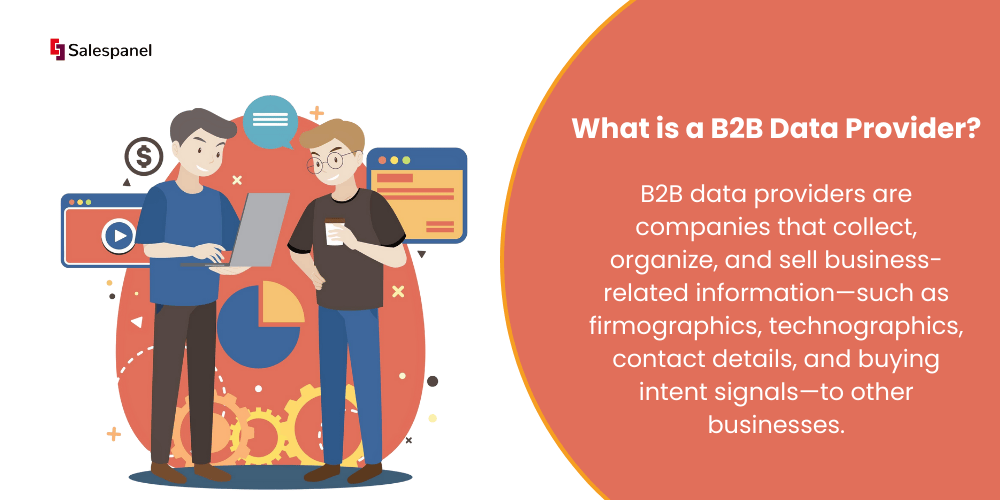
B2B data providers are companies that collect, organize, and sell business-related information—such as firmographics, technographics, contact details, and buying intent signals—to other businesses. They help sales, marketing, and revenue teams identify and target ideal prospects more effectively. In essence, they turn raw market data into actionable intelligence for lead generation, segmentation, and sales outreach.
12 Best B2B Data Providers You Must Check Out for 2026
Here are the reviews for the twelve best B2B data providers in 2026—with details about their key features, use cases, pricing, and pros and cons.
1. Salespanel
Salespanel is a premium choice among B2B data providers, with an account deanonymization accuracy rate of more than 67% for anonymous website traffic.
This distinguishes itself from traditional B2B contact database platforms as a sophisticated marketing automation and visitor intelligence platform, engineered to thrive in an era of increasingly stringent privacy regulations and ad-blocking.
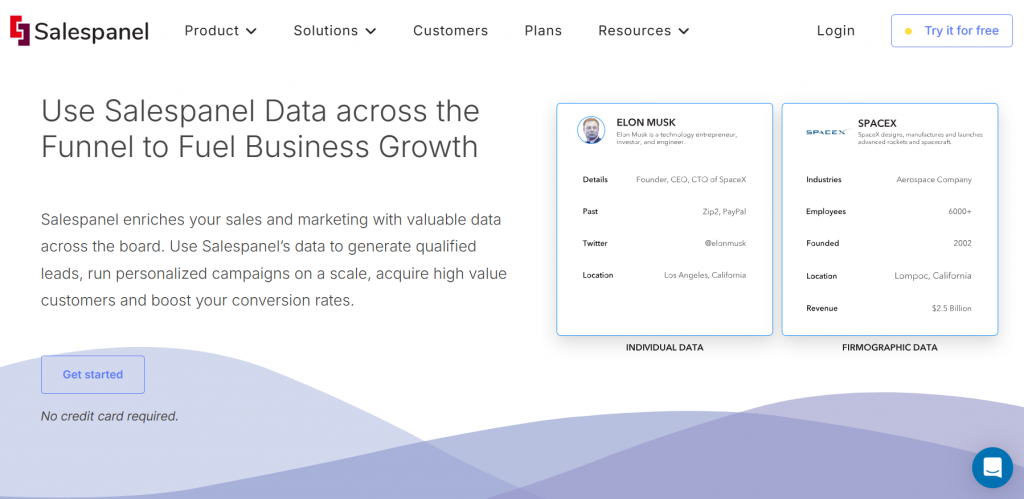
Image Source: https://salespanel.io/data-platform/
Key Features and Use Cases
- Server-Side Tracking: This is Salespanel’s standout feature. For a marketing operations team struggling with data gaps from ad blockers or ITP (Intelligent Tracking Prevention), implementing server-side tracking provides a more durable data pipeline. It ensures that critical engagement metrics and lead sources are accurately captured, leading to better ROI attribution and campaign optimization.
- AI-Powered Lead Scoring: Salespanel doesn’t just collect data; it translates the information into valuable insights. For example, a sales team can use Salespanel’s lead scoring function to automatically prioritize inbound leads based on their on-site behavior (e.g., visiting the pricing page) and firmographic data (e.g., company size, industry). This ensures sales reps focus their energy on the most promising opportunities first.
- Visitor Identity Resolution: Salespanel excels at stitching together a visitor’s journey across multiple sessions and touchpoints. This is invaluable for account-based marketing (ABM) strategies, where identifying all stakeholders from a target account who interact with your website is crucial for coordinated outreach.
Why It Stands Out
Salespanel’s commitment to education and strategic guidance sets it apart.
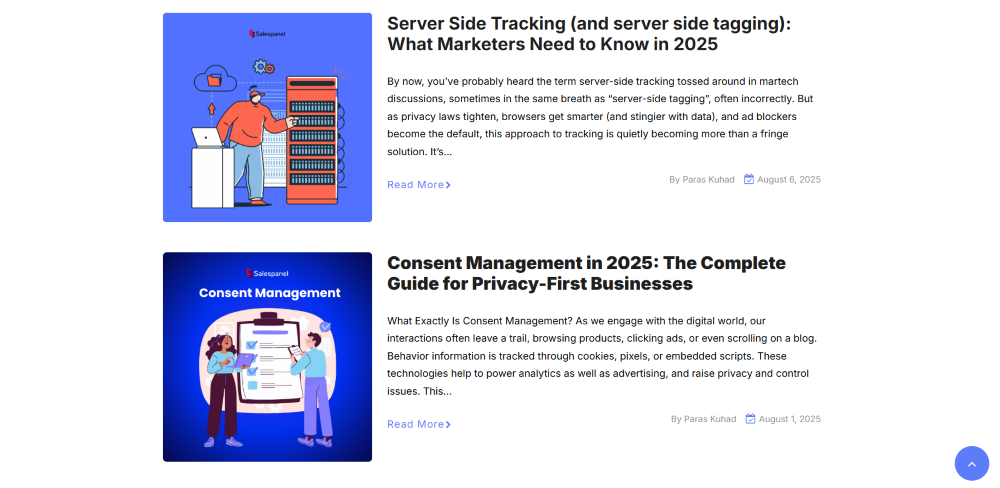
Image Source: https://salespanel.io/resources/
The platform is backed by an extensive library of resources on topics like privacy-first consent management and server-side tagging. This combination of powerful technology and expert knowledge makes it ideal for B2B professionals who need to future-proof their data strategies.
Pricing
Salespanel offers three pricing plans:
- Customer Data Platform: Starts at $99 USD/month (billed annually)
- Account Reveal: Starts at $99 USD/month (billed annually)
- Salespanel Agents: Starts at $499 USD/month (billed annually)
Pros and Cons
Pros:
- Advanced server-side tracking provides superior data accuracy
- AI-driven prospecting and identity resolution for precise lead qualification
- Strong educational content supports strategic implementation
Cons:
- Limited or less mature integrations and features for certain use-cases
- Primarily designed for B2B; may be overly complex for B2C models
2. ZoomInfo
ZoomInfo is a comprehensive GTM intelligence platform, often considered a one-stop shop for sales and marketing teams.
It combines a massive B2B database of company and contact information with a suite of built-in tools for sales engagement, conversation intelligence, and data orchestration. This integrated approach makes it a powerful choice for organizations looking to streamline their entire prospecting and outreach workflow within a single ecosystem.
Key Features and Use Cases
While other software that focus solely on data provision, ZoomInfo emphasizes actionability. Its platform includes features such as intent data to identify companies actively researching solutions like yours and technographics to pinpoint prospects using specific technologies.
Its enterprise-grade data delivery capabilities further set it apart from pure-play data vendors. Data integrates seamlessly (via the OperationsOS module) with native workflow tools and cloud data warehouses, such as AWS and Databricks. This allows for seamless Data-as-a-Service implementation, enriching internal systems at scale.
Pricing
ZoomInfo offers three pricing modules—for Sales, Marketing, and Talent. Pricing information is not publicly available on their website, but you can contact their sales team for personalized quotes tailored to your company’s size, data needs, and feature access.
Pros and Cons
- Pro: Broad data coverage combined with a robust suite of GTM tools
- Con: The premium pricing model can be a significant investment, and some users report occasional inaccuracies in data for more junior-level contacts
3. Dun & Bradstreet (D&B)
Dun & Bradstreet is a legacy name among B2B data providers, offering global commercial data and business insights through its massive D&B Data Cloud.
Its core strength lies in its proprietary D-U-N-S Number, a unique nine-digit identifier for businesses that creates a live, linked corporate tree for identity resolution. This system provides a clear view of company hierarchies and ownership, making it invaluable for enterprise-level risk assessment, supply chain management, and complex account-based marketing.
Key Features and Use Cases
Compared to newer players who focus on sales prospecting, D&B’s data is deeply rooted in financial risk and compliance, making it a trusted source for regulated industries. Direct APIs enable real-time data enrichment and integration with existing CRM and ERP systems, ensuring that business-critical data remains accurate across the organization.
Moreover, you can use the D-U-N-S Number to de-duplicate and clean your existing customer database. This helps create a single source of truth for accounts, revealing company-account relationships you can leverage for strategic upselling to existing clients.
Pricing
Dun & Bradstreet offers sales prospecting data through its D&B Hoovers® Essentials module, starting at $49/month for 150 company credits + 150 contact credits. You can also avail the annual plan at $529/year for 1,800 company credits + 1,800 contact credits.
Pros and Cons
- Pro: Widely trusted by large enterprises and regulated industries due to strong data lineage and entity matching.
- Con: Pricing can be complex and lacks transparency, often representing a significant investment geared toward enterprise-level budgets.
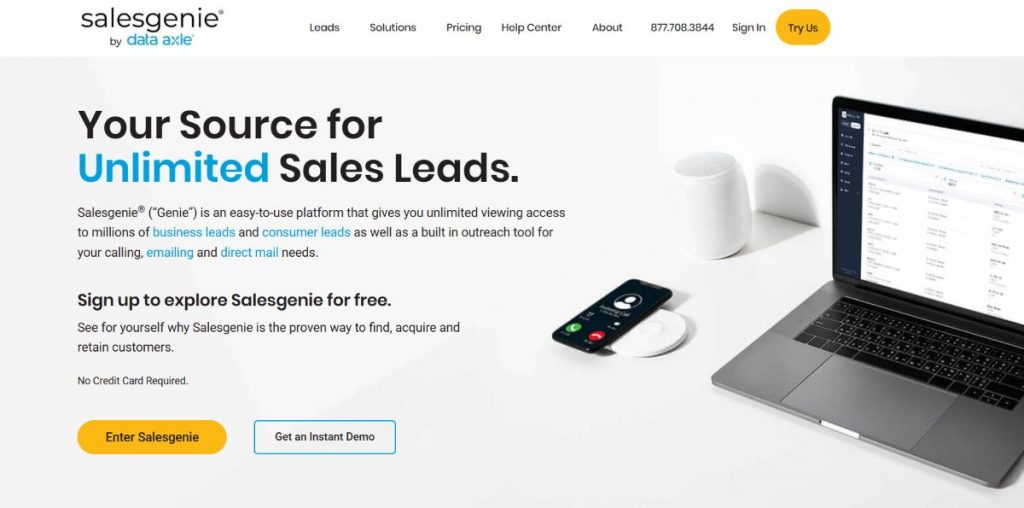
4. Salesgenie (from Data Axle)
Salesgenie from Data Axle is a straightforward B2B and B2C data provider focused primarily on the US market.
It is designed for sales professionals and small to mid-sized businesses that need a simple, effective tool for building targeted prospecting lists. The platform offers a clean interface for searching its database of millions of US business records, filtering by firmographics, and downloading contact lists for immediate outreach.
Key Features and Use Cases
Unlike more complex, enterprise-focused B2B data providers, Salesgenie’s core strengths lie in accessibility and ease of use. A key differentiator is its focus on telemarketing compliance, with features such as DNC (Do Not Call) and SAN (Subscription Account Number) scrubbing to help users stay within legal guidelines. Its dedicated iOS and Android mobile apps further make Salesgenie a practical choice for on-field sales teams, a feature not offered by larger platforms.
Pricing
Salesgenie offers three pricing plans:
- Basic: Starts at $99/month (billed annually)
- Pro: Starts at $149/month (billed annually)
- Team: Starts at $299/month (billed annually)
Pros and Cons
- Pro: Transparent pricing and a user-friendly interface make it highly accessible for teams without dedicated data analysts.
- Con: Data breadth is limited primarily to the US market, and it lacks the advanced intent data and workflow integrations found in enterprise-grade solutions.
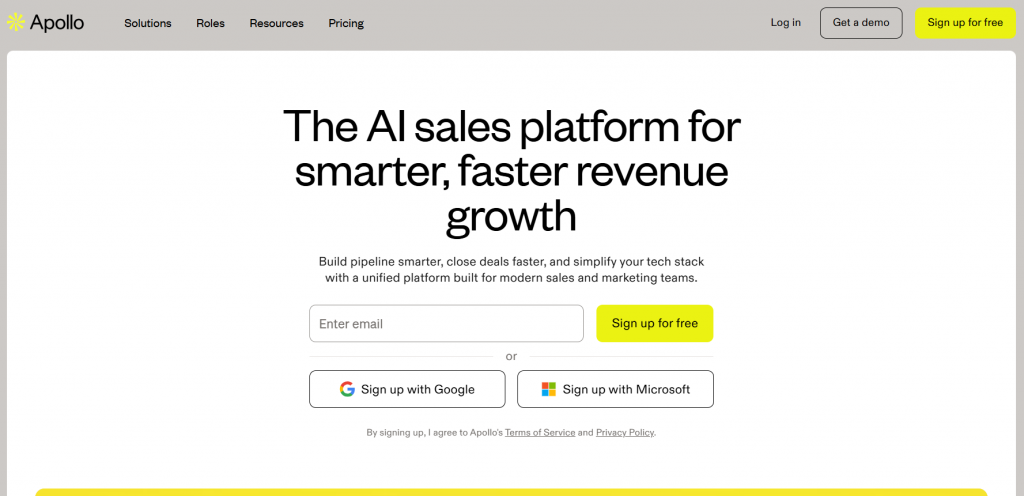
5. Apollo.io
Apollo.io is an all-in-one sales intelligence and engagement platform that effectively bundles a vast B2B contact database with a full suite of prospecting tools.
This integrated approach is particularly appealing to SMBs and lean sales teams looking for a single, cost-effective solution for lead generation, outreach sequencing, and analytics. It provides a powerful combination of verified contact data, firmographics, and advanced signals, such as technographics and buyer intent, within a single unified interface.
Key Features and Use Cases
Compared to B2B data providers that require separate tools for activation, Apollo.io offers a native workflow integration. Users can build prospect lists and immediately enroll them into multi-step email and call sequences using a built-in dialer and scheduler. This removes the friction between data acquisition and sales execution, streamlining the prospecting process.
Its direct CRM synchronization and flexible data export options ensure that insights gathered on the platform can enrich other systems of record without complex manual processes. Last but not least, Apollo.io also offers a browser extension to enrich LinkedIn profiles in real time. You can instantly add prospects to specific lists or outreach sequences directly from their profile page, dramatically speeding up your prospecting workflow.
Pricing
The sales prospecting features of Apollo.io are packaged in its Outreach solution, which comes with four pricing plans:
- Free: $0 for 1,200 credits per user per year (granted monthly)
- Basic: Starts at $49/user/month (for 30,000 credits per user per year)
- Professional: Starts at $79/user/month (for 48,000 credits per user per year)
- Organization: Starts at $119/user/month (for 72,000 credits per user per year)
Pros and Cons
- Pro: An extensive feature set at a price point significantly lower than many enterprise competitors, with wide CRM integration.
- Con: Data accuracy can be inconsistent for certain segments, requiring manual verification before launching large-scale campaigns.
6. Lusha
Lusha is a B2B contact data provider recognized for its user-friendly interface and powerful browser extension.
It excels at delivering verified email addresses and direct-dial phone numbers, with a workflow optimized for speed, making it ideal for sales development representatives (SDRs) who need to source contact information quickly from platforms like LinkedIn or company websites.
Key Features and Use Cases
Unlike comprehensive GTM platforms, Lusha focuses on one core task: accurate contact retrieval. Its standout feature is the extension-first workflow, which allows for rapid, on-demand data acquisition without leaving the prospect’s profile or site.
Lusha also offers bulk enrichment capabilities and direct CRM integrations, ensuring that the gathered data seamlessly populates systems like Salesforce and HubSpot, making it one of the more agile B2B data providers for high-velocity sales teams. Last but not least, its highly intuitive and popular Chrome extension provides a smooth user experience for on-page prospecting. You can instantly save verified contacts directly to your CRM to build out your account map and initiate outreach in minutes.
Pricing
Lusha offers three pricing plans:
- Free: $0 USD for 40 credits per month (granted monthly)
- Pro: Starts at $17.95 USD/month (for 3,000 credits per year)
- Premium: Starts at $41.95 USD/month (for 7,200 credits per year)
Pros and Cons
- Pro: The fast, easy-to-use extension workflow is ideal for SDR teams, and the generous free monthly credit allotment allows for effective testing.
- Con: Data accuracy can vary across different market segments, and high-value data like mobile numbers consumes credits at a higher rate.
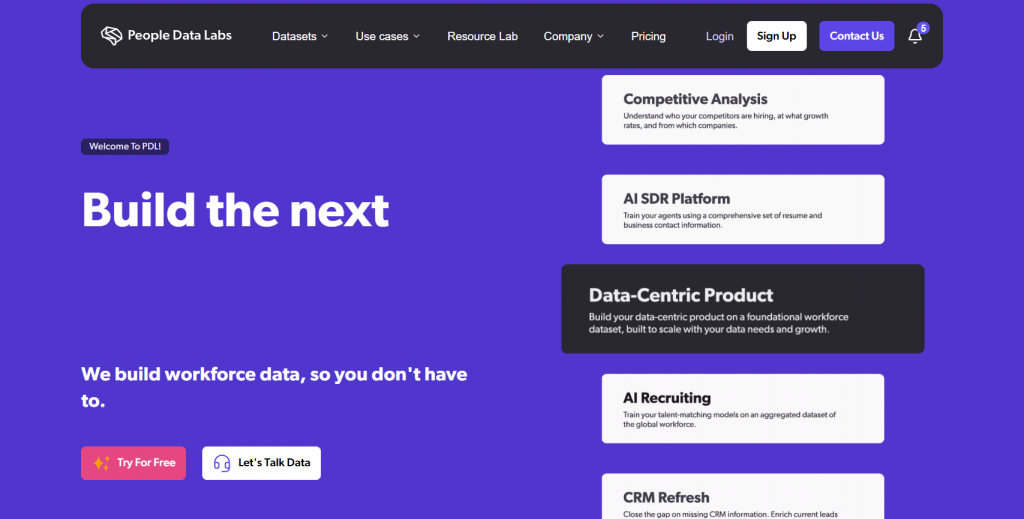
7. People Data Labs (PDL)
People Data Labs (PDL) is a developer-first B2B data provider that delivers person and company data primarily through a suite of APIs.
PDL operates differently from other platform-based solutions, enabling engineering teams to programmatically enrich their internal systems, power applications, or create custom workflows, for granular, on-demand data access with a high degree of technical control.
Key Features and Use Cases
People Data Labs stands out for its transparent, API-credit-based pricing model, which lets users get started for free and scale their usage as needed. This self-serve approach, combined with extensive documentation, is a significant differentiator from the enterprise sales cycles common among other B2B data providers.
PDL focuses exclusively on being a data “utility,” providing the raw ingredients for enrichment, search, and IP intelligence without bundling them into a front-end sales or marketing application. This makes it the ideal solution for companies with engineering resources that need to build custom data enrichment, identity resolution, or prospecting features into their own products or internal tools. You can also use the free API key to build a proof of concept. For instance, you can create a simple script that enriches new sign-up emails with company and role data, qualifying leads programmatically before they even reach the CRM.
Pricing
Lusha offers three pricing plans:
- Free (Testing APIs): $0/month (for 100 records per month)
- Pro (Full APIs): Starts at $98/month (for 350 records per month)
- Enterprise (Bulk Data): Custom pricing
Pros and Cons
- Pro: Highly transparent and developer-friendly pricing and documentation, offering significant flexibility.
- Con: Requires dedicated engineering resources to integrate and maintain; it is not an out-of-the-box solution for non-technical users.
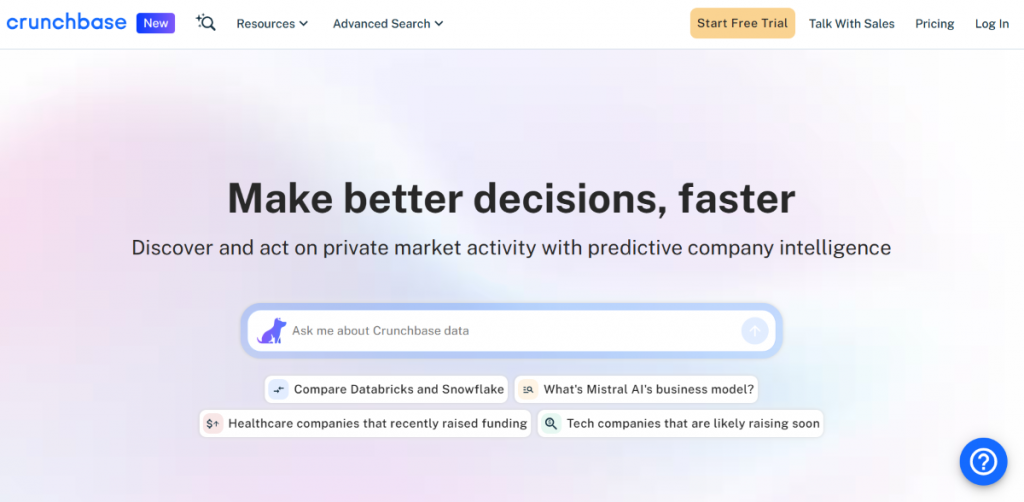
8. Crunchbase
Crunchbase excels as a company intelligence platform, providing deep insights into firmographics, funding data, and corporate structure.
It is primarily used for strategic market research and identifying high-potential accounts rather than for bulk contact acquisition. This focus makes it an invaluable resource for sales teams engaged in account-based marketing (ABM) or for venture capitalists tracking market trends and emerging companies for potential investment opportunities.
Key Features and Use Cases
Crunchbase’s core strength is its rich, context-heavy company profiles. It provides detailed funding history, M&A activity, and leadership changes. Even though its native contact data is limited, it promotes sales prospecting through its Marketplace, allowing users to integrate specialized third-party datasets for contact details, technographics, or IP information. This approach enables teams to build a custom intelligence stack based on their specific needs.
The comprehensive funding data and investment signals offered by Crunchbase are unmatched, making it the go-to source for understanding a company’s financial health and growth trajectory. Want to make the most of this platform? Use the “Signals” feature to create alerts for companies that have recently received funding. This is a powerful buying trigger, as these companies often have new budgets and are looking to invest in growth tools and services.
Pricing
Crunchbase offers two pricing modules:
- Pro: Starts at $49/month (billed annually)
- Business: Starts at $199/month (billed annually)
Crunchbase also offers an API at custom pricing. Specific quotes are available upon request.
Pros and Cons
- Pro: Excellent for discovering target accounts and gaining strategic context, with an affordable entry point via the Pro plan.
- Con: Native contact data is limited and often requires purchasing add-ons, making it best used alongside a dedicated contact provider.
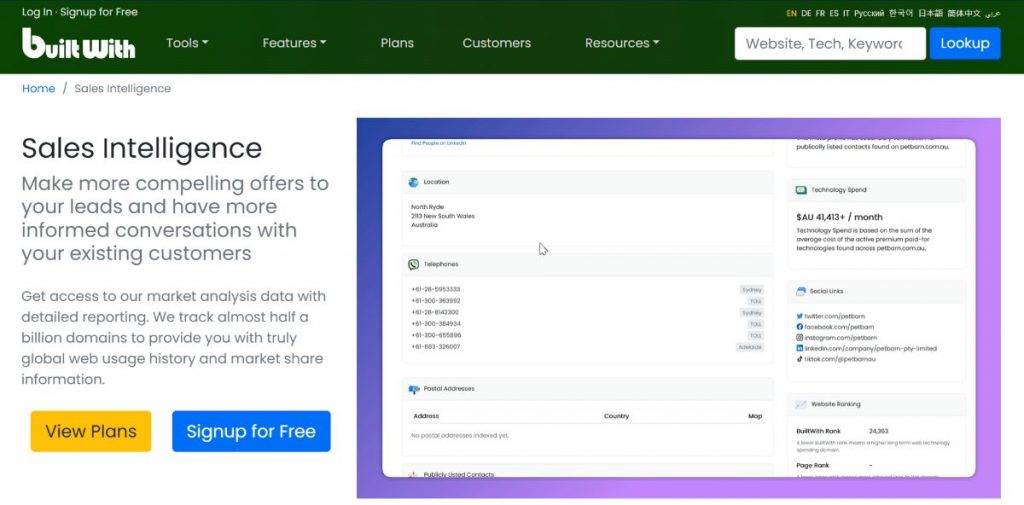
9. BuiltWith
BuiltWith is a powerful market intelligence platform focused exclusively on technographics.
It crawls the web to catalog the technologies used by millions of websites, from analytics and tracking scripts to e-commerce platforms and advertising networks. This makes it an indispensable tool for B2B companies whose products or services integrate with, compete against, or are sold to users of specific software technologies.
Key Features and Use Cases
Compared to broader B2B data providers, BuiltWith’s core strength is its laser focus on the technology stack. It provides not just current technology usage but also historical data, showing when a site added or removed a particular tool.
This enables sales teams to identify highly relevant prospects, such as companies that recently churned from a competitor or those using a complementary technology that makes them an ideal fit for integration. Its comprehensive historical technology data allows users to track tech adoption and churn trends over time for specific websites or entire market segments. Want to make the most of this platform? Use the “Technology Trends” report to identify fast-growing technologies in your space. Create a list of websites that have recently adopted a complementary tech, and target them with a pitch that highlights your synergistic value.
Pricing
BuiltWith offers three pricing plans:
- Basic: Starts at $295/month (billed annually)
- Pro: Starts at $495/month (billed annually)
- Team: Starts at $995/month (billed annually)
Pros and Cons
- Pro: Highly accurate and focused technographic data with clear, published pricing tiers.
- Con: It is strictly a technographics tool and does not provide general company firmographics or direct contact information, such as email addresses or phone numbers.
10. AWS Data Exchange
AWS Data Exchange does not function as a typical B2B data provider, but rather as a centralized data marketplace for organizations already within the Amazon Web Services ecosystem.
The software allows these companies to discover, subscribe to, and use third-party datasets from hundreds of qualified providers. This model is ideal for data science, analytics, and operations teams looking to easily procure and integrate firmographic, technographic, or intent data directly into their cloud workflows, thus avoiding the hassle of data storage.
Key Features and Use Cases
While traditional providers require custom integrations, AWS Data Exchange delivers data directly to a customer’s AWS environment, such as an Amazon S3 bucket. This dramatically simplifies the data ingestion pipeline for technical teams.
The platform’s strength lies in its vast catalog and procurement flexibility, enabling users to find niche datasets and pay via subscription or on-demand models, all consolidated under their existing AWS bill. It simplifies data acquisition for large-scale enrichment and analytics projects.
Pricing
Each dataset has its own pricing model (subscription or pay-as-you-go), and users also pay for standard AWS usage costs (e.g., storage, transfer). Specific quotes are available upon request.
Pros and Cons
- Pro: Streamlined data procurement and delivery for existing AWS users, with a wide variety of datasets available in one place.
- Con: Data quality is inconsistent as it depends entirely on the third-party provider. Buyers must perform their own due diligence.
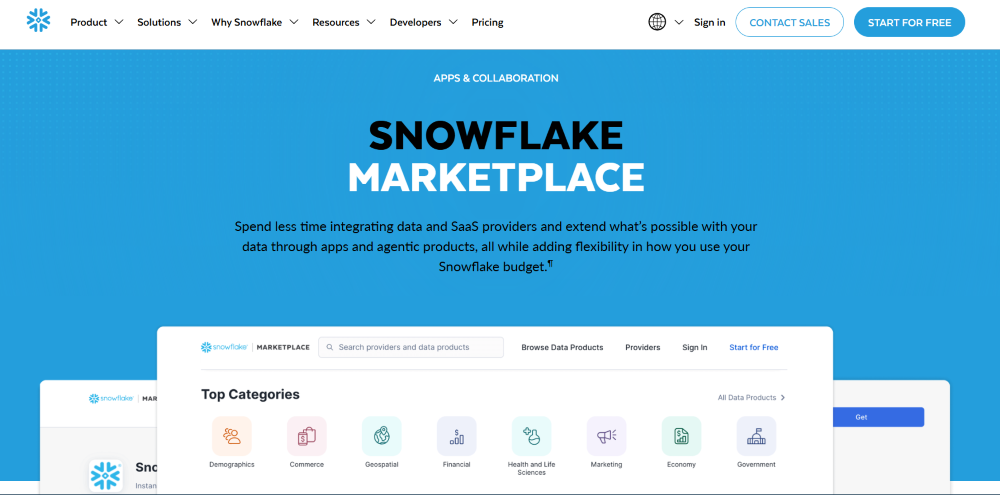
11. Snowflake Marketplace
Unlike traditional B2B data providers, Snowflake Marketplace functions as a centralized hub for live, ready-to-query datasets directly within the Snowflake Data Cloud.
Instead of exporting and importing files, businesses can subscribe to B2B datasets such as firmographics, intent data, and technographics and access them instantly. This removes the complex ETL (Extract, Transform, Load) pipelines typically required to ingest third-party data.
Key Features and Use Cases
One standout feature of Snowflake Marketplace is its “zero-copy” data sharing architecture. When you access a dataset, you are querying the provider’s data live, ensuring you always have the most current information without managing data refreshes or storage duplication.
This model allows data science and operations teams to seamlessly blend third-party B2B data with their own internal customer information for more sophisticated analysis, segmentation, and model building directly within their data warehouse. You can further use the Snowflake Marketplace to trial multiple intent data providers. Subscribe to sample datasets from several vendors and run parallel tests against your internal data to see which provider’s signals correlate most strongly with actual sales conversions before committing to a larger purchase.
Pricing
Snowflake Marketplace uses a credit-based consumption pricing model and offers integrations with all three major cloud platforms—AWS, Azure, and GCP.
You can choose from any of the three pricing options:
- Standard: Starts at $2.00/credit
- Enterprise: Starts at $3.00/credit
- Business Critical: Starts at $4.00/credit
Pros and Cons
- Pro: Immediate, zero-copy data access simplifies integration and ensures data freshness.
- Con: Requires an active Snowflake account, which comes with its own compute and storage costs separate from the data subscription.
12. HubSpot Breeze Intelligence (Clearbit by HubSpot)
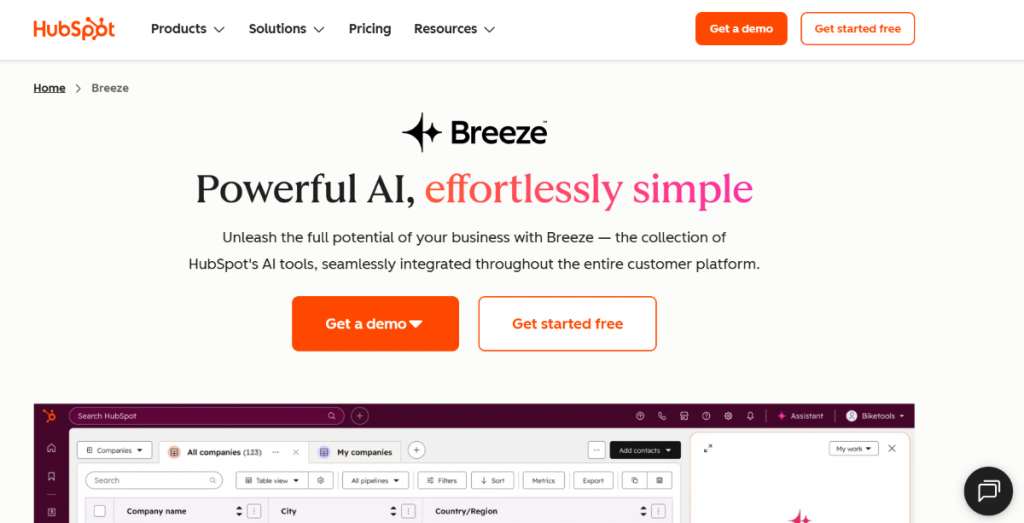
Following its acquisition of Clearbit, HubSpot has integrated core data enrichment capabilities directly into its platform as HubSpot Breeze Intelligence.
This offering embeds company and contact enrichment, along with buyer intent signals, natively within the HubSpot ecosystem. It is designed specifically for existing HubSpot users, transforming their CRM from a simple system of record into an active intelligence engine without requiring third-party integrations.
Key Features and Use Cases
Compared to standalone B2B data providers, Breeze Intelligence operates on a credit-based consumption model tied directly to a user’s HubSpot subscription tier. This approach simplifies procurement and billing by including and managing credits within the HubSpot account.
The platform’s standout feature is its seamless workflow integration: users can autofill forms, automatically enrich new contacts, and trigger marketing automation sequences based on enrichment data or intent signals, all from one place. The complete native integration within HubSpot workflows allows for immediate data activation without API calls to external services. You can further use the form shortening feature to improve conversion rates on landing pages.
Pricing
HubSpot Breeze Intelligence uses a credit-based system and is available with a subscription for all of its products—Marketing Hub, Sales Hub, Data Hub, Service Hub, and Content Hub.
The credits are based on your subscription model as follows:
- Starter: 500 credits/month
- Professional: 3000 credits/month
- Enterprise: 5000 credits/month
Pros and Cons
- Pro: Perfect, frictionless integration for HubSpot users and a clear, predictable credit usage model.
- Con: Its value is entirely locked within the HubSpot ecosystem, and high-volume data enrichment can become costly if you exceed your credit allotment.
Key Takeaway: Activating Data for a Smarter GTM Motion

Navigating the landscape of B2B data providers can feel overwhelming, but the journey from data acquisition to revenue activation is the definitive challenge for modern go-to-market teams.
As we have explored contact data providers ranging from enterprise giants like ZoomInfo and Dun & Bradstreet to specialized platforms like BuiltWith and People Data Labs, a central theme emerges: success in today’s competitive market is predicated on building a dynamic, intelligent data ecosystem that powers every stage of the customer lifecycle.
The most critical takeaway is that your choice of B2B data provider is not a standalone decision. It is about selecting a platform that integrates seamlessly into your existing tech stack and, more importantly, enhances your own first-party data.
The Shift from Static Lists to Dynamic Intelligence
The future of B2B sales and marketing does not rely on data quantity but rather on data quality—shifting your mindset from a one-time data purchase to a continuous intelligence loop.

- Combine Third-Party and First-Party Data: The ultimate competitive advantage lies in combining external and internal data.
For example, you might use a provider like Apollo.io to identify high-fit accounts, but the real magic happens when you pair that with first-party behavioral insights, such as those available on Salespanel. Its website visitor tracking feature, for example, allows you to see which of those target accounts are actively browsing your pricing page or specific product features, transforming a cold lead into a warm, prioritized opportunity. - Prioritize Actionable Signals: Static data points like employee count and revenue are foundational, but they don’t indicate purchase intent.
Look for providers that offer dynamic signals, such as hiring trends, technology adoption, or funding announcements. When combined with behavioral triggers, this creates a holistic view that enables highly relevant and timely outreach. - Embed Compliance and Quality: Data decay is a constant threat, and privacy regulations are non-negotiable. Your selection process must prioritize providers with a clear commitment to data accuracy, refresh rates, and global compliance standards like GDPR and CCPA. The B2B data provider you choose must be transparent about its data collection and verification methods.Take Salespanel, for instance. It adheres closely to the EU’s GDPR mandates as a data controller, ensuring that users do not process personal data without consent.
Next Steps: A Strategic Framework that Supports Your GTM Strategy in 2026
Choosing the right B2B data provider is a strategic initiative that directly impacts your GTM efficiency and revenue ceiling. Before signing a contract, work through these critical steps to ensure your investment delivers tangible ROI.

- Audit Your Current Data and GTM Needs: Start internally. What are the biggest gaps in your current data? Are you struggling with TAM definition, lead enrichment, contact acquisition, or identifying buying intent? Define your primary use case first.
- Evaluate Integration Capabilities: Your data is only as valuable as its accessibility. Ensure your chosen provider has native or robust API integrations with your core systems, particularly your CRM and marketing automation platform. This prevents data silos and enables your teams to work efficiently.
- Run a Pilot or Data Sample Test: Never commit without validation. Request a data sample or run a small pilot project to test the provider’s data against your own records. Measure accuracy, fill rates, and contact quality within your specific ICP. This practical test will reveal more than any sales pitch.
Ultimately, the best B2B data providers act as a catalyst, enriching your understanding and empowering you to engage prospects with unprecedented precision. By moving beyond static information and embracing a multi-layered, dynamic data strategy, you transform data from a simple commodity into your most powerful engine for predictable and sustainable growth.
Ready to turn anonymous website traffic into actionable, pipeline-driving opportunities? Salespanel captures first-party intent data and de-anonymizes your visitors, helping you identify in-market accounts and understand their buying journey. Check out Salespanel’s resources to learn more about how to activate your own data and enrich it for a smarter GTM motion.
Sell more, understand your customers’ journey for free!
Sales and Marketing teams spend millions of dollars to bring visitors to your website. But do you track your customer’s journey? Do you know who buys and why?
Around 8% of your website traffic will sign up on your lead forms. What happens to the other 92% of your traffic? Can you identify your visiting accounts? Can you engage and retarget your qualified visitors even if they are not identified?